Home Blog Page 1230

Panlilio joins board of Marcventures Holdings

ALFREDO S. PANLILIO — BW FILE PHOTO

MANAGEMENT Association of the Philippines (MAP) President and seasoned executive Alfredo S. Panlilio has joined the board of listed holding company Marcventures Holdings, Inc.

Mr. Panlilio was elected as an independent director following the annual stockholders’ meeting on July 25, Marcventures Holdings said in a stock exchange disclosure on Monday.

Last month, Mr. Panlilio was appointed as an independent director of listed conglomerate Vivant Corp.

Marcventures Holdings is a holding company. One of its subsidiaries is mining company Marcventures Mining and Development Corp., which holds a mineral production sharing agreement in Cantilan, Surigao del Sur.

Other subsidiaries include BrightGreen Resources Corp., Alumina Mining Philippines, Inc., and Bauxite Resources, Inc., which are also involved in the mining business.

Marcventures Holdings shares dropped by 3.77% or two centavos to 51 centavos per share on Monday. — Revin Mikhael D. Ochave

Europeans, not Trump, ended up chickening out

STOCK PHOTO | Image by Scottsdale Mint and Tahmeed Ahmad from Unsplash

By Lionel Laurent

Donald Trump’s world tour of arm-twisting on trade has landed its latest deal: A 15% baseline tariff on European Union goods, lowered from the recently threatened 30%, in return for an apparent smorgasbord of continental investments into the US and huge purchases of energy and military equipment. Japan sealed a similar deal last week while pushing back on some extravagant Trumpian claims. “It was the best we could get,” European Commission President Ursula von der Leyen said.

Many will agree with her. The US is the EU’s biggest trade partner and a dominant defense and technology supplier — a spiral of tit-for-tat tariffs is something Europeans simply can’t afford, as LVMH Moet Hennessy Louis Vuitton SE boss Bernard Arnault said last week. Sealing the deal before the Aug. 1 deadline at a level big companies say they find “manageable” is market positive, lifting the tariff fog and avoiding a worst-case scenario drag on euro zone gross domestic product of 1.2%, according to Barclays Plc. From German autos to French aerospace, transatlantic trade is looking a little less stuck.

Yet it’s hard to fully reconcile the we-dodged-a-bullet rhetoric with the reality that Europe’s 27-country single market faces a real hit. The combination of a 15% tariff rate and the euro’s 13% rise against the US dollar year-to-date represents a competitiveness double-whammy with little in return. The details are lacking and it’s unclear if this really is the end of hostilities. While US tariffs are expected to curb euro zone GDP by around 0.4%, that could rise to 0.7% if more surprises are to come, warns Bloomberg Economics.

Considering EU officials claimed to be ready in a worst-case scenario from possible retaliation against US tech firms like Amazon.com, Inc. to teaming up with other vulnerable trade targets like Canada, it’s curious that so much has been given up for so little. Trump also claimed the EU is promising to buy $750 billion in US energy, invest $600 billion in the US, and buy “vast” amounts of US weapons — a reminder of the continent’s dependence on American security that has only helped the Trump administration wring concessions on trade and tax. A few months ago, German Chancellor Friedrich Merz called for a more “independent” Europe; today, the Italian left calls this deal “unconditional surrender.”

Maybe the EU’s playbook needed a defter, more political hand. Then again, there may be other, more structural issues at play here, from the US’s weaponization of existing dependencies like defense to a divergence of interests among the EU’s members. France’s Emmanuel Macron has been pushing hardest for a tough response, but Germany’s Merz is clearly not in the mood for a trade war — with a struggling car industry to defend. It’s easy to see how Brussels lowered its ambitions, from tariff-free trade to an “asymmetric” US punishment with no EU riposte.

Of course, tariffs cut both ways. The US consumer will, all things being equal, suffer as protectionist levies are passed on and the global economy suffers a $2 trillion hit that saps investment. A lot now depends on the strategies of multinationals and industries; some will choose to absorb the tariff impact themselves, others will try to keep negotiating with the promise of new factories to come. One of LVMH’s tariff-mitigation strategies is a new plant in Texas — following one it opened in 2019. A lot also depends on just how expansive the part of the deal promising zero-tariff goods turns out to be.

Still, even as markets celebrate the sugar rush of a Trump who’s willing to make deals and not just threats, this feels like a dangerous moment for the EU. Its already weak growth is about to get weaker, while at the same time it drags its feet on closer integration that would make it less dependent on the US and China. Maybe it isn’t Trump who always chickens out.

BLOOMBERG OPINION

Digital banks’ NPL ratio at near 2-year low

BW FILE PHOTO

DIGITAL BANKS’ nonperforming loan (NPL) ratio fell to a near two-year low in May as soured debts declined even as they disbursed more loans, latest data from the Bangko Sentral ng Pilipinas (BSP) showed.

The digital banking sector’s gross NPL ratio declined to 7.15% as of May from 9.5% at end-April and 20.64% a year prior. This was the lowest ratio seen since the 6.1% recorded in June 2023.

The BSP began consolidating data from digital banks starting March 2023.

The data showed that digital banks’ gross nonperforming loans were at P3.87 billion as of May, 21.66% lower than the P4.94 billion seen a year prior.

Loans are considered nonperforming once they remain unpaid for at least 90 days after the due date. These are deemed risk assets since borrowers are unlikely to pay.

Meanwhile, the sector’s total gross loan portfolio, exclusive of interbank loans receivable, was at P54.097 billion, more than doubling from the P23.92 billion in the comparable year-ago period.

BSP data also showed that digital banks’ past due ratio likewise dropped to 13.36% in May from 17.83% a month prior and 26.09% in 2024, with past due loans at P7.23 billion. Restructured loans accounted for just 0.01% of the industry’s total loan portfolio at P6.21 million, lower than the 0.02% in April.

Meanwhile, digital banks’ NPL coverage ratio was at 137.11% as of May, surging from 71.5% a year prior. Their allowance for credit losses rose to P5.3 billion from P3.53 billion, making up 9.81% of their total loan portfolio, down from the 14.76% loan loss reserves ratio seen at end-May 2024.

“The improving trend in digital banks’ NPL ratio may have to do with the expansion in their loan portfolio from very low levels in recent years, thereby leading to a higher base that quantitatively reduced the NPL ratio,” Rizal Commercial Banking Corp. Chief Economist Michael L. Ricafort said.

“Also, learning from past mistakes on lending that led to higher NPL ratio in the past through improved credit risk standards when loan portfolio amounts were much smaller,” Mr. Ricafort said. “That also helped reduce NPL ratio eventually with a much bigger loan portfolio of digital banks that are relatively new in the banking industry.”

BSP data showed that the highest NPL ratio posted by the digital banking sector thus far was the 25.33% recorded at end-March 2024.

Ronald B. Gustilo, national campaigner for Digital Pinoys group, likewise said that the decline in the sector’s NPL ratio may be a “strong indicator of improving portfolio quality and enhanced risk management practices.”

“Digital banks may have become stricter as more Filipinos are burdened with loans that may be very hard for them to pay. It could also indicate that borrowers are also wary of acquiring loans that could further bury them in debt,” he said.

“While it is still higher than the NPLs of traditional banks, the narrowing gap shows that digital banks are stabilizing, proving their viability as inclusive yet responsible financial service providers.”

The central bank in January lifted a three-year moratorium on digital banking licenses, allowing four more players to operate in the country to add to the current six.

The digital banking sector booked a net loss of P1.04 billion as of March, narrower than the P7 billion at end-December and the P2.07-billion loss in the same period a year ago.

Meanwhile, the industry’s assets stood at P133.5 billion as of May, up from P117.66 billion at end-December and P100.35 billion a year prior. — L.M.J.C. Jocson

PHL developers tap retiree demand with golf, wellness estates

FILINVESTGROUP.COM

PROPERTY DEVELOPERS in the Philippines are integrating wellness features and golf courses into estate developments to capture demand from the growing retirement market.

Ayala Land Hospitality, which manages a portfolio of 4,000 rooms across its homegrown and luxury brands, aims to attract retirees by incorporating wellness across its leisure estates.

“We’re actually looking into that… we’re exploring assisted living, [and] all that comes with kind of our new outlook on wellness,” Ayala Land Hospitality Creative Director Paloma Urquijo Zobel de Ayala said on the sidelines of a forum hosted by the Philippine Hotel Owners Association, Inc. last week.

For its part, Filinvest Hospitality Corp. (FHC) is looking to attract the retirement market through its golf-integrated developments.

“In Mimosa, we have our Golf Ridge Estates, which is a condominium development that’s focused on the golf kind of lifestyle,” FHC Senior Vice-President Francis Nathaniel C. Gotianun said on the sidelines of the same forum.

“So, we have these kinds of leisure products that are trying to attract retirees.”

FHC manages seven hotels under brands such as Crimson, Quest, and Timberland Highlands.

Likewise, Filinvest Mimosa Plus Leisure City in Clark, Pampanga, houses two 18-hole golf courses managed by FHC.

The retirement market, which is composed mainly of former Filipino citizens and foreigners looking to settle in the Philippines, presents opportunities in the country’s residential and hospitality sectors, said David Leechiu, founder and chief executive officer of Leechiu Property Consultants, Inc. (LPC).

“The economic drivers for the retirement market are so compelling — we’ve been talking about it for 30 years,” Mr. Leechiu said in a separate briefing earlier this month.

“But why aren’t they coming? Because they are not convinced that we are ready to take them on,” he said.

As an example, he said golf courses are an effective way to “attract them [retirees] to come to the Philippines and [stay] until they are comfortable to live here.”

Mr. Leechiu also cited the need to improve the country’s infrastructure, security, and connectivity to encourage more retirees to invest and settle in the country.

About 3,812 foreigners are enrolled under the Special Resident Retiree’s Visa (SRRV), a non-immigrant visa that grants former Filipinos and foreigners aged 50 and above multiple-entry and indefinite stay privileges in the Philippines.

Data from the Philippine Retirement Authority also showed that the top SRRV applicants are Chinese, followed by Americans, Indians, and Koreans. — Beatriz Marie D. Cruz

Grammy-winning jazz musician Chuck Mangione, 84

AMAZON.COM

AMERICAN two-time Grammy-winning jazz flugelhorn player Chuck Mangione, best known for his 1970s cross-over hit “Feels So Good,” died last week at age 84 at his home in Rochester, New York.

The prolific musician and composer — whose career spanned five decades and 30 albums — died in his sleep on Tuesday, a local funeral home said.

“Chuck’s love affair with music has been characterized by his boundless energy, unabashed enthusiasm, and pure joy that radiated from the stage,” his family said in a statement to the Rochester Democrat & Chronicle newspaper.

Mr. Mangione showed his appreciation for his audiences by sitting at the edge of the stage after his concerts, signing autographs for fans who stayed to meet him and the band, it said.

Born Charles Frank Mangione in 1940 in Rochester, he was a virtuoso flugelhorn and trumpet player. He grew up in a household where his father exposed him to the jazz greats of the 1950s, including Dizzy Gillespie, a family friend who dined with them frequently.

He began taking music lessons at age eight, and by the time he was a teenager, Mr. Gillespie was so impressed by his musical prowess that he gave Mr. Mangione one of his trademark “upswept” trumpets.

His composition “Chase The Clouds Away” was featured at the 1976 Summer Olympics in Montreal, while his “Give It All You Got” was the theme music for the 1980 Winter Olympics in Lake Placid, New York.

Mr. Mangione’s biggest hit was his 1977 single “Feels So Good,” which reached No. 4 on the Billboard Hot 100 and was nominated for Record of the Year at the Grammys.

His album by the same name is a staple on smooth jazz radio stations.

Mr. Mangione won two Grammys out of 14 nominations — the first in 1977 for best instrumental composition for “Bellavia,” named in honor of his mother. In 1979 he won in the best pop instrumental performance category for The Children of Sanchez. The latter, a soundtrack for the movie of the same name, also won a Golden Globe.

In the late 1990s, Mr. Mangione’s music attracted new fans after he played himself on the Fox TV cartoon show King of the Hill as a celebrity spokesman for the fictional “Mega-lo-mart,” with the slogan “shopping feels so good.” He also scored the music for the 1998 Valentine’s Day episode. — Reuters

PLDT secures Rated 3 design, facility certifications for key data centers

EPLDT.COM

PLDT INC., through its unit ePLDT, Inc., said all its flagship data centers have received Rated 3 certifications for both design and facility, as part of efforts to help establish the Philippines as a data center and artificial intelligence (AI)-ready hub.

“Our goal has always been to position the Philippines as a digital and AI innovation hub… With VITRO Santa Rosa (VSR) and our broader data center ecosystem, we are building the infrastructure backbone needed to power industries, accelerate AI adoption, and drive long-term national progress,” PLDT Chairman Manuel V. Pangilinan said in a media release on Monday.

VITRO Inc., a unit of ePLDT — the data center arm of PLDT — said VITRO Santa Rosa has maintained its TIA-942 Rated 3 Design Certification since 2023, which signifies that the data center’s infrastructure has been designed to be consistently maintainable and that all its critical components can be maintained without disrupting services to end users.

“These milestones go beyond design validation — they demonstrate VITRO’s longstanding leadership in building and operating world-class data centers at scale,” said ePLDT President and Chief Executive Officer Victor S. Genuino.

Mr. Genuino said that the company’s VITRO Santa Rosa, with a capacity of 50 megawatts, is the largest and most advanced operational data center in the Philippines.

“It is hyperscale by design and AI-ready by infrastructure. VSR is where cloud and AI converge, giving enterprises an optimal environment where they can grow and innovate in the AI era,” he said.

Furthermore, VITRO Santa Rosa is fully integrated with PLDT’s domestic fiber network and connected globally through international subsea cable systems.

In April, PLDT inaugurated VITRO Santa Rosa, adding that the facility can be scaled up to 100 megawatts.

Currently, ePLDT operates 11 data centers across the Philippines — including in Makati, Taguig, Pasig, Parañaque, Subic, Clark, Cebu, and Davao — with a combined capacity of nearly 100 megawatts, supporting enterprise and hyperscale demand as the company eyes further expansion.

At the local bourse on Monday, shares in the company closed P5, or 0.39% lower, at P1,290 apiece.

Hastings Holdings, Inc., a subsidiary of the PLDT Beneficial Trust Fund and part of MediaQuest Holdings, Inc., holds a majority stake in BusinessWorld through the Philippine Star Group, which it controls. — Ashley Erika O. Jose

SONA 2025 and a ‘classless’ society

Yesterday, President Ferdinand R. Marcos, Jr. delivered his fourth State of the Nation Address (SONA). Since this column was submitted several hours before the SONA was held at 4 p.m. Monday, I have looked back on some of the President’s pronouncements in his last three SONAs, focusing on public finance and fiscal economics.

“Disbursements for 2022 to 2023 will be maintained at… P4.955 trillion and P5.086 trillion, respectively… P5.402 trillion or 20.7% of our GDP in 2024 to P7.712 trillion or 20.6% of GDP in 2028.” — First SONA, July 25, 2022

“The essential tax measures under our Medium-Term Fiscal Framework, such as… excise tax on single-use plastics, VAT on digital services, rationalization of mining fiscal regime, motor vehicle user’s charge/road user’s tax, military and uniformed personnel pension.” — Second SONA, July 24, 2023

“Tax and non-tax revenue collection has also become more efficient, in pace with our rejuvenated economy. Notably, for the past two years, our GOCCs have remitted dividends to the National Government with a combined tally exceeding their contributions in 2022.” — Third SONA, July 22, 2024

I checked on the fiscal performance from 2022-2024, then the fiscal targets for 2025-2028. Actual disbursements were P5.16 trillion in 2022, P5.34 trillion in 2023, and P5.92 trillion in 2024. The disbursement targets are P6.08 trillion in 2025, then P6.63 trillion in 2026, P6.97 trillion in 2027 and P7.47 trillion in 2028.

This means that government has been overspending or overshooting its targets in disbursements since 2022 that will continue until 2028.

No revenue targets were mentioned in SONA 2022 to 2024. The numbers on revenues from the Bureau of the Treasury (BTr) and Development Budget Coordination Committee (DBCC) are: P3.54 trillion in 2022, P4.42 trillion in 2024, P4.98 trillion in 2026, and P5.91 trillion in 2028.

The budget deficits are as follows: P1.61 trillion in 2022 (from P1.67 trillion in 2021), P1.51 trillion in 2024, P1.65 trillion in 2026, and P1.55 trillion in 2028.

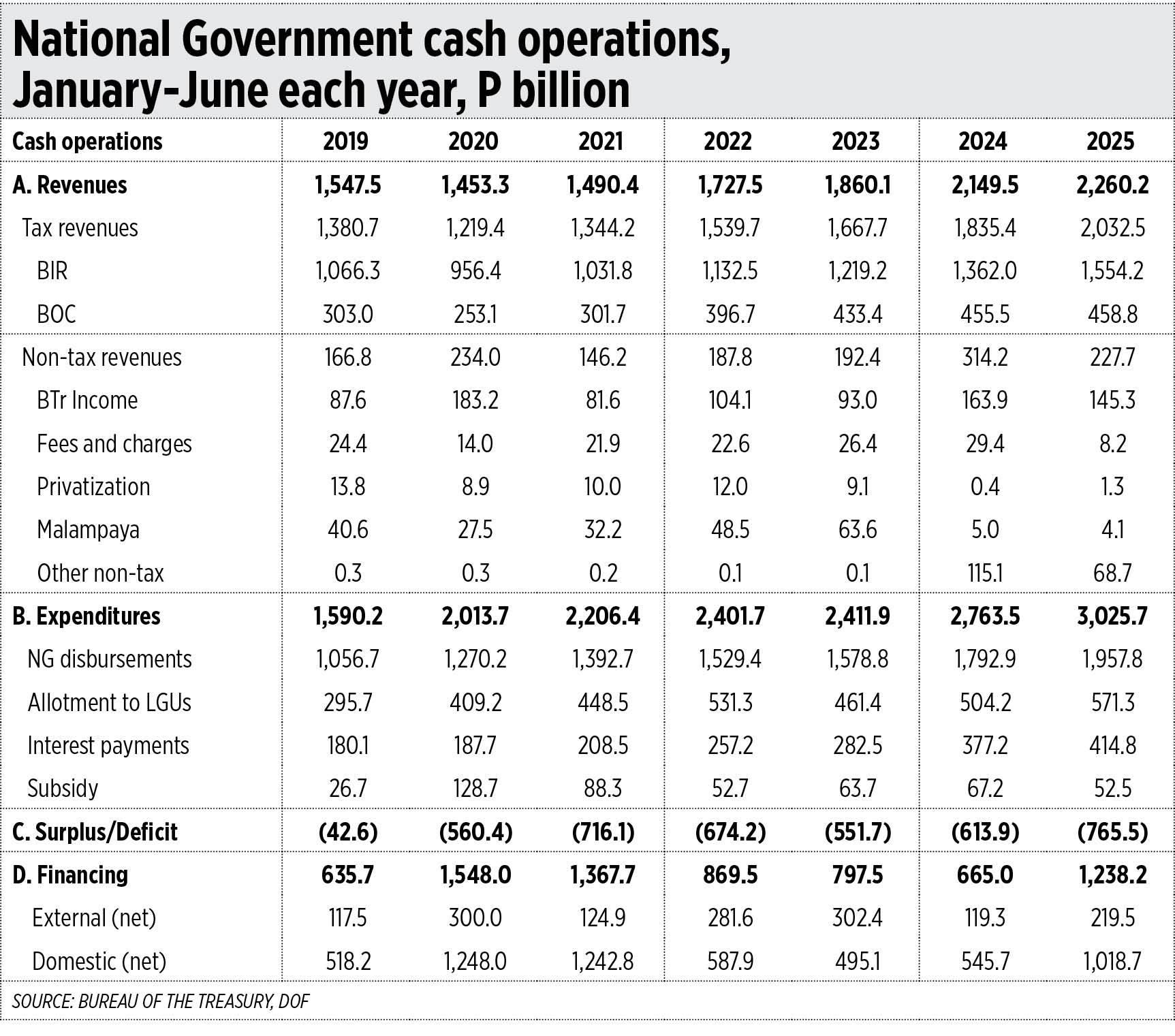
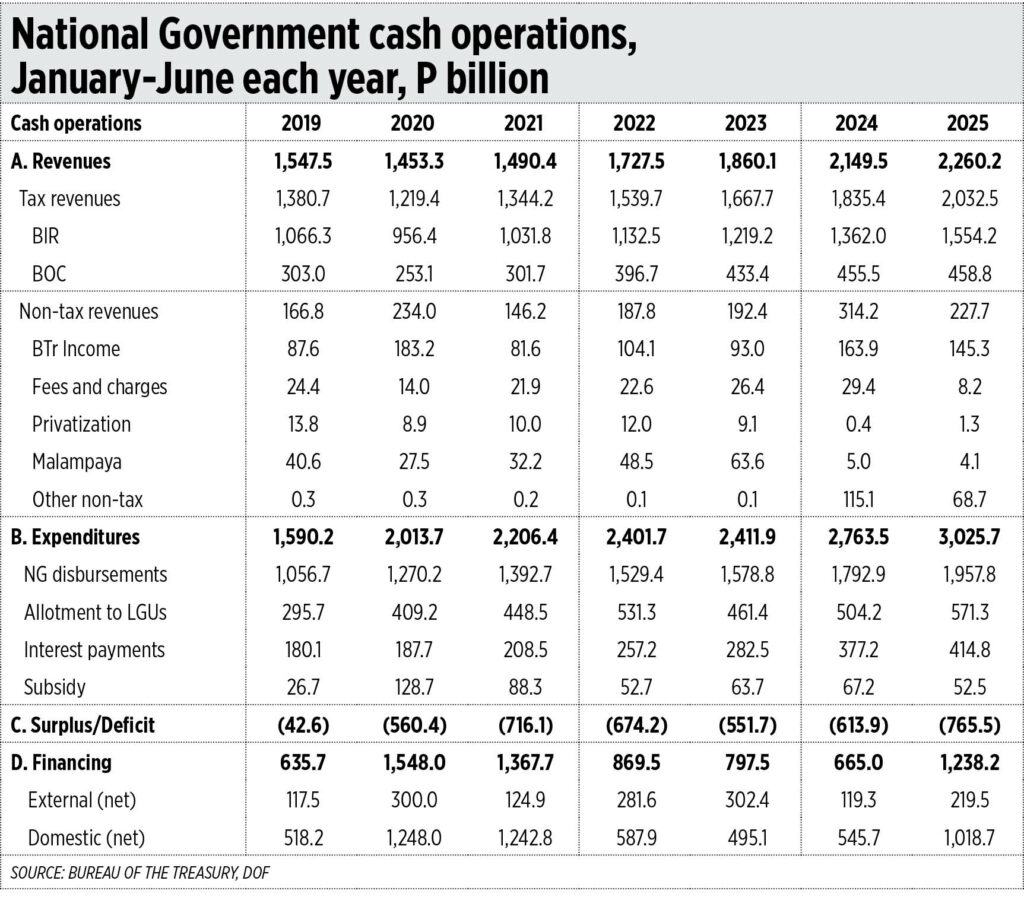
Last week the BTr released the cash operations report for June 2025. I compared the cumulative January-June data with previous years and saw some good and bad news.

The good news is that on the revenue side, the “Other non-tax” revenue that refers mainly to higher mandatory remittance of government-owned and -controlled corporations (GOCCs), has significantly jumped from almost zero in previous years to P115 billion in 2024 and P69 billion in 2025. This is better called the “Recto effect.” Finance Secretary Ralph G. Recto ordered the GOCCs to raise their mandatory remittances to the Treasury from 50% to 75% and it went well.

The bad news comes from the revenue side. The Bureau of Customs (BoC) has seen poor collections in 2024 and 2025, nearly as flat as the 2023 level. New BoC Commissioner Ariel Nepomuceno has a heavy burden — to significantly raise the customs collections, mainly by addressing the considerable levels of smuggling and illicit trade in many sectors, from tobacco to petroleum to gadgets.

The bigger piece of bad news is on the spending side. Both National Government (NG) and local government units (LGUs) spending are jumping up simultaneously, instead of NG spending rising moderately if not remaining flat as more functions and revenues go to the LGUs.

The result is inevitable — the budget deficit in 2025 is back to 2020 and 2021 levels during the time the lockdown dictatorship led to a huge decline in revenues while expenditures for subsidies jumped high (see the table).
Budget Secretary Amenah F. Pangandaman has pushed measures for spending transparency and responsibility, like the Open Government Partnership (OGP) and the Government Optimization Act, formerly the National Government Rightsizing Program bill, that became a law.

The big problem in fiscal economics is often on the spending side and not so much on the revenue side. As a clear example — in April the various agencies submitted a total budget wish list of P10 trillion for 2026, even if the DBCC expenditures target is only P6.6 trillion to control the deficit and borrowings.

There are two specific expenditures that I want to mention — infrastructure and flood control projects of the Department of Public Works and Highways (DPWH), and the military and uniformed personnel (MUP) pension.

The Philippines, Luzon in particular, has just experienced 12 straight days of rain, from July 17 to July 28, when this column went to press. Heavy rains occurred on July 18 to 25, Friday to Friday, that led to a “classless society” — no classes (for elementary to college levels) were held for six days straight. There was a lot of flooding in many cities, municipalities, and barangays. Meaning that of all the trillion plus pesos worth of flood control projects by the DPWH, many are ineffective or perhaps non-existent. Big reforms and accountability are needed here.

The southwest monsoon or “habagat” plus three consecutive storms over the past two weeks have caused 30 deaths and affected 5.57 million individuals from 1.54 million families across 6,053 villages in 17 regions. The data is from the National Disaster Risk Reduction and Management Council or NDRRMC.

The MUP pension fund, which averaged P120 billion/year from 2021-2024, increased to P144.7 billion in 2025, and is targeted at P217 billion in 2026, a 50% increase in just one year. This is patent abuse of taxpayers. Those personnel do not contribute to their own pensions, they take home their salaries with no pension deductions unlike government doctors and nurses, government lawyers and engineers, government teachers and professors, and others who contribute monthly for their future pension.

The President had already mentioned the need for reforms of the MUP pension in his SONA 2023. There should be follow-up measures to reform this anti-taxpayers policy.


Bienvenido S. Oplas, Jr. is the president of Bienvenido S. Oplas, Jr. Research Consultancy  Services, and Minimal Government Thinkers. He is an international fellow of the Tholos Foundation.

minimalgovernment@gmail.com

UnionBank books P3.25-B net profit

BW FILE PHOTO

UNION BANK of the Philippines, Inc. (UnionBank) booked a net income of P3.25 billion in the first half on the back of strong revenues, it said on Monday.

The bank’s revenues rose by 9.2% year on year to P39.7 billion in the period amid higher net interest income and an expanded fee income base, it said in a disclosure to the stock exchange

Its financial statement was unavailable as of press time.

UnionBank said its strong revenue performance as well as “one-time costs aimed at enhancing operational and financial resiliency” helped offset the earnings impact of higher credit costs, which came amid the increase in its new credit card customers.

“As we continue our efforts to grow our customer base, we are also ensuring we enhance operational resilience to be able to deliver our desired customer experience. These strategic moves come with upfront costs booked in 1H 2025. This positions us to better reflect the bank’s true performance moving forward,” UnionBank President and Chief Executive Officer Ana Maria Aboitiz-Delgado said.

“Our topline has consistently shown an encouraging trend, and with lower costs ahead, we anticipate improved net income in the coming months. These efforts position the bank for a more resilient, sustainable, and accelerated trajectory as we enter the next phase of our growth journey,” she added.

UnionBank’s net interest income stood at P31.311 billion in the first semester, with interest income at P41.765 billion and interest expense at P10.454 billion. Its net interest margin increased by 61 basis points to 6.4%.

“This was driven by continued growth in the bank’s high-yielding consumer portfolio — particularly in credit cards and personal loans — underpinned by continuous customer acquisition and cross-sell initiatives,” UnionBank said.

Its net loans and other receivables stood at P519.003 billion at end-June.

On the funding side, deposit liabilities were at P682.554 billion.

“Funding costs also improved amid a declining interest rate environment and an increase in the share of low-cost CASA (current account, savings account) deposits. The bank’s CASA ratio improved to 65.2%, underscoring the strength of its transaction banking franchise,” it said.

Meanwhile, other income was at P8.44 billion.

“UnionBank’s retail customer base reached 18 million as of the first half of 2025, contributing to higher transaction volumes and a 17.1% year-on-year increase in fee income,” it said.

“The bank’s fees-to-assets ratio stood at 1.3%, among the highest in the industry, reflecting its strong ability to generate fee-based revenues relative to its size.”

On the other hand, UnionBank’s operating expenses were at P23.37 billion in the first semester, with provisions for credit losses at P11.55 billion.

The bank’s assets stood at P1.14 trillion as of June, while total capital was at P195.97 billion.

UnionBank’s shares closed at P32 apiece on Monday, dropping by 30 centavos or 0.93%. — A.M.C. Sy

FAO: Philippines’ undernourishment prevalence in 2022-2024 hits record low

THE NUMBER of Filipinos experiencing moderate or severe food insecurity declined after the pandemic to 37.8 million during the 2022 to 2024 period, according to the Food and Agriculture Organization (FAO). Read the full story.

FAO: Philippines’ undernourishment prevalence in 2022-2024 hits record low

AGI says 12,000 room key target achievable by 2028

ALLIANCEGLOBALINC.COM

ALLIANCE GLOBAL Group, Inc. (AGI) is on track to reach 12,000 room keys across its key hospitality units by 2028, the company’s president said.

“Before 2028, we will definitely hit 12,000 room keys through our Megaworld Hotels & Resorts and through Travellers [International Hotel Group], which currently hosts Newport World Resorts,” AGI President, Chief Executive Officer, and Vice Chairman Kevin Andrew L. Tan said during Philippine Hotel Connect 2025, a forum hosted by the Philippine Hotel Owners Association, Inc., on Thursday last week.

This year alone, AGI expects to end 2025 with 10,000 room keys, he added.

Mr. Tan also cited plans to invest $2 billion (around P114 billion) to expand the company’s integrated resort developments, pointing to new projects in Boracay, Aklan and Lapu-Lapu City, Cebu.

The company earlier said it is investing P5 billion in Travellers International’s ongoing expansion, including the development of The Narra Palm Hotel and Villa within the Newport World Resorts complex.

“This hotel is comprised mostly of suites and villas. It’s very much a curated service… and it’s elevating the hospitality industry to new heights,” Mr. Tan said.

He also said there are plans to build Narra Palm Hotels in both Boracay and Cebu.

Megaworld is also adding around 3,600 room keys through new hotels in Metro Manila, Pampanga, Palawan, Bacolod, Iloilo, and Boracay.

AGI is likewise investing in the upskilling of Filipino talent in the hospitality industry.

“We’re investing a lot of our capital as well in building schools and institutions that will help train the next generation of tourism executives,” he told the forum.

AGI is also optimistic about the growth of the local tourism industry, citing the country’s ongoing infrastructure developments.

“We believe there’s nowhere else to go but up. So, our group’s committed to really expand aggressively,” Mr. Tan said. — Beatriz Marie D. Cruz

Cleo Laine, British jazz singer who performed with Ray Charles and Frank Sinatra, 97

AMAZON.COM

LONDON — British jazz singer Cleo Laine, who performed with musical greats including Frank Sinatra and starred as an actor in London’s West End and on Broadway, has died aged 97, the Guardian newspaper reported on Friday, citing a statement from her children Jacqui and Alec.

Born to an English mother and a Jamaican father in a suburb of London in 1927, she initially worked as a hairdresser, a hat-trimmer, and a librarian. She married in 1946 and had a son while still a teenager.

Driven on by her dream of becoming a singer, she divorced and got her big break in 1951, when she joined the band of English saxophonist and clarinetist John Dankworth at 24.

Mr. Dankworth’s band decided her name was too long — at the time she thought she had been born Clementine Campbell, though a passport application later revealed her mother had used her own surname Hitching on the birth certificate.

The men of the Dankworth Seven band thought her name was too cumbersome for a poster, and that her nickname Clem was too cowboy-like. They settled on a new stage persona for her by drawing “Cleo” and “Laine” from hats.

In 1958, she and Mr. Dankworth married. Their home became a magnet for London’s jazz set: friends included stars from across the Atlantic such as Oscar Peterson and Ella Fitzgerald, Lester Young and Dizzy Gillespie.

After acting as well as singing in Britain through the 1960s, Ms. Laine toured Australia in 1972 and performed at New York’s Lincoln Center. The recording of a further show, at Carnegie Hall, won her a Grammy.

Recordings included “Porgy and Bess” with Ray Charles. In 1992 she appeared with Frank Sinatra for a series of shows at the Royal Albert Hall in London, but she was best known for her work with Mr. Dankworth’s bands. He later became her musical director.

The couple built their own auditorium in the grounds of their home near London and were friends with the late Princess Margaret, the sister of the late Queen Elizabeth II. Their two children went on to become musicians.

Mr. Dankworth — who Ms. Laine described as being “joined at the hip” with her — died in 2010. Hours after his death, Ms. Laine performed a scheduled show in their auditorium, announcing the news about her husband only at the end of the concert. — Reuters

Power distributor Meralco sees P50-billion earnings this year

PHILSTAR FILE PHOTO

By Sheldeen Joy Talavera, Reporter

POWER DISTRIBUTOR Manila Electric Co. (Meralco) is on track to hit its target earnings of P50 billion for this year, driven by its power generation business, its chairman said.

At a press briefing on Monday, Meralco Chairman and Chief Executive Officer Manuel V. Pangilinan said the company is on track for “low double digits” over last year’s P45.1-billion earnings.

“The biggest growth will come from generation,” Mr. Pangilinan said.

Betty C. Siy-Yap, Meralco’s senior vice-president and chief finance officer, said Meralco saw its core net income increase by 9.5% to P14.4 billion from a year earlier, driven by solid contributions from its power distribution and generation businesses.

Revenues declined by 2% to P130.7 billion due to lower pass-through charges and the implementation of a refund.

For the six months ending in June, the power distributor reported a 10% increase in its core net income to P25.54 billion from P23.21 billion in the same period last year.

Of this total, the distribution business accounted for 54%, power generation contributed P13.7 billion or 37%, while retail electricity supply and non-electricity businesses accounted for 9%.

Gross revenues climbed by 3% to P245.22 billion from P237.48 billion, driven by higher pass-through charges, an increase in sales volume from the distribution utility and retail electricity supply, and higher revenues from power generation in the reserve market.

Residential sales volume rose by 0.7% to 9,778 gigawatt-hours (GWh), due to steady growth in newly energized accounts offsetting flat demand.

Commercial sales volume climbed by 0.3% to 10,103 GWh, supported by the ramp-up and expansion in retail and restaurant sectors, which countered the impact of office vacancies due to the exit of Philippine offshore gaming operators.

Industrial sales increased by 0.5% to 7,137 GWh, as growth in the semiconductor and cement sectors and a recovery in steel offset the decline from operational shifts in food and beverage and the termination of embedded generation accounts.

By the end of the first half, consolidated customer count had reached 8.1 million, marking a 3% increase from 7.9 million in the same period last year.

“As we move into the second half, we remain focused on achieving key milestones that will enable us to meet our full-year profit target and business goals,” Mr. Pangilinan said.

COAL POWER PROJECT
Emmanuel V. Rubio, president and chief executive officer of Meralco PowerGen Corp. (MGen), announced that the Department of Energy (DoE) had reissued the “committed capacity” status for its Atimonan Energy Power Plant project, reaffirming that the project is outside the coverage of the coal moratorium.

MGen is the power generation arm of Meralco.

Following the go-signal from the government, MGen, through its subsidiary Atimonan One Energy, Inc., is set to pursue the development of the 1,200-megawatt ultra-supercritical coal-fired power plant, beginning with the processing of the required additional permits through the Energy Virtual One-Stop Shop.

“As MGen plays a key role in ensuring the country’s energy security and leading the energy transition, our investment in Atimonan will help address today’s needs while preparing for tomorrow’s opportunities,” Mr. Rubio said.

In 2020, the DoE issued a moratorium on the development of new coal-fired power plants.

Meralco’s majority owner, Beacon Electric Asset Holdings, Inc., is partly owned by PLDT Inc.

Hastings Holdings, Inc., a unit of the PLDT Beneficial Trust Fund subsidiary MediaQuest Holdings, Inc., has an interest in BusinessWorld through the Philippine Star Group, which it controls.

ADVERTISEMENT
ADVERTISEMENT