Home Blog Page 121

The Iran war is costing China dearly, too

COMMONS.WIKIMEDIA.ORG/ MNXANL

By Shuli Ren

TO THINK about how the Iran war affects China, you might take a look at Yiwu, a global trading hub in the eastern Zhejiang province that hosts sprawling wholesale markets selling goods from hair clips to toys.

Exporters are eager for business. At the entrance is a prominent display that reads “World’s capital of small commodities eagerly embraces your gracious presence.” Buyers from Gulf states are the city’s most prized guests, as Middle Eastern restaurants — the best in China according to social media influencers — spread across the main shopping districts. After all, these customers bring big business. Exports to the region doubled in five years, exceeding $120 billion in 2025. In the first two months of the year, China’s exports to the United Arab Emirates (UAE) and Saudi Arabia alone grew 23%. 

With the Iran war entering the fourth week, the much-anticipated visitors from the region have practically disappeared as air traffic disruptions continue. Those in town are rushing to find flights home, while local vendors worry about the safety of their Iranian customers, having not heard from them as the country experiences a near-total internet blackout. Some have reportedly applied to join the army to defend their country’s sovereignty.

Even if Middle Eastern buyers are still able to place orders via WeChat, their Chinese suppliers in, especially electronics makers, are pulling the plug. Their math no longer works.

Take air conditioners, for example. Last year, China shipped over 17 million units to the Middle East, or roughly 20% of the country’s total exports. Overseas sales might be tumbling by 12% this month, readings from online orders show.

Transportation costs have become prohibitively expensive. Freight for a standard container to the Persian Gulf has risen 35% in March, while insurance premiums have jumped by 143%. Sellers also have to pay insurers war surcharges of up to $4,000 per container.

Manufacturers are also concerned about procurements of raw materials, from copper to aluminum, not wanting to be caught at the wrong end of the cycle. The price of aluminum soared at the start of the war as commodities traders worried about supply disruptions. The region accounted for 9% of global production in 2025. But as the conflict drags on, prices of industrial metals have plunged in recent days over fears of a global recession. A 10% rise in raw materials costs can shave gross margins for home-appliances makers Midea Group Co., Haier Smart Home Co., and Gree Electric Appliances, Inc. of Zhuhai by as much as 6%.

Yiwu provides a small glimpse of the existential threat a prolonged war may pose to China. A collapse of global demand will dent the economy’s only bright spot — exports that the government has counted on to help meet its annual growth targets. This pillar is now looking wobbly as elevated energy costs drain consumers’ wallets around the world.

A slowdown in exports will likely create more overcapacity, trigger fiercer price wars at home, and trim corporate profits. This perhaps explains why China’s stock market is finally pricing in the Iran war after weeks of calm.

There’s now a debate in mainland China over what the war means for the country. In the near-term, the government needs to handle an energy crisis that has already erupted. To be sure, almost everyone agrees that the formidable strategic oil reserves Beijing has built buffers the economy better than its north Asian neighbors. It’s the long-term impact that has investors at odds. Some argue that the war is good for China because US military resources will be diverted away from the Pacific, and that Beijing will win the AI arms race because it has a superior energy infrastructure.

I disagree with this bullish view. In the last two years, China caught a lucky break because of robust global demand, allowing it to sell into Europe and the Global South even as President Donald Trump raised US tariffs. This gives his counterpart, Xi Jinping, the policy space to let a weak economy bottom out on its own. Indeed, the government has dialed down fiscal support, while sounding unfazed by the continued housing market decline.

This rug of policy comfort will be pulled from under China’s feet if we enter a global recession. Unlike Trump’s claims, wars have no winners.

BLOOMBERG OPINION

More MSMEs turn to influencers to drive growth

STOCK PHOTO | Image by FREEPIK

By Almira Louise S. Martinez, Reporter

MORE MICRO, small and medium enterprises (MSME) are tapping influencers to boost revenue and business growth, as content creators continue to gain traction in the Philippines, according to marketing firm Blogapalooza, Inc.

“Businesses are also starting to see that creators are becoming an integral part of marketing,” Blogapalooza Chief Executive Officer Hazel Bernadette B. Gapuz told BusinessWorld via Zoom. “The way that consumers decide has already evolved.”

Blogapalooza is a Philippine-based influencer marketing and talent management firm.

Unlike traditional advertising that relies on celebrities, influencers can build more personal connections with audiences, making them particularly effective for small brands seeking to strengthen their online presence, Ms. Gapuz said.

“Consumers trust content creators, who are like their peers,” she said. “That’s their edge over traditional celebrities because when you’re digital‑first, you speak internet language.”

“The traditional way of doing advertising won’t work anymore,” she added.

As demand for influencer marketing grows, Ms. Gapuz noted that the industry remains fragmented and largely unstandardized, particularly in terms of pricing.

“Creators are starting to think of themselves as media entities,” she said. “Some of them really professionalize it — even to the point of hiring a team or setting up their own studio.”

She said the influencer market is becoming more professionalized, with many of them investing more in their businesses. “It just makes sense that the cost is increasing.”

Despite rising fees, many MSMEs continue to invest in influencer marketing because of its results‑driven nature.

“Smaller businesses obviously don’t have a lot of money to pay these big names,” Ms. Gapuz said. “They need sales right away, or if sales don’t come, they need a specific path to justify the influencer spending.”

Some small brands are also turning to in‑house creators or collaborating with influencers through X‑deals, where content is exchanged for products or experiences instead of cash.

“While costs are the primary barrier to most small businesses, there are creative ways of going around them,” she said.

Data from consumer intelligence firm Meltwater showed that influencer marketing spending in the Philippines reached $109 million in 2024, up 15.9% from the previous year.

Influencer advertising also accounted for 5.6% of total digital advertising spending in the country.

“It’s a massively growing industry,” Ms. Gapuz said. “We’ve seen how much it has grown over the past couple of years. There’s a lot of potential, even if the industry isn’t fully mature yet.

Ayala names Urquijo head of Ayala Land urban estates

JAIME Z. URQUIJO — FACEBOOK.COM/AYALACORPORATION

A MEMBER of the Zobel family’s next generation will take on a larger role in Ayala Group’s property operations at Ayala Land, Inc. (ALI) effective April 15.

Jaime Z. Urquijo, Ayala Corp.’s chief sustainability and risk officer, has been seconded to Ayala Land to serve as head of urban estates.

“In this role, Mr. Urquijo will lead the continued development of Ayala’s Metro Manila estates as it strengthens its efforts to build sustainable and distinctive urban communities,” the company said in a regulatory filing on Tuesday.

The group also named Paolo Maximo F. Borromeo as chief social infrastructure officer. He will hold the position alongside his current role as president and chief executive officer of Ayala Healthcare Holdings, Inc.

Mr. Borromeo will oversee Ayala’s social infrastructure businesses, which include healthcare, education, community development, and livelihood programs. He will also manage the company’s sustainability, state affairs, and external communications units.

At the local bourse on Tuesday, shares in Ayala Corp. were unchanged at P490 apiece, while Ayala Land shares climbed 3.19% to P17.46 each. — Alexandria Grace C. Magno

Malayan Insurance rolls out zero-interest installment payment options for products

MALAYAN Insurance Co., Inc. is offering installment payment options with 0% interest for some of its products to make comprehensive insurance coverage more accessible amid shifting economic priorities.

“Our mission has always been to give our clients peace of mind and financial security during life’s unexpected events,” Paolo Y. Abaya, president and chief executive officer of Malayan Insurance, said in a statement on Tuesday.

“Through these 0% installment options, we aim to remove financial barriers to protection and ensure that every Filipino can safeguard what matters most — easily and affordably.”

The nonlife insurer said these easier payment options aim to help provide relief to consumers as they prioritize immediate expenses due to economic worries.

Customers can avail of its AutoMaster car insurance and Home Protect products without a one-time lump-sum payment, as they can divide their total annual premiums into terms of three or six months without any interest or financing fees.

“Even with these manageable staggered payments, policyholders are guaranteed immediate, full, and uncompromised protection the moment their installment plan is approved, ensuring there are zero gaps in their security,” Malayan Insurance said.

The installment facilities are now available via participating credit card partners and for purchases via its website.

Malayan Insurance’s premiums earned stood at P5.516 billion in 2025, latest Insurance Commission data showed. Its net income was P383.533 billion. — A.M.C. Sy

Arts & Culture (03/25/26)


Manila hosts 1st Southeast Asian Congress of Hispanists

THE Embassy of Spain is presenting the first Southeast Asian Congress of Hispanists this week. The event brings together scholars, researchers, and practitioners dedicated to the study of the Spanish language, literature, and culture. Participants from across Southeast Asia, along with invited experts from Europe and the United States, will come together at the Instituto Cervantes in Intramuros from March 26 to 27 to foster dialogue on the role of Hispanic studies in a global and multicultural context. The event is being held through the Instituto Cervantes and its Cultural Section and in collaboration with the Academia Filipina de la Lengua Española and the Fundación Duques de Soria. Further information may be found at https://www.hispanismosea.org/.


Next-gen creators in multimedia exhibition

THE multimedia art exhibition ORGANICA: Emergence is presenting a collection of over 170 prints, traditional and digital artworks, and immersive installation pieces. Featured works range from illustrations, graphic design, photography, and 3D modeling to animation, games, video clips, films, and motion graphics. It likewise includes paintings, sculptures, and zines, among many others. Anchored in the theme of Bio Art, the showcase explores art as a living system. It features the portfolios of graduating Multimedia Arts students from the De La Salle-College of Saint Benilde (DLS-CSB) and is free and open to the public from March 26 to 28 at the Ayala Malls Circuit in Makati City.


NCCA stages Pakudos cultural recollection

THE National Commission for Culture and the Arts (NCCA) will be staging its first Lenten cultural recollection, titled Pakudos. The activity will kick off with a Holy Mass and be followed by a cultural performance by MB Rosie Sula, Sinukwan Kapampangan, Powerdance, Manunubli ng Sinala, and JM Yosures, who are all respected cultural performers from their regions. The Lenten presentation will be held on March 27, 5 p.m., at the Rizal Park Open-air Auditorium in Manila.


Kaida Contemporary mounts Fil-Chi women’s exhibit

AS PRODUCTS of migration, the Filipino-Chinese are a multi-hyphenate people with an identity in constant flux. This will be explored in Kaida Contemporary’s ongoing exhibit for women’s month, To know a bird’s song go to the mountains , curated by Janice Liuson-Young. Anchored on reinterpretations of the titular Chinese proverb, the exhibit seeks to unpack the reconfigurations of home through the works of 13 female Filipino-Chinese artists: Celine Lee, Shireen Co, Julieanne Ng, Sarah de Veyra-Buyco, Valerie Chua, Kadin Tiu, Jing, Tracie Anglo-Dizon, Billie Jean Chuaunsu, Janice Liuson-Young, Aze Ong, Kim Lim, and Helena Go. It runs until April 7 at Kaida Contemporary, located on 120 Kamias Rd., Diliman, Quezon City.


NYC-based Filipino artist exhibits at Art Cube Gallery

AN EXHIBITION titled The Family and Medical Leave Act (FMLA) is the 18th solo show of Julio Jose “Jojo” Austria, a Filipino artist based in New York City (NYC). FMLA is defined as unpaid and job-protected time off granted to employees specifically to care for an immediate family member, administered by the United States’ Department of Labor. The show poster was based on an actual form that the artist filled out as a Museum of Modern Art (MoMA) worker of nine years. Here, the term leave of absence (LOA) takes on a dual meaning — for the artist, a return to familial duty in the Philippines, his physical absence in studio bringing a different kind of presence within the paintings themselves. FMLA runs until April 7 at Art Cube Gallery at the OPVI Center, 2295 Chino Roces Ave., in Makati City.


PETA redefines people’s theater in Control + Shift

THE Philippine Educational Theater Association (PETA) is bringing back Control + Shift: Changing Narratives, which runs at the PETA Studio Theater from April 10 to 19. It will feature a “StudioLab” of fresh stories and restaged productions, with two new works produced under PETA’s Artist-Teacher Training alongside two returning pieces from last year’s festival and one developed with a theater group from a community partner. Set A features Jhudiel Clare Sosa’s Cleaners, directed by Julio Garcia, and Herlyn Alegre’s Monit-oh! Monit-ah!, directed by Norbs Portales. Set B features Mikaela Regis’ At Nagkatawang-tao Ang Verbo, directed by Anthony Cruz, and Anj Heruela’s Baga ng Gumuguhong Langit, directed by Ian Segarra. The PETA Theater Center is at No.5 Eymard Drive, New Manila, Quezon City.


Tiffany Lafuente, Maricar Tolentino at MO_Space

TWO EXHIBITIONS are on view at MO_Space this month. In The FUN Stuff, Tiffany Lafuente cracks the veneer of everyday life, poking fun at mundane rituals as well as the domestic objects that allow us to fashion identities and shape how others perceive us. Meanwhile, in /hour, Maricar Tolentino sets down what she has previously practiced, the density of pigments and insistence of imagery, and picks up time and repetition. In white-on-white thread, she accounts for what labor demands and what it cannot, in hours, days, weeks, and months. The exhibitions run until April 19 at MO_Space, Bonifacio High Street, BGC, Taguig.

The move to a digital apostille system

STOCK PHOTO | Image by Wirestock from Freepik

The Philippines acceded to the Hague Apostille Convention on Sept. 12, 2018. The Convention took effect in the Philippines on May 14, 2019. The Convention was intended to simplify the authentication of public documents for use abroad by replacing the multi-step legalization process with a single certification known as an apostille. An apostille serves to authenticate the origin of a public document, and verify the signature, seal, or stamp of the issuing authority so that the document may be recognized in another contracting state without further authentication. For documents intended for use in countries that are not parties to the Convention, the traditional consular legalization through the relevant embassy or consulate remains necessary.

Following the Philippines’ accession to the Hague Apostille Convention, apostilles have been traditionally secured through a paper-based process with the Department of Foreign Affairs (DFA). Applicants are required to obtain the original document from the issuing agency, secure an online appointment with the DFA, and appear in person or through an authorized representative to submit the document for apostille.

In 2024, the DFA introduced the e-Apostille service for Philippine Statistics Authority (PSA) civil registry documents. This allowed applicants to obtain apostilles for PSA e-Certificates without the need for personal appearance, with the apostille issued and transmitted electronically. However, the system was limited in scope and applied only to PSA or civil registry documents.

On March 16, in addition to PSA e-Certificates, the DFA introduced a digital apostille system for Commission on Higher Education (CHED) Electronic Certification, Authentication, and Verification (eCAV) documents. Such a development in the apostille process framework allows the said public documents to be issued, apostilled, and thereafter transmitted entirely in their electronic form.

Under this system, documents such as birth, marriage, and death certificates which can be currently obtained as PSA e-Certificates may be subsequently apostilled without the need for their physical submission, within a shorter apostille process timeline. Academic records processed through CHED’s eCAV platform may also be e-Apostilled. The apostille is issued electronically and transmitted directly to the applicant. This start-to-finish digital process is aimed to minimize processing time and eliminating the need for personal appearance before the PSA, CHED, and the DFA.

It is important to note that e-Apostilles are intended only for electronic transmission to the applicant and should not be printed for use as the e-Apostille loses its validity when printed and submitted as hard copies.

To balance the efficiency and practicality that come with the transition to an e-Apostille digital system, the DFA put in place safeguards to preserve the integrity and authenticity of apostilled documents. Verification mechanisms — including QR codes, verification links, and a digital signature checker — are available to ensure that e-Apostilles remain secure and could be readily validated by their receiving authorities.

Although the e-Apostille is available for select public documents, the traditional apostille process for other documents remains available. Applicants who need the apostille of physically issued or executed documents or whose intended recipients do not accept electronic apostilles, may continue to avail of the online appointment system with the DFA and the physical submission of documents for apostille. These multiple modes of securing apostilles allow for flexibility, accommodating varying requirements across agencies and jurisdictions.

The introduction of the digital apostille system reflects a calibrated step toward greater efficiency and accessibility in public service. The DFA continues to exert recognizable efforts in streamlining the apostille process for documents while maintaining the safeguards necessary to keep the integrity of public documents used in cross-border transactions. The start of the e-Apostille system is a step forward to making processes simple, straightforward, and readily available to the public.

This article is only for general informational and educational purposes and is not offered as and does not constitute legal advice or opinion.


Christianna Manami Y. Salud is a senior associate of the Immigration department of the Angara Abello Concepcion Regala & Cruz Law Offices (ACCRALAW).

cysalud@accralaw.com

(632) 8830-8000

Rimini Street helps firms optimize legacy IT systems

UNSPLASH

By Edg Adrian A. Eva, Reporter

RIMINI STREET, INC., a global provider of enterprise software support, is helping companies extract more value from their existing information technology (IT) systems as many firms struggle to realize returns on artificial intelligence (AI) investments.

Michael L. Perica, executive vice-president and chief financial officer at Rimini Street, said many organizations fail to generate meaningful benefits from early AI initiatives due to the absence of a clear strategic roadmap and inadequate data infrastructure.

“One will not have success unless you have an overall roadmap, a strategy, and the appropriate preparedness to fully realize the benefits of investing in this technology,” he told BusinessWorld via Microsoft Teams.

“At Rimini Street, we support clients, optimize their existing systems, and then prepare them for innovation,” he added.

Only 20% of chief financial officers are satisfied with their technology investments including security, AI, customer-facing software-as-a-service (SaaS) platforms and enterprise resource planning systems, according to the Rimini Street Survey 2024, which polled almost 3,000 global finance and IT leaders.

The survey found that companies often experience negative consequences from these investments, such as rising costs, limited future flexibility and significant organizational disruption.

To address these challenges, Mr. Perica said Rimini Street offers a vendor‑independent support model that lets organizations continue using their software releases for as long as needed, without being forced into costly upgrades or system migrations.

“We have our own innovative solutions that use agentic AI and workflows on your own data and systems, maximizing your customizations or even those of others,” he said.

They also work with partners for agentic AI, allowing organizations to prioritize and invest at their own pace with their data, while achieving the appropriate level of preparedness, he pointed out.

This approach, he said, lets firms recover 80% to 90% of their maintenance and support spending, freeing up what he described as “sacred dollars” that could be redirected toward strategic initiatives such as digital transformation and AI deployment.

“Redeploying those savings is what puts one in a position to optimize preparedness and ultimately fund innovation,” he said.

Among Rimini Street’s offerings is Rimini Consult, an advisory service focused on preparing legacy systems for modern technologies.

The firm’s enterprise architects and data specialists clean and standardize existing databases and build custom digital integrations that allow older systems to work seamlessly with newer AI tools.

Among Rimini Street’s clients in the Philippines is Philippine Airlines, which it provided with third-party support for its core enterprise software, allowing the carrier to cut maintenance costs and fund its digital transformation, Mr. Perica said.

He advised companies to maintain control over their data and avoid “vendor lock‑in” arrangements that limit flexibility and long‑term value from technology investments, including AI.

He further urged firms to align technology spending with their own strategic priorities rather than adapting their business models to match a software provider’s roadmap.

The Philippines and the broader Southeast Asian region, Mr. Perica said, represent an “emerging and exciting market” for Rimini Street.

The company plans to deepen engagement with Filipino partners, monitor regional technology trends, and tap into local talent to support its global operations, he said.

Regulators warn online lenders over data privacy violations

STOCK PHOTO | Image by Yura Fresh from Unsplash

THE SECURITIES and Exchange Commission (SEC), Department of Information and Communications Technology (DICT), and National Privacy Commission (NPC) issued a joint advisory reminding online lending platforms (OLPs) to comply with data privacy and borrower protection rules.

“The government recently received numerous reports of [OLPs] engaging in harassment, intimidation, public shaming and unlawful use of personal data in their collection practices,” the advisory read.

“Digital transformation must protect — not prey upon — the Filipino people. The National Government stands firm in enforcing the law and safeguarding the rights, privacy, and dignity of every Filipino in the digital economy,” it added.

The advisory cited Republic Act No. 10173, or the Data Privacy Act of 2012, and Republic Act No. 11765, or the Financial Products and Services Consumer Protection Act. It also referenced SEC Memorandum Circulars No. 18 and 19 (both Series of 2019), which prohibit unfair debt collection practices and require disclosure of OLP operations by financing companies.

The SEC, DICT, and NPC said OLPs must not access borrowers’ contact lists or contact non-guarantors, as these practices may lead to harassment, unauthorized debt collection, and excessive processing of personal data.

The joint advisory also requires OLPs to securely dispose of data once it is no longer needed and to allow users to revoke application permissions after the purpose has been fulfilled, among other requirements.

“Violations of applicable laws, [implementing rules and regulations], and SEC regulations may subject the erring [financing and lending companies] to administrative sanctions, including fines, suspension or revocation of authority to operate, and other penalties provided under relevant laws,” the SEC, DICT, and NPC said.

The regulators also reminded OLP users to remain vigilant against risks to their personal data. They advised users to download applications only from official or verified sources linked to SEC-registered firms.

The advisory also emphasized the need to review privacy notices carefully, noting that some applications use deceptive tactics to process user data. It added that borrowers should check application permissions to prevent unnecessary access beyond legitimate needs.

“Borrowers must also inform and secure the express consent of their guarantors,” the three agencies said.

Victims of unfair debt collection may file complaints with the SEC Financing and Lending Companies Department through its e-mail address or hotline.

Harassment, threats, fraud, and scams should be reported to authorities, including the DICT, National Bureau of Investigation, and Philippine National Police. — Alexandria Grace C. Magno

Philippines improves in women’s health ranking but still lags among its peers in the region

The Philippines improved two places to 107th out of 144 countries and territories in the latest edition of The Hologic Global Women’s Health Index by global medical technology company Hologic, Inc. Out of a possible 100, where higher scores are better, the country got 46.36, below the global average of 53.96. This put the Philippines as the second worst among its peers in the East and Southeast Asian region. The index measures women’s health across the dimensions of preventive care, emotional health, opinions of health and safety, basic needs, and individual health.

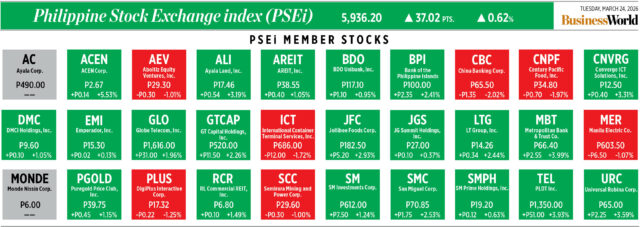
How PSEi member stocks performed — March 24, 2026

Here’s a quick glance at how PSEi stocks fared on Tuesday, March 24, 2026.


Japanese combat troops to join PHL Balikatan war games for first time

DVIDS/ LANCE CPL. ISAIAH CAMPBELL

By Kenneth Christiane L. Basilio, Reporter

JAPANESE combat troops are set to participate in annual war games in the Philippines for the first time next month as Manila and Tokyo seek to boost interoperability amid shared security concerns with China.

Japan’s combat forces will take part in the Philippines’ flagship Balikatan military exercises in April alongside US troops, in drills expected to be the most extensive in scope and intensity to date, Philippine military Chief of Staff General Romeo S. Brawner, Jr. said on Tuesday.

“For the very first time, after a very, very long time, combat troops from Japan, from the Japanese Self-Defense Forces, will be coming here to the Philippines to join us in the Balikatan exercise,” he told reporters on the sidelines of a forum organized by think tank Stratbase Institute.

“Aside from having more participants — we can see Japan’s participation — this will expand the scope of our defensive operations,” he said in mixed English and Filipino. “Our exercises will be broader, and we will be better prepared for any eventuality.”

The Armed Forces of the Philippines will launch Balikatan — Filipino for “shoulder‑to‑shoulder” — on April 20, Mr. Brawner said.

The annual drills have evolved into Southeast Asia’s premier combat rehearsal as the Philippines and its allies deepen security cooperation in response to China’s growing assertiveness in the region.

Philippine and US forces have traditionally anchored the exercises, but Japan’s participation this year highlights Manila’s efforts to expand its network of security partners beyond Washington.

Mr. Brawner declined to provide detailed information about the scale of Japan’s involvement but said the drills would be more intense and would include efforts to strengthen capabilities against emerging threats, including cyberwarfare. Japan is expected to take part in command‑and‑control exercises as well as live‑fire drills.

“I cannot divulge the exact numbers of what type of units are coming in or the equipment they’re going to bring here, but suffice to say that they will be sending a bigger contingent,” he said.

Japan’s participation is particularly notable given its pacifist Constitution, imposed by the US after World War II that renounces the use of military force. Japan invaded several Asian nations during the war, including the Philippines.

“In 1945, we found ourselves on opposite sides of the war,” Mr. Brawner said. “This time, we find ourselves on the side of efforts to promote a rules‑based international order.”

Japan has emerged as a “like‑minded partner” of the Philippines in promoting regional stability, Mr. Brawner said, as China intensifies what Manila describes as coercive actions in the South China Sea while Tokyo faces its own maritime disputes with Beijing.

“It is a partnership that not only responds to present challenges, but anticipates future demands that are anchored in mutual respect, guided by shared values and committed to lasting peace and stability,” he said.

China claims sovereignty over much of the South China Sea based on a so‑called nine‑dash line map that dates back to the 1940s.

The claim overlaps with the Philippines’ exclusive economic zone, where Beijing has deployed coast guard and maritime militia vessels despite a 2016 ruling by a United Nations‑backed arbitral tribunal that voided its claims. Beijing has continued to reject the ruling.

Like the Philippines, Japan is also embroiled in a dispute with China over the Senkaku Islands, which lie near key shipping lanes and are believed to be rich in marine resources.

“Some countries promote only their own interests and do this through coercion, forcing what they want to happen in the region,” Mr. Brawner said. “That cannot be allowed.”

“This is why the coalitions we are building are important, and one of our most significant partners is Japan,” he added.

Separately, the Philippine Coast Guard (PCG) said China’s coast guard plans to conduct a “clearing operation” near the disputed Scarborough Shoal, a traditional fishing ground for Filipino fishermen.

In a statement, the PCG said it deployed vessels to protect more than 20 Filipino fishing boats from harassment after monitoring a Chinese coast guard ship that broadcast its “intention to conduct a clearing operation” southeast of the shoal.

The Chinese Embassy in Manila did not immediately reply to a request for comment sent via Viber.

Two PCG vessels, along with five patrol boats from the Bureau of Fisheries and Aquatic Resources, were dispatched to escort Filipino fishermen in the area.

The deployment followed encounters last week in which Chinese coast guard ships allegedly used sirens and deployed rigid‑hull inflatable boats to drive Filipino fishermen away from the contested feature.

“The joint deployment ensured the safety and security of the Filipino fishermen,” the PCG said, adding that authorities also provided fuel, food packs, and ice bags to extend their fishing operations in the area.

Philippines declares energy emergency amid surging fuel prices 

An attendant updates the fuel prices at a gas station in Cubao, Quezon City, March 10, 2026. — PHILIPPINE STAR/MIGUEL DE GUZMAN

By Chloe Mari A. Hufana, Reporter

Philippine President Ferdinand R. Marcos, Jr. declared a national state of energy emergency on Tuesday, which gives the government expanded powers to secure fuel supplies and shield the economy from surging oil prices triggered by the war involving Iran, Israel and the US. 

In Executive Order No. 110, Mr. Marcos said escalating hostilities in the Middle East and disruptions in critical shipping routes such as the Strait of Hormuz pose an “imminent danger” to the country’s energy security, underscoring the Philippines’ vulnerability as a major importer of petroleum products. 

The order activates a coordinated response framework known as UPLIFT or Unified Package for Livelihoods, Industry, Food and Transport, aimed at stabilizing fuel supply, sustaining economic activity and protecting sectors most exposed to rising energy costs. 

Global oil prices have surged since the conflict erupted late February, raising inflation risks for the Philippines, where fuel costs directly affect transportation fares, food prices and electricity rates. 

The move comes even as Malacaсang has maintained that the country is not facing an immediate fuel shortage, citing stable inventories and diversification of supply sources. 

The Palace said the government is negotiating with alternative suppliers including China, Russia, Japan, South Korea, Brunei and India to reduce reliance on Middle Eastern oil. Mr. Mr. Marcos earlier said talks with these countries had been “positive,” though no supply agreements have been announced. 

Under the executive order, the Department of Energy (DoE) may take emergency actions such as direct procurement of petroleum products and closer coordination with state‑owned companies, including the Philippine National Oil Co. Authorities are also empowered to tighten oversight of fuel pricing and crack down on hoarding, profiteering and market manipulation. 

The government will prioritize fuel allocation for critical sectors including public transport, healthcare, power generation and utilities. 

Approvals for energy projects will be fast‑tracked to boost domestic generation capacity, while government offices will implement stricter conservation measures, including a four‑day workweek to curb energy use. 

Short‑term relief measures include fuel subsidies for transport operators and drivers, fare support for commuters, expanded public transport services and targeted assistance for households and industries most exposed to higher fuel costs. 

The order also outlines longer‑term steps to reduce dependence on imported oil, including accelerating renewable energy development, expanding electric vehicle adoption in mass transport and promoting energy‑efficiency measures across sectors. 

A Cabinet‑level committee headed by Mr. Marcos will oversee implementation, bringing together officials from economic, transport, agriculture and social welfare agencies to coordinate supply‑side interventions and targeted relief. 

As the Iran war nears its one‑month mark, the Philippines has relied heavily on fuel and cash subsidies to cushion the impact on consumers. 

The President has asked Congress to grant him emergency powers to suspend or reduce excise taxes on petroleum products, though he has yet to sign the proposed measure and has cited complex fiscal calculations. 

Fuel prices rose again this week, extending one of the longest streaks of increases in recent years. Some oil companies raised diesel prices by as much as P18 per liter and gasoline by about P8, while government estimates pointed to increases of up to P11.88 for diesel, P6.47 for gasoline and P13.66 for kerosene. 

In Metro Manila, pump prices could climb to P126.78 per liter for diesel, P98.07 for gasoline and P157.45 for kerosene, marking the 13th straight weekly increase for diesel and kerosene and the 11th for gasoline. 

ADVERTISEMENT
ADVERTISEMENT