Home Blog Page 120

April hike would be ‘rash,’ says Pantheon Macroeconomics
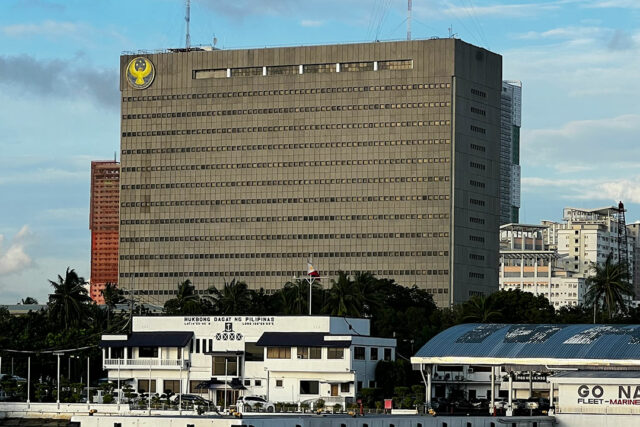
BW FILE PHOTO

By Katherine K. Chan, Reporter

RAISING the key policy rate would be a “rash” move even as headline inflation is expected to breach the Bangko Sentral ng Pilipinas’ (BSP) target band by the second half of the year, Pantheon Macroeconomics said.

In a report on Monday, Pantheon Macroeconomics Chief Emerging Asia Economist Miguel Chanco and Asia Economist Meekita Gupta said an April hike is now “on the table” but the central bank will likely stand pat until next year.

“More aggressive, even if ‘staggered,’ fuel price increases were implemented by the Philippines’ main oil retailers last week, to the point where a target reverse repo rate hike by the Bangko Sentral ng Pilipinas next month is now on the cards,” they said.

However, Mr. Chanco and Ms. Gupta noted that it would be reckless of the BSP to tighten next month as inflation pressures prove supply-driven and amid lingering growth woes.

“Whether or not the Board should hike, however, is a separate question,” Mr. Chanco told BusinessWorld in an e-mail. “From our standpoint, we think that it would be rash.”

“This is not a repeat of 2022, when the economy was booming and global food prices (were) skyrocketing in tandem, which made the energy crisis in 2022 much worse from an inflation standpoint. Fundamentally, there’s also little monetary policy can do to mitigate a supply-side inflation shock,” he added.

Earlier this month, BSP Governor Eli M. Remolona, Jr. said global oil prices staying above $100 per barrel could drive inflation past their 2%-4% target, which could prompt the Monetary Board to lift its key rates.

Finance Secretary Frederick D. Go also said that consistently high energy prices will push the Board to consider tightening as early as next month.

If realized, the central bank would be ending its near two-year easing cycle. Since August 2024, it has slashed the benchmark borrowing rate by a total of 225 basis points (bps) to an over three-year low of 4.25%.

Meanwhile, China Banking Corp. (Chinabank) Chief Economist Domini S. Velasquez said the BSP will likely maintain a “wait-and-see stance” in the near term, noting that monetary policy may not be as helpful considering the current macro backdrop.

“The current oil shock is largely supply-driven, meaning monetary policy has limited ability to offset its impact on prices,” Ms. Velasquez told BusinessWorld in an e-mail.

She said demand conditions remain “soft,” as the central bank estimates a negative output gap through at least next year.

“Given these factors, the BSP is likely to adopt a wait-and-see stance, allowing the effects of the oil shock to play out before making further policy adjustments,” she added.

On the other hand, Deutsche Bank Research said the BSP’s easing cycle likely hit a dead-end, with tightening now possible in the next meeting as the Middle East war drags on.

“Within Asia, as we warned earlier, rising oil prices point to no further rate cuts by BI (Bank of Indonesia) and BSP, with the latter potentially hiking as early as April,” it said in a separate report.

INFLATION OUTLOOK
Pantheon economists said in their report that it is “highly unlikely” for inflation to reach levels last seen in 2022 or when the headline print ranged between 6% and 8% amid Russia’s invasion of Ukraine.

Still, Pantheon now sees inflation breaching 4% from June to September to average 3.8% for the entire 2026, higher than their previous estimate of 3.2%.

If realized, inflation will exceed the BSP’s 3.6% forecast for the year.

“Restarting a rate-hiking cycle now, so soon after the most recent cut in February, would be a blow to the corporate sector too,” Mr. Chanco and Ms. Gupta added. “The BSP’s credit access index remains in the red despite 225 bps in policy rate cuts since late-2024.”

On the other hand, DBS senior economists Chua Han Teng and Radhika Rao said oil price shocks will likely lead to higher food prices, which would affect the Philippines considering food and nonalcoholic beverages comprise about 38% of its consumer price index basket.

“Food carries a significant weight in ASEAN-6’s consumer price index basket, at 20-36%, with Thailand, Vietnam, and Philippines the most vulnerable to accelerating food prices,” they said.

However, Mr. Chanco and Ms. Gupta noted that the suspension of excise tax on fuel would help tame inflation.

“We see a number of reasons why the Board should hold fire,” they said. “For a start, legislation to suspend excise taxes on fuel is now awaiting the President’s signature, a move that we think would be just about enough to stop headline inflation from surpassing the key 4% mark; our 2026 projection would fall to 3.5%.”

Under the 2017 Tax Reform for Acceleration and Inclusion law, the National Government (NG) imposes an excise tax of P10 per liter on gasoline, P6 per liter on diesel and P5 per liter on kerosene.

The NG is seeking to suspend this levy to ease the burden of soaring pump prices on consumers.

As of Monday, a bill authorizing the President to suspend or cut excise tax on petroleum products amid economic emergencies is awaiting President Ferdinand R. Marcos, Jr.’s signature.

Meanwhile, Mr. Chanco noted that the peso’s latest plunge to a record low is not a major concern for the BSP’s second policy review of the year on April 23.

“I doubt that the peso will be too much of an issue for the BSP next month, as it’s not as if the PHP (Philippine peso) is under specific pressure. Most currencies in Asia are feeling the pinch,” he told this paper.

On Monday, the local unit slumped to a fresh low of P60.30 against the greenback after falling by 20 centavos from its P60.10-per-dollar finish on Thursday.

Chinabank’s Ms. Velasquez also sees economic growth weakening amid the widening oil shocks, shifting the pressure to fiscal policy to support the economy.

“Given the sharp rise in oil prices and their spillover to a broad range of goods, we expect growth to come in weaker than previously anticipated this year,” she said. “Higher fuel costs are likely to weigh on household consumption and could lead to some uptick in unemployment as firms adjust to rising input costs.”

“Overall, there remains scope for fiscal policy to play a more active role in supporting growth, especially as monetary policy faces limits in addressing a supply-driven shock,” Ms. Velasquez added.

MPIC eyes over P200-B capex for 2026 on Meralco solar push

STOCK PHOTO | Image by Jcomp from Freepik

PANGILINAN-LED Metro Pacific Investments Corp. (MPIC) is eyeing over P200 billion in capital expenditures (capex) for 2026, nearly double its P116-billion spending in 2025, mainly driven by Manila Electric Co.’s (Meralco) solar projects, although the budget may still be reviewed amid geopolitical uncertainties, a company official said.

“For 2026, the biggest capex will really be Meralco to finish the solar plants,” MPIC Chief Finance, Risk, and Sustainability Officer Chaye A. Cabal-Revilla told reporters on the sidelines of the Economic Journalists Association of the Philippines’ sustainability forum on Monday.

Meralco PowerGen Corp., the power generation arm of Meralco, is currently developing the P200-billion MTerra Solar project, a massive integrated solar facility across Nueva Ecija and Bulacan.

She said the 2026 capex plan, which was approved last year, may be reviewed due to current geopolitical developments.

“But we haven’t really done that because it’s still in the early stages. But as far as we’re concerned, our capex plans are still in the pipeline. So, we haven’t stopped anything,” she said.

MPIC Chairman, President, and Chief Executive Officer Manuel V. Pangilinan earlier said the group may revisit budgets, particularly for its major subsidiaries.

“Let’s redo our budget and rethink whether we should update based on these latest trends, because part of the great uncertainty is when will this Iran thing finish,” he said.

In 2025, MPIC recorded a 15% increase in consolidated core net income to P27.1 billion, as its power, water, toll road, and healthcare businesses posted higher contributions.

Meralco’s higher power generation, Maynilad Water Services, Inc.’s higher water tariffs, increased traffic and toll rates, and higher patient volumes across the Metro Pacific Hospitals network drove the growth.

Power remained the group’s largest contributor, accounting for P22.1 billion or 69% of total net operating income.

Meralco’s core net income rose 12% to P50.6 billion, while revenue increased 6% on higher retail electricity sales and improved power generation availability.

The water segment, led by Maynilad, recorded a 19% increase in core net income to P15.2 billion. Metro Pacific Tollways Corp. (MPTC) toll revenues reached P36.9 billion, up 17%.

“Our results in 2025 reflect the steady demand for reliable infrastructure and the consistent work of our teams across the group. Power, water, mobility and healthcare are essential services, and our focus has always been on improving how we deliver them to the communities we serve,” Mr. Pangilinan said.

MPIC is one of the three key Philippine units of Hong Kong-based First Pacific Co. Ltd., alongside Philex Mining Corp. and PLDT Inc.

Hastings Holdings, Inc., a unit of PLDT Beneficial Trust Fund subsidiary MediaQuest Holdings, Inc., holds a majority stake in BusinessWorld through the Philippine Star Group, which it controls. — Alexandria Grace C. Magno with inputs from Sheldeen Joy Talavera

ICTSI unit to sell 51% stake in China terminal for P6.77 billion

ICTSI.COM

RAZON-LED International Container Terminal Services, Inc. (ICTSI) said its unit is divesting its stake in Yantai International Container Terminals Ltd. (YICTL) for 773.21 million renminbi, or about P6.77 billion.

In a regulatory filing on Monday, ICTSI said its wholly owned subsidiary, ICTSI Hong Kong Ltd., had signed an agreement with Yantai Port Holdings Co. Ltd. for the sale of its 51% equity interest in YICTL.

YICTL is a joint venture in which ICTSI Hong Kong holds a 51% majority stake. The company operates and manages a port terminal in Shandong province, China.

The remaining ownership in YICTL is held by Yantai Port Holdings at 36.5% and DP World China Ltd. at 12.5%.

ICTSI said DP World China has also entered into an equity interest transfer agreement covering its stake, adding that upon completion of the transaction, Yantai Port Holdings will own 100% of YICTL.

ICTSI said the sale of YICTL aligns with its long-term strategy of focusing on concession contracts where it has control over key aspects of the business, particularly long-term development and commercial activities.

The company said it is rationalizing its portfolio and reallocating resources to existing projects and those in the pipeline.

ICTSI reported a 23% increase in attributable net income for 2025 to $1.05 billion, driven by higher cargo volumes across its port operations.

Gross revenue rose 17.88% to $3.23 billion in 2025 from $2.74 billion a year earlier.

For 2026, ICTSI has set aside an estimated $740 million, primarily for expansion, equipment acquisition, and upgrades.

ICTSI is a global port operator with operations in 20 countries across Asia, the Americas, Europe, the Middle East, and Africa.

At the local bourse on Monday, shares in ICTSI fell by P2, or 0.29%, to close at P698 each. — Ashley Erika O. Jose

The Dawn celebrates 40 years with Kwarenta concert

PINOY ROCK band The Dawn will return to the concert stage with Kwarenta, their 40th anniversary concert, taking place in June.

Though the band is associated with Filipino rock in the 1980s, their legacy as one of the pillars of the local music scene continues to resonate. Fans can look forward to seeing the current lineup of members, made up of Jett Pangan (vocals), Francis Reyes (guitar), JB Leonor (drums), Rommel Sanchez (guitar), and Bim Yance (bass).

Popular songs from The Dawn include “Enveloped Ideas,” “Salamat,” and “Iisang Bangka,” which they will play at the concert.

“We had a really difficult time choosing songs for our setlist,” Mr. Pangan said at a press conference on March 19. “We want to please everyone, from hardcore fans to newer listeners.”

“It’s a 40th anniversary thing, so it can’t just be a normal show,” added Mr. Reyes, noting that it will still be a rock concert but with a unique production and arrangement.

Directed by Paolo Valenciano, Kwarenta will showcase a career-spanning setlist drawn from The Dawn’s 1987 self-titled debut up to 2018’s Ascendant. The concept and design were teased to be “more ambitious and carefully curated.”

For the five current members, the concert will serve as “a comprehensive portrait of The Dawn’s journey as a collective,” throughout lineup changes, industry shifts, and the loss of key figures — including founding guitarist Teddy Diaz.

Mr. Pangan even corrected a common misconception about the operatic introduction of their hit song, “Enveloped Ideas,” which many believed was sung by him.

“That’s not me. That’s Pablo Molina. He’s a tenor who studied at the Philippine Women’s University (PWU), a classmate of Teddy,” he explained. “He’s a real opera singer. Teddy was studying at PWU, majoring in guitar and minoring in voice, he was classmates with tenors.”

In a similar vein, the band seeks to pay tribute to all the former members who helped shape The Dawn.

“Since it’s been 40 years of the band, we want to say thanks to former members. Hopefully they’ll come by and jam with us. Because they also built their own fanbase during their time with The Dawn. We called them and hopefully all of them show up,” Mr. Pangan said.

For Mr. Sanchez, the key to the band’s longevity is the friendships formed over the years.

Ang saya namin magkakasama (We’re happy being together) before and after gigs or practices. And I think I’m speaking for everyone that whether it’s rehearsal or a gig, it’s our happy place,” he said.

Mr. Reyes added that it’s all about accepting each other’s quirks.

“When you’re younger, you tend to be sensitive about someone’s quirks and you’re not aware na may katok ka rin sa pag-iisip (that you’re also kind of crazy),” he explained. “Being middle-aged men, having seen life inside and outside music, and realizing things that are important, I think we’ve all learned to laugh at each other’s quirks.”

The celebration of The Dawn’s 40th anniversary will also extend globally with the Kwarenta Tour, with dates across Australia, New Zealand, Singapore, and more cities to be announced soon.

On June 27, the Kwarenta concert will take place at The Theatre at Solaire in Parañaque City. Tickets will be available starting April 6. — Brontë H. Lacsamana

Alternergy starts operations of Nueva Ecija hydropower plant

The newly energized facility is Alternergy’s second renewable energy plant commissioned this year. — ALTERNERGY HOLDINGS CORP

RENEWABLE ENERGY developer Alternergy Holdings Corp. has started injecting power into the grid as it commenced commercial operations of its P1.7-billion run-of-river (RoR) hydropower plant in Gabaldon, Nueva Ecija.

“The start of the commercial operations of Balsik Solar and now Dupinga RoR Hydro completes Alternergy’s Triple Play portfolio of wind, solar and hydro renewable resources,” Alternergy President Gerry P. Magbanua said in a statement on Monday.

“With hydro now online, our Triple Play strategy of diversifying revenues across complementary technologies is expected to boost Alternergy’s asset base and share value to our investors,” he added.

The hydropower facility is expected to deliver 23,000 megawatt-hours (MWh) of electricity annually, supplying about 13,000 households under a 25-year power supply agreement with Nueva Ecija Electric Cooperative II – Area 2.

The newly energized facility is Alternergy’s second renewable energy plant commissioned this year, following the 28-megawatt-peak (MWp) solar farm in Hermosa, Bataan, which began operations last month.

Eduardo Martinez Miranda, president of Alternergy Mini Hydro Holdings Corp., the company’s hydro subholding firm, said the company is also exploring other shovel-ready RoR projects in Kiangan, Ifugao.

“This is another challenge, but we are looking forward to implementing the strategies, innovations and lessons learned from our already completed project,” he said.

Alternergy is also ramping up two more projects expected to come online this year: the 128-megawatt (MW) Tanay and the 64-MW Alabat wind power projects.

These projects will add 225 MW of new generating capacity, contributing to the company’s goal of reaching one gigawatt of capacity by 2030.

At the local bourse on Monday, shares in the company rose by 4.23% to close at P0.74 each. — Sheldeen Joy Talavera

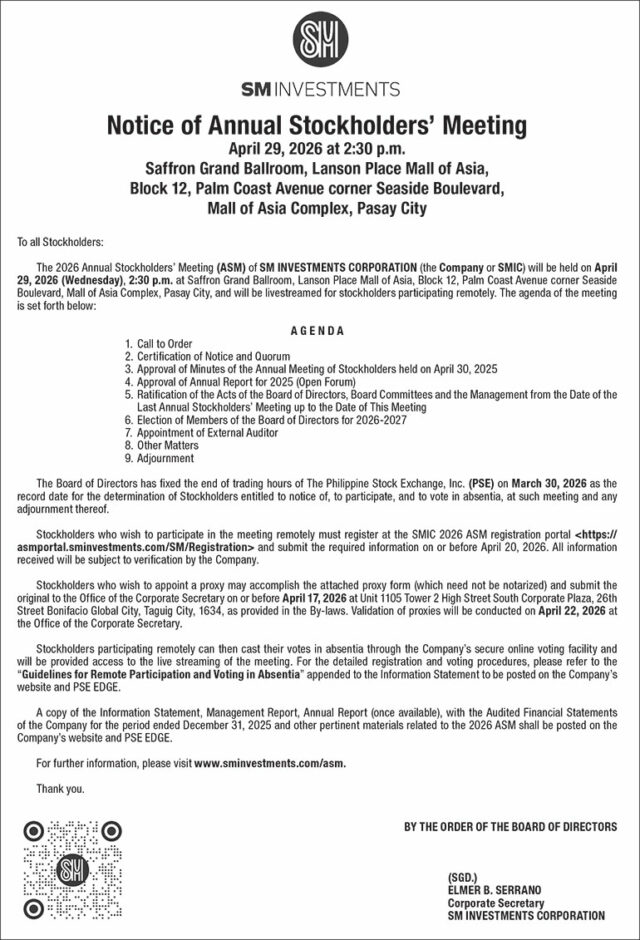
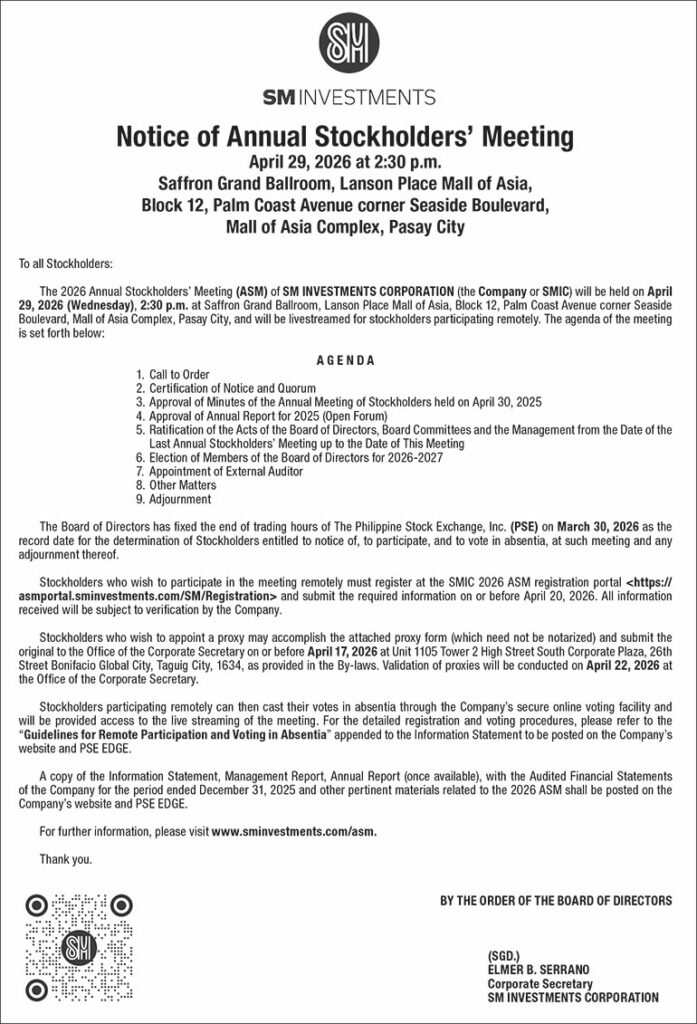
SM Investments Corp. to hold Annual Stockholders’ Meeting on April 29


Spotlight is BusinessWorld’s sponsored section that allows advertisers to amplify their brand and connect with BusinessWorld’s audience by publishing their stories on the BusinessWorld Web site. For more information, send an email to online@bworldonline.com.

Join us on Viber at https://bit.ly/3hv6bLA to get more updates and subscribe to BusinessWorld’s titles and get exclusive content through www.bworld-x.com.

Behind the scenes: Pioneers talk about women in the music biz

THE “She Means Business” panel (l-r): Jess & Pat’s co-owner Alex Majam, music photographer Kris Rocha, EMI Records Philippines label head Bel Certeza, Over October band manager Katrina Romero, and Funky Beat Entertainment head Ziera De Veyra. — BRONTË H. LACSAMANA

NO ONE really talks about the people working offstage, those who are responsible for bringing musicians together and breathing life into a live show. Even less talked about is how, in the Philippine indie music scene, many of them happen to be women.

At Gabi Na Naman Productions’ women-centered Lilet Fair, held in Mandaluyong City on March 21, five female pioneers of behind-the-scenes work in local music gathered to talk about their journeys.

Titled “She Means Business,” the panel included music venue Jess & Pat’s co-owner Alex Majam, EMI Records Philippines label head Bel Certeza, Over October band manager Katrina Romero, music photographer Kris Rocha, and Funky Beat Entertainment head Ziera De Veyra.

FAN BEGINNINGS
All of them started as fans, said Ms. Majam.

She cited venues like Route 196, Saguijo, and Cubao Expo as places she and her business partner/husband frequented as students. Jess & Pat’s was meant to be a burger shop, their final thesis project, but the live music aspect of their opening was easily the best part about it.

“We opened in September 2016. It was so fun and we thought, why not do this again and again?” she said. “Later on, we decided to be a gig place, to support the local music and arts scene.”

For Ms. Rocha, her calling was a hobby at first, stemming from taking pixelated photos at an Alicia Keys concert in 2004 using a digicam. When the singer returned in 2008, Ms. Rocha brought a megapixel camera which helped her take higher quality photos.

With the help of a friend, she eventually ended up as an official photographer at big concerts. “This means we have to shoot everything — the musicians, the staff, the fans, the people behind the scenes. It’s to show that there’s so much more to the performance onstage,” she explained.

As for Ms. Certeza, considered a pillar of indie music coverage in the 2000s, being a huge fan of Up Dharma Down led her to extensively document the band, which even resulted in a documentary about them. After that, she expanded to posting videos and writing about live music in general through her website, Indie Manila.

“I really came from the indie/underground scene. Now, as a label head, I’m very pro-artist,” she said. “That’s the main reason [UMG Philippines] hired me — they wanted me to sort of adapt the artist-centric approach on a bigger scale. Now, I have the capacity to support artists with the machinery of a global label.”

Meanwhile, Ms. Romero started out going to gigs as well and doing one-off projects with various productions and musicians. At some point, she became a full-time manager.

“I left my day job to work in music,” she shared. “Right now, I’m focusing on my artist, the band Over October, and a rising artist called MRLD.”

As a founder of a music management company, Ms. De Veyra agreed that a career in music always begins with one’s aspirations. Though she’s now also responsible for co-producing the local leg of the international festival Fête de la Musique, she started with producing a church event.

Kinailangan ng pang-fundraising at sinubukan ko imbitahin ’yung Radioactive Sago Project sa church. Pumunta naman sila (We needed to do some fundraising, so I tried inviting the band Radioactive Sago Project to church. And they went),” she explained.

ASSERTING THEMSELVES
Each of them had their fair share of challenges holding their own as women in the music business, which used to be a male-dominated industry, especially behind-the-scenes.

Ms. Majam admitted that being the co-owner of a venue with her husband meant that a respectful dynamic was natural to them. “I don’t experience difficulty speaking out, but I know a lot of friends who experience that. It can be really, really tough, and I’m happy to see more women leading and paving the path,” she said.

Difficult situations can also arise — from industry controversies to burnout — and Ms. Rocha talked about how each person can navigate it on their own terms.

“I was covering big international concerts, then there was a controversy with my producer friend, and my name got dragged along with it. I went back to shooting small shows and gigs,” she said. “Then, it was at Sonic Boom that I met Urbandub, December Avenue, Clara Benin. I met people in the local scene. The universe dropped that on me and I kept my passion.”

She also stressed the importance of hobbies — for her, going to the gym and doing CrossFit. “Dahil doon, kaya ko pa rin tumakbo (becasue of that, I can still run) from gen[eral] ad[mission] to ground floor to get the perfect shot!”

Ms. Certeza agreed with the advice to stay grounded no matter what. “Coming from indie to a label, there are moments where it’s tiring to keep working. It’s about knowing your purpose, so I try to find again the spark I once felt, which I do by going back to gigs at Mow’s or Saguijo and speaking to people in the community,” she explained.

For Ms. Romero, who manages a band of four men, speaking up was a challenge.

“They won’t listen to you up until you get really mad,” she said. “There’s also this belief that, in this industry, iba mag-alaga ang babae. Kapag lalaki ang manager, very brusco. May lambing ang babae (women take care of things differently. When the manager is a man, they can be very brusque. Women have a certain tenderness).”

Before she was a manager, Ms. Romero said that she had experienced being shouted at in front of organizers. “This field is a bit crazy. That’s why I’m now very hands-on as a manager, because not all demands might be followed, because akala nila papayag ka (they think you’ll allow it). You really have to assert [yourself],” she said.

Finally, Ms. De Veyra reminded everyone that the music industry must always be founded on respect, from all parties.

Dapat talaga may respeto sa lahat, kahit sino man ang kasama mo (There really should be respect for everyone, whoever you are working with), up to the backstage and the crew.” — Brontë H. Lacsamana

When code writes itself, what happens to Philippine software?

STOCK PHOTO | Image by Pressfoto from Freepik

The $6.8-billion slice of our IT-BPM (Information Technology and Business Process Management) industry built on writing code for the world faces an existential question — and the clock is not waiting for us to answer it.

Thirty percent. That is how much of Microsoft’s code is now written by artificial intelligence (AI), according to the company’s own disclosure. Google reports a similar figure, over a quarter. Gartner forecasts that by the end of 2026, 60% of all new code produced globally will be AI-generated. These aren’t projections from breathless futurists. They are operational realities reported by the people signing the paychecks.

For an economy that has bet a significant portion of its future on writing other people’s software, those numbers should keep policymakers up at night.

The Philippine IT-BPM sector closed 2025 with $40 billion in export revenues and 1.9 million workers, according to the IT and Business Process Association of the Philippines (IBPAP). That is more than 8% of GDP. By almost any measure, a success story. But look closer. An AMRO (ASEAN+3 Macroeconomic Research Office) analysis from December 2025 found that contact centers still accounted for 83% of industry revenue. IT and software development services represented just 16% to 18%, or between $6.1 billion and $6.8 billion per ASEAN Briefing. That software slice is the industry’s upmarket frontier, its claim to a future beyond voice calls. It is also the slice most directly in the path of AI coding agents.

The disruption is not theoretical anymore. A Stanford Digital Economy Lab study released in August 2025, drawing on millions of ADP payroll records, found that employment for software developers aged 22 to 25 declined nearly 20% from its late 2022 peak. Older developers held steady or gained. AI is eating entry-level coding work first. Stack Overflow’s 2025 Developer Survey reported that 65% of developers worldwide now use AI coding tools at least weekly. Last February, one engineer at a major San Francisco tech company told the SF Standard that his entire job had become acting as a proxy. His manager tells him what to do, and he tells Claude to do it.

This is where the Philippine exposure gets specific. A February 2025 IMF working paper on the Philippine labor market found that roughly one third of Filipino workers are highly exposed to AI. But it also noted that about 61% of those exposed jobs are “highly complementary” to AI, meaning productivity could rise if workers learn to use the tools rather than compete against them. The operative word is “if.” The IMF’s finding is a conditional promise, not a guarantee. Complementarity only materializes through deliberate investment in skills, tools, and institutional redesign.

The problem is that the Philippine software outsourcing model was built on a specific value proposition: English-speaking developers at 60% to 70% lower cost than American equivalents, producing competent code on a follow-the-sun schedule. That proposition assumed coding labor was the bottleneck. AI coding agents are dissolving it. A senior architect in Taguig and a senior architect in Ho Chi Minh City both become less differentiated when the routine code between their design decisions gets written by a machine in seconds.

And Vietnam is not standing still. In December 2025, Vietnam’s National Assembly passed a comprehensive AI law, the first standalone AI legislation in Southeast Asia, set to take effect this month. The country is producing over 55,000 tech graduates annually, has attracted AI-focused R&D centers from Samsung, Qualcomm, and NVIDIA, and is actively positioning itself as an AI-native development hub rather than a traditional outsourcing destination. The Philippines’ regional competitors aren’t just adapting to the same disruption. They are building legal and institutional frameworks to capture the next wave while we are still debating how to protect the last one.

So, what do we do about it? Three things, with urgency.

First, IBPAP, the Department of Information and Communications Technology (DICT), and the major outsourcing firms need to redefine the Philippine value proposition away from “we write code cheaper” toward “we deliver AI-augmented outcomes faster.” This requires equipping Filipino developers with AI coding tools and training them to orchestrate, validate, and govern AI-generated output. The companies that wait will find their clients replacing offshore teams with smaller domestic teams armed with AI.

Second, the education pipeline needs a hard reset. CS programs at UP Diliman, Ateneo, De La Salle, and the State Universities and Colleges feeding the IT-BPM talent pool cannot keep teaching students to write code the way they did in 2019. The Stanford data is clear: the market for entry-level developers who only know textbook algorithms is collapsing. Filipino graduates need to emerge fluent in AI-assisted development, prompt engineering, system design, and the security oversight of AI-generated code. Recent industry assessments show that 45% of AI-generated output still contains vulnerabilities. The Commission on Higher Education should be coordinating curriculum reform with IBPAP on a crisis timeline.

Third, the IBPAP roadmap targeting $59 billion in revenue and 2.5 million jobs by 2028 needs a credibility check. Those targets were set before AI coding agents reached their current capability. Growth will come from AI-augmented high-value services, not from adding more seats writing more lines of code. The roadmap should be stress-tested against a scenario where AI reduces the labor content of software delivery by 30% to 50% within three years. If that exercise has not happened, it should happen this quarter.

The Philippine IT-BPM industry has survived predictions of its demise before. Chatbots. The offshoring backlash. The pandemic. Each time, it adapted. But those were threats to efficiency. This one is a threat to the core product. When the code writes itself, the country that still sells code-writing labor holds a depreciating asset.

The $40-billion question is whether we depreciate with it. The window for deciding is not five years. It is now.

This article reflects the personal opinion of the author and does not reflect the official stand of the Management Association of the Philippines or MAP.


Itamar Gero is a member of MAP NextGen Committee. He is founder and CEO of Truelogic, Inc., an AI-enabled digital performance agency working with the country’s largest brands on their digital strategies.

map@map.org.ph

aepascual@gmail.com

Top Line plans P1.5-B preferred share offer to fund import, trading

TOPLINE PRESIDENT and Chief Executive Officer Eugene Erik C. Lim — BW FILE PHOTO

CEBU-BASED fuel retailer Top Line Business Development Corp. is planning to raise up to P1.5 billion through a follow-on offering to support its import and trading operations.

In a statement on Monday, the company said it had filed a registration statement with the Securities and Exchange Commission (SEC) covering the offer and sale of up to P1 billion in perpetual preferred shares, with an oversubscription option of up to P500 million.

The base offer consists of up to 10 million perpetual preferred shares, with an oversubscription option of up to five million shares, priced at up to P100 apiece.

A follow-on offering refers to the issuance of additional shares after an initial public offering to raise capital.

“The preferred share issuance marks an important step in strengthening our capital base while providing stable returns for our investors through fixed dividends,” Top Line President and Chief Executive Officer Eugene Erik Lim said.

“As we build on the momentum from our initial public offering last year, this fundraising will support our vertical integration strategy by enhancing supply chain capabilities, expanding our retail network, and improving procurement flexibility,” he added.

Proceeds from the offer will fund the expansion of the company’s supply chain network, including its planned shift to direct fuel importation through subsidiary Topline Logistics and Development Corp., following the establishment of its trading arm in Singapore.

Last month, Top Line said it plans to set up a wholly owned subsidiary in Singapore to facilitate fuel importation and optimize procurement.

A portion of the proceeds will also be allocated to expand depot infrastructure and storage capacity to support higher import volumes, which the company said will underpin the growth of its retail arm, Light Fuels Corp.

“Through these initiatives, we aim to improve operational resilience, enhance margins, and deliver sustainable long-term value to our shareholders,” Mr. Lim said.

The company has tapped PNB Capital Investment Corp. as sole issue manager and, together with Security Bank Capital Investment Corp., as joint lead underwriters and joint bookrunners.

The offer period is scheduled from May 19 to June 1, 2026, subject to regulatory approvals.

F. Yap Securities Investment Analyst Marky Carunungan said “the raise is less about pure hedging against disruptions and more about repositioning the business toward margin expansion, with volatility becoming a potential earnings lever rather than just a risk.”

“By moving into direct sourcing and expanding storage, the company is effectively increasing its exposure to inventory and trading dynamics. This enhances supply security, but more importantly, it gives TOP the ability to optimize procurement timing and capture spreads across the value chain,” he said in a phone message.

Top Line began in leasing and real estate before entering the fuel sector in 2017. It is now involved in commercial trading, depot operations, and retail fuel distribution in the Visayas. Through Light Fuels, the company opened its first service station in Mandaue City, Cebu, in 2023. — Sheldeen Joy Talavera

T-bills partially awarded as yields jump past 5%

BW FILE PHOTO

THE GOVERNMENT made a partial award of the Treasury bills (T-bills) it offered on Monday as yields jumped past the 5% level amid continued market caution on concerns that the prolonged Middle East war would stoke inflation.

The Bureau of the Treasury (BTr) raised just P19.2 billion via the T-bills it auctioned off, below the P27-billion program even as total tenders reached P36.78 billion, higher than the P31.5 billion in bids recorded last week.

Broken down, the government borrowed P9 billion as planned through the 91-day T-bills as demand for the tenor reached P16.613 billion. The three-month paper fetched an average rate of 5.004%, climbing by 10.4 basis points (bps) from 4.9% last week. Bids accepted had yields ranging from 4.945% to 5.004%.

The Treasury likewise raised the programmed P9 billion via the 182-day debt as tenders reached P13.83 billion. The average rate of the six-month T-bill was at 5.032%, rising by 8.4 bps from 4.948% previously. Tenders awarded carried rates from 4.999% to 5.125%.

Meanwhile, the BTr raised just P3.705 billion from the 364-day securities, below the P9-billion plan as bids totaled just P6.305 billion. The one-year paper’s average yield was at 5.166%, up by 10 bps from 5.066% last week. Accepted bids had rates from 5.1% to 5.25%.

The Treasury said it made a partial award to cap the rise in the one-year tenor’s average yield.

At the secondary market before Monday’s auction, the 91-, 182-, and 364-day T-bills were quoted at 4.9813%, 4.9581%, and 5.0886%, respectively, based on PHP Bloomberg Valuation Service Reference Rates data provided by the Treasury.

“The T-bill auction drew higher demand than last week and some bills were fully awarded except the 364-day bill. As expected, yields were a little higher due to inflationary worries amid the Middle East war,” a trader said by telephone.

T-bill yields rose as oil prices continued to surge, fueling concerns over increasing costs that could lead the Bangko Sentral ng Pilipinas (BSP) to consider a rate hike, Rizal Commercial Banking Corp. Chief Economist Michael L. Ricafort said in a Viber message.

The BSP said last week that it is closely monitoring the impact of the escalating Middle East war on inflation and the broader economy.

The Monetary Board will next meet to discuss its policy stance on April 23. In February, the central bank cut benchmark borrowing costs by 25 bps for a sixth straight meeting to bring its policy rate to 4.25%.

It has now delivered a total of 225 bps in cuts since it began easing in August 2024.

BSP Governor Eli M. Remolona, Jr. earlier said that headline inflation could breach 4% if oil hits $100 a barrel, adding that if fuel prices rise sharply and persistently, they could be forced to tighten their policy stance. The Monetary Board last hiked borrowing costs in October 2023.

Finance Secretary and Monetary Board Member Frederick D. Go also said last week that a prolonged surge in oil prices due to the Middle East war could prompt the Monetary Board to raise borrowing costs as early as next month.

Iran will attack Israel’s power plants and plants supplying US bases in the Gulf if President Donald J. Trump carries out his threat to “obliterate” Iran’s power network, the country’s Revolutionary Guards said in a statement on Monday, Reuters reported.

Iranian attacks have effectively closed the Strait of Hormuz, which carries a fifth of global oil and liquefied natural gas, causing the worst oil crisis since the 1970s.

On Monday, Brent crude futures rose 65 cents to $112.84 a barrel by 0446 GMT. US West Texas Intermediate was at $98.75 a barrel, up 84 cents. Both contracts were down more than $1 earlier in the session.

On Tuesday, the government is targeting to raise up to P40 billion from a dual-tenor Treasury bond (T-bond) offering or P10 billion to P20 billion each in reissued seven year T-bonds with a remaining life of three years and one month and 25-year securities with a remaining life of 23 years and 10 months.

The Treasury wants to raise P248 billion from the domestic market this month, or P108 billion in T-bills and P140 billion in T-bonds.

The government borrows from local and foreign sources to help finance its fiscal deficit, which is capped at P1.647 trillion or 5.3% of gross domestic product this year. — Aaron Michael C. Sy with Reuters

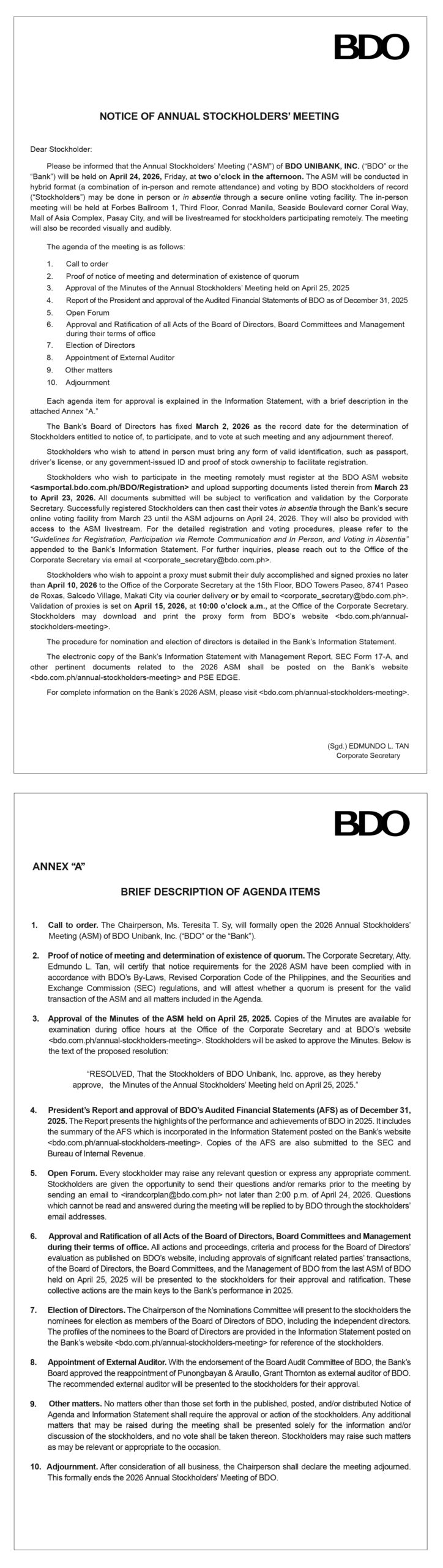
BDO Unibank, Inc.: Notice of 2026 Annual Stockholders’ Meeting

BDO Unibank, Inc. will hold its Annual Stockholders’ Meeting on April 24, 2026, Friday, at 2:00 p.m., at Forbes Ballroom 1, Third Floor, Conrad Manila, Seaside Boulevard corner Coral Way, Mall of Asia Complex, Pasay City, and will be livestreamed for stockholders participating remotely.


Spotlight is BusinessWorld’s sponsored section that allows advertisers to amplify their brand and connect with BusinessWorld’s audience by publishing their stories on the BusinessWorld Web site. For more information, send an email to online@bworldonline.com.

Join us on Viber at https://bit.ly/3hv6bLA to get more updates and subscribe to BusinessWorld’s titles and get exclusive content through www.bworld-x.com.

Netflix, Warner Music strike multi‑year deal for artist documentaries

NETFLIX and Warner Music Group (WMG) have put together an exclusive multi-year deal to produce documentary series and films exploring the lives, music, and legacies of the label’s storied artist roster.

The partnership, announced on Friday, hands Netflix access to one of the most formidable vaults in music history. WMG represents legends like David Bowie, Cher, Fleetwood Mac, Aretha Franklin, and Joni Mitchell, alongside contemporary superstars such as Charli XCX, Coldplay, and Bruno Mars.

The deal marks the latest front in an intensifying race between music-rights owners and streaming platforms eager to turn deep catalogs into premium visual content and subscriber growth.

Music documentaries have increasingly become a vehicle for fan-driven and culturally resonant programming, a trend underscored by Taylor Swift’s Eras Tour film grossing over $260 million globally.

Under the agreement, WMG will work with Unigram — the production company aligned with the label — which will serve as the studio for its long-form projects. Each title will be developed in collaboration with the artists themselves or their estates.

The partnership bolsters Netflix’s growing slate of music-driven programming, where it has already built a reputation as a heavyweight in the genre with titles such as Homecoming: A Film by Beyoncé and Quincy among its highest-profile releases.

Rival platforms have also been aggressively investing in music storytelling. Disney+ hosts a range of high‑profile releases including The Beach Boys, while Max has drawn attention with documentaries such as Stax: Soulsville USA, showcasing historic labels and influential artists.

Apple Music, meanwhile, has pushed into original music video content, producing documentaries and livestreaming concerts through its Apple Music Live series, which has featured artists such as Harry Styles and Billie Eilish. — Reuters

ADVERTISEMENT
ADVERTISEMENT