Home Blog Page 1186

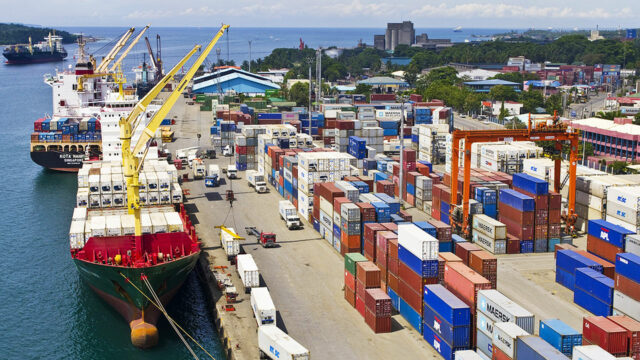
Port cargo volume up 5.48% in 2nd quarter

ICTSI

THE Philippine Ports Authority (PPA) said port cargo volume grew 5.48% in the second quarter, mainly driven by foreign shipments.

Citing preliminary data, the PPA said ports under its jurisdiction handled 83.30 million metric tons in the quarter.

Domestic cargo throughput totaled 29.54 million metric tons.

Foreign cargo throughput was 53.76 million metric tons, up 3.74% year on year.

PPA container ports serviced 2.14 million twenty-foot equivalent units (TEUs), up 10.31% from a year earlier.

Passenger traffic rose 13.74% to 26 million in the second quarter.

For the six months to June, cargo throughput rose 7.76% to 149.23 million metric tons.

Container traffic amounted to 4.18 million TEUs, up 11.8% from a year earlier.

In a separate statement, the PPA said it generated P14.68 billion in revenue in the first six months, up 13.70% from a year earlier due to higher vessel and cargo traffic. — Ashley Erika O. Jose

PCCI plans five more trade missions this year

THE Philippine Chamber of Commerce and Industry (PCCI) said it will be participating in five more foreign trade missions this year to help attract new investment to the Philippines.

“We are hoping to showcase the Philippines as the new investment hub,” PCCI President Enunina V. Mangio told reporters on the sidelines of the Metro Manila Business Conference at Seda Vertis North on Thursday.

She said that the PCCI will be taking part in trade missions to Vietnam, Australia, South Korea, Qatar, and Italy.

“We are hoping for further collaboration,” she added.

“In Korea, we’re looking at manufacturing. They are very much interested in our manufacturing,” she said. “They are also interested in digitalization and infrastructure.”

She also noted Korean interest in partnerships for road and bridge projects in Bohol.

Australia, meanwhile, will host a global summit for business chambers.

“We’re looking forward to meeting some business groups interested in expanding their businesses here in the Philippines,” she said.

She said a visit to Japan yielded an offer to train workers to make them hireable by Japanese companies.

In particular, she said Japanese companies will be sponsoring Filipinos for language studies.

“During our visit there, four companies expressed interest in expanding their business in the Philippines,” she added.

She said she expects Philippine exports to continue growing this year with exporters enhancing their product offerings.

“For this Christmas season, we’re trying to help exporters of Christmas decorations, furniture, and all that. I still believe, as far as our exporters are concerned, that our quality has improved a lot,” she said.

“I think our export market will expand … I can see that our exporters are working hard to improve their products,” she added.

She expects more handicrafts business towards the end of the year from the US and Europe. — Justine Irish D. Tabile

PHL stocks inch down on GDP report, tariff fears

PHILIPPINE STAR/KRIZ JOHN ROSALES

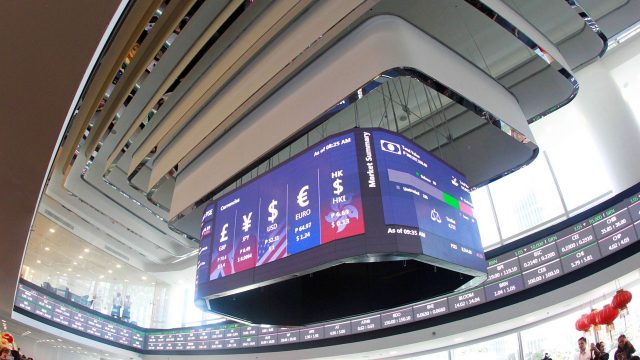
PHILIPPINE STOCKS edged lower on Thursday to end a four-day climb as the market reacted to second-quarter gross domestic product (GDP) data and amid renewed tariff concerns following fresh threats from US President Donald J. Trump.

The bellwether Philippine Stock Exchange index (PSEi) slipped by 0.09% or 5.96 points to close at 6,364.69, while the broader all shares index went down by 0.1% or 3.90 points to end the trading session at 3,776.06.

“The local market declined this Thursday… as investors digested our second quarter GDP data. Economic growth came in at 5.5%, posting a marginal improvement from the prior quarter’s 5.4% and slower than the same period last year’s 6.5%,” Philstocks Financial Inc. Research Manager Japhet Louis O. Tantiangco said in a Viber message.

“The PSEi closed at 6,364.69, down by 0.09%, as the market absorbs the recent GDP news. Some investors might have expected stronger results following the solid performance of the agriculture sector,” Regina Capital Development Corp. Head of Sales Luis A. Limlingan said in a Viber message.

The second-quarter GDP expansion matched the 5.5% median forecast in a BusinessWorld poll of 17 economists as well as the lower end of the government’s 5.5%-6.5% target for this year.

For the first half, Philippine economic growth averaged 5.4%, a tad below the government’s goal.

“US President Donald J. Trump’s plan to impose 100% tariffs on semiconductor and chip imports except for firms producing in the US also weighed on market sentiment,” Mr. Tantiangco added.

“Moreover, several companies released their earnings today, impacting both the index and the broader market,” Mr. Limlingan said.

Majority of sectoral indices closed lower on Thursday. Industrials sank by 1.52% or 139.68 points to 9,010,54; holding firms went down by 1.38% or 73.84 points to 5,277.65; property retreated by 0.24% or 5.83 points to 2,417.14; and mining and oil slipped by 0.53 point to 9,210.04.

Meanwhile, services climbed by 2.04% or 46.77 points to 2,329.05; and financials went up by 0.61% or 13.57 points to 2,204.3.

“International Container Terminal Services, Inc. was the top index gainer, climbing 2.7% to P494. Monde Nissin Corp. was the main index laggard, plunging 9.81% to P7.17,” Mr. Tantiangco said.

Value turnover went down to P6.27 billion on Thursday with 685.52 million shares traded from the P6.78 billion with 664.92 million issues exchanged on Wednesday.

Decliners outnumbered advancers, 124 versus 73, while 42 names were unchanged.

Net foreign buying decreased to P153.38 million on Thursday from P211.85 million on Wednesday. — Revin Mikhael D. Ochave

Marcos urges assertive global action amid tensions in Indo-Pacific region

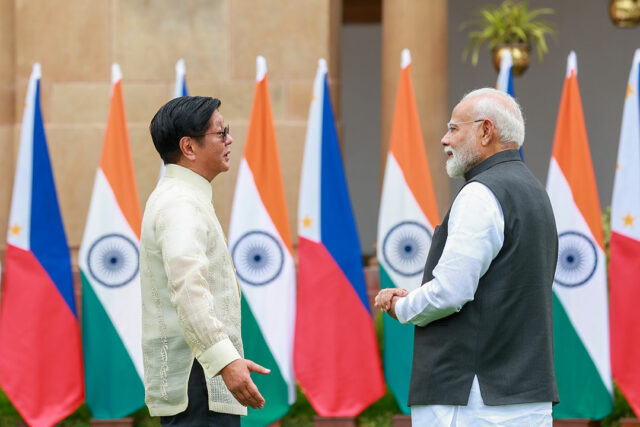
PRESIDENT Ferdinand R. Marcos, Jr. is welcomed by Indian Prime Minister Narendra Modi in New Delhi in this photo dated Aug. 5. — NOEL PABALATE/PPA POOL

PRESIDENT Ferdinand R. Marcos, Jr. on Wednesday called on like-minded nations to take a stronger, more assertive role in defending the rules-based international order, warning that rising global tensions and the erosion of multilateral norms are endangering the post-World War II system.

Speaking at the Observer Research Foundation’s Indo-Pacific Oration in New Delhi, Mr. Marcos said traditional powers are becoming increasingly inward-looking, creating space for provocations that threaten global stability — particularly in the Indo-Pacific region.

“There are those who sometimes justify such provocations under the pretext of geopolitics,” Mr. Marcos said, according to an official transcript released by Malacañang.

He took particular aim at how the international community has treated disputes in the South China Sea, where the Philippines has maritime tensions with China.

“The complex issue of competing claims in the South China Sea has, for years, been unfortunately and simplistically reduced to ‘the South China Sea disputes,’ as if claims were all equal. They are not,” he said.

Mr. Marcos cited the importance of international law, citing the 1982 United Nations Convention on the Law of the Sea (UNCLOS) and the 2016 arbitral ruling that rejected China’s expansive claims in the disputed waterway.

He reiterated Manila’s commitment to upholding these legal frameworks and urged other nations to do the same.

His remarks came as the Philippines and India elevated their bilateral relationship to a strategic partnership during his five-day state visit to India.

The visit, which comes at a time of intensifying power competition in the Indo-Pacific region, has focused on strengthening cooperation in defense, trade and maritime security.

Mr. Marcos said India’s foreign policy reflects the type of trust and responsible behavior the Philippines seeks in its partners, contrasting it with what he implied was China’s increasingly provocative posture.

The visit also coincided with another point of contention: the fallout from China’s Aug. 4 launch of a Long March 12 rocket, which reportedly resulted in debris falling into Philippine waters between Puerto Princesa and the Tubbataha Reefs in the Sulu Sea.

“The Philippines notes with concern China’s launch,” said Foreign Affairs Secretary Ma. Theresa P. Lazaro, as quoted in an earlier Palace briefing.

The government has since said it would examine the incident further for any possible violations, while the Philippine Space Agency confirmed the debris drop zone was near the country’s maritime territory.

Mr. Marcos’ call to action reflects the Philippines’ broader strategy of diversifying its alliances and encouraging a coalition of democracies to push back against coercive behavior in the region.

About $3.36 trillion worth of global trade passes through the South China Sea annually, underscoring the economic and strategic stakes.

The Philippine leader is in India for a five-day state visit at the invitation of Prime Minister Narendra Modi. He met earlier this week with both Mr. Modi and Indian President Droupadi Murmu to reaffirm defense and economic ties between the two democracies.

India remains one of the Philippines’ most significant trading partners, with bilateral trade reaching $3.53 billion in fiscal year 2023–2024, up from $3.05 billion the year before, based on data from the Indian Embassy in Manila.

India exports engineering goods, auto parts, electronics, petroleum, steel, medicines, chemicals, rice, and meat to the Philippines. In turn, the Philippines exports electrical machinery, semiconductors, copper, lead, plastics, precious stones and animal feed.

The Philippines also imports about 20% of India’s pharmaceutical exports to Southeast Asia, making it a key partner in the region’s healthcare supply chain.

The state visit comes amid the 75th anniversary of diplomatic relations between the Philippines and India. In June, the Philippines started granting visa-free entry to Indian nationals, which is expected to boost tourism and business travel and further strengthen bilateral ties. — Chloe Mari A. Hufana


PHL, India ink 18 business deals as Marcos pushes strategic economic ties

PRESIDENT Ferdinand R. Marcos, Jr. and the Philippine delegation at the Philippines-India Business Forum in Bengaluru, India on Aug. 7. — NOEL B. PABALATE/PPA POOL

THE PHILIPPINES and India signed 18 business agreements on Thursday, expanding economic cooperation across key sectors such as renewable energy, education, information technology, manufacturing and digital services.

“These agreements serve as tangible outcomes of our collaborative efforts and will serve as the foundation for ongoing and future business engagements between the Philippines and India,” Trade Secretary Maria Cristina Aldeguer-Roque told a business forum in Bangalore, India’s tech hub.

Her remarks were aired via a livestream on Radio Television Malacañang’s (RTVM) YouTube channel.

The agreements mark a significant development in Manila’s push to diversify trade partnerships as President Ferdinand R. Marcos, Jr. leads a Philippine delegation on a five-day state visit to India.

The two nations recently elevated ties to a strategic partnership and are working towards a preferential trade agreement.

Indian investment in the Philippines stands at about $5 billion, spanning industries such as pharmaceuticals, agriculture, information technology services, healthcare and textiles.

A trade deal with India will give the Philippines access to a market of more than 1.4 billion people and aligns with Mr. Marcos’ broader strategy to strengthen economic ties across the Indo-Pacific region.

“Our young, skilled, English-speaking workforce continues to attract global investment, making us a preferred destination for talent,” Mr. Marcos told Indian business leaders. “Our policy direction is very clear — to make the Philippines a trusted, connected, and competitive node in the Indo-Pacific economy.”

He highlighted key economic reforms aimed at improving the country’s investment climate, including the Corporate Recovery and Tax Incentives for Enterprises (CREATE) More Act, the Public-Private Partnership (PPP) Code and green lanes for strategic projects.

He also cited the newly enacted enterprise-based education and training law designed to align the workforce with industry needs.

The President cited the Philippines’ roadmap for long-term industrial cooperation in six priority areas — electric vehicles, advanced electronics, renewable energy, high-tech agriculture, healthcare and cybersecurity.

Mr. Marcos also highlighted the Philippines’ interest in joint ventures with Indian firms in smart manufacturing, mineral processing, shipbuilding and data center infrastructure.

“We see a strong alignment with Indian industries’ global footprint and a tremendous potential for shared success,” he added.

India remains one of the Philippines’ top trading partners, with bilateral trade reaching $3.53 billion in fiscal year 2023–2024, up from $3.05 billion a year earlier, according to the Indian Embassy in Manila.

India exports engineering goods, medicines, chemicals, rice, meat, and electronics to the Philippines, while the Philippines ships semiconductors, copper, plastics, and animal feed in return. — Chloe Mari A. Hufana

Marcos says Philippines open to joining BRICS bloc

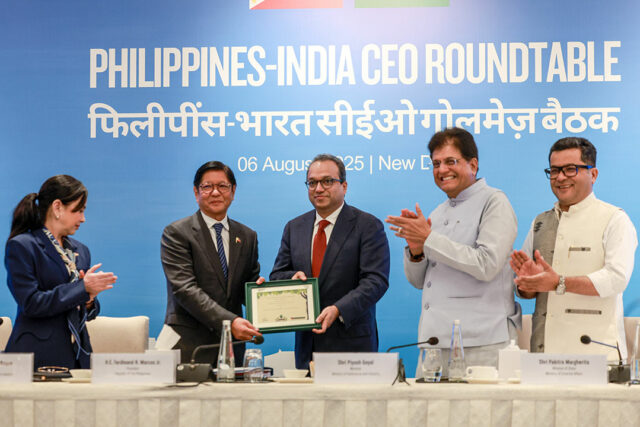
PRESIDENT Ferdinand R. Marcos, Jr. at the Philippines-India Chief Executive Officer (CEO) Roundtable in New Delhi on Aug. 6. — NOEL B. PABALATE/PPA POOL

By Chloe Mari A. Hufana, Reporter

PRESIDENT Ferdinand R. Marcos, Jr. said the Philippines is open to the possibility of joining the BRICS bloc, as Manila seeks to expand its global partnerships amid shifting geopolitical dynamics.

“I’ll certainly be open to it,” he told India-based news outlet Firstpost in an interview posted on its YouTube channel. “I haven’t given it a lot of thought… We’d have to certainly look into it, but it provides us more options.”

The President noted that while Manila is not “necessarily” planning to join the bloc now, the idea could be studied further with his Cabinet. “We’re too concerned looking internally — how to make the economy work, how to bring growth, how to create jobs… so well, it’s a thought,” he added.

His remarks come during a five-day state visit to India that ends on Aug. 8, during which he met with Indian President Droupadi Murmu and Prime Minister Narendra Modi to deepen diplomatic and economic ties.

The trip coincides with growing interest in alternative platforms for trade and development among developing countries.

BRICS — originally comprising Brazil, Russia, India, China, and South Africa — expanded its membership to include Egypt, Ethiopia, Iran, Saudi Arabia, the United Arab Emirates, and briefly, Argentina.

Indonesia officially joined the bloc in January. BRICS nations now account for over 40% of the world’s population and about the same share of global economic output, according to International Monetary Fund (IMF) data.

The expansion highlights BRICS’ appeal to emerging economies seeking alternatives to Western-dominated institutions such as the Group of Seven (G7), especially amid global uncertainties driven by US President Donald J. Trump’s return to power.

Josue Raphael J. Cortez, a diplomacy lecturer at De La Salle-College of St. Benilde, said the Philippines’ possible interest in BRICS aligns with its foreign policy trajectory.

With Southeast Asian peers like Indonesia, Vietnam, Thailand and Malaysia already involved, BRICS offers a platform to engage in multipolar cooperation, he said.

“Undoubtedly, this may be viewed by its Western partners as a way of policy shifting,” he said in a Facebook Messenger chat, citing the US’ cautious stance toward the group. “However, in light of recent political and economic developments, there is nothing erroneous with such a move if ever.”

Mr. Marcos’ openness to BRICS comes just weeks after his meeting with Mr. Trump at the White House, where both sides reaffirmed defense cooperation.

The Philippines’ possible membership in a bloc with key American rivals Russia, China, and Iran may signal policy-shifting, as it has always been proactive in strengthening ties with existing alliances.

“But the times we are in call for us to expand our cooperation with groups, regardless of ideological and political nuances,” Mr. Cortez said.

BIR files P1.4-B tax evasion cases vs firms, CPAs

THE Bureau of Internal Revenue (BIR), led by Commissioner Romeo D. Lumagui, Jr., filed multiple criminal cases against 23 corporations, 56 corporate officers, and 17 accountants for allegedly using ghost receipts to evade P1.4 billion in taxes. — DEPARTMENT OF JUSTICE

THE Bureau of Internal Revenue (BIR) on Thursday filed criminal complaints against several corporations, officers, and accountants for allegedly using ghost receipts to evade P1.4 billion in taxes.

The 23 cases, filed before the Department of Justice (DoJ), targeted 23 corporations, 56 corporate officers, and 17 accountants in the construction, manufacturing, food, electronics, entertainment, marketing, and retail industries.

“They obtained multiple suspicious purchases from ghost corporations or those corporations that exist only on paper but without actual business operations, employees, or tangible assets,” BIR Commissioner Romeo D. Lumagui, Jr. said in a statement.

“These suspicious purchases were linked to ghost receipts which have no actual transactions and were only used to create the appearance of legitimate business expenses/purchases to lower tax payments,” he added.

Justice Undersecretary Jesse Hermogenes T. Andres said the scheme usually involves companies inflating their expenses with fake transactions to cut their tax liability.

“The scheme is normally to reduce the tax liability by adding up expenses to the gross revenue which are not really real expenses. So, the tax liability will be less,” Mr. Andres told reporters during a briefing at the DoJ in Manila.

“But the supporting receipts for these expenses are the fraudulent or fake receipts coming from these companies that are really just put up for the purpose of supplying these fraudulent expense receipts.”

Mr. Lumagui said the respondents will be allowed to submit evidence disproving their links to ghost receipts in a separate audit.

“We also give them the opportunity to prove that those are not really ghost receipts. So aside from the due process that the Department of Justice will carry out, we also have our own due process through auditing,” the commissioner said.

“And ultimately, they haven’t been able to prove anything — they haven’t shown us that the amount stated on the receipt is the same amount they actually paid to the corporation that issued the receipt. So it’s clearly a case of tax evasion,” he added.

This initiative forms part of the BIR’s Run After Fake Transactions (RAFT) program, which targets businesses and individuals suspected of engaging in the sale or purchase of fraudulent receipts, Mr. Lumagui noted.

Earlier this year, the BIR filed criminal cases against a well-known cosmetics company and a shoe company for tax evasion from fake receipts. The DoJ later indicted them after finding probable cause.

Mr. Lumagui said ghost receipts account for a majority of the government’s nearly 40% value-added tax gap.

He urged those who used ghost receipts to stop evading taxes and resorting to illegal tactics as it deprives legitimate businesses that comply with tax laws of a fair playing field.

“If you’re expecting the BIR to stop pursuing this issue, or if you’re counting on finding some illegal workaround to get out of it, we’ve already shown that those tactics won’t work anymore,” Mr. Lumagui said in Filipino.

“This is also why we’re focusing on this: because legitimate businesses that do pay their taxes properly are the ones suffering. Through our efforts, we are simply leveling the playing field to ensure that everyone pays the correct taxes. So, let’s stop this practice, and let it be clear that we will not stop going after those involved.” — Katherine K. Chan

Marcos: E-gaming policy not final

A person holds cards near a keyboard, chips and dice in this illustration picture. — REUTERS/DADO RUVIC/ILLUSTRATION

PHILIPPINE President Ferdinand R. Marcos, Jr., on Thursday said his administration has yet to finalize its policy on online gambling, amid growing calls from lawmakers and civil society groups to impose tighter regulations or a full ban on the sector.

“We had not — we still have to form the policy on what we are going to do about online gambling, and to this end, I have already started to organize… to convene a conference of… [with] stakeholders,” he said in a video blog posted on his social media.

Mr. Marcos said the government must first hold a broad consultation involving regulators, church leaders, parents, and other affected sectors before laying down rules. He warned that an outright ban could push the industry underground, rendering it even more difficult to regulate.

The President’s remarks come as civil society groups and lawmakers raised concerns over the proliferation of digital gambling platforms, citing addiction and mounting debt among vulnerable communities, particularly the youth.

Despite the urgency, he skipped the subject during his fourth State of the Nation Address (SONA) last July 28.

“The first effect of banning it fully is to put it underground, and then we have no control,” he said. “That’s when there is really no regulation.”

Mr. Marcos distinguished the current debate over online gambling from the previous controversy surrounding Philippine offshore gaming operators (POGOs).

While POGOs were not initially illegal, their operations were later marred by human trafficking and scams, prompting a total ban he announced on his third SONA in 2024.

Rather than targeting online gambling as a whole, the President emphasized that the administration’s priority would be addressing the social costs, such as indebtedness and youth exposure to gambling.

“The problem is not online gambling. The problem[s] are the social effects on our children and those who are addicted to gambling,” he noted.

The government is expected to unveil a clearer policy framework following the outcome of stakeholder consultations.

On the same day, the Bangko Sentral ng Pilipinas (BSP) said it is finalizing new rules to mitigate gambling-related harm by strengthening financial safeguards across banks, e-wallets, and payment platforms.

Proposed measures include biometric ID checks, daily transaction limits, time-based payment restrictions, and user tools for spending caps, voluntary breaks, and self-exclusion.

The BSP said these safeguards aim to curb addiction, fraud, and financial harm while encouraging responsible use of digital finance.

The overall gaming industry booked P215-billion gross gaming revenue in the first half, with P93.36 billion generated by integrated resorts. — Chloe Mari A. Hufana

VP impeachment archiving questioned raps archiving questioned

BW FILE PHOTO

HOUSE SPEAKER Ferdinand Martin G. Romualdez on Thursday questioned the Senate’s decision to archive Vice-President Sara Duterte-Carpio’s impeachment complaint, saying the case is still on-going as the Supreme Court (SC) has yet to issue its final ruling on the matter.

In a statement, Mr. Romualdez said the House did not impeach Ms. Duterte out of political vendetta amid tensions between the Marcos and Duterte camps, but as part of its constitutional duty to hold public officials accountable.

“To archive is, in effect, to bury the articles of impeachment,” he said. “Yet the ruling of the Supreme Court is not final.”

The Philippine Senate on Wednesday night archived the impeachment complaint against Ms. Duterte, citing the SC’s ruling that declared the proceedings unconstitutional. Archiving the case means it could be reopened later with majority approval.

The House had asked the High Court on Monday to reverse its ruling that voided the Vice-President’s impeachment.

He questioned why the Senate decided to archive the case despite the House’s motion for reconsideration still pending before the SC.

“The court found our arguments serious enough to require the respondents, including the Vice-President, to submit their comment,” he said. “The case is active.”

“Why the rush?”

A total of three complaints were hurled against Ms. Duterte in December last year. But she was only impeached in February after more than 200 congressmen signed a fourth complaint, allowing the chamber to immediately send the ouster changes to the Senate without any hearing.

“We exercised that power lawfully, transparently, and in good faith — not out of spite, but out of duty. Not to attack, but to ask for answers — answers the Vice-President never gave,” said Mr. Romualdez.

Ms. Duterte’s impeachment was the culmination of a months-long feud with President Ferdinand R. Marcos, Jr., following their falling out after his allies in the House launched an inquiry into her use of confidential and intelligence funds.

“This was never about political maneuvering,” Mr. Romualdez said. “It was about accountability anchored on verified facts and sworn documents.”

UNLIKELY REVERSAL
Meanwhile, a senator on Thursday said that it is “highly unlikely” for the SC to change its ruling after the Senate had voted to archive the case.

“It is dead, but it is not really buried. In effect because it is in the archive, but it can still be pulled out again if the Supreme Court’s decision changes,” Senator Maria Imelda “Imee” R. Marcos told a news briefing, citing the opinion of former Supreme Court Justice Adolfo S. Azcuna.

Ms. Marcos, however, noted that it will be “highly unlikely” for the tribunal to reverse its unanimous decision.

“It is like dismissal but there is still a chance for it to be revived if the Supreme Court reverses its decision. It is highly unlikely that a unanimous Supreme Court decision be overturned on a motion for reconsideration,” she added.

She added that there is also no guarantee that Ms. Duterte would file her own Motion for Reconsideration (MR).

“If the decision is affirmed what is the guarantee that there is no second MR, by the time these motions are resolved, it will definitely be past Feb. 6,” Ms. Marcos said. — Kenneth Christiane L. Basilio and Adrian H. Halili

Visa extension probe sought

STOCK PHOTO | Image from Freepik

A RESOLUTION calling for a probe into alleged anomalies in the processing of tourist visa extensions in the Bureau of Immigration (BI) has been filed in the Senate.

“This is about the (alleged) ‘pay for stay’ of illegal Chinese citizen staying here. We are not sure yet if they are involved in POGOs (Philippine offshore gaming operators) or other illegal activities,” Senator Maria Imelda “Imee” R. Marcos told a news briefing on Thursday.

She said that some foreigners remained in the country despite overstaying their visas or being unqualified for renewal.

Ms. Marcos alleged that foreign citizens seeking an extension of their visas are given a “price menu” between P15,000 to P70,000 depending on how long they plan to stay in the country.

Senate Resolution no. 36 directs the appropriate Senate committee to conduct an inquiry into the alleged anomalies and corrupt practices in the processing of tourist visa extension for foreign nationals in the agency.

“Reports and complaints have surfaced from national and other stakeholders alleging corrupt practices, inefficiency, and irregularities committed by BI personnel, specifically in the processing of tourist visa extensions,” the resolution read.

She added that the alleged corrupt practices have not only resulted in the loss of revenue on the part of the Philippine government but have also undermined public trust in the integrity of government institutions.

It also harmed “country’s reputation as a destination for foreign visitors, and tarnishing the credibility and reputation of the BI and the entire immigration system leading to a lack of confidence in the government’s ability to manage the entry and exit of foreigners into the country.” — Adrian H. Halili

EDSA busway rehab eyed this year

Commuters line up at the Main Avenue station of the EDSA bus carousel in Quezon City, July 18, 2022. — PHILIPPINE STAR/MIGUEL DE GUZMAN

THE Department of Transportation (DoTr) is targeting to start the rehabilitation of the Epifanio de los Santos Avenue (EDSA) busway stations within the year.

Transportation Secretary Vivencio B. Dizon said the agency is working double time to commence the upgrade of the busway within 2025, which will include phases one and two of the project.

“The phases one and two, each worth roughly about P200 million,” Mr. Dizon said, noting that the first phase of the rehabilitation covers the Monumento, Bagong Barrio, North Avenue, and Guadalupe stations. The second phase will cover three more stations.

The design phase of the busway station’s upgrade is projected to be completed within one year and three months while the construction is expected to be completed within a nine-month period.

Further, Mr. Dizon said that the DoTr is still looking at the privatization of the operations and maintenance of the EDSA busway, once the rehabilitation is fully completed.

The DoTr earlier said that the planned privatization of the EDSA busway project is on hold for now as the agency studies improvements for the bus system. — Ashley Erika O. Jose

Sari-sari stores near schools reach 102,000

A vendor sits in a stall selling products in sachet packaging at a public market in Manila, Philippines, Aug. 1, 2019. — REUTERS

MOM-AND-POP stores, also known as sari-sari stores, located near schools have reached 102,058 by June, a study by tech startup Packworks.io showed.

It added that stores within a 400-meter radius of schools grew by 31% to 95,000 last year from 71,000 a year prior.

“This trend reveals a deeper story: in rural regions, these stores are experiencing a significant increase in sales and transaction volume,” it said.

According to Packworks, most sari-sari stores near schools are located in the rural regions, particularly in the Zamboanga Peninsula; Cordillera Administrative Region; northern Mindanao; eastern Visayas; and western Visayas.

Aside from their growing numbers, sari-sari stores also recorded a 130% increase in sales in July last year, coinciding with the beginning of classes on July 29, 2024.

“For the current school season in 2025, stores generated a 71% sales spike in June, with the school year starting on June 16,” Packworks said.

Total sales of school supplies increased by 9% from 2023 to 2024, while the overall gross merchandise value (GMV) last year declined 3% to P1.31 million.

“Our latest findings show that the country’s ‘tingi’ economy extends beyond household commodities to school supplies as well,” said Packworks Chief Data Officer Andoy Montiel.

“The contradiction between the increase in sales transactions and the decrease in the overall GMV between 2023 and 2024 indicates that sari-sari stores, especially those in rural areas, are not just participating in the back-to-school season but strategically adapting to it with a model that works for their communities,” he added.

According to Packworks’ data, pad paper was the top-selling item in sari-sari stores, which had a 7.4% spike in GMV sales from 2023 to 2024.

Other top-selling school products were colored pencils, bond paper, paper glue, and correction tape. — Justine Irish D. Tabile

ADVERTISEMENT
ADVERTISEMENT