Home Blog Page 1107

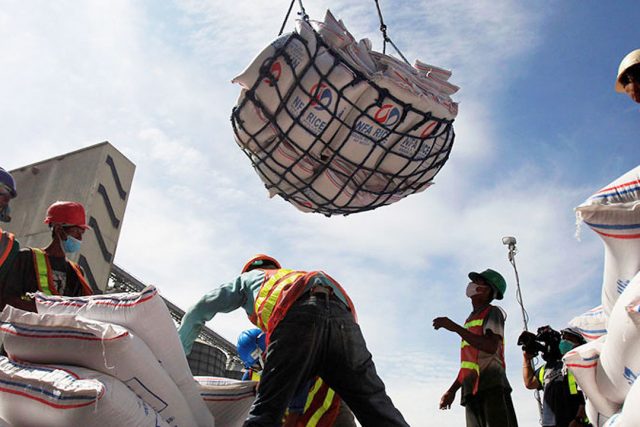
Revenue impact of rice import suspension seen at P4.3 billion

REUTERS

THE Bureau of Customs (BoC) estimated that the suspension of rice imports will result in foregone revenue of more than P4.3 billion.

Customs Commissioner Ariel F. Nepomuceno told BusinessWorld that the estimate is based on the BoC’s year-earlier collections of P1.64 billion in September and P2.68 billion in October.

“The total is around P4.3 billion. But if we factor in growth in volume for this period, foregone revenue could be higher,” Mr. Nepomuceno said via Viber.

The temporary ban is set to begin on Sept. 1, after President Ferdinand R. Marcos, Jr. ordered the halt to rice imports to provide relief for farmers during the harvest.

Some farmers are being offered prices for their grain below the cost of production.

Rice tariffs remain among the BoC’s top revenue sources.

After Executive Order 62 slashed rice import tariffs to 15% from 35% in June 2024, the Department of Agriculture called for a “gradual hike” to return to the original rate.

Assistant Commissioner Vincent Philip C. Maronilla has said that the rice tariff reduction led to about P20 billion in foregone revenue last year.

Finance Secretary Ralph G. Recto said he expects a “slight drop” in Customs revenue due to the two-month ban but still expects the collection target to be met.

In July, Customs collections rose 6.4% year on year to P80.36 billion, bringing the seven-month total to P544.23 billion.

This year, the BoC has been set a target to collect P958.7 billion. — Aubrey Rose A. Inosante

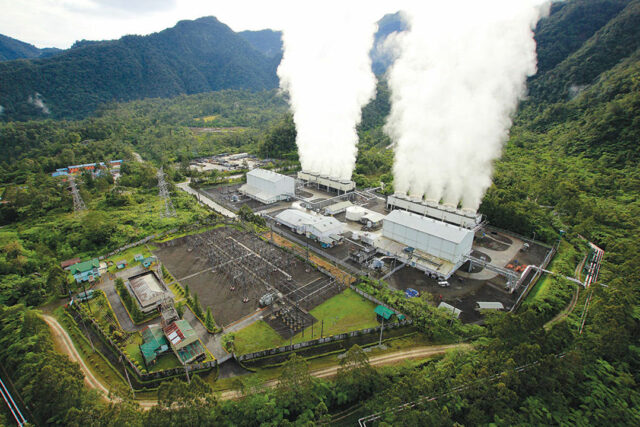
Geothermal de-risking plan expected within the year

EDC

THE Department of Energy (DoE) said it hopes to submit its $250-million geothermal resource de-risking facility (GRDF) proposal to the Department of Economy, Planning, and Development Investment Coordination Committee (DepDev ICC) within the year.

“We are almost done with the preparations to seek DepDev ICC approval,” Energy Undersecretary Mylene C. Capongcol told BusinessWorld.

The DoE has tapped the Asian Development Bank (ADB) for technical assistance to develop and implement the de-risking facility. 

According to the ADB, the GRDF aims to “reactivate greenfield investment in geothermal,” which has been stranded since 2001, by reducing investment risk during the pre-development stage through sharing exploration costs and risk with the private developers.

“The facility will fund or co-share the cost of exploration and drilling which is the riskiest part of the development,” Ms. Capongcol said.

“If they succeed, they will pay back the money extended to them. If not, it will be a grant,” she added.

The funding will be provided $60 million by the ASEAN Catalytic Green Finance concessional funds and $190 million by the ADB.

The Philippines’ installed geothermal energy capacity was 1,952 megawatts (MW) in 2023, making it the third-biggest geothermal producer.

As of April, 31 geothermal service contracts are being monitored by the DoE, which have a total potential capacity of 1,077.22 MW.

In June, the DoE issued notices of award to three geothermal power project bids with a combined capacity of 30.89 MW, part of the third round of green energy auction.

The GEA program is designed to help the Philippines achieve its renewable energy (RE) goal of increasing the share of RE in the power generation mix to 35% by 2030 and 50% by 2040. — Sheldeen Joy Talavera

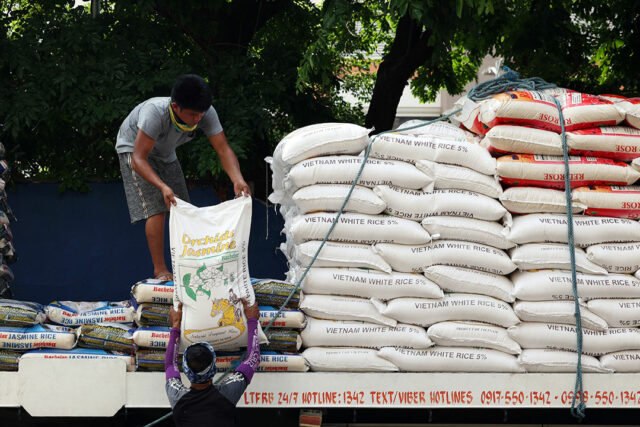
Agri dep’t to digitally track rice supply, prices

PHILIPPINE STAR/KRIZ JOHN ROSALES

THE Department of Agriculture (DA) said on Monday that it will launch a command center to track the rice supply chain in November.

The facility, fed with trade data primarily from the Osiris system of the Bureau of Plant Industry, will initially focus on the rice value chain — “an essential but challenging staple in the Philippines,” the DA said in a statement.

“Wild swings in rice prices could unsettle economic assumptions, particularly those tied to inflation,” it said.

The digital nerve center will consolidate critical data including production, imports, stock levels, various types of products and wholesale and retail prices.

It will also collect data on consumption rates, production and post-harvest infrastructure, utilization, irrigation coverage, spoilage, and global market trends.

“The DA has most of these data, but they are scattered across various agencies,” Agriculture Secretary Francisco P. Tiu Laurel, Jr. said.

“We must bring them together and make market sense of them, plus gather additional data that we lack, so we can use our limited resources more efficiently and productively,” he added.

The DA said “sharper forecasting” of supply and demand will be provided by the command center — facilitated by the expected restoration of regulatory powers over the rice industry to the DA and National Food Authority through amendments to the Rice Tariffication Law.

Improved forecasting accuracy will provide “much-needed predictability” and improved incomes for rice farmers, it added.

The command center model will later be applied to high-value crops, livestock, poultry, and fisheries. — Kyle Aristophere T. Atienza

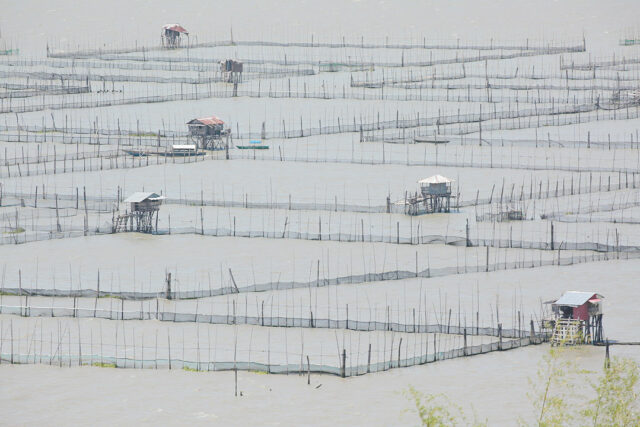
Mushroom waste being tested as fish feed

PHILIPPINE STAR/ MICHAEL VARCAS

THE Department of Science and Technology (DoST) said it is funding a project that seeks to turn mushroom farming waste, known as spent mushroom substrate (SMS), into fish feed for tilapia aquaculture.

The DoST’s Philippine Council for Agriculture, Aquatic and Natural Resources Research and Development (PCAARRD) said tilapia farmers face rising feed costs, one of the most expensive inputs.

“Traditionally, fish feed is made using fishmeal or plant-based ingredients like soybean meal,” it said.

“However, the cost and environmental concerns tied to these ingredients have prompted a search for more sustainable alternatives,” it added.

PCAARRD said SMS could be a sustainable and cost-effective fish feed ingredient due to widespread availability from a “booming mushroom industry.”

Now on its second year, the project, being conducted by researchers from the Partido State University in Bicol, has developed five types of fish feed with varying amounts of SMS replacing soybean meal.

The experimental feed was evaluated for key qualities such as durability in water, safety, nutritional value, and fish acceptance.

The project team collected two types of SMS, freshly harvested and aged from mushroom farms to determine which version is more suitable for feed use. The samples were then analyzed at the University of the Philippines Los Baños to assess their nutrient composition, including protein, fiber, fat, and moisture content.

The analysis also identified 12 types of beneficial bacteria from the Bacillus family living in the SMS. These microbes are known for their ability to survive in tough environments and even improve gut health in animals.

“Results from the project showed significant differences in their proximate compositions, microbial loads, and functional characteristics, each influencing their suitability for different applications,” PCAARRD said.

“But generally, aged SMS was found to be more suitable as an aquafeed ingredient as it has higher protein and fiber levels, lower fat and moisture, and showed better stability, making it a good option for feed formulation,” it added.

By repurposing SMS, the initiative supports a circular economy, “turning what was once discarded into a useful resource while also reducing the cost of aquafeeds,” PCCARD noted.

“In the long run, the project seeks to achieve improved tilapia production, less waste from mushroom farms, and more affordable fish farming across the region,” it added. — Kyle Aristophere T. Atienza

The Advance Pricing Agreement: What it means for businesses

The Bureau of Internal Revenue (BIR) has announced that it will conduct a public consultation on the draft Revenue Regulations governing the Advance Pricing Agreement (APA) on Aug. 28, 2025. This marks a significant step forward in the Philippines’ efforts to modernize its transfer pricing framework and align with international best practices.

The journey toward an APA regime has been long. In 2013, the BIR issued Revenue Regulations (RR) No. 2-2013, formally introducing the concept of APAs through its Transfer Pricing Guidelines. However, progress since then has been limited, with few public developments on APA implementation.

Despite the delay, the BIR has taken several measures to strengthen transfer pricing compliance and safeguard the tax base against profit shifting. These include Revenue Audit Memorandum Order (RAMO) No. 1-2019, which established standardized audit procedures for related party and intra-firm transactions and RR No. 34-2020, along with its subsequent amendments, which require taxpayers to file BIR Form No. 1709 (Information Return on Related Party Transactions).

Currently, the Philippines remains one of the few Southeast Asian countries without a fully operational APA program. In contrast, Singapore (the first in the region to implement APA in 2006), Indonesia, Vietnam, Malaysia, and Thailand have developed and/or established active APA regimes.

WHAT IS AN APA?
RR No. 2-2013 defines APA as a facility available to taxpayers engaged in cross-border transactions. It is an agreement entered into between the taxpayer and the BIR to determine in advance an appropriate set of criteria (e.g., transfer pricing method, comparables and appropriate adjustments thereto) to ascertain the transfer prices of controlled transactions over a fixed period. The purpose of an APA is to reduce the risk of transfer pricing examinations and double taxation.

There are two kinds of APA: unilateral APA, and bilateral or multilateral APA. A unilateral APA involves only the taxpayer and BIR, while a bilateral/multilateral APA involves the Philippines and one or more of its treaty partners. A bilateral or multilateral APA is authorized under the Mutual Agreement Procedure (MAP) Article of the 37 Philippine tax treaties.

It is not a mandatory requirement for taxpayers to avail of an APA for their controlled transactions. If a taxpayer avails of an APA, it may choose freely between a unilateral and bilateral/multilateral APA. If a taxpayer does not choose to enter into an APA and its transactions are subject later to transfer pricing adjustments, it may still invoke the MAP Article to resolve double taxation issues.

APA PROCESS
As of writing, the draft Regulation on APA is not yet available. However, the APA process typically follows a structured, multi-phase approach. While the exact steps may vary slightly by jurisdiction, the following outline reflects best practices from Southeast Asian countries and international standards: pre-filing consultation; formal application submission; acceptance and review; information gathering and analysis; negotiation; agreement and execution; implementation and monitoring; and renewal or revision.

The BIR is expected to adopt a similar phased approach.

DURATION OF APA
The time it takes to finalize an APA can vary significantly depending on the jurisdiction, complexity of the transactions, and whether the APA is unilateral, bilateral, or multilateral. Based on OECD statistics, the global average for a bilateral APA to finalize is just over three years. Similarly, in the ASEAN region, the average duration to finalize an APA is two to five years.

WHAT’S IN IT FOR THE TAXPAYERS
The implementation of an APA program by the BIR offers Philippine taxpayers several meaningful benefits. First and foremost, it provides certainty and predictability in how transfer pricing methods will be treated, thus, helping businesses avoid unexpected tax assessments. By agreeing on pricing methods in advance, taxpayers can significantly reduce the risk of audits and adjustments.

For multinational enterprises, APAs also help prevent double taxation, which ensures that income isn’t taxed more than once across jurisdictions. While the APA process requires upfront effort, it ultimately leads to lower compliance costs, as annual reporting becomes more streamlined and focused.

Finally, the APA program positions the Philippines more competitively within the region. As neighboring countries already offer APAs, having a robust program in place can boost investor confidence and make the country a more attractive destination for cross-border investments.

TAKEAWAY
With the holding of public consultation, the Philippines is a step closer to moving toward implementing a formal APA program. This consultation signals a shift toward aligning with international best practices and offers taxpayers a valuable opportunity to shape the framework that will govern how transfer pricing is managed in the country. For businesses, it’s a chance to engage early, prepare strategically, and potentially benefit from a more predictable and cooperative tax environment.

We hope the upcoming public consultation on the APA will serve not just as a procedural formality, but as a meaningful dialogue between the BIR and stakeholders. This is a valuable opportunity for businesses, tax professionals, and industry groups to share insights, raise concerns, and help shape a framework that promotes fairness, transparency, and certainty in transfer pricing compliance.

Let’s Talk TP is an offshoot of Let’s Talk Tax, a weekly newspaper column of P&A Grant Thornton that aims to keep the public informed of various developments in taxation. This article is not intended to be a substitute for competent professional advice.


Paul Vinces C. Leorna is a manager from the Tax Advisory & Compliance Practice Area of P&A Grant Thornton, the Philippine member firm of Grant Thornton International Ltd.

pagrantthornton@ph.gt.com

Philippines’ DFA says Gaza offensive dims hopes for peace in Middle East

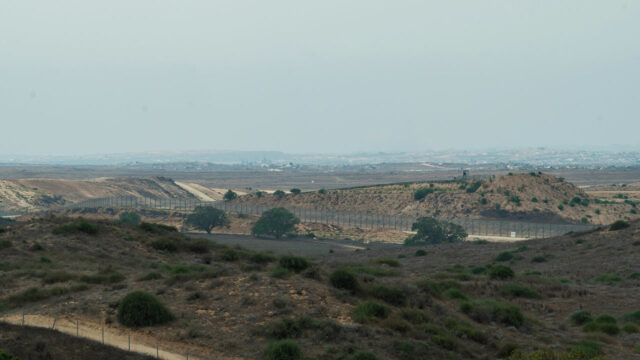
A VIEW of the Gaza Strip from Kobe’s Hill in Sderot, southern Israel on Aug. 12. — NORMAN P. AQUINO

THE PHILIPPINES on Monday said Israel’s military offensive in Gaza City could further derail efforts to achieve peace in the Middle East.

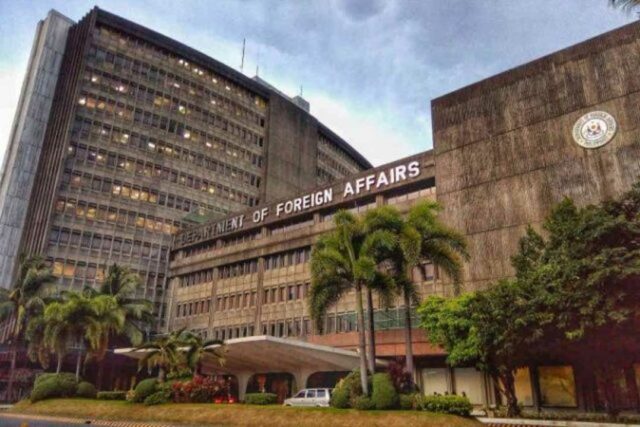
In a statement, the Department of Foreign Affairs (DFA) said Jerusalem’s planned military takeover of Gaza and its continued blockade of humanitarian aid threaten to worsen the “humanitarian catastrophe” and undermine regional stability.

“These developments aggravate an already dire humanitarian situation and further diminish prospects for a just, lasting and comprehensive peace in the Middle East,” the agency said.

It added that the Philippines “joins the international community in its urgent call for an end to the ever-worsening humanitarian catastrophe in Gaza,” citing Israel’s alleged restrictions on food and water, large-scale displacement and civilian casualties in Gaza and reports of settlement expansion in the West Bank.

The Embassy of Israel in Manila declined to comment.

In a Facebook post at the weekend, the embassy said claims of famine in Gaza are “politically motivated and false,” noting that Israel facilitates massive humanitarian aid every single day, while Hamas exploits it for its own purposes.

“Since the beginning of the war, over 100,000 trucks of aid have entered Gaza, with nearly 80% consisting of food,” it said, citing the daily entry of humanitarian aid trucks carrying food, medicine, water and shelter supplies.

In August alone, food trucks delivered the equivalent of 4,400 calories per person per day, it said, adding that market prices of food in Gaza have dropped sharply, “proving increased availability.”

Israeli forces launched an assault on the eastern and northern outskirts of Gaza City at the weekend as part of the nation’s plan to seize the territory’s largest urban area and defeat the terrorist group Hamas, which Gazans elected in 2007.

The decades-long conflict between Israel and Palestine has seen repeated bouts of violence, mass displacement and failed peace efforts that continue to destabilize the region.

Israel’s military launched an operation in Gaza in response to the Hamas-led attack on southern Israel on Oct. 7, 2023, when about 1,200 people were slaughtered and 251 others were taken hostage.

“Israel understands that the Philippines, for the longest time, has always pursued a humanitarian approach and is convinced of the peaceful settlement of disputes in times of hostilities,” Josue Raphael J. Cortez, a diplomacy instructor at De La Salle-College of St. Benilde’s School of Diplomacy and Governance in Manila, said in a Facebook Messenger chat.

Jerusalem’s plan to capture Gaza City may stoke tensions in the Middle East, with retaliation likely on the table for Hamas, he added.

“It would be an unwieldy move for Israel to continue pursuing such a proposition as it would just invite further sanctions and global condemnation,” he said. “This, in turn, could undermine its legitimacy.”

Israeli Prime Minister Benjamin Netanyahu last week said his government would resume talks on the release of hostages held in Gaza and negotiate terms for ending the nearly two-year war, but only under conditions acceptable to Israel.

The fighting has killed tens of thousands, most of them civilians, according to international monitors.

Meanwhile, Hamas militants have agreed to a Qatari- and Egyptian-brokered 60-day truce that would allow the release of half of about 50 hostages still in captivity. About 20 of them are still alive, according to the Israel Defense Forces.

“The Philippines therefore strongly calls on Israel to heed the ceasefire proposal as a crucial step to protect civilians and revive the path to peace,” the DFA said. — Kenneth Christiane L. Basilio and Norman P. Aquino

Poll: Most Filipinos see China as ‘greatest threat’

PHILIPPINE COAST GUARD/HANDOUT VIA REUTERS

By Kenneth Christiane L. Basilio, Reporter

A VAST majority of Filipinos distrust China and view it as the country’s “greatest threat,” according to an OCTA Research survey released Monday, highlighting growing public unease over tensions in the South China Sea.

The July poll found that 85% of Filipinos don’t trust China, with respondents from the Mimaropa, Western Visayas, Bicol and Caraga regions registering unanimous distrust. In Metro Manila and Luzon, nine of 10 said they distrust Beijing, while skepticism was also high in the Visayas (77%) and Mindanao (84%).

Wariness of China cut across socioeconomic classes, peaking at 90% among lower-income Filipinos, followed by 85% among middle-income and 80% in upper-income groups.

About 74% of Filipinos identified China as the greatest threat to the Philippines, with two-thirds citing Beijing’s aggressive actions in the South China Sea as the primary reason. Other factors included the entry of smuggled goods (13%), crimes linked to Chinese nationals (9%) and job competition (8%).

“The survey findings highlight a multi-dimensional distrust toward China,” OCTA said in the report. “Filipinos not only view China as a direct threat to the country’s sovereignty and territorial integrity, but also express concerns about its economic activities and social impact on local industries and communities.”

China claims nearly the entire South China Sea based on a 1940s map, overlapping with the Philippines’ exclusive economic zone. A United Nations-backed tribunal based in The Hague voided Beijing’s claim in 2016, but China has rejected the decision and continues to maintain a strong presence in contested areas.

The survey also found that 76% of Filipinos back government efforts to push back against China’s actions in the West Philippine Sea, with only 3% opposed and 19% undecided. Support was highest in Metro Manila (89%), followed by Mindanao (86%), the Visayas (78%) and Luzon (67%).

Philippine Navy Rear Admiral Roy Vincent T. Trinidad, the military’s spokesman on the South China Sea, said the findings show broad public support for defending sovereignty.

“It adds more legitimacy to our stand when you know you have the backing of the vast majority of our people,” he told reporters. “Issues in the West Philippine Sea are the greatest threat to our existence as a republic that we all have to face together.”

The Chinese Embassy in Manila did not immediately reply to a Viber message seeking comment.

OCTA interviewed 1,200 adults nationwide from July 12 to 17 for the survey, which had an error margin of ±3 points.

PHL to keep security stance at Second Thomas Shoal despite China’s moves

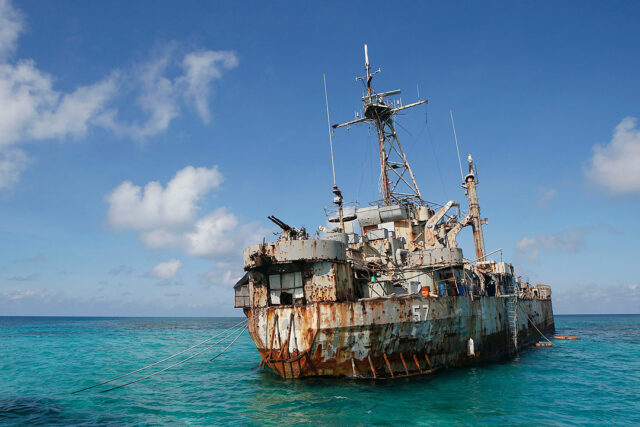
THE BRP SIERRA MADRE, a marooned transport ship which Philippine Marines live in as a military outpost, is pictured in the disputed Second Thomas Shoal, part of the Spratly Islands in the South China Sea. — REUTERS

THE PHILIPPINES will keep its security posture at Second Thomas Shoal in the South China Sea despite increased Chinese activity in the area, Defense Secretary Gilberto C. Teodoro, Jr. said on Monday, stressing that any shift would harm the country’s national interest.

Speaking at a National Heroes’ Day commemoration at the Libingan ng mga Bayani in Taguig City, Mr. Teodoro said recent movements by Chinese vessels near the shoal do not pose an immediate threat to Filipino troops stationed there but emphasized that forces remain on alert.

“To change our stance will be a great detriment to our national interest,” he told reporters. “Many countries support our position, aside from international law.”

The Philippines has kept a small detachment of marines aboard the BRP Sierra Madre, a World War II-era ship deliberately run aground in 1999 to serve as a military outpost at the contested shoal. The vessel has since symbolized Manila’s resistance to Beijing’s expansive claims.

The Philippine military last week reported increased activity by the Chinese Coast Guard near the shoal, citing drills involving water cannons and the deployment of small and inflatable boats.

Manila and Beijing have long been at odds over maritime claims in the South China Sea, where repeated confrontations have included ramming incidents and the use of water cannons against Philippine resupply missions.

China claims almost the entire strategic waterway through its so-called nine-dash line map, an assertion voided by a 2016 ruling by a United Nations-backed arbitral tribunal.

The court found no legal basis for Beijing’s claim, but China has rejected the decision and continued to bolster its presence in disputed areas, including the Spratly Islands, Scarborough Shoal and Second Thomas Shoal.

Mr. Teodoro said the Philippines’ stance is backed by international law and growing international support, with allies voicing opposition to Chinese actions seen as destabilizing. — Kenneth Christiane L. Basilio

PHL suspends classes, gov’t work amid bad weather

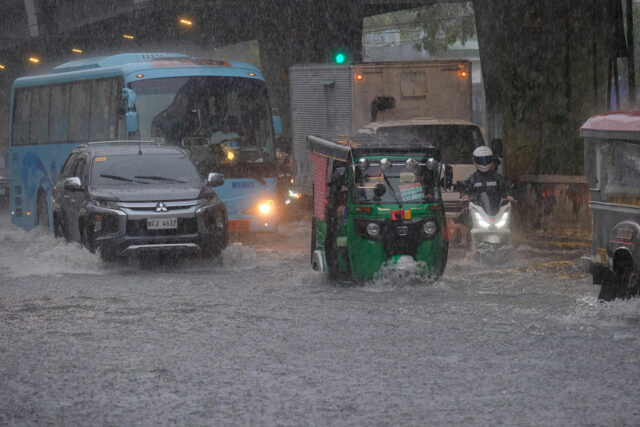
MOTORISTS and commuters wade through gutter-deep flood along Taft Avenue in Manila following heavy rains, Aug. 24, 2025. — PHILIPPINE STAR/RYAN BALDEMOR

THE GOVERNMENT suspended classes and government work for Tuesday as the state weather bureau expects heavy rainfall triggered by the low-pressure area (LPA) and the southwest monsoon.

In a Facebook post on Monday, the Department of the Interior and Local Government announced that classes in public and private schools at all levels and work in government offices are suspended in the following areas: Metro Manila, Aurora, Quezon, Rizal, Laguna, Camarines Norte, Camarines Sur, Albay, Sorsogon, Catanduanes, Masbate, Northern Samar, Eastern Samar, Leyte, Southern Leyte.

In a 5 p.m. weather advisory on Facebook, the Philippine Atmospheric, Geophysical and Astronomical Services Administration (PAGASA) said it expects heavy rainfall over Aurora, Quezon, Laguna, Rizal, Camarines Norte, Camarines Sur, Albay, Sorsogon, Catanduanes, Masbate, Northern Samar, Eastern Samar, Leyte, and Southern Leyte due to the LPA; while the southwest monsoon is expected to bring heavy rains over Palawan and Antique until Tuesday afternoon.

In a separate 24-hour forecast, issued at 4 p.m. on Facebook, PAGASA said the LPA was estimated 290 kilometers (km) northeast of Maasin City in Southern Leyte or 130 km east northeast of Borongan City in Eastern Samar, as of 3 p.m.

It added the southwest monsoon is affecting the western section of Southern Luzon.

Meanwhile, more than 50,000 people across several regions in the Philippines were affected by heavy rains and flooding brought by the combined effects of the southwest monsoon and Tropical Cyclone Isang, internationally called Kajiki, the National Disaster Risk Reduction and Management Council (NDRRMC) reported on Monday.

In an 8 a.m. situational report, the NDRRMC said a total of 11,374 families, or 50,678 persons were affected in Cagayan Valley (Region II), Bicol (Region V), Soccsksargen (Region XII), Cordillera Administrative Region (CAR), and the Bangsamoro Autonomous Region in Muslim Mindanao (BARMM).

BARMM recorded the highest number of affected residents, with 24,911 individuals or 5,013 families.

Of these, 329 families or 1,203 persons took shelter in six evacuation centers, while 4,815 families or 24,075 persons were assisted outside evacuation sites.

The state weather bureau monitored a low-pressure area developed into Tropical Depression Isang on Aug. 22, which made landfall over Casiguran, Aurora, two days later, before crossing Northern Luzon. It intensified into a tropical storm as it exited the Philippine area of responsibility on Aug. 23.

Flooding was also reported in at least 30 areas, with 27 incidents in Metro Manila and three in Maguindanao del Norte and Maguindanao del Sur.

Most of the floods in the capital region quickly subsided, but flash floods in Maguindanao resulted in one death after a civilian was swept away while crossing a river in Tubuan, Datu Blah T. Sinsuat.

This comes as the national government ramps up its crackdown on questionable flood control projects, following the typhoons in July that exposed both the country’s overwhelmed drainage systems and alleged corruption in flood mitigation efforts.

The weather disturbance also forced the suspension of classes in 131 cities and municipalities, mostly in the CAR (77 areas), Metro Manila (16 areas), the Ilocos Region (10 areas), Cagayan Valley (10 areas), and Bicol Region (18 areas). Work was likewise suspended in San Agustin, Isabela.

Ten road sections and two bridges in Northern Luzon were rendered impassable at the height of the storm but have since been cleared and reopened.

Authorities reported that 643 families or 1,512 individuals were pre-emptively evacuated in Albay, while government relief operations have reached 1,441 families so far.

Assistance worth P1.7 million has been provided to victims in Cagayan Valley and Bicol Region. — Chloe Mari A. Hufana with CAT

FNI slams Chairman’s arrest

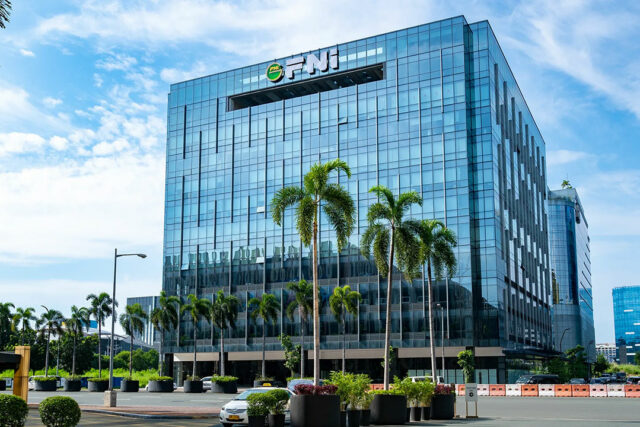
GFNI.COM.PH

GLOBAL Ferronickel Holdings, Inc. (FNI) on Monday strongly denounced the “unlawful” arrest and detention of its Chairman, Joseph Sy, over a “baseless” accusation of misrepresenting his citizenship.

The nickel company asserted Mr. Sy’s citizenship has been confirmed by at least six rulings from the Bureau of Immigration (BI), the Department of Justice, the Office of the President, the Securities and Exchange Commission (SEC), and the Supreme Court.

“He entered the country on his valid Philippine passport, which the Supreme Court has recognized as official proof of identity of Filipino nationality,” FNI said in a statement.

“His detention is a grave injustice, but we remain confident that the truth and the law will prevail.”

The company noted that its operations and all companies under the Group remain “stable, legitimate, and unaffected.”

The Philippine Nickel Industry Association (PNIA) on Monday also called for the release of FNI’s chairman, saying BI’s detention is “deeply troubling and illegally inconsistent” considering it has twice recognized Mr. Sy’s citizenship.

“His continued detention on mere suspicion of being an alien, without lawful basis and outside the BI’s jurisdiction, is a grave injustice and a violation of the fundamental principles of due process,” it added.

PNIA noted the arrest and subsequent detention of Mr. Sy sends a “wrong message” to investors as the Philippines seeks to bolster business confidence.

“We call on the authorities to act swiftly, observe due process, and immediately resolve this matter by releasing Mr. Sy without delay,” it said.   

Developments over Mr. Sy’s detention are being closely monitored by the SEC, which said it will evaluate whether necessary actions are warranted under its jurisdiction.

“Any action taken by the SEC on the matter will be in line with promoting transparency and confidence in the markets, especially matters that affect the governance of publicly listed companies,” the corporate watchdog said in a statement sent to BusinessWorld on Monday.

Amid the detention, the SEC reminded listed companies that all material developments that could influence the decision of investors must be “promptly disclosed” to the public as mandated under Rule 17.1.1 of the implementing rules and regulations of the Securities Regulation Code, as well as the consolidated listing and disclosure rules of the Philippine Stock Exchange.

“The commission reiterates its commitment to upholding the interests of the investing public and ensuring that the integrity of the capital market is preserved,” it said.

Sought for comment, the BI noted in a Viber message to BusinessWorld that Mr. Sy is the subject of a mission order and an investigation from the BI, which received information from government intelligence sources about his “alleged illegally acquired Philippine documents.”

The BI said he was found to be using a Philippine passport issued in 2021 and was in possession of several Philippine identity cards showing that he is a Filipino.

“However, Viado shared that their Alien Registration Division was able to confirm that his fingerprints matched that of a Chinese citizen, who previously held a long-term visa and an Alien Certificate Registration Identity Card,” it added.

The BI said Mr. Sy is “said to own many major businesses in the country” and has “infiltrated different economic and business groups.”

“Without naturalization, a foreign national is not eligible to get Philippine citizenship documents,” BI Commissioner Joel Anthony Viado said.

“Government intelligence sources have reason to believe that this is another case of assumed Philippine identity, similar to that of Alice Guo,” he added.

Meanwhile, Senator Risa N. Hontiveros-Baraquel raised concerns over Mr. Sy’s detention after she learned that he had served as a volunteer with the Philippine Coast Guard (PCG), citing it could be a national security risk.

The PCG did not immediately reply to a Viber message seeking comment.

“The Senate must immediately probe his affiliations, background and the circumstances under which he obtained his Philippine documents,” Ms. Hontiveros said in a statement.

The BI said Mr. Sy, who is facing a deportation case for misrepresentation, is currently held at the BI’s holding facility in Bicutan, Taguig.

BI operatives arrested Mr. Sy on Aug. 21 after arriving from Hong Kong. He was detained due to an alleged misrepresentation of his citizenship.   

FNI is a listed mining company that has business interests in nickel ore mining, logistics, cement and steel production, and port operations. — Kenneth Christiane L. Basilio, Revin Mikhael D. Ochave, and Kyle Aristophere T. Atienza


Marcos vows fight vs corruption

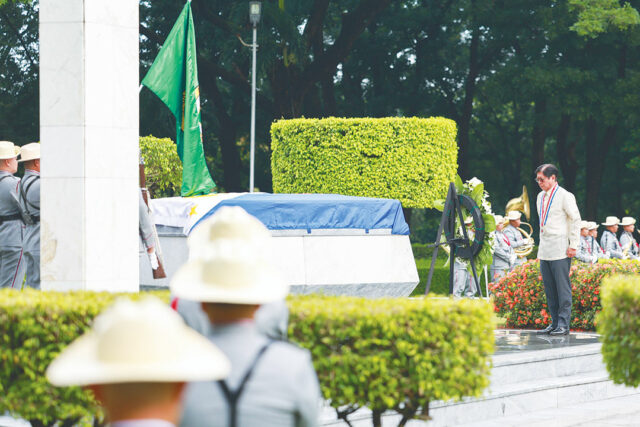
PRESIDENT Ferdinand R. Marcos, Jr. led the wreath-laying at the Tomb of the Unknown Soldier at the Libingan ng mga Bayani (Heroes’ Cemetery) in Taguig City on Monday, as the nation commemorated National Heroes’ Day. — PHILIPPINE STAR/NOEL B. PABALATE

PRESIDENT Ferdinand R. Marcos, Jr., marked the Philippine National Heroes’ Day on Monday with a pledge to hold public officials accountable for corruption and abuse of power, framing the fight against graft as central to protecting the nation’s future.

Speaking at the Heroes’ Cemetery in Taguig City, Mr. Marcos said corruption robs not just public funds but also “the health, dreams, and future of the next generations of Filipinos.”

He urged citizens to expose wrongdoing and reject even “small deceptions” that, if tolerated, erode society.

The call comes as the Marcos administration cracks down on anomalous infrastructure projects, following several reports of substandard works and government officials implicated as orchestrators.

“This government will not leave you behind,” Mr. Marcos said in Filipino, according to a transcript from his office.

“We will hold accountable all those involved in anomalies and corruption. We will reveal the full truth, and we will make sure that the people will never again suffer from neglect and abuse.”

The President linked his message to the day’s commemoration, highlighting lesser-known Filipino heroes, such as Teresa Magbanua, dubbed the “Visayan Joan of Arc,” as examples of Filipinos who sacrificed for freedom. 

He said ordinary workers, from farmers and teachers to healthcare staff, continue to embody modern heroism through service.

Mr. Marcos warned that while strengthening national defense remains essential, new threats include corruption and the abuse of authority.

He called on the youth to be more vigilant and socially aware, saying the failure to prepare them to defend freedom would betray both the sacrifices of past heroes and the country’s future.

“Let us fight corruption. Let us fight abuse of power. Let us fight the trampling of our rights,” Mr. Marcos said.

Meanwhile, the Philippine Army also launched an army-wide simultaneous blood donation drive last Aug. 23.

Commanding General Lt. Gen. Antonio G. Nafarrete, in a statement on Monday, said more than 3,000 blood bags were collected from soldiers, reservists, civilians, and other uniformed personnel.

He commended the troops for “enacting heroism through their donations” and underscored the Army’s commitment to providing lifesaving support to communities.

National Heroes’ Day is observed in the Philippines every last Monday of August to honor Filipinos who fought for the nation’s independence and those who continue to serve the country with dedication. — Chloe Mari A. Hufana

Filipinos in NYC bus crash discharged

DEPARTMENT OF FOREIGN AFFAIRS FACEBOOK PAGE

THE THREE Filipinos involved in a bus crash in New York City (NYC) over the weekend have been discharged, the Department of Foreign Affairs (DFA) reported on Monday.

In an update to reporters via WhatsApp, the DFA cited the Philippine Consulate General in New York, saying the three Filipinos have been given clearance to travel.

The three are residing in Qatar and were vacationing in the city.

“A consulate representative will meet them to ascertain their needs and ensure their welfare until their scheduled departure,” the DFA added.

The crash, involving a tourist bus carrying 54 passengers from India, China, and the Philippines, killed five people and injured dozens. Police reports noted that many were not wearing seat belts. — Chloe Mari A. Hufana

ADVERTISEMENT
ADVERTISEMENT