Home Blog Page 1093

Contractors to face tax fraud audit
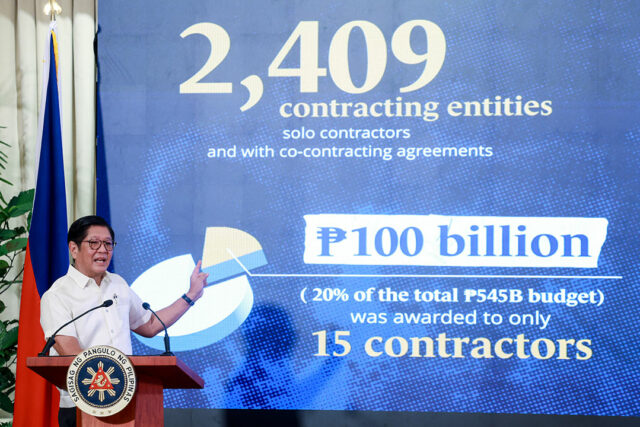
President Ferdinand R. Marcos, Jr. earlier this month launched a new website www.sumbongsapangulo.ph, where citizens can report anomalous flood control projects. — PHILIPPINE STAR/NOEL B. PABALATE

THE BUREAU of Internal Revenue (BIR) will investigate the contractors allegedly involved in anomalous flood control projects for possible tax fraud, according to Commissioner Romeo D. Lumagui, Jr.

“The BIR will undertake a parallel investigation of contractors implicated in irregular flood control projects. We will support the President’s crusade by auditing the tax returns and payments of these entities,” Mr. Lumagui said in a statement on Tuesday.

The tax agency’s probe comes after President Ferdinand R. Marcos, Jr. ordered a sweeping crackdown on corruption in public works, particularly in flood control.

Mr. Marcos earlier this month identified 15 contractors that have cornered around 20% or P100 billion worth of flood control projects out of the P545-billion budget since 2022.

Mr. Lumagui said the tax fraud investigation will focus on the contractors involved in these anomalous flood control projects as identified by Mr. Marcos.

“Should any contractor be found to have underpaid or evaded taxes, the BIR will not issue an updated tax clearance to them. The contractor will be disqualified from participating in future government procurements, and the final settlement of their existing government contracts will be suspended,” he said.

Under Revenue Regulation (RR) No. 17-2024, contractors must secure an updated tax clearance from the BIR before the final settlement of any government contract.

Failure to present this clearance will result in the suspension of contract settlements and the imposition of a tax lien over the contract amount in favor of the government, the BIR said.

The updated clearance guarantees that every contractor has no outstanding tax liabilities and has duly filed and paid all applicable taxes.

The BIR clarified that this document is different from the required initial tax clearance during the eligibility phase of the procurement process.

These clauses under Sections 2 and 3 of RR No. 17-2024 are meant to safeguard public funds from contractors who fail to comply with tax obligations.

Additionally, Section 235 of the National Internal Revenue Code authorizes the BIR to conduct multiple audits within the same taxable year in cases involving fraud or irregularities, as determined by the commissioner.

Earlier this week, the Department of Public Works and Highways announced the suspension of District Engineer Abelardo D. Calalo, who allegedly offered around P3.13 million in cash to Batangas Rep. Leandro L. Leviste to dissuade investigations into anomalies in flood control projects.

Meanwhile, Mr. Lumagui said those contractors involved in “ghost” projects will be issued deficiency tax assessments, once the BIR receives official certification from relevant agencies that there were no actual projects.

“If the BIR, through certification or endorsement from the appropriate government agencies, confirms that a flood control project is a ghost project, we will disallow all related cost and expense claims,” he said.

“No project means no deductible expense. A tax deficiency assessment will be issued accordingly.”

The Senate and House of Representatives have launched inquiries into the alleged irregularities in flood control projects. — Aubrey Rose A. Inosante


Philippines could be hit with more tariffs as Trump threatens countries with digital taxes

Toy figures of people are seen in front of the displayed logos of Disney +, HBO Max, Apple TV, Netflix, Hulu and Prime Video. — REUTERS/DADO RUVIC/ILLUSTRATION

By Aubrey Rose A. Inosante and Justine Irish D. Tabile, Reporters

THE PHILIPPINES may face additional tariffs after US President Donald J. Trump’s fresh tariff threat against countries that impose digital taxes on US technology companies, analysts said.

In a post on Truth Social, Mr. Trump threatened countries that have digital taxes with “substantial additional tariffs” on their exports to the US if they do not remove these laws.

“With this truth, I put all countries with digital taxes, legislation, rules, or regulations, on notice that unless these discriminatory actions are removed, I, as President of the United States, will impose substantial additional tariffs on that country’s exports to the USA, and institute export restrictions on our highly protected technology and chips,” Mr. Trump said.

The Philippines, which began enforcing its digital tax law in June, may be among the countries facing additional US tariffs.

“Likely to have an impact on us since we impose 12% VAT (value-added tax) on digital services,” Ateneo Center for Economic Research and Development Director Ser Percival K. Peña-Reyes said in a Viber message.

Republic Act No. 12023 imposes a 12% VAT on nonresident digital service providers such as Netflix, Amazon, and Google. The law aims to level the playing field between local and foreign digital platforms.

“This could be part of Trump’s reciprocal tariffs on digital transactions that are taxed by different countries around the world, especially by developed countries,” Rizal Commercial Banking Corp. Chief Economist Michael L. Ricafort said in a Viber message.

“So, there is a risk of retaliatory US tariffs in the country (Philippines), though the effect could still be minimal or negligible,” he added.

Mr. Peña-Reyes warned that the US may hike the current 19% tariff on Philippine goods since Mr. Trump remains “unpredictable.”

The US began imposing a 19% tariff on Philippines goods on Aug. 7.

Mr. Ricafort said the US president could still try to get concessions in terms of reduced digital transaction taxes for US companies as part of the trade negotiations.

Mr. Trump in February signed a memorandum to combat the digital service taxes imposed by foreign governments on American companies.

The directive renewed the digital service tax investigations that were initiated during Mr. Trump’s first term while also investigating additional countries that use digital service tax.

Analysts cautioned the Philippine government against hastily lifting the VAT on US technology firms.

“(This is) something the government should study and weigh carefully — revenues lost from lifting tax versus revenues from lower exports due to higher tariff,” Mr. Peña-Reyes said.

The Department of Finance has estimated that the government will generate P102.12 billion in revenue from digital VAT collections between 2025 and 2028.

“It’s hard to be optimistic that the trade benefits we may get from lifting taxes will be greater than the impact of additional revenues we may get from taxes which, if used correctly, may help in developing industries through government support and additional incentives,” Matt Reinielle M. Erece, an economist at Oikonomia Advisory and Research, Inc., said.

Asian Consulting Group Founding Chairman and Chief Tax Advisor Raymond A. Abrea said that the Philippine law is not solely targeted at US tech giants, “but reflects a broader global move to modernize tax systems in the digital age.”

“The Philippines did not create a separate digital tax. We simply expanded VAT to include online transactions and digital service providers, ensuring fairness between traditional and digital businesses,” Mr. Abrea said in a Viber message.

Mr. Trump had claimed these digital taxes were “designed to harm, or discriminate against American technology,” while giving a pass for Chinese firms.

Meanwhile, Mr. Erece said the threat of additional tariffs poses risks to the country’s export sector and broader economic performance.

“Therefore, the country must do two things: continue close but persistent trade negotiations with the US but also be aggressive in supporting and incentivizing exporting industries to develop competitive goods that remain attractive to foreign consumers despite tariffs being in place,” he said.

Philippine Chamber of Commerce and Industry Chairman George T. Barcelon said that businesses are in a wait-and-see stance until the new tariffs are clarified.

“We are taxing services that come from the US, like a lot of software platforms. Even if it’s on the cloud, on a prescription basis, now, there’s already a VAT,” Mr. Barcelon said in a phone interview.

“I do not know whether that translates to the fact that President Trump will impose their version of a tax on our exports. But it sounds like that will be the effect,” he added.

Meanwhile, the 19% US tariff is expected to have a smaller impact on the Philippine economy than previously expected, Fitch Solutions’ unit BMI said.

“We estimate that the revised tariff rate will lead to a 0.4-percentage-point (ppt) reduction in output over the medium term, a significant improvement from the 1.4-ppt decline we estimated in April,” BMI said in a report.

BMI said it maintained its full-year gross domestic product (GDP) growth forecast for the Philippines at 5.4% as it expects global economic conditions to deteriorate in the second half when US tariffs take effect.

BMI’s forecast is below the government’s 5.5-6.5% GDP growth target for the year.

“The Philippines remains a largely domestically driven economy. While interest rates have eased considerably from their peak, erratic US trade policies will weigh on global investor sentiment and limit foreign direct investment inflows,” BMI said.

“As such, we see little prospect for a meaningful investment recovery in the near term. Household consumption is showing similar weakness. Import volumes — a reliable proxy for private spending — continue to contract sharply and recent consumer surveys suggest confidence has eroded further as trade tensions escalate,” it added. — with K.K.Chan

Illegal gambling boom could put PHL at risk of returning to ‘gray list’

Gambling dice and chips are seen on the keyboard in this illustration picture, June 5, 2020. — REUTERS/DADO RUVIC/ILLUSTRATION

THE BANGKO SENTRAL ng Pilipinas (BSP) is still studying further regulations to help curb risks related to e-gambling, as the proliferation of illegal sites could derail the country’s anti-money laundering efforts.

BSP Governor Eli M. Remolona, Jr. said the central bank can do more to tighten safeguards on e-gambling, after it ordered all electronic wallet providers to remove in-app gambling assets.

“We’re still studying it. Basically, as before, we just want to put sand in the wheels. Marami pang pwedeng gawin (There’s more that can be done)… along the same lines,” he told reporters on the sidelines of the 2025 Manila Tech Summit in Taguig City.

Following the BSP’s order, e-wallets, banks, and its other supervised institutions have removed links that would direct users to gaming or gambling websites.

Asked if the rise of e-gambling could affect the Philippines’ efforts to remain out of the Financial Action Task Force (FATF) “gray list,” Mr. Remolona replied: “Yes, but this will be resolved.”

He said illegal gambling sites will be addressed by the Department of Information and Communications Technology.

In February, the FATF removed the Philippines from its list of jurisdictions under increased monitoring for “dirty money” after over three years or since June 2021.

The next assessment is slated for 2027, when the FATF will verify if the country’s anti-money laundering measures are being sustained and still in place.

In June, the European Commission removed the Philippines from its list of “third countries” flagged with “high risk” of money laundering and terrorism financing.

“Exiting the FATF gray list and EU’s (European Union) high-risk list this year was not just compliance, it was a global validation,” Fintech Alliance.PH Chairman and Rizal Commercial Banking Corp. Executive Vice-President and Chief Innovation and Inclusion Officer Angelito “Lito” M. Villanueva said in a speech during the Tech Summit.

Mr. Villanueva said the organization condemns the misuse of digital payment platforms for e-gambling.

“We uphold a zero-tolerance policy against the misuse of digital payment platforms for illegal businesses, especially online gambling,” Mr. Villanueva said. “Consumer protection and industry integrity are nonnegotiable.”

In recent years, e-wallets have helped fuel the popularity of gambling websites after integrating gambling-related services in their apps, making it easy for users to access online casinos.

However, concerns over rising gambling addiction and mounting debt have prompted lawmakers and regulators to consider measures to ban or restrict online gambling in the country.

Union Bank of the Philippines, Inc. Chief Economist Ruben Carlo O. Asuncion said the government risks losing its “hard-won gains” against money laundering if it has no clear action on unregulated e-gambling platforms.

“The rapid growth of online gambling, especially through unregulated platforms, poses a real threat to the Philippines’ progress in exiting the FATF gray list,” Mr. Asuncion said in a Viber message. “Weak KYC (know-your-customer) controls and cross-border anonymity make it a prime channel for illicit financial flows.”

He also noted that the BSP should finalize its regulations on gambling-related financial activity to curb its potential impact on the country’s anti-money laundering efforts.

“To safeguard our AML standing, the BSP must tighten oversight of e-gambling transactions — enforcing stricter KYC, banning unlicensed operators, and finalizing rules that flag or restrict gambling-related financial activity,” Mr. Asuncion said.

“Collaboration with fintechs (financial technology) and legislative support will be key to closing regulatory gaps,” he added.

The BSP is still finalizing new rules to mitigate gambling-related harm by strengthening financial safeguards across banks, e-wallets, and payment platforms.

The central bank had also proposed measures such as biometric ID checks, daily transaction limits, time-based payment restrictions, and user tools for spending caps, voluntary breaks, and self-exclusion.

It said these safeguards aim to curb addiction, fraud, and financial harm while encouraging responsible use of digital finance. — Katherine K. Chan

Steamlined rooftop solar financing needed to unlock potential

Rooftop solar facility refers to a solar photovoltaic (PV) energy generating system built on the rooftop of a residential, commercial building, or industrial facility, which is used for self-consumption or commercial purposes. This file photo shows solar panels set up on the roof of a home in Algete, outside Madrid, Spain. — REUTERS/SUSANA VERA

By Sheldeen Joy Talavera, Reporter

WHILE rooftop solar financing in the Philippines is gaining traction, more efforts are needed to unlock its potential, according to major banks.

Dexter Lloyd C. Cuajotor, head of retail lending at Bank of the Philippine Islands (BPI), said the demand for solar rooftop financing solutions are expected to continue to expand in the coming years.

“BPI is optimistic about the rising demand for solar financing, driven by the steady growth in solar energy adoption, supported by the continued decline in solar installation costs brought by more solar panel providers in the market, more favorable government policies and stronger awareness campaigns that highlight the benefits of renewable energy,” he told BusinessWorld.

Rooftop solar facility refers to a solar photovoltaic (PV) energy generating system built on the rooftop of a residential, commercial building, or industrial facility, which is used for self-consumption or commercial purposes.

As of April, behind-the-meter solar PV systems had an installed capacity of 46 megawatts, data from the Department of Energy (DoE) showed.

Compared with large-scale renewable energy projects, rooftop solar projects tend to be viewed to be “lower risk and more scalable” as they require less capital expenditures and are quicker to implement, Mr. Cuajotor said.

He said that among the challenges faced by banks when evaluating rooftop solar financing are the availability of reliable solar panel providers, insufficient collateral property to cover the loan, and when savings on electricity do not cover the monthly amortization.

“The financing requirements of rooftop solar systems are generally much smaller versus utility-scale solar projects, so it is understandable that there is more attention on the latter,” Juan Paolo E. Colet, managing director of China Bank Capital Corp., said via Viber.

Mr. Colet said that there are banks that are supportive of rooftop solar developers amid growing demand for loans in the sector.

“When we evaluate potential rooftop solar financing deals, it’s important that our bank gets comfortable with the capabilities and track record of the developers and suppliers, the profile of the energy customers or offtakers, the quality of the contracts, and the size and characteristics of the project portfolio,” he said.

Eduardo V. Francisco, president of BDO Capital and Investment Corp., said that financing for rooftop solar loans is challenging as banks look at these individually, instead of portfolio lending.

“We don’t look at the rooftop solar as a security investment unlike buying a car or a home. So, we have to do something,” he said.

However, for a small installer of rooftop solar, what is needed is a type of financing that allows a “simple process, small loans, and faster turnaround,” according to Philippine Solar and Storage Energy Alliance Chairman Theresa Cruz-Capellan.

“Banks are a very reliable source of credit and financing. But they are not the best option for homeowners or small business for rooftop solar financing,” she said.

“The steps required by the banks, not because they like to, but because they are regulated and subjected to a lot of laws, are cumbersome for a small installer or homeowner to deal with,” she added.

Ms. Cruz-Capellan said that the industry is working on opening a way for everyone to access funds, especially amid a significant downtrend in the cost of solar panels.

The DoE is seeking to promote solar roof-mounted technologies to empower more electricity end-users and augment power supply in the country.

Aside from net metering, a program allowing electricity end-users to install renewable energy facilities and export excess power to the grid, the DoE has also paved the way for new business opportunities to solar PV developers.

Citing the Expanded Roof-mounted Solar Program, Energy Undersecretary Mylene C. Capongcol said that solar PV owners can inject power to the grid during a supply shortfall, lease or rent available rooftops for solar power projects, and peer-to-peer power sharing schemes.

“Locators or business establishments with rooftop solar may trade among each other and the excess is sold to the grid,” she said.

FNI shares plunge after Sy’s arrest; company says contingency ready

JOSEPH C. SY — GFNI.COM.PH

By Revin Mikhael D. Ochave, Reporter

SHARES of Global Ferronickel Holdings, Inc. (FNI) fell on Tuesday as investors reacted to the arrest of the mining company’s chairman, Joseph C. Sy, over allegations that he misrepresented his citizenship.

FNI shares sank by 12.14% or 17 centavos to P1.23 apiece at the close of Tuesday’s trading.

“Most likely the decline in the share price of FNI is related to the arrest of its chairman, Joseph C. Sy, due to alleged immigration violations,” AP Securities, Inc. Research Head Alfred Benjamin R. Garcia said in a Viber message.

“Most likely sentiment towards the company won’t improve until the issue is resolved,” he added.

In separate stock exchange disclosures on Tuesday, FNI said Mr. Sy has been placed under detention by the Bureau of Immigration (BI) over an allegation of being an “overstaying alien.”

Mr. Sy, arrested on Aug. 21, now faces a deportation case for misrepresentation.

However, FNI said the charge has “no lawful basis” since Mr. Sy is a Filipino citizen, as affirmed in multiple rulings by various government agencies, including the BI, the Department of Justice, the Office of the President, the Securities and Exchange Commission, and the Supreme Court.

FNI also said that Mr. Sy has formally disputed the BI’s allegation through a motion to dismiss filed with the BI.

“We are confident that this matter will be resolved in accordance with the rule of law. In the meantime, we assure all stakeholders that the operations of FNI and its subsidiaries remain stable, unaffected, and fully compliant with all applicable regulations,” FNI said.

FNI also noted that Mr. Sy has never been involved in any criminal activity, describing him as a longstanding, multi-awarded business leader whose initiatives have created livelihood opportunities and socio-economic infrastructure for communities.

Meanwhile, FNI said it has initiated an internal review regarding the matter involving Mr. Sy.

If Mr. Sy is deemed an alien, FNI said it is ready to comply with national requirements through the divestment of his shareholdings to qualified holders, as well as coordinating with regulatory agencies to meet all legal and administrative obligations.

The company said it will also implement corporate actions to ensure the continuity of leadership and business operations.

“The citizenship case involving Mr. Joseph Sy pertains to him in his personal capacity. FNI, as a corporation, has a separate and independent juridical personality from its shareholders and officers. The company continues to operate in the ordinary course of business with its full management and organizational complement,” it said.

FNI is engaged in nickel ore mining, logistics, cement and steel production, and port operations.

Hann Holdings says timing, not fundamentals, behind IPO deferral

Hann Resorts Facade — HANN HOLDING INC

HANN HOLDINGS, INC. said its decision to defer its P13-billion initial public offering (IPO), originally scheduled for listing next month, aims to protect investors until market conditions improve.

“We believe it is in the best interests of our investors and stakeholders to enter the market when conditions will allow for a fair reflection of the value we have created and the opportunities ahead,” Hann Holdings Chairman, President, and Chief Executive Officer Dae Sik Han said in an e-mailed statement on Tuesday.

“Our decision to defer the offering and listing is a matter of timing, not fundamentals. The strength of our business, our growth pipeline, and our long-term strategy remain firmly intact,” he added.

Hann Holdings, which operates the Hann Casino Resort in Clark, Pampanga, was supposed to be the second IPO this year, following Cebu-based fuel retailer and distributor Top Line Business Development Corp. The Philippine Stock Exchange expects six IPOs this year.

The company said it intends to proceed with the public listing at an “opportune time when market and industry conditions are more favorable.”

“In the meantime, we remain fully committed to executing our business plans, advancing our strategic initiatives, and maintaining governance and disclosure practices at the highest level,” Mr. Han said.

“When the right window emerges, we are confident that our listing will be a catalyst for further growth,” he added.

Last week, various news outlets reported that Hann Holdings opted to defer its IPO, citing market conditions. This reversed the company’s stance earlier this month when it said there was no expected pushback on its public listing.

According to the company, its stock market debut was postponed after consultations with advisers and stakeholders.

“The company continues to execute strongly on its business strategy and growth initiatives. However, it believes that current market conditions do not allow for an offering outcome that would accurately reflect its intrinsic value and long-term prospects,” it said.

“Against this backdrop, Hann Holdings has acted decisively to protect investor value by deferring its listing until conditions are more conducive,” it added.

Hann Holdings’ IPO consists of a primary offer of up to 500 million common shares and an overallotment option of up to 50 million secondary common shares, priced at up to P23.60 apiece. The overallotment option will be offered by Hann Holdings’ parent company, Hann Group Holdings W.L.L.

The offer period was supposed to run from Sept. 9 to 15, with listing on Sept. 23, according to the latest prospectus dated July 31.

Hann Holdings projected P11.43 billion in net proceeds, which will fund the development and expansion plans of Hann Philippines, Inc., as well as general corporate purposes.

The company tapped CLSA Ltd. as the sole global coordinator for the IPO. It will also serve as joint bookrunner, together with domestic underwriters Asia United Bank Corp., BDO Capital & Investment Corp., China Bank Capital Corp., and PNB Capital and Investment Corp. — Revin Mikhael D. Ochave

DoubleDragon readies P10.9-B bond issue as BSP rate decision approaches

HOTEL101GLOBAL.COM

LISTED DoubleDragon Corp. (DD) is preparing to launch a bond offer of up to P10.9 billion in September as the Bangko Sentral ng Pilipinas (BSP) is set to decide on policy rates later this week.

“This proposed DD double-seven retail bond issuance is expected to be boosted by the expected upcoming BSP interest rate reduction this week,” DD said in a regulatory filing on Tuesday.

DD said it expects the bond issuance to “demonstrate a positive (and) robust capital market in the Philippines.”

The bonds will carry a 7.7% interest rate with maturities of 3.5 years and 5.5 years.

“The double-seven 7.7% interest rate signifies number 7 twice, as 7 is a number believed by many as lucky and the number forms similar to the shape of an auspicious dragon,” DD said.

A BusinessWorld poll conducted last week involving 20 analysts showed that the Monetary Board is expected to cut the target reverse repurchase rate by 25 basis points at its policy meeting on Aug. 28.

If implemented, this would bring the benchmark rate down to 5% from the current 5.25%.

The BSP is expected to further reduce interest rates after Philippine inflation fell to a near six-year low of 0.9% in July.

The planned DD bond issuance will be drawn from the company’s bond program, which was approved by the Securities and Exchange Commission through shelf registration in 2024.

It secured the highest PRS Aaa credit rating from the Philippine Rating Services Corp.

“This retail bond tranche was decided to be issued earlier to capitalize on the September 2025 issuance window, during which the DD double-seven peso retail bond will be the only bond offering in the market,” DD said.

DD shares rose by 0.82% or eight centavos to P9.80 apiece on Tuesday. — Revin Mikhael D. Ochave

PHL startups Enstack, Netbank, Xpress cited in Forbes Asia’s 100 to Watch list

THREE PHILIPPINE STARTUPS were cited in the 2025 edition of Forbes Asia’s 100 to Watch list, which features rising small companies across the Asia-Pacific region.

The list, now in its fifth annual edition, included Philippine companies namely e-commerce and retail management app Enstack, banking solutions provider Netbank, Inc., and ride-hailing startup Xpress Super App.

“The 100 to Watch list offers a window into the vibrant world of startups and small companies in the Asia-Pacific region,” Forbes Asia said in a statement on Tuesday.

Founded in 2021, Enstack offers an artificial intelligence (AI)-assisted app that helps small and mid-sized businesses design web stores, write product blurbs, manage invoices and payments, ship packages, and track inventory.

The company, which expanded to Thailand this year, has raised $3 million in total funding from a range of backers, including Xendit, Mangrove Capital Partners, BlackPine, and Unifier Ventures.

Netbank provides digital financial services, including loan management, payments, and disbursements, after acquiring a rural bank in 2019. Its clients include Smart Money, TikTok, and Lazada. It is backed by Beenext and Kaya Founders.

For the first half, Netbank posted a P22.2-million net profit ($390,000), a turnaround from the P34.9-million loss a year earlier, driven by loan growth and higher deposits.

Xpress, established in 2022, offers ride-hailing, delivery, and courier services. The company plans to add flight and ferry bookings, reservations for activities, and a digital payment option. It was co-founded by PJ Lhuillier Group President and Chief Executive Officer Jean Henri D. Lhuillier and AppFactorie founder Nathan Taylor.

In May, Xpress launched 40 BYD electric and hybrid vehicles for hire, with plans to further expand its green fleet. The Xpress app has over 100,000 downloads on Google Play, while a separate app for its driver community has over 10,000 installs.

Forbes Asia Editorial Director Rana Wehbe Watson said the 100 startups on the list have raised a total of nearly $3 billion in funding to date.

“Our fifth annual Forbes Asia 100 to Watch list showcases a range of innovative startups in fields including biotech, spacetech and green tech. They are utilizing advanced technologies like AI to enhance their products, which include gene-editing tools and propulsion systems for spacecraft,” Ms. Watson said.

The 100 to Watch list covered 16 countries and territories in Asia-Pacific, led by India with 18 companies, followed by Singapore and Japan with 14 each, China with nine, Indonesia and South Korea with eight each, and Australia with seven.

Biotechnology and healthcare accounted for the largest share among sectors with 18 companies, followed by enterprise technology and robotics with 16 each.

For the selection of companies in the list, Forbes Asia solicited online submissions and invited accelerators, incubators, universities, venture capitalists, and others to nominate companies.

To qualify, companies must be based in the Asia-Pacific region, be privately owned for-profit ventures, and have no more than $50 million in annual revenue and no more than $100 million in total funding as of Aug. 15. — Revin Mikhael D. Ochave

Foreign telcos, including Starlink, eye role in drafting Konektadong Pinoy IRR — DICT

Elon Musk talks about his company’s Starlink project at the Mobile World Congress, Barcelona, Spain, June 30, 2021. — BRISA PALOMAR / PACIFIC PRESS/SIPA USA VIA REUTERS CONNECT

SOME FOREIGN PLAYERS have also signified their interest in helping craft the implementing rules and regulations (IRR) of the Konektadong Pinoy Act, the Department of Information and Communications Technology (DICT) said.

“New players are welcome to submit their white paper. I receive white papers left and right. I think it is appropriate to say that current operating telcos have a stronger say. There are foreign telcos who have expressed their interest in helping out in the IRR, but they are limited in submitting their white paper,” DICT Secretary Henry Rhoel R. Aguda told Money Talks with Cathy Yang on One News on Monday.

Mr. Aguda did not identify the foreign players, but he said that Elon Musk’s Starlink is one of them.

“There is Starlink because they operate in the country now even without Konektadong Pinoy,” he said, noting that Starlink has provided its suggestions on how to accelerate connectivity in the country.

PLDT Inc. and Converge ICT Solutions, Inc. have previously indicated their readiness to take part in drafting the IRR of the Konektadong Pinoy Act, also referred to as the Open Access in Data Transmission Act.

The DICT said it will convene stakeholders for the drafting of the IRR, which it aims to finalize within 60 to 90 days.

“DICT and National Telecommunications Commission (NTC) have already completed our legal work to ensure that when we draft the IRR, all stakeholders are involved. And I personally reach out to the large telcos, their CEOs, and the chamber to ensure they’re welcome to participate in the IRR,” he said.

Meanwhile, Globe Telecom, Inc. has expressed its concerns over the measure lapsing into law.

“By not signing it, Malacañang is taking a neutral stance on the Konektadong Pinoy Act. We shall work with the government on how we can improve the standards in the industry to safeguard the public,” Globe General Counsel Froilan M. Castelo, who is also the president of the Philippine Chamber of Telecommunications Operators (PCTO), said in a statement on Tuesday.

The listed telecommunications company said that while the Konektadong Pinoy Act aims to broaden digital access, its current form presents grave threats to the industry.

“Its current form poses grave risks that include weakening cybersecurity, undermining national safeguards, and unsettling an industry that is vital to the country’s economy and overall national security,” Globe said.

Globe said that the law contains loopholes, particularly in the vetting of new market entrants, which further heightens the risk of “inadequately screened operators” being allowed to gain access to critical infrastructure.

“The law also permits the unregulated use of spectrum by satellite operators. This risks placing the Philippines in breach of its international treaty obligations and, more seriously, invites harmful interference with frequencies used by the country’s defense and disaster-response agencies,” Globe said.

Globe also said that the passage of Konektadong Pinoy into law brings both risks and opportunities.

The Ayala-led telecommunications company also said that because the law removed the Congressional franchise requirement, it discards a long-established safeguard of oversight.

“The absence of such checks undermines regulatory integrity and may unsettle the investment climate. Existing operators that have built networks under strict requirements should not be exposed to unfair competition from newcomers exempt from these same obligations. Investor confidence, built over decades, must not be eroded by uncertainty,” Globe said.

Business groups, including the Joint Foreign Chambers (JFC), EU-ASEAN Business Council (EUABC), IT and Business Process Association of the Philippines (IBPAP), and US-ASEAN Business Council (USABC), have voiced their backing for the Konektadong Pinoy Act, highlighting that its enactment into law would enhance internet access nationwide and strengthen the Philippines’ economic competitiveness.

“We also believe the law’s success will depend on the development of implementing rules and regulations that protect the free and seamless flow of data across borders. This approach will ensure that businesses are able to innovate and scale globally, allowing the Philippines to fully harness the digital economy’s potential,” they said. — Ashley Erika O. Jose

Gov’t fully awards T-bill offer at lower yields before BSP review

BW FILE PHOTO

THE GOVERNMENT made a full award of the Treasury bills (T-bills) it offered on Tuesday as yields dropped across the board, driven by strong demand on expectations that the Bangko Sentral ng Pilipinas (BSP) will cut key rates this week.

The Bureau of the Treasury (BTr) raised P25 billion as planned from the T-bills it auctioned off as the offer was more than four times oversubscribed, with total bids reaching P113.02 billion. However, this was slightly lower than the P113.751 billion in tenders recorded on Aug. 18.

It fully awarded its offering as the tenors’ average rates were all lower than previous auction results and prevailing secondary market rates, the BTr said in a statement.

Broken down, the Treasury borrowed P8 billion as planned via the 91-day T-bills as total tenders for the tenor reached P31.89 billion. The three-month paper was quoted at an average rate of 5.195%, down by 3.9 basis points (bps) from the 5.234% seen in the previous auction. Accepted yields ranged from 5.188% to 5.2%.

The government likewise raised the programmed P8 billion from the 182-day securities as tenders amounted to P39.27 billion. The average rate of the six-month T-bill was at 5.398%, dropping by 3.7 bps from the 5.435% fetched last week, with accepted rates ranging from 5.388% to 5.413%.

Lastly, the Treasury sold the planned P9 billion in 364-day debt as demand for the tenor totaled P41.86 billion. The average rate of the one-year T-bill went down by 4.2 bps to 5.522% from 5.564% previously. Tenders accepted carried yields of 5.518% to 5.53%.

At the secondary market before Monday’s auction, the 91-, 182-, and 364-day T-bills were quoted at 5.2578%, 5.483%, and 5.5985%, respectively, based on PHP Bloomberg Valuation Service Reference Rates data provided by the Treasury.

“Treasury bill average auction yields were again mostly slightly lower for the eighth straight week in view of the widely expected 25-bp BSP rate cut as early as the next rate-setting meeting on Thursday, supported by benign inflation recently,” Rizal Commercial Banking Corp. Chief Economist Michael L. Ricafort said in a Viber message.

Strong demand also drove T-bill yields lower, Mr. Ricafort added.

A trader likewise said in a text message that T-bill yields dropped before the anticipated BSP cut this week as investors sought to lock in still-high rates.

“Some market players may have aimed to get ahead,” the trader said, adding that the long weekend may have led to the slight decrease in demand from the previous week’s auction.

All 20 analysts in a BusinessWorld poll expect the BSP’s policy-setting Monetary Board to cut the target reverse repurchase rate by 25 bps to 5% from the current 5.25% at its meeting on Thursday.

This would be the third straight 25-bp reduction since April.

The central bank has so far slashed borrowing costs by a cumulative 125 bps since it began its easing cycle in August 2024.

BSP Governor Eli M. Remolona, Jr. earlier said that a cut is “quite likely” at this week’s meeting, with one more reduction likely for the rest of the year as they expect inflation to remain within target.

After this week’s review, the Monetary Board’s remaining meetings for this year are scheduled for Oct. 9 and Dec. 11.

Inflation sharply eased to a near six-year low of 0.9% in July from 1.4% in June, bringing the seven-month average to 1.7%, a tad higher than the central bank’s 1.6% forecast but below its 2-4% annual target.

Tuesday’s T-bill auction was the last for the month. The government raised P103.5 billion from the short-term papers in August, above the P100-billion plan as it fully awarded its offerings and even upsized its award at one auction.

On Wednesday, the government is looking to borrow a combined P35 billion via a dual-tranche offering of reissued Treasury bonds (T-bonds), or P10 billion from seven-year papers with a remaining life of two years and seven months and P25 billion through 25-year notes with a remaining life of 24 years and five months.

The BTr is looking to raise P160 billion from the domestic market this month, or P100 billion through T-bills and P60 billion via T-bonds.

The government borrows from local and foreign sources to help fund its budget deficit, which is capped at P1.56 trillion or 5.5% of gross domestic product this year. — A.M.C. Sy

PHirst Park Homes enters Mindanao with P5.3-B GenSan township project

PHIRST PARK HOMES FACEBOOK ACCOUNT

PHIRST PARK HOMES, the affordable housing brand of Century Properties Group, Inc. (CPG), is set to enter Mindanao with a P5.3-billion township project in General Santos (GenSan) City.

Located in Barangay Baluan, PHirst Park Homes GenSan is a 25-hectare master-planned community positioned to support the city’s continuing growth, PHirst Park Homes said in a stock exchange disclosure on Tuesday.

Accessible through the Sarangani-Davao del Sur Coastal Road, PHirst Park Homes GenSan will feature about 2,000 move-in-ready housing units designed to meet the needs of growing families.

The project will offer two signature PHirst models: Amani, a townhouse with a floor area of 40 square meters (sq.m.) on typical lots ranging from 44 sq.m. to 60.5 sq.m.; and Dua, a single-attached unit with a 48-sq.m. floor area on a 77-sq.m. lot, with prices starting at P2.8 million.

Prices for the Amani townhouses will range from P1.8 million to P2.1 million, while Dua houses will cost around P2.8 million.

“PHirst’s expansion in Mindanao, through PHirst Park Homes Gen San, directly reflects our unwavering vision to empower Filipino families with access to quality homes,” PHirst President and Chief Executive Officer Ricky M. Celis said.

The township will include amenities that promote recreation and community interaction, as well as open spaces for accessibility and enjoyment, while ensuring a safe and secure environment, PHirst added.

“Staying true to its promise of ‘a home in a park, and a park in a home’ experience, the community showcases a harmonious balance of comfort, nature, and modern living,” PHirst said.

Mindanao is emerging as a strategic economic hub due to ongoing infrastructure projects, making it an attractive real estate market, the company said. It cited the upcoming Mindanao Railway Project, which is expected to connect major cities, streamline regional transportation, and enhance global connectivity.

“Such developments are opening new economic corridors and driving robust regional activity across provinces and key urban centers — making Mindanao one of the most attractive and promising markets in the real estate industry,” it added.

PHirst also said rapid urbanization and the growing population highlight the urgency of addressing the country’s housing backlog.

“With its upcoming entry into Mindanao, PHirst is well on track to build a strong footprint across all major regions in the Philippines — bringing the dream of homeownership closer to more Filipino families nationwide,” the company said.

On Tuesday, CPG shares rose by 3.12% or two centavos to close at 66 centavos apiece. — Beatriz Marie D. Cruz

AM Best keeps ratings, downgrades outlooks for Malayan Insurance

DEBT WATCHER AM Best has affirmed its ratings for Malayan Insurance Co., Inc. but revised the outlooks to “negative” from “stable” due to losses from catastrophes and other events.

AM Best affirmed Malayan Insurance’s financial strength rating (FSR) of B++ (Good), long-term issuer credit rating of “bbb” (Good) and Philippines national scale rating of aa+.PH (Superior), it said in a statement on Aug. 21. However, it downgraded its outlooks for these ratings to negative.

“The credit ratings reflect Malayan’s balance sheet strength, which AM Best assesses as strong, as well as its adequate operating performance, neutral business profile and appropriate enterprise risk management. In addition, the ratings factor in a neutral impact from the company’s ultimate ownership by Pan Malayan Management and Investment Corp.,” it said.

“The revised outlooks to negative from stable reflect continued pressure on Malayan’s operating performance fundamentals, mainly due to underwriting performance volatility driven by catastrophe and large loss events in recent periods,” AM Best added.

The credit rater noted that Malayan Insurance posted underwriting losses during three of the last five years with a five-year average combined ratio of 105.6%.

“In 2024, while total operating earnings remained profitable, the company reported an underwriting loss, driven by elevated catastrophe losses that negatively impacted the company’s core commercial lines. Investment income continues to be the principal contributor to Malayan’s overall earnings, supporting the company’s track record of positive earnings,” it said.

“For the first half of 2025, the company recorded an underwriting loss largely driven by adverse loss reserve development on prior periods.”

AM Best said they expect the nonlife insurer’s underwriting profitability to improve on the back of its ongoing portfolio remediation measures.

Meanwhile, it said Malayan Insurance’s balance sheet remains robust, backed by its risk-adjusted capitalization that it expects to “remain at the strongest level over the medium term.”

“Nonetheless, the company’s risk-adjusted capitalization is viewed to be sensitive to shock events, particularly arising from the occurrence of multiple severe catastrophe events in short succession. Offsetting factors include the company’s high reliance on reinsurance to support the underwriting of large commercial risks and its exposure to counterparties that are non-rated on an international FSR scale,” it said.

“AM Best views Malayan’s investment portfolio to have moderate risk, comprising mainly fixed-income securities and a moderate exposure to equity investments,” it added.

Meanwhile, AM Best’s neutral business profile assessment for the company reflects Malayan Insurance’s position as one of the largest nonlife insurance companies in the Philippines based on gross premiums written. “The company benefits from its affiliation with the Yuchengco Group of Companies, a large conglomerate in the Philippines, in terms of branding and distribution.”

Malayan Insurance recorded P15.07 billion in gross premiums written in 2024, data from the Insurance Commission showed, ranking second among nonlife insurers.

In a separate statement, Malayan Insurance said AM Best’s affirmation of its credit ratings show its financial resilience despite a challenging operating environment.

“While the outlooks have been revised to negative from stable, this adjustment reflects recent factors that are affecting the industry, resulting in underwriting performance volatility. Despite this, Malayan has maintained a track record of positive overall earnings, with investment income serving as a principal contributor to its profitability, ensuring consistent financial performance despite these external pressures,” the nonlife insurer said.

“The recent pressures on underwriting performance are a reflection of the current industry landscape, especially with the increased natural catastrophes affecting the entire sector. However, Malayan remains fully committed to navigating these conditions with resilience and strategic agility,” Malayan Insurance Chief Executive Officer Paolo Y. Abaya said.

The insurer added that it will continue its digital transformation as part of its long-term growth strategy.

Malayan Insurance booked a net income of P340.56 million and assets worth P40.92 billion in 2024. — A.M.C. Sy

ADVERTISEMENT
ADVERTISEMENT