Home Blog Page 1085

Tile cuts and installation made perfect with Rubi

Your tiles are not only things you step on. They speak of your character, style and preference for safety. Tiles set the tone of a space, giving it order, structure, and design aesthetics. But the look of a tile floor depends not only on the choice of tile but also on how well it is installed. Uneven joints, cracks, or air pockets can disrupt the clean finish, and in spaces like kitchens or bathrooms, improper installation can even lead to costly water damage. And this is where Wilcon Depot’s Rubi tiling solutions come in.

Precision in Every Cut

Tile installation starts with accurate cutting. Corners, edges, and fixtures demand tiles that fit seamlessly into place, and every miscut wastes material. Rubi answers this challenge with professional-grade tools designed for efficiency and accuracy.

The Rubi HIT-1200 hand tile cutter is built for repetitive cutting of ceramic tiles. Its magnetic system allows one-handed use, while chrome, corrosion-resistant rails give it stability. Built on an aluminum frame and base, it balances strength and lightness, keeping the cutter rigid when handling larger tiles. Added support arms and a soft-grip handle make it practical even for big projects.

The TX-MAX Manual tile cutter takes precision further with reinforced components and a high breaking power of 2,645 pounds. Designed for heavy-duty use, it handles ceramic, porcelain, and tougher materials with scoring wheels engineered for clean breaks. Compared with electric grinders, these manual cutters save on energy, reduce maintenance, and extend tool lifespan, all while delivering consistent results.

For glazed, porcelain, and natural stone, Rubi also offers the DC-250 electric tile cutter. Available in two sizes, it accommodates long cuts with plunge and miter capabilities. Its removable table makes cleaning easier, while built-in wheels and foldable legs simplify transport and storage. Powered by a 1.5HP motor, it offers smooth cutting for tougher materials.

Beyond cutting, tiles — especially large and heavy ones — need careful handling. Rubi’s SC-200 suction cup with vacuum pump adapts to different textures, from smooth porcelain to rough stone, making lifting and positioning safer and more manageable. Available in single, double, and triple suction options, these tools help minimize breakage and keep work efficient.

Rubi also considers worker safety, subjecting its suction cups to rigorous testing for reliable use on site. Handling becomes less about strength and more about control.

Laying It Right

Once tiles are cut and positioned, the focus shifts to installation. A common issue is “kapak,” or air pockets trapped beneath tiles. These weaken adhesion and can cause long-term damage. To address this, Rubi offers the RV-18 energy light vibrator. Compact and battery-operated, it vibrates tiles into place, eliminating air bubbles and ensuring strong contact with the substrate. With an adjustable vibration frequency of up to 10,000 RPM, it adapts to various tile sizes and weights, holding up to 50 kilograms per load.

Leveling is equally crucial for a seamless floor. The Rubi Delta level system simplifies this process using wedges, strips, and pliers to align tiles and reduce lippage. The result: an even surface that passes both the eye test and the coin test, where a coin glides smoothly across the tile joints without snagging.

Rubi offers a system that combines precision and practicality. Every feature is designed to reduce waste, cut down on labor time, and improve the overall finish of a project. It gives you the confidence to approach tile installation with accuracy and efficiency.

Watch and learn more about Rubi, or head to the nearest Wilcon Depot or Do It With Wilcon near you.

Follow for more inspiration tips, or visit wilcon.com.ph. Follow their social media accounts on Facebook, Instagram, and TikTok, or subscribe and connect with them on Viber Community, LinkedIn, and YouTube. Or you may contact Wilcon Depot Hotline at 88-WILCON (88-945266) for inquiries.


Spotlight is BusinessWorld’s sponsored section that allows advertisers to amplify their brand and connect with BusinessWorld’s audience by publishing their stories on the BusinessWorld Web site. For more information, send an email to online@bworldonline.com.

Join us on Viber at https://bit.ly/3hv6bLA to get more updates and subscribe to BusinessWorld’s titles and get exclusive content through www.bworld-x.com.

Amazon Connect pushes cloud-based call center tools in the Philippines

Pasquale DeMaio, vice-president of Amazon Connect, delivers his keynote presentation during AWS Cloud Day Philippines held at Shangri-La The Fort, Manila on Aug. 19.

Amazon Web Services (AWS) is strengthening the presence of its AI-powered contact center platform Amazon Connect in the Philippines as the business process outsourcing industry seeks tools that improve efficiency and transform customer experiences. Unlike traditional contact center solutions requiring months of implementation and expensive hardware, Amazon Connect offers a fundamentally different approach.

Pasquale DeMaio, vice-president of Amazon Connect, said the platform gives companies the ability to expand operations, manage expenses, and improve service delivery without losing the qualities that have made the Philippines a preferred hub for customer support.

“Our technology is differentiated by the fact that it is native AI,” Mr. DeMaio told BusinessWorld. “It’s built from the ground up to bring things together in one system. That lets businesses move quickly and improve experiences right now with AI.”

Cloud-powered service

Amazon Connect is a cloud-native service that allows companies to set up contact centers in minutes, with some customers launching production environments in less than 24 hours. Firms pay only for what they use, avoiding upfront costs and long-term contracts — saving up to 80% compared to traditional contact center solutions. AWS said the platform runs on its infrastructure, which provides availability and security at scale, with the same technology that powers Amazon’s own global customer service operations handling millions of interactions daily.

The first version of Amazon Connect focused mainly on voice calls, but changing customer expectations pushed the company to expand its capabilities. Over time, Amazon added AI-powered tools across multiple channels. These include automated call routing, real-time assistance for agents, and predictive insights designed to help businesses anticipate customer needs — all while maintaining industry-leading security and compliance certifications crucial for BPO operations in the Philippines.

Breaking down customer challenges

Companies often struggle to understand their customers because of disconnected systems and scattered data, according to Mr. DeMaio. Many businesses face difficulty unifying information across platforms such as chat, voice, and databases, which makes it harder to deliver a smooth customer experience.

Amazon Connect, he explained, seeks to address those challenges through more than 100 pre-built connectors that can pull data from different parts of an organization. Custom integrations are also possible, giving companies flexibility in aligning their systems and analytics.

Globe Telecom, one of the country’s largest mobile network operators, for instance, transitioned thousands of agents from its legacy system to Amazon Connect, improving scalability and enhancing customer self-service through process automation and AI-powered chatbots.

Mr. DeMaio stressed, however, that Amazon Connect is not designed to replace human agents. Instead, automation handles routine tasks such as password resets and balance checks, while more complex or emotional conversations remain better suited for people.

To reduce repetitive work, the system automatically generates notes and codes after calls, cutting down paperwork for staff. In pilot tests, Amazon Connect measured the heart rates of agents using its AI tools and found they were calmer and more effective during customer interactions.

He explained that the long-term goal of the system is to make agents “superhuman” by giving them technology that allows them to focus on empathy and problem-solving. This allows BPO providers to offer higher-value services and creates more rewarding career paths for agents.

For companies weighing automation against human involvement, Mr. DeMaio advised looking at where human interaction creates value.

“Every business should ask where human interaction shapes how customers see the brand,” he said. “The value comes when automation and agents make each other better.”

Reshaping customer service

In the past, companies measured customer satisfaction through surveys or callbacks, but those methods often failed to capture the full experience, according to Mr. DeMaio. Such approaches provided incomplete information and did not always reflect how customers truly felt.

With AI tools, businesses can now give real-time feedback to agents, monitor whether concerns require further action, and even anticipate customer behavior. For instance, companies can identify if a client is underusing a product, showing signs of dissatisfaction, or at risk of switching providers. This method allows businesses to re-engage customers, address issues directly, or reward loyalty before problems escalate.

“Now that we can bring AI to monitor every conversation, we can actually see if the customer was satisfied and if their problem was solved,” he added.

Mr. DeMaio also cited the Philippines as a growing part of Amazon Connect’s global strategy. The country’s service-oriented culture and long-standing reputation for customer care make it an important location for innovation in contact centers.

Amazon Connect’s expansion builds on the country’s established standing in the outsourcing industry, where millions of workers are employed in customer support roles.

“We have always seen the Philippines as a place where people care very deeply about service, customer experience, and engagement with their customers. At Amazon, we want to be the most customer-centric company in the world. We believe that alignment gives us a strong opportunity to partner with businesses in the Philippines to deliver great outcomes,” Mr. DeMaio explained.


Spotlight is BusinessWorld’s sponsored section that allows advertisers to amplify their brand and connect with BusinessWorld’s audience by publishing their stories on the BusinessWorld Web site. For more information, send an email to online@bworldonline.com.

Join us on Viber at https://bit.ly/3hv6bLA to get more updates and subscribe to BusinessWorld’s titles and get exclusive content through www.bworld-x.com.

The Mall | Nustar Cebu bags three major awards at the 13th Propertyguru Philippines Property Awards

The Mall | NUSTAR Cebu, the flagship luxury retail destination of Robinsons Land Corporation in Cebu, earned top recognition at the 13th PropertyGuru Philippines Property Awards, bringing home three prestigious awards: Best Retail Development, Best Retail Architectural Design, and Best Retail Interior Design.

These wins reinforce The Mall | NUSTAR Cebu’s position as a landmark of luxury, setting new standards in development and design in the Philippines.

Recognized for Excellence in Development and Design

Winning across three categories, The Mall | NUSTAR Cebu was praised for its visionary retail concept, world-class design and refined interiors. As the first and only luxury retail destination in the Visayas and Mindanao, The Mall | NUSTAR Cebu exemplifies Robinsons Land’s commitment to creating spaces that are as iconic as they are meaningful to the communities they serve.

“As one of our tenants remarked, The Mall at NUSTAR is by far the most beautiful mall in the country — and this award affirms that,” said May Adolfo, general manager of The Mall | NUSTAR Cebu.

The PropertyGuru Philippines Property Awards, now in its 13th year, is regarded as the gold standard of real estate excellence in the country, celebrating the nation’s most distinguished developments across design, innovation, and sustainability. For The Mall | NUSTAR to secure three wins in highly competitive categories underscores the project’s unmatched quality and vision.

Elevating Cebu’s Position in Luxury Retail

The Mall | NUSTAR Cebu continues to reshape the luxury shopping experience in the Visayas and Mindanao. The awards signal Cebu’s growing stature as a center for luxury, design, and investment, with The Mall | NUSTAR standing as a testament to Robinsons Land’s vision of bringing global experiences to regional centers. More luxury brands, entertainment concepts, and bespoke experiences are set to open, further establishing the development as the premier retail destination in the country.

About The Mall | NUSTAR Cebu

The Mall | NUSTAR Cebu is the ultimate luxury retail destination in the Visayas and Mindanao, offering an unparalleled selection of international fashion brands, world-class dining, family entertainment, and bespoke experiences. With its iconic architecture, immersive interiors, and sweeping coastal views, The Mall | NUSTAR Cebu sets a new benchmark for luxury shopping and leisure in the Philippines. For more information, visit www.nustar.ph or call (032) 888-8282.


Spotlight is BusinessWorld’s sponsored section that allows advertisers to amplify their brand and connect with BusinessWorld’s audience by publishing their stories on the BusinessWorld Web site. For more information, send an email to online@bworldonline.com.

Join us on Viber at https://bit.ly/3hv6bLA to get more updates and subscribe to BusinessWorld’s titles and get exclusive content through www.bworld-x.com.

Taiwan estimates China spent 40% more on Pacific drills last year to hit $21 bln

A NAVY miniature is seen in front of displayed Chinese and Taiwanese flags in this illustration taken April 11, 2023. — REUTERS

 – China spent $21 billion on military exercises in the Taiwan Strait, the East and South China Sea and the Western Pacific last year, nearly 40% higher than 2023, according to Taiwan government estimates based on its tracking of aircraft and ships and working out the cost of fuel and other expenses.

The internal research by Taiwan’s armed forces, reviewed by Reuters and corroborated by four Taiwan officials, offers rare detail of where China’s defense spending is probably going as Beijing expands its military footprint and scope of its drills, alarming regional capitals and Washington.

China budgeted 1.67 trillion yuan ($233.47 billion) in defense spending for last year, but diplomats widely believe that number is under-reported. China does not give any breakdown on how the money is spent.

The officials, who were briefed on the research, declined to be identified because of the sensitivity of the matter.

Neither China’s defense ministry nor its Taiwan Affairs Office responded to requests for comment. China, which views Taiwan as its own territory over the objections of Taipei’s government, has repeatedly said its military spending is transparent and presents no threat.

Reuters could not independently confirm the accuracy of the Taiwanese estimate. Experts said the report’s methodology was feasible and could provide valuable information, although they cautioned that it necessarily included some guesswork.

Taiwan’s military compiled its estimates in a report this month based on Taiwanese surveillance and intelligence on Chinese military activity in the Bohai Sea off northeast China, the East China Sea, the Taiwan Strait, the South China Sea, and the Western Pacific.

The reports tallied China’s naval and air missions there in 2024, then estimated how much fuel and other consumables would cost for each hour of activity. The total was around 152 billion yuan ($21.25 billion), including maintenance, repairs and salaries, the report and the officials briefed on the research said.

That estimated spending represented about 9% of China’s reported 2024 military spending, up from 7% in 2023 based on the same estimates, according to Reuters calculations based on the research.

“China’s ongoing military expansion and grey-zone provocations are severely undermining peace and stability in the Indo-Pacific region,” Taiwan’s defense ministry said in a statement to Reuters, which did not address the report’s spending and other estimates.

In 2024, Chinese aircraft, including J-10 fighter jets, H-6 bombers, and drones, made nearly 12,000 flights in the region, amounting to about 37,000 hours in the air, the report shows. Those both represent roughly a 30% increase from the year before, the officials said.

The Chinese navy made more than 86,000 sailings, including of aircraft carriers and destroyers, amounting to a total time at sea of more than 2 million hours, about a 20% increase from a year ago for both metrics, the report said.

Roughly 34% of the Chinese naval journeys were made in the highly contested South China Sea, about 28% were in the East China Sea bordering Japan and South Korea, and nearly 14% were in the sensitive Taiwan Strait, the report shows.

“They are trying to normalize their military power projection and intimidation around the first island chain,” said one of the officials briefed on the research.

The First Island Chain is an area that runs from Japan through Taiwan, the Philippines and on to Borneo, enclosing China’s coastal seas as well as the disputed South China Sea.

China’s navy has also been operating even further from the country’s shores, including participating in anti-piracy patrols off Somalia, while the United States has reported an uptick in Chinese naval movements around Alaska and the northern Pacific.

The research is designed to help Taiwanese policymakers understand how China allocates military resources across regions, as well as to gauge Beijing’s pace of military expansion, the officials briefed on the reports said.

The 152 billion yuan figure amounts to about a quarter of Taiwan’s 2024 defense budget. – Reuters

YouTube reaches agreement with Fox to prevent disruption

REUTERS

Alphabet-owned YouTube and Fox said on Thursday they have reached an agreement that will keep Fox News, Fox Sports and other Fox channels available to YouTube TV subscribers.

The companies did not disclose the financial terms of the agreement.

Earlier this week YouTube had been in negotiations with Fox, with the media company asking for payments above those received by partners providing comparable content.

On Wednesday, YouTube said it reached a short-term agreement with Fox that would buy time for the parties to reach a new distribution agreement.

In February, YouTube TV reached a deal with media giant Paramount Global to keep channels like CBS, Comedy Central and Nickelodeon available, after failed negotiations for a new contract had briefly left the future of the streaming partnership in limbo.

The carriage dispute caught the attention of Federal Communications Commission Chairman Brendan Carr, who said that the company removing Fox channels from its YouTube TV would be “a terrible outcome”.

“Millions of Americans are relying on YouTube to resolve this dispute so they can keep watching the news and sports they want—including this week’s Big Game: Texas @ Ohio State,” Carr wrote on Tuesday on the social media platform X. “Get a deal done Google!” – Reuters

Thailand set for bumpy ride as PM faces judgement day in court

FREEPIK

 – Thailand’s Constitutional Court will on Friday decide the fate of Prime Minister Paetongtarn Shinawatra in a case that could see her dismissed after only a year in power, bringing the prospect of turmoil ahead whatever the outcome.

Mr. Paetongtarn, the daughter of influential billionaire Thaksin Shinawatra, is accused of violating ethics in a leaked June telephone call with Cambodia’s former leader Hun Sen when both countries were at the brink of an armed border conflict.

The 39-year-old appeared to kowtow to Hun Sen, prompting outrage and protests that have left her coalition government hanging by a thread. She has apologized and said she wanted to defuse tensions and save lives.

Fighting on the border erupted a few weeks after the call but a ceasefire is now in place.

Mr. Paetongtarn could become the fifth premier in 17 years to be removed by the Constitutional Court, underlining its central role in a long-running power struggle during which the Shinawatra political dynasty has endured two military coups and the fall of three of its governments.

The verdict is due from 3 p.m. (0800 GMT) and if she is dismissed, a flurry of horse-trading is expected before parliament chooses the next prime minister, who could come from her ruling Pheu Thai party, her fragile coalition, or even the opposition.

“Appointing a new prime minister…will be difficult and may take considerable time,” said Stithorn Thananithichot, a political scientist at Chulalongkorn University.

“It’s not easy for all parties to align their interests,” he said. “Pheu Thai will be at a disadvantage … bargaining power will belong to all parties except Pheu Thai.”

There are five people eligible to become prime minister from candidates submitted prior to the 2023 election.

Only one is from Pheu Thai, 77-year-old Chaikasem Nitisiri, a former attorney general with limited cabinet experience.

Others include former premier Prayuth Chan-ocha, who has retired from politics and led a coup against the last Pheu Thai government in 2014, and Anutin Charnvirakul, a deputy premier before he withdrew his party from Paetongtarn’s coalition over the leaked phone call.

If Mr. Paetongtarn survives, it may not be for long. Her coalition has a razor-thin majority and could face protests from nationalists and parliamentary challenges that would hamstring efforts to implement its agenda and revive a flagging economy.

“The government would be unstable,” said analyst Stithorn. “Paetongtarn lost credibility from the day the phone conversation was leaked.” – Reuters

Ukraine’s Zelenskiy says Europe must clearly define security guarantees

UKRAINE’s President Volodymyr Zelensky speaks during a joint news conference with US President Joseph R. Biden (not pictured) in the East Room of the White House in Washington D.C., Dec. 21, 2022. — REUTERS

Ukrainian President Volodymyr Zelenskiy told a group of European leaders on Thursday it was important to produce a clear definition of security guarantees for Ukraine as part of a plan to secure a peace settlement with Russia after 3-1/2 years of war.

The virtual meeting with Polish President Karol Nawrocki and the leaders of Estonia, Latvia, Lithuania and Denmark was organized in Poland and followed an overnight Russian attack on Kyiv that local officials said killed 22 people.

Mr. Zelenskiy said the meeting’s participants had “synchronized” positions by seeking greater pressure on Russia ahead of diplomatic meetings on the Ukraine conflict, which began with Russia’s invasion of its smaller neighbor in February 2022.

In his remarks to the meeting, posted on the presidential website, Mr. Zelenskiy said Ukraine believed Kremlin leader Vladimir Putin was still interested only in continuing the war.

Ukraine needed a solid basis for security guarantees that U.S. President Donald Trump has agreed to and that have been under discussion for a week, and a shared understanding that Putin deserved more pressure, Mr. Zelenskiy said.

“And when we talk about security guarantees, we need clear answers – who will help us defend on the ground, in the air and at sea if Russia comes again?” he said. “And how exactly you can take part. I’m asking you to define your role.”

Mr. Zelenskiy said it was “important that President Trump sees we in Europe are united in our determination to end the war”.

Trump has been trying to arrange a meeting between Mr. Putin and Mr. Zelenskiy, and said he could impose new sanctions on Moscow if there is no progress in ending the conflict. The White House said the president was “not happy” with the overnight Russian assault.

Mr. Zelenskiy has long backed Trump’s call for a meeting and supported calls from European leaders for a ceasefire ahead of negotiations.

Senior Ukrainian officials are due to hold talks with Trump administration officials in New York on Friday. – Reuters

Big Bad Wolf Books donates to DepEd, public library

Lesley Reinares-Almeda, country manager of Big Bad Wolf Books Philippines with the Department of Education Director IV - Internal Cooperations Office and Government Relations Amorsolo R. Camara Jr. | Photo by Almira Louise S. Martinez

Malaysian company Big Bad Wolf (BBW) Books donated 1000 books to the Department of Education (DepEd) and 500 books to INNOTECH on Tuesday to further improve literacy among Filipino youth.

“We champion not just reading, we champion education, literacy in general,” Lesley Reinares-Almeda, country manager of BBW Books Philippines, told BusinessWorld in an interview.

“When we donate, it’s not for us to feel good, but for us to keep on being true to our mission of changing the world one book at a time,” she added.

The donated books, which are fiction, non-fiction, and children’s stories, will be distributed in public schools and the INNOTECH public library in Quezon City.

“Our learners are from pre-school up until college,” Ms. Almeda said. “We try to create the books as well based on the needs of the beneficiary.”

Apart from the donation, the BBW Books held a two-day book expo, featuring around 300,000 books from international and local publishers, at the INNOTECH L.B. Soriano Hall & Lobby Area from August 26 to 27.

“We wanted it to be accessible and affordable, not just for SEAMEO INNOTECH employees, but around the community of UP Diliman as well,” said the BBW executive.

According to the 2024 Functional Literacy, Education, and Mass Media Survey (FLEMMS), 93.1% of respondents are basic literate, or can read, write, and compute; however, only 70.8% are considered functionally literate, or able to comprehend.

The local statistics agency said that for every nine individuals aged 10 to 64 who can read, write, and compute, two have difficulty with comprehension. – Almira Louise S. Martinez

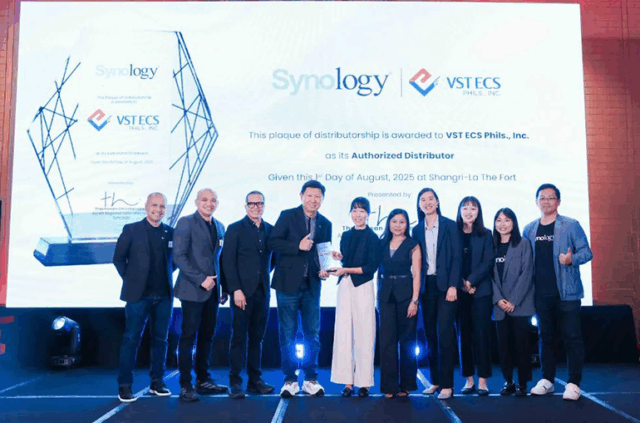
Synology partners with VST-ECS to expand distribution network in the Philippines

Jimmy Go, president and CEO of VST ECS Phils., receives the Plaque of Distributorship from Thachawan Chinchanakarn, ASEAN regional sales manager of Synology, together with the VST ECS and Synology team. In photo, from left to right: Gary Del Castillo, assistant manager, Technology Product and Support Group A, VST ECS Phils.; Dave Esmama, sales and marketing manager, Corporate Business Group 5, VST ECS Phils.; Paul M. Alcantara, 1st vice-president and group general manager, Volume Business Group, VST ECS Phils.; Jimmy Go, president and CEO, VST ECS Phils.; Thachawan Chinchanakarn, ASEAN regional sales manager, Synology; Maybel Estipular, manager, Technology Product and Support Group A, VST ECS Phils.; Claire Huang, country manager for the Philippines, Synology; Evonne Tu, regional marketing manager, Synology; Tiffany Mi, marketing manager for the Philippines, Synology; and Adrian Hsieh, solution team lead, Synology

Synology, Inc., a global leader in networkattached storage (NAS), data protection, and hybrid cloud solutions, today announced the appointment of VST ECS Phils., Inc. as its official distribution partner in the Philippines. This partnership marks a significant milestone in Synology’s commitment to expanding its local presence and accelerating access to secure, scalable, and high-performance data infrastructure across the country.

As digital transformation accelerates across industries in the Philippines, organizations face increasing challenges in securing, managing, and scaling their data infrastructure. Modern organizations require more than just basic storage — they need an end-to-end infrastructure that combines centralized data storage, automated backup, hybrid cloud integration, and built-in cybersecurity features.

VST ECS will distribute Synology’s complete portfolio of solutions, including its network-attached storage (NAS), comprehensive data backup and recovery solutions, surveillance systems, as well as business productivity solutions. These solutions empower organizations to streamline IT operations, enhance data protection, and improve overall productivity.

“We’re excited to strengthen Synology’s footprint in the Philippines through this partnership with VST ECS. With their extensive distribution network and deep local expertise, we expect connections with more organizations, accelerated market growth, and increased delivery of enterprise-grade data solutions to the vast market,” said Claire Huang, Synology’s country manager for the Philippines.

“Our collaboration with VST ECS reinforces our long-term commitment to supporting the Philippines’ digital growth. Together, we aim to empower organizations of all sizes with reliable, innovative, and future-ready IT solutions that strengthen the country’s technological capabilities and accelerate its digital transformation,” said Thachawan Chinchanakarn, ASEAN regional sales manager at Synology.

With its extensive nationwide reach and in-depth understanding of local market needs, VST ECS is well-positioned to bring Synology’s solutions to a broad range of business users, helping them build secure, scalable, and intelligent IT environments.

“As the country’s leading ICT distributor, VST ECS plays a pivotal role in empowering organizations with the right technologies to modernize infrastructure and future-proof operations. Our partnership with Synology allows us to deliver a comprehensive suite of solutions that simplify data management, enhance protection, and support seamless hybrid cloud adoption. Backed by our nationwide channel network and deep technical expertise, we are committed to expanding Synology’s presence and enabling more organizations to build agile, secure, and scalable IT environments,” said Jimmy D. Go, president and CEO of VST ECS Phils., Inc.

This collaboration is part of Synology’s broader initiative to deepen its footprint in Southeast Asia by strengthening its local partner ecosystem and ensuring easier access to enterprise-grade data solutions.

About Synology

Synology, Inc. is a global leader in network-attached storage (NAS) and data management solutions, providing businesses with innovative, reliable solutions to protect and manage their data. Synology’s advanced products are trusted by organizations worldwide to secure and optimize their critical data. For more information, please visit https://www.synology.com/en-ph.

About VST-ECS Philippines

VSTECS Philippines is the leading and largest ICT distributor in the country, recognized for its extensive portfolio of products, solutions, and services across diverse market segments. Our portfolio is unparalleled, representing over 100 renowned brands and encompassing a wide range of technology solutions. Our meticulously tailored solutions serve the retail, mobility, commercial, and enterprise markets, precisely meeting industry-specific requirements and driving innovation across sectors. For more information, please visit https://www.vstecs.com.ph/.


Spotlight is BusinessWorld’s sponsored section that allows advertisers to amplify their brand and connect with BusinessWorld’s audience by publishing their stories on the BusinessWorld Web site. For more information, send an email to online@bworldonline.com.

Join us on Viber at https://bit.ly/3hv6bLA to get more updates and subscribe to BusinessWorld’s titles and get exclusive content through www.bworld-x.com.

Iriga university says gov’t subsidy, non-profit model drive more students to private schools

University of Sainty Anthony (USANT) President Emmanuel "Mickey" SD. Ortega during a media briefing in Quezon City. | Photo by Almira Louise S. Martinez, BusinessWorld

Non-profit initiatives and government subsidies are helping attract more students to private schools amid a nationwide decline in enrollment, according to the University of Saint Anthony (USANT) in Iriga City.

“Under the Tertiary Education Subsidy, the cities without any SUCs (state universities and colleges), students who are residents of the city were given a subsidy,” USANT President Emmanuel “Mickey” SD. Ortega told BusinessWorld in an interview.

“Essentially, that allows students who normally can’t afford a private education they are able to go to a private institution,” he added.

The Tertiary Education Subsidy (TES) program under the Commission on Higher Education (CHED)’s Unified Student Financial Assistance System for Tertiary Education (UniFAST) is a “grant-in-aid program that supports the full or partial cost of tertiary education of priority students in SUCs, CHED-recognized local universities and colleges (LUCs) and private higher education institutions (HEIs).”

Mr. Ortega said that, in addition to the TES, the government should “give more subsidies to non-profit (private) institutions to help them to be on par with the DepEd (Department of Education) and CHED regulations,” ensuring that they continue to provide quality education.

In a report by the Philippine Institute for Development Studies (PIDS) on August 4, 200 private HEIs nationwide have shut down operations due to enrollment decline influenced by the free tuition in SUCs, LUCs, and state-run Technical-Vocational Institutions.

“While free tuition has made education more accessible, it has also redirected enrollment away from private HEIs, putting their financial viability at risk,” the agency added.

Apart from financial assistance from the government, non-profit models can give private institutions a competitive edge in drawing students, according to Mr. Ortega.

“Ours is doing alright, attracting a lot of enrollment because of the ecosystem of how a non-profit works, where 100% of the profit goes back to the university,” he said.

In a regular for-profit private college, part of the net income is distributed among its stockholders. Meanwhile, for non-profit institutions, the board of trustees is not entitled to any of the profit.

“[It] allows us to innovate faster when it comes to salary and wages, benefits, infrastructure, events, and even calamity efforts,” the university president said.

USANT’s enrollment growth increased by 58.7% from 2020 to 2025. The ongoing enrollment in the private university for the school year 2025-2026 sees a 5.9% increase in basic education enrollees and a 6.9% increase in college enrollees compared to the previous school year. – Almira Louise S. Martinez

Building sustainable economic estates

“Sustainability must be integrated into the planning and development processes to ensure the long-term viability of economic estates, according to Monica L. Trajano, vice president for commercial strategy at Aboitiz InfraCapital Economic Estates. She said that the company, along with its co-developers nationwide, has to collaborate with the government to advance the green economy in the Philippines.

Interview by Patricia Mirasol
Video editing by Jayson Mariñas

42% of Filipinos drink less alcohol – study

WIL STEWART-UNSPLASH

According to market research firm CGA by NIQ, 42% of Filipino drinkers have reduced their alcohol consumption—significantly above the Asia-Pacific average decline of 30%.

“The shift toward mindful consumption is not a passing trend, but a cultural reset that’s redefining how, when, and why people drink,” CGA by NIQ Head of On Premise APAC James Phillips said in a news release.

The research found that several factors impact alcohol moderation across APAC. Prioritization of well-being at 41% remains a key driver for the reduced intake, followed by cost-cutting measures at 25% to save more money.

The study added that while some are completely avoiding alcohol, 31% of those who still drink in moderation prefer to only drink on special occasions.

Meanwhile, 32% of APAC alcohol consumers have tried a low-alcohol or alcohol-free drink at a bar, restaurant, or similar venue. Among all of the alcohol-free categories, beer is the most appealing drink ahead of wine and spirits.

“It presents big challenges for suppliers, manufacturers and operators, including the need to cater for moderating guests without alienating core consumers,” Mr. Philips said.

“Brands that can gain a deep understanding of this complex recalibration and adapt nimbly will be the ones that stay relevant in the months and years ahead,” he added.


Young alcohol drinkers

Donnabel Tubera-Panes, medical officer IV of Baguio City Health Services Office, said in a webinar hosted by the National Institutes of Health – Health Promotion Program (NIH-HPP) in April that monthly alcohol consumption among 10 to 19-year-old Filipinos doubled from 2021 to 2023.

This phenomenon among the youth is associated with impaired brain functions such as reduced emotional and behavioral control, decreased coordination, slowed breathing, and slowed heart rate, the NIH-HPP said in a Facebook post.

“Advocates stress that no level of alcohol consumption is truly safe,” it said. “To reduce the risk of disease and protect quality of life, they urged the public to choose an alcohol-free lifestyle.”

The group added that the government must also strengthen public health measures by increasing excise taxes on alcohol, as well as tobacco and vape products, which pose significant threats to the health of the people.

In the 2026 Budget of Expenditures and Sources of Financing (BESF), the government projects to collect ₱359.65 billion in excise taxes on selected goods, up 9.35% from this year’s ₱328.9 billion.

The Bureau of Internal Revenue (BIR) said on Monday that it expects to collect P132.07 billion in excise taxes from alcohol products, and P42.09 billion from sugar-sweetened beverages. – Almira Louise S. Martinez

ADVERTISEMENT
ADVERTISEMENT