Home Blog Page 1009

Closing the $1.5-trillion gap: How FDI can help achieve the SDGs in Asia and the Pacific

STOCK PHOTO | Image by Studiogstock from Freepik

By Heather Lynne Taylor-Strauss and Eiichiro Takinami

OVER THE PAST two decades, foreign direct investment (FDI) has been the single largest and most stable source of external development capital in Asia and the Pacific (see the figure). In 2022 alone, FDI flows into the region exceeded $300 billion, outpacing official development aid (ODA), remittances and portfolio investment flows. Even in 2023, when global investment slowed under higher interest rates and geopolitical uncertainty, FDI into the region remained close to $290 billion.

For a region facing a $1.5-trillion annual financing gap to achieve the Sustainable Development Goals (SDGs), this is more than a statistic. It is a reminder that the future of development finance and achievement of the 2030 Agenda for Sustainable Development depends on whether countries can effectively attract and channel FDI. From the Addis Ababa Action Agenda (AAAA) in 2015 to the most recent Sevilla Commitment agreed at the International Conference on Financing for Development (FFD4), the global community is aligned to leveraging FDI for sustainable development. In fact, the Sevilla Commitment elevated the role of FDI. While the AAAA positioned FDI as complementary to public finances for sustainable development, the Sevilla Commitment identified FDI as a key source of development capital, devoting an entire subsection to scaling up FDI.

ODA, portfolio investments, and remittances all play important roles. But none match the stability, scale, or transformative power of FDI. While ODA is vital for humanitarian and social priorities, donor budgets are increasingly squeezed by competing demands such as defense spending and climate adaptation. Portfolio investments represent a large volume but are more susceptible to global economic events and often seek short-term returns. Personal remittances are stable and sustain household welfare. However, remittances are primarily consumption-oriented and often are not channeled to building productive capacity. FDI is different. It can build renewable energy plants, expand digital infrastructure, and create jobs. It is not just money flowing in; it is productive capital tied to long-term development.

Nonetheless, not all FDI is equal. Its impact depends on whether investments are effectively channeled towards SDG priorities. To accomplish this, investment promotion agencies (IPAs), with their mandates to promote, attract, and facilitate FDI, play a crucial role. With the right strategies and tools, IPAs can ensure that the FDI contributes to sustainable development needs.

The following three areas are particularly important for action by the IPAs.

1. Aligning and implementing IPA’s investment attraction strategies with SDGs. IPAs need to create medium-term investment promotion and attraction strategies that are aligned with their SDG priorities. This involves IPAs finding their country’s “niche” target sectors to attract investments. Aligning strategies with the SDGs is essential because many corporate investors now value alignment as part of their ESG investment criteria. Over the past several years, ESCAP — the United Nations Economic and Social Commission for Asia and the Pacific — has supported its member States in developing and implementing practical, targeted investment promotion and attraction strategies. These projects have enabled IPAs to narrow their focus, identify niche opportunities, and connect with high-potential investors.

2. Leveraging regional cooperation on investment promotion. While IPAs often compete for investors, regional cooperation can be even more powerful — especially in attracting cross-border investments that require scale. By pooling markets and aligning promotion efforts, countries can present themselves not as fragmented destinations but as part of a larger, integrated investment destination. This approach not only makes the region more attractive to global investors but also enables each country to highlight its comparative strengths within wider value chains.

ESCAP has been at the forefront of advancing such cooperation. In Southeast Asia, the ASEAN Regional Investment Promotion Action Plan (RIPAP) 2025-2030 was endorsed by all ASEAN member States as the first region-wide initiative to jointly promote investment opportunities. In Central Asia, ESCAP and the International Islamic Trade Finance Corporation launched the Boosting Exports through FDI program, which helps countries attract investment that strengthens regional value chains and to become more competitive.

Regional collaboration of this kind demonstrates that cooperation — not just competition — can unlock larger, more sustainable flows of FDI.

3. Developing impact measurement tools. Developing and utilizing impact measurement tools can help IPAs demonstrate how their work is contributing to advancing the SDGs. With database systems and tools, IPAs can track growth in sectors like green industries or progress on digital transformation, making their impact more visible. For example, Investment Fiji has tailored its Customer Relationship Management system to more effectively monitor how the investment they have helped facilitate contributes to the SDGs.

As traditional development aid budgets plateau, FDI remains the most stable and transformative capital for building productive capacity. FDI has already been instrumental in driving SDGs in areas such as transitioning to clean energy, accelerating digital connectivity, and generating decent jobs needed for inclusive growth. But to fully realize this potential, governments and IPAs must be strategic, collaborative and impact-driven.

ESCAP stands ready to support its member States and their IPAs in developing and implementing FDI promotion and attraction strategies aligned with SDGs.


Heather Lynne Taylor-Strauss is the Economic Affairs Officer while Eiichiro Takinami is a Junior Economic Affairs Officer at ESCAP.


Home Credit eyes P100-billion loan receivables this year

HOMECREDIT.PH

HOME CREDIT PHILIPPINES is targeting P100 billion in loan receivables by the end of 2025, supported by a growing customer base, expanding partner stores, and manageable non-performing loans (NPLs).

“As of the end of 2024, our loan receivables were at about P74 billion,” Sheila A. Paul, chief marketing officer at Home Credit Philippines, said on the sidelines of a press event on Thursday. “

As of June 2025, it is P85 billion already. And we’re hoping to hit the magic P100 billion within the year.”

The consumer finance company recorded 12.2 million customers as of July, up from 11 million in October last year. “It is increasing faster than last year … So, it actually signifies we’ve made a lot of progress on making our products more accessible,” Ms. Paul said.

Home Credit also expanded its partner stores to 18,000 from 16,000 last year, alongside a growing sales associate network that now totals 10,000. Its top-selling products remain televisions, air conditioners, and refrigerators, with rising demand for inverter technology helping customers lower electricity costs.

Smartphone financing is expected to reach P20 billion this year, double last year’s P10 billion, with iPhones remaining the top choice among consumers upgrading to premium devices.

The company’s NPL ratio remains below 10%, still higher than traditional banks but considered manageable. “Of course, the lower, the better. But as long as we’re able to manage it within that threshold, I think we are fine,” Ms. Paul said.

She added that the company does not require additional safeguards at present but will review its strategy if market conditions change.

Home Credit is also anticipating strong sales during the Christmas season, its historically busiest period. “So I think it is also going to be the same this year, and so we expect to hit our targets for the year,” Ms. Paul said. — Justine Irish D. Tabile

Toronto Film Festival: Bumble biopic Swiped takes on Silicon Valley ‘boys club’

Lily James in Swiped (2025)

TORONTO — The new biopic Swiped, starring British actor Lily James as dating app Bumble founder Whitney Wolfe Herd, takes the audience back to Silicon Valley in the early 2010s, before swiping left or right had anything to do with match-making.

Directed by Rachel Lee Goldenberg, the film follows Wolfe Herd’s journey through a male-dominated tech industry, leading her to launch Bumble — but not before her contentious departure from rival app Tinder, which she co-founded.

“Seeing Whitney go through an experience where she starts out working within the status quo and playing into the boys club… and then realizing what was wrong with that and being able to turn it all around and create her biggest success… I think that’s a really helpful path for all of us,” Ms. Goldenberg told Reuters before the movie’s world premiere at the Toronto International Film Festival on Tuesday.

Bumble, which launched in 2014, stood out from competitors by requiring women to make the first move by writing to their matches first.

Ms. Wolfe Herd was not involved in the making of the film because of a nondisclosure agreement she signed in her settlement with Tinder.

“The filmmakers and the writers drew everything from the public domain in order to tell this story,” Ms. James told Reuters.

“(They) spent a lot of time developing this story to make it feel as real and deep and true to her story as we possibly could, and I loved doing the research. It was a brilliant part of the process.”

Online dating apps have struggled in recent years to retain audiences, especially Gen Z users. In June, Bumble announced it would lay off nearly a third of its workforce.

Swiped will start streaming globally on Disney+ and Hulu on Sept. 19. — Reuters

Fearless Justice Conchita Carpio-Morales

It was more than a book launch — it was a tribute to courage, industry, and integrity. Held July 16 at the Makati Shangri-La, former Ombudsman and Supreme Court (SC) Justice Conchita Carpio-Morales launched her memoir titled Neither Fear Nor Favor published by Milflores Publishing, Inc. before a full house of legal luminaries (including former Chief Justice Art Panganiban, Justice Antonio Carpio, Former Senator Frank Drilon and Mila), media leaders (Rappler’s Maria Ressa, Vergel Santos and Chit), family, and friends (like former Bangko Sentral ng Pilipinas Governor Say Tetangco and Elma, Lita Salvador, her sister Marylou, Juliet Evangelista), among others.

The event featured a brief talk by author Jose “Butch” Dalisay, followed by a lively and witty Q&A led by Rappler Senior Investigative Reporter Lian Buan. Paterno Esmaquel II, also of Rappler, moderated an open forum where Justice Chit’s classmate, former BIR Commissioner Liwayway Chato, Kababayan Dr. Joven Cuanang of St. Luke’s, and Dr. Antonio Calanoc of Asian Hospital reflected on their personal encounters with her.

Her career spans from the Department of Justice, Court of Appeals, the Supreme Court, and Ombudsman and characterized by her unwavering commitment to justice, transparency, and ethics. She said she enjoyed her years as a trial judge where she personally prepared her own decisions. Her discernment was sharp — she based her decisions on facts and appreciation of witness credibility. She noted that “having a good lawyer really matters.”

Former UP Law Dean Fides “Deng” Cordero Tan said, “Lawyers dream of becoming Supreme Court Justice because the court is a place of honor for lawyers and there is nothing higher.” During the administration of President Gloria Arroyo in 2002, whom she has not met before, she was appointed Associate Justice of the Supreme Court. Since the Court’s founding in 1901 headed by the first Chief Justice Cayetano Arellano until 2023, there have been 195 Justices, and only 18 were women. At the SC, her being a woman was not a factor in her discharge of duties. She said there was no advantage to being a woman, although male colleagues treated her like a “fragile egg.”

William Gladstone said, “Justice delayed is justice denied.” Under the Constitution, you’re supposed to decide a case within two years of submission. Being a hard and conscientious worker, by the time Justice Chit retired in 2011, her docket was spotless, with not a single case left pending. The timely delivery of justice helped build confidence in her swift resolution of grievances.

Justice Chit is a “sis” of my sister Carolina “Kay” Jimenez in the UP Phi Delta Sorority and my “roommate” Ed, a UP Alphan, was her “brod.” In 2019, it was an honor for me to be a judge of The Outstanding Women in the National Service (TOWNS) with Justice Chit, together with PEZA’s Lilia De Lima. Perhaps I was drawn to Justice Chit as her character is like that of my mother, Carolina “Arling” Gozon — courageous, no-nonsense, and speaks her mind. Justice Chit said, “Courage runs in the Carpio women from childhood. We were taught to fend for ourselves.”

Her distinguished career and outstanding accomplishments in the field of law with unquestionable integrity and fearless dispensation of justice earned Justice Chit many awards. This included Asia’s version of the Nobel Prize, the prestigious Ramon Magsaysay Award in 2016. In her acceptance speech, always asked why she continued to serve even after her retirement, she revealed her secret: her inspiration from where she draws her energy are her grandchildren Ennio and Cece “because I want to secure a just and honest society for you and every Filipino child.”

Her greatest legacy may be the generations she inspired. Former SEC Commissioner Ephyro “Eph” Amatong called her “a living embodiment of what a Justice should be. She commands respect — not with force, but with principle. Her staff had to constantly be on their toes and get the job done according to her high standards.  No political agenda — she just does her job well and with integrity. Globally recognized anti-corruption expert Ed Cid Butuyan, echoed that view: “Justice reform is slow and cyclical. It’s easy to give up. But if you have a sense of justice and purpose, you can move mountains — as Justice Chit did.”

Dean Fides noted that “what sets Justice Chit apart isn’t her razor-sharp legal mind — it’s her fearless spirit. She fears only God. Nothing else.” The book Neither Fear Nor Favor is a declaration of how Justice Conchita Carpio-Morales lived and served our country. Thank you, Justice Chit! How I wish there were more of you!

The views expressed herein are the author’s own and do not necessarily reflect the opinion of her office as well as FINEX.


Flor G. Tarriela is a banker and an environmentalist/gardener. She founded Flor’s Garden in Antipolo, an events destination and an accredited ATI National Extension Service Provider

Chip in with Taiwan: A capable friend for the Philippines and a partner in shared prosperity

STOCK PHOTO | Image by Jcomp from Freepik

By Wallace Minn-Gan Chow

AS THE INDO-PACIFIC region faces mounting turbulence, Taiwan and the Philippines should stand shoulder to shoulder, not just as neighbors across a narrow strait, but as brothers connected through shared Austronesian roots, democratic values, and common struggles. Today, the Philippines deserves capable friends who bring solutions, not coercion. Taiwan, with its proven resilience and unmatched innovation, the path for the Philippines forward is clear: it is time to chip in with Taiwan.

CLOSE IN DISTANCE, CLOSE IN BLOOD
Filipinos and Taiwanese share Austronesian roots, proving that our ties are not only geographic but also deeply human. Today, this kinship extends to politics and security: two vibrant democracies facing the same pressures from a big neighbor’s authoritarian playbook.

The people of Batanes in the northern Philippines (Ivatan) and the Lanyu in Taiwan (Tao/Yami) share a remarkable cultural and linguistic connection. Their languages echo one another, sharing about 65% lexical similarity, their traditions of seafaring and stone houses reflect shared ways of life, and their genes still carry traces of an ancient connection. More than neighbors, they are extended family linked by history, culture, and a friendship as enduring as the ocean that unites them.

A NATURAL SEMICONDUCTOR PARTNERSHIP
According to Moody’s ratings, the Philippines is emerging as Southeast Asia’s hub for semiconductor assembly and testing, with the sector already accounting for 32% of exports in 2024. Taiwan, meanwhile, produces over 90% of the world’s most advanced chips and leads in innovation and design.

Together, our strengths are complementary. Taiwan brings cutting-edge R&D and front-end manufacturing, while the Philippines offers downstream capacity and a young, dynamic workforce. By cooperating, Manila and Taipei can build a “non-red supply chain” that resists authoritarian capture and sustains global prosperity.

THE LUZON ECONOMIC CORRIDOR: A DEMOCRATIC LIFELINE
The Philippines, the United States, and Japan have launched the Luzon Economic Corridor to strengthen regional integration. With Taiwan’s participation, this corridor could become a democratic lifeline, linking Filipino labor, Taiwanese innovation, and allied investment into a resilient economic artery.

For the Philippines, this means jobs and inclusive growth. For Taiwan, diversification and security. For the world, a supply chain not held hostage by coercion.

RELIABLE BUT STILL EXCLUDED
Taiwan has consistently proven it is more than capable of contributing to the global commons. From pioneering smart healthcare and clean energy to advancing the UN Sustainable Development Goals, Taiwan’s footprints of friendship is everywhere.

And yet, Taiwan remains blocked from the United Nations system, silenced by Beijing’s distortion of UN General Assembly Resolution 2758. That resolution decided only who would represent China in the UN. It said nothing about Taiwan’s sovereignty, nor did it authorize Beijing to speak for the 23 million Taiwanese people. That misuse must end.

The tide is turning. The United States, Australia, the Netherlands, Belgium, the UK, and the European Parliament have all affirmed that UNGA Resolution 2758 does not determine Taiwan’s status and should not exclude it from international organizations. The US went further, passing the Taiwan International Solidarity Act in 2023 to counter Beijing’s misuse of UNGA Resolution 2758.

Even UN Deputy Secretary-General Amina J. Mohammed admitted that leaving out Taiwan contradicts the UN’s pledge to “leave no one behind.”

Across the world, voices are asking: does clinging to Beijing’s “One China Policy” serve national interests, or does it simply entrench dependence on a power that disrespects rules-based international order? For the Philippines, the answer is clear.

STRONGER TOGETHER
The Philippines and Taiwan are partners by destiny. Close in distance, connected by blood, and united by democracy, we are stronger together.

The United Nations must end Taiwan’s exclusion and honor its promise to “leave no one behind.” For the Philippines, chipping in with Taiwan means standing for peace, democracy, and resilience in the face of coercion.

Taiwan is offering friendship, capability, and commitment. To chip in with Taiwan is to build a future where nations thrive together, not under the shadow of intimidation, but in the light of mutual respect and shared prosperity.


Wallace Minn-Gan Chow is the Representative of the Taipei Economic and Cultural Office in the Philippines.

On free meals at work

Some companies offer workers free breakfast and even buffet lunches. I don’t understand this practice. Why can’t they simply raise salaries? Could you help me make sense of this policy? — Black Lotus.

The idea of providing free meals is a recruitment and retention strategy adopted by Silicon Valley. Such strategies have also been justified as a motivational tool, ensuring loyalty and productivity.

Free food may look like corporate generosity, but it’s not. Rather, it’s a practice that can’t be easily copied by competitors. Google, for one, offers almost everything, including vegan dishes and energy-boosting smoothies.

By keeping their employees onsite, Google minimizes lunch-hour escapes that eat into working hours. A study by ezCater’s Food for Work Report 2024 found that employees receiving free meals at work can save more than 30 minutes per working day. Multiply that across thousands of workers, and you’ll understand the value of hot meals as a smart investment.

In the Philippines, such trends have trickled down to certain BPOs in Metro Manila and other industries. Companies like Transcom offer free meals to employees with perfect attendance through its “Rewards Card” system. This improves retention in an industry notorious for attrition rates as high as 40%.

Outside of the BPO industry, EEI Corp., a major construction firm, spends P580 million annually on free meals for workers.

Japanese companies based in the Philippines also offer free meals, but take a different approach. One electronics manufacturer gives the equivalent of P2,000 as a monthly meal allowance per worker, which is administratively easy to do. 

One electronic components factory with more than 3,000 workers spends about P30 per meal for lunch, in addition to free coffee during breaks. A Japanese mobility company used to give free unlimited rice to more than 2,000 regular workers until the practice was discontinued due to waste.

They replaced it with a meal allowance of P175 per person for every eight hours of work. That means P3,500 allowance for a minimum of 20 working days per month.

In all these, the underlying message is simple. Well-fed workers make fewer mistakes. In industries where precision matters, a good meal is cheaper than rework or accidents.

POWER PRINCIPLES
The offerings of these Philippine-based companies may not be as glamorous as Silicon Valley sushi, but the power principle is the same — to keep their workers healthy, energized, and physically present all the time. For many people, free meals or cash allowance represent a meaningful financial cushion.

A free or subsidized lunch is money saved, which adds up over time. That’s a form of financial wellness. So, why would companies spend millions feeding their people instead of simply raising salaries? The answer lies in the following:

One, improved labor productivity. Employees who don’t waste time commuting or even walking some distance for food are more focused. In situations where every second counts, like customer service or assembly lines — time saved is money earned.

Two, cultural engagement. Meals create communal spaces. In the Philippines, where “salo-salo” (food sharing) is cultural, communal eating builds a family-like atmosphere, akin to the traditional practice of laying out a single, bountiful spread of food and eating on banana leaves.

Three, talent magnet. Free meals make a difference for job applicants. It’s an attractive perk for both fresh graduates and seasoned professionals. For millennials and Gen Z workers, who prefer enriching work experiences over cash, enjoying free meals signals the employer’s dynamism.

Four, health is wealth. Companies that control the menu can influence healthier choices, reducing sick days. A balanced diet beats unhealthy instant noodles and dried fish. And while offering free unlimited rice is attractive, a healthier option might be one free cup and a subsidized second cup.

Five, cost-effective loyalty. Free meals may actually cost less than frequent salary hikes. For example, providing lunch for P100 daily adds up to P2,200 monthly per employee. Compare that with across-the-board salary increases, which become part of fixed payroll obligations, like bonuses.

RISKS AND REALITIES
But not all is gravy. There’s a fine line between providing free meals as a genuine benefit and using it as a solution for deeper issues. Employees may appreciate the perk, but if workloads are unbearable, managers are toxic, or salaries become stagnant, no amount of free adobo and kare-kare will solve morale problems.

What matters is the intent — showing employees they are valued beyond spreadsheets.

Free meals keep people healthier, happier, and loyal. They reduce downtime, encourage collaboration, and help companies stand out in the talent market. Because sometimes, the best way to feed a company’s bottom line is to first feed its workers.


Join our Oct. 17, 2025 public workshop on “How to Detect and Investigate Employee Fraud.” For details, e-mail operations@reyelbo.consulting or register via https://reyelbo.com/contact-us

PLDT, gov’t agencies launch unified 911 emergency response system

The Unified 911 is a joint initiative of the Department of the Interior and Local Government (DILG), the Bureau of Fire Protection (BFP), PLDT Inc. (PLDT), through its corporate business arm PLDT Enterprise and ICT subsidiary ePLDT, NGCS Inc., and NGA 911 Philippines, the local arm of US-based NGA 911 LLC.— NGA 911 PHILIPPINES

PLDT INC., led by Manuel V. Pangilinan, partnered with the Department of the Interior and Local Government (DILG) and the Bureau of Fire Protection (BFP) to launch a unified 911 emergency response hotline.

“At its core this is a promise made by the government to its citizens… that in times of danger, Filipinos can call one number, and find assistance and help,” Mr. Pangilinan said on Thursday.

The system, rolled out through PLDT units PLDT Enterprise and ePLDT, Inc., modernizes 911 call handling and integrates police, fire, medical, and rescue services into a centralized, technology-enabled platform. It links national agencies with local government units (LGUs) for faster, more coordinated response.

Features include multiple reporting channels, live video streaming, centralized data reporting on ePLDT’s Pilipinas Cloud, GPS-based location tracking of callers and responders, geo-fencing, and integration with CCTV systems of national and local agencies, PLDT said.

“By collaborating with the government, which includes our active engagement with the Private Sector Advisory Council (PSAC), PLDT is shaping a future where technology drives smarter governance, faster response, and stronger communities,” Chief Operating Officer Menardo G. Jimenez said.

PLDT will also provide command centers for the system at strategic locations, including the National Command Center, the BFP Command Monitoring Center, major regional hubs in Cebu and Cagayan de Oro, and seven satellite centers.

Hastings Holdings, Inc., a unit of the PLDT Beneficial Trust Fund subsidiary MediaQuest Holdings, Inc., holds a majority stake in BusinessWorld through the Philippine Star Group. — Ashley Erika O. Jose

The (fashion) show must go on, despite death of Giorgio Armani

DESIGNER Giorgio Armani appears on the runway at the end of the Giorgio Armani Fall-Winter 2025/2026 menswear collection during Milan Fashion Week in Milan, Italy on Jan. 20. — REUTERS FILE PHOTO/ALESSANDRO GAROFALO

MILAN — The Emporio Armani and Giorgio Armani fashion shows will take place later this month as scheduled, despite the recent death of the company’s founder and creative director, the Italian luxury group said on Wednesday.

Giorgio Armani died last week at the age of 91.

The group also confirmed the opening of a retrospective exhibition to celebrate the company’s 50th anniversary, during Milan Fashion Week.

“The regular staging of the fashion shows and the inauguration of the exhibition, on which Giorgio Armani worked until the very end, reflect the company’s determination to carry forward a legacy of commitment, respect, and dedication to work, values that have always defined Mr. Armani,” the group said in a statement. — Reuters

How PSEi member stocks performed — September 11, 2025

Here’s a quick glance at how PSEi stocks fared on Thursday, September 11, 2025.


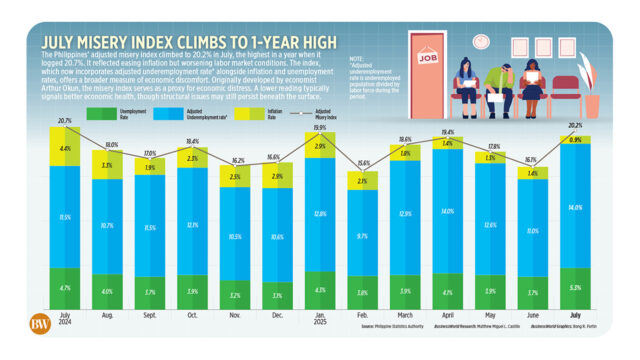
July Misery Index climbs to 1-year high

The Philippines’ adjusted misery index climbed to 20.2% in July, the highest in a year when it logged 20.7%. It reflected easing inflation but worsening labor market conditions. The index, which now incorporates adjusted underemployment rate* alongside inflation and unemployment rates, offers a broader measure of economic discomfort. Originally developed by economist Arthur Okun, the misery index serves as a proxy for economic distress. A lower reading typically signals better economic health, though structural issues may still persist beneath the surface.

July Misery Index climbs to 1-year high

Manila rejects Beijing plan to set up nature reserve at Scarborough Shoal

A LANDSAT 7 image of Scarborough Shoal in the South China Sea. — WIKIPEDIA

By Adrian H. Halili and Kenneth Christiane L. Basilio, Reporters

THE PHILIPPINES on Thursday rejected China’s plan to set up a national nature reserve at Scarborough Shoal, saying it is “patently illegal.”

In a statement, National Security Adviser Eduardo M. Año said the plan is a strategic move to project greater control over the rocky atoll, a prime fishing patch located within the Philippines’ 200-nautical mile (370 kilometers) exclusive economic zone.

“This move by the People’s Republic of China is less about protecting the environment and more about justifying its control over a maritime feature that is part of the territory of the Philippines,” he said.

“It is a clear pretext towards eventual occupation,” he added.

The Chinese Embassy in Manila did not immediately reply to a Viber message seeking comment.

Mr. Año said the plan violates the United Nations Convention on the Law of the Sea (UNCLOS), the 2016 arbitral ruling by a United Nations-backed tribunal and the 2022 Declaration on the Conduct of Parties.

The Department of Foreign Affairs (DFA) in a separate statement said it would file a formal diplomatic protest against the plan.

“The Philippines will be issuing a formal diplomatic protest against this illegitimate and unlawful action by China as it clearly infringes upon the rights and interests of the Philippines in accordance with international law,” the agency said in a statement.

Beijing recently approved the creation of the reserve at Scarborough Shoal — which Manila calls Bajo de Masinloc — one of the most contested areas in the South China Sea.

China’s State Council said the nature reserve is an important measure to maintain the “diversity, stability and sustainability of the natural ecosystem” of the maritime feature.

The reserve will cover more than 3,500 hectares at Huangyan Island, the Chinese name for Scarborough Shoal, with its coral reef ecosystem as the main protection target, according to China’s National Forestry and Grassland Administration.

The DFA said it “strongly protests” the move, stressing that the shoal is “a long-standing and integral part of the Philippines over which it has sovereignty and jurisdiction.”

“The Philippines likewise has the exclusive authority to establish environmental protection areas over its territory and relevant maritime zones,” it said. “Refrain from enforcing and immediately withdraw its State Council issuance and comply with its obligations under international law.”

Scarborough Shoal, located about 120 nautical miles (222 kilometers) off Zambales province, has been under de facto Chinese control since 2012.

In 2016, a Hague-based arbitral tribunal voided China’s sweeping South China Sea claims, but Beijing has ignored the ruling.

The South China Sea has become a regional flashpoint as China continues to assert its sweeping claim over almost the entire sea, a vital global trade route that is also believed to be rich in undersea gas and oil deposits.

‘EFFECTIVE PUSHBACK’
Manila and Beijing have repeatedly locked horns over maritime features that both nations claim in the disputed waters, including Scarborough Shoal. The atoll lies about 222 kilometers west of Luzon Island and is nearly 900 kilometers away from Hainan, the nearest major Chinese landmass.

Access to Scarborough has been restricted after China seized control of the atoll in 2012 following a standoff with Philippine forces.

The Philippines brought its dispute over the contested shoal to a UN-backed tribunal in 2013, which ruled in 2016 that China had interfered with Filipino fishermen’s access to the area.

But sovereignty over the rocky atoll remains unresolved as the ruling did not assign ownership despite voiding China’s expansive South China Sea claims.

The Philippines should strongly respond to China’s plan to put up a national nature reserve in Scarborough Shoal, according to analysts, warning that the move could undermine Manila’s posture in the South China Sea.

They said Beijing is likely testing Manila’s resolve in asserting its claim over the region, and a weak response could embolden China to push similar assertions over other contested maritime features.

“China will likely want to see what the response will be from the Philippines,” Julio S. Amador III, chief executive officer at Manila-based geopolitical risk firm Amador Research Services, said in a Viber message.

“If it sees that there is no effective pushback, then there is a strong possibility that it will try to do the same over other features,” he said.

The Philippines should establish a consistent presence in the shoal amid Beijing’s plan to establish a nature reserve, Sherwin E. Ona, a security analyst and political science associate professor at De La Salle University, said in a Viber message.

“I will not be surprised if China builds structures in Bajo de Masinloc, claiming it to be a fishing sanctuary,” he said.

“We could summon the Chinese ambassador to the Philippines to discuss and shed light upon the matter,” Josue Raphael J. Cortez, a diplomacy instructor at De La Salle-College of St. Benilde’s School of Diplomacy and Governance, said in a Facebook Messenger chat.

The Philippine delegation may also raise China’s reserve plan to both the nation’s bilateral consultation mechanism as it presents challenges to Manila’s sovereignty if enacted, he added.

The bilateral consultation mechanism was established in 2017 amid disputes in the waters where trillions worth of shipborne trade passes through annually.

“If left unaddressed, this may be problematic as to how our two countries will move forward,” said Mr. Cortez.

China’s reserve plan may also stoke further tension in the contested shoal, said Chester B. Cabalza, founding president at Manila-based think tank International Development and Security Cooperation.

“It would make Scarborough a flashpoint area, escalating more chaos with anticipated restriction of access and deprivation of resources,” he said via Messenger chat.

DPWH files graft cases vs 20 workers, 4 contractors over flood control projects

PHILIPPINE STAR/EDD GUMBAN

By Erika Mae P. Sinaking and Kenneth Christiane L. Basilio, Reporters

PUBLIC WORKS Secretary Vivencio “Vince” B. Dizon on Thursday filed criminal complaints against 20 workers and four contractors before the Office of the Ombudsman in connection with anomalous flood control projects in Bulacan province.

“The President told me that everything that needs to be answered should be answered,” he told a news briefing. “Enough talk, enough process, let’s take action, and this is our first action.”

The respondents were accused of graft, malversation and violations of the procurement law. Mr. Dizon said the offenses involve more than P8.8 million, making them nonbailable. “The penalty for all counts of these offenses is life in prison,” he added.

The Department of Public Works and Highways (DPWH) officials charged include former district engineers, assistant engineers, project engineers and cashiers who allegedly authorized questionable payments. Among them are Henry Alcantara, Bryce Erickson Hernandez and JP Mendoza, who have all appeared at a House of Representatives probe of bogus flood control projects.

Four contractors were also impleaded. The charges cover five flood control projects in Bulacan, with evidence gathered over the past week.

Mr. Dizon said more cases would be filed in the coming weeks and vowed full cooperation with the planned independent commission that will probe flood control anomalies nationwide.

“We will serve as a resource for the independent commission. Whatever documents and testimonies they need, we will provide, and we will give full cooperation,” he said.

The secretary also urged citizens to participate in the accountability drive by monitoring projects, checking if they exist on the ground, and submitting documentation of irregularities.

“Let us channel our anger to catch these people,” he said, noting that evidence of unexplained wealth posted on social media could also be submitted.

Mr. Dizon also sought to address concerns of harassment against ordinary DPWH employees, stressing that “just because they are wearing a DPWH uniform does not mean they’re thieves.”

On Wednesday, he issued a memo temporarily suspending the prescribed office uniform amid the ongoing investigation. “It is pitiful… sometimes they get caught, they get harassed when they ride jeeps, buses, the MRT,” he said, citing requests from the DPWH union to protect innocent workers from unfair treatment.

Meanwhile, the Commission on Audit (CoA) has flagged billions of pesos in questionable DPWH disbursements over the past decade.

The agency had issued 10,333 notices worth about P308 billion against DPWH spending since 2010, CoA Chairman Gamaliel A. Cordoba told lawmakers at a House hearing. These include 1,985 disallowance notices worth P5.79 billion, which cover transactions deemed unnecessary, excessive or illegal.

Another 8,294 suspension notices worth P303.67 billion were issued, temporarily holding state spending that may be irregular or unlawful.

CoA also issued 54 charge notices against DPWH worth P8.8 million for unremitted revenues.

The flood control controversy has intensified scrutiny of the agency’s infrastructure projects, long plagued by allegations of corruption and fund misuse.