Home Blog Page 1001

Petron bondholders swap $333M into new notes, tender $54M for cash

PETRON.COM

ANG-LED Petron Corp. reported strong preliminary participation in its recently completed exchange and tender offers for its $550-million 5.95% Senior Perpetual Capital Securities.

As of the Sept. 12 deadline, holders tendered $333.19 million for exchange into new securities and $54.2 million for cash, reducing the outstanding old bonds to about $162.6 million, the company said in a disclosure on Monday.

The exchange and tender offers allow securityholders to either swap existing securities for new ones or sell them back for cash, under the terms outlined in the Exchange and Tender Offer Memorandum. Investors who opt for the exchange will receive $1,000 worth of new securities plus any accrued distributions.

The new senior perpetual notes carry a minimum initial rate of 7.35% per year, up from the previous 5.95%, and include an optional redemption in September 2028.

Petron said the initiative helps optimize its capital structure, extend repayment timelines on existing obligations, and refinance operations, while supporting its fuel, refining, and retail businesses.

The offers were conducted offshore and are not registered for sale in the United States or in jurisdictions where such offers would be unlawful. Completion depends on meeting or waiving financing and other conditions, and the company reserves the right to modify, withdraw, or cancel the offers at its discretion.

On Monday, Petron shares were unchanged at P2.43 apiece. — Alexandria Grace C. Magno

Lola Amour, Kokoro share the stage

LOLA AMOUR

More international collaborations up ahead

FILIPINO pop rock band Lola Amour welcomed a guest to their concert Love on Loop last week — Kokoro of the Japanese pop group PSYCHIC FEVER — who performed with them onstage for two songs.

The concert celebrated Love on Loop, the band’s sophomore album released in August. In it is their joint single with Kokoro, titled “The Moment,” which they performed with him, alongside Lola Amour’s hit single “Raining in Manila.”

For Kokoro (full name: Kohatsu Kokoro), it was an enjoyable experience recording music and rehearsing with the Filipino band.

“What I learned from Lola Amour are the strong vibes of their music and the maturity of their sound,” said Kokoro at a press conference right before the Sept. 12 concert in Makati. His answers in Japanese were translated into English by a live interpreter.

“Before recording, to get the mature vibe of their sound, I experimented with my cup of coffee and pretended it was wine in my hand,” he shared.

Lola Amour frontman Pio Dumayas added that the collaboration was a smooth experience, thanks to the Warner Music team that brought both artists together.

“I was intimidated at first, but now Kokoro is good friends with all of us,” he said.

The band even joked that the recording process for “The Moment,” which was done remotely in Japan and the Philippines, kept up their image as “a serious band” — which shattered, of course, when Kokoro finally met them in person.

For the Japanese artist, the lighthearted demeanor of Lola Amour helped him enjoy the experience of concert rehearsals.

“They have a warm aura and were very kind to me, so I’m thankful for that. It didn’t feel like a job at all. It was fun,” Kokoro said.

Both expressed an eagerness to collaborate again in the future, be it with each other or with more international artists.

The band is already doing collaborations. Aside from Kokoro, Lola Amour’s album Love on Loop, features New Zealand artist Riiki Reid on the track “One Day Away.” Mr. Dumayas explained that their attitude to working with other musicians is always “why not?”

“With this album, every song was personal to us. We wrote it by sitting down, talking about each bandmate’s experience, then writing a song,” he said.

When asked which was his favorite, he pointed to “Dance With My Mistakes” because it “deepens in the context of the other songs.”

“We’re much more ‘adult’ as a band now,” said Mr. Dumayas. “Pre-pandemic, we were just college kids with a hobby. We had to learn to be adults and to be professional, and that’s where we are now.” — Brontë H. Lacsamana

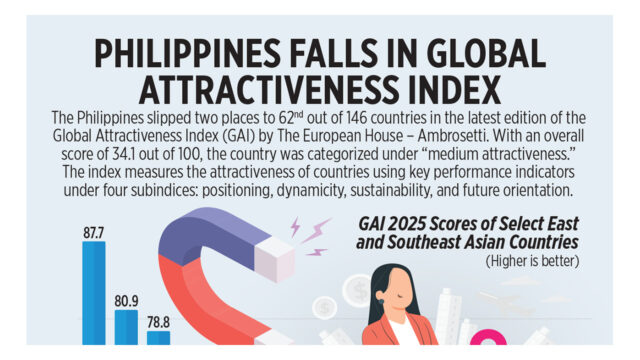
Philippines falls in Global Attractiveness Index

The Philippines slipped two places to 62nd out of 146 countries in the latest edition of the Global Attractiveness Index (GAI) by The European House – Ambrosetti. With an overall score of 34.1 out of 100, the country was categorized under “medium attractiveness.” The index measures the attractiveness of countries using key performance indicators under four subindices: positioning, dynamicity, sustainability, and future orientation.

Overseas Filipinos’ Cash Remittances

Digital terror threats are rising in Southeast Asia

STOCK PHOTO | Image by DC Studio from Freepik

By Karishma Vaswani

INDONESIA hasn’t suffered a major terrorist attack in more than two years. But this calm is deceptive. The threat has shifted online, making it harder to detect, and potentially more insidious.

This isn’t an isolated problem. Islamic State used online radicalization and recruitment to draw fighters to Syria and Iraq, extending its influence to the Sahel and Afghanistan.

But recently the digital terror threat is becoming more urgent in Southeast Asia. Singapore’s latest security assessment warns of a worrying trend of individuals being exposed to extremist groups on social media. Physical training camps or sermons are no longer necessary for the ideology to spread, raising the risk of homegrown attacks, and complicating counterterrorism efforts.

Indonesia and the Philippines remain among some of the most affected by terrorism in the region, along with Myanmar and Thailand, according to the Global Terrorism Index 2025. Jakarta and Manila’s scores improved, but their governments can’t afford to ignore future threats. Radicalization, recruitment, and financing are moving into the digital space, making for a far more challenging enemy.

Southeast Asia’s demographics make it particularly vulnerable. Several nations have among the world’s largest youth populations. With widespread smartphone access and high social media penetration, children and teens are especially exposed. Ignoring this means a new generation could get radicalized well before adulthood.

Still, there are reasons to be cautiously optimistic. Indonesian officials have lauded what’s been dubbed a “Zero Attack” phenomenon since 2023. Last year, Jemaah Islamiyah, once the region’s most feared terrorist group, and responsible for the 2002 Bali bombings, said it was formally disbanding. In the Philippines, the partial decommissioning of the armed wing of the Moro Islamic Liberation Front is encouraging, notwithstanding recent concerns over tensions in the group.

These successes shouldn’t mean complacency. Israel’s war in Gaza, and the sense of injustice it fuels around the Muslim world, is feeding extremist narratives. Online platforms provide ample space for these messages to spread, often beyond the realm of conventional policing.

Funding shortfalls also increase vulnerabilities. Earlier this year, President Prabowo Subianto’s administration announced a budget cut to several agencies, including the National Counterterrorism  Agency. This risks underfunding the institutions vital for detecting future threats.

Indonesia’s next generation of extremists is being groomed digitally. In May, police in South Sulawesi arrested an 18-year-old for spreading Islamic State propaganda online, and threatening bomb attacks on social media. Last year, authorities blocked more than 180,000 online posts linked to intolerance, radicalism, extremism and terrorism originating from radical groups.

The most chilling trend is the targeting of children. Authorities say extremist groups linked to Islamic State are luring minors as young as 12 through digital channels, often without parents and teachers realizing until it’s too late. In Central Java, a young boy joined an Islamic State-linked terror group after being radicalized virtually.

These extremist groups are also exploiting Southeast Asia’s booming digital economy. Online gaming, projected to reach $15.21 billion by 2033, remains underregulated, making it easier for anonymous fundraising, money laundering and illicit transfers.

Indonesia’s counterterrorism strategies have been successful in the past. At one point, the world’s most populous Muslim nation was considered a haven of terror by US and American officials worried about al-Qaeda using it as a base. But after the Bali bombings killed more than 200 people, Densus 88, the nation’s elite counterterrorism unit, cracked down. It dismantled terror networks — sometimes brutally — and forced militants into deradicalization programs.

These methods need to evolve for the modern era. Indonesia “risks facing a new and more complex wave of radicalization,” notes Muhammad Makmun Rasyid, a member of the Bureau for the Prevention of Extremism and Terrorism, at the Indonesian Council of Ulama.

Modern militancy can’t be policed solely by security agencies. It requires a whole-of-society response. Protecting young people will need early detection and education, not punishment. Indonesia’s counterterrorism agency has begun strengthening community-level prevention, but more training for teachers, parents, and religious leaders is vital.

Regional coordination must also deepen. Extremist networks often exploit policy gaps between nations. Countries are already working together to stem terror financing and improve intelligence sharing, but efforts remain fragmented. Cyber cooperation between the 10 members of the Association of Southeast Asian Nations is growing, but the bloc lacks formal mechanisms that could help law enforcement. Real-time intelligence sharing has made progress, but it isn’t seamless.

Indonesia and its neighbors have shown they can dismantle terror groups. But the absence of bombs doesn’t mean the absence of danger.

BLOOMBERG OPINION

DM Wenceslao enters co-working market with Parañaque hub AXS Aseana

D.M. WENCESLAO and Associates, Inc.

By Beatriz Marie D. Cruz, Reporter

LISTED property developer D.M. Wenceslao and Associates, Inc. (DMW) has entered the flexible workspace market with the opening of its first co-working hub in Parañaque City, banking on rising demand for hybrid work arrangements.

“AXS Aseana is the company’s response to the growing demand for flexible and accessible workspaces in the country,” DMW Chief Executive Officer Delfin Angelo “Buds” C. Wenceslao said in an e-mailed reply to questions.

The 687-square-meter hub, located on the 11th floor of the Aseana Two office tower along Bradco Avenue, can accommodate up to 182 people.

It offers plug-and-play offices, conference and meeting rooms, virtual offices, huddle areas, a café, telepods, full backup power, and business-grade optic connectivity.

Mr. Wenceslao said the facility caters to tech-savvy professionals, remote workers, and startups seeking a professional environment without the overhead costs of traditional offices.

The property’s location provides access to major transport links, including the LRT-1 Redemptorist Aseana Station and the EDSA Bus Carousel, with connections to hubs such as the Parañaque Integrated Terminal Exchange.

Rates for private offices start at P14,000 per seat per month and P16,000 for a manager’s room.

Dedicated co-working desks are priced at P14,000 per seat per month, while hot desks cost P5,000. Day passes are available at P200 per hour or P500 per day.

The flexible workspace sector is projected to account for 30% of global office stock by 2030, according to property consultancy Jones Lang LaSalle, Inc.

D.M. Wenceslao & Associates slipped 0.94% or P0.05 to close at P5.25 per share on Monday.

AMLC asks for additional budget to fund efforts against dirty money risks

THE Anti-Money Laundering Council (AMLC) is seeking an additional P162.9 million for their 2026 budget to fund their programs to combat “dirty money” and terrorism financing risks, including P23 million in intelligence funds to investigate and possibly prosecute these cases.

“The AMLC, in order to combat terrorism financing and also money laundering, needs intelligence funds or confidential funds for our investigation group or the investigation and enforcement department,” AMLC Executive Director Matthew M. David said at a Senate budget briefing on Monday.

He said these funds will be used for the possible prosecution of money laundering and terrorist financing cases, which are part of the agency’s seven programs, activities and projects (PAPs) that are not fully covered in its 2026 budget proposal approved by the Department of Budget and Management.

Under the National Expenditure Program (NEP) for 2026, the AMLC has been allotted P170.161 million, below its proposed budget of P333.1 million.

“The process of identification alone requires confidential funds, and non-identification may lead to possible terrorist or money laundering activities,” Mr. David said.

“Without any financial funding, an efficient and effective prosecution of money laundering and terrorist financing cases may not be possible.”

Senate President Pro Tempore Panfilo “Ping” M. Lacson said they will consider the AMLC’s request after the agency submits its position paper.

The AMLC’s functions include gathering intelligence, identifying money laundering and terrorism financing, sharing vital actionable financial information with other relevant government agencies, and assisting in the prosecution of money laundering and terrorism financing cases.

Mr. David said they are also requesting additional funds for the AMLC’s efforts to ensure that the Philippines stays off the Financial Action Task Force’s (FATF) gray list of countries under increased monitoring for “dirty money” risks. The AMLC originally sought P39.385 million for this, but only P5.426 million was allotted under the 2026 NEP, he said.

The Philippines was removed from the FATF’s gray list in February, nearly four years after it entered the list in June 2021 following a successful on-site visit and completion of the recommended action plan.

Mr. David said the National Anti-Money Laundering and Counter-Financing of Terrorism Strategy for 2023 to 2027 is part of their plan.

Other PAPs outlined by the AMLC are the maintenance and enhancement of its cybersecurity and database as well as its information communications technology equipment and software, and capacity building.

“Maintaining and procuring these systems is vital for the AMLC for ensuring the security of our information collected and stored by the AMLC, as you very well know, we receive big data from the different covered persons through suspicious transaction reports and covered transaction reports,” Mr. David said.

The AMLC received at least 34 million transaction reports from covered persons, or institutions like banks and casinos, last year, he said.

Senator Sherwin T. Gatchalian, who chairs the Senate Committee on Finance, approved the AMLC’s budget under the 2026 NEP for plenary discussion. — Katherine K. Chan

ICTSI boosts Manila terminal capacity with new hybrid cranes

ICTSI

RAZON-LED International Container Terminal Services, Inc. (ICTSI) said it is boosting the capacity of its flagship Manila International Container Terminal (MICT) by adding eight hybrid rubber-tired gantries (RTGs) as part of a broader program to handle rising cargo volumes while cutting emissions.

Built by Japan’s Mitsui Engineering and Shipbuilding Co. Ltd., the RTGs feature an 80-kilowatt lithium-ion battery coupled with a 100-kilowatt engine-operator set, reducing fuel use and emissions compared with conventional 220-kilowatt hybrid units, ICTSI said in a statement on Monday.

A regenerative braking system captures energy to recharge the batteries, enhancing efficiency and lowering operating costs, it noted.

With the new units, MICT now operates 18 quay cranes and 60 RTGs, making it the country’s largest container-handling fleet.

“The investment is part of ICTSI’s broader expansion program, including the development of Berth 8 and other infrastructure upgrades, which increase terminal capacity and streamline operations,” the company said.

The RTGs also support ICTSI’s sustainability targets, which include cutting emissions per container move by 26% by 2030 and achieving net-zero emissions by 2050.

The company said it continues to invest in “low-emission technologies, renewable energy, better waste management, and digital solutions to enhance efficiency while minimizing its environmental footprint.”

ICTSI operates 33 terminals in 19 countries across six continents. Shares rose 1.74% to close at P489.80 apiece on Monday. — Sheldeen Joy Talavera

Entertainment News (09/16/25)


Cavetown releases new single, announces album

UK-BORN singer-songwriter, and producer Cavetown (real name: Robin Skinner) has released a new single titled “Rainbow Gal.” Along with a music video, the synth track is a love song inspired by his relationship. It reflects on the grounding comfort his partner brings to him even from afar. Cavetown has also announced his forthcoming album, Running With Scissors, set for release on Jan. 16, 2026 via Futures Music Group. “Rainbow Gal” is out now on all digital music streaming platforms.


Disney and Pixar’s Elio to debut on Disney+

THE ANIMATED FILM by Disney and Pixar, Elio, is set to premiere on Disney+ on Sept. 17. The space-based story follows Elio Solís, an imaginative, alien-obsessed boy who makes first contact with extraterrestrials. When they mistake him for Earth’s leader, he is thrust into his lifelong dream of communing with aliens. The film will be released on Disney+ this week.


Films on EJKs headline human rights festival

SHORT FILMS and documentaries on extrajudicial killings (EJKs) amid the Philippines’ war on drugs will be screened for free at De La Salle-College of Saint Benilde (DLS-CSB). The screenings are part of the 2025 Benilde Human Rights, Democracy, and Peace Festival. The lineup includes Basurero (2019) by Eileen Cabihing, Alunsina (2020) by Kiri Dalena, and Iiyak ang Langit (2025) by Kasharelle Javier and Monica Calderon. The event, slated for Sept. 19, from noon to 2 p.m., is free and open to the public. It will be held at the MCAD Multimedia Room, Benilde Design + Arts Campus, Dominga St., Malate, Manila. For more information, visit facebook.com/MCADManila.


Sanya Lopez drops ‘Hot Maria Clara’ club mix

GMA ACTRESS and singer Sanya Lopez has released a club mix of her 2022 hit, “Hot Maria Clara.” Ms. Lopez said in a statement that the song’s lasting appeal is due to its powerful message. “For me, a Hot Maria Clara is a woman who has the balance of being conservative and modern,” she explained. It has been given new life with the updated party track version that is now available on digital platforms nationwide.


K-drama Would You Marry Me? out in October

A NEW Korean romcom series is set to premiere on Disney+ next month. Titled Would You Marry Me?, it stars Choi Woohsik as a fourth-generation heir to Korea’s oldest bakery, and Jung Somin as a local designer who has recently separated from her fiancé. The two must pretend to be a happily married couple to be eligible for a luxury townhouse won via a newlywed lottery. The series drops on Disney+ on Oct. 10.

Revenue reforms and Asian credit ratings

The spending side of the Philippines’ public finance needs major reforms that include spending cuts in many agencies like the corruption-tainted Department of Public Works and Highways (DPWH). Instead, we can increase infrastructure projects via Public-Private Partnerships (PPP).

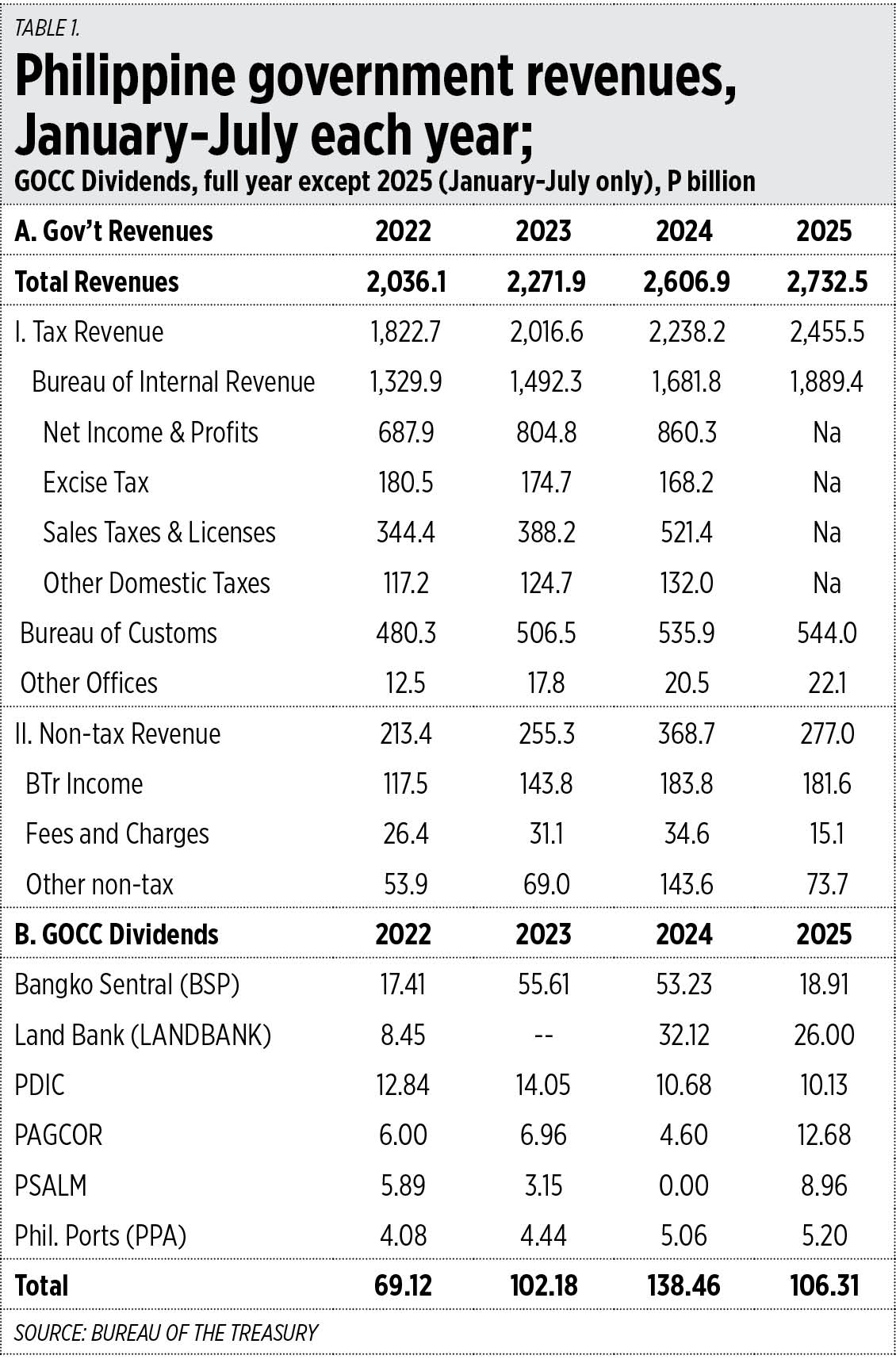
The revenue side too needs additional reforms, especially when it comes to excise tax because the declining trend continues with more privatization of government assets, and with rising dividends given by government-owned and -controlled corporations (GOCCs).

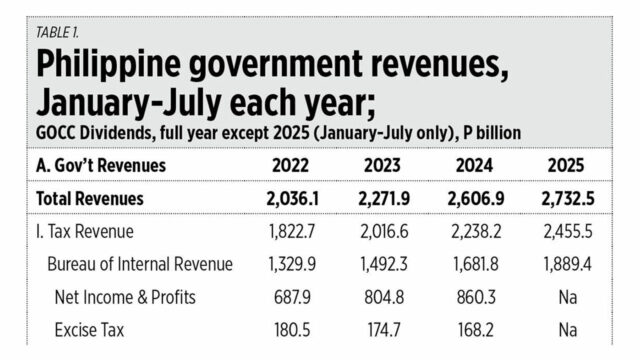
Bureau of Internal Revenue (BIR) collections continue their natural annual increase even without any major tax hikes; it is the Bureau of Customs that needs dynamism (see Table 1).

“A closer look at some indicators will belie Secretary [Ralph] Recto’s statements. The seemingly satisfactory revenue effort is deceiving. Note that ‘better-than-expected’ nontax revenue collections primarily drove higher total revenue collections. These nontax revenues included public-private partnership concession fees amounting to P30 billion, and notably, P167.2-billion transfer of funds from two government-owned and -controlled corporations (GOCCs), the Philippine Health Insurance Corp. (PHIC) and the Philippine Deposit Insurance Corp. (PDIC).”

That paragraph is from “Binding constraints: Corruption and limited fiscal space” by Pia Rodrigo and Filomeno S. Sta. Ana III, a story in BusinessWorld’s Anniversary Report, which came out earlier this month. The above statement on the transfer of PHIC and PDIC funds to the national treasury as non-tax revenue is not accurate. As shown in Table 1, a big Land Bank of the Philippines dividend of P32 billion last year constituted a big increase in non-tax revenues.

The needed reforms in excise tax relate mainly to tobacco taxes. Revenues from alcohol, sugary drinks, mining, and automobile keep rising or remain steady; it is the revenue from tobacco that keeps declining as the tax rate increases. Tobacco smugglers and their corrupt protectors in government love high tobacco tax rates because the price gap between legal or taxed products and illegal or untaxed products becomes wider. Smokers and vapers naturally want cheap products, and illicit and smuggled tobacco are sold at lower prices.

It is wrong for health activists and agencies to depend on tobacco and alcohol taxes to fund public health. Many health activist groups want to stop people from smoking and vaping completely, so one assumes that they wish that tobacco tax revenues would someday be zero. Yet they demand more billions of pesos from more smokers and drinkers who pay higher tobacco and alcohol taxes.

Any tobacco and alcohol tax revenue should go to the National Treasury, with zero earmarked for the Health department or for the Philippine Health Insurance Corp. (better known as PhilHealth). That way, there is zero dependence on smokers and drinkers.

INFRASTRUCTURE
Meanwhile, the economic and infrastructure teams went to Osaka, Japan last week for a Philippines Economic Briefing on Sept. 12. There was also the Philippines-Japan High-Level Joint Committee Meeting on Infrastructure Development and Economic Cooperation on Sept. 11.

The Philippine delegation was led by Finance Secretary Ralph G. Recto. The delegation included Economics Secretary Arsenio Balisacan, Trade Secretary Ma. Cristina Roque, and Energy Secretary Sharon Garin. Budget Secretary Amenah Pangandaman was not there as she was facing and addressing spending concerns on DPWH flood control projects and other agencies at the Senate hearings and other venues.

I checked the status of the Philippines’ credit rating with respect to its neighbors in Asia. We are just one notch from attaining an “A” rating from the Big Three agencies — S&P, Moody’s, and Fitch — while we have already secured an “A” from Ratings and Investment (R&I, Japan) and the Japan Credit Ratings Agency (JCRA), as seen in Table 2.

Improved credit ratings would mean the lower cost of government borrowings to cover domestic infrastructure and social services spending. While this is a good way towards fiscal consolidation, a better way is to cut spending somewhere, like abolishing old subsidy programs when new subsidy programs are created.

Also, there should be major reforms in the military and uniformed personnel (MUP) pension system. Active duty personnel should contribute to their own pensions someday. A pension fund is personal, not social or collective, so its funding should also be personal, not social or collective. And the indexation of retired personnel’s pensions to the salaries of active personnel of equal rank should be abolished.


Bienvenido S. Oplas, Jr. is the president of Bienvenido S. Oplas, Jr. Research Consultancy Services, and Minimal Government Thinkers. He is an international fellow of the Tholos Foundation.

minimalgovernment@gmail.com

Peso declines vs dollar

BW FILE PHOTO

THE PESO declined against the dollar on Monday after the United States urged its allies to impose tariffs on countries that are buying oil from Russia.

The local unit closed at P57.181 versus the greenback, dropping by 8.1 centavos from its P57.10 finish on Friday, Bankers Association of the Philippines data showed.

The peso opened Monday’s session weaker at P57.20 versus the dollar. Its intraday high was at P57.16, while its worst showing was at P57.38 against the greenback.

Dollars traded went up to $1.52 billion on Monday from $1.48 billion on Friday.

The dollar was generally stronger on Monday as US President Donald J. Trump said they could impose more sanctions on Russia, Rizal Commercial Banking Corp. Chief Economist Michael L. Ricafort said in a Viber message.

Mr. Trump said on Saturday that the US is prepared to impose fresh energy sanctions on Russia, but only if all North Atlantic Treaty Organization (NATO) nations cease purchasing Russian oil and implement similar measures, Reuters reported.

In recent weeks, the US has stepped up pressure on NATO countries to tighten energy sanctions on Russia in a bid to help end its war with Ukraine — a conflict Mr. Trump has struggled to bring to a close despite repeated threats of harsher penalties on Moscow and its partners.

For Tuesday, a trader said the peso could move between P57 and P57.40 per dollar, while Mr. Ricafort expects it to range from P57.10 to P57.30. — A.M.C. Sy with Reuters

Proptech firm Lhoopa eyes doubling housing delivery in 2026

PHILSTAR FILE PHOTO

LHOOPA, INC., a property technology (proptech) startup, hopes to double the number of housing units it delivers to Filipino families in 2026 as demand for affordable homes continues to outpace supply, its chief executive officer (CEO) said.

“Looking ahead, our target is to double the number of homes we deliver year on year from 2025 to 2026,” Lhoopa CEO and Co-Founder Marc-Olivier Caillot said in an e-mailed reply to questions.

The Philippines faces a persistent housing shortage, with the backlog projected to hit 22 million units by 2040 if unaddressed, according to the United Nations Human Settlements Programme.

Mr. Caillot said affordability, accessibility, and information gaps remain the main obstacles.

Many units marketed as “below market value” still exceed 30% of household income, while affordable projects are often located far from jobs, schools, and transport hubs, he noted.

Complex loan applications also discourage low-income families from buying homes, he also said.

Through its digital platform, Lhoopa streamlines the housing process from land acquisition to move-in.

In the first half, about 7,000 families acquired homes through the platform, with 88% being first-time buyers, according to Lhoopa.

Women accounted for 51% of purchases, while most clients were young working families and members of the essential workforce such as clerks, construction workers, and community service providers.

To expand its reach, the company is focusing on underserved markets outside Metro Manila by establishing local networks in fast-growing cities.

Lhoopa said it is also broadening partnerships with brokers, contractors, developers, and banks to improve financing access.

It uses data and artificial intelligence to evaluate long-term demand, development trends, and disaster risks.

The company is also enhancing its broker and contractor apps to better track loan applications and project timelines, it said.

“Our direction is clear: consistent growth, quality service, and a bigger share of the backlog addressed each year,” Mr. Caillot said. — Beatriz Marie D. Cruz

Grab expands partnership with Alipay+, enabling in-app ride bookings

PEOPLE are seen using their mobile phones along Claro M. Recto Avenue in Divisoria, Manila, Dec. 27, 2022. — PHILIPPINE STAR/EDD GUMBAN

RIDE-HAILING superapp Grab has integrated its services into artificial intelligence (AI)-powered travel assistant Alipay+ Voyager, allowing users to book rides across Southeast Asia without downloading the Grab app.

The partnership enables travelers to access Grab’s services in over 800 cities across eight countries — the Philippines, Singapore, Vietnam, Malaysia, Thailand, Cambodia, Indonesia, and Myanmar — directly from the Alipay+ Voyager app.

“With Southeast Asia growing in popularity as a travel destination, making Grab’s services directly available within Alipay+ partner apps offers users the most comprehensive and trusted local transportation across the region,” Scarlett Xing, general manager of Alipay+ Travel Solutions at Ant International, said in a statement.

The integration is expected to make transportation more convenient in a region that hosts millions of tourists annually.

Launched in June by Chinese fintech provider Ant International, Alipay+ Voyager is an end-to-end AI travel assistant that allows users to plan and book trips. It is linked to digital wallet providers such as Alipay (Mainland China), AlipayHK (Hong Kong), and GCash (Philippines), with plans to expand to additional partners this year.

“Alipay+ Voyager will continue to expand our ecosystem, particularly across essential travel services, to connect more partners with mobile-savvy travellers, while we collaborate to create new ways of engagement across the entire travel journey,” Ms. Xing said.

The move strengthens Alipay+ and Grab’s partnership, which began in 2023 with users able to pay on Grab via the e-wallet provider.

“This collaboration underscores our shared commitment to enhancing the travel experience and providing greater convenience for millions of users,” Grab Head of Mobility Samir Kumar said.

Alipay+ connects about 36 leading payment partner apps with over 1.7 billion users and more than 100 million in-store merchants across 70 markets. — Beatriz Marie D. Cruz

ADVERTISEMENT
ADVERTISEMENT