Home Blog Page 9944

Dining Out (01/30/20)

M Bakery’s Valentine specials

AS VALENTINE’S DAY draws closer, M Bakery has come up with special Valentine’s Day exclusives that can be ordered in advance. There are decorated Rose Cupcakes, available in vanilla, chocolate or red velvet. Each cupcake is piped with red, white, or pink vanilla buttercream. For something cute there are classic Valentine’s Day cupcakes available in vanilla, chocolate, or red velvet that come with sprinkles, a red or white heart, and a topper of your choice. Buy a dozen Valentine’s Day mini cupcakes as the bakery has given its Classic Vanilla and Chocolate Mini Cupcakes a touch with red, white, and pink-themed chocolate and vanilla icing, as well as sprinkles and heart decorations. There are also edible image cupcakes. Choose from Classic Vanilla or Chocolate cupcakes topped with Vanilla Buttercream and a message to choose from. Go beyond cupcakes with the bakery’s cake choices: Red Velvet Cake with white vanilla buttercream and Valentine’s day confetti; Red Velvet Banana Pudding with layers of red velvet cake and vanilla pudding swirled with cream cheese and bananas; and classic sugar cookie mixed with Valentine’s Day confetti. M Bakery is found at the One Bonifacio High Street Mall, Bonifacio Global City or call 0917-633-1718 to place advance orders.

Lung Hin’s new Chef’s Recommendations

LUNG HIN, Marco Polo Ortigas Manila’s award-winning authentic Cantonese restaurant, features a new set of dishes prepared by Executive Chinese Chef Ken Leung. This season’s selection includes Deep-fried pigeon with golden garlic, Steamed live crab with egg white and Chinese wine, and Wok-fried shrimp with Daliang milk (Shunde-style). Available from Feb. 5 to April 30, the restaurant’s new Hong Kong Chef’s Recommendations are available for lunch and dinner service daily. For more information and reservations, call 7720-7720 or e-mail restaurant.mnl@marcopolohotels.com.

Yellow Cab’s new pizza size and promo

YELLOW CAB’s New York-style pizzas are now available in an new size — nine-inch pizzas with edge-to-edge toppings. Starting at P299, one can pick from a wide range of Classic and Signature flavors such as: Hawaiian, New York Classic, Manhattan Meatlovers, Garden Special, Roasted Garlic and Shrimp, BBQ Chicken, and Four Cheese. Meanwhile, to mark the new year, Yellow Cab is offering the New Year, New York deal — three nine-inch New York Classic pizzas for P699. The promo is now available in all Yellow Cab stores nationwide for dine-in, take-out, curbside pick-up, and delivery until Feb. 25. For more information, visit https://www.facebook.com/YellowCabPizzaOfficial/.

Teriyaki Boy and Sizzlin’ Steak tweak favorites

THE NEW DECADE kicks off with Teriyaki Boy and Sizzlin’ Steak’s new and improved menus. “With the start of a new decade, we are excited for our customers to come back and try all their favorite Japanese and Steak dishes, now made with even better ingredients,” said Teriyaki Boy and Sizzlin Steak Senior Marketing Manager, Cherry Hernandez. Teriyaki Boy has tweaked its dishes starting with Teriyaki Boy Chicken (P349); Beef Teriyaki (P399) which is now more tender, flavorful, and affordable; Teriyaki Boy’s Tonkatsu (P289), made from imported US pork battered with a Japanese-style breadcrumb, deep-fried until golden brown, and served with cabbage salad and a drizzle of sesame dressing. There is also Ebi Tempura (P269), with one order of three pieces of prawns that are significantly bigger and crunchier. Diners can avail of this crunchy dish for P199 only (P70 less than its regular price) until Jan. 31, in celebration of Tempura month. Over at Sizzlin’ Steak, guests can Create Your Own Sizzlin’ Meal with a range of meats to pair with rice, one’s choice of side dish, and sauce. For more information, visit facebook.com/SizzlinSteak and facebook.com/TeriyakiBoyPh. For orders and inquiries, visit www.sizzlinsteak.com and www.teriyakiboy.com.ph.

Arthaland raises P3 billion in green bond offer

THE maiden offering of ASEAN green bonds by niche property developer Arthaland Corp. has been oversubscribed to reach P3 billion.

In a stock exchange disclosure yesterday, the listed firm said the P1-billion oversubscription option of its P2-billion green bonds “has been exercised in full,” which means the company was able to raise P3 billion from the first tranche of its total shelf registration of P6-billion ASEAN green bonds.

Arthaland started its offer period for the fixed-rate bonds on Jan. 22, which ended on Jan. 28. The bonds have an interest rate of 6.3517% per annum and are scheduled to mature by 2025.

BDO Capital and Investment Corp. and ING Bank acted as the joint lead underwriters and joint bookrunners, while PNB Capital and Investment Corp. acted as the co-lead manager for the issuance.

The offer of Arthaland marks the Philippines’ first non-bank corporate issuance of ASEAN green bonds registered with the Securities and Exchange Commission (SEC).

Green bonds, also called climate bonds, are a type of loan that are committed to be used for environmental projects. The SEC adopted the ASEAN green bond standard for the Philippines, which requires that proceeds from such issuances must be “exclusively applied to finance or refinance, in part or in full, new and/or existing eligible green projects.”

Arthaland said before that the cash to be generated from its green bond offer will be used to finance its pipeline of green projects. The company has several internationally and locally recognized green buildings in its portfolio, such as the Arthaland Century Pacific Tower and Arya Residences in Bonifacio Global City, Taguig.

The company has a plan to expand its development portfolio by five times until 2024, which will result in an increase in its gross floor area to above 500,000 square meters.

Earnings of Arthaland in the first nine months of 2019 soared to P647.36 million from P75.64 million a year ago, driven by the 151% growth in its revenues to P1.49 billion.

Its shares at the stock exchange inched up one centavo or 1.23% to P0.82 apiece on Wednesday. — Denise A. Valdez

How PSEi member stocks performed — January 29, 2020

Here’s a quick glance at how PSEi stocks fared on Wednesday, January 29, 2020.


Unmarked fuel subject to seizure after February deadline, BoC says

FULL compliance with the fuel marking program is expected by February, with oil companies on notice that any unmarked fuel discovered after the deadline is subject to seizure.

Customs Assistant Commissioner Vincent Philip C. Maronilla told reporters Wednesday that the deadline has been extended previously and no further extensions will be granted.

“If they don’t comply by February, we will start testing,” adding that unmarked fuel is subject to government action, including “confiscation.”

“We won’t extend the deadline,” Mr. Maronilla added.

Fuel marking is an anti-smuggling measure in which a dye is injected into all fuel products that are tax-paid. The absence of the marker dye is deemed prima facie evidence that the fuel is not tax compliant and possibly smuggled.

Marking was made mandatory by the Tax Reform for Acceleration and Inclusion (TRAIN) Law.

As of January, the total amount of fuel marked amounted to 2.5 billion liters. The government said twenty-six facilities, including fuel storage depots and refineries, have started to mark their fuel.

The program is a joint effort between the BoC (Bureau of Customs) and the Bureau of Internal Revenue (BIR).

“We need to proceed and conduct… random inspections… (The) BIR will be handling all the gasoline stations,” BIR Director Beverly S. Milo in a briefing on Wednesday.

Fuel marking has increased government revenue, though Customs Deputy Commissioner Teddy S. Raval said the impact has been “significant.”

“The data we have shows an increase in the collection of duties from oil… Compared to the previous years. In 2017, the collection for oil products by the Bureau of Customs was P45.9 billion; In 2018, when the TRAIN law was in effect, it… doubled to P91.9 billion, I’m referring to oil products alone; And in 2019… collections from oil products by the Bureau of Customs, again increased by as much as P45 billion, kasi ang total namin (because our total) for 2019 is P145.2 billion,” he said at the briefing. — Gillian M. Cortez

US free trade talks seen as casualty of visa/VFA spat

By Jenina P. Ibañez
Reporter

TRADE SECRETARY Ramon M. Lopez said that negotiations for a free trade agreement (FTA) with the US could be hampered by the mood in the US Congress, which backed sanctions against Philippine officials, leading Malacañang to threaten to withdraw from the Visiting Forces Agreement (VFA).

“You can get a sense of the mood in the (US) Congress… anything to do with us baka maging (might become a) big issue. Baka hindi sila (They might not be) excited, or may not be supportive,” he said.

President Rodrigo R. Duterte threatened to end the VFA, an arrangement adopted by both countries after the removal of US bases here, after the US canceled the visa of a key Duterte ally, Senator Ronald M. dela Rosa.

Mr. Lopez said he has no specific information on US legislators’ inclinations with regard to a Philippine FTA, but notes that this may be a concern.

“’Yung FTA naman with the US, while we are open to it, siyempre depende rin sa kabilang (it depends on the other) side… The USTR (United States Trade Representative) may be interested, but the Congress I don’t know,” Mr. Lopez said.

“They know our interest is there so hindi na natin i-push ngayon, o i-push (we won’t push for it now or) next month.”

He said that the Philippines has been ready to commence negotiations.

“You have to work with their internal processes (and the) mood in Congress — we don’t know if that represents the whole Congress so baka ilang congressmen lang din ‘yun (it could be just a few legislators). We are leaving it up to them.”

The Philippines currently enjoys zero or reduced tariffs on over 5,000 products under the US Generalized System of Preferences agreement, which ends on Dec. 31, 2020.

The US is one of the Philippines’ top trade partners. It is the Philippines’ top export destination, taking in 16.3% of all exports or $10.55 billion in the first 11 months of 2019. The Philippines imported $7.13 billion worth of US goods, or 7.2% of the total, over the same period.

Asked about the impact on investors of a VFA dispute, American Chamber of Commerce Senior Advisor John Forbes said in a mobile message that investors expect a strong bilateral relationship.

“Investors like to see smooth bilateral relations. AmCham supports US military resources helping with disaster relief, as they did after Typhoon Yolanda, and training jointly with the AFP (Armed Forces of the Philippines). Thus we believe it is very important for the VFA to continue,” he said.

Mr. Lopez added the trade department continues to be open to an FTA with the European Union, even as talks have stalled.

“We have also been open to that. Sila rin ‘yung nag-put (they are the ones who put it) aside I guess for now. Kasi ‘di ba we’re supposed to have a next round of meetings. So hindi naman sila naglalagay ng (they haven’t put up a) schedule. But with the new trade commissioner, we will find out their priorities,” he said.

Delegation of the European Union to the Philippines Charge de Affaires Thomas Wiersing told reporters last week that the FTA is not off the table, but there is currently no agreement on the next round of talks.

Ireland’s Phil Hogan became the new European Commissioner for Trade on Dec. 1, 2019.

University of Asia and the Pacific economist George N. Manzano in a mobile message said investors may adopt a wait-and-see approach as the spat plays out.

“Political tensions in principle are not going to be very helpful in raising investor confidence. But at this stage of sabre-rattling, investors may just adopt a wait-and-see stance,” he said.

Senate urges POGO crackdown

THE Senate Committee on Foreign Relations said Wednesday that it supports a crackdown on Philippine Offshore Gaming Operators (POGOs) due to non-compliance with various tax, business-registration, and immigration laws.

“Number one… kung illegal ’yang mga ’yan, (If POGO workers are here illegally) there should be a massive crackdown. Send them home,” Senator Aquilino L. Pimentel III, who chairs the panel, said in a briefing.

He said the indications are that many of them have not complied with immigration rules, based on reports that a majority of industry workers entered the country using the visa-on-arrival scheme.

Malaki ang pagkakataong illegal ‘yang mga ‘yan kasi may report tayong nare-receive na visa upon arrival ang mga nakuha ng mga ‘yan (There is a good chance many of them are illegal because of reports that they availed of the visa-on-arrival scheme).”

He urged the Bureau of Immigration, the Department of Labor and Employment and the Philippine National Police to conduct the crackdown.

The committee is also reviewing measures to ensure the BI becomes stricter in granting visas on arrival.

He said a crackdown brings the Philippines in line with Chinese views on the industry. In August the Chinese Embassy in Manila said all forms of gambling by Chinese citizens including online gambling and gambling overseas are illegal.

“If we have a massive crackdown, we will have a convergence of interests between the Philippines and China.”

The Department of Interior and Local Government (DILG) said it will step up monitoring of POGOs and other buildings occupied by Chinese firms, amid complaints about increased prostitution and kidnapping.

“So, all these POGO centers are under watch of the Philippine National Police and we will prevent any commission of crime or any violation of law and order,” Local Government Secretary Eduardo M. Año said in a briefing.

The DILG is also working with the Department of Information and Communications Technology to stop online prostitution. — Charmaine A. Tadalan

Pushback against disaster department as officials back NDRRMC set-up

RESOURCE PERSONS told a Senate committee that they support the current disaster coordination set-up as legislators heard evidence Wednesday on a measure proposing to create a Department of Disaster resilience.

The Department of Science and Technology (DoST) recommended that the government preserve the current role of the National Disaster Risk Reduction and Management Council (NDRRMC).

“I believe that we have to give a chance to the NDRRMC because it has been there for just a couple of years and we can see that in recent occurrences of disasters, it is the President himself who said he is satisfied with the way the coordination of the response was done,” Science and Technology Secretary Fortunato T. dela Peña told the panel.

“If I were to be asked, I would prefer that we maintain the NDRRMC.”

He also opposed the transfer of agencies under the DoST to the proposed Department, including the key offices that deal with weather forecasting and seismology.

“The mandates of PHIVOLCS (Philippine Institute of Volcanology and Seismology), and PAGASA (Philippine Atmospheric, Geophysical and Astronomical Services Administration) should remain with the DoST because they are science institutions.”

PHIVOLCS Director Renato U. Solidum said the agency’s transfer might prevent it from carrying out its mission, and proposed capacity-building measures to the increase disaster-management expertise of the proposed department.

“What is needed in the Philippines are disaster-risk managers and disaster managers. These are the competencies that we need in the new department and that is what we lack,” he said.

“Simply coordinating teams will not solve the problem. We need people to really focus on things, but other departments will still continue to do their jobs.”

Office of Civil Defense administrator Ricardo B. Halad noted that some of the proposed department’s functions have been devolved to local governments.

“The issuance of building permits is done by the local chief executive, the formulation of CLUPs or Comprehensive Land Use Plans, is done by the local government unit and these are approved by either provincial governors or the Housing and Land Use (Regulatory) Board. I don’t see the role for the DDR,” he said. — Charmaine A. Tadalan

DoF touts gov’t soft-loan programs for LGUs

THE Department of Finance (DoF) said local government units (LGUs) can tap concessional loan programs offered by state-owned banks and the DoF itself, drumming up the possibilities for loan financing of local infrastructure and social programs.

It said in a statement Wednesday that the facilities can finance up to 100% of the total project cost, and include programs offered by Land Bank of the Philippines (LANDBANK) and the Development Bank of the Philippines (DBP).

It said LANDBANK’S Omnibus Term Loan Facility (OTLF) provides funding for qualified LGUs for infrastructure and socio-economic projects listed under the Local Development Plan and Public Investment Program.

According to Finance Secretary Carlos G. Dominguez III, who is also a chairman of LANDBANK, the program reduces transaction costs by doing away with individual approval for each project.

The City of Manila was among the LGUs that availed of the program, taking up a P10 billion line last year to fund the renovation and upgrade of the city’s infrastructure, especially those relevant to health, education and tourism.

Using a prescribed formula, LANDBANK determines the LGU’s net debt service ceiling and its borrowing capacity.

Mr. Dominguez said LGUs can also tap a DBP facility that offers up to 100% financing for priority programs.

The loan size is based on the Estimated Calculated Cost Ranges (ECCR) or the winning bid price, but must not exceed the LGU’s net debt service ceiling and borrowing capacity.

Mr. Dominguez said the LGU’s amortization should not exceed 20% of its internal revenue allotment (IRA) share.

The IRA is the local government’s share of the national government’s revenue.

DBP has financed school buildings, markets, administration offices, multipurpose halls, sports complexes, hospitals, heavy equipment and information technology equipment, among others, he said.

The DoF said LGUs can also access concessional funding and technical assistance from the department’s, Municipal Development Fund Office (MDFO).

According to MDFO’s website, a total of 240 LGUs with 307 subprograms have been approved so far to avail of loans under the financing windows of the Municipal Development Fund-Second Generation Fund (MDF-SGF).

Among the 11 financing windows is the Disaster Management Assistance Fund (DMAF), which LGUs can tap for disaster prevention and mitigation initiatives. A total of 75 LGUs with 97 projects have been approved for the program.

It said the Municipal Development Fund Project (MDFP) has benefited 109 LGUs with 151 subprojects identified as priorities. — Beatrice M. Laforga

Gaining certainty on uncertain tax positions for financial reporting

(First of two parts)

Globally adopted, the International Financial Reporting Standards (IFRS) were developed as a set of principle-based standards for a consistent approach to financial reporting. One of its principles, known as International Financial Reporting Interpretations Committee 23 or IFRIC 23 for short, entitled Uncertainty over Income Tax Treatments, was issued in May 2017 as a guide to recognize and account for uncertain income tax treatments. It covers annual reporting periods beginning on or after Jan. 1, 2019.

For entities operating on a calendar year basis, compliance with IFRIC 23 is a must for the financial statements that will be issued in the next few months. Thus, accountants and those who prepare financial statements should be aware of the tax treatments/practices that may be covered by IFRIC 23.

Walking down the tax memory lane, let us take a closer look at the requirements of IFRIC 23.

SETTING THE BOUNDARIES OF UNCERTAINTY FOR RECOGNITION PURPOSES
IFRIC 23 presents challenges, especially for large entities, as there is a need to account for a lot of tax treatments. It does not help that Philippine tax laws, rules, and regulations are riddled with numerous uncertainties. Therefore, it is vital to identify which tax treatment/practice is covered by IFRIC 23.

INCOME TAX ONLY
Foremost, IFRIC 23, being an interpretation of International Accounting Standard 12 (IAS 12), covers solely income tax treatments; other taxes are governed by separate accounting standards, as applicable (e.g., IAS 37 on Provisions, Contingent Liabilities, and Contingent Assets). The interpretation is to be applied in the “determination of taxable profit (tax loss), tax bases, unused tax losses, unused tax credits, and tax rates” relative to uncertainties in income tax treatment.

IFRIC 23 defines an “uncertain tax treatment” as any tax treatment, where there is uncertainty over whether the relevant taxation authority will accept the tax treatment under tax law. The dilemma may happen when the acceptability of a particular tax treatment is unclear or ambiguous until resolved in the future. Taxation authority refers to the body or bodies that decide whether tax treatments are acceptable under tax law. It may include a court.

In the Philippine context, an uncertain tax treatment may stem from conflicting provisions in the Tax Code or issuances from the Bureau of Internal Revenue (BIR). It may also arise from conflicting court decisions, which can only be clarified by a decision of a higher-level court.

After establishing which tax treatments are uncertain, entities need to reflect them in the financial statements.

UNCERTAINTY IN MEASURING INCOME TAX-RELATED ACCOUNTS
IFRIC 23 provides that an entity shall consider each uncertain tax treatment, depending on which approach better predicts the resolution of the uncertainty. In doing so, an entity shall assume that a taxation authority has a right to examine the treatments and has full knowledge of all related information when making those examinations (thus, implying a high detection risk). As such, the likelihood of a tax treatment being questioned by the BIR is irrelevant for IFRIC 23 purposes. Instead, assessing the probability of acceptance will primarily be based upon the technical merits and legal bases used by management in electing a tax treatment.

If an entity considers that the taxation authority will probably accept an uncertain tax treatment, it shall apply the tax treatment in its income tax filings, as if no uncertainty exists. This tax approach shall be used to determine the taxable profit (tax loss), tax bases, unused tax losses, unused tax credits, and tax rates.

Otherwise, the entity shall reflect the effect of the uncertainty by using either of two methods. Depending on which one could best predict the resolution of such uncertainty, it may apply either (1) the most likely amount method (appropriate for possible outcomes that are binary); or (2) the expected value method (the sum of the probability-weighted amounts in a range of possible outcomes).

In the Philippines, the first method may be more applicable since, generally, the BIR will either assess deficiency taxes at full amount or none at all.

CONSIDERED SEPARATELY OR TOGETHER WITH OTHER UNCERTAINTIES
IFRIC 23 also provides guidance on whether an entity should consider each uncertain tax treatment separately or together with other uncertainties. The decision should be based on which approach better predicts the resolution of the uncertainty by considering: (a) how the entity calculates its income tax and supports tax treatments; or (b) how the entity expects the taxation authority to make its examination and resolve issues that might arise from that examination.

Note that in most cases, the BIR and the courts generally consider the cumulative impact of the findings in quantifying the assessed amount.

INITIAL APPLICATION AND CHANGE IN FACTS AND CIRCUMSTANCES
On initial application, an entity may apply IFRIC 23 either: (a) retrospectively by applying IAS 8 on Accounting Policies, Changes in Accounting Estimates and Errors, if possible without the use of hindsight; or (b) retrospectively with the cumulative effect of initial application as an adjustment to the opening balance of retained earnings (or other component of equity, as appropriate).

Any change in facts and circumstances must be reflected as such as a change in accounting estimate (i.e., prospectively).

A change occurs if the facts and circumstances on which the judgment or estimate was based become different, or when new information affects the judgment or estimate (e.g., the expiration of the tax authority’s right to examine). Hence, a judgment or estimate must be reassessed to determine any changes that may develop.

In my next article, we shall take a closer look at how the provisions of IFRIC 23 apply in actual practice. I will also discuss some key considerations that must be made as an entity adopts IFRIC 23.

The views or opinions expressed in this article are solely those of the author and do not necessarily represent those of Isla Lipana & Co. The content is for general information purposes only, and should not be used as a substitute for specific advice.


Gabriel Eroy is a Manager at the Tax Services Department of Isla Lipana & Co., the Philippine member firm of the PwC network.

(02) 8845-27 28

gabriel.eroy@pwc.com

Deadly as a virus

As of this writing, there were about 4,600 reported cases of Novel Corona Virus worldwide, and with about 100 deaths attributed to it specifically in China, where it all started. The world is worried, perhaps even more worried than when SARS or MERS wrought havoc years back. Incidentally, all these deadly viral infections started to occur only in the last 20 years.

There must be something really wrong with the world right now. Disease, plagues, deadly weather disturbances, and geological catastrophes are all happening, one after the other. Then, there is the threat of war in the Middle East, and other political upheavals globally. With the natural balance obviously upset, is the world trying to rectify the imbalance?

But there are things just as deadly as natural calamities and killer viruses. Man-made and technology-based, even mobile phones have become modern day killers. In itself, a cellular phone unit is nothing but a tool. But, in the wrong hands, or as the result of misuse or mishandling, it can also lead to serious injury or even death. Just as unpredictable as a virus.

Consider the US statistics from the National Highway Traffic Safety Administration (NHTSA), an agency under the US Department of Transportation. According to the NHTSA, distracted driving cases in the US claimed 3,166 lives in 2017 alone. And by distracted driving, it refers to “any activity that diverts attention from driving, including talking or texting on your phone, eating and drinking, talking to people in your vehicle, fiddling with the stereo, entertainment or navigation system — anything that takes your attention away from the task of safe driving.”

It adds that “texting is the most alarming distraction. Sending or reading a text takes your eyes off the road for five seconds. At 55 mph, that’s like driving the length of an entire football field with your eyes closed. You cannot drive safely unless the task of driving has your full attention. Any non-driving activity you engage in is a potential distraction and increases your risk of crashing.”

And while we have moved to address this particular issue locally by legislating against mobile phone use while driving or operating motorized vehicles, it appears the law is observed more in breach. I still see a lot of people fiddling with their phones or taking calls (holding their phones) while driving. Motorcycle riders are just as guilty, and are courting greater risk as they take one hand off the handlebar while moving.

One can only wonder about the local statistics for apprehension as well as the data with respect to accidents and deaths related to mobile phone misuse. When the Anti-Distracted Driving Act was new, there were a number of apprehensions reported out. To date, however, such violations no longer seem to rank high among the priorities of traffic enforcers.

ALEXANDRE BOUCHER/UNSPLASH

As the government continues the pilot testing for motorcycle taxis, with around 60,000 units nationwide, I believe we are now looking at the possibility of even more mobile phone-related accidents. It is for the simple reason that the operation of motorcycle taxis relies heavily on their drivers/riders using cellular units to book passengers and to navigate.

But distracted driving is only one side of the equation. Equally problematic, in my opinion, is the utter disregard for safety of selves and others by the “walking dead” — or zombie-like pedestrians who are glued to or are distracted by their mobile phones as they “navigate” city streets on foot. Add to this the riders of bicycles or scooters, whether powered by electricity or by feet, who are just as distracted by their mounted mobile phones.

This “viral” problem has its variations, which include the use of earphones or ear pods while walking, particularly while crossing streets, or while on public transportation. Worse, I see a lot of motorists — on cars and motorcycles — actually using ear pods while driving. By doing so, they unwittingly lose situational awareness. This, to me, makes mobile phone abuse just as deadly as a killer virus.

I truly believe “distracted walking” to be an emerging urban problem that requires immediate attention. USA Today has reported, for instance, that “pedestrian deaths [in the US] totaled nearly 6,000 in 2017 for the second straight year amid mounting signs that walkers and drivers are dangerously distracted, according to a new study,” adding that “experts suspect that smartphones and marijuana use are key factors in the deadly trend.”

The report added that “texting while walking is especially risky in urban environments. Combine that with drivers who are using their phones or touchscreens while driving, and it’s a recipe for fatalities.” USA Today even quoted a news source as commenting that “people outside cars are dying at levels we haven’t seen in 25 years.”

And while we have a local law against distracted driving, many might find it ridiculous to legislate against mobile phone use by pedestrians. However, the city of Montclair in California, for instance, has actually banned through local ordinance walking across the street while using a phone or headphones. Even Honolulu in Hawaii has a similar law, USA Today reported.

The bottom line, however, is that it will be difficult to legislate a statute to regulate undesirable human behavior. At best, public campaigns can be waged to remind people about the need to prioritize safety over convenience and the dangers of “distracted walking.” However, expect people to be dismissive of such campaigns unless there are rewards and penalties involved.


Marvin Tort is a former managing editor of BusinessWorld, and a former chairman of the Philippines Press Council.

matort@yahoo.com

Convenience stores and the Tokyo 2020 Olympics as a looking glass

I always visit the konbini whenever I visit Japan. Japanese convenience stores or konbini are not only open 24/7 and have quintessential Japanese snacks such as nikuman, karaage, oden, and onigiri; they also provide much needed services such as ATMs, delivery services, and bill payments. Indeed, konbini are inextricably linked to my Japanese experience: my first memories as an exchange student was eating curry bread from a konbini, I often practiced my Japanese whenever I bought and talked to the owner of our neighborhood konbini, and still I love to hear the “Irasshaimase” greeting as I enter a konbini.

CHALLENGES FACED BY KONBINI
Not only is the konbini different from stores in the Philippines due to its product lineup or its aesthetics layout, it differs because it has become an integral part of Japanese modern life: an accessible place for the community to buy meals, get essential services, and also a refuge during emergencies. Indeed, media news reports often show konbini providing much-needed food, supplies, and shelter during emergencies and natural calamities.

However, konbinis are facing plenty of challenges. Konbinis have reached a saturation point where there are too many stores. Lower profit margins, high franchise fees, and increasing operating costs also threaten konbinis. However, by far the biggest challenge faced by konbini is an acute shortage of labor. This is not due to low wages, harsh working conditions, or high turnover rates; rather there are simply not enough workers who want to work in konbinis. Thus, konbinis have been tapping a new labor source: foreign students.

SIDE DOORS TO JAPAN
While the usual narrative says that migrants take jobs away from locals, most migrant workers are actually employed in so-called 3D jobs that local workers do not want to do — Dirty, Difficult, and Dangerous. In the case of Japan, it is not that workers shun the konbini; rather, there are simply not enough workers due to its rapidly shrinking and ageing population. And yet, even as Japan needs foreign labor, its foreign population only makes up 2% of its total population and the country has one of the lowest migration rates among OECD countries. Various historical, economic, and cultural factors can explain this, but the most salient would be its belief that it is a monoethnic society that is not ready to receive a massive influx of foreigners.

So how does Japan get much-needed foreign labor while satisfying the conservative elements of Japanese society? By accepting foreign labor not through its front door, but rather through its side door. Since Japan explicitly only accepts skilled workers, much needed semi-skilled workers enter Japan through the side door. Most of the foreigners working in konbini have student visas. Entering Japan ostensibly to study the Japanese language, they are working in konbini or in factories to pay for their tuition and living costs. Thus, we see the sudden influx of Vietnamese and South Asians working in konbinis.

TOWARDS AN OPEN DOOR OR XENOPHOBIC BACKLASH?
In spite of cases of migrant labor abuse and the threat of xenophobic backlash, Japan is now gradually opening its doors.

While in previous years it has relied on its side door policy of getting “non-workers,” it has now passed new laws to gradually accept semi-skilled and skilled migrant workers. Known as the Specified Skilled Worker (SSW) Visa, Japan will now accept two types of workers. Type 1 workers will be employed in manufacturing, construction, healthcare, and service sectors, and the visa will allow guest workers to stay up to five years but they will not be allowed to bring their families to Japan. Type 2 workers, such as nurses, are considered highly skilled workers, and will have provisions for long-term settlement and for workers to bring their families to Japan.

While it is yet to be seen how Japan will implement these new policies and how the general public will react towards migrants, the policies seem to promise more humane, transparent, and equitable employment for its foreign workers.

In particular, workers from Indonesia, Vietnam, and the Philippines are seen as the best source of skilled workers under the SSW visa program, especially those who will be employed in the service, hospitality, and healthcare sectors. Will Filipinos who enter Japan become a permanent fixture of Japanese society? Will Japan become a more open multicultural society or will there be a xenophobic backlash from its conservative elements? It may be too soon to tell, but there might be a proxy measure to understand its future — the upcoming Tokyo 2020 Olympics.

SIGNIFICANCE OF THE 1964 AND 2020 TOKYO OLYMPICS
Other than the simply hosting an international sporting event, the 1964 Tokyo Olympic Games was Japan’s coming out party. Rising from the devastation and dark shadows of the Second World War, the games showed the world that Japan was not only a modern society with a bustling economy and a stable democracy, it was once again a respectable member of international society. Indeed the 1964 games also coincided with the opening of its iconic Shinkansen bullet train, with the games seemingly ushering its unprecedented post-war economic miracle.

Fast-forward more than 50 years later, the 2020 Olympics promises to be a glimpse of Japan’s not so distant future. Now that the 2020 Olympic Games will begin in a few months, let us look closely at how Japan will handle the challenges of hosting an international sports event with guests who needs various language and cultural requirements.

Perhaps, after the games Japan will realize that it needs to become a multicultural society. Perhaps, after the games its citizens will see the value of genuine multiculturalism — not only to help foreign workers and Japanese citizens coexist, but, above all, see that foreigners are productive and responsible guest workers who can help reinvigorate the Japanese economy. Perhaps the games will also become another coming out party for Japan — a sign to the world that it has become a truly genuine multicultural society.

Hopefully, next time I visit Japan and enter my beloved konbini, I will be welcomed not only with an “Irasshaimase,” but also a “Kamusta po?”


Benjamin A. San Jose is an assistant professor of Japanese studies and Political Science at the Ateneo de Manila University, Philippines. San Jose received his Ph.D. in international public policy from the University of Tsukuba. His current research focuses on the use of migration management in the labor migration policy process of the Philippines and Japan. He also teaches courses on International Relations, Philippine-Japan relations, and is pursuing research on Japan’s changing public diplomacy in the Asian region.

bsanjose@ateneo.edu

NCoV, IPR and WHO

The Novel Coronavirus (2019-nCoV) is new and hence, no existing vaccine and treatment can fight and control it. As of noon, Jan. 29, some 132 people have died and 6,000+ people are ill.

The good news is that some innovator pharmaceutical and biotechnology companies are quickly developing vaccines and other treatment. Among these companies and groups are Johnson and Johnson, and Hong Kong researchers.

The bad news are: it could take up to a year before the vaccines becomes available to the public after a series of clinical trials; and, the virus is already mutating, becoming “more easily spreadable” so that by the time the vaccines become available, new strains would have already emerged, requiring another set of vaccines and treatment.

The World Health Organization (WHO) is the main global agency that monitors and finds ways to control the virus. Their top officials have already met China PM Xi Jinping.

On Feb. 3 to 8, the WHO Executive Board (EB) will meet in Geneva, Switzerland. The EB is the decision-making arm of the WHO and it sets the agenda for the year’s work.

From what I gathered, the EB this year is considering a plan of work to weaken intellectual property rights (IPR) in order to improve access to new medicines and vaccines. These plans would be inimical and disruptive to innovation while doing little to improve access to medicines. The real reasons why access is poor in many countries is related to weak healthcare systems, regulatory barriers, taxes and tariffs, etc. and not IPR like patent protection.

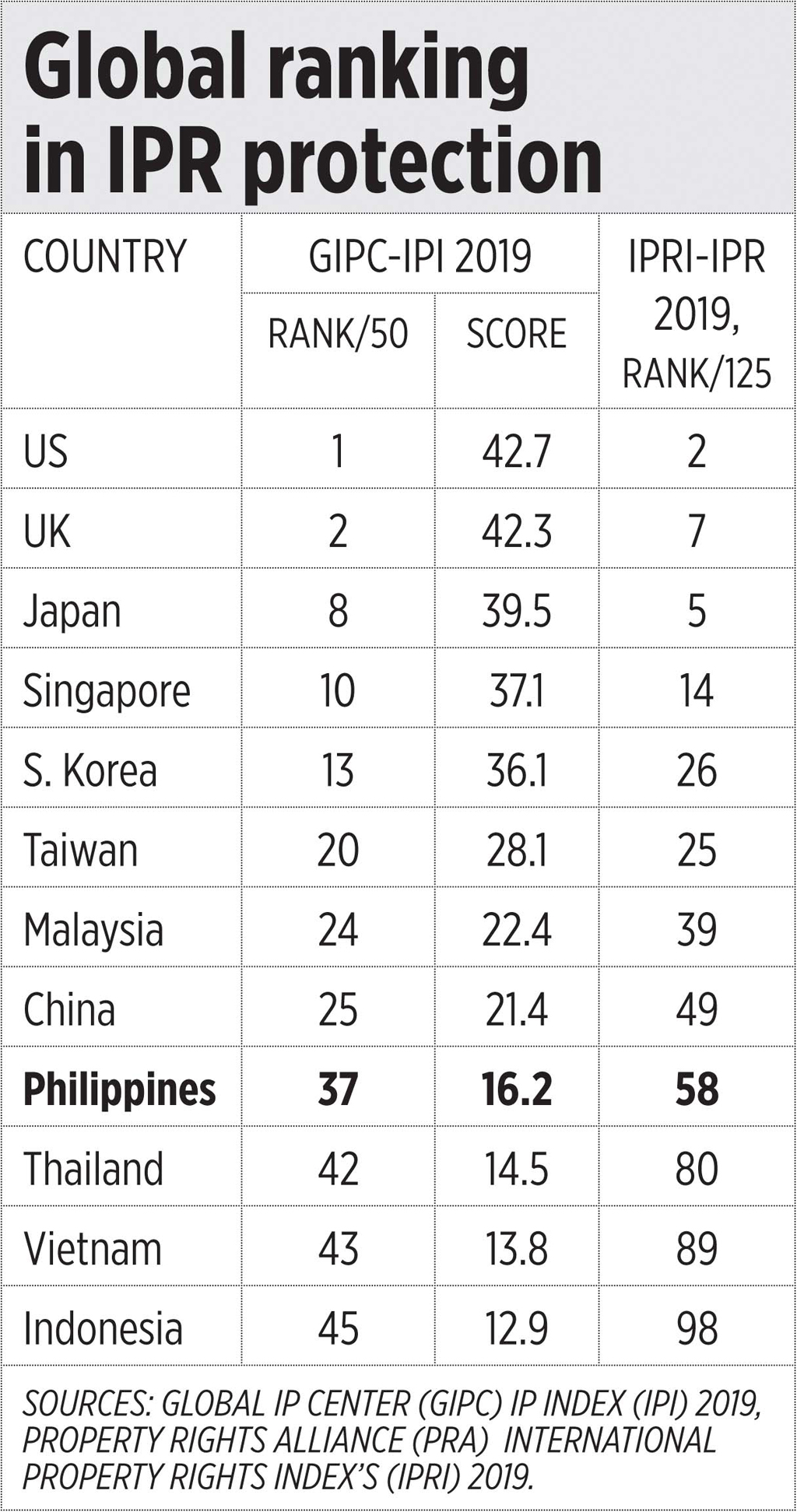
Last September, the Geneva Network (UK) plus five independent think tanks in the ASEAN including Minimal Government Thinkers (Philippines) launched their report, “The importance of IPR in progress: reform agenda for ASEAN countries” in Makati. The Philippines and many ASEAN countries do not rank and perform well globally in IPR protection (see Table).

Our report on IPR in the ASEAN noted that in the health sector, life science patents are becoming more difficult to obtain and there are concerns that compulsory licensing (CL) of famous, patented drugs may become more widely used by governments. CL is driven by envy more than desire for public health. Many pharma companies would not spend on very expensive and risky R&D (patients under clinical trials may suffer serious side-effects) but when the new drug molecule is later proven to be safe and effective in killing or controlling certain diseases, various lobbies to issue CL becomes louder. When CL becomes a norm, the likelihood that newly invented, more powerful medicines will be launched in developing countries like the Philippines will grow thin, which will also undermine the availability of generic medicines of the same molecule someday.

For now, the WHO has three important challenges.

One, set aside its itch for IPR-busting policies like CL. The evolving nCoV and other viruses will require evolving medicines and vaccines. IPRs like patents for newly developed treatments should be encouraged, not discouraged and demonized.

Two, encourage member-countries to speed up the examination of patents, do not discriminate against specific technologies in the granting of patents, restrict the use of CL of patents to true emergencies, and provide sufficient terms of regulatory data protection for medicines, veterinary and agricultural biotechnology.

Three, step back from producing and encouraging more regulations and restrictions in fighting non-communicable diseases (NCDs) and refocus its resources and research on really killer communicable and infectious diseases. There are many, past and present like ebola, SARS, MERS-CoV and nCoV.


Bienvenido S. Oplas, Jr. is the president of Minimal Government Thinkers.

minimalgovernment@gmail.com

ADVERTISEMENT
ADVERTISEMENT