Home Blog Page 989

David Ellison races to rebuild Paramount’s mountain of content

HOURS AFTER his company’s merger with Paramount closed in August, Chief Executive Officer (CEO) David Ellison’s empire-building kicked into gear.

His studio chiefs announced they had won a bidding war to distribute a new James Mangold heist film starring Timothée Chalamet. Days later came a blockbuster seven-year, $7.7-billion deal for exclusive US streaming and broadcast rights to the Ultimate Fighting Championship (UFC), beginning next year.

The UFC deal built upon an earlier $1.5-billion agreement with South Park creators Trey Parker and Matt Stone for global streaming rights to their adult animated series — signaling Mr. Ellison’s willingness — and ability — to pay top dollar for premium content across multiple genres.

Since Skydance Media’s takeover of Paramount, the 42-year-old son of Oracle billionaire Larry Ellison has moved at breakneck speed to transform the storied studio into something far more ambitious: a sprawling sports, media, and news empire that marries Hollywood’s creative muscle with Silicon Valley’s technological prowess. His father, the second richest person in the world, gives him the financial power to implement big ideas.

“Legacy media kind of swam out to the middle of the lake and wasn’t exactly sure how to get to the other side,” Mr. Ellison said during a recent briefing on the Paramount Pictures lot. “We’re gonna get to the other side of the lake.”

Mr. Ellison’s most audacious move may be yet to come.

Paramount’s new chief executive is preparing a bid to acquire Warner Bros. Discovery, home to Warner Bros. film and television studios, HBO, CNN, TNT and Warner Bros. Games. The company is on the verge of breaking up, as its television business declines, but Mr. Ellison intends to go bigger, creating a media colossus combining Paramount’s library of classics like The Godfather and Star Trek with Warner Bros.’ own extensive collection.

Some observers see bigger ambitions in Mr. Ellison’s media moves.

In recent weeks, Mr. Ellison installed Kenneth Weinstein — a supporter of President Donald J. Trump and the former CEO of conservative think tank Hudson Institute — as ombudsman of CBS News. At the same time, he has reportedly been in talks to acquire the Free Press and bring founder Bari Weiss into a leadership role at CBS News.

Media commentators like Oliver Darcy speculate that Mr. Ellison may have a broader goal: creating a news media empire combining CBS with CNN’s real-time television and text news operations, potentially forging a conservative media powerhouse rivaling Rupert Murdoch’s global empire in scale and influence.

Gabriel Kahn, a professor at the University of Southern California’s Annenberg School for Communication and Journalism, rejects that notion, saying the Trump-friendly conservative media world is already a crowded space. Rather, he sees Mr. Ellison attempting to appease Mr. Trump to further his media ambitions.

“We’ve already seen with Paramount, to get a deal passed with this administration, you have to pay tribute,” Mr. Kahn said. “Now you’re talking about a much larger deal, one would assume the size of the tribute would increase. If CNN is no longer a thorn in the side of Trump, that would be a green light to consolidate as much market share as he can.”

SILICON VALLEY PEDIGREE SETS ELLISON APART
As Mr. Ellison pushes Paramount into the future, he’ll lean on his Silicon Valley sensibility roots.

“One of the things that people are underestimating is his sense of tech, compared to some of the other guys,” said Endeavor CEO Ari Emanuel, who predicted that changes to come “will be refreshing.”

Mr. Ellison’s Silicon Valley pedigree sets him apart in an industry where many executives climbed the ladder from entry-level Hollywood jobs. He spent summers writing computer code for Oracle and gleaned insights about the movie business from Pixar co-founder Steve Jobs, who was his father’s close friend. Those tech sensibilities now inform his vision for Paramount as a “tech-forward company” blending Hollywood’s “creative heart” with Silicon Valley’s “innovative spirit.”

Just what that marriage of tech and Hollywood will look like isn’t clear, but David Ellison appears built for taking risks. He learned to fly at 13 alongside his father, and by 16 was piloting an Extra 300 aerobatic plane — a passion that inspired his studio’s name, derived from the stunt flying technique known as “skydancing.”

Raised by his mother Barbara Boothe with a strong work ethic, Mr. Ellison initially studied business at Pepperdine University before transferring to USC’s film school. In 2006, he dropped out to finance Flyboys, a World War I pilot movie that flopped. Undeterred, he pivoted to a partnership deal with Paramount that yielded his first success: the Coen brothers’ 2010 True Grit remake, which earned 10 Oscar nominations.

Box office triumphs followed with World War Z, Star Trek, Mission: Impossible films, and Top Gun: Maverick, establishing Mr. Ellison’s credibility with top-tier film makers and talent agents.

“He’s an owner-operator that actually loves film and television and stories, and that is needed now more than ever,” said Bryan Lourd, CEO of Creative Artists Agency. Reuters

BIS warns of mounting disconnect between debt and stock markets

REUTERS

LONDON — The Bank for International Settlements (BIS) has warned that record global share prices appear increasingly disconnected from the rising concerns about government debt levels in the bond markets.

The BIS, which acts as an umbrella group for the world’s central banks, said the rise in the premium investors demand to buy the 30-year debt of top economies this year showed “mounting concerns about the fiscal outlook.”

Earlier this year Moody’s became the last of the main credit rating agencies to strip the United States of triple A status, while France on Friday had its rating cut to its lowest ever level by Fitch over concerns about government finances.

“This is a time to be watchful of potential amplification channels that could propagate stress,” the head of the BIS’ Monetary and Economic Department Hyun Song Shin said, adding that the elevated valuations of risky assets leave them vulnerable.

He also highlighted how government bond issuance was increasingly being absorbed by highly leveraged investors such as hedge funds and that markets can erupt, “well before debt levels exceed textbook definitions of sustainability.”

Meanwhile, US trade tariff impacts have been smaller than expected so far and there was no evidence yet of global investors materially shifting away from US assets.

While some non-US investors sold significant volumes of US bonds and stocks in April, the BIS said most of the flows had reversed in May and June.

“The outsize holdings of US assets by global investors, coupled with the slow pace of strategic asset allocation decisions and mandates, indicate that any significant portfolio shift away from US assets is likely to be gradual,” it added.

COVID IMPACT ON INFLATION EXPECTATIONS
The report also included the first installment of a new global survey of public inflation expectations being compiled by the BIS.

Looking at 13 advanced and 18 emerging market economies, it showed how the post-COVID spike in global prices has fundamentally pushed household inflation expectations higher, especially in countries that saw the biggest increases.

It “raises concerns about the lasting effects of temporary inflation surges,” the BIS said, adding that households generally didn’t blame central banks for the inflation issues and backed the idea of them being independent from governments.

Back on the current outlook, Mr. Shin said there was now a cooling of the real economy taking place, especially in places like the US labor market.

If that continues, the market reaction will need to be watched “very carefully,” he said, given that stock market valuations are now close to dot.com bubble levels and corporate bond spreads very tight.

Moves in the dollar do not “square well” with interest rate differentials, the BIS said, while the currency’s bounce in July came when equity markets were making strong gains — a correlation that also doesn’t often occur.

“The potential unwinding of these very ample financial conditions is something that we should all be looking out for,” Mr. Shin said. — Reuters

Del Monte Pacific suspended from trading on report filing lapse

DELMONTEPACIFIC.COM

THE Philippine Stock Exchange (PSE) suspended trading of Del Monte Pacific Ltd. (DELM) shares on Tuesday after the company failed to file its annual report for the fiscal year ended April 30.

In an Aug. 8 filing, DELM said it could not submit its annual report (SEC Form 17-A) within the deadline, citing complexities arising from recent developments involving its US subsidiaries.

It requested a 15-day extension to complete its financial review and audit.

“The requested period of 15 days extension is therefore necessary for the company to work on the recommendations (if any) so as to allow the company to finalize the audited financial statements of the company for FY2025,” DELM said.

The company missed the extended Aug. 28 deadline, violating the exchange’s reporting rules.

On Sept. 9, the PSE warned DELM that its shares could be suspended starting Sept. 15 for failing to meet the extension.

According to the company, the delay stemmed from its separation from US subsidiary Del Monte Foods Corp. (DMFI) on May 1, after DMFI filed for voluntary Chapter 11 bankruptcy in April.

DMFI secured $912.5 million in financing to sustain operations and, under court oversight, sold most of its assets.

The restructuring was intended to support the subsidiary’s recovery and ensure continuity of service. — Alexandria Grace C. Magno

Filling up the gap at the southern flank of the first island chain: The role of the Philippines’ Comprehensive Archipelagic Defense Concept

During President Ferdinand Marcos, Jr.’s first official visit to India, he candidly announced what several defense officials, analysts, and military officers had only privately discussed in the Philippines: “If there is an all-out war, we will be drawn into it. We will have to go into Taiwan and bring our people home.”

Firstpost Managing Editor Palki Sharma raised this query during an interview about how the Philippines will respond if China launches an armed invasion of Taiwan. President Marcos Jr. replied that the Philippines “cannot stay out if a conflict breaks out between China and Taiwan,” as his country would be pulled into this armed conflict to “protect 250,000 Overseas Filipino Workers (OFW)” earning their living in Taiwan. Several days later, after his arrival to Manila, he repeated what he announced while he was in Delhi: “To be practical about it, if there is confrontation over Taiwan between China and the United States, there is no way that the Philippines can stay out of it because of our geographical location.”

President Marcos Jr. repeated this statement in the face of the Chinese foreign ministry’s vicious objection to what he said about what the Philippines would do if China launched its expected armed and forceful unification with Taiwan. The President’s bold statement about the Philippines’ role in a Taiwan contingency reflects his nation’s concern about the fate of hundreds of thousands of Filipinos working in this island republic. It also indicates his administration’s recognition of the tyranny of geography.

Located north of the Luzon Straits and the Bashi Channel, Taiwan is the Philippines’ closest neighbor. Historically, the Philippines has faced more existential security threats emanating from Taiwan. At the beginning of the Pacific War in December 1941, Japanese air and amphibious forces attacked the Philippines from Taiwan. Based in Taiwan, Imperial Army Japanese land-based bombers and fighters wiped out half of the United States Armed Forces in the Far East (USAFE) airpower at Clark Airfield and other airfields in Central Luzon. General Hisaichi Terauchi commanded the Imperial Japanese Army that launched the amphibious operations from Taiwan with four corps, landing at Batanes Islands in the middle of the Luzon Strait and on the tip of Northern Luzon. Both the Philippines and Taiwan are also part of the first island chain*.

THE GAP AT THE CHAIN’S SOUTHERN FLANK
The first island chain is the geopolitical linear arrangement of three major island groups: Japan/the Ryukyu Islands, Taiwan, and the Philippine archipelago. Recently, Chinese maritime expansion has challenged the US’ strategic position in the first-island chain from Japan to Taiwan to the Philippines. Projecting its growing comprehensive power westward, China seeks to break past the first island chain, namely Japan’s Ryukyu Island chain, Taiwan, and the Philippines, into the open waters of the Western and Central Pacific. Within this geopolitically confined island chain in the Western Pacific, China is conducting a massive naval build-up and operations aimed at pushing the US and neutralizing its allies over these contested island states, Japan, Taiwan, and the Philippines.

From China’s perspective, the Philippines is an attractive, appealing, and easy secondary spoil for its irredentist gambit next to Taiwan. Chinese analysts and strategic thinkers considered the Philippines a tail, a liability, and a vulnerability in the island chain. Chinese defense analysts and strategic thinkers disparaged the Philippines as the weakest link in the first island chain and a fair and easy target of its maritime expansion. For them, China must neutralize the Philippines as a necessary and significant step towards effecting sea control over the South China Sea and advancing beyond the first island chain. If given the opportunity, Beijing prefers Washington to abandon Manila as a treaty ally, thus effectively undermining American credibility with its more militarily capable Indo-Pacific allies such as Japan, South Korea, and even Taiwan.

FILLING THE GAP: THE CADC
In January 2024, Philippine Secretary of National Defense Gilberto Teodoro announced a new defense concept called the Comprehensive Archipelagic Defense Concept or CADC. Mr. Teodoro clarified, “CADC is about developing our (military capabilities) to protect and secure our entire territory and Exclusive Economic Zone (EEZ) to ensure that our people and all generations of Filipinos to come shall freely reap and enjoy the bounties of natural resources that are rightfully ours within our domain.”

This requires the Armed Forces of the Philippines (AFP) to create a credible defensive posture to build the country’s deterrent capabilities in the Philippines’ archipelagic waters and EEZ. The Philippine military must develop and enhance its maritime domain awareness, connectivity, intelligence capabilities (C41STAR), and area denial and deterrence capabilities in maritime and aerial domains.

The Marcos administration adopted the CADC, thereby accepting as a matter of national policy the long-drawn recognition within the national defense establishment and the AFP that China’s maritime expansion in the South China Sea poses an existential threat to Philippine national security.

The CADC requires the AFP to abandon its old 20th century concept of securing the country’s long and rugged coastal areas. This obliged the Philippine military to anticipate an invading force moving toward the country’s shoreline before mounting any combat operation against this amphibious enemy. Instead, the AFP is adapting to a new strategic paradigm to bolster its anti-access and area denial capabilities within the Philippines’ archipelagic territories, including its EEZ. These capabilities are aimed at preventing foreign navies from operating or crossing the vast stretches of its archipelagic territory, with the stated goal of making its EEZ in the West Philippine Sea/South China Sea a no-go zone for the Chinese maritime militia, the China Coast Guard, and People’s Liberation Army Navy.

The CADC’s long-term goal is to project the AFP’s capabilities to the Philippines’ 200-nautical-mile EEZ. These moves aim to bolster the Philippines’ diplomatic and strategic leverage against Chinese maritime expansion in the South China Sea. However, by implementing the CADC, the Philippines is also preparing to address another potential flashpoint in its immediate northern neighbor: Taiwan. The CADC would effectively enable the Philippines to fill the strategic vacuum in the southern flank of the first island chain.

*According to Wikipedia, “The first island chain is the first string of major Pacific archipelagos out from the East Asian continental mainland coast.” — Ed.


Renato Cruz De Castro, a Professor at De La Salle University, is a Trustee, Program Convenor, and Non-Resident Fellow at the Stratbase Institute.

KaHero eyes double growth as MSMEs seek digital tools

KAHERO.CO

By Beatriz Marie D. Cruz, Reporter

LOCAL POINT of sale (PoS) platform KaHero is targeting to double its reach in the next three years, banking on rising demand among micro, small and medium enterprises (MSME) for digital solutions to improve efficiency and scale operations.

“Our goal is to double our reach in the next two to three years, helping tens of thousands of MSMEs scale through our solutions,” Paulo Raval, head of sales and marketing at KaHero, said in an e-mailed reply to questions.

He said the company is aiming for annual growth of 30% to 40%, supported by a shift in mindset among MSMEs. “The biggest driver is that more MSMEs are now actively looking for digital solutions to make their work easier.”

MSMEs account for 99% of registered businesses in the Philippines, but many still struggle with structural barriers such as limited funding, slow internet connection and uneven access to technology. KaHero said it wants to fill this gap with accessible and customizable digital tools.

The platform allows business owners to manage operations in a single hub. Users can monitor franchise reports, track performance metrics, streamline purchasing and customize their online stores.

Its features include a cloud-based PoS system, inventory and employee management, shift scheduling and analytics.

KaHero serves about 1,000 MSMEs in the Philippines and overseas, spanning industries such as food and beverage, retail and services — including restaurants, cafés, pharmacies and kiosks. Subscription pricing starts at P8,000 yearly, according to its website.

To broaden its reach, KaHero is preparing to roll out a “sachet” pricing model designed for flexibility.

“We plan to let MSMEs pay only for the tools they need, with bundles depending on their size and stage, including access to artificial intelligence (AI)-powered features like smart analytics, expense tracking and customer insights,” Mr. Raval said.

Competition in the PoS and MSME tech space remains stiff, with multiple players offering cloud-based solutions. Connectivity issues in far-flung areas also remain a challenge. Still, KaHero sees these risks as opportunities to innovate.

To increase adoption, the company is refining its interface to be simpler and more mobile-friendly, while developing AI-driven tools tailored to industries. Planned upgrades include smarter analytics dashboards, automated expense tracking, AI chat support, and deeper customer insights.

“We’re working on smarter analytics, expense tracking, AI chat support and customer insights to help MSMEs make faster, better decisions,” Mr. Raval said.

Philippines rises to 50th in Global Innovation Index

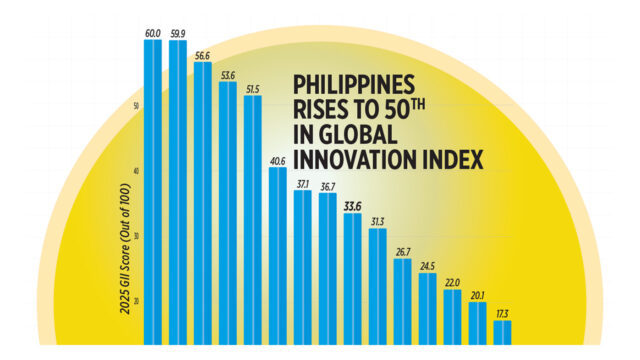
THE Philippines placed 50th out of 139 countries in the 2025 Global Innovation Index (GII), up three places from a year earlier, according to the World Intellectual Property Organization (WIPO). Read the full story.

Philippines rises to 50<sup>th</sup> in Global Innovation Index

Jimmy Kimmel defeats George Santos’ appeal over videos

JIMMY KIMMEL in Who Wants to Be a Millionaire. — IMDB

NEW YORK — Jimmy Kimmel defeated an appeal by former New York Congressman George Santos accusing the late-night host of tricking him into making personalized videos on the Cameo app and using them to poke fun at the now-imprisoned Republican.

In a 3-0 decision on Monday, the 2nd US Circuit Court of Appeals in Manhattan said Mr. Kimmel made “fair use” of the videos on his ABC show Jimmy Kimmel Live! to comment on Mr. Santos’ alleged willingness to “say absurd things” for money.

“The complaint paints a portrait of defendants motivated by (sarcastic) criticism and commentary,” not a desire to usurp Mr. Santos’ financial interest in the videos, Circuit Judge Raymond Lohier wrote.

Mr. Santos’ lawyers did not immediately respond to requests for comment. A lawyer for Mr. Kimmel, ABC and its parent Walt Disney had no immediate comment.

The defendants were accused of copyright infringement, fraudulent inducement and other wrongdoing over the videos, which Mr. Kimmel broadcast in segments called “Will Santos Say It?”

Mr. Santos has estimated he made more than $350,000 from the videos, for which he charged about $350 each. He sought unspecified damages.

Mr. Santos was sentenced in April to 7-1/4 years in prison after pleading guilty to wire fraud and aggravated identity theft connected to fundraising for his successful 2022 congressional run.

Mr. Santos spent 11 months in office embroiled in scandal, following revelations he had fabricated much of his resume, and was expelled from Congress.

He is housed in a medium-security prison in Fairton, New Jersey, and eligible for release in September 2031.

A trial judge in Manhattan dismissed Mr. Santos’ civil case against Mr. Kimmel on Aug. 19, 2024, the same day Mr. Santos pleaded guilty in the criminal case in Central Islip, New York. Reuters

Peso back at P56 level with Fed cuts eyed

PHILIPPINE STAR/ WALTER BOLLOZOS

THE PESO returned to the P56 level on Tuesday amid a weaker dollar as markets expect several rate cuts from the US Federal Reserve to support growth in the world’s largest economy.

The local unit closed at P56.91 versus the greenback, jumping by 27.1 centavos from its P57.181 finish on Monday, Bankers Association of the Philippines data showed.

The peso opened Tuesday’s session slightly stronger at P57.07 versus the dollar. Its intraday high was at P56.90, while its worst showing was at P57.165 against the greenback.

Dollars exchanged rose to $1.95 billion on Tuesday from $1.52 billion on Monday.

“The dollar-peso closed lower as the market continued to price in the series of rate cuts from the Fed,” a trader said in a phone interview.

The greenback slid ahead of a widely expected cut by the Fed this week and potentially further easing for the rest of the year following recent data showing signs of weakness in the world’s largest economy, Rizal Commercial Banking Corp. Chief Economist Michael L. Ricafort said in a Viber message.

For Wednesday, the trader sees the peso moving between P56.60 and P57 per dollar, while Mr. Ricafort expects it to range from P56.80 to P57.05.

The dollar slid to a more than two-month low against sterling and the euro and a 10-month trough versus the Australian dollar on Tuesday as investors firmed bets for a Federal Reserve interest rate cut this week, Reuters reported.

The US dollar index, which tracks the currency against a basket of six major rivals, fell to 97.121 after hitting its lowest since July 7, with US President Donald J. Trump renewing calls for aggressive monetary easing.

Markets expect a 25-basis-point (bp) rate cut on Wednesday, with rapidly softening labor market data being the key driver of the ramp-up in easing bets in recent weeks.

Mr. Trump in a social media post on Monday called on Fed Chair Jerome H. Powell to enact a “bigger” cut, pointing to the housing market.

“Focus remains on the Fed meeting on Wednesday,” said Mohit Kumar, strategist at Jefferies. “Key would be Powell’s tone.”

“If Powell puts more emphasis on inflation risks or the uncertainty surrounding the growth and inflation outlook, we could see the market paring back some of the rate cut expectations,” he added.

Elsewhere, sterling rose 0.2% to $1.3627, hitting its highest since July 8.

Data showed on Tuesday that Britain’s jobs market has lost a little more steam, potentially easing worries at the Bank of England about persistent inflation pressures.

The euro rose as much as 0.3% against the weakening dollar to $1.1797, a level not seen since July 3.

The Australian dollar edged 0.06% lower to $0.6666 after climbing to $0.6677, its strongest level since Nov. 8.

Against the yen, the dollar slipped 0.3% to 146.920 ahead of the Bank of Japan policy meeting on Friday, with money markets expecting the central bank to keep rates at 0.5%.

Japan’s farm minister and the chief government spokesperson joined the race on Tuesday to lead the ruling party and replace outgoing Prime Minister Shigeru Ishiba, who announced his resignation last month. — A.M.C. Sy with Reuters

STN gets SEC nod for valuation, clears way for PSE listing of unlisted shares

PHILIPPINE STAR/KRIZ JOHN ROSALES

STENIEL MANUFACTURING CORP. (STN) secured approval from the Securities and Exchange Commission (SEC) for its share valuation, paving the way to issue additional shares and list previously unlisted stock on the Philippine Stock Exchange (PSE).

The SEC approval allows STN to apply P247.64 million in advances for the subscription of 123.82 million additional shares at a par value of P1 each, the company announced on Tuesday.

The certificate is a prerequisite under SEC rules for STN’s plan to list 542.63 million unlisted shares.

The listing will proceed once the company complies with all SEC and PSE requirements, following board approval in May 2023.

Steniel Manufacturing, established in 1963, and its subsidiaries produce, process, and sell paper products, paperboard, and corrugated cartons.

The PSE lifted the nearly 18-year trading suspension on STN shares in April 2024. The suspension, imposed in July 2006, followed liquidity issues and default on a P636-million loan from 2000.

STN lowered its debt by transferring idle machinery to creditors (dacion en pago) and converting some of its debt into equity.

It also satisfied the PSE’s minimum public float requirement by selling shares to three third-party investors.

STN shares were unchanged at P2.46 each on Tuesday. — Alexandria Grace C. Magno

From outrage to action: Why the private sector must build a blockchain for public projects

THIS RESOURCE WAS GENERATED WITH AI/FREEPIK

In recent weeks, headlines have once again been dominated by corruption scandals surrounding infrastructure projects. Allegations of ghost projects, padded contracts, and manipulated bidding processes within the Department of Public Works and Highways (DPWH) have sparked both anger and despair among ordinary Filipinos. For many, this feels like déjà vu: we have seen this movie before, and the ending is always the same — taxpayer money gone, accountability missing, and trust in our institutions further eroded.

But what if, instead of waiting for government reforms that may never come, the private sector itself took the lead in building a transparent system to monitor all public projects? For decades, corruption has been treated as an inevitability in the Philippines. It is time to flip the script. The tools to do so already exist.

At the heart of our governance crisis is a massive trust gap. Budget releases, bidding documents, change orders, disbursements, and project completion reports are scattered across multiple agencies and often buried in paper trails. By the time anomalies surface — if they ever do — the money is gone, and accountability is elusive. This is not just inefficiency; it is systemic vulnerability. Every fragmented record is an open door for manipulation. Every opaque transaction is an invitation to corruption. Filipinos have grown accustomed to this opacity, but in a digital age, we must demand better.

Most people associate blockchain with cryptocurrency speculation. But blockchain’s most powerful use case is not financial speculation — it is trust without intermediaries. By design, blockchain systems create tamper-evident records: once an entry is validated by multiple independent parties, it cannot be altered without leaving a trace. Imagine if every peso released for a DPWH project, every contract awarded, every change order approved, and every progress milestone achieved were recorded on a blockchain validated not by government alone, but by a consortium of private sector, civil society, academe, and media institutions. Each record would require multi-party signatures before it became final. Each daily ledger could be anchored to a public blockchain, ensuring no backdoor edits were possible. This is not a futuristic concept — it is an available, tested technology. And unlike past “good governance” pilots that depended solely on government agencies, this system would rest on the principle of shared custody of truth. No single office, politician, or bureaucrat would control the record.

Why must the private sector lead? Because public frustration with government-only solutions has reached a boiling point.

Citizens no longer believe that self-policing will work. The only credible way forward is for independent validators — business groups, universities, NGOs, professional associations, and news organizations — to jointly monitor the ledger of public projects.

This is not about replacing government. Agencies like the DPWH, Department of Budget and Management, the Commission on Audit, and local government units would still provide the source documents. But instead of those documents disappearing into filing cabinets, they would be hashed, logged, and validated across a multi-stakeholder blockchain. A public explorer and open data portal would allow journalists, researchers, and ordinary citizens to see project progress in near-real time.

The financing can also be insulated from political influence. A blind trust, funded by corporate and philanthropic donations, can support the technical infrastructure, security audits, and validator operations. Donors would not gain governance rights; decision-making would remain in the hands of a broad, balanced community.

For each project, the ledger would track identity details such as project ID, title, location, implementing office, contractor, and procurement reference numbers. It would log the entire budget trail: allotments, releases, obligations, disbursements, and change orders. Procurement events, from pre-bid to award notices, contract execution, and variation directives, would be preserved as immutable records. Delivery and quality milestones — progress billings, geo-tagged photos and videos, lab test results, and as-built plans — would be linked with cryptographic proofs. Oversight artifacts such as site inspection reports, third-party audit notes, citizen feedback tickets, and Freedom of Information links would complete the picture. Every entry would carry the multi-party digital signatures of independent validators, and any dissent would also be recorded, creating a visible trail of contestation rather than silent suppression.

There is a unique window of opportunity to act. Public attention is focused on corruption in infrastructure, while interest in blockchain is growing beyond cryptocurrencies. Internationally, countries from Nigeria to Estonia are using blockchain to monitor identity, voting, and procurement. Filipinos are ready to demand the same standard of transparency. If we miss this moment, frustration will once again fade into cynicism. Worse, the cycle of scandal will continue — costing billions in wasted funds and perpetuating inequality as essential services remain underfunded.

The fight against corruption cannot be left to government agencies alone. Just as communities once built roads, schools, and bridges through bayanihan*, today we must build a new kind of infrastructure: a digital bayanihan against corruption. Private sector organizations — from chambers of commerce to professional associations — can take the first step by joining as validators. Universities can contribute data science and policy expertise. Media outlets can serve as independent watchdogs. NGOs can provide citizen feedback and advocacy. By working together, we can create a system where integrity is verified by many, not hidden by a few.

Every corruption scandal provokes outrage, but outrage alone does not change systems. The challenge is to convert protest into practice — to build mechanisms that make cheating nearly impossible and accountability automatic. Blockchain is not a silver bullet. But it is a foundational safeguard that reduces discretion, increases transparency, and empowers citizens to verify the record themselves. Combined with civic participation and sustained oversight, it offers the best shot we have at breaking the cycle.

The private sector has long called for good governance. Now is the time to prove our commitment by building it. If we succeed, every Filipino taxpayer will finally have a reason to believe that their hard-earned contributions are building roads, bridges, and schools — not ghost projects and lining politicians’ pockets. The choice is stark: continue lamenting scandals as they recur or seize the tools of technology and bayanihan to rewrite our governance story. The latter is difficult, but it is the only path to a future where integrity is not a campaign promise, but a daily practice.

*Bayanihan – communal effort


Dr. Donald Patrick Lim is the founding president of the Global AI Council Philippines and the Blockchain Council of the Philippines, and the founding chair of the Cybersecurity Council, whose mission is to advocate the right use of emerging technologies to propel business organizations forward. He is currently the president and COO of DITO CME Holdings Corp.

Ako Packaging develops cassava-based ‘green’ plastic bags

FACEBOOK.COM/AKOPACKAGING

By Edg Adrian A. Eva, Reporter

BULACAN-BASED startup Ako Packaging is producing 100% compostable plastic bags made from cassava starch, offering local businesses an alternative to conventional plastics that take centuries to decompose.

“The cassava bags actually melt in hot water, and they’re fully compostable,” Nikki L. Sevilla, Ako Packaging chief executive officer and co-founder, said in an interview. “They can be eaten by microorganisms, so they are a direct replacement for plastic packaging.”

Unlike traditional plastic bags that may take 20 to 500 years to degrade, Ako Packaging’s products can break down in about 180 days and may be disposed of with food waste. The bags are made from biomaterials, combining cassava resin with plant-based additives to balance biodegradability and durability.

“So, it can be used for food crops or ornamental crops. That’s the benefit of using compostable packaging,” Ms. Sevilla said.

Plastic pollution has been a longstanding environmental challenge in the Philippines, contributing to risks such as wildlife harm and flooding. Greenpeace Philippines said in July that waste clogging waterways worsened recent flooding, urging the government to curb plastic production.

The Philippines produces about  2.15 million tons of plastic waste annually, with about 35% ending up in the environment or landfills, according to a 2023 report by the World Wide Fund for Nature.

Ms. Sevilla said that given the scale of the problem, alternatives such as bioplastics should be explored more seriously. With the country’s worsening plastic waste problem, something must be done, and one option is to explore better alternatives, she said.

Ako Packaging’s cassava bags have been adopted by several micro, small and medium enterprises. The company is now seeking partnerships to scale up production into the hundreds of thousands or even millions of bags each month.

The startup is also continuing research to improve its cassava-based bags, which have limitations, such as unsuitability for wet items.

Ms. Sevilla said she hopes more innovators in the bioplastic space would emerge to boost competition and make sustainable packaging more affordable.

Auto Sales (August 2025)

PHILIPPINE VEHICLE sales declined year on year in August to the lowest volume in four months, dragged by weaker demand for both passenger and commercial cars, according to industry data. Read the full story.

Auto Sales (August 2025)

ADVERTISEMENT
ADVERTISEMENT