Home Blog Page 9728

Improved sentiment, lower oil prices to boost peso

THE PESO could find support from better market sentiment this week, as governments around the world announced more measures to help cushion the impact of the coronavirus disease 2019 (COVID-19) pandemic.

On Friday, the peso ended trading at P50.97 per dollar, recovering by 13 centavos from the P51.10 finish on Thursday, according to the website of the Bankers Association of the Philippines.

However, it weakened by 33 centavos from its P50.64-per-dollar close on March 13.

UnionBank of the Philippines, Inc. Chief Economist Ruben Carlo O. Asuncion said the peso’s rebound came after governments around the world moved to respond to the pandemic.

“The peso came in stronger as markets were better as an unprecedented stew of fiscal stimulus measures were pledged to be undertaken by governments and central banks worldwide. This is also true on the domestic front,” Mr. Asuncion said in a text message.

Among these moves is the latest rate cut from the Bangko Sentral ng Pilipinas (BSP), according to Rizal Commercial Banking Corp. (RCBC) Chief Economist Michael L. Ricafort.

“The latest [50-basis-point (bp)] BSP rate cut supports sentiment on the local economy and financial markets…,” Mr. Ricafort said in a text message.

The latest cut by Monetary Board reduced the overnight reverse repurchase, overnight lending and deposit rates to 3.25%, 3.75%, and 2.75%, respectively.

The move followed the BSP’s decision to reduce key rates by 25 bps in February.

On the fiscal side, the Economic Development Cluster last week announced a P27.1-billion spending package to help sectors affected by the pandemic which has caused Luzon to be placed under enhanced community quarantine. The funds will support the tourism industry, give aid to farmers, and to purchase more testing kits, among others.

BSP Governor Benjamin E. Diokno said on Sunday that falling oil prices will also help prop up the peso.

In an interview with ABS-CBN News Channel or ANC, Mr. Diokno said the peso will benefit from lower oil prices amid a decline in demand because of the virus outbreak.

“It (the peso) is steady, as you can see now. With…oil prices going down…, we’re benefiting from this. I think we’ll be okay,” Mr. Diokno said.

This week, the market will continue to monitor developments on the virus outbreak and how authorities around the world are supporting affected sectors.

“Major stimulus would be any additional stimulus measures by various governments around the world to combat the adverse effects of the coronavirus concerns on the global economy and financial markets,” Mr. Ricafort said.

UnionBank’s Mr. Asuncion said he is positive the local unit will be resilient this week, especially if the market sees more stimulus measures from the government.

“I expect the peso to hold up as long as the market senses the efforts of local institutions in supporting sentiment and the market in general,” he said.

Various business groups have urged Congress to deliver a fiscal response in view of the pandemic.

In a statement, they said the maximum fiscal response should include, among others, an increase in funds for conditional cash transfer recipients and additional support for the Department of Labor and Employment to support workers affected, and an increase in public investment spending just like what Germany will be doing.

Local health officials said that 73 new infections were recorded as of Sunday morning, raising the total to 380. Meanwhile, casualties totaled 25.

COVID-19 has already infected more than 300,000 globally, with over 13,000 deaths, while more than 95,000 have recovered.

For this week, RCBC’s Mr. Ricafort gave a forecast range of P50.70 to P51.20, while UnionBank’s Mr. Asuncion sees the peso moving between P50.70 to P51 against the dollar. — L.W.T. Noble

NY fashion labels turn to making face masks to fill health care shortages

NEW YORK fashion designers are offering to produce masks and gowns to help fill the shortage of protective equipment needed to deal with the expanding coronavirus outbreak.

Designer Christian Siriano told Governor Andrew Cuomo on Twitter that his sewing team is available to pitch in after the governor’s plea for protective equipment. Cuomo responded with his own Tweet urging more designers to come forward. The winner of Project Runway’s fourth season posted a video showing a prototype of the mask.

The American Apparel & Footwear Association, an industry trade group, said some members are converting production lines to produce much-needed equipment. It declined to name the companies.

Hedley & Bennett, which makes clothing for chefs and restaurant workers, offered to make face masks and gowns at its 16,000-square-foot facility in Los Angeles. Pamela Barsky, an East Village designer whose tote bags have a cult following, said her small production team could make 500 masks a day.

Recreational sewers are also joining. A family of medical professionals in the Boston area set up a volunteer mask sewing group and received thousands of messages from volunteers. New York-based hobbyists also sprung into action after the governor’s press conference on Friday, taking to Twitter to offer their services.

Some New Yorkers were ahead of the curve. Berchell Egerton, 28, was selling homemade face masks in Union Square for $5 a pop last Saturday. He started selling the colorfully printed cotton masks for $15 a few years ago.

Egerton dropped prices in light of the coronavirus outbreak. Halfway through his stint in Union Square, Egerton had sold 33 masks and was already planning to make P95-style respirator masks as soon as an order of filters arrived. — Bloomberg

Shares may drop further as coronavirus spreads

By Denise A. Valdez
Reporter

LOCAL SHARES are expected to decline further this week as the country continues its efforts to stop the spread of the coronavirus disease 2019 (COVID-19).

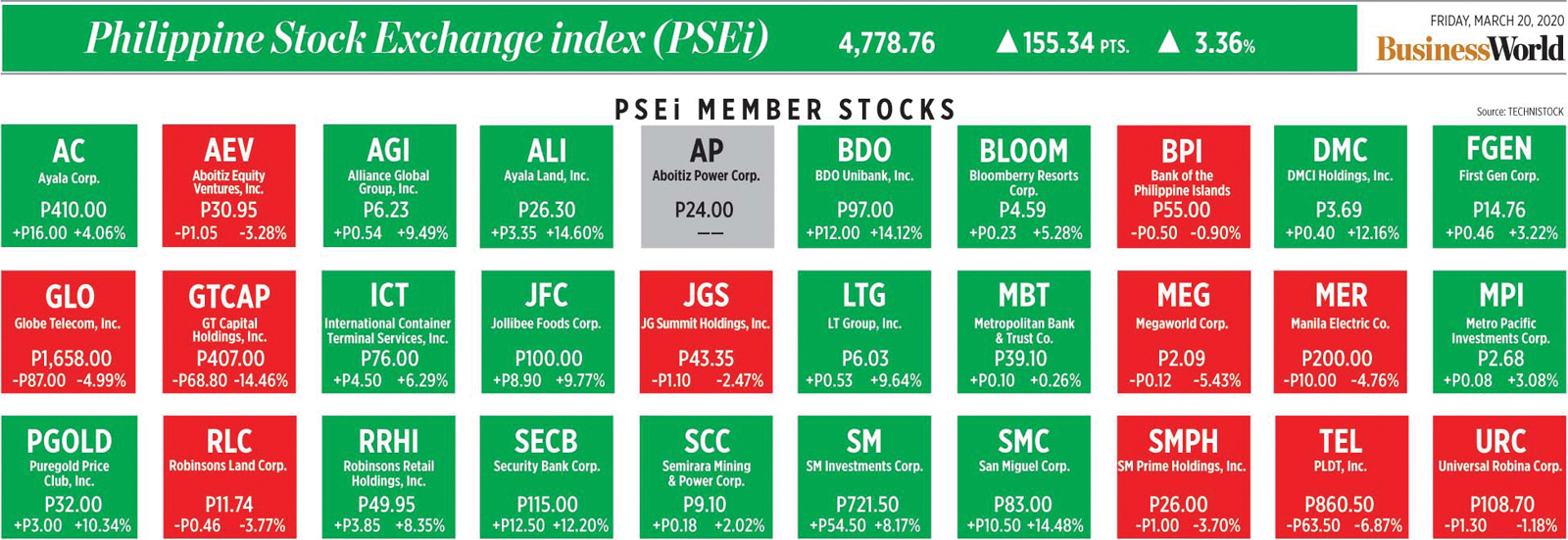
The 30-member Philippine Stock Exchange index (PSEi) improved 155.34 points or 3.36% to 4,778.76 on Friday. But this is lower by 1,015.18 points or 17.5% on a weekly basis, marking the fourth week the PSEi moved downward.

Value turnover during last week’s three-day trading week averaged P7.51 billion, 3.7% up from a week ago. Net foreign selling stood at P1.27 billion from P748.05 million the previous week.

Trading was suspended from March 17-18. It recorded its biggest single-day drop of 711.95 points or 13.34% to 4,623.42 when it reopened on Thursday. It also fell by as much as 24.29% to 4,039 in the intraday that day.

“[W]e expect another volatile week ahead in the market, and bias on the downside as COVID-19 cases in the Philippines are mounting and showing no sign of subsiding yet,” Philstocks Financial, Inc. Research Associate Claire T. Alviar said in a text message. “Many investors will still rush to have cash on hand due to the enhanced community quarantine in Luzon, which can drag the bourse further.”

The Health department reported 380 confirmed cases of COVID-19 in the Philippines as of Sunday morning. The virus has already killed 25 patients, while 15 have recovered from the illness.

Online brokerage 2TradeAsia.com said the effort of the government to put Luzon on lockdown will have to come at the expense of economic growth.

“Authorities are therefore in a precarious (and unprecedented) balancing act, leaving markets to spiral into speculation, and price-in longer storms,” it said in a note.

It noted that the problem remains a medical issue, therefore stimulus packages that try to pump out liquidity, while appreciated, may not be enough in the end. “[W]ith no hands to deploy said liquidity at the household level, markets will have to digest paltry earnings expectations, and favor safer heavens, at least for now,” 2TradeAsia.com said.

Bangko Sentral ng Pilipinas Governor Benjamin E. Diokno said on Friday that he expects growth to fall within just 5-5.5% this year, below the government’s 6.5-7.5% target. Philstocks’ Ms. Alviar said this may cause a weakening in investor sentiment as the market prices in this new outlook following earlier forecasts of strong economic growth.

2TradeAsia.com said what could help lift the market are investors hunting for sectors whose cash flow models are insulated, like telecoms and companies operating outside Luzon. Another are those betting on the recovery of worst-hit stocks like airlines.

“Advocates of the same with ample liquidity and stretchable time horizons will see the dip as opportunity to arbitrage the time difference (albeit gradually),” it said. It put immediate support at 4,000 and resistance at 5,000.

Senate bill seeks perks for organic fertilizer use

A MEASURE providing incentives to farm cooperatives and associations for the use of organic fertilizer has been filed in the Senate.

In Senate Bill No. 1339, Senator Maria Lourdes Nancy S. Binay proposed to exempt cooperatives and association from the payment of certain fees and charges.

The bill amends Presidential Decree No. 1144 by exempting those engaged in the domestic sale and trade of organic fertilizer from registration fees, license fees and other administrative charges.

“Much of the fertilizer needs of our farmers are still being met by traditional organic fertilizers,” Ms. Binay said in the explanatory note.

“With the recent attraction towards organic farming, local demand for traditional organic fertilizers has increased in the past few years.”

The bill directs the Fertilizers and Pesticide Authority (FPA) to issue guidelines for screening cooperatives and associations that may avail of the exemption.

It will also grant an amnesty to farmers who may have unknowingly violated provisions of the Decree, which prohibits the sale of pesticides, fertilizers or any agricultural chemical that has not been registered with the FPA.

The law provides for penalties of 15g20 years imprisonment, if the value involved is more than P50,000.

For P10,000 or less, violators are subject to 10-15 years imprisonment and a fine worth three times the amount involved, subject to a cap of 20,000. In cases when the amount cannot be determined, a fine of P5,000-P10,000 will be imposed.

The amnesty, which should be applied for within two years from the law’s effectivity, is intended to encourage farmers to register with the FPA.

“Regulation should be encouraged in view of the susceptibility of a free market regime to abuse,” Ms. Binay said.

Funding for the measure is set at P50 million. — Charmaine A. Tadalan

Speeding toward green mobility

There’s a surreal but almost palpable shroud that has covered the country — nay, the world — as I type out my inaugural column for this section. I had wanted this debut to coincide with the very special edition of Velocity you have in hand — an issue marking and celebrating a year since BusinessWorld’s motoring section had a reboot and renaming.

Instead, we are presenting “Speeding Toward Green Mobility” amid an unprecedented “enhanced community quarantine” here in Metro Manila and the entire Luzon island. Nations are scrambling to contain the Covid-19 pandemic which is sweeping across the world. I hope you are all well at home and are doing exactly that — staying at home. There’s no need to risk yourself and your loved ones to exposure unless you absolutely need to. And when you do, don’t forget the usual protective measures we should know by heart by now.

So, yes, instead of a celebration, our anniversary issue, while no less relevant, appears as a somber reminder of our mortality — and that we are largely helpless when Mother Nature decides to shrug her shoulders to demand a break, and some respect. The virus strain, first identified in Wuhan in the Hubei Province of China, is believed to have been initially transmitted when some foolish people decided to feast on exotic animals like bats and pangolins.

That’s what happens when we beat our chest and have the temerity to declare ourselves rulers of this domain. We are not.

In the same vein, mankind has long wrought havoc on the atmosphere by pumping it full of carbon emissions from our automobiles, power plants, factories, and such. Just as China has apparently banned the farming and consumption of wild animals, do we need a threat like Covid-19 to disabuse ourselves from harmful habits?

Thankfully, while some sectors and leaders still deny the onerous state of our environment and how we’re pushing it to the brink, there are louder voices of sound mind holding very important positions in both government and business.

We have long been in the age of alternative powertrains in aid of cutting our vehicles’ harmful pollutants. The Corporate Average Fuel Economy (CAFE) standards are ever-improving, ever-stringent regulations mandating that auto companies continuously cut emissions. In another front, more brands are looking at actually ditching the conventional internal combustion engine (ICE) in favor of more environment-friendly propulsion systems.

While alternative, more sustainable, and less-polluting fuels are in the mix, various levels of electrification are winning out in terms of viability. Toyota had pioneered the entry of the hybrid vehicle in 2009 via its now-iconic Prius. Despite the promised benefits of fuel economy and a smaller carbon footprint though, car buyers largely stayed away owing to its higher pricing compared to similar, albeit traditionally-powered counterparts.

But today’s a vastly different era compared to when the Prius first entered the scene here. Electric vehicles have ceased to be a novelty. We have a thriving electric vehicle scene, spearheaded by the Electric Vehicle Association of the Philippines (EVAP).

While more recent figures will surely be negatively impinged upon with the disruption of Covid-19, the graph had been on an upward trajectory, as reported by EVAP in its Velocity-exclusive report some weeks back. “The optimism of EVAP is bolstered by a study conducted last year by the Edison Electric Institute that global EV sales totaled about 2.1 million for 2018, an increase of 64% compared to the total sold in 2017. In 2018, EV sales increased by 79% in the US, 78% in China, and 34% in Europe compared to 2017.

“In the US market alone, EV sales represented approximately 17% of global EV sales in 2018. More than 1.18 million EVs were on the road in the US as of March 31, 2019. Its market share grew to 1.8% in March 2019, up from 1.6% in March 2018.”

Domestically, EVAP shared equally heartening news. Local electric tricycle BEMAC produced 3,000 e-trikes under the Tricycle Replacement Program of the Department of Energy (DoE); same goes with electric jeepneys which are gaining “public acceptance and have now achieved a foothold in the domestic mass transport industry,” reported EVAP Chairman Rommel Juan.

Big auto brands are today not averse to releasing and championing the electric. It’s unsurprising to even hear of luxury brands pushing hybrids, PHEVs, and full electrics. More significantly for us, they’re already here, and they are fast shaping a new normal. Lexus has been quietly but routinely leading hybrid sales in the country.

The Prius is no longer alone in holding the electric torch. It was a big statement by Toyota to bring in the hybrid version of its Corolla Altis. As you know, the Corolla nameplate is the world’s most popular model. For a relatively affordable P1.58 million, more people can take a serious look at the hybrid as a realistic mode of transportation. The price of admission has gotten that much lower.

Truly, there’s hope for the planet, even as we seek greater mobility for more. These two do not need to be on opposite sides of the spectrum anymore. The writing on the wall is clear: We’re speeding towards green mobility, and not even Covid-19 can stand up to that. We’ll see you on the other side of this crisis. Keep safe, and keep faith.

Aboitiz firms expand customer aid during lockdown

THE Aboitiz Group is expanding its assistance to customers during the Luzon lockdown through payment extension, waived rental fees and sustained operations for basic necessities.

In a statement yesterday, the group said its power, banking, land, food, infrastructure and construction units are all working together to help the country as it fights the spread of the coronavirus disease 2019 (COVID-19).

Aboitiz Power Corp., through its distribution units Visayan Electric, Davao Light, Cotabato Light and Subic EnerZone, is implementing a 30-day extension for bills due Mar. 15 until Apr. 14

Banking unit Union Bank of the Philippines is similarly extending the payment for credit cards and loans until Apr. 14. Its subsidiary City Savings Bank is also extending its 30-day loan payment moratorium for motorcycle loan borrowers in good standing.

AboitizLand, Inc. is waiving the rent for tenants in its malls in Luzon and Visayas. It is also extending the payment deadline for bills issued last month.

Customers of AboitizLand’s residential segment are getting payment extensions for accounts due March 16 to April 15. Penalties and fees related to transactions during this period have also been waived.

Food unit Pilmico Foods Corp. and water units Lima Water Corp. and Apo Agua Infrastructura are maintaining operations to support the need for basic necessities.

Construction projects under Aboitiz Construction, Inc. are also proceeding but in observance of strict precautionary measures.

“We in Aboitiz fully recognize the impact of the current situation on our clients and customers — and we are doing our best to help them cope until things return to normal,” Aboitiz Group President and Chief Executive Officer Sabin M. Aboitiz said in the statement.

NESTLÉ PHILIPPINES
Meanwhile, Nestlé Philippines said it is giving benefit packages to more than 5,000 employees, especially those at the frontlines of food production.

Among the benefits are a guaranteed full pay for those working from home, a special premium pay for the lean workforce that stayed in production, paid salaries for those unable to report for work due to the lockdown, early crediting of the March payroll with performance bonuses, medical support for employees, and free shuttle service with meals and lodging for those in factories.

The company is also assisting third-party merchandising agencies, co-manufacturers and distributors by offering free transportation or gasoline reimbursement for skeleton staff and giving gift products for merchandisers and truckers.

“We are grateful particularly to our frontliners who help make our products accessible to consumers. We recognize that they are facing great challenges and making tremendous sacrifices, and so for our part we can only find ways to support and care for them,” Nestlé Philippines Chairman and Chief Executive Officer Kais Marzouki said in a statement. — Denise A. Valdez

BSP targets to issue bonds by second half

THE BANGKO SENTRAL ng Pilipinas (BSP) will go ahead with its planned issuance of its own securities in the second half of the year, despite some pre-launch activities being postponed due to the enhanced community quarantine in Luzon.

“The BSP is looking at formally launching the BSP Securities issuance in the second half of 2020, on the assumption that all of the requirements to support the issuance of negotiable BSP Securities are already completed by then, particularly the required IT (information technology) systems,” the central bank said in an emailed response to reporters.

It noted that the connection between the BSP’s Monetary Operations System and the National Registry of Scripless Securities needs to be finished for the issuance of the negotiable BSP securities.

The central bank said they have been doing industry consultations since February on the proposed features of BSP securities.

“[S]ome of the pre-launch activities initially scheduled in Q1 2020, particularly those requiring interactions with other government agencies and counterparties, may have to be pushed back in view of the one-month community quarantine implemented in Luzon,” the BSP said.

“Meanwhile, all other preparatory activities are proceeding as planned,” it added.

Under the New Central Bank Act, the central bank regained its authority to issue its own set of securities, just like the Bureau of the Treasury.

The central bank has an existing term deposit facility (TDF) with weekly auctions which serves as its principal tool to shore up excess funds in the financial system and guide market interest rates.

Deputy Governor Francisco G. Dakila, Jr. has said they are still assessing the tenors of the bond issuance to make sure this will not compete with the BSP’s TDF and the Treasury bills. — L.W.T. Noble

How PSEi member stocks performed — March 20, 2020

Here’s a quick glance at how PSEi stocks fared on Friday, March 20, 2020.


COVID-19 and the economy

I am pleased to share with readers a post Christine Tang and I wrote for GlobalSource Partners (globalsourcepartners.com ) on March 18 on the potential economic growth impact of COVID-19 and on March 19 on the recent actions government has taken in the monetary and fiscal policy areas.

On Monday last week, as it became evident that putting Metro Manila on lockdown was not going to significantly limit the movement of people, President Rodrigo Duterte, upon the recommendation of health officials, expanded the lockdown to the entire island of Luzon, imposing strict home quarantine on all households, at the same time, suspending all public transport systems and closing down private establishments except those providing basic necessities, including health-related outlets, groceries and supermarkets, and banks. Also allowed to continue operating are export-oriented firms, including the business process outsourcing sector, while movement of goods will remain unhampered. Additional permissions followed a day later, including trading in capital markets, deliveries of food and medicines, and easing of restrictions for outbound international passengers, including overseas workers.

Considering the limited supply of testing kits when local transmissions began multiplying early this month, the lockdown appears to be the government’s only avenue to “flatten the curve” of daily infections and reduce the stress on local health facilities. As of March 21, 307 people have tested positive for COVID-19, with 19 fatalities and 13 recoveries.

Clearly, it is not possible at this time to quantify the cost of the lockdown. The assessment of the Central Bank governor of quarterly activity, taking note that the lockdown straddles the end of Q1 and start of Q2, is as follows: if it succeeds, the economy is in for a sharp V-shaped rebound; if it fails, the cost could be “large and protracted” with the recovery taking an elongated U shape.

This uncertainty on the adverse impact of the local lockdown is compounded by similar uncertainties regarding the effectiveness of drastic measures taken by governments in the west to contain the spread of the coronavirus in their own countries. Quite apart from the broadening impact on international economic activity (travel and trade), plunging stock prices, and outsized monetary policy responses, with the US Fed cutting rates by 150bp to zero, are reminiscent of conditions during the 2008-09 Global Financial Crisis, when world GDP contracted. The main piece of good news at this time is that China is starting to get back on its feet, with factory activity returning to “normal”

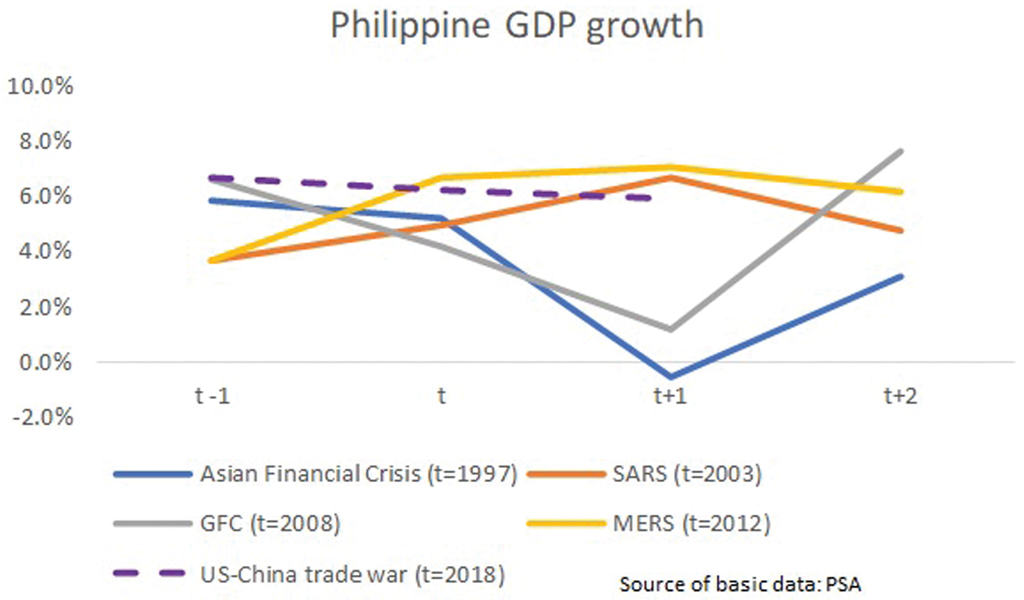
For now, we leave with readers the chart below of Philippine GDP performance during similar episodes in the past. We note that overall growth in past coronavirus outbreaks (SARS and MERS) held steady, suggestive of within-year recovery from any adverse impacts. On the other hand, past financial crises tended to drag on, taking time to resolve, with growth rates sharply down the year after the onset of the crisis. Considering trade tensions, the global spread of COVID-19 (it is a pandemic), the stringent measures taken by many governments, and the fact that the local lockdown covers an area accounting for about 70% of Philippine GDP, we think that the dotted line will continue to trend down, less sharply the sooner the virus is contained and the lockdown lifted. Lately, other analysts have started to downgrade GDP forecasts to below 5.5%. We think the likely downsides are deeper, even going to negative territory, unless stimulus measures from fiscal and monetary authorities to counter the downsides bring quick relief.

There is room for accommodation on both fiscal and monetary fronts, although ensuring bang for the buck will require careful targeting. For instance, on the monetary side, more interest rate cuts are expected beyond the “almost certain” 25bp signaled so far, which will also make the BSP’s rediscounting facility more attractive and encourage banks to lend to firms facing liquidity problems. On the fiscal side, in addition to a higher budget deficit (3.6% of GDP signaled so far) that preserves programmed spending, finance managers have announced additional off-budget support that will be coursed through public financial institutions with mandates to promote affected sectors, including tourism and micro/small/medium-sized enterprises, agriculture as well as incomes support through unemployment benefits for members of pension institutions.

This health crisis is happening at a time when the private side is much weaker and the credit cycle is nearing its end. Domestic investment activity did not perform up to par last year and some of the negative effects on current consumption are not readily recoverable within the year (e.g. permanent income losses, cancelled events). Moreover, the health of the world economy is much weaker considering ongoing trade tensions, tenuous geopolitical conditions (including an ongoing oil price war), and weakened international cooperation mechanisms.

MONETARY POLICY RESPONSE TO COVID-19
The Monetary Board (MB) of the Bangko Sentral ng Pilipinas (BSP) has introduced a package of measures to help combat the adverse effects of COVID-19 on domestic economic activity. These included: 1.) a 50bp cut in the set of policy rates, with the key overnight borrowing and lending rates reduced to 3.25% and 3.75%, respectively; 2.) temporarily setting the interest rate on its rediscounting facility equal to the lending rate; and, 3.) authorizing certain regulatory forbearance for banks involving more relaxed rules on compliance reporting, calculation of penalties on required reserves, and single borrower limits.

Per its statement, given the significant downward adjustment in its inflation forecast (2.2% this year and 2.4% next), the set of measures is intended not only to support growth momentum and uplift market confidence but mitigate the risk of financial sector volatility, ensure adequate domestic liquidity and credit in the financial system, and lower borrowing costs for affected firms and households. While signaling readiness to provide other supplemental measures, the MB nonetheless stressed the need for “urgent and carefully coordinated measures with other government agencies to alleviate the spillover effects of the pandemic on people and firms, with a view toward preventing any long-lasting economic and social damage.”

We agree with this. Policy stimulus needs to provide quick relief to affected sectors to avert a deeper decline in GDP growth and ensure more rapid recovery. As monetary policy works with a lag, the greater burden at this time falls on fiscal policy, which needs to provide immediate support not only to the health sector but direct subsidies to poor households who do not have the means to pay for basic food requirements if they are ordered to stay home. Philippine employment statistics show a large number of “underemployed” workers (over 6 million for the entire country) who, like some of the other non-regular/contractual wage/salaried workers, would receive no pay if they do not work.

So far, of the P27.1 billion mostly off-budget package announced by the economic team, only P3.2 billion will benefit displaced workers in the near-term. This is just a fraction of the P13.6-billion income replacement cost estimated by the Chairman of the House Ways and Means Committee for Metro Manila alone. Also, the government would need to consider providing tax relief for firms with short-term liquidity problems (as in other countries) and plan for continuing social distancing measures even after the lockdown is lifted, for example, supporting public transport systems.

We think that given the seriousness of the crisis and how other countries have responded with large stimulus packages, markets would be forgiving of a one-off unplanned increase in the budget deficit in 2020 that allows the economy to recover quickly. Considering the continuous downtrend in the debt ratio and rise in the tax effort since the administration came into office, we think an overall deficit number not exceeding 5% for this year would be reasonable.


Romeo L. Bernardo was finance undersecretary during the Cory Aquino and Fidel V. Ramos administrations.

romeo.lopez.bernardo@gmail.com

Global distancing

COVID-19 said it to the whole world: stay home. With the lockdowns of their communities, countries humbly said yes. It seems it is only in the Philippines that the term “lockdown” has been so fearfully avoided, but call it by whatever name, “enhanced community quarantine” is a lockdown — both a lock-in and a lock-out, where plain quarantine is simply a lock-in. Whatever, just stay home.

“Enhanced Community Quarantine” (ECQ) is the official nomenclature for the government’s master plan launched on March 17 for the containment of the COVID-19 which was declared to be a Public Health Emergency of International Concern (PHEIC) by the World Health Organization (WHO) on Jan. 30. A pandemic, that is what the PHEIC is, but the WHO seemed coy at first about using certain words that stir passion. And now our Department of Health (DoH) and other involved agencies of government repeatedly tell the public not to panic.

But panic cannot be banned like banning travel and movement to and from the isolation area. Panic is the human regret on an assessment post facto of what might have been done early enough not to be in this sorry situation, and a fear for one’s vulnerability that there is not yet a solution or at least protection to this strange new virus. In this day and age of advanced technology and instant information and communication, why did the world not react sooner to slay the dragon that came from Wuhan, China — this appalling COVID-19?

Should the airports of the world not have been already on high alert for inbound passengers from Wuhan back then, when the Wuhan Municipal Health Commission had already announced the first death caused by the new coronavirus on Jan. 11, and the second death on Jan. 17? Thailand had reported its first case of an infected Chinese national who had arrived from Wuhan on Jan. 13, and Japan its first infection on Jan. 16, according to the timeline of CNN (March 19, 2020). By Jan. 20, China reported 139 new cases of the sickness, including a third death.

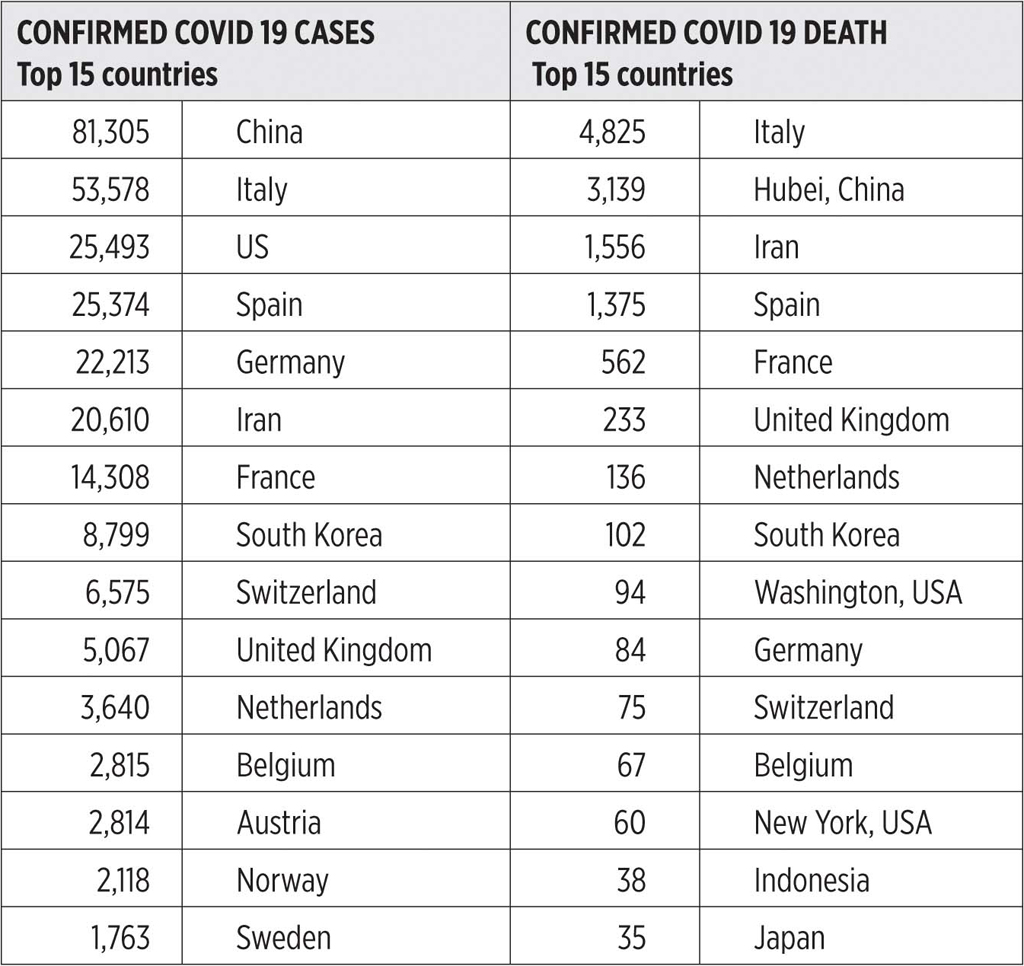
Real time global tallies provided by Johns Hopkins University, CSSE (https://systems.jhu.edu/) as of yesterday morning, March 22, show 168 countries with 304,528 confirmed cases of COVID-19, where 12,973 or roughly 4.25% have died from the virus. The top 15 most affected and afflicted are listed in the Table here.

Not for lack of sensitivity and compassion, it is not surprising that China has the most number of confirmed cases, 26.7% of the total COVID-19 cases diagnosed worldwide, because the virus first appeared in Wuhan, as China itself admits. What is alarming is Italy, which has the second largest number of confirmed cases, 17.5%, in the world, and the most number of mortalities, 37.2% of total deaths. Also strange is how Iran is 6th for confirmed cases, of which 7.5% have died, the third most fatalities in the world.

The immediately evident culprit for the spread of the virus is travel. The first case known of a coronavirus-infected airline passenger (neither the virus nor the disease it causes was named yet then) was on Jan. 13, when Thai airport authorities reported a Chinese national who had arrived from Wuhan. Three days later, Japanese authorities confirmed that a Japanese man who traveled to Wuhan was infected with the virus. In the succeeding days, a second and a third man died from the yet-unknown virus in China. When on Jan. 21, when officials in Washington State confirmed the first case on US soil, the US screened all arriving passengers in its airports and rejected all those who had Wuhan in their recent travel history. Alas, a whole planeload of passengers from Wuhan arrived in the Philippines on Jan. 21. They were allowed to mix and mingle with society until one really sick Wuhan tourist asked for medical assistance on Jan. 25, but died on Feb. 7.

France and Spain joined Italy in imposing lockdowns on tens of millions of people, Australia ordered self-isolation of arriving foreigners, and other countries extended entry bans as the world sought to contain the spreading coronavirus, Reuters reported on March 16. Several countries imposed bans on mass gatherings, shuttered sporting, cultural, and religious events, while medical experts urged people to practice “social distancing” to curb the spread.

And so President Rodrigo Duterte declared first a “community quarantine” for Metro Manila on March 16, expanded the quarantine area to the whole of Luzon on March 17, therewith declaring a state of calamity for six months for the whole country — basically for the mobilization of funds for local government units to provide logistics for police to physically contain people in their areas and health officials to treat patients, and help them to recover. According to Johns Hopkins monitoring, 92,296 or 30.2% of total confirmed cases have recovered around the world, the most (approximately 77%) coming from China.

It is most thought-provoking in this time of COVID-19 that this is probably the first time in history since the World Wars (now 75 years ago) that the world has so carefully repaired and rebuilt national boundaries — purposely, and not by political whims, by the lockdowns in many communities in many countries, and the self-quarantine of individuals themselves, who see the need for protection and survival. The airports and seaports are mostly closed to inbound travel. For at least 30 days, this lock-in, lock-out situation will rule the world — never mind maximizing trade and commerce for the meantime. All sharing and taking between nations, communities, alliances and between individuals will only be for the continuing humanitarian supply of basic needs like food and medicine.

Pwede pala, so it can be done. In the quarantines and lockdowns, it is as if the world stood still, to re-assess the speed of its rotation around the worshipped sun of prosperity. In the slacked pace forced by the COVID-19, perhaps introspection will be on self-reliance and sustainability, in lieu of the gross taking from the other to gain more than what is needed — that is called Greed. After the World Wars, the race for power and wealth among nations has become another extended war. The economics of scarce resources was altered by the rush to globalization and borderless resources.

Is global distancing among countries suggested by the social distancing of COVID- 19?


Amelia H. C. Ylagan is a Doctor of Business Administration from the University of the Philippines.

ahcylagan@yahoo.com

The need to invest in soft power

This is alternative reading for those who need a break from corona virus-related news.

Frequent travelers like myself get the same response whenever we ask foreigners what their impressions are of the Philippines.

Regardless of whether they are from Europe, Asia or the Americas, the impressions are all the same. The most common impression is that we have a President who has little regard for human rights and who kills without impunity. On second breath, we are known as a country often beset by natural disasters. Some think of us as a nation that grapples with widespread poverty and that has a government too corrupt to address it. A few may recognize the Philippines as a source country for domestic helpers, medical practitioners and seamen.

It’s a shame since there are many favorable aspects about the country which remain unknown. Among them is the fact that we are one of the fastest growing economies in the world; a nation that is rapidly modernizing with a massive infrastructure program underway; a country in the pink of financial health, duly certified by credit rating agencies; a nation blessed with extraordinary landscapes and seascapes; a people that are kind and hospitable. I can go on… suffice it to say that the Philippines has so many good attributes that remain unannounced and unrecognized.

The reality is, if we neglect to control our international image, the world will form its own opinions of us based on newsfeeds on mass media. More often than not, these newsfeeds are of a negative slant since negative news attracts more readers.

I have appealed many times to Secretary Martin Andanar of the Presidential Communications Operations Office (PCOO) to give due attention to our country brand and international profile. So far, my calls have been ignored. It seems that the PCOO is more concerned about pushing government’s propaganda and making the President look good.

In this respect, the PCOO maintains a myopic, insular view of its mandate. What a waste — with its budget and platform, the PCOO could be a potent tool for nation building. Another opportunity squandered…

Why is managing our international image important?

Having a favorable international image creates natural supporters for the country. It allows us to attract followers, cohorts and cliques not by force or money but by persuasion. A favorable image allows people to prefer anything that emanates from the country — be it its people or its products.

Having this appeal (or attraction) is what diplomats refer to as “soft power.”

The Philippines needs to amass soft power since we are in that awkward position where our economy is too small to dictate global policy, yet large enough to be affected by every accord signed by more powerful nations. We must gain a louder voice in the world stage to protect our interests. Soft power gives us the gravitas we need.

How does a nation gain soft power? According to the University of Southern California’s Center for Public Diplomacy, soft power is created when the world begins to appreciate these facets of a country: 1. Its culture, whether traditional or pop culture; 2. Its politically correct government policies (e.g democracy, free trade and human rights); 3. Its progressive economy; 3. Its locally made products of specialty (e.g. furniture from Cebu); 4. Its homegrown enterprises with an international footprint (e.g. Jollibee); 5. Its specialized fields of education (e.g. rice technology); 6. Its cuisine; 7. Its luxury goods (e.g. south sea pearls); 8. Its tourism products (e.g. sun and sea, wellness and eco-tourism) 9. The attributes of the people (e.g. friendliness, hospitality); 10. The unique qualities of Filipinos life (e.g. bayanihan)

The ability to influence policy and global decisions is where true power lies.

There was a period in time when the Philippines had the strongest soft power in Asia. Former President Ferdinand Marcos understood soft power and played it to the hilt.

Under his administration, he championed ASEAN as a founding member. He created a cultural assault by exporting Filipino dance (Bayanihan dancers), music (Madrigal singers), and film (Metro Manila Film Festival). He supported the International Rice Research Institute and created PhilRice. He established the Philippines as a forerunner in medical research. He jockeyed to have the Philippines host international events such as the United Nations Conference on Trade and Development. He bid to make Manila the headquarters of the Asian Development Bank. He made the Philippines the first to undertake a green agricultural revolution.

Of course, the manner by which Marcos expended the nation’s resources and whether his programs were successes or failures are another issue. What I wish to underscore is that under Marcos, Philippine soft power was at its peak. As a result, the world recognized the Philippines as a nation to be reckoned with — progressive, attractive, and substantive. Our voice was loudest in international fora, our exports thrived as did foreign investments and tourism.

Governments after Marcos mistakenly thought that investing in soft power was frivolous. How wrong they were. The present dispensation is no exception.

We can learn valuable lessons from South Korea.

In the 1990’s South Korea developed a movement called “hallyu” or the Korean cultural wave. The South Korean government was so committed to hallyu that it created its Basic Law for Cultural Industry Promotion in 1999 and allocated $148.5 million to it — a large budget at the time. At the heart of hallyu is a program to export Korean pop culture. This was done not only to derive revenues from it but more importantly, to foster better understanding of Korean culture and to shape its image as a modern, advanced, open-minded society.

South Korea’s first major global success came in the form of K-dramas. The 2002 drama, Winter Sonata, became a global phenomenon partly through the South Korean government’s deals with broadcasters in Asia, the Middle East, and Europe to air the show on prime time. K-dramas succeeded in increasing positive feelings towards Korea.

Later on, hallyu expanded to music. Large investments were made to develop pop artists who could compete with their American or British counterparts. Slick music videos were produced to support the marketing assault. In the early 2000s, groups like EXO, Super Junior, and Wonder Girls made an impact in international markets.

The turning point came in 2012 when Psy’s “Gangnam Style” became the first YouTube video to achieve 1 billion views.

K-Pop has since turned into a giant, money-making industry for South Korea. The boy-band, BTS, was the second best-selling artists of 2018 worldwide. As of 2019, the group raked-in aggregate revenues of $4.65 billion.

Last year, hallyu has began to conquer the film industry as Bong Joon-ho’s dark comedy, Parasite, won multiple Oscar awards.

Hallyu brought about other economic benefits apart from record sales, movie receipts and television rights. It caused a spike in demand for Korean cosmetics and skincare products which grossed $2.64 billion in 2015. It caused Korean export of cars and electronics to boom. Tourism-wise, inbound travel to South Korea peaked at 17.5 million last year. Korean cuisine products is now mainstream. Korean-made products are now deemed to be of high quality.

Politically, hallyu played a role in the designation of Ban Ki-moon as the Secretary-General of the United Nations from 2007 to 2016.

The Korean experience shows that soft power is an investment that yields tremendous dividends in the realms of trade and diplomacy.

It is time the Philippines stopped looking inward and invested in our own hallyu movement.


Andrew J. Masigan is an economist.

How prepared are we to fight Covid-19? What has to be done?

That all countries failing the test of beating COVID-19 is not an imagined fear. What we are seeing now is severe stress to the point of failure in all country health systems, regardless of preparedness.

But how prepared are we for the health emergency that is upon us?

The Global Health Security Index or the GHS Index gives us perspective. Published by the Center for Health Security, Johns Hopkins Bloomberg School of Public Health and Nuclear Threat Initiative in October 2019, the GSH ranks the Philippines and 194 other countries with regard to health security capabilities.

The publication’s finding is disturbing: “The Global Health Security (GHS) Index analysis finds no country is fully prepared for epidemics or pandemics. Collectively, international preparedness is weak. Many countries do not show evidence of the health security capacities and capabilities that are needed to prevent, detect and respond to significant infectious disease outbreaks.”

Overall, the Philippines is ranked 53rd, with a score of 47.6. The global average score is 40.2. The Philippines is thus categorized as a “more prepared country.”

Here are some indicators on how the Philippines fares, which have relevance to fighting COVID-19.

On “early detection and reporting for epidemics of potential international concern,” the Philippines is ranked 41st, with a score of 63.6, against the average score of 41.9 (categorized as “more prepared” country).

On the “rapid response to and mitigation of the spread of an epidemic,” the Philippines is ranked 69th, with a score 43.8 against the average score of 38.4 (more prepared).

On having a “sufficient and robust health system to treat the sick and protect health workers, the Philippines is ranked 47th, with a score of 38.2 against the global average score of 26.4.

And here is the most telling part: The GHS Index shows that all countries are failing when it comes to the key indicator that will save us from a severe pandemic: sufficient and robust health system to treat the sick and protect health workers. Out of a possible score of 100, even the top country, the US, has a score of 73.8. The Philippines is barely halfway with a score of 38.2. Worldwide, the average score is 26.4.

We are in the same league as Italy 36.8 and Iran 34.6. That puts us on track with these two countries most heavily burdened by COVID-19 — and Italy scores much better overall than the Philippines when it comes to health systems (Italy 31, Philippines 53).

But as the GHS Index said, no country is fully prepared for a pandemic like COVID-19. Many countries, even those categorized by the GHS Index as prepared — including the US, which is in relative terms the most prepared — have been caught flatfooted. The GHS Index came out three months before the COVID-19 outbreak in Wuhan.

The Philippines was able to do early detection, but was overwhelmed by many constraints, both objective and subjective, in preparing for the COVID-19 onslaught.

It is still not too late for the Philippines to emulate what countries in this region have done to blunt the pandemic. But given the resources we have, we need to use our wits and optimize the resources of the health system we have which is neither resource-rich nor technically prepared.

The Philippines must use its best available tools to overcome the crisis.

Our major advantage is a large pool of health workers, not only in the Department of Health (DoH) and local governments, but also in other agencies outside the regular health system but who are already in government. These extra health workers need to be identified and enlisted now to address any need for a surge in health workers should the crisis worsen.

The private sector is another source of additional health workers and the DoH and health authorities in provincial and city governments have to start enlisting them as a health augmentation pool.

It is both a weakness and a strength that the country has a decentralized health system. But during an epidemic, the country needs one health authority for the entire system. It is important for the health authority to have a single command but with decentralized action at the provincial and city levels, much like the uniformed police and military.

Right now, the hospitals are the first line of defense as they absorb all the positive cases, persons under investigation (PUIs), persons under monitoring (PUMs), and everyone with one of the symptoms of influenza like illness (ILI).

They also face the challenge of blindly caring for all without having the luxury to analyze where the patients are coming from. This happens in a clustering of cases to which one must assign a team from the ESU (epidemiological surveillance unit) at provincial and city levels to limit the impact of the cluster event. These units can support hospitals by predicting where the next outbreak will be and conduct testing or act on information regarding new cases. Done consistently and properly this can reduce the current burden of hospitals.

Demographically, the enhanced community quarantine covers 100% of Metro Manila’s 13 million-population — confined to their households and communities, 24/7. Before quarantine, 60% of that population would be working and commuting half the day.

Without the relief brought by population mobility in daytime, surveillance systems need to ramp up their activities, and public health centers serving these communities should set up influenza or fever lanes to identify pockets of outbreaks early and deploy testing if needed. This to avoid communities from exhibiting a “cruise ship effect.”

Given the above, this is where a single health authority has to take hold of the system and start assigning tasks rationally. The DoH can use the Local Government Code’s Section 105 to take over province-wide and city-wide health surveillance systems to prepare for the coming surge of patients and allocate limited resources. Municipal and component city clinics will now report to the higher health authority.

In the same vein, now is actually the time to implement the province-wide and city-wide health systems, as mandated by the Universal Health Care law.

Further, the DoH and local health authorities can realign province-wide and city health systems to set up a wide net of surveillance for ILI and a secondary line for SARI (severe acute respiratory infection or atypical pneumonia). This can be set up at the level of the rural health unit/health center, out-patient department (OPD), or private clinic.

This system should identify communities where there is a large number of consultations for this type of illness in order to catch potential cases and treat those who do not have to be referred. This eases up the pressure on higher-level hospitals and maintains healthcare for the greatest number.

In addition, the DoH and local health authorities can call on the other government and private sectors to support the system and deputize them as public health workers.

This move will necessitate some easing up of the enhanced community quarantine: There is a potential danger that those with influenza-like illness and potential source of COVID-19 infection will stay at home until it is too late. We could be covering up the clusters of illness developing in our urban communities in particular, making it harder to flatten the curve.

Physical distancing or social distance should not limit or curtail one’s access to health services. Local health authorities with DoH supervision must make this clear to police and military authorities.

It must also be clear to us as a nation that we will stand alone for the major part of this crisis. All the houses are burning globally, and the fire trucks are nowhere to be found.


Juan Antonio Perez III is a friend and partner of Action for Economic Reforms, is a civil servant at the Commission on Population and Development, and a public health worker with experience in local health systems and health information systems.


ADVERTISEMENT
ADVERTISEMENT