Home Blog Page 942

Baguio Council to quiz Discayas over P110-M tennis court, parking building

BAGUIO CITY — The Baguio City Council will summon the Discaya couple to explain the involvement of the St. Gerrard Construction company in the P110-million Burnham Park tennis court and parking building project, which has drawn criticism for poor quality and lack of transparency.

Vice Mayor Faustino A. Olowan said the invitation aims to clarify the group’s role in the controversial project, which was already inaugurated last May despite ongoing complaints.

The firm was reportedly blacklisted in 2020, raising questions about how it secured the contract — particularly under Mayor Benjamin B. Magalong.

Mr. Olowan said, “We need to set the facts straight,” with several councilors backing a resolution to formally summon the Discayas in the next session.

Facing public pressure, Mayor Magalong has since called for an independent third-party probe. “This is about protecting public interest,” he said, though he earlier defended the project’s legality.

Lawyer Francis Camtugan, who first flagged the issue, believes local officials — including the Bids and Awards Committee — must also be held accountable. He stressed the need for full transparency of all project documents.

Mr. Camtugan also warned that summoning the Discayas could create a “security nightmare” and asked, “Are we ready to pay the price?” — Artemio A. Dumlao

Potential entrants sending telecom investment feelers

BW FILE PHOTO

By Ashley Erika O. Jose, Reporter

AT LEAST FOUR foreign companies have signified their interest in entering the telecommunications industry following the passage of the Konektadong Pinoy Act, the Department of Information and Communications Technology (DICT) said.

It added that the implementing rules and regulations (IRR) for the law are due for release by  the end of October.

“We are on track… final comments (on the draft IRR) will be submitted by the first of October. From there it’s due for publication. Before the end of October, (the IRR) should be out,” Information and Communications Technology Secretary Henry Rhoel R. Aguda told reporters on the sidelines of Arangkada Philippines Investment Forum 2025 Thursday.

The Konektadong Pinoy Act, or the Open Access in Data Transmission Act, lapsed into law in August. It streamlines the licensing process for new entrants, boosting competition in data transmission.

He did not identify the four potential entrants, saying only that they are from the US, Japan, India, and the Middle East.

Mr. Aguda said the IRR will address the concerns  raised by incumbents, who participated actively in drafting the IRR.

The Philippine Chamber of Telecommunications Operators has said that some provisions of the law undermine regulatory oversight and fair competition, noting that the law only requires entrants to obtain cybersecurity certification after two years of operations.

The IRR will set security standards applicable to all, incumbents and new entrants alike, he said.

New entrants will also be directed to underserved markets or the geographically isolated and disadvantaged areas (GIDA).

“Part of the IRR is to encourage them to operate in areas without connectivity,” Mr. Aguda said.

Mr. Aguda has said that some foreign companies like Elon Musk’s Starlink have signified their interest in helping prepare the IRR.

Public works slowdown starting to affect sales of European suppliers

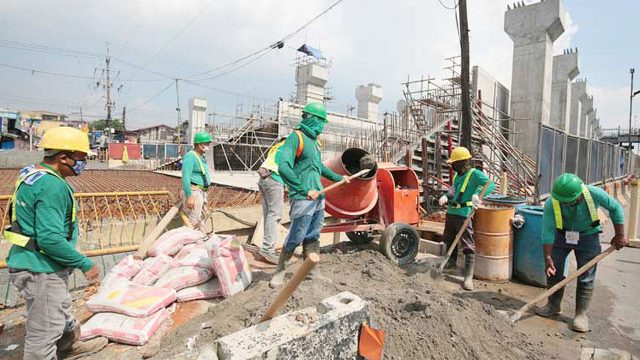
Workers are seen mixing cement at a construction site in Quezon City, May 19, 2020. — PHILIPPINE STAR/ MICHAEL VARCAS

EUROPEAN COMPANIES, particularly those involved in construction, are reporting a slowdown in orders as an offshoot of the corruption scandal in public works, the European Chamber of Commerce of the Philippines (ECCP) said.

Florian Gottein, ECCP executive director, said some members of the chamber produce materials  used for infrastructure projects.

“Because some of those projects are now being put on hold, they have experienced a reduction in sales, and it might go on for the next couple of weeks and months,” he told reporters on the sidelines of the Arangkada Forum on Thursday.

Such concerns are being raised by European firms doing business in the Philippines rather than those that are yet to invest in the country, he said.

“But the matter has also made it to the news in our respective home countries. And definitely it is not the best picture we are sending out there,” he added.

He said that the business community is still gauging how far the allegations will go, whether they affect only involve flood control projects or other categories of infrastructure as well.

“For now, we are still in a wait-and-see position…The chambers have made statements that it is definitely not a conducive environment for business here, but we trust in the government and the responsible organizations to investigate and immediately act on their findings as well,” he added.

Asked how corruption will affect free trade agreement negotiations, he said the government must act quickly to investigate and determine the next steps.

“We also hope that we will see safeguards in place that will prevent similar situations from happening again in the future,” he added

He said that ease of doing business (EoDB) remains a top concern for European investors in the Philippines, even more than corruption.

“Corruption is one topic, but I think what is really of more concern to our members is the EoDB,” he said.

“We have a beautiful EoDB law, but I think many of our members are struggling with its proper enforcement, proper implementation, or the lack thereof,” he added.

He also said that the cost of doing business in the Philippines is also a concern for investors.

“If you compare the cost of doing business here in the country to other countries in the region, it is higher here, and I think corruption plays into that,” he said.

“When you want to participate in government-funded projects, there are kickbacks, and what we see now is 25-30% of the project cost is being siphoned off. It also plays into the topic of why the cost of doing business is so high in the Philippines,” he added.

In its Reform in Motion: 15 Years of Arangkada and the Road Ahead policy book, the Joint Foreign Chambers of Commerce of the Philippines (JFC) presented its priority executive actions.

These include the improved implementation of the EoDB Act, the Corporate Recovery and Tax Incentives for Enterprises to Maximize Opportunities for Reinvigorating the Economy (CREATE MORE) Act, and the Ease of Paying Taxes Act.

It also asked for a reconsideration of the use of digital and integrated systems for the pre-border technical verification and cross-border electronic invoicing of all imported commodities and Food and Drug Administration revised registration fees, as well as streamlined travel requirements and visa applications.

It also sought a review of taxes on non-resident foreign corporations and the Extended Producers’ Responsibility Act. — Justine Irish D. Tabile


ADB open to expanding support for PHL flood-resilience projects

PHILIPPINE STAR/MIGUEL DE GUZMAN

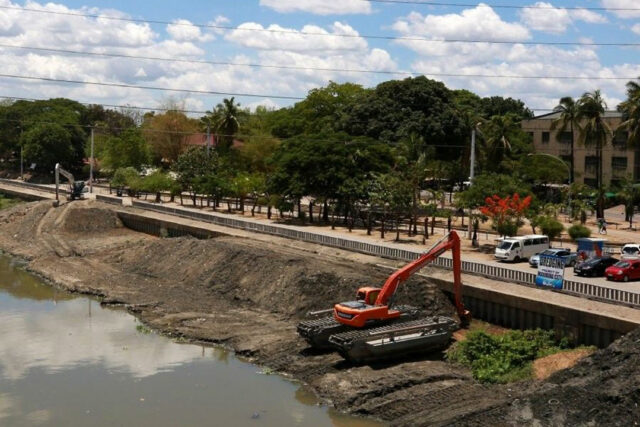
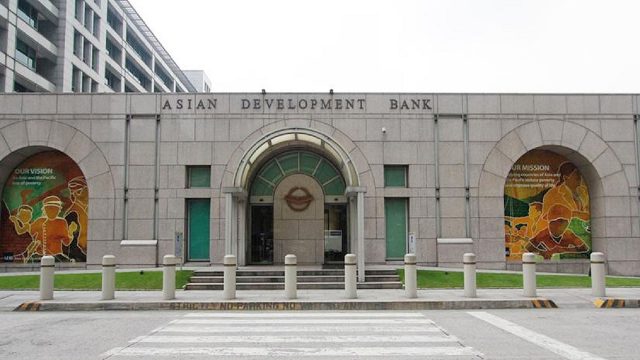
THE Asian Development Bank (ADB) said it is open to expanding its flood-resilience initiatives in the Philippines as infrastructure projects come under closer scrutiny.

“We’re doing planning on 13 river basins around the country for a future project, and given what’s going on, we may be asked to do more,” ADB Country Director Andrew Jeffries told reporters on Thursday.

He noted that there might be discussions in the future on how the ADB can help address corruption in such projects.

“Our role isn’t to shy away from problems. Our role is to try to help our developing member countries’ governments solve problems,” he said.

Public works projects, particularly those connected to flood mitigation, have been found to be defective, uncompleted, or even never started despite billions in funding.

Mr. Jeffries said the ADB is currently working on two river basins in Mindanao and one in northern Luzon.

“We’re working on a larger one that’s a few years away. So we will be likely supporting flood protection more in the future,” he said.

He also said the ADB is also working on some waste management initiatives around Metro Manila, but is not currently involved in flood control in the capital region.

At the Arangkada Philippines Investment Forum, more digitalization was proposed as a means of curbing corruption and addressing the concerns of foreign investors.

“Digitalization opens the door to more equal access to information and I think some of those investments kind of can help on a lot of fronts, whether it’s government processes, improvement, but also dealing with more information transparency kind of helps on the corruption side, too,” Mr. Jeffries said.

Gonzalo J. Varela, the World Bank lead economist for Brunei, Malaysia, the Philippines and Thailand,  said raising the quality of regulators is also crucial to ensure more competition in the market. — Aubrey Rose A. Inosante

Livestock measure set to lapse into law on Sept. 28, could unlock P20B in funds

STOCK PHOTO | Image by Barbara Barbosa from Pexels

THE livestock industry could soon have access to P20 billion in funding once an animal industry development law comes into force, a Department of Agriculture (DA) official said.

“On the 28th (of September) if the President will not sign, the livestock bill will become law. It’s P20 billion annually from the government, which the private sector might want to consider co-investing in,” Agriculture Undersecretary Asis G. Perez said at the Arangkada Philippines investment forum on Thursday.

Senate Bill No. 2558, or the proposed Animal Industry Development and Competitiveness Act, calls for the government to subsidize the interest on loans for livestock projects.

Mr. Perez said eligible industries for funding are livestock, poultry, and dairy.

Congress has approved the bicameral conference committee report on the proposed law, which is currently awaiting the signature of President Ferdinand R. Marcos, Jr.

In the second quarter, livestock output as measured by value of production fell 5.9% to P59.6 billion, accelerating the year-earlier decline of 0.3% and the 2.8% drop in the first quarter.

Overall, the value of production of agriculture and fisheries at constant 2018 prices rose 6.7% to P437.53 billion, accelerating from 2% in the first quarter and reversing the year-earlier decline of 3.2%.

Mr. Perez said agriculture remains marginalized, highlighting the need for more investment.

He said that the current administration has created a framework for development in agriculture focused on improving agro-fisheries performance and mechanization. — Sheldeen Joy Talavera

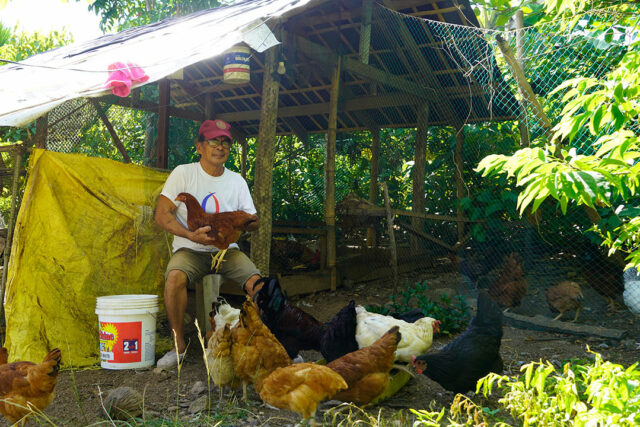
Nearly half of all households growing their own food in response to hardships — SWS

MIMAROPA.DA.GOV.PH

SOME 49% of households said they are producing at least some of their own food due to economic difficulties the Social Weather Stations (SWS) survey organization said.

Surveying 1,200 adults nationwide in late June, 8% of the sample said they produce “a big part” of their food while 41% said they produce “a small part.”

The SWS found that families that produced a large portion of their food reported experiencing hunger at an 11% rate, compared with a 14% rate for those producing some of their food and 19% for those that did not produce any food.

Crops accounted for 86% of home-made food, followed by livestock (59%) and fish (7%).

Producing food was most prevalent in Mindanao or the Visayas, where the rate of self-produced food was 59% and 54% respectively. — Andre Christopher H. Alampay

PHL, Singapore start double taxation talks

A VIEW of the city skyline in Singapore, Dec. 31, 2020 — REUTERS

THE Philippines and Singapore have started negotiations to update their 1997 double taxation agreement (DTA), the Department of Finance (DoF) said.

In a statement on Thursday, the DoF said the first round of negotiations for the Elimination of Double Taxation with Respect to Taxes on Income and the Prevention of Tax Evasion and Avoidance concluded earlier this month.

“The DTA between the Philippines and Singapore has been in place for almost 50 years. It’s high time we recalibrate the terms to reflect the realities of today’s rapidly shifting global economy,” Finance Secretary Ralph G. Recto said.

The Philippines has around 44 double taxation agreements, including  those with the US, the UK, Spain, South Korea, Japan, Germany, China, Canada, Australia.

The Philippines is also working on a DTA with Hong Kong. It signed an agreement with Cambodia in February.

He added that significant developments in international taxation have taken place since the original deal was signed, and that trade relations have evolved significantly. He added that double taxation issues potentially affect 200,000 Filipinos in Singapore.

“Renegotiating the DTA will be very important to increase the flow of trade and investment and give a very positive signal to the business community that our governments share a commitment to enhancing the cross-border economic activity,” Singapore Ambassador to the Philippines Constance See said. — Aubrey Rose A. Inosante

PHL exports to feel full impact of US tariff in 2026, AMRO says

REUTERS

PHILIPPINE exports are likely to face headwinds through 2026, reflecting the full impact of higher US tariffs, the ASEAN+3 Macroeconomic Research Office (AMRO) said.

“Growth will be driven mainly by robust private consumption, while private investment and exports will face challenges from US tariff policies,” AMRO Principal Economist Jinho Choi said in a statement on Thursday.

“If sustained, the tariff impact — partly offset by front-loaded export orders this year — could weigh more heavily in 2026.

The 19% tariff on Philippine goods took effect on Aug. 7, although negotiations are ongoing.

In a recent report, the United Nations Development Programme (UNDP) projected a 13% contraction in Philippine exports to the US. 

AMRO said Philippine near-term growth and financial conditions remain stable but below pre-pandemic levels, propped up by “solid domestic demand.”

The Philippine economy grew 5.5% in the three months to June, supported by a rebound in agriculture production and stronger household consumption.

The government growth target is 5.5% to 6.5% for the full year, and 6% to 7% next year.

“However, sustaining momentum and lifting medium-term growth will require refinement to the country’s growth strategy, including more effective investment by both the public and private sectors to prepare for climate shocks and the upskilling of the labor force for the age of artificial intelligence (AI),” it said.

The preliminary assessment was made during AMRO’s Annual Consultation Visit to the Philippines between Sept. 2 and 19.

In addition, AMRO said inflation is expected to “remain low and stable,” settling within Bangko Sentral ng Pilipinas (BSP) target range. Inflation is projected at 3.2% in 2026 from 1.8% this year.

“Softer supply-side pressures — such as easing food and global commodity prices — alongside measures such as tariff cuts on rice and the streamlining of non-tariff barriers, are helping to contain inflation even as robust demand continues,” it added.

AMRO said the BSP should proceed cautiously with further rate adjustments, “given the near-zero output gap and potential supply shocks.”

The Philippines should accelerate fiscal consolidation in the medium to long term while investing in infrastructure upgrades and reinforcing its financial stability framework, AMRO said.

“Enhancing monetary policy transmission — by deepening liquidity, broadening the long-term bond investor base, and improving interest rate pass-through in the bank credit channel — would also strengthen policy effectiveness,” it added. — Aubrey Rose A. Inosante

PHL stocks drop as peso tumbles versus dollar

BW FILE PHOTO

By Alexandria Grace C. Magno

PHILIPPINE STOCKS slipped to the 6,000 level on Thursday as weak sentiment and a soft peso dragged all sectoral indexes lower.

The benchmark Philippine Stock Exchange index (PSEi) fell 1.08% or 66.44 points to close at 6,042.28, while the broader all shares index dropped 0.78% or 28.79 points to 3,653.5.

AP Securities, Inc. said in a market note that selling pressure continued to weigh on share prices.

“The market continued to decline today, with no green candles seen throughout the week,” Luis A. Limlingan, head of sales at Regina Capital Development Corp., said in a Viber message. “Additionally, the depreciation of the peso against the dollar, with USD/PHP hitting the P58 mark, is weighing on sentiment.”

The peso closed at P58.10 a dollar on Thursday, 63.9 centavos weaker than the previous day’s close, after US Federal Reserve officials signaled caution on further rate cuts due to persistent inflation and a weak job market.

US equities also traded lower as investors assessed Fed comments and the outlook for inflation. Fed Chairman Jerome H. Powell earlier this week gave few hints on the timing of the next rate cuts, after the central bank lowered rates for the first time this year.

“Meanwhile, US equities are trading lower today as investors digest remarks from Fed officials and ponder the persistence of inflation pressures,” Mr. Limlingan said. “The market seems cautious, watching whether fundamentals can support stretched valuations.”

All local sectoral indexes ended in the red. Mining and oil lost 2.81% to 11,929.66; holding firms slid 1.79% to 4,922.35; industrials dropped 1.43% to 8,716.55; property fell 1.35% to 2,361.60; financials eased 0.33% to 2,058.97; and services slipped 0.19% to 2,231.54.

Value turnover rose to P6.97 billion with 2.61 billion shares traded, higher than Wednesday’s P5.26 billion from 5.37 billion shares. Losers beat winners 134 to 64, while 50 stocks were unchanged.

Net foreign buying reached P574.62 million, reversing Wednesday’s P370.63 million in net selling.

ERC seeking to balance affordable power rates, attracting investment 

BW FILE PHOTO

THE Energy Regulatory Commission (ERC) said it is seeking to strike a balance between setting fair electricity prices and encouraging investment.

“The greatest shield against high prices is not the discretionary power of a regulator to cut a single contract, but the relentless, ongoing pressure of a competitive market where suppliers must constantly offer their best price to win a supply contract,” ERC Chairman and Chief Executive Officer Francis Saturnino C. Juan said in a statement on Thursday.

He was responding to a statement by consumer group Power for People Coalition (P4P), which objected to the proposed new rules to govern the competitive selection process (CSP) of power supply agreements (PSA) and transmission ancillary contracts.

“We are disappointed that Chair Saturnino Juan’s first order of business as new ERC chief is to cede ground to power players, enabling them to raise prices as they please at the expense of ordinary Filipinos,” P4P Convenor Gerry Arances said in a Sept. 19 statement.

“Protecting consumer interests is not an optional duty for the ERC. It is its primary mandate — and part of that responsibility is scrutinizing these contracts to prevent abuses and ensure least-cost electricity,” he added.

Republic Act No. 9136 or the Electric Power Industry Reform Act of 2001 tasks the ERC with promoting competition, encouraging market development, and expanding consumer choice in the electric power industry.

Distribution utilities conduct CSPs to procure power at a least-cost basis, a process which produces a PSA.

Mr. Juan has been proposing to amend the rules governing the PSAs of distribution utilities and power suppliers to streamline the approval process and shore up investor confidence.

The proposed changes are meant to expedite resolution of PSA applications and facilitate the entry of new generating capacity to support growing demand.

Mr. Juan said that the new regulatory framework is governed by the CSP policy of the Department of Energy (DoE) and the Supreme Court’s landmark decision in Alyansa ng Bagong Pilipinas vs. ERC.

“In this new era, the role of the ERC is not diminished; it is transformed. Its mandate is clearer and more critical than ever: to be the guardian of the competitive process and the guarantor of its integrity,” he said.

He said that the ERC’s primary duty in its rate-setting function is to uphold the outcomes of a “genuinely competitive CSP.”

Mr. Juan said doubting the outcome and unilaterally reducing the contracted rate “under the guise of regulatory review” undermines the entire foundation of the competitive market.

The DoE has said that the Commission must ensure that the CSP is truly competitive and compliant.

“Once it is established that the process was fair and the costs are just and prudent, the regulator must have the courage to trust the market it was mandated to create and promote,” Mr. Juan said.

“Upholding a competitively derived price is the highest form of consumer protection—it protects consumers from the hidden costs of uncertainty, underinvestment, and the return of negotiated monopolistic rates.” — Sheldeen Joy Talavera

ADB awaits approval of $500-M project to streamline PHL business rules

BW FILE PHOTO

THE Asian Development Bank (ADB) said it is seeking board approval this year for a $500-million project to reduce regulatory barriers for businesses in the Philippines.

ADB Country Director for the Philippines Andrew Jeffries told reporters that the project, known as BEST, is in the bank’s board approval pipeline this year.

“One of them I mentioned… (is) the BEST program, Business Environment Strengthening with Technology ,” he said on the sidelines of an event on Thursday.

The bank is working with the Anti-Red Tape Authority (ARTA) and the Board of Investments (BoI) to implement the program, he said.

In a concept note, the ADB described BEST as supporting and strengthening the government’s efforts to enhance and improve the business environment, with the goal of elevating the number of startups as well as investment.

High logistics costs remain a challenge to Philippine competitiveness, Mr. Jeffries added, citing geographical factors.

The Philippines has some of the highest logistics costs in ASEAN, with logistics accounting for 27% of the cost of goods.

Corresponding rates are 16% for Vietnam and 11% for Thailand.

“A big part of our program is working on those types of infrastructure projects, which again gets back to overall competitiveness,” he said.

“There was another Department of Transportation report that estimated the cost of port congestion at about P43 billion a year.”

Separately, Gonzalo J. Varela, World Bank lead economist for Brunei, Malaysia, the Philippines and Thailand, said energy and transport remain key factors affecting costs in the Philippines, to the detriment of investment.

“If you think about logistics costs, there’s high logistics costs, accumulation economy, this is an economy that still has very strict cabotage restrictions,” he said in a panel discussion.

Cabotage refers to the right of shippers to operate within a given country.

Mr. Varela said more competition is needed in sea transport because of the  current high prices. — Aubrey Rose A. Inosante

Former DFA head says global economy calls for tailored ‘micro policy’ approach

PHILSTAR FILE PHOTO

THE GOVERNMENT needs to engage more with industry representatives to better tailor policy to their specific needs in the context of complex global economic forces, former Foreign Affairs Secretary Jose Rene D. Almendras said.

In a speech after receiving the Arangkada Lifetime Achievement Award, Mr. Almendras called the outcome of this custom-fit approach “micro-policies, which he said were needed in light of unique challenges confronted by every sector.

“Policy can no longer be simply or generally macro, but more now than ever, micro,” Mr. Almendras said

“Competitors must come together as industry groups to study, develop, and strategize and advocate for their specific industries,” he added, noting that the environment is now shaped by what he called “geoeconomics.”

He said the government should also adjust its policymaking perspectives to reflect micro-policy considerations.

“Many countries and their leaders have invited private sector groups to be active participants in policy discussions, strategy formulation, and decisions,” he said, noting that one of the advanced countries already has a playbook for each major industry that considers geoeconomics.

He said such a playbook anticipates the impact on each industry of actions taken by other countries and sets down possible responses.

“The recent shifts and trends, now referred to as the new age of geoeconomics, pose a more complex challenge,” he said.

He said that geoeconomics “is the use of economic tools and power by a state to achieve strategic geopolitical or economic goals, often by leveraging trade, finance, and investments to influence or coerce other countries.”

He cited the need to accelerate all the pending free trade agreements (FTAs) .

“Bilateral relationships now seem to take precedence over multilateral relationships. Nation-to-nation, economy-to-economy discussions, and thus, negotiations, have become the norm,” he said.

“FTAs are now more important than ever. My wish is we accelerate all the pending FTAs that we, the Philippines, have with many, many countries,” he added.

Mr. Almendras said countries need to be more nimble and adjust quickly and effectively to change.

“This highlights the need for constant and active engagement by all stakeholders, including the government. This is not a one-meeting, one-discussion situation. This requires constant and active engagement,” he said.

“By having a regular set of meetings on a regular basis, it will enable us to monitor, keep abreast, and be proactive if and when possible,” he added. — Justine Irish D. Tabile
ADVERTISEMENT
ADVERTISEMENT