Home Blog Page 926

SWIFT, top global banks to work on blockchain-based overhaul

STOCK PHOTO | Image by Pikisuperstar from Freepik

LONDON — Global financial messaging network SWIFT and more than 30 global banks announced on Monday they were now working “at pace” on making cross-border payments instantaneous and on a system capable of handling the various new forms of digital money.

SWIFT, a key part of the world’s financial architecture, said the institutions were collaborating on a blockchain-based “shared digital ledger” they see as vital for modernizing international bank transactions.

The timeline is yet to be defined, but it will initially focus on enabling real-time 24/7 cross-border payments, which should also make the process cheaper given it can currently take days.

Belgium-based SWIFT also plans to build on recent pilot projects to make its systems “interoperable” with new ones now emerging for stablecoins, tokenized bank deposits and central bank digital currencies (CBDCs) being developed by the likes of China and the European Central Bank.

SWIFT’s main advantage is that its existing network is already usable in over 200 countries and connects more than 11,000 banks who use it to send trillions of dollars every day.

US President Donald J. Trump’s son and crypto advocate Eric Trump recently described SWIFT as “antiquated,” but its hope is that by adding blockchain functionality it can evolve and still provide compliance and resilience features traditional banks require.

Stablecoins are rapidly moving from niche crypto instruments into the mainstream. A report by Citi last week estimated there could be up to $4 trillion worth of stablecoins in circulation by 2030, with $100 trillion of trade to be done using them a year.

About 90% of the world’s central banks are now exploring digital versions of their fiat currencies as they look to avoid getting left behind.

SWIFT said it is envisaged that the shared digital ledger — a secure, real-time log of transactions between banks — would “record, sequence and validate transactions and enforce rules through smart contracts.”

The group of more than 30 global financial institutions that will help design and build the ledger include JPMorgan, HSBC, Deutsche Bank, MUFG, BNP Paribas, Santander and OCBC, as well as a number of banks from the Middle East and Africa. — Reuters
RLC unit sees up to 15% ADR growth from Go Hotels rebrand

ROBINSONS HOTELS AND RESORTS

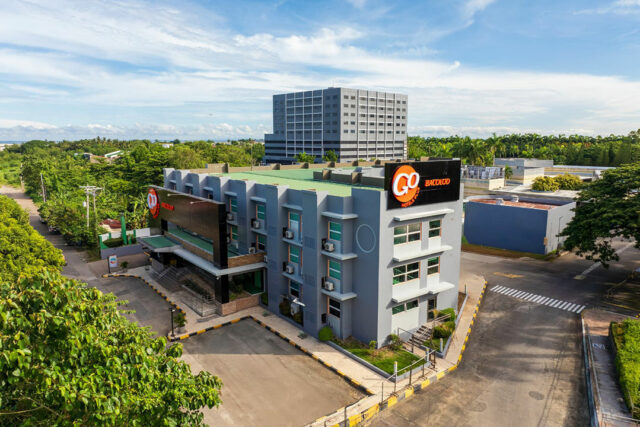
ROBINSONS HOTELS and Resorts (RHR), the hospitality arm of Gokongwei-led Robinsons Land Corp. (RLC), expects up to 15% growth in the average daily rate (ADR) of its rebranded Go Plus Hotels in Mandaluyong and Bacolod.

“In various emerging markets in Philippines, the guests are seeking enhanced amenities while still at a smart price point. This has been our inspiration to upgrade and renovate our hotels in Mandaluyong and Bacolod, to Go Plus,” Barun Jolly, RLC vice-president and RHR business unit general manager, said in an e-mailed reply to questions.

“The focus of the rebranding is to uplift the ADRs of these hotels and we are seeing 10% to 15% rate growth in its Go Plus properties,” he said.

ADR, a key metric in the hospitality industry, measures the average rental income earned by a hotel from each paid and occupied room daily.

Last week, RHR announced the rebranding of Go Hotels in Bacolod to Go Hotels Plus Bacolod. First opened in 2012, the upgraded property features 105 rooms, modern amenities, and signature local delicacies.

It also has a function room that can accommodate up to 50 guests, catering to business meetings, corporate functions, and intimate celebrations.

The upgraded hotel lobby highlights Bacolod’s signature maskaras, while the R Coffee Cart serves drinks made exclusively for RHR.

Other amenities include 100% cotton linens, chiropractic and hypoallergenic pillows, complimentary Wi-Fi in all rooms, in-room safety deposit boxes, and a newly installed door alarm system. It also has upgraded flooring to reduce noise.

The hotel offers access to key locations in the province, such as Robinsons Place Bacolod, major transport hubs, and tourist destinations like The Ruins, The Negros Museum, and Lakawon Island.

Guests who book until Sept. 30 are entitled to special introductory rates starting at P1,500 (room only) for superior rooms, lower than the standard rate of P3,019.

Across its Go Hotels properties, RLC is targeting value-conscious travelers seeking clean and safe hotel rooms, Mr. Jolly said, noting that most of its guests are Filipinos aged 20 to 35 years old.

The Go Hotels Plus brand was introduced in 2022 as a response to the economy and leisure sectors’ recovery from the COVID-19 pandemic. Since its launch, RHR has opened Go Hotels Plus properties in Tuguegarao and Mandaluyong.

The company reported a 9% increase in its first-half revenues on the back of a strong performance across its brands, which include Summit Hotels & Resorts, Grand Summit Hotels, FILI, and NUSTAR.

RHR has a portfolio of over 4,000 room keys across 27 hotels. Other properties in its portfolio include The Westin Manila, Crowne Plaza Manila Galleria, Holiday Inn Manila Galleria, and Dusit Thani Mactan Cebu. — Beatriz Marie D. Cruz

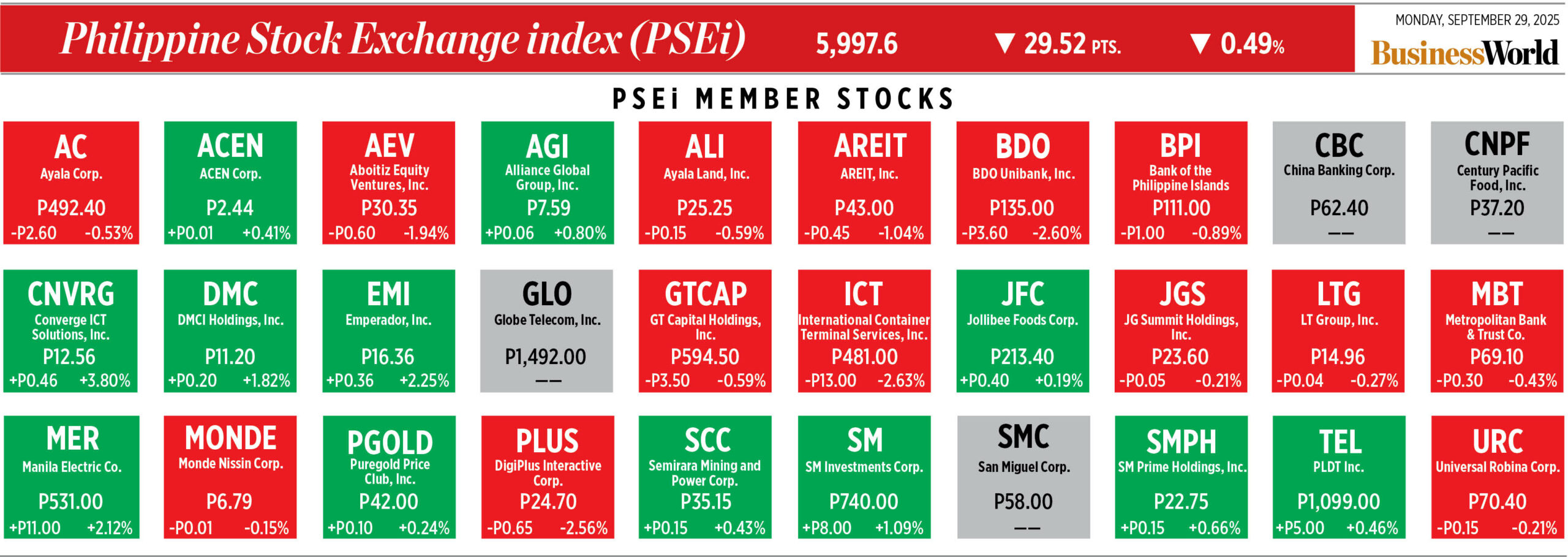
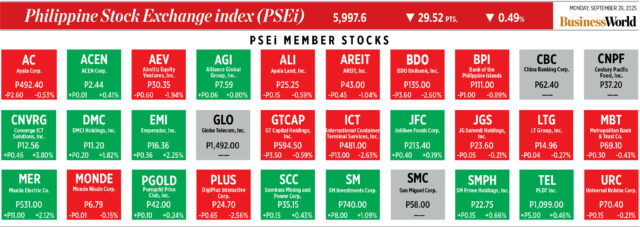
How PSEi member stocks performed — September 29, 2025

Here’s a quick glance at how PSEi stocks fared on Monday, September 29, 2025.


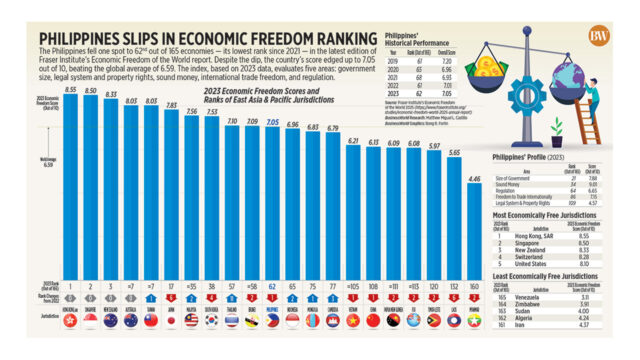
Philippines Slips in Economic Freedom Ranking

THE Philippines slipped one spot in a global index on economic freedom, despite improvements in some areas, according to the Canada-based think tank Fraser Institute. Read the full story.

Philippines Slips in Economic Freedom Ranking

PSEi falls below 6,000 on strong selling pressure

REUTERS

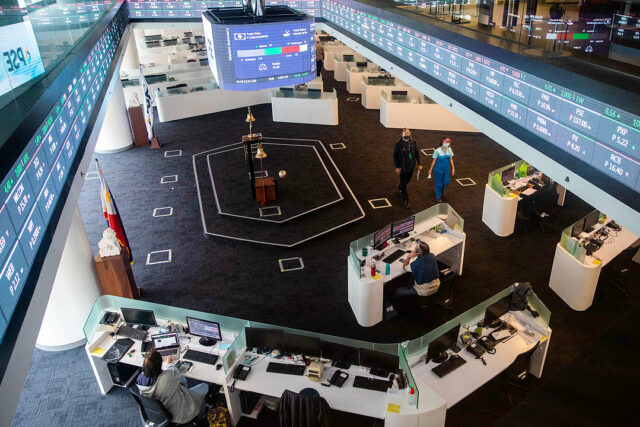
THE MAIN INDEX on Monday fell below the 6,000 mark for the first time in nearly six months, succumbing to selling pressure amid a lack of positive trading drivers.

The benchmark Philippine Stock Exchange index (PSEi) sank by 0.49% or 29.52 points to close at 5,997.60, while the broader all shares index dropped 0.23% or 8.46 points to 3,636.34.

This was the stock benchmark’s worst finish in almost six months or since it ended at 5,822.85 on April 7, which was also the last time the PSEi closed below the 6,000 line.

“The PSEi fell below the 6,000 mark as prices continued to decline despite last week’s all-red performance. Selling pressure remains strong, with the market still lacking any positive catalyst,” Regina Capital Development Corp. Head of Sales Luis A. Limlingan said in a Viber message.

“Adding to the bearish sentiment are the ongoing uncertainties in the country and the continued depreciation of the peso against the US dollar, which is dampening confidence among both local and foreign investors,” he said.

Net foreign selling went down to P405.93 million on Monday from P551.36 million on Friday.

Meanwhile, the peso dropped by 4.5 centavos to close at P58.145 against the dollar on Monday from its P58.10 finish on Friday.

This was the local unit’s weakest finish in two months or since it ended at P58.32 on July 31.

“The PSE index closed slightly below the key support at 6,000 on anemic volume as investors remain on the sidelines,” AP Securities, Inc., said in a market note.

Value turnover dropped to P4.72 billion with 1.37 billion shares traded from Friday’s P5.46 billion with 1.66 billion shares changing hands.

The majority of sectoral indices closed higher on Monday. Mining and oil increased by 5.32% or 639.31 points to 12,653.66; industrials rose by 0.9% or 79.03 points to 8,815.07; holding firms went up by 0.31% or 15.28 points to 4,931.66; and property climbed by 0.01% or 0.30 point to 2,325.34.

Meanwhile, services slumped by 1.58% or 35.04 points to 2,176.90, and financials dropped by 1.22% or 25.47 points to 2,047.17.

Decliners outnumbered advancers, 106 to 100, while 58 names were unchanged.

Mr. Limlingan said the market will likely wait for fresh labor market data from the United States for leads.

Meanwhile, most share markets rose in Asia on Monday while the dollar eased as investors braced for a possible shutdown of the US government, which would in turn delay publication of the September payrolls report and a raft of other key data, Reuters reported.

President Donald J. Trump was set to meet with the top Democratic and Republican leaders in Congress later on Monday to discuss extending government funding. Without a deal a shutdown would begin from Wednesday, which is also when new US tariffs on heavy trucks, patented drugs and other items go into effect. — A.G.C. Magno with Reuters

ADB projects properly supervised, DoF says following infra scandals

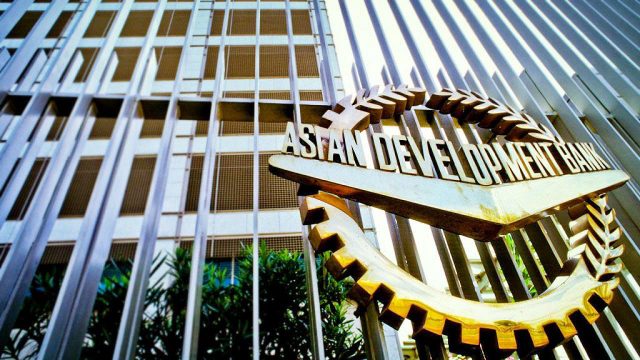
THE public-works corruption scandals have driven the Department of Finance (DoF) to assure the Asian Development Bank (ADB) that adequate safeguards are in place for projects funded by the bank.

Finance Secretary Ralph G. Recto said agencies implementing foreign-funded projects are accountable and observe good-governance practices.

Mr. Recto made the remarks during a site visit to the Malolos-Clark Railway Project (MCRP) segment at the Clark Freeport Zone on Monday, saying he will not risk “the ADB’s trust” to ensure the bank continues to support Philippine development.

He said the creation of the Independent Commission for Infrastructure represents a government guarantee that every project will be properly engineered to endure.

Economy Undersecretary Rosemarie G. Edillon has said that official development assistance (ODA) partners will be looking at how the government addresses corruption in flood control and other infrastructure projects.

The DoF said the MCRP segment was 42.4% complete as of June. Once operations start in 2028, it is expected to reduce the current three-hour bus commute between Malolos and Clark to just an hour.

ADB Country Director Andrew Jeffries has said that the flood control scandal will not deter the bank from supporting the Philippines, adding that its projects are also subject to close oversight.

After the visit, the DoF said Mr. Recto met with ADB officials including with Mr. Jeffries at the ADB’s Clark office.

Mr. Jeffries described the Philippines as a “particularly special and important relationship.”

A total of 25 Infrastructure Flagship Projects are funded by the ADB in support of the administration’s Build, Better, More Program.

The ADB is the Philippines’ second-largest ODA partner, accounting for $10.40 billion or 28.7% of total ODA financing as of March. — Aubrey Rose A. Inosante

Farmers call for safeguard duties on imported rice

PHILIPPINE STAR/KRIZ JOHN ROSALES

FARMERS said the government needs to initiate a safeguard duties investigation into foreign rice producers, claiming that domestic cultivators have suffered losses amounting to P43 billion due to unfair competition from imported rice.

Raul Montemayor, national manager of the Federation of Free Farmers (FFF), said freezes on rice imports and hikes on rice import tariffs need to be supplemented by a formal safeguard duties investigation.

“By itself, the import ban will not prop up palay prices significantly, because traders anticipate that cheap imports will flood the market again when the ban is lifted in November,” Mr. Montemayor said in a petition to the Department of Agriculture (DA).

In his petition, he urged the government to use its authority under Republic Act (RA) 8800, or the Safeguard Measures Act. RA 8800 allows industries that claim to be unfairly disadvantaged by foreign competition to propose the imposition of safeguard duties against their foreign competitors.

The law gives the government the power to impose safeguard duties on such imports, on top of regular taxes charged on the commodity.

On top of paying the current 15% tariff, importers will be required to post a bond equivalent to the safeguard duty, according to the law.

The Magsasaka Party-list provided the estimate of lost income sustained by 2.5 million rice farmers.

The government froze rice imports for 60 days starting Sept. 1 to provide relief to farmers, who have been receiving low prices for their palay (unmilled rice). However, farmgate prices have not risen significantly in response.

Traders use stocks of imported rice as leverage against farmers, giving them the ability to walk away if farmers insist on selling for more. In some provinces, the farmgate price for palay reportedly fell to as low as P8 per kilo before the import freeze.

After the freeze was announced, farmgate prices rose to about P14 per kilo before falling back to P10.

The National Food Authority buys clean and dry palay for P23-30 per kilo depending on location and grain quality, serving as a buyer of last resort for farmers. However, it can buy only a small portion of the harvest due to storage and budget constraints.

The DA is reportedly weighing an extension of the ban until the end of the year to see if the intended price relief materializes.

Magsasaka Chairman Argel Joseph T. Cabatbat said current prices are unsustainable due to the pressure on farmers from cheap imports.

Mr. Cabatbat said: “The very survival of rice farmers and the long-term security of our entire agricultural sector” is at stake.

The FFF and Magsasaka support raising import tariffs to reduce the differential traders pay between foreign and domestic rice, encouraging them to pay fair prices for the Philippine harvest. — Andre Christopher H. Alampay

Maharlika says long-term nature of its investments leaves it relatively unaffected by infrastructure scandal

A MAHARLIKA Investment Corp. (MIC) director said it takes a long-term view of investing in strategic Philippine projects and does not expect to be affected by the corruption scandal engulng public works projects.

Stephen Anthony T. CuUnjieng, MIC independent director, said the sovereign wealth fund does not behave like the typical stock market investor, who can pull out when sentiment turns negative.

Speaking on the program Money Talks with Cathy Yang on One News on Monday, Mr. CuUnjieng said:

“Basically, we’re not in-and-out investors like the stock market… In fact, people could even say, if you’re taking a long-term view, this is a positive opportunity for a long-term player like Maharlika.”

MIC holds a 20% stake in Synergy Grid & Development Phils., Inc., giving it a “foothold” in the National Grid Corp. of the Philippines.

The sovereign wealth fund also signed an agreement with Saudi Arabian energy company ACWA Power to develop renewable energy projects for off-grid locations.

The corruption scandal in public works projects has had far-reaching consequences, affecting not only flood-control contractors, government engineers overseeing the projects, and even legislators who allegedly directed the projects to be funded.

The review of projects suspected of being tainted by corrupt dealings is threatening to stall public spending, a key driver of the economy’s opportunities.

Mr. CuUnjieng noted that a more pressing concern is in the services of the business process outsourcing industry, whose investors can easily exit the country.

He said the economy’s dependence on services and remittances apart from consumption make it possible to “ignore the market” though he described the structure of the economy as “a three- or four-legged stool that lacks a leg, which is manufacturing.”

He acknowledged the potential for a slowdown in government infrastructure disbursements as the investigations into flood-control projects gather momentum.

Mr. CuUnjieng said state-run banks such as Land Bank of the Philippines and the Development Bank of the Philippines are unlikely to face bank runs — a rush to pull out deposits by panicked account holders concerned that the banks could fail.

“Most of their deposits and clients are…related to the National Government, LGUs (local government units) and government agencies. They’re not going to be prone to a bank run. I would think I’m relatively sanguine on the liability side of deposits,” he said.

Bangko Sentral ng Pilipinas Governor Eli M. Remolona has said there have been no signs of bank runs despite the freeze ordered on more than 700 accounts and assets linked to public works fraud.

“The real problem, I think, which we’ve seen in previous investigations, is the breadth of the anti-disclosure, the secrecy law and banking systems. You really don’t have anything that restrictive in other countries,” Mr. CuUnjieng said. — Aubrey Rose A. Inosante

DoTr will continue push for lower domestic airfares

PHILIPPINE STAR/WALTER BOLLOZOS

THE Department of Transportation (DoTr) said it will continue to push airlines to reduce fares on domestic destinations after agreeing with Philippine Airlines (PAL)  to cap its one-way Siargao fare at P11,500, effective immediately.

Acting Secretary Giovanni Z. Lopez made the remarks while speaking to the Senate Committee on Finance. He added that the DoTr will work with the Department of Tourism (DoT) on its regional airport modernization program to make them ready to accommodate growing demand.

“In the first week of September, the maximum one-way fare to Siargao was P17,500. PAL has agreed to lower it to P11,500 one way,” he said.

BusinessWorld sought comment from PAL but it had not replied at the deadline.

Mr. Lopez said the DoTr is also in the process of expanding runways in destinations like Siargao to allow them to handle regional single-aisle jets.

Flights to Siargao are costly due to runway limitations that accommodate only turboprop aircraft, resulting in higher costs per passenger, Mr. Lopez said.

The Civil Aviation Authority of the Philippines (CAAP) has said that Siargao and Busuanga airports will be first in line for runway extensions.

CAAP said right-of-way challenges are among the obstacles being encountered in the runway extension projects, but environmental considerations are also at play.

Mr. Lopez said the new Antique Airport will also be opened this year, featuring a new passenger terminal building that can serve up to 300 passengers from the current capacity of 64.

The terminal also features a larger departure and arrival area, including more check-in counters and facilities for persons with disabilities. — Ashley Erika O. Jose

ASEAN ministers in PHL to prepare regional agro-forestry strategy

JOHN FELIX M. UNSON

THE Department of Agriculture (DA) said the Philippines will host the ASEAN Ministers on Agriculture and Forestry (AMAF) meeting in Pasay City until Oct. 3 to map out competitiveness and sustainability plans for the agro-forestry industry.

The DA said the ministers will discuss technology generation, rural community development, encouraging private sector investment, and promoting sustainable environmental management and conservation.

The DA will also host discussions on the impact of climate change on agriculture and improving the industry’s resilience.

Agriculture Secretary Francisco P. Tiu Laurel, Jr., who will chair the discussions, said “This effort aligns with ASEAN’s broader vision of becoming a single market and production base.”

Representatives from China, Japan, and South Korea will be in attendance for the AMAF Plus Three Meetings and the ASEAN-Japan Ministers on Agriculture and Forestry Meeting. — Andre Christopher H. Alampay

TP ICAP plans P443-M Taguig expansion

TP ICAP Management Services Ltd. is investing P443 million in a Taguig City expansion which is expected to create 400 jobs, the Philippine Economic Zone Authority (PEZA) said.

In a Facebook post, PEZA said that it signed the supplemental agreement with TP ICAP for its expansion project in ECOPRIME, BGC, Taguig City.

TP ICAP Group PLC is a provider of financial markets infrastructure specializing in liquidity, trade execution, market data, and electronic trading.

“The supplemental agreement further strengthens this partnership, aligning with PEZA’s mission to attract high-value technology and services firms that drive inclusive and sustainable growth,” it said on Monday.

“Through its PEZA registration, TP ICAP in the Philippines will provide technology support and ancillary services for its global operations,” it added.

It has over 5,300 employees across 28 countries and is a leading inter-dealer broker.

The additional investment brings the company’s total investment in the Philippines to P500 million, PEZA said. — Justine Irish D. Tabile

PHL urged to sign double taxation agreement with Ireland

BW FILE PHOTO

THE PHILIPPINES needs to pursue a double taxation agreement (DTA) with Ireland as a follow-up to its ongoing negotiations with Hong Kong and Singapore, a tax expert said.

Eleanor L. Roque, tax principal at P&A Grant Thornton, said Ireland presents a strategic opportunity for a DTA, due to its status as a global hub for information technology (IT) and digital enterprises.

“Ireland has become a hub for a lot of IT and digital companies, but we don’t have a DTA,” she told BusinessWorld via Viber on Monday.

Last week, the Department of Finance said the Philippines and Singapore started negotiations to update their 1997 agreement to reflect the evolution of the global economy.

Ms. Roque said such agreements encourage the flow of income from both countries by removing the risk of double taxation.

The Philippines has around 44 double taxation agreements, including those with the US, the UK, Spain, South Korea, Japan, Germany, China, Canada, and Australia.

Internal Revenue Commissioner Romeo Lumagui, Jr. said a DTA with Hong Kong is also in the works with negotiations seen concluding by Sept. 29.

The DoF also signed an agreement with Cambodia in February.

Ms. Roque also said the DTA with Hong Kong is crucial due to the large volume of transactions to and from the city. — Aubrey Rose A. Inosante

ADVERTISEMENT
ADVERTISEMENT