
Home Blog Page 9194

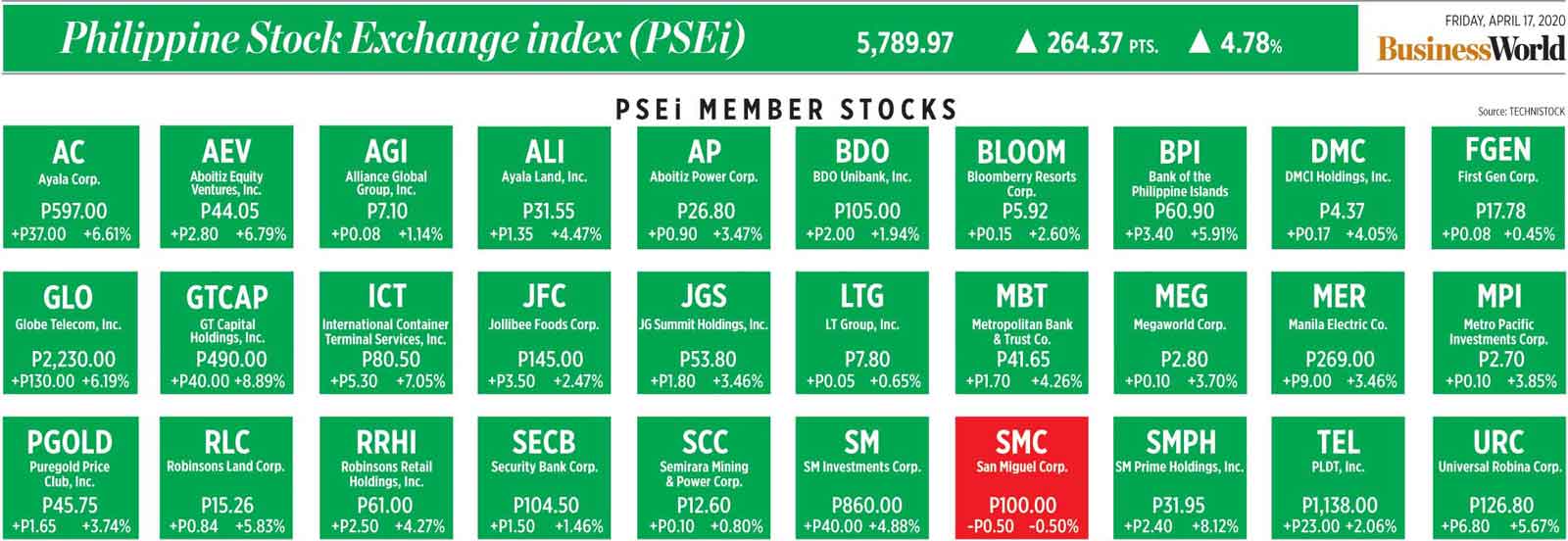
How PSEi member stocks performed — April 17, 2020

Here’s a quick glance at how PSEi stocks fared on Friday, April 17, 2020.

Plant Camote: An economic recovery plan

First off, there’s a difference between economic relief and economic recovery. Economic relief refers to the assistance government must extend to workers and businesses because it ordered them to stop due to the public health emergency. Economic relief is both a humanitarian response — help people who suffered through no fault of their own — and an economic one — to prevent consumer demand from cratering. Economic relief is immediate and urgent. Economic relief also includes the managed transition from a total lockdown to a new normal balancing the needs of public health and the economy.

It’s the policy government must adopt at the height of this pandemic.

In this regard, the government spent about P200 billion for social amelioration, about P50 billion to help employees in the MSME sector, and other programs. This is a good start but must be augmented much more to address the toll on people’s livelihoods.

Economic recovery, however, refers to a plan to restart the economy, recover lost ground, and revive. The plan must consider the post-pandemic conditions: hundreds of thousands, if not millions, of newly unemployed, including skilled OFWs returning from abroad, depressed worldwide and domestic demand, and the new normal of social distancing.

However, the economic recovery plan must also be anchored on making structural changes that will sustain the economic recovery for a long time, and not merely on the sugar high of fiscal stimuli. The economic recovery plan should also be developed with the idea of “not wasting a good crisis” as my friend and fellow columnist, former Finance Undersecretary Romy Bernardo likes to say, meaning using the crisis as an opportunity to push for reforms that would not have been possible before.

With that in mind, here are my notes for an economic recovery plan.

1. While we have a Universal Health Care Law in place and despite projected increases in investment in public health infrastructure because of the present crisis, it’s doubtful if these will lead to better health outcomes. The reason is that Philhealth, which is supposed to be the lead agency in implementing the Universal Health Care Law (UHCL), is known to be corrupt, incompetent and inefficient.

Even before the epidemic crisis, there have been several scandals in Philhealth involving fraudulent claims. Also, even before the crisis, Philhealth delayed paying private hospitals, causing the latter to consider denying service to Philhealth members.

Philhealth should be reformed and the implementation of the UHCL should be implemented along Public-Private Partnership lines. For example, Philhealth should bid out a contract to the private sector for the health maintenance of a region and the private sector provider will be paid in accordance with certain agreed health outcomes, with a bonus if it exceeds those health outcomes.

Health outcomes can easily be measured, from lower morbidity rates, hospital stays, recoveries, accessibility, patient experience, etc. Therefore, payments will be made on the basis of those health metrics and health outcomes. The idea is not to pay for the process — more dialysis, more operations, or more unnecessary procedures — but on the outcomes, which is what matters.

In addition, Philhealth can give the contract to different providers in different regions (provided they win the bids), which can provide some competition and basis for comparison (similar to the Maynilad and Manila Water model with different concession areas). These will also produce innovations in the health sector as the different private companies try to innovate on how to provide the best health outcomes at the least possible cost. In other words, the incentive is on innovations and tangible results, and not on expensive procedures or fraudulent claims.

One possible innovation is to use nurse aides to visit households to do preventive health care. In other words, the system is geared toward disease prevention, which is more cost efficient than treating already sick people at hospitals. These nurse aides can also be used for contract tracing should the Covid epidemic persist. Telemedicine can also be used to maximize the time of scarce doctors and allow rural residents to save on going to the urban centers for health advice and diagnosis.

2. I remember my former college economics professor, Dr. Bernardo, aka “Dr. Boom,” Villegas, telling us students that during an economic crisis, “plant camote.” He wasn’t speaking literally but symbolically and lightheartedly. What he meant was that if there’s a crisis, agriculture is the way to go.

It’s really a profound statement. It doesn’t only mean that you won’t go hungry if you go to agriculture, but that agriculture should be the foundation of development.

I also echo Agriculture Secretary William Dar’s chant: “Plant! Plant! Plant!”

What have we learned from this crisis? That food production is extremely important, particularly from a food and national security standpoint. Government should be encouraging even urban agriculture, so cities won’t go hungry, especially if they get cut off from the countryside.

Indeed, probably the age of food surpluses may be gone for good. Climate change and the disruption in global trade will probably cause shortages in the near future.

There’s also another major reason to focus on agriculture. Overall economic demand is collapsing, both worldwide and domestically, due to the loss of jobs and income. Fiscal stimuli can help create demand, but that has a limit. However, agriculture is one of the sectors where the old Say’s law still applies: Supply creates its own demand. Since most of our people are still food hungry, the increased food production will find a ready market. Investing in agriculture, therefore, is a form of economic stimuli.

Finally, another benefit of agriculture is that it’s much easier to do social distancing working in the farms.

3. It’s not enough to just put more budgetary resources to agriculture. Agricultural productivity is key, not production per se. This means the application of capital, technology, and management to agriculture. The old romantic picture of a farmer with a carabao has to give way to mechanized, scientific farming. Agribusiness, in other words.

However, the rigidities in the present Comprehensive Agrarian Reform Law (CARL) will chain us to low-productivity, subsistence agriculture. The five-hectare limitation in the law means that successful farmers can’t expand beyond five hectares.

The CARL was passed in a different era, when the most pressing problem was insurgency caused by the unequal distribution of land. Given a post-COVID-19 world with food security being paramount, it’s time to move away from simple land distribution toward agricultural productivity.

How to amend CARL politically? I propose the condonation of agrarian reform beneficiaries’ debt to the Land Bank in exchange for removing the restrictions in CARL. Only 25% of the beneficiaries are paying their amortizations anyway. The rest don’t. Condonation of their debt, in order to free the rural land market for agribusiness purposes, will serve a public good.

4. Mining and forestry should be part of the post-COVID-19 recovery plan. Both mining and forestry production (and the related wood processing and furniture industries) can easily be jumpstarted to absorb the growing unemployed without any subsidy from the government. What both only need is a signature from the President or the Department of Environment and Natural Resources (DENR) Secretary.

In the case of mining, all the government has to do is to lift the moratorium on mining and remove the uncertainties with respect to taxation. There’s no reason why we shouldn’t push responsible mining, particularly now. It will generate foreign exchange to partially compensate for the loss of dollar revenues from electronics exports, BPO services, and OFW remittances. Gold prices have increased as a result of the crisis. Mining, particularly gold mining, remains an attractive investment.

The top three mining projects in the Philippines — Tampakan, Philex, Kingking — will generate at least $3 billion in new investments. That’s a lot of jobs in the countryside.

As for environmental concerns, that should still be taken into account but securing environmental permits should be made faster and easier and not be an excuse for shaking down the company.

Forestry is another winner, the Philippines being a tropical country. It takes only ten to 15 years to grow a tree to maturity here, depending on the species, while it takes more than 20 years in a temperate country. Finland, a forestry superpower in Europe, produces from five to 15 cubic meters per hectare. Plantation farmers in Mindanao can produce over 100 cubic meters per hectare.

The reason why forestry production has stagnated is the over-regulation of tree plantation by the DENR. The DENR applies the same stringent regulations that they apply to natural forests to plantation forests. Therefore, tree farmers need a permit for everything — for planting, for inventorying, for harvesting, for transport, etc. The same overregulation also killed wood processing plants, the natural buyers of the products of tree farms. The absurdity of this over-regulation is the fact that planting a tree for harvest is no different from planting cabbage to sell, but the government doesn’t regulate the planting and harvesting of cabbage.

All the government has to do in order to stimulate the industry and create green jobs is to issue an Executive Order or a Department Administrative Order (DAO) making a distinction between natural forests and plantation forests and liberalizing tree farming.

There are other major reasons why we need to boost forestry production. One is that forestry production is important for water conservation, and therefore agriculture and food production. The other reason is that this COVID-19 crisis has taught us that diminishing forestry cover could bring more wildlife, which carry viruses, in contact with people.

5. Rigidities will slow down or prevent our economic recovery. Rigidities are unbending rules dictated by law or regulation that prevent economic actors from adjusting to the situation. For example, the constraints in our Labor Code, specifically the legal minimum wage law and the labor security provisions, will make it harder for companies to absorb the masses of newly unemployed caused by this crisis. These rigidities will also make it harder to revive our manufacturing sector (which we have realized is needed to produce goods critical to our health sector, such as ventilators and masks).

Why is this so? The supply of labor will dramatically increase with the mass layoffs and the return of hundreds of thousands of our OFWs. However, the floor price of entry labor is fixed, due to the legal minimum wage and other mandated costs (SSS, 13th month pay, holiday pay, etc.). Furthermore, the labor security provision in the Labor Code discourages firms from hiring more people since they may be stuck with them even if they turn out to be lazy or dishonest.

Normally, the price of labor should fall until the markets clear, i.e. until all labor is absorbed. However, these can’t happen when the price of labor is fixed. Even asking employees to take a pay cut during this crisis to keep them employed is illegal under Philippine law. Therefore, the only alternative for businesses is bankruptcy or mass layoffs.

With the labor rigidities, what will likely happen is that many desperate men and women will go to the informal market, where they will be exploited, or try their luck in the crime market, i.e. steal or cheat or sell their bodies as prostitutes. In other words, the Labor Code will end up being anti-labor as it sets the stage for the desperate unemployed to be exploited.

Furthermore, there’s another reason to reform the Labor Code. FIRe (The Fourth Industrial Revolution) is here. Even the middle class workers, from accountants to call center agents, are in danger of losing their jobs due to FIRe. The Labor Code must, therefore, be flexible enough to adjust to these changes. Rather than labor security, the focus of the Labor Code should be on retraining and some form of unemployment insurance.

Politically, it may be difficult to reform the Labor Code. The leftists (who had also opposed the National ID) and organized Labor will be against it, as will the grandstanding politicians. However, a crisis of this magnitude can force minds to consider the unthinkable.

At the very least, the President must be given the power to suspend Labor regulations for MSMEs during this public health emergency.

Perhaps, it’s also time to act on former Socio-economic Planning Secretary Gerry Sicat’s suggestion of creating special employment zones in areas of high unemployment rates, where enterprises can get exemptions from the Labor Code, but have commitments to create jobs. When the demand for labor has picked up, workers can simply leave for better paying jobs. Alternatively, wage subsidies can be tried to generate employment, but the program would entail resources the government doesn’t have now.

Short of reforming the Labor Code, passing the Apprenticeship Law has become more urgent. This will allow companies to invest in the training or retraining of the vast masses seeking employment without being penalized by the labor security regulations of the Labor Code.

There’s no reason why we can’t get back the labor-intensive industries and light manufacturing that have fled to Vietnam and Bangladesh. Or, attract companies fleeing China. Our competitive advantage remains our relatively more educated and English-speaking workforce. However, we can be a manufacturing powerhouse only if we remove the rigidities in our Labor Code.

6. Another rigidity that will slow down our recovery is the anti-foreign ownership provisions in our Constitution. For example, our airlines are in dire straits because of the collapse in the travel market caused by the pandemic. The Philippine government may not have enough funds to bail them out, or it may do so but create a moral hazard, since some airlines had been suffering from bad management even before the crisis. Therefore, an answer could be foreign white knights who could take over majority control of our airlines and infuse new management. Better to have foreign owned airlines than not have any airline industry at all. However, under our present Constitution and the Public Service Act, airlines are “public utilities” that must be operated only by companies that are majority-controlled by Filipinos.

Another rigidity in the Constitution is the provision on 100% Filipino ownership of mass media. This provision has been made irrelevant by technology, as companies like Facebook, TikTok, and Netflix are practically media companies operating here through the Internet.

There has been a suggestion that we promote creative industries as export winners to compensate for the fall in our exports and OFW remittances in the same way South Korea developed its creative industries after the financial crisis of 2008.

But this suggestion will go nowhere. Firstly, our Filipino mass media companies need more capital to compete in the world market. Cheap, plentiful capital can only be sourced from overseas (especially at this time). Local media companies need an infusion of technology too. However, even now, ABS-CBN is being crucified for using derivatives, which gives foreign holders equity benefits without the control feature of common shareholders. The rigidity in our Constitution will doom any effort of ABS-CBN, or any Filipino media company, makes to go global.

Secondly, there’s the matter of convergence — the fusing of media, telecommunications, and software industries into one. Our telecommunications services remain poor because there’s the lack of competition caused by the Constitutional prohibition of foreign ownership of public utilities. It has enabled the development of a telecom duopoly. How can we develop our creative industries then when the cost and quality of telecom services lag behind the region?

7. Presently, worldwide demand has cratered. Consequently, oil prices have fallen. There is a fear that economic depression, with deflation and mass unemployment, has set in.

However, inflation may roar back. One cause is the supply chain disruptions, which have caused shortages in goods. The supply chain efficiency made possible by global specialization may never come back. For national security and geopolitical reasons, governments may want to keep industries domiciled at home, even if that would be more costly and inefficient.

Moreover, companies may rethink Just-In-Time (JIT) practices, which had allowed them to optimize the use of capital and minimize inventory, because JIT makes companies vulnerable to supply chain disruptions.

Another cause would be a decline in overall productivity. Social distancing at the workplace, work from home arrangements, staggered working hours, as well as social distancing in restaurants and buses will take a toll on productivity. Costs are bound to go up overall. Stagflation may be the result.

We should prepare for this new era, and not assume that inflation will be persistently tame.

In this regard, the answer to stagflation is to enable more competition. In the 1970s, in the era of stagflation after the oil price shock, the US embarked on a period of deregulation. It started with former President Jimmy Carter who deregulated the airline industry, which led to lower fares, better service, and more choices. Former President Ronald Reagan expanded deregulation into other industries such as banking and the US economy bounced back.

The Philippines should pay heed to those lessons as it is the most concentrated economy in Asia. Pro-competition policies should be part of a post-Covid recovery plan.


Calixto V. Chikiamco is a board director of the Institute for Development and Econometric Analysis.

idea.introspectiv@gmail.com

www.idea.org.ph

Bringing the COVID-19 fight to where it lives

Exactly a month ago, former Economic Planning Secretary Ernesto Pernia (then the concurrent chair of the Commission on Population and Development or POPCOM, where I work as Executive Director) sent me a text:

“A worry to consider re Community Quarantine (even unexpanded) is the likely wide-scale negative externality. Imagine ordinary workers and others living especially in low-income houses/quarters congested as they already are during non-work hours (social distancing a luxury) with scarce water supply and food, let alone pastime activity/entertainment. Contagion is inevitable but without testing available and health workers/inspectors to detect symptoms, there’ll be so many latent COVID-19 positives to infect several others in the quarantined community.”

After I replied about non-pharmaceutical interventions (NPIs) like social or physical distancing needing to be complemented by other NPIs in epidemiology at community level like contact tracing, Secretary Ernie concluded:

“Surveillance mechanism, better as social distancing is infeasible.”

That, coming from my boss, was my cue: We need to develop other weapons in the Philippines’ COVID-19 fight.

POPCOM started analyzing the 2010 Census of Population and Housing produced by the Philippine Statistics Authority for clues; the census is the only time the government actually goes into every household and sees the way its citizens live.

Then I came across a post from Sonny Africa of IBON which pointed out that three out of 10 houses in Metro Manila are inadequate for social distancing. This led us to narrow the analysis to the living space Filipinos have and whether physical distancing is possible.

When one thinks about living space, one can think about Hong Kong where the average living space is down to 4.3 square meters, about the size of a table tennis table. Some countries have mandated six square meters as the minimum to achieve physical distancing.

In our National Capital Region (NCR), 3.785 million Filipinos (27.2% of NCR’s population of 13.867 million) live in 812,584 housing units under 20 square meters, which leaves only 4.25 square meters per person. When we drill down to single-detached houses of less than 20 square meters, the poorest in Metro Manila (2.066 million, or 14.9% of NCR’s population) have living spaces down to four square meters per person. “Infeasible” is the term Secretary Pernia would use.

If we look further into these cramped houses, one can see that a significant number of senior citizens (84,726) are residents, thus these seniors are at greater risk of acquiring COVID-19. Yet another 51,365 senior citizens live alone in this type of housing, apart from any family member. As such, they are isolated and may be unable to move around in an enhanced community quarantine setting.

Some Barangays are More Vulnerable to COVID-19

POPCOM analysis shows that communities are vulnerable in the following ways:

Large numbers of housing and population in a limited land area. (For example, Barangay Pinagbuhatan in Pasig has a land area of 1.52 square kilometers with 125,597 people.)

Large numbers of small houses under 20 square meters with a household size of four or more. (Pinagbuhatan has 3,590 of these housing units with 15,680 residents.)

Senior citizens living in small houses. (Pinagbuhatan has 416 seniors residing in this kind of housing.)

Seniors living alone in small housing. (236 seniors in Pinagbuhatan live alone in small houses.)

With the approval of the Inter-Agency Task Force on Emerging Infectious Diseases (IATF-EID), POPCOM will monitor all of the 42,044 barangays nationwide on their vulnerabilities based on living spaces and the number of senior citizens living in COVID-19-susceptible conditions.

While we learn more every day about COVID-19 and know where it is spreading, we are always one step behind, because it takes two weeks to manifest itself in terms of confirmed cases and one to two days for the test results to come out. If we know where we are vulnerable, we can best defend ourselves and pursue the virus in the communities where it thrives, which is among vulnerable Filipinos living in cramped spaces.

Sun Tzu can teach us a lesson about this COVID-19 war: “If you know the enemy and know yourself, you need not fear the result of a hundred battles.”

Local chief executives (city and municipal mayors) can use this vulnerability analysis to prioritize barangays for contact tracing using their health and population staff members whenever confirmed cases are discovered. Newly confirmed or even suspect cases can trigger targeted testing of close contacts, suspects, and probable cases, as well as senior citizens/persons with co-morbidities in their vicinity.

While testing for COVID-19 is a much talked about topic, no one really talks about the number of tests we really need to make since we can probably do only 10,000 a day at best. Without really significant testing capacity (which for our population should be around 100,000 per day, or three million a month) at the peak, we need to optimize other non-pharmaceutical interventions, aside from physical distancing.

The Demographic Vulnerability Tool needs to be used, most specially in local government units (LGUs) with few or no cases, as the tool is best used for defense and early response. Without testing, suspects must be identified soon and isolated.

How can this be done? The four agencies (POPCOM, the Department of Health, the Department of the Interior and Local Government and the National Economic and Development Authority) are proposing the mobilization of health and population workers as Local Epidemiology and Contact Tracing Teams (LECTT) by each municipal or city mayor. Nothing would satisfy Former Secretary Pernia more than seeing his recommendation bear fruit. The infeasible can yet be made more effective if we use our vulnerability to our advantage.


Juan Antonio Perez III is a doctor of medicine, and a partner of Action for Economic Reforms. He is a civil servant at POPCOM and a public health worker with experience in local health systems and health information systems.

Get your act together!

Surely the changes of functionaries and point persons for the national crisis cannot be comic relief in this terrifying time of the coronavirus pandemic.

In the first week of March, former Presidential Spokesman Harry Roque made a Tweet announcing his first TikTok video on the internet, dancing to the hit song “The Weekend” by SZA as floating hearts appear everywhere, GMA News online reported on March 4. To many, the 10-second video may have seemed absurd and unbecoming for a former presidential spokesman, who was/is supposed to have the elegance of words and demeanor mirroring that of the president. The same news report said, “Just this January, President Rodrigo Duterte said that Roque would be handling the government’s cases against water concessionaires Maynilad and Manila Water.”

Ah, so Roque is back in the good graces of President Duterte. It will be recalled that Roque resigned as spokesman to run for senator in the 2019 elections, but was not endorsed by President Duterte. He was replaced by Chief Presidential Legal Counsel Salvador Panelo. But in the hurly burly of the COVID-19 pandemic that started to brew in January and the declaration of a national calamity with the ensuing community quarantine in mid-March, it was noticeable that the availability and exposure of Panelo in media was waning, and, for a while, it was Senator Bong Go announcing the pandemic developments and government action for the president. And then Panelo was not seen or heard from anymore.

On April 13, Easter Monday, Panelo resigned as Presidential Spokesman, at the same time announcing the re-appointment of Roque as his replacement. Panelo is still the Chief Presidential Legal Counsel.

That same week, 14 Senators signed Senate Resolution No. 362 against Health Secretary Francisco Duque III, citing his “lack of foresight and inefficiency” as grounds for his removal from office, ABS-CBN News reported on April 16. “Knowing fully well the danger posed by the COVID-19 pandemic in the beginning of the year, Secretary Duque failed to put in place the necessary precautionary measures to lessen, if not at all prevent, the impact of this health crisis,” said the resolution, a copy of which was obtained by ABS-CBN News. “Rather than providing enlightening viewpoints on the problems and challenges confronting the country in light of the COVID-19 pandemic, the present Secretary’s actions… show lack of competence, efficiency, and foresight bordering on negligence in handling the health crisis,” it said.

The Department of Health (DoH) did not only fail to immediately suspend travel to and from China, where the virus first emerged, but Duque even “warned [Congress] of the repercussions of banning flights,” the senators emphasized.

President Duterte, that same day, said Duque will stay on as Secretary of Health.

Before the octave of Easter was even over, Socioeconomic Planning Secretary and NEDA (National Economic and Development Authority) Chief Ernesto Pernia resigned on Friday, April 17, as reported in the Philippine Daily Inquirer of April 18. “After reflection during Holy Week, and consultations with my family and close colleagues, I have decided to resign from my post as secretary of socioeconomic planning. This is due partly to personal reasons and partly to differences in development philosophy with a few of my fellow Cabinet members,” Pernia said in a statement where he thanked the President for appointing him to the position.

In an earlier interview with DZMM radio, Pernia said he supported a “calibrated” lifting of the enhanced community quarantine after April 30. “The problem was Pernia made his case too strongly, placing him in an awkward position which prompted his exit,” one House leader reportedly said to the Inquirer. “President Duterte was more keen on stronger enforcement of the lockdown in hopes of seeing a substantial drop in COVID-19 cases,” the lawmaker said, as quoted by the Inquirer.

“At the time of his resignation, Pernia chaired the technical working group in the Inter-Agency Task Force on the Management of Emerging Infectious Diseases, which was drafting an anticipatory and forward planning blueprint for a post-COVID-19 scenario,” Albay Representative Edcel Lagman said with regret.

So, where is our country and its waiting, panicking citizens at — now — on the planning for the post-COVID-19 scenario? Can there be enough remaining trust and confidence in retained DoH Secretary Duque, despite the very telling petition for his replacement by the 14 senators? Can the people expect timeliness and integrity of information on the present health crisis and the post-crisis recovery plans from the new/old presidential spokesman? TikTok videos and Viber joke time will only feed the repressed anxieties of the people.

A Viber post — forwarded from a personal friend and family doctor — reportedly from Dr. Dennis Garcia, infectious disease expert of Makati Medical Center, said: “When May 1 comes and we go out of our homes, we will not be immune to COVID-19 any more than we were before March 16, except for the few of us who were infected in the preceding six weeks.” Dr. Garcia says “a quickly developed and approved vaccine is the only real solution for an illness with no clear effective treatment.”

Whether the Viber post is fake or not is not important — it’s prediction is. It says that if there is no efficient planning for now, “16.4 million Filipinos (of the 82 million estimated to be infected in varying degrees) will need in-patient hospital care between May 1 to Oct. 17.” If it sows panic, so be it, because many of the people — especially the poor who are worried for their daily survival, and not discounting the rich and middle class who are worried about getting on with making money again — are now restless and perhaps growing complacent about the virulence of COVID-19.

As of yesterday, Sunday, the Johns Hopkins COVID-19 map reported that worldwide there are 2,310,572 cases, 76.87% growth from last week, and 158,691 deaths or a mortality rate of 6.86%. The top five countries, plus China, the Philippines, Vietnam, and Taiwan, are shown in the accompanying table.

The Philippines is not doing as badly (assuming the statistics are accurate) compared to other countries. Perhaps it is the resilience and native good health of Filipinos, and the relative discipline and overall good behavior during the quarantine. Perhaps it is the fear of death, and of losing loved ones that keeps the Filipino spirit high and hopeful.

May the government leaders please get their act together, and prove themselves worthy of the faith and trust of the Filipino people that we will combat and kill COVID-19 first, and soon. And then the economic planning for after coronavirus can follow. As all economists and our health officials and practitioners say — everything depends on the primary assumption of the virus being controlled before scenarios and expected results can even be thought of.


Amelia H. C. Ylagan is a Doctor of Business Administration from the University of the Philippines.

ahcylagan@yahoo.com

Breaking the vicious cycle of economic stoppage

Governments around the world have a conundrum. Should they order longer quarantine periods to flatten the pandemic curve even if it would mean a longer and deeper recession? Or should they shorten their quarantine periods at the risk of instigating a second spike in infections?

Different countries have different priorities. In the Philippines, President Rodrigo Duterte has decided to extend the Enhanced Community Quarantine (ECQ) until the end of April. This will bring the period of economic stoppage to 49 days. Clearly, the government believes that at this point, the health consequences of lifting the ECQ in Luzon and other key cities is far greater than its economic cost.

The 49-day quarantine has put the economy in a downward spiral that operates as a vicious cycle.

First, the quarantine caused severe supply chain disruptions among manufacturers and traders. Raw materials are unable to reach their factories to be made into finished goods. Finished goods are unable to reach shipment ports and retails stores. Labor is paralyzed due to the lack of public transportation.

Second, the infectious nature of the virus sparks fear, panic, and paranoia among the consuming public. An atmosphere of uncertainty overcomes market sentiments. This leads both private citizens and businesses to hold on to their cash and beef-up their precautionary savings. Consumption of goods and services plummets as do new investments.

Third, corporate cash reserves are depleted as businesses must still pay their fixed overhead expenses like payroll and rent without the sales to back it up. This is especially true for the micro-, small-, and medium-sized enterprise (MSME) sector.

Fourth, businesses cut costs to survive. Massive lay-offs take place which results in a spike in unemployment. Assuming a third of all MSMEs go bankrupt on the back of this crisis, as many as 14.5 million of our countrymen may lose their livelihoods.

Fifth, the more unemployed people there are means less people spending on goods and service. Poor sales cause more companies to permanently close. Loan defaults surge. Poor market conditions coupled with a weakening financial system fuels the fire of uncertainty anew. Heightened uncertainty brings us back to the second point. Then the cycle repeats itself with greater intensity.

How badly has the economy been affected so far?

The National Economic Development Authority (NEDA) recently adjusted its forecast for the year pegging GDP growth to between -0.6 to 4.3%, assuming the effects of the contagion last until June.

I find NEDA’s growth projection to be too wide in range to be meaningful.

London-based Capital Economic provides a more accurate forecast. According to the British think tank, first quarter GDP growth was approximately 4.7% while the second quarter will likely register a contraction of -3%. A recovery is foreseen in the third and fourth quarters with growth projected at 1.1% and 0.07%, respectively. This puts the whole year growth rate at 0.9%, which is in the bottom range of NEDA’s projection. This was validated by the International Monetary Fund which recently downgraded the country’s growth prospect to -0.06% for the year.

The economy is seen to contract by -4.3% if the ECQ is extended to May.

Beyond the month of May, the economy will continue to perform sluggishly unless stimulated. Fiscal stimulation is the only way the vicious cycle can be broken. How much stimulus does the economy need to restore its growth momentum to pre-COVID-19 levels?

Think of the economy as a wheel that is rolling on an even surface. Simple physics dictates that if you decelerate that wheel by 10%, you would need a force greater than 10% to get that wheel rolling at its former pace. The greater the force, the faster the recovery will be.

That “greater force” is government spending. Hence, assuming the impact of the pandemic is a reduction in gross domestic product of $38.3 billion (representing 10% of 2020’s forecasted GDP), the government must spend at least $40 billion to stimulate the economy to its pre-COVID-19 velocity.

Pump-priming activities can come in the form of accelerating infrastructure projects, spending to increase the capacity of the healthcare sector, increasing conditional cash transfers, providing rescue loan packages to MSMEs, and inducing fresh investments.

As of this publication, Congressman Joey Salceda has proposed a stimulus package equivalent to 8.7% of GDP or roughly $33.32 billion. This is close to Thailand and Singapore’s stimulus packages which are at 9% and 12% of GDP, respectively. I am hoping that Mr. Salceda’s package will be considered by both the legislature and the executive branch.

One thing is for sure, the government’s stimulus package must prioritize MSMEs since they comprise 99.6% of all businesses operating in the country and collectively employ 66% of the workforce. If the MSME sector collapses, the entire economy will go down with it.

With the 49 day lockdown of Luzon and key cities in the Visayas and Mindanao, MSMEs are already fighting for their lives. The specter of bankruptcy faces thousands of MSMEs and only a financial lifeline from the government can save them.

A crucial part of the stimulus package should be extending financial support to credit-worthy MSMEs. Financial support should not be a token amount but substantial enough to save a company in financial distress. Business groups have recommended the equivalent of three times their monthly payroll. Extending a financial lifeline to MSMEs will save the very backbone of the economy whilst preserving millions of jobs.

Government’s stimulus package must be massive and must come immediately. Without it, the vicious cycle will repeat itself in the third quarter.


Andrew J. Masigan is an economist.

DTI monitoring prices charged by online sellers, crematoriums

THE Department of Trade and Industry (DTI) is reviewing the prices charged by online sellers during the enhanced community quarantine, and is also looking at charges for cremation services.

Trade Secretary Ramon M. Lopez told DZMM radio on Saturday that prices of products sold online, including grocery delivery, should remain the same.

“Service fee papatong ‘yun (will be added), but the price (of the product) itself should not change,” he said, noting that consumers may choose which online platforms to buy from because the industry is competitive.

Online sellers must list the breakdowns or itemize their pricing, Undersecretary Ruth B. Castelo said.

Mr. Lopez also said that the current pricing of cremation services should not have changed from their levels prior to the pandemic.

He said DTI’s consumer protection group has been studying the pricing of the services and have shared information to Carlito G. Galvez, Jr., the chief implementer of the COVID-19 National Action Plan.

He added that government agencies, including local governments and the Metropolitan Manila Development Authority, must help ensure prices do not rise.

Mr. Lopez also addressed rubbing alcohol manufacturers’ concerns about the increasing costs of raw materials.

Hindi dapat magtaas din ‘yan… (the consumer protection group has) to study the sourcing. Kung ang sources ay worldwide, globally nagtaas ‘yung global price nito, wala tayong magagawa. Pero kung mga local ang sourcing nung iba, hindi dapat magtaas ‘yung presyo nila dahil kung hindi nagtaas ‘yung cost. So kailangan the manufacturer should be able to justify kung meron siyang pagtaas ng presyo. (Prices should not rise. The consumer protection group has to study the sourcing. If the sources are worldwide, and the global price increased, there’s nothing we can do. But if the sourcing is local, the prices must not increase if the costs did not increase. So the manufacturer should be able to justify why they increased their prices.)”

He said the manufacturer must be able to submit its justification to the DTI, before the department allows changes in pricing.

DTI had earlier asked for more manufacturers to help produce alcohol after high demand at groceries and supermarkets.

The DTI and agriculture and health departments released on March 18 joint memorandum circular 2020-01 imposing the price freeze on basic necessities and prime commodities after the declaration of the state of public health emergency on March 8 and state of calamity on March 16.

Violators may face up to P2 million in fines or up to 15 years imprisonment. — Jenina P. Ibañez

IP authorities warn of widespread PPE counterfeiting during crisis

THE National Committee on Intellectual Property Rights (NCIPR) is warning against the counterfeiting of masks and other goods needed to contain the spread of coronavirus disease 2019 (COVID-19) after a surge in complaints during the enhanced community quarantine.

The Intellectual Property Office of the Philippines (IPOPHL) said in a statement Saturday that its enforcement office received 21 counterfeiting and piracy complaints in March, surpassing the 14 complaints for 2019. IPOPHL is the vice-chair of the NCIPR.

IPOPHL said that products likely to attract significant counterfeiting include masks, personal protective equipment, pharmaceuticals, hygiene products, food, and beverages.

“Counterfeiters will likely ride on the wave of the public’s spending behavior, as observed historically in both local and global markets,” IPOPHL Director General Rowel S. Barba said.

“The gaping hole between supply and demand all over the world is also an easy entry point for counterfeiters. We saw this week that amid the continuing global mask shortage, mask maker 3M Co. filed its first COVID-related lawsuit for alleged trademark infringement, among others,” he said, adding that products that bypass quality control checks for food and medicine can damage health.

IPOPHL said that among March reports, 19% involved piracy or the illegal streaming or downloading of movies.

“The findings are expected given that many are scrambling to find various sources of entertainment during the quarantine period,” Mr. Barba said.

“We have taken action by informing the rights holders, associations, and involved platforms and coordinating with them for the successful removal of the offending posts or offers.”

The office said that seizure operations and case filings are suspended while trial courts are shut, but that the NCIPR is hoping that the Philippine National Police and the Bureau of Customs could help contain counterfeiting at checkpoints.

“We were assured by the PNP and Customs that their inspection efforts will be thorough enough to capture counterfeits, arrest their movement, and prevent them from exacerbating our present burdens,” IPOPHL Deputy Director General Teodoro C. Pascua said.

Mr. Barba asked the public to report products they suspect are counterfeit, including those from online sellers. — Jenina P. Ibañez

SEC adjusts grace period for loans falling due within ECQ

THE Securities and Exchange Commission (SEC) is requiring financing and lending companies and microfinance non-government organizations to extend the 30-day grace period for loans due within the enhanced community quarantine (ECQ) period, covering those payments due when ECQ was extended to April 30.

In a notice on its website, the corporate regulator said the extension of the ECQ over Luzon until the end of the month should be considered by lenders in adjusting debt collection schedules.

“[T]he initial 30-day grace period for the payment of loans… shall apply to all loans with principal and/or interest falling due within the extended ECQ period, from March 17 to April 30,” it said.

Republic Act No. 11469 or the Bayanihan to Heal as One Act calls for a minimum 30-day grace period for loan payments during quarantine as assistance to the public during the coronavirus disease 2019 (COVID-19) outbreak.

The SEC issued a notice on April 2 ordering lenders to observe the law for all loans due from March 17 to April 12 — the initial period of the ECQ.

On April 7, the government decided to extend the ECQ period until midnight of April 30 after deciding that the lockdown had yet to contain the outbreak.

The extended ECQ prompted the SEC to call on lenders to likewise adjust their implementation of the 30-day grace period for borrowers.

In a separate advisory, the SEC said it has been receiving reports that some lenders refused to comply with the policy.

“The commission advises the public that it takes every report and complaint seriously. Accordingly, a number of (financing and lending companies) are already being investigated for possible violation of the law…,” it said.

Several lending and financing companies have previously announced extended loan payment deadlines in view of the quarantine: BDO Unibank, Inc.; Metropolitan Bank & Trust Co.; Bank of the Philippine Islands; Rizal Commercial Banking Corp.; Union Bank of the Philippines; East West Banking Corp.; China Banking Corp.; CIMB Bank Philippines; and Philippine Savings Bank. — Denise A. Valdez

DoE asks LGUs to provide grace period on energy firms’ tax payments

THE Department of Energy (DoE) asked local government units (LGUs) to extend the deadline for the payments of taxes, dues, and other obligations by energy facilities in their jurisdictions.

In a statement over the weekend, the DoE said it has ordered the energy industry, LGUs and power consumers to observe the current guidelines on the deferment of payments within the sector following the extension of the enhanced community quarantine (ECQ) to April 30.

“Having access to power services is extremely critical during this national public health emergency, so we hope that these guidelines will allay at least some of the worries of the members of the energy family,” DoE Secretary Alfonso G. Cusi said.

The Energy Regulatory Commission (ERC) released an advisory on Wednesday allowing power consumers to pay their deferred bills in installments starting mid-May until September.

The deferred amounts, it said, will appear as separate items in their bills in the succeeding months.

The ERC also advised consumers that the collection of the feed-in-tariff allowance (FiT-All), which they also pay as part of their electricity bills, is still suspended for the next billing period.

Aside from power consumers, all public and private power corporations were also granted a similar grace period on paying their dues, universal charges, total trading amounts, and other relevant charges falling within the ECQ period.

This includes payments due to the National Power Corp., the National Transmission Corp., the National Grid Corp. of the Philippines, the Power Sector and Liabilities Management Corp., the Independent Electricity Market Operator of the Philippines, as well as the fuel or resource suppliers of generating facilities and independent power producers. — Adam J. Ang

Testing your capital agenda amid COVID-19

We are currently in an unprecedented global crisis, and every country is struggling to deal with outbreaks of COVID-19 in their respective jurisdictions. Luzon is still in the midst of an enhanced community quarantine with other parts of the country rapidly following suit. We are faced with rising COVID-19-positive cases with our frontliners and health care system being pushed to the limits.

The pandemic has brought massive disruption to our daily lives and livelihoods; businesses are being shaken all around the world. The pandemic-related disruption presents different and more complex challenges compared to typical business disruptions in the dimensions of scale, velocity, duration, workforce shortage, external coordination and infrastructure availability.

As private companies continue to grapple with the evolving situation, they have to be proactive and predictive in their decision-making to preserve continuity and build resilience. It is more imperative now to test the companies’ commitment to their Capital Agenda. Our EY Capital Agenda framework presents COVID-19 considerations for companies to consider in today’s current business predicament.

INVESTING — BUY AND INTEGRATE
1. If you are in the middle of an acquisition:

a. Consider the impact on the closure process — should you close early or postpone the acquisition?

b. Ask for further scenarios that stress test the original assumptions underlying the maintainable earnings, cash flows and cost implications.

c. Revisit the robustness of your supply chain set up, working capital and short-term liquidity risks.

d. Reconsider the overall synergies and your other exposures.

2. If you are in the middle of a major capital program:

a. Revisit the feasibility of the entire project;

b. Revisit the revenue, cost estimates, and project timelines;

c. Review any delay exposures, liquidity damages and mitigation options.

3. Look for new business models and emerging investment opportunities.

DIVESTING — SELL AND SEPARATE
1. If you are in the middle of a divestment:

a. Assess the impact on the forecast cash flows, working capital, profitability and balance sheet of the business to be sold.

b. Assess the robustness of the supply chain set-up.

c. Assess the timing of the sale, the impact on the potential buyers, and pricing expectations.

d. Increase the frequency of reporting the overall results, risks and mitigating factors through data and smart analytics to the potential buyers.

2. If you are in the middle of a fund-raising exercise:

a. Reconsider the pricing and timing of the transaction, especially if it is through public markets.

b. Reconsider the purpose, timing and deal terms.

c. Explore alternative options.

3. If the business is significantly impacted, then management will need to assess the company’s short-term liquidity needs and funding options.

OPTIMIZING — CORPORATE FINANCE
1. Review the supply chain resilience:

a. Consider inventory levels for critical components.

b. Anticipate possible supplier disruptions and consider alternatives.

c. If multi-sourced, optimize production and logistics locations from impacted cities to alternative locations.

2. Scenario plan for short-term and medium-term recovery cycles.

3. Explore synergies across your business portfolio by leveraging common customers, suppliers and financing sources.

4. Explore restructuring options for the capital base — e.g. share buybacks, debt restructuring.

5. Explore cost/financing mitigation options embedded in existing contracts, insurance arrangements and government incentive programs.

PRESERVING — RESHAPING AND RESTRUCTURING
1. Consider employee well-being, communication and continuous engagement.

2. Prepare for multiple scenarios with staged action plans for prolonged employee and customer commitment, and supply chain disruptions.

3. Set up short-term cash flow monitoring; scenario plan for short and medium-term disruptions to the business and assess your cash flow needs.

4. Assess working capital management measures; proactively plan and intervene to prevent inventory build-up and collection challenges for receivables.

5. Immediate implementation of cost savings and profit improvement plans.

6. Review the impairment risk of assets; anticipate any potential breach of financial covenants.

7. Undertake deep supply chain risk assessments.

Anticipating, planning and forecasting for business disruptions are already complex and difficult exercises, but companies traditionally have past experience, conventional wisdom and corporate finance tools to guide them. However, in this unprecedented crisis, it may prove impossible to some.

Despite the challenges, however, companies need to take stock of their current business models, plan for recovery, and prepare for a new normal once the pandemic has been contained and, eventually beaten. After this crisis is over, those who will emerge are those companies that are resilient and agile enough to reshape their business models as they prepare for a post-COVID 19 world.

This article is for general information only and is not a substitute for professional advice where the facts and circumstances warrant. The views reflected in this article are the views of the author and do not necessarily reflect the views of SGV, the global EY organization or its member firms.


Marie Stephanie C. Tan-Hamed is a Transaction Advisory Partner of SGV & Co.

President weighs lockdown; lawmaker seeks 2 more weeks

PRESIDENT Rodrigo R. Duterte is expected to decide whether to lift or extend a Luzon-wide lockdown that has brought the Philippine economy to a standstill amid the coronavirus disease pandemic, and will probably continue to mandate social distancing protocols in the absence of any cure.

The National Economic and Development Authority (NEDA) will present to an inter-agency task force made up of Cabinet officials its recommendations once the lockdown that started on March 17 expires on April 30, NEDA Undersecretary Rosemarie G. Edillon said in a mobile-phone message on Sunday.

“The matter will still be presented before the Inter-Agency Task Force (IATF), the parameters to be used and the decision,” she said. “We just know that social distancing will still be observed.”

Albay Rep. Jose Maria Clemente S. Salceda yesterday said the Luzon lockdown should be extended by two more weeks.

“The risk of a resurgence of infection remains significant and the total economic cost of a resurgence in infection is triple the cost,” he told CNN Philippines.

The congressman said 130,000 people will have been tested by the end of April, which is “too small for a country of 110 million.”

NEDA heads the IATF technical working group that will recommend measures and policies in the battle against the COVID-19 virus.

Ms. Edillon said their recommendations would be used in Mr. Duterte’s decision on the lockdown.

Mr. Duterte can either lift, extend or modify lockdown protocols meant to contain the pandemic that has sickened 6,259 and killed 409 people in the Philippines.

The President will meet with health experts today including, former Health secretaries, to discuss options, Senator Christopher Lawrence T. Go, his former aide, told DZBB radio yesterday.

Mr. Duterte locked down the entire Luzon island on March 17, suspending work, classes and public transportation to contain the pandemic. He later extended it by two more weeks until April 30.

Justice Secretary Menardo I. Guevarra, a task force member, said it was not practical to wait for zero human transmission of the virus before lifting the lockdown.

“It may not be advisable to wait until the entire country reaches a zero level of human transmission,” he told reporters in a group message. “By then, we may have hit the tipping point where it would be extremely difficult to recover from the economic and social devastation.”

Senator Christopher T. Go in a radio interview said the president is meeting with health experts to consult on the extension or modification of the ECQ after April 30.

Experts from the University of the Philippines reported despite the ECQ appearing successful, its expansion “may not be sustainable over the long run,” and extending restrictions on movement of goods and services might “unnecessarily paralyze the economy.”

Resigned Socioeconomic Planning Secretary Ernesto M. Pernia last week said extending the lockdown beyond April 30 would be difficult, and should be gradually lifted instead.

In an interview with the ABS-CBN News Channel yesterday, he reiterated his proposal for selective quarantine after April 30, adding that this should be accompanied by mass testing.

Joey Concepcion, Mr. Duterte’s adviser for entrepreneurship, wants selective lockdown or village-based strategies to avoid penalizing areas that remain COVID-19-free. — Beatrice M. Laforga, Genshen L. Espedido, Vann Marlo M. Villegas and Charmaine A. Tadalan

QC COVID-19 cases top 1,000 as national tally reaches 6,259

QUEZON City will strictly enforce monitoring and surveillance in coronavirus hotspots after infections rose to more than a thousand, according to the local government.

The city in a social media post at the weekend said cases have reached 1,042 with 90 deaths.

The villages of North Fairview, Novaliches Proper and New Era were placed under “extreme enhanced community quarantine,” bringing the number of villages under the reinforced quarantine protocol to 34, the local government said.

“There will be strict monitoring and surveillance in these areas,” it said. “Expect quarantine checkpoints manned by police, village law enforcers and health authorities.

The village of Batasan Hills posted the biggest number of cases with 30, followed by Culiat with 19 and Pasong Tamo with 16.

DoH reported 172 new infections on Sunday, bringing the national tally to 6,259.

Twelve more patients died, raising the death toll to 409, it said in a bulletin. Fifty-six more patients have gotten well, bringing total recoveries to 572, it added. — Vann Marlo M. Villegas
