Home Blog Page 900

Vietnam’s economy accelerates despite dip in US exports, footwear drop

A VIETNAM DONG note is seen in this illustration photo May 31, 2017. — REUTERS

HANOI — Vietnam’s economy accelerated in the third quarter, despite a 20% US tariff in force since Aug. 7 that is slowing Vietnamese exports to the United States, especially of footwear and textiles, government data showed on Monday.

Gross domestic product in the Southeast Asia nation rose 8.23% in the July-September period from a year earlier, accelerating from an upwardly revised 8.19% in the second quarter.

The acceleration supports the Vietnamese government’s target of 8.3%-8.5% expansion this year but appears at odds with forecasts from international organizations. The World Bank projects 6.6% growth this year, while the International Monetary Fund estimates 6.5%.

Growth was driven by foreign investment and rising exports, which continued to increase in the third quarter from a year earlier despite US tariffs that took effect in early August.

However, monthly data showed a slowdown, with September exports down 1.7% from August. Shipments to the United States, Vietnam’s main market, fell 1.4% compared with August, marking the second consecutive monthly drop, according to data from Vietnam’s statistics agency.

FOOTWEAR EXPORTS TO US DOWN
Among industrial sectors that saw a drop in exports to the US, footwear was the hardest hit, recording a 27% drop in September from August, data from the customs department showed.

Vietnam is home to large manufacturing operations of big footwear multinationals, including Nike, Adidas, and Puma, which produce a large part of their global output of shoes through suppliers in Vietnam.

Textile and garment exports to the United States fell 20%, but rising shipments of coffee, chemicals and some electronics partly offset those losses.

Compared with a year earlier exports to the United States increased by 38%. Total exports over the July-September period rose 18.4% from a year earlier to $128.57 billion, while imports jumped 20.2% to $119.66 billion, resulting in a trade surplus of $8.91 billion, the statistics office said.

Industrial production rose 9.1% in the first nine months of this year from a year earlier, while foreign investment inflows rose 8.5% on the year to $18.8 billion, the highest in five years.

TOURISM, LENDING, CONSUMERS SUPPORT GROWTH
Vietnam’s stock market rose 2% on Monday after the economic data were released.

Growth was helped by a booming tourism sector, with foreign arrivals to the country in the first nine months of this year up 21.5% compared to the same period in 2024, for a total of 15.4 million.

A splurge in lending is also supporting economic expansion, with the central bank expecting credit to increase by 19% to 20% this year.

Retail sales increased 11.3%, while consumer prices in September rose 3.38% from a year earlier, below a target of 4.5% to 5% this year. — Reuters

Russia says it downs 251 Ukrainian drones, including 61 over Black Sea

Army soldier figurines are displayed in front of the Ukrainian and Russian flag colors background in this illustration taken, Feb. 13, 2022. — REUTERS/DADO RUVIC/ILLUSTRATION

RUSSIA said on Monday its air defense units destroyed 251 Ukrainian drones overnight, most of them over the southwest, with 61 over the waters of the Black Sea and one heading towards Moscow.

The Russian defense ministry posted the figures on the Telegram messaging app, but there was no official information on possible damage. The ministry reports only the number of drones destroyed, not how many Ukraine launches.

Ukrainian news channels on Telegram said a large fire was sparked by a hit on an oil depot in Feodosia on the Crimean coast of the Black Sea. A fuel tank at the depot exploded as a result of the attack, the RBK-Ukraine media outlet said.

Reuters could not independently verify the reports on Feodosia. — Reuters

St Luke’s CEO: More public hospitals seen to adopt robotic surgery 

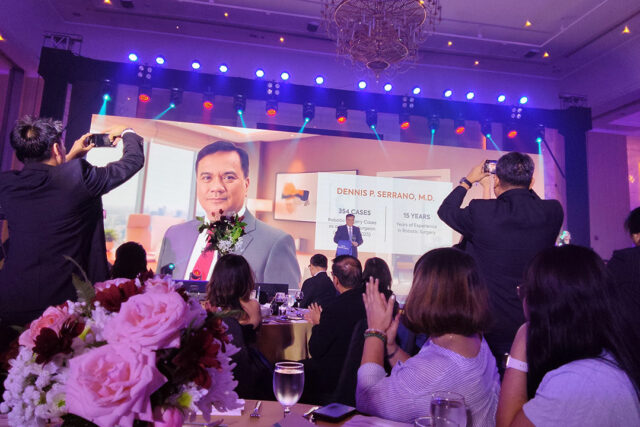
St. Luke’s Medical Center President and CEO Dennis P. Serrano speaking at a milestone event on October 2 marking over 2500 robotic surgeries. — EDG ADRIAN A. EVA

After recently achieving the country’s highest number of robotic-assisted procedures, St. Luke’s Medical Center’s (SLMC) chief expects the technology to see wider adoption in public hospitals, with the center committing to augment the training of government medical professionals. 

“Once we have that commitment from the government and public hospitals, I think we will see this phenomenon sooner rather than later,” Dennis P. Serrano, president and chief executive officer (CEO) of SLMC, told BusinessWorld on the sidelines of the celebration of its 2,500 completed robotic surgery milestone on Thursday. 

Around ten government hospitals, notably the Philippine General Hospital, have already acquired robotic surgical platforms in recent years, with another two to three hospitals likely to follow in the next few months, Mr. Serrano said. “The government, I think, has enough resources to help our hospitals acquire this technology,” he said. 

As one of the country’s spearheads in robotic surgeries, Mr. Serrano also said that SLMC is committed to augmenting the training of medical professionals in public hospitals. 

“We don’t want to monopolize patient care or patient technology because we believe that it is something that has to be shared,” he said. “As I speak, I have permitted nurses from Southern Philippines Medical Center to observe our robotic surgical procedures.” 

The hefty price of robotic-assisted surgeries has also been seen to decrease in recent years due to wider adoption by various hospitals and is expected to drop further in the coming years, the SLMC CEO said. 

He added that health maintenance organizations (HMOs) are now seeing the potential of the technology to be incorporated into their coverage. 

“I hope that becomes something they will realize more, because essentially, payer structures are also a very important driver in bringing costs down,” Mr. Serrano said. 

SLMC will continue to invest in the technology as more patients recognize its potential, and because it is the future of surgery, he said. Edg Adrian A. Eva

SN Aboitiz Power Group reveals 451% ROI from low-code platform adoption 

Rakesh Nandakumar, Kissflow AVP for Southeast Asia with Maria Theresa Cabigon, SNAP Chief Information Officer. — EDG ADRIAN A. EVA

SN Aboitiz Power Group (SNAP), a joint venture between Aboitiz Power Corp. and Norwegian firm Scatec, revealed that it has generated more than a fourfold return on investment (ROI) since adopting the low-code platform Kissflow in 2021 to unify and digitize its workflows. 

“We just found out it yielded a 451% return on investment,” Maria Theresa Cabigon, SNAP’s Chief Information Officer, said on Thursday, noting that the findings were from an independent ROI study conducted by Nucleus Research, a US-based research and advisory firm. 

“So, to put that in simple terms, for every peso we invested, we got more than four pesos back. And we recovered our entire initial investment in less than three months,” Ms. Cabigon said. 

Using Kissflow’s low-code platform, SNAP quickly built more than 114 applications, replacing legacy systems and helping to streamline operations. 

The applications were deployed across the company’s human resources, operations, and information technology (IT) management. 

It has also allowed 19 employees to be trained as citizen developers, enabling them to create applications without extensive IT knowledge or support. 

Rakesh Nandakumar, Associate Vice President for Southeast Asia at Kissflow, told BusinessWorld that the cumulative benefits of the platform for SNAP amount to about $300,000. 

“The report just validates, economically as well, that the steps they’ve taken are the right steps. But for me, what’s very inspiring is that they have 19 folks who are solving problems and they are not IT professionals,” Mr. Nandakumar said. 

Ms. Cabigon also told BusinessWorld that digital transformation is crucial for businesses, especially as data becomes key to decision-making. 

She noted that without digitizing information, insights are difficult to obtain, particularly in the current artificial intelligence-driven era. Edg Adrian A. Eva

First Philippine-made battery-electric ferry launched on Pasig River 

The M/B Dalaray is a battery electric passenger ferry that can carry up to 40 passengers with a range of 45 kilometers per charge with a running time of two to three hours. — DOST

The Department of Science and Technology (DOST) on Monday launched the country’s first locally developed battery-electric passenger ferry, which aims to ease traffic congestion in Metro Manila while promoting sustainability by eliminating fossil fuel consumption. 

The M/B Dalaray is the first locally designed and fabricated battery-electric ferry and it is set to become operational ahead of the Christmas rush in November for free. 

“(It) was built with the conditions of the Pasig River in mind: ensuring passenger comfort, energy efficiency, and ease of maintenance,” DOST Secretary Renato U. Solidum Jr. told reporters during the launch event. 

The ferry will traverse the Pasig River, connecting major cities such as Pasig, Makati, Mandaluyong, Taguig, and Manila, as well as nearby areas around Laguna Lake, including Rizal and Laguna. 

It received P30 million in funding for Phase 1 and more than P54 million for the entire project, according to DOST. 

The groundbreaking locally-made ferry is powered by lithium-ion batteries that can be fully charged in two to three hours, allowing it to have a range of approximately 45 kilometers. It is also equipped with a hybrid solar inverter system that supplies power to onboard facilities such as lighting and air-conditioning. 

“This project symbolizes our move toward a greener, cleaner, and smarter mode of transportation,” Mr. Solidum said. 

The M/B Dalaray project was led by University of the Philippines professor Dr. Lew Andrew R. Tria and funded by the DOST, while the Philippine Council for Industry, Energy, and Emerging Technology Research and Development (DOST-PCIEERD), monitored the project.  

It was also carried out in collaboration with the Metro Manila Development Authority (MMDA), operator of the Pasig River Ferry Service; the Maritime Industry Authority (MARINA); and other relevant organizations. 

MMDA Deputy Chairman Frisco S. San Juan Jr. said the prototype is a cost-efficient addition to its existing fleet of 11 diesel-powered ferries, which have been serving around a thousand passengers on average per day. 

Mas matipid ito. Pareho lang sa kotse, (katulad ng) sa electric car [This is more economical. It’s just like a car, similar to an electric car],” Mr. San Juan told reporters at the sidelines of the launch event. 

He also noted that the ferry can carry around 40 passengers per trip and is expected to help cut MMDA’s operational costs, as it no longer uses fuel. 

Mr. San Juan said the MMDA hopes to replace all its existing ferries with battery-electric powered ones within five years, if it receives sufficient funding. Edg Adrian A. Eva 

Vietnam’s economy grows by 8.23% in Q3 despite drop in US exports

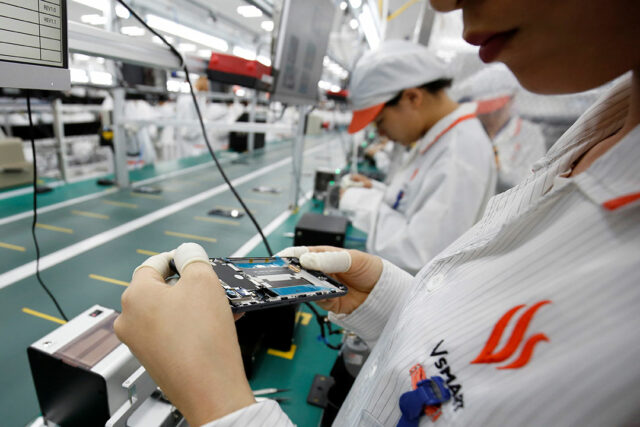
A MANUFACTURER works at an assembly line in Hai Phong, Vietnam. — REUTERS

HANOI — Vietnam’s economy grew 8.23% year-on-year in the third quarter, up from 7.96% in the second, despite a 20% US tariff on exports that took effect on August 7, government data showed Monday.

Exports over the July-September period rose 18.4% from a year earlier to $128.57 billion, while imports jumped20.2% to $119.66 billion, resulting in a trade surplus of $8.91 billion, the National Statistics Office said in a report.

As well as the 20% tariff, the United States also imposed a 40% levy ontransshipments from third countries through Vietnam.

Total September exports fell 1.7% compared to a month earlier, amounting to a value of $42.67 billion. Shipments to the United States over the month were down 1.4% compared to August.

Two-way trade between Vietnam and the United States stood at $112.8 billion during the first nine months of this year as a whole, while trade with China reached $134.4 billion, the NSO said. China is Vietnam’s largest source of imports.

Industrial production in the Southeast Asian manufacturing hub also rose 9.1% in the first nine months of this year from a year earlier, the NSO said.

Consumer prices in September rose 3.38% from a year earlier, it said, and retail sales were up 11.3%.

Foreign arrivals to the country in the first nine months of this year also rose 21.5% year on year to 15.4 million, it said.

Vietnam is targeting gross domestic product growth of 8.3%-8.5% this year. That is faster last year’s 7.09% growth, and higher than the World Bank’s forecast of 6.6% and the International Monetary Fund’s estimate of 6.5% growth.

On Friday, the central bank said it would prioritise growth over the remainder of the year and it urged banks to cut their lending interest rates.

The central bank said credit growth, a key driver of the economy, was expected to increase 19%-20% this year.

For the first nine months of this year, exports rose 16% from a year earlier to $348.74 billion, while imports were up 18.8% at $331.92 billion, amounting to a trade surplus of $16.82 billion, according to the NSO.

The United Nations Development Programme has estimated that tariffs could cut Vietnam’s exports to the US by one-fifth, making it the worst-hit country in Southeast Asia. — Reuters

Former BPI president and CEO Xavier Loinaz passes away

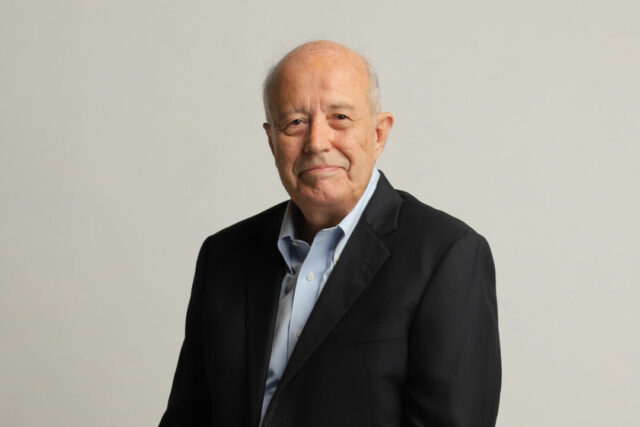
Former Bank of the Philippine Islands President and CEO Xavier P. Loinaz — BANK OF THE PHILIPPINE ISLANDS

VETERAN BANKER and former Bank of the Philippine Islands (BPI) President and Chief Executive Officer (CEO) Xavier P. Loinaz died on Oct. 4, the listed bank said late on Sunday.

“The Bank of the Philippine Islands mourns the passing of Mr. Xavier P. Loinaz, a visionary leader whose legacy continues to shape both our institution and the Philippine banking industry,” the bank said in a statement.

“The entire BPI family joins the Loinaz family in grief and remembrance. We honor XP’s remarkable life, his enduring contributions, and the countless ways he helped shape our bank, our industry, and our nation.”

Mr. Loinaz was president and CEO of BPI from 1982 to 2004. After his term, he continued to serve as a member of the bank’s board of directors until 2020.

“He guided the bank through some of the most tumultuous periods in the nation’s history, from the debt crisis of the early 1980s to the Asian Financial Crisis of the late 1990s. Despite these external challenges, his steady and disciplined leadership brought innovation, resilience, and growth to BPI,” the bank said.

During his term, BPI was the first bank in the Philippines to roll out automated teller machines in the early 1980s and then Internet banking in 1999. He also oversaw BPI’s landmark acquisitions of Family Bank from the Gotianun family in the mid-1980s, CityTrust Banking Corp. in the mid-1990s, and Far East Bank and Trust Co. in 2000.

“These moves not only expanded BPI’s reach but also helped solidify its position as a market leader,” the bank said. “His acquisition of life and property and casualty insurance companies also marked the beginning of bancassurance in the Philippines, a pioneering step that integrated banking and insurance services for Filipino families.”

“To us at BPI, Xavier Loinaz was not only a visionary leader but also a mentor and an inspiration. He taught us discipline, integrity, and the importance of serving with purpose. The innovations he introduced, and the people he guided, continue to carry his legacy forward,” BPI President and Chief Executive Officer Teodoro K. Limcaoco said. “We will always be grateful for his steady hand and his belief in the Filipino spirit. He leaves behind an institution made stronger by his leadership — and a family of bankers who will forever remember him with respect and gratitude.” — AMCS

MOVE IT unveils ‘driver-led, tech-reinforced’ safety promise, setting a new bar for MC taxi standards

Leaders of MOVE IT rider-partner communities sign the Katuwang sa Kaligtasan sa Kalsada pledge as they co-champion a safety-first culture in the motorcycle-taxi industry. Spearheading the pledge is Motorcycle Community Philippines Chairman Romeo Maglunsod.

Motorcycle taxi platform MOVE IT is elevating industry standards with a Driver-Led, Tech-Reinforced Safety Commitment a comprehensive program that pairs professionalized rider training with live safety technologies at scale. The company reported a 99.999% incident-free completion rate across thousands of daily rides, and says its priorities are now squarely on the remaining ~0.001% trips.

“Near-perfect isn’t the finish line,” said MOVE IT General Manager Wayne Jacinto. “Leadership in safety means raising the bar every day professional riders, real-time protection, and transparent accountability on every single trip.”

At the MOVE IT Moto-Taxi Road Safety Dialogue, 31 MOVE IT rider-partner communities signed the Katuwang sa Kaligtasan sa Kalsada, a pledge that anchors a community-led safety culture across the motorcycle taxi sector.

Driver-Led Safety: Professional Standards by Design

MOVE IT’s Pasado Bago Pasada framework subjects every rider to rigorous onboarding, continuous upskilling, and bi-annual retraining.

Highlights of the Pasado Bago Pasada Framework:

  • Every rider undergoes full government clearance verification. MOVE IT reports 100% compliance with document requirements.
  • Almost 60% of motorcycles pass inspection on the first attempt, underscoring the strict compliance standards for roadworthiness before deployment.
  • More than 80% of applicants clear the initial skills test, with the remainder retrained until they meet safety benchmarks.
  • All riders are mandated to retrain every six months, reinforcing a culture of continuous improvement.
MOVE IT General Manager Wayne Jacinto emphasized the platform’s uncompromising focus on driver quality, highlighting its rigorous onboarding and training standards.

MOVE IT also collaborated with Ateneo’s Bulatao Center for Psychological Services to produce a first-of-its-kind Behavioral Assessment Tool for the motorcycle taxi industry, set to roll out this quarter. Unlike conventional tests that focus solely on technical skills, the tool is designed to measure how riders make decisions, manage stress, and respond to high-pressure or unexpected situations on the road. By grounding assessments in behavioral science, MOVE IT raises the bar on rider professionalism, ensuring that safety is defined not just by ability, but by judgment and conduct in real-world conditions.

Tech-Reinforced: Progressive Safety Innovations

While professional standards are central, MOVE IT said technology is equally critical in keeping roads safe. Through its strategic partnership with Grab, the platform has strengthened its safety infrastructure to support thousands of rides in real time.

In its relaunch in 2023, MOVE IT rolled out first-of-its-kind safety tools in the industry — from live location-sharing and in-app SOS integration, to passenger and driver verification selfies and AI-driven trip monitoring.

The platform has since expanded its safety stack with additional tools designed to address some of the most common risks on Philippine roads:

  • Overspeeding Alerts provide real-time reminders when riders exceed safe limits, reinforcing responsible driving behavior and reducing accident risk.
  • Fatigue Nudges monitor trip patterns to detect signs of overwork, prompting riders to take breaks and ensuring they are alert before going on the road.
  • AudioProtect records trip audio in the background, giving both riders and passengers added security by providing clear context for investigations and ensuring fairness in resolving disputes or safety-related reports. Audio Protect will be live on MOVE IT in Q4 2025.

Together, these features aim to prevent accidents before they happen, protect riders and passengers during trips, and deliver greater transparency when incidents occur.

Fair Accountability: Shared Protection and Rapid Response

MOVE IT said professional riders and advanced technology must be backed by transparent accountability.

  • Reports filed through the app prompt swift investigation, with high-risk cases leading to preventive suspension pending due process. The same standards apply to complaints from riders against passengers.
  • An Emergency Response Unit of volunteer riders serves as first responders, reaching incidents within 30 minutes to provide aid and coordinate with hospitals and authorities.
  • All trips are insured, covering both passengers and riders, through partnerships with providers including AIG and Cocolife.

The Coalition for Filipino Commuters, an advocacy group for passenger rights and interests, commended MOVE IT’s progress, calling it “inspiring to see how MOVE IT, together with other platforms, is proactively transforming and growing our industry for the better through their respective pioneering efforts.” At the same time, the group stressed that “platforms can only go so far on their own. It is time to standardize these safety measures through the official legalization of motorcycle taxis.”

Mr. Jacinto closed with a call for collective action: “Safety is not a milestone but a daily mission. We will continue to raise the standards — through professional riders, progressive technology, and fair accountability — until every commuter embraces motorcycle taxis as a truly reliable and viable transport option for our nation.”


Spotlight is BusinessWorld’s sponsored section that allows advertisers to amplify their brand and connect with BusinessWorld’s audience by publishing their stories on the BusinessWorld Web site. For more information, send an email to online@bworldonline.com.

Join us on Viber at https://bit.ly/3hv6bLA to get more updates and subscribe to BusinessWorld’s titles and get exclusive content through www.bworld-x.com.

How China waged an infowar against US interests in the Philippines

Chinese and Philippine flags and a sign reading "Influence campaign" are seen in this illustration taken Oct. 3, 2025. -- REUTERS/Dado Ruvic/Illustration

MANILA – As Chinese ships fired water cannons at Philippine vessels in the South China Sea in November 2021, Beijing’s then-ambassador to Manila asked Filipinos on Facebook to share their favorite things about China.

Among the hundreds of gushing responses were three from a young man named “Vince Dimaano.”

His comments – like many responding to the Chinese embassy’s posts – weren’t genuine. They came from fake accounts paid for by the diplomatic mission, according to internal documents from a Manila-based marketing agency.

The firm, InfinitUs Marketing Solutions, waged a cyber campaign paid for by China to weaken support for Philippine government policy and to sow discord over Manila’s security alliance with the United States, according to a review of the documents and the fake Facebook accounts, as well as interviews with two former company employees and two Philippine officials.

The Chinese-owned company also used the fake profiles to amplify anti-American content created by Filipino writers, including some who had received money from Beijing, Reuters found.

InfinitUs and its owner Paul Li did not respond to questions. The company has previously denied any involvement with “illicit digital activity.”

A Chinese foreign ministry spokesperson told Reuters that Beijing doesn’t interfere in the internal affairs of other countries. Allegations of Chinese influence campaigns made by some Filipino politicians “have failed and instead have backfired,” the spokesperson said.

The explosion of social media has turbocharged influence operations in the Philippines , according to Jonathan Malaya, until recently a senior official with the Philippine National Security Council. Manila is of increasing strategic importance to Washington and Beijing due to its proximity to Taiwan. China’s leaders have asked their military to be ready to seize the democratically governed island by 2027.

InfinitUs first came under the spotlight at an April Senate hearing, when then-Majority Leader Francis Tolentino accused it of using fake accounts to boost the embassy’s profile and conduct an “influence operation” against the Philippines. Tolentino produced a copy of a check from the embassy to InfinitUs and highlighted posts by accounts that Reuters later identified as inauthentic, but he did not elaborate further.

The scope of InfinitUs’s activities went beyond the pro-China propaganda that Tolentino alleged, Reuters reporting revealed.

Its work included disparaging the US-Philippine alliance and Western-made COVID vaccines. The news agency also uncovered that InfinitUs had created Ni Hao Manila, a media outlet designed to look Filipino-run, according to the former employees.

InfinitUs employees used accounts masquerading as pro-Beijing Filipinos to attack the US and abuse a prominent nationalist lawmaker, the profiles and company records show. The documents include an August 2023 contract tasking InfinitUs with “guiding public opinion” on Facebook and X, as well as work-progress reports created for the embassy.

Reuters identified at least ten Facebook accounts that were part of what InfinitUs called an “army” in the documents. The platform’s owner Meta did not comment on the influence campaign but confirmed the accounts violated policy and removed them after being alerted by the news agency.

“ARMY ALWAYS SUPPORTS THE ADVOCACIES AND ACTIVITIES OF THE CHINESE AMBASSADOR’S PAGE,” read one work-progress report, referring to the troll army.

“Army propagated the special video explainer about the cons of the Typhon missile of the US being deployed (sic) the Philippines,” said another report from November 2024.

The accounts also promoted pro-China content featuring Filipino media personalities. They include Rommel Banlaoi, a Chinese-educated counter-terrorism scholar whose 2022 nomination to be deputy national security advisor was successfully opposed by security officials.

Banlaoi was among dozens of prominent Filipinos who have received awards from the Association of Philippines-China Understanding (APCU) since 2021. The organization was re-established by ex-Philippine president Gloria Arroyo and a Chinese Communist Party (CCP) agency that the US previously accused of “co-opting subnational governments.”

The embassy-funded awards came with thousands of dollars – multiples of the average Philippine monthly wage – APCU told Reuters.

Banlaoi did not respond to questions.

Asked about Reuters’ findings, Malaya – the Philippine official – said the government was aware “third-party proxies” echoed Chinese talking points that were then circulated by fake accounts “in an attempt to give it virality.”

“The end goal (of China) is to make the Philippines compliant,” Tolentino told Reuters.

The Philippines lacks robust foreign interference laws, though lawmakers are working on modernizing and expanding the rules so they also punish spreading disinformation. Potential penalties include heavy fines.

The activities of the InfinitUs-controlled accounts fit China’s foreign influence playbook, said Bethany Allen of the Australian Strategic Policy Institute think-tank, who has studied such information campaigns and reviewed Reuters’ findings.

X and YouTube host many accounts “which promote ‘happy nice China’ content (and sometimes more directly political content),” she said in an email, adding that they usually did not disclose affiliation with Beijing despite likely being funded by the CCP.

YouTube owner Alphabet and X did not return requests for comment.

CHINA, U.S. WAGE INFORMATION WAR

Both China and the U.S. have engaged in infowars over the Philippines.

Reuters revealed last year the U.S. had operated a program during the pandemic to undermine Chinese vaccines in the Philippines, including through fake social-media accounts.

The Chinese embassy said at that time that Washington should “stop slandering and smearing other countries.”

The U.S. has more recently slashed funding for programs aimed at countering Beijing’s propaganda. In April, the State Department shuttered an office that had worked closely with Manila to counter Chinese influence campaigns after Secretary of State Marco Rubio accused it of censorship and wasting funds.

Manila had contributed to a database on Chinese operations run by the office, according to a Philippine official familiar with the matter.

A State Department spokesperson told Reuters that Manila and Washington continue to cooperate against “malign CCP activities.”

“Operations that undermine democratic discourse or spread discord are unacceptable” and foreign interference in the Philippines must be challenged, the spokesperson added.
The White House said in a statement that its effort to “eliminate waste, fraud, and abuse has not hindered U.S. influence.”

TROLL ARMY

Philippine President Ferdinand Marcos Jr has, since taking office in 2022, forged closer security ties between Washington and Manila, a former colony that remains a key node in America’s Indo-Pacific defense strategy.

The Philippines also maintains extensive cultural and economic links with neighboring China.

Marcos Jr, who succeeded the pro-Beijing Rodrigo Duterte, has said that Manila would inevitably be pulled into any conflict over Taiwan.
Manila has also taken a more assertive stance in its territorial dispute with Beijing, which claims almost the entire South China Sea. China has frequently disrupted – sometimes violently – operations of Philippine vessels in Manila’s exclusive economic zone.

Marcos Jr’s foreign policy marked a sharp departure from his predecessor. While Duterte cozied up to China, Beijing rapidly militarized reclaimed islands in disputed waters and conducted aggressive maneuvers at sea.

As China’s image in the Philippines suffered, its Manila mission turned to InfinitUs.

Its owner, Li, also operates a business facilitating Chinese migration to the Philippines, corporate records show.

In fall 2020, InfinitUs brought online several Facebook accounts, which Reuters identified through an undated company report sent to the embassy. The document included records of comments the profiles had posted on the mission’s social pages.

The behavior of one of the profiles – “Vince” – was representative of the set.

“Vince” often praised China and defended its coast guard, while regularly sharing embassy content. The account lauded China’s Sinovac vaccine and circulated negative articles about Western-made shots.

“We should stop fighting China” on the maritime issue, “Vince” wrote.

InfinitUs did not appear to take great care in making the accounts seem authentic. The photo for one of the profiles was identical to an image for a “handsome Asian man” offered by visuals provider Dreamstime.

Dreamstime said it was aware its images were often misused by bot and troll networks and that it opposed such activity.

“Vince” also posted virtually identical reviews of businesses as two other accounts Reuters identified as controlled by InfinitUs, which Margot Hardy of online analysis firm Graphika said was a marker of inauthentic behavior.

InfinitUs was also behind profiles that attacked a prominent lawmaker, its embassy reports show.

The firm’s November 2024 report related how those accounts swarmed the profile of then-Congressman Robert Ace Barbers, a vocal proponent of legislation to bolster Filipino maritime claims.

The document described an “aggressive comment campaign” on Barbers’ Facebook posts that month to “protest his negative comments about China in relation to the new maritime protocols.”

It did not include examples. But days after the legislation passed, uncorroborated accusations of criminality began to multiply on Barbers’ previously published posts.

Barbers’ posts typically attracted several dozen comments each, but responses surged to the hundreds in late November.

“These trolls were programmed to influence the Filipinos to vote for someone,” said Barbers, referring to May’s midterm elections for which he was term-limited.

Meta told Reuters it invests heavily to protect elections online.

US-based disinformation analytics firm Cyabra told Reuters that a surge of fake accounts likely linked to Beijing also targeted Marcos Jr on X with allegations of corruption and drug addiction during the campaigning period.

Reuters was not able to verify independently the existence of such a campaign but it reviewed many unsubstantiated X posts during that period that accused the president of illegal behavior.

The Chinese Foreign Ministry spokesperson said: “We will not, and have no interest in, interfering in Philippine elections.”

PROXY WARFARE?

The trolls buttressed news-and-culture outlet Ni Hao Manila, which means “Hello, Manila” in Mandarin.

The outlet has posted videos highlighting Beijing’s naval prowess and criticizing Philippine security cooperation with the U.S. Some of its posts were also shared by the InfinitUs fake accounts.

One of the former employees said InfinitUs had purchased fake likes and follows from Facebook vendors for Ni Hao Manila, which has about 115,000 followers on YouTube and 300,000 on TikTok.

Graphika’s Hardy said the outlet’s TikTok channel exhibited inorganic behavior like videos with hundreds of likes but no comments.

TikTok said it investigated Ni Hao Manila’s account after being notified by Reuters and removed fake followers.

Ni Hao Manila amplified content from at least one Filipino involved in managing APCU, the Communist Party-affiliated organization.

Several serving or former Philippine officials also received awards that APCU says came with cash ranging from between roughly $850 and $3,440.

They include Manuel Mamba, a provincial leader who has opposed some plans to host the U.S. military; Regina Tecson, a key aide to Duterte’s daughter Sara; and Jaime T. Cruz and Carlos Chan, both former envoys to Beijing.

Mamba, who received an award APCU said was worth $2,570, told Reuters he accepted a plaque but was “not aware of any monetary award or quid pro quo in connection with this recognition.”

He said his engagement with foreign representatives – which had included receiving a donation from Taiwan for typhoon victims – was “consistent with my responsibility to promote cooperation and opportunities beneficial to my constituents.”

Tecson said there were no conditions attached to her award of about $1,700 and that she used the money for charity work.

Other recipients announced by APCU include Banlaoi, the national security nominee, as well as writers Herman Tiu Laurel, Adolfo Paglinawan and Rod Kapunan.

All four were also identified as instruments for Chinese influence in a 2024 presentation about foreign interference created for internal use by a Philippine security agency and seen by Reuters.

Tiu Laurel did not respond to specific questions but said the award recognized “individuals who stand for the truth in Philippine-China relations.”

APCU, as well as Cruz, Chan, Paglinawan and Kapunan did not return requests for comment.

Surveys indicate Filipino support for the U.S. alliance remains strong but former senator Tolentino said Beijing’s efforts were showing some signs of success.

Polls show the frontrunner for the 2028 presidential elections is Sara Duterte, who has criticized the term-limited Marcos Jr’s pro-American policies.

“Filipinos believe in social media,” Tolentino said. “They can be swayed.” — Reuters

MPTC seeks SEC approval for P20-B fixed-rate bond issuance

NLEX.COM.PH

METRO Pacific Tollways Corp. (MPTC) is seeking regulatory approval to raise up to P20 billion through a bond issuance to help finance its expressway projects in Luzon and the Visayas.

In a statement on Monday, the tollways arm of Metro Pacific Investments Corp. (MPIC) said it has filed a registration statement with the Securities and Exchange Commission (SEC) for the proposed offering, which will consist of P15 billion in fixed-rate bonds, with an oversubscription option of up to P5 billion.

Proceeds from the issuance will be used to fund the construction of the Manila-Cavite Expressway (CAVITEX), Cavite-Laguna Expressway (CALAX), and Lapu-Lapu Expressway (LLEX).

The offer period is targeted to run from Nov. 17 to 21, while the bonds are expected to be issued and listed on the Philippine Dealing and Exchange Corp. (PDEx) on Dec. 2.

MPTC is the tollways unit of MPIC, one of the three key Philippine subsidiaries of Hong Kong-based First Pacific Co. Ltd., along with Philex Mining Corp. and PLDT Inc.

Hastings Holdings, Inc., a unit of the PLDT Beneficial Trust Fund’s MediaQuest Holdings, Inc., has a majority stake in BusinessWorld through the Philippine Star Group, which it controls. — A.E.O. Jose and A.L. Balinbin

Toyota Financial Services launches P2-billion bond offer

PHILSTAR FILE PHOTO

TOYOTA Financial Services Philippines Corp. (TFSPH), the automotive financing and leasing arm of GT Capital Holdings, Inc., has launched its P2-billion maiden bond offering to fund asset growth and diversify its funding sources, the listed conglomerate said on Monday.

The bonds will be issued in up to two series: two-year Series A bonds due 2027 with a fixed rate of 5.7725% and three-year Series B bonds due 2028 with a rate of 5.9418%.

The offer period will run from Oct. 6 to 13, according to GT Capital. First Metro Investment Corp. and ING Bank N.V. Manila Branch are the joint lead arrangers and bookrunners for the transaction. Both firms will also serve as the selling agents, alongside Metropolitan Bank & Trust Co. and BPI Capital Corp.

TFSPH aims to reach a wider investor base that includes both institutional and individual investors, GT Capital said.

Philippine Rating Services Corp. (PhilRatings) assigned TFSPH an issuer credit rating of PRS Aaa with a stable outlook.

In the first quarter of fiscal year 2025, TFSPH’s total revenues rose by 11% to P3.9 billion, while loan receivables increased by 9% to P159.4 billion.

TFSPH is 60% owned by Japan-based Toyota Financial Services Corp. and 40% by GT Capital. — A.L. Balinbin and B.M.D. Cruz

Philippines to open January rice import window, extend ban through end-2025

PHILSTAR FILE PHOTO

By Kenneth Christiane L. Basilio

The Philippines will implement a one-month rice import window in January next year and reimpose a halt from February to April, as the government extends its rice import ban until end-2025, its Agriculture chief said on Monday, in a plan “more or less” approved by President Ferdinand R. Marcos, Jr.

Agriculture Secretary Francisco P. Tiu Laurel, Jr. said the government plans to allow about 300,000 metric tons of rice imports in January 2026, an amount he said would be sufficient to support local stocks for consumption.

“I believe we have to import by January just to be sure,” he told lawmakers at a House of Representatives hearing in Filipino. “Our imported stocks, which we stopped in September, are estimated to run out by the end of November and we’ll be running on local stocks in December.”

“That kind of situation is quite risky,” he added.

Mr. Marcos earlier suspended rice imports for 60 days starting Sept. 1 to protect Filipino farmers during the harvest season and stabilize rice prices. The suspension was originally supposed to end on Nov. 2 and applies only to regular milled and well-milled rice.

“We will extend the rice import stoppage until the end of 2025,” Mr. Tiu Laurel said.

He said the Philippines, the world’s top rice buyer, had imported about 3.5 million metric tons (MMT) of rice as of end-September, overshooting this year’s rice import target by 800,000 tons.

“We should be at the 2.7 [MMT levels] in imported rice, so we are… in excess,” he said. “The monthly import volume should only be around 300,000 tons, or 3.6 MMT a year.”

ADVERTISEMENT
ADVERTISEMENT