Home Blog Page 9

Paddington musical triumphs at London’s theatrical Olivier Awards

LONDON — Paddington Bear was the big winner at the Olivier Awards in London on Sunday, with a stage adaptation of the beloved children’s books picking up seven prizes at Britain’s top theater honors.

Paddington The Musical, based on author Michael Bond’s books and the 2014 film adaptation, brings to life the marmalade-sandwich-loving bear, a refugee from Peru who is named after the London train station where he is found. The show, with music and lyrics by musician Tom Fletcher, won prizes including best new musical, best director, and best actor in a musical for the duo who portray the title character together.

“With everything that is happening in this world there will be further displaced people, please be welcoming, accepting and helpful to those people and treat them as you would if you were Paddington himself,” James Hameed, who voices Paddington off-stage in the show while co-winner Arti Shah plays the bear on stage, said in their joint acceptance speech.

“Paddington reminds us to be welcoming, inquisitive, and most importantly kind.”

It had led nominations alongside Into the Woods, a production of Stephen Sondheim’s musical featuring Brothers Grimm characters that won best musical revival, with 11 nods each.

Punch, based on a real-life story of one man’s fatal punch, won best new play.

Snow White star Rachel Zegler won best actress in a musical for her portrayal of Argentine first lady Eva Peron in Evita, which saw her performing the show’s big number “Don’t Cry For Me Argentina” live from a balcony outside the theater.

“Thank you so much to the city of London for making me feel so welcome here. I never could have imagined it,” Ms. Zegler said.

“It was the honor of a lifetime singing to the people of Argyll Street eight times a week. I can’t believe I got so lucky.”

Gone Girl star Rosamund Pike won best actress for legal drama Inter Alia, while Jack Holden beat the likes of Loki actor Tom Hiddleston, and Breaking Bad star Bryan Cranston to win best actor for true-crime thriller play Kenrex.

A new production of Arthur Miller’s All My Sons won best revival and best supporting actor for Paapa Essiedu, who plays Professor Snape in the upcoming Harry Potter television series.

Named after actor Laurence Olivier and first handed out in 1976, the awards are Britain’s most prestigious theatrical honors.

As well as celebrating their 50th anniversary, the awards marked other major theater milestones: 40 years of Phantom of the Opera and 20 years of Wicked, with special performances for both.

Sunday’s ceremony at the Royal Albert Hall also saw veteran stage actor Elaine Paige receive a special award in recognition of her “defining contribution to musical theater.” — Reuters

Treasury bills fetch lower rates, mixed demand

BW FILE PHOTO

TREASURY BILLS (T-bills) offered on Monday fetched lower yields as the market corrected following a decline in global oil prices last week amid a temporary ceasefire between the United States and Iran, although demand was largely skewed towards shorter tenors as uncertainty remains high.

The Bureau of the Treasury (BTr) raised P32.06 billion via the T-bills it auctioned off, above its P30-billion program as total tenders reached P99.425 billion or more than thrice the amount on offer. This was also higher than the P50.203 billion in demand recorded on April 6.

The government fully awarded the 91-day and 182-day papers, with strong demand and lower yields prompting the Auction Committee to double its acceptance of noncompetitive bids for both tenors to P7.2 billion, it said in a statement. Meanwhile, it partially awarded the one-year T-bill to cap its average rate.

Broken down, the Treasury raised P16.8 billion via the 91-day T-bills, well above the P12 billion it placed on the auction block, as demand for the tenor reached P50.825 billion. The three-month paper fetched an average rate of 4.75%, falling by 23.5 basis points (bps) from 4.985% last week. Bids accepted had yields ranging from 4.7% to 4.798%.

The government also borrowed P10.71 billion via the 182-day debt, higher than the P9-billion offering as tenders reached P34.715 billion. The average rate of the six-month T-bill was at 4.882%, declining by 19.8 bps from 5.08% previously. Tenders awarded carried rates from 4.81% to 4.995%.

Meanwhile, the BTr sold only P4.55 billion in 364-day securities, below the P9 billion on offer, even as bids totaled P13.885 billion. The one-year paper fetched an average yield of 5.168%, down by 3.6 bps from 5.204% last week. Accepted bids had rates from 5.138% to 5.19%.

At the secondary market before Monday’s auction, the 91-, 182-, and 364-day T-bills were quoted at 4.7599%, 4.9141%, and 5.1591%, respectively, based on PHP Bloomberg Valuation Service Reference Rates data provided by the Treasury.

T-bill yields corrected lower to mirror the week-on-week decline in comparable secondary market rates as the US-Iran truce caused global oil prices to go down, leading to lower domestic pump prices that eased inflation concerns slightly, Rizal Commercial Banking Corp. Chief Economist Michael L. Ricafort said in a Viber message.

“T-bill average auction yields also declined after relatively large total bids versus previous weeks especially since the war in the Middle East started,” he said.

“There was high demand for shorter tenors again, similar to last week. Also, yields moved lower despite the upward movement of oil prices and US Treasury yields,” a trader said in a text message.

Demand for risk assets rebounded following the US-Iran ceasefire deal announced last week, although sentiment soured anew on Monday as talks between the warring countries ended with no agreement over the weekend.

Oil prices surged on Monday as the US moved to impose a blockade on Iranian shipping after the collapse of weekend peace talks, Reuters reported.

The US move, aimed at putting pressure on Tehran, leaves a fragile ceasefire hanging in the balance and no end in sight to the choke on Middle East energy exports — though the mood on trading floors leaned toward hoping for a resolution.

Brent crude futures were up 7.3% at $102 a barrel — a gain of more than 40% since the war shut navigation of the Strait of Hormuz.

US Treasuries and bonds around Asia traded lower, with Japan’s benchmark 10-year yield hitting a 29-year high of 2.49%, though moves were relatively modest and took most assets to roughly where they sat before last week’s ceasefire.

The Wall Street Journal reported that Mr. Trump and his advisers were weighing limited strikes on Iran, though there were no immediate reports of attacks in the Asia day.

Mr. Trump said on Sunday that the price of oil and gasoline ​may remain high into the midterm elections in the US in November, a rare acknowledgement of the potential political fallout from the war.

With inflation fears reviving, investors are now bracing for central banks, such as the European Central Bank and Bank of England, tilting towards raising rates in a sharp reversal from pre-war bets on rate cuts or a prolonged pause.

On Tuesday, the BTr is targeting to raise P20 billion to P30 billion from reissued 20-year Treasury bonds (T-bonds) with a remaining life of five years and three months.

The Treasury wants to borrow up to P248 billion from the domestic market this month, or P140 billion via T-bills and P108 billion through T-bonds.

The government borrows from local and foreign sources to help fund its budget deficit, which is capped at P1.61 trillion or 5.3% of gross domestic product this year. — A.M.C. Sy with Reuters

Metro Manila condo demand up 19% in Q1, seen as seasonal rebound — LPC

A VIEW of buildings in Makati City. — PHILIPPINE STAR/MICHAEL VARCAS

DEMAND for Metro Manila condominiums increased 19% year on year in the first quarter (Q1), driven by end-user purchases and developer incentives, though Leechiu Property Consultants (LPC) said the uptick reflects a seasonal rebound rather than a full market recovery.

Total condominium take-up reached 7,732 units in the January-to-March period, recovering from a “sharp slowdown” in the previous quarter, LPC said in its first-quarter residential market report released last week.

Despite the improvement, LPC said the market remains vulnerable to external shocks and structural constraints.

“A more decisive recovery is unlikely until external risks moderate and rental yields begin to normalize relative to capital values,” it said.

Investor activity remained subdued, with rental yields at 3.8% for primary units and 4.6% for secondary units, levels the firm said are insufficient to offset high acquisition costs.

“Speculative investor interest remained muted due to subdued rental yields as rental rates normalize and capital values of primary units remain elevated,” it said.

The market also faces elevated inventory, with unsold condominium stock equivalent to about 31 months, though this was partly eased by slower project launches and improved absorption.

“Tempered project launches and incremental gains in absorption provided temporary relief to inventory pressure,” LPC said.

Demand was more resilient in the mid-market segment, while higher-end buyers continued to adopt a wait-and-see approach.

LPC said global risks, including geopolitical tensions in the Middle East, could drive inflation and interest rates higher and dampen remittance flows from overseas Filipino workers.

“Given heightened global and geopolitical risks, market participants should maintain a cautious stance — closely assessing supply-chain impacts, preserving liquidity, and deferring aggressive expansion until conditions stabilize,” said Roy Golez, LPC director for research, consultancy, and valuation.

Residential activity is also gradually shifting to provincial areas supported by infrastructure development, where flexible payment terms and improved accessibility are helping sustain demand and price growth, the firm said. — Alexandria Grace C. Magno

Foodpanda sees higher oil prices driving online grocery demand

FOODPANDA PHILIPPINES

ONLINE delivery platform Foodpanda Philippines said volatility in oil prices linked to conflict in the Middle East could increase demand for its online grocery service, pandamart, as consumers seek to manage transport costs.

“We see this as an opportunity to drive trials, especially among customers who may not have tried online grocery shopping yet,” Foodpanda Philippines Director for Q-Commerce Joseph Wijesekara said in an e-mailed reply to questions.

Escalating conflict in the Middle East has pushed oil prices higher in recent weeks, with Brent crude averaging about $100.75 per barrel as of April 12.

Philippine Energy Secretary Sharon S. Garin said on Monday that oil companies would cut diesel prices by P23 per liter this week.

Despite fluctuations in oil prices, the company said it does not plan to raise prices, Mr. Wijesekara said.

“For us, this is also an investment in helping educate Filipinos that there are now more convenient and accessible ways to do their grocery shopping,” he said.

Foodpanda Philippines also expects pandamart to double its business this year, supported by its 24/7 operations.

“We expect pandamart to double as a business this year, and our 24/7 service is one of the key growth drivers supporting that momentum,” Mr. Wijesekara said.

Last month, Foodpanda said its pandamart service would operate 24/7 nationwide to address demand for availability and speed in the quick-commerce (q-commerce) sector.

Mr. Wijesekara said the shift to a 24/7 grocery service aims to support convenience for consumers managing long work hours and commutes.

“It’s not meant to replace offline shopping, but to complement it in a way that fits how people live today,” he said.

With its 24/7 model, pandamart aims to serve demand for deliveries beyond regular store hours.

The service offers a full grocery selection, including produce, meat, seafood, and household items.

Growth in digital payments may also support demand, Mr. Wijesekara said, as more consumers adopt contactless transactions.

Data from the Bangko Sentral ng Pilipinas showed that 57.4% of retail payments were made through digital channels as of 2024.

Foodpanda launched pandamart in Singapore in 2019 and has since expanded the service to markets across Asia-Pacific, including the Philippines, Malaysia, Thailand, Taiwan, Hong Kong, Bangladesh, and Pakistan. — Beatriz Marie D. Cruz

The same AI mistake, three times

STOCK PHOTO | Image from Freepik

By Erika Fille T. Legara

JUST RECENTLY, I was in a room full of seasoned board directors asking the now-familiar questions about AI and cybersecurity. That part is hardly surprising anymore. Most boards are trying to understand where AI actually matters, what it changes, what it breaks, and how seriously they should treat the noise around it.

One of them asked a question I liked immediately because it was simple in form and difficult in substance: What is the most frequent and biggest mistake many enterprises make with AI? And how can we make things better?

The answer, of course, depends on the organization. Two companies can spend the same amount on AI and end up in very different places, depending on how mature they are, how decisions are made, and how clear leadership is about the investment’s purpose. The mistakes also changed shape over time. The enterprise that ignored data and analytics in 2017 was making a different mistake from the enterprise that built an AI center in 2019, and both are different from the enterprise that now claims to have an AI strategy when what it really has is a budget line for chatbots.

Nevertheless, there is a pattern across all three.

The most common mistake enterprises make with AI is treating it as a technology buying exercise rather than a strategy, capability, and governance problem.

I tend to think about this in waves because I have lived through them that way.

WAVE 1: NOT SEEING IT AT ALL
In 2017, I came home to the Philippines after almost six years of working in Singapore. That was also the year I designed the first formal Master of Science in Data Science program in the country at the Asian Institute of Management. We built the program to be rigorous, but also practical. One of the things I insisted on was a final capstone project in which student teams worked on real company problems rather than toy datasets or abstract classroom exercises.

At the time, pitching this was tough.

This was the first wave. Many enterprises were still at or near zero in terms of structured, data-driven decision-making. They were certainly aware of the language. Executives could talk about descriptive, predictive, and prescriptive analytics because those categories had already entered management vocabulary. But in many organizations, that was where the sophistication ended. The terms were familiar, but the operational meaning was not.

Even getting companies to participate was a struggle. Some weren’t convinced there was anything worth investing in. Others were curious, even willing, but once we got to the data question, the gap between interest and readiness became obvious. The data didn’t exist in a usable form, or it was siloed across systems that had never been asked to talk to each other. Curiosity without data readiness turns out to be a very common starting point.

You had to convince them that better data, better analytics, and better models were not luxury items for “innovative” firms, but capabilities that could reduce cost, improve efficiency, and support better decisions. Sure, that sounds obvious now, but it did not feel obvious then.

So in that first wave, the mistake was underestimation. Many enterprises simply did not grasp what these tools could do, or what it would take to build the foundations for using them well.

WAVE 2: EXCITEMENT WITHOUT DIRECTION
Then came the second wave, which was almost the mirror image.

By the late 2010s and into the pre-pandemic period, some firms had become very excited about AI, and, in fairness, some of that excitement was justified. Money started moving. Enterprises launched centers, labs, innovation units, and transformation teams. They hired expensive talent and approved large budgets for use cases that were often not especially sophisticated; in some cases, spending hundreds of millions on fairly standard machine learning problems without having thought seriously about operationalization, adoption, workflow redesign, or accountability.

That is where things began to go off the rails.

A company would build a center, then a lab, then another adjacent team with a slightly different mandate. It all looked active and modern, and it made for good PR and annual reports. But after three to five years, boards would ask the obvious question: what, exactly, has materialized? Too often, the honest answer was “not much.” There might be pilots, dashboards, or prototypes, and perhaps even technically competent models somewhere in the organization, but rarely a clear line connecting any of it to enterprise strategy, operating priorities, or measurable business outcomes.

This is where many boards become understandably disillusioned. They have seen the spending, approved the talent, and heard management talk about transformation for years, yet the outcomes remain fuzzy, fragmented, or local. So the reaction becomes abrupt. Funding slows, then stops. That overcorrection is its own problem, but it usually begins with a real governance failure, where management spent aggressively without enough strategic discipline.

WAVE 3: EVERYONE’S A CONVERT, SAME MISTAKE
Then ChatGPT arrived and kicked off the third wave. The public release made AI legible to a much wider population of executives and directors who had previously treated it as technical background noise. Money started moving again, and with it came a renewed sense of urgency as organizations suddenly felt they needed an AI strategy. The trouble is that in many organizations, that quickly became shorthand for “go buy some GenAI.”

There’s a definitional problem hiding inside a lot of AI announcements right now. When companies say they want to invest in AI, many mean they want to buy GenAI systems, often from several vendors at once, and sometimes for use cases that are barely distinguishable from one another. One government agency I came across was seriously committed to what it called “AI transformation.” What it actually had was a collection of chatbots: different vendors, different tasks, no coordination, no connective tissue, no clear line back to any strategic objective. The spending was real, but the fragmentation had not gone away. It was the same pattern I had been watching for nearly a decade.

The numbers are already cautionary. BCG found that only 26% of companies generate tangible value from AI, and MIT’s NANDA research found that only about 5% of enterprise AI pilots achieve measurable revenue impact. Gartner warned that at least 30% of generative AI projects would be abandoned after proof of concept because of poor data quality, weak risk controls, or unclear business value.

Generative AI can absolutely be useful. In some organizations, it is one of the fastest ways to improve knowledge work, customer interaction, or internal productivity. The argument is not against it. It is against the collapse of the whole field of AI into one highly visible category of tools. For many firms, the highest-value use cases may have little to do with generative AI at all. Better forecasting, logistics optimization, anomaly detection, fraud analytics, and conventional machine learning systems can create enormous value when tied to actual business priorities. In many environments, these will matter more than an enterprise chatbot layered on top of messy internal processes.

THE PATTERN UNDERNEATH ALL THREE WAVES
That is why I keep coming back to the same point. AI belongs in operations and governance, where strategy gets tested in practice.

Boards should be asking management to show how AI investments connect to strategic imperatives, what specific outcomes they expect, what supporting data and systems are required, how the organization will absorb and use the outputs, and who is accountable when an AI-enabled decision fails or causes harm. That is a far better conversation than asking whether the company is “doing AI.”

The fix is not conceptually complicated, though it is difficult institutionally. It starts with strategy, being honest about the actual business problem before selecting a tool, and being specific enough about the expected outcome that you could, two years from now, look back and say whether the investment worked. It also means treating data, process, talent, and governance with the same seriousness as the model itself, because those are usually what determine whether a technically sound system ever produces anything useful. Fragmentation is the enemy here, whether that means duplicative vendor contracts, disconnected pilots, or GenAI deployments sitting atop processes nobody has bothered to redesign. Innovation and governance are not in tension; if anything, governance is what keeps an organization from spending several years and a great deal of money discovering that motion is not the same thing as progress.

If I had to answer that board question in one line, I would say this:

The biggest enterprise mistake with AI is mistaking motion for progress.

That mistake looked like neglect in the first wave, overexcited but incoherent spending in the second, and fragmented GenAI buying in the third. Different packaging, same strategic weakness.


Erika Fille T. Legara, Ph.D. is a physicist, educator, and data science and AI practitioner working across government, academia, and industry. She is the inaugural managing director and chief AI and data officer of the Philippine Education Center for AI Research, and an associate professor and Aboitiz chair in Data Science at the Asian Institute of Management. She serves on corporate boards, is a fellow of the Institute of Corporate Directors, an IAPP Certified AI Governance Professional, and a co-founder of CorteX Innovations Corp.


The winners at the 2026 Olivier Awards

THE Olivier Awards for theater were handed out in London on Sunday. Below is a list of winners in the major categories.

Best new play Punch

Best new musicalPaddington The Musical

Best musical revivalInto the Woods

Best revivalAll My Sons

Noël Coward award for best new entertainment or comedy playOh, Mary!

Best actor — Jack Holden, Kenrex

Best actress — Rosamund Pike, Inter Alia

Best actor in a musical — James Hameed and Arti Shah, Paddington The Musical

Best actress in a musical — Rachel Zegler, Evita

Best actor in a supporting role — Paapa Essiedu, All My Sons

Best actress in a supporting role — Julie Hesmondhalgh, Punch

Best actor in a supporting role in a musical — Tom Edden, Paddington The Musical

Best actress in a supporting role in a musical — Victoria Hamilton-Barritt, Paddington The Musical

Sir Peter Hall award for best director — Luke Sheppard, Paddington The Musical

Peso sinks back to P60:$1 level as US-Iran peace talks collapse

BW FILE PHOTO

THE PESO slid back to the P60-per-dollar level on Monday as global crude oil prices climbed again after peace talks between the United States and Iran ended without a deal.

The local unit sank by 16.5 centavos to close at P60.135 against the greenback from its P59.97 finish on Friday, data from the Bankers Association of the Philippines showed.

The currency opened Monday’s session sharply weaker at P60.25 per dollar. It traded at the P60 level the entire day, with its intraday best at P60.13 and its weakest showing at P60.50 against the greenback.

Dollars traded went up to $1.89 billion from $1.49 billion on Friday.

“The dollar-peso closed higher and reached an intraday high of P60.50 on renewed demand for safe-haven assets following the collapse of US-Iran talks and Trump’s blockage of the Strait of Hormuz,” a trader said in a phone interview.

The peso was also dragged down by dollar demand driven by hedging activities as entities rushed to purchase fuel supplies following the decline in global crude oil prices following the announcement of a two-week ceasefire between the US and Iran, Rizal Commercial Banking Corp. Chief Economist Michael L. Ricafort said in a Viber message.

“The gauge of the US dollar versus major global currencies corrected slightly higher and global crude oil prices corrected higher… after the US and Iran did not reach an agreement during the talks in Islamabad, Pakistan.”

For Tuesday, the trader sees the peso to range from P60 to P60.50 per dollar, while Mr. Ricafort expects it to move between P60 and P60.25.

The safe-haven dollar firmed on Monday after peace talks between the US and Iran broke down and as the American Navy prepared a blockade of Iranian ports, Reuters reported.

The euro was down 0.3% at $1.1694, while the British pound fell 0.2% to $1.3429, although both were above earlier lows. The risk-sensitive Australian dollar was 0.3% lower at $0.7052 and the New Zealand dollar was off 0.1% at $0.5834.

President Donald J. Trump on Sunday said the US Navy would start blockading the Strait of Hormuz after talks with Iran failed to reach a deal to end the war, jeopardizing a fragile two-week ceasefire. The US Central Command said US forces would begin implementing the blockade of all maritime traffic entering and exiting Iranian ports from 10 a.m. ET (1400 GMT) on Monday.

The dollar has tended to benefit when tensions between Iran and the US have flared, given its status as a safe-haven and the limited exposure of the US to imported energy-price inflation.

Crude prices jumped on Monday, with Brent crude futures back above $101 per barrel.

The latest data from the Commodity Futures Trading Commission (CFTC) showed that speculators raised their net long positions in the US dollar in the latest week. Positioning in the euro flipped to a net short for the first time since March last year, the CFTC said on Friday.

Against the yen, the US dollar was up 0.3% at ¥159.68 as yields on Japan’s benchmark 10-year government bonds jumped 5.5 basis points to 2.49%, the highest in almost three decades.

Bank of Japan Governor Kazuo Ueda said on Monday that economic and price developments were moving roughly in line with the bank’s forecasts, but called for vigilance to the impact of the escalating conflict in the Middle East. — A.M.C. Sy with Reuters

Malls save P202.18M from energy efficiency measures — DoE

PHILIPPINE STAR/ MICHAEL VARCAS

MAJOR MALL OPERATORS saved about P202.18 million after adopting energy efficiency measures in response to a government call amid a national energy emergency, the Department of Energy (DoE) said.

A total of 158 malls generated savings equivalent to 23 megawatts (MW) of electricity over 19 days, the DoE said in a social media post on Monday.

The agency attributed the savings to adjustments in mall operations aimed at easing pressure on the power system.

Participating operators included Araneta Malls, Megaworld Lifestyle Malls, SM Supermalls, Power Plant Mall (Rockwell), Robinsons Malls, and Ayala Malls, among others.

Some malls have also begun adopting rooftop solar systems and participating in the government’s Green Energy Option Program, which allows eligible consumers to select their preferred electricity supplier.

Last month, several mall operators in Metro Manila shortened operating hours following the government’s declaration of a national energy emergency.

Government agencies also reported a 14% reduction in fuel and electricity use, equivalent to about 0.70 MW in energy savings, the DoE said.

The agency attributed these savings to operational efficiency measures, including optimized energy use in offices and facilities, as well as efforts to promote fuel efficiency while maintaining public services.

“By leading by example, the government advances a more sustainable, responsible, and energy-efficient way of operating, helping ease pressure on the power system and ensuring that resources are used wisely for the benefit of all Filipinos,” the DoE said.

The government also implemented a temporary four-day workweek in some agencies to conserve energy amid rising fuel prices.

“Energy efficiency is a national priority. Every step we take to reduce unnecessary consumption and strengthen efficiency helps fortify our country against volatility that may begin beyond our shores but is felt by every Filipino household, commuter, worker, and enterprise,” Energy Secretary Sharon S. Garin previously said in a statement. — Sheldeen Joy Talavera

Century Properties board OKs internal mergers, awaits approvals

CENTURYPROPERTIES.COM.PH

CENTURY Properties Group, Inc. (CPG) said its board has approved the merger of subsidiaries as part of a restructuring plan, subject to approval from shareholders, creditors, and regulators.

In a disclosure on Monday, the company said the board approved the merger of PHirst Park Homes, Inc. into CPG, with the parent firm as the surviving entity.

It also approved the merger of Century Limitless Corp. (CLC) and Century Communities Corp. (CCC), with CLC as the surviving entity.

“The respective plans of merger will be submitted for approval by the stockholders during the upcoming annual stockholders’ meeting. The consummation of the proposed mergers shall be subject to the approval of creditors and relevant regulatory authorities,” the company said.

CPG said the restructuring aims to improve resource allocation and operational synergies, enhance financial management, utilize tax assets, and improve regulatory and tax administration.

Separately, the board approved the company’s financial report for the year ended Dec. 31, 2025.

The board also approved the appointment of SyCip Gorres Velayo & Co. (SGV) to provide non-audit services related to merger support, including compliance, financial reporting, and due diligence requirements.

At the local bourse on Monday, shares in Century Properties Group, Inc. closed unchanged at P0.67 apiece. — Alexandria Grace C. Magno

Energy Trumpflation and the Philippines’ evolving energy mix

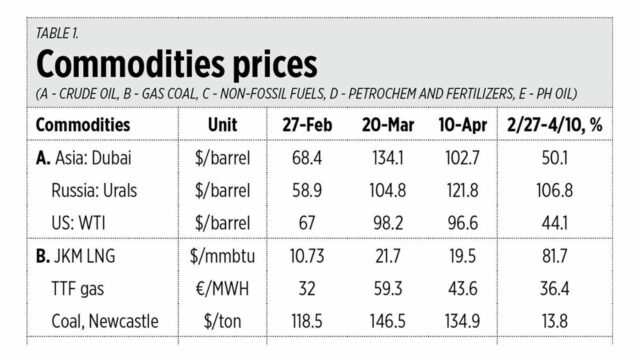
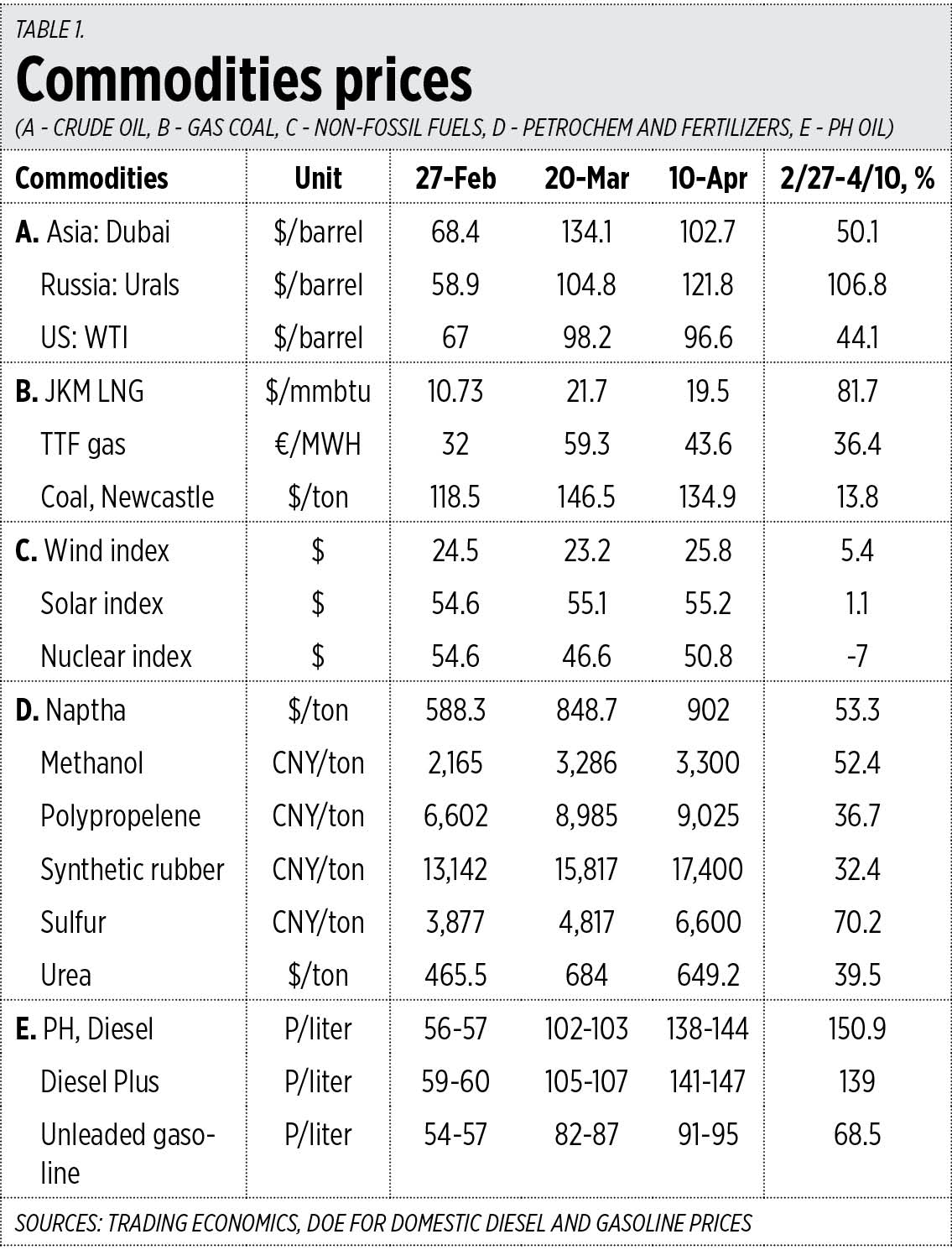
Here is an update of my weekly monitoring of “Trumpflation” because of the US and Israel’s irresponsible and prolonged war on Iran. The Strait of Hormuz was open until Feb. 27, the day before the US-Israel attacks. Let us look at some notable numbers, after six weeks of war, from Feb. 27 to April 10.

1. The price of Dubai crude is up by 50%, WTI or US oil is also up by 44%, meaning even the US is experiencing a tight oil supply. The biggest increase is Russia’s Urals oil which is up by 107%. Petron Philippines was forced to buy oil from Russia to help stabilize domestic oil supply.

2. The prices of imported liquefied natural gas (LNG) also jumped, with the Japan Korea Marker (JKM) up by 82%. Our big LNG power plants in Batangas, owned by LNGPH, will reflect these higher prices but the good news is that our LNG imports from the Gulf are small.

I chanced upon LNGPH President Yari Miralao, he said that “Only 7% of LNGPH’s cargoes since mid-2023 come from the Middle East. The remaining 93% are sourced from other regions. We remain vigilant in managing our supply portfolio and ensuring that fuel for our plants are secured in a timely, reliable, and predictable manner.”

3. Coal prices have increased by only 14%. Even many greenie Europeans are firing up their remaining coal plants and shedding plans of their early decommissioning.

4. The non-fossil fuels solar-wind index is up by only 1% and 5%, they are not attractive for many energy investors. The nuclear index even contracted by 7%.

5. The prices of industrial petrochem and fertilizer products remain high. Methanol is up by 52%, naptha by 53%, sulfur 70%, and urea 40%. Sulfur, phosphate, ammonia, and urea are important components of fertilizer production. Solar and wind power sources cannot produce naptha, methanol, sulfur, etc., only crude oil and natural gas can.

6. Our domestic diesel prices have jumped up by 151% while gasoline prices have increased by 68% (see Table 1). The reasons why the increases in domestic oil prices are higher than global crude oil prices include: a.) the Peso/$ depreciation, b.) higher shipping fees including insurance, and, c.) low or non-optimized local diesel storage facilities, among others.

Last week the Independent Electricity Market Operator of the Philippines (IEMOP) released the market operations at the Wholesale Electricity Spot Market (WESM) for March, to be reflected in the April electricity billing.

Power demand in March was 509 megawatts (MW) more than in February, while supply in March was 79 MW less than in February. The lower reserve margins led to the higher WESM price of P4.31 per kilowatt-hour (kWh) in March from P3.50/kWh in February.

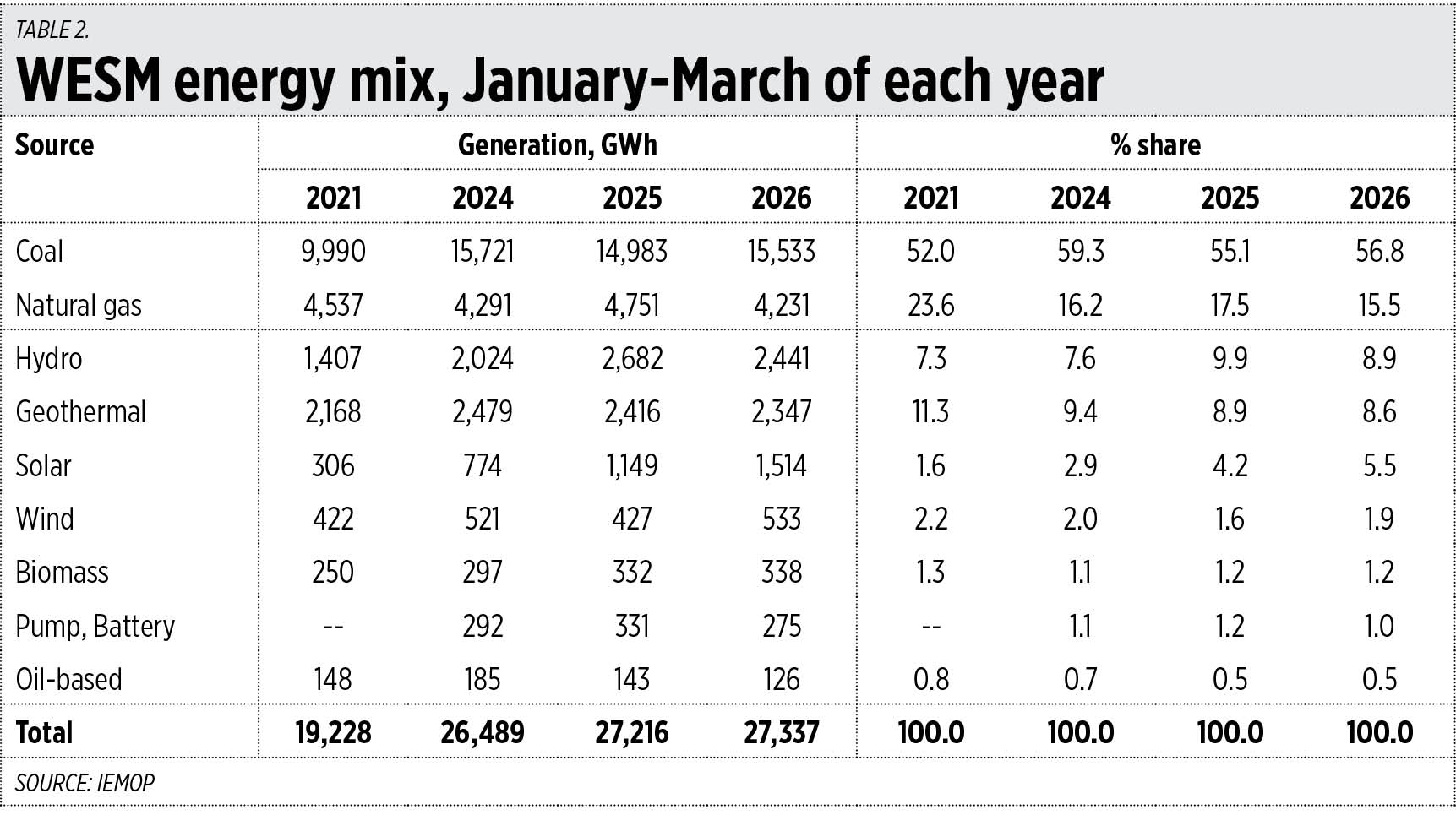
I checked the generation mix in the first quarter (January to March), then looked at data from 2021 onwards. Here is some of the evolution in our electricity sourcing.

1. For fossil fuels, the share of coal increased from 52% in 2021 to 59% in 2024, and decreased a little to 57% in 2026. The share of natural gas has been consistently declining, from 24% in 2021 to 15.5% in 2026.

2. For conventional and stable renewable energy sources, hydro power’s share has increased marginally from 7% in 2021 to 9% in 2026. Geothermal has seen a declining share, from 11% in 2021 to 9% in 2026.

3. For variable and unstable renewable energy sources, the share of solar has been rising, from 1.6% in 2021 to 5.5% in 2026, while wind’s share has marginally declined, from 2.2% in 2021 to 2% in 2026. Biomass’ share is flat at 1.2% (see Table 2).

Despite the constant demonization of coal by climate alarmists, coal is the most reliable and most affordable electricity source to avoid blackouts. By installed capacity, coal is only 40% of the total, but in actual electricity generation coal is 57% of the total.

The dirtiest energy for lighting is candles not coal. We need more coal, not less.

On hydro, I remember my tour last month of the Ambuklao hydro plant in Benguet, owned by SN-Aboitiz Power (SNAP), when I was toured by Ambuklao plant manager Hollis Fernandez. This was a day after PEPIF 2026 in Baguio. I was really amazed at how SNAP has significantly expanded Ambuklao’s capacity. It started out producing 75 MW of electricity when it was commissioned in 1956, then stopped operations in 1991 after the big earthquake. SNAP took over in 2007, rehabilitated and modernized it, and got 112.5 MW of power from it. Getting 37.5 MW more power while using the same reservoir and dam is a huge engineering innovation by SNAP.

As of this writing, the day before publication, WTI oil is $104.5/barrel, another jump from last Friday’s closing of $96.6/barrel. This comes after the US-Iran negotiation in Pakistan collapsed, meaning prolonged conflict and more Trumpflation.

One measure that the Department of Energy can explore is to raise our diesel storage by optimizing any underutilized storage facilities of private oil and LNG companies in the country.

I chatted briefly with Arnel Santos, the current COO of Meralco PowerGen (MGEN) Thermal and a former Shell executive for 25 years (starting in Shell Philippines, then moving to Shell Singapore, Malaysia, and Canada). He told me that “The Philippines does have significant storage, most of it sits within commercial terminals that are continuously used for operations… available working tank space for incremental volumes for specific products like diesel and in specific locations… Since we are in crisis all available storage should be leveraged. This is no different from suspending WESM and going on admin pricing.”

I hope that Energy Secretary Sharon Garin will consider this proposal, that the Energy department or the Philippine National Oil Co. rent those underutilized tanks at negotiated rates.


Bienvenido S. Oplas, Jr. is the president of Bienvenido S. Oplas, Jr. Research Consultancy Services, and Minimal Government Thinkers. He is an internationa fellow of the Tholos Foundation.

minimalgovernment@gmail.com

Chelsea Logistics and Infrastructure Holdings Corp. to hold Annual Meeting of Stockholders on May 12 via remote communication

NOTICE OF ANNUAL STOCKHOLDERS’ MEETING

Please take notice that the Annual Meeting of Stockholders of CHELSEA LOGISTICS AND INFRASTRUCTURE HOLDINGS CORP. will be held on Tuesday, May 12, 2026 at 11 A.M., via Remote Communication https://chelsealogistics-ph.zoom.us/j/86143659565?pwd=Gahfaln9zjdUS9Ykvv7fSi8ukGFc0v.1with the following:

AGENDA

1. Call to Order

2. Certification of Notice and Determination of Quorum

3. Report of the President & CEO for the Year 2025

4. Approval of the Minutes of the Annual Stockholders’ Meeting held on April 28, 2025

5. Ratification and confirmation of all acts and resolutions of the Board and Management executed in the normal course of business covering the period February 16, 2025 until February 15, 2026

6. Election of Members of the Board of Directors

7. Appointment of External Auditor

8. Other Matters

  • Amendment of the Employee Stock Option Plan, as Amended

9. Adjournment

Only stockholders of record as of April 20, 2026 are entitled to notice of, and to vote at, this meeting.

The Annual Stockholders’ Meeting on May 12, 2026 shall be conducted via remote communication.

Stockholders who intend to participate are required to register by sending an email, together with the requirements to ASM@chelsealogistics.ph on or before May 6, 2026, 5PM (Philippine Time). Full list of requirements may be viewed on the following linkhttps://www.chelsealogistics.ph/annual-stockholders-meeting/. The registration is subject to validation, and successful registrations will receive an electronic invitation via email, along with a complete guide on how to join, participate and vote in the Meeting.

Copies of the Notice of the Meeting, Definitive Information Statement and other related documents may be found on https://www.chelsealogistics.ph/annual-stockholders-meeting/ and through the PSE Edge Portal. Proxy Forms and Special Powers of Attorney or other Authorization forms are available on the Company’s website must be submitted to the Office of the Corporate Secretary, 18th Floor, Udenna Tower, Rizal Drive corner 4th Avenue, Bonifacio Global City, Taguig City by mail or sent by email to ASM@chelsealogistics.ph. Validation of proxies and registration shall commence on April 20, 2026 until 5 p.m. of May 6, 2026. Participation in the meeting as well as voting shall be through remote communication. Detailed Procedure for voting shall be posted on the Company’s website.

Stockholders may also send your queries regarding the conduct of the Meeting to ir@chelseashipping.ph.

Taguig City, 9 April 2026.


HENEDINA V. SAN JUAN
Corporate Secretary


Spotlight is BusinessWorld’s sponsored section that allows advertisers to amplify their brand and connect with BusinessWorld’s audience by publishing their stories on the BusinessWorld Web site. For more information, send an email to online@bworldonline.com.

Join us on Viber at https://bit.ly/3hv6bLA to get more updates and subscribe to BusinessWorld’s titles and get exclusive content through www.bworld-x.com.

Entertainment News (04/14/26)


Free film screenings for Food Month

A RICH collection of films which explore the concept of food as art, ecstasy, and power will be screened for free this April. This is an initiative by MCADxMoving Image, a program of the Museum of Contemporary Art and Design of the De La Salle-College of Saint Benilde. The selection was curated by Sam Marcelo, the head of publications of MCAD. First is Babette’s Feast (1987), a romcom by Danish film director and actor Gabriel Axel, which will be screened on April 22. Next is Japanese comedy Tampopo (1985) by actor and screenwriter Jûzô Itami, on April 23. Finally, there’s the romantic drama Like Water for Chocolate (1992) by Mexican filmmaker and actor Alfonso Arau, on April 24. MCADxMoving Image is free and open to the public. It is held at noon on the scheduled dates at the 5th floor auditorium of the Benilde Taft Campus Duerr Hall along Taft Ave., Malate, Manila. Interested participants may register through tinyurl.com/MCADxMovingImageAprilScreening.


Cup of Joe headlines Tang Refreshing Rave in La Union

ON April 17, Tang is bringing a new beach experience to La Union with Tang Refreshing Rave, a free event set along the shores of San Juan town and headlined by Cup of Joe. The event features live performances, free-flowing Tang mixes, and interactive activities. There will also be a special meet-and-greet with the band on April 17 at San Juan Beach Front, in front of Laud Lounge and Monaliza Surf Resort. Gates open at 3 p.m.


BINI debuts at Coachella Festival

P-POP girl group BINI took to the Coachella Valley Music and Arts Festival stage on April 11, marking a landmark moment for OPM on the global stage. Their fans, called Blooms, showed their support by joining watch parties across Metro Manila and nearby cities, arranged by the fan group BLOOM Philippines. The group performed 10 songs during their 45-minute set at the Mojave stage of the festival in Indio, California, that drew music fans from all over the world. BINI’s performance can be watched on the Coachella YouTube channel. BINI will return to the Coachella stage on April 18.


Viki drops two Korean titles

FROM anonymous love texts to a decades-old murder mystery, Rakuten Viki is lining up two Korean titles this April. One is Heart Signal 5, back after a three-year hiatus. It is a slow-burn romance and interactive guessing game. Meanwhile, new crime thriller The Scarecrow, inspired by a real-life case, dives into a tense investigation led by Squid Game’s Park Hae-soo. Both titles highlight Viki’s push to expand beyond traditional dramas, offering a mix of reality and high-stakes storytelling. Heart Signal 5 premieres on April 16, followed by The Scarecrow on April 20. Both will be available on Viki across Southeast Asia, the Americas, Oceania, the Middle East, and India.


Music Travel Love adds CDO tour stop

THE Philippine tour of Music Travel Love has added an additional stop at The Atrium, Limketkai Center, in Cagayan de Oro (CDO) City on June 26. This new show joins their previously announced performances in Cebu on June 27 at the Waterfront Cebu City Hotel & Casino, and in Manila on June 28 at the New Frontier Theater, Araneta Center, Quezon City. Music Travel Love is composed of Bob and Clint Moffatt, a Canadian brother duo who have been performing from the age of four with over 6,000 live performances. Tickets for the Cagayan de Oro show will go on sale starting April 14, noon, with tickets ranging in price from P850 to P4,790.


5-week screenwriting workshop for beginners

THIS SUMMER, The Mad Goats Inc. (TMGI) — a creative partnership between filmmakers Katski Flores and Michiko Yamamoto — is launching “The Mad Goats WIP Series: Screenwriting for Beginners,” a five-week program designed to guide aspiring writers from concept to a fully developed, pitch-ready project. Opening in May, it is a hands-on program over five consecutive Saturdays, each session running for four hours. Unlike traditional lecture-based workshops, WIP is designed as a working lab where participants will be actively developing their own material throughout the course. Slots are limited, and interested participants may inquire and reserve their seats via the sign-up sheet on the website, www.themadgoats.com, or e-mail admin@themadgoats.com for details.


Pinoy short film on disinformation competes in Italy

OUT OF over 1,800 global entries, Richard Soriano Legaspi’s short film Panulukan (Crossroads) was recently selected to compete at the Grifo International Film Festival in Italy. The film, which tackles themes of disinformation and the Duterte administration’s war on drugs, was screened at the Teatro Comunale Tullio Giacconi in the town of Chiaravalle, in the province of Ancona, Italy. It follows four strangers traveling home to Manila who discover they are on entirely opposed paths. Two are paid trolls defending the state’s brutal campaign, while the other two are staunch critics of the violence. The film was developed as a competitive grant recipient of EngageMedia’s Tech Tales: Films about Digital Rights in the Asia-Pacific in 2021.


Mark Carpio releases new EP

OPM SINGER Mark Carpio has dropped his new EP, Huling Pag-ibig, released under EMPIRE.PH Music and ONErpm. A milestone in his 10-year career, the four-track EP weaves themes of love, loss, and emotional closure into one cohesive package. The title track, produced by RJ Pineda, draws inspiration from Adele’s sweeping ballads but is reimagined through a distinctly Filipino lens. “Ayaw Mo Na,” co-written with Ethan Loukas, taps into a more organic folk direction. The focus track, “Paalam Na,” produced by Line In Productions’ Nikhil Amarnani, has more alternative pop/rock sensibilities. Huling Pag-ibig is out now on all digital music streaming platforms.


Bicolana rapper XYVRL releases remix

BICOLANA rapper XYVRL has dropped “Scottie T (Remix),” featuring Ivo Impreso of PLAYERTWO. Building on her earlier single “Scottie T,” the remix elevates the original’s competitive energy with a harder edge and a wider perspective, built on sharp hip-hop production and basketball-inspired wordplay. “Scottie T (Remix)” by XYVRL featuring Ivo Impreso is now streaming on all major digital platforms.


John Rex drops new single

KAPUSO pop singer and The Clash Season 5 Grand Champion John Rex is back in the spotlight with a revival of the hit ballad “Umaasa Pa Rin” under GMA Music. Originally a rock-infused track by The Mike Bon Gang and the theme song for the Philippine TV airing of the Koreanovela Reply 1997 on GMA, “Umaasa Pa Rin” has transformed to showcase Mr. Rex’s signature vocals, trading the original’s grit for a slower, more emotional ballad arrangement. “Umaasa Pa Rin” is now available on digital platforms worldwide.