Home Blog Page 838

itel launches SUPER 26 ULTRA, powered by UNISOC T7300, delivering flagship-level performance

itel, a leading global tech empowerment brand, has officially announced the launch of its itel SUPER 26 ULTRA, designed for style, strength, and intelligence, which will be available at the price under US$200 in Nigeria, Indoensia, Bangladesh, Pakistan and other key global markets.

The itel SUPER 26 ULTRA delivers premium curved AMOLED display, high-quality IP65 durability, and smart AI interaction, all at a price point that makes these strong features accessible to millions. Powered by the advanced UNISOC T7300 6nm processor, it offers unmatched fluency, superior gaming, and a 6-Year Fluency Guarantee to users worldwide.

Ultra Performance

At the heart of the itel SUPER 26 ULTRA lies the UNISOC T7300 chipset, delivering power efficiency and speed. With 2× Cortex-A78 performance cores and world-leading scores of over 510,000 on AnTuTu, the T7300 ensures smooth multitasking, faster app launches, and fluid user experiences.

The UNISOC T7300 also introduces the industry’s first 6-Year Fluency Guarantee, meaning users can rely on sustained performance over time — a promise rarely seen in this category. Whether streaming, browsing, or working, the itel SUPER 26 ULTRA ensures consistent responsiveness that lasts.

Stunning Ultra Display

The device is equipped with a 6.78-inch 3D-curved AMOLED display, featuring a 144Hz refresh rate, 1.5K resolution, and up to 4500 nits brightness — the brightest in its class. With Corning® Gorilla® Glass 7i protection and support for HDR10+, the display offers cinema-grade visuals with durability and clarity, even under direct sunlight.

UNISOC Miracle Gaming

Powered by the UNISOC Miracle Gaming Engine and reinforced with 10-Layer IceCool Cooling Technology, the SUPER 26 ULTRA delivers an exceptionally immersive gaming experience. This combination ensures smooth frame rates certified for titles like PUBG, ultra-fast touch response for precise control, and SDR-to-HDR visual enhancement for richer colors, sharper details, and clearer in-game scenes. At the same time, the Comfort System keeps the device temperature below 43°C even during intense play, allowing gamers to enjoy extended sessions without overheating. With this balance of power, speed, and thermal stability, the SUPER 26 ULTRA is the smart choice for mobile gamers at a highly competitive price.

Ultra Imaging and Advanced AI for Everyone

The SUPER 26 ULTRA boasts a 32MP front camera and a 50MP stabilized rear camera, enhanced by itel’s MASTER AI Imaging Engine 2.0 for crystal-clear snapshots in all lighting conditions. Exclusive features like XDR video recording and creative AI tools enable users to capture and edit content effortlessly.

In addition, powered by the UNISOC T7300, the SUPER 26 ULTRA introduces “Hi Sola” — an upgraded AI assistant — offering nearly 80% of efficient AI functionalities at a fraction of the cost. From AI imaging and real-time translation to voice assistance and creative editing, the device makes smart technology accessible to all.

Slim Design with All-Day Power and Smarter Connectivity

Despite its 6000mAh high-capacity battery, the SUPER 26 ULTRA maintains a remarkably slim 6.8-mm body, ensuring comfort without compromise. Users can enjoy extended battery life with the elegance of a lightweight design.

The device also supports NFC Touch Transfer for instant file sharing and UltraLink Free Call, enabling phone-to-phone voice and text communication even without network coverage — expanding connectivity beyond conventional limits.

With its blend of sleek design, exceptional rugged build quality, stable performance equipping UNISOC T7300 6nm processor, along with practical AI, itel Super 26 Ultra truly refine the value in budget-friendly smartphone, poised to become the new benchmark. For more information please visit: https://www.itel-life.com/.

About UNISOC

UNISOC is a global leader in chip design with over 20 years of expertise in the communications semiconductor industry. With a broad market presence spanning mobile phones, AIoT, automotive electronics, and other sectors, UNISOC empowers billions of users worldwide with smart connectivity. The company is dedicated to fostering shared growth with global customers, industries, and society, Innovating for a Better World.

About itel

Established over 15 years, itel is a Technology Empowerment Brand for masses. Adopting “Enjoy better life” as its brand philosophy, itel’s mission is to provide budget-friendly consumer electronic products to emerging markets consumers. In 2025, itel has expanded its presence in more than 80 emerging markets globally, including SSA, Southeast Asia, South Asia, Middle East and Latin American. itel has a product portfolio of smartphones, electronics accessories, home appliances, and lifestyle products. In 2024, it ranked No. 1 Global Smartphone brand under $75 and No. 1 feature phone brand.


Spotlight is BusinessWorld’s sponsored section that allows advertisers to amplify their brand and connect with BusinessWorld’s audience by publishing their stories on the BusinessWorld Web site. For more information, send an email to online@bworldonline.com.

Join us on Viber at https://bit.ly/3hv6bLA to get more updates and subscribe to BusinessWorld’s titles and get exclusive content through www.bworld-x.com.

Philippines likely to hit low-end of 2025 GDP target – Balisacan

PHILIPPINE STAR/EDD GUMBAN

Department of Economy, Planning, and Development (DEPDev) Secretary Arsenio M. Balisacan said he is confident Philippine economic growth will hit the lower end of the target this year, despite a slowdown in the third quarter.

“The growth that we are expecting for 2025 is now 5.5 to 6.5% The low-end of the range is still very much achievable,” he told reporters on the sidelines of an event on Oct. 16.

Economic managers will meet next week to assess whether revisions to this year’s growth outlook are needed, he added.

Budget Secretary and Development Budget Coordination Committee (DBCC) Chairperson Amenah F. Pangandaman on Wednesday told BusinessWorld that the gross domestic product (GDP) target for 2025 “remains attainable.”

Finance Secretary Ralph G. Recto earlier said flagged a slowdown in the third quarter and possibly until early 2026 as corruption probes curb public spending.

Aside from slower public spending, Mr. Balisacan said weather disruptions may have dampened economic activity in the July-September period.

“There may be a bit of a slowdown (in third quarter) because of these supply shocks that we have seen. There are so many typhoons that we have seen during the quarter, many days of work suspension. So economic activity is really affected,” he said.

Asked whether third quarter growth could fall below the 5.5% annual GDP growth in the second quarter, Mr. Balisacan said: “Hopefully not.”

However, he noted third quarter growth could have been slower than initially expected earlier this year.

Mr. Balisacan said fourth quarter growth is usually good as consumers spend more during the holidays.

The DepDEV official said the investment component of GDP may have been subdued in the third quarter and may continue to be muted in the coming months amid higher tariffs.

Mr. Balisacan also warned that recent corruption scandals may weigh on investor and consumer confidence, but the impact will likely be short-lived.

Despite these headwinds, Mr. Balisacan said seeing signs of relief, with easing inflation and lower interest rates.

“The effects of falling interest rates months earlier are of course beginning to be felt now because there are usually lagged effects of interest rate changes and investment and consumption decisions,” he said.

The Bangko Sentral ng Pilipinas has cut policy rates by a cumulative 175 basis points (bps) since its easing cycle started in August 2024. Last week, the BSP cut its benchmark rate by 25 bps to 4.75%, and left the door open to further policy easing.

For 2026, Mr. Balisacan said the 6% to 7% GDP growth target remains in place but “things are evolving quite rapidly.”

“We hope that there will be greater clarity and less uncertainty in the coming years,” he said, adding US tariff policy is a major source of uncertainty.

In the same interview, Mr. Balisacan cautioned lawmakers against proposals to grant tax holidays and reduce the value-added tax (VAT), citing that any measures that erode revenues should be “avoided.”

“What we should do is to strengthen and improve the enforcement, implementation of our tax measures to ensure that we’ll achieve the medium-term fiscal framework,” he said.

“Because… not only the credit rating agencies but the investors, domestic and foreign, are watching.”

Several bills have been filed in Congress seeking to either scrap or reduce the VAT rate, and offer a one-month income tax break, amid billion-peso flood control mess. – Aubrey Rose A. Inosante

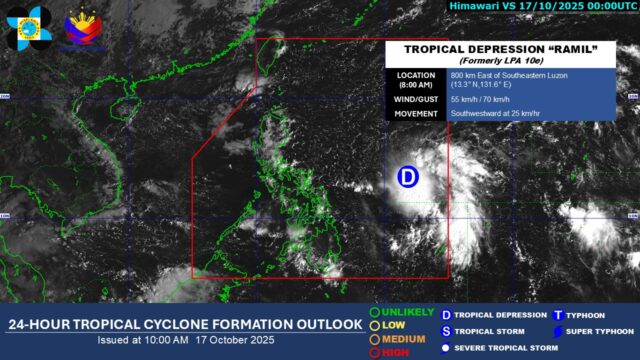
Tropical Depression Ramil develops, may hit Luzon by Sunday

DOST-PAGASA FB PAGE

The low-pressure area located off the c ountry’s eastern coast has developed into Tropical Depression Ramil on Friday and is expected to make landfall on Sunday in Aurora or Quezon Province, the state weather bureau said.

“Its effect is not yet felt in any part of the country,” Grace Castañeda, weather specialist of Philippine Atmospheric Geophysical and Astronomical Services Administration (PAGASA) said in a 5:00 a.m. media briefing.

“However, this afternoon, as Tropical Depression Ramil moves closer, its trough or extension may bring scattered rain over the eastern portions of Southern Luzon and the Visayas.”

Ramil, the second tropical cyclone this October, was located 1,145 kilometers east of southeastern Luzon, moving west-northwestward at a slow pace.

It has a maximum sustained winds of 45 kilometers per hour (kph) near its eye, and gustiness of 55 kph.

During the forecast period, PAGASA has hoisted Tropical Cyclone Wind Signal No. 1 where strong winds are expected in more than a dozen areas in Luzon and the Visayas.

This covers areas, including the easternmost portion of Quezon, Camarines Norte, Catanduanes, Camarines Sur, Albay, and the northern and eastern portions of Sorsogon.

In the Visayas, it was likewise in effect over the eastern portion of Northern Samar, the state weather bureau said.

PAGASA also issued a heavy rainfall outlook, with 50 to 100 millimeters of rain expected on Saturday over Quezon, Camarines Norte, Camarines Sur, Catanduanes, Albay, Sorsogon, and Northern Samar.

The same amount of rainfall is also expected on Sunday over Ilocos Norte, Ilocos Sur, La Union, Apayao, Abra, Kalinga, Mountain Province, Ifugao, Benguet, Cagayan, Isabela, Quirino, Nueva Vizcaya, Aurora, and Quezon Province.

PAGASA said Tropical Depression Ramil is expected to continue intensifying over the Philippine Sea and may reach tropical storm category by early Saturday. — Edg Adrian A. Eva

US prosecutors charge voting tech company Smartmatic in alleged bribery scheme

Voting technology company Smartmatic was charged in US federal court in Florida on Thursday with money laundering and other crimes, in an alleged foreign bribery conspiracy involving three of its former executives to secure business in the Philippines.

Federal prosecutors named Smartmatic parent SGO Corp as a defendant in the ongoing criminal prosecution filed in 2024 against three former executives for their alleged roles in the scheme.

Prosecutors have alleged the executives funneled $1 million in bribes between 2015 and 2018 to a former Philippine election official, also a defendant, to obtain business.

Smartmatic in a statement on Thursday called the charges “wrong on the facts and wrong on the law.” The company said it will contest the claims, and was confident it will prevail.
“We believe the US Attorney’s Office for the Southern District of Florida has been misled and politically influenced by powerful interests, despite our extensive cooperation with the government,” Smartmatic said. “This is again, targeted, political, and unjust.”

Federal prosecutors in Miami did not immediately respond to a request for comment.

Smartmatic’s president and co-founder, Roger Alejandro Pinate Martinez, and others charged have pleaded not guilty. Pinate has called the indictment legally deficient and asked a court to dismiss it.

Prosecutors said the bribes were paid through a slush fund created by over-invoicing voting machine costs for the 2016 Philippine elections and then disguised in financial documents using coded language.

The indictment comes as Smartmatic is suing Fox Corp and commentators for $2.7 billion damages for allegedly defaming it with false claims that its machines rigged the 2020 US presidential election.

Fox has denied the allegations, saying its coverage of newsworthy allegations against Smartmatic was fair and protected by the First Amendment of the US Constitution. — Reuters

Hospital for the poor receives dialysis machine from Mikee Romero

Our Lady of Peace Hospital (OLPH) in Parañaque formally received the donation for a brand-new hemodialysis machine from former Deputy House Speaker and businessman Michael “Mikee” Romero in partnership with the World Surgical Foundation Philippines (WSFP).
 
Mr. Romero’s donation comes in the heels of a recent assistance for the supply of vital medical diagnostic materials and equipment for far-flung Tawi-Tawi hospitals. Mr. Romero personally visited Mapun and Taganak islands, the most far-flung and southernmost of the Philippine archipelago.
 
The dialysis machine for the Parañaque hospital and other life-saving equipment are for treatment of indigent patients for who was built the hospital through the efforts of the surgeon-nun Sister Eva Maamo, who is now chairman emeritus of the Foundation for the Our Lady of Peace Missions, Inc. (FOLPMI).
 
It will be a cornerstone of OLPH’s Hemodialysis Center for the Poor, which will implement a no-balance-billing policy to ensure free dialysis sessions for marginalized Filipinos.
 
The donation comes amid a surge in dialysis cases nationwide. The National Kidney and Transplant Institute (NKTI) has reported a 22% rise in patients undergoing dialysis from 2023 to 2024, including an alarming increase in younger individuals. On average, one Filipino dies every hour due to kidney failure.
 
OLPH coordinates with the WSFP for its initiatives to enhance its capacity to serve indigent communities.
 
Mr. Romero’s donation also strengthens the WSFP’s Adopt-a-Hospital Program, which helps capacitate partner hospitals to deliver affordable and quality healthcare.

Founded by Sister Eva Maamo, a surgeon and Ramon Magsaysay Awardee, OLPH has long been known as a “hospital for the poor.” Through the Foundation of the Our Lady for Peace Mission, Inc. has provided medical and surgical care to underserved populations for decades and has been a consistent partner in humanitarian and community development work.
 
Mr. Romero and his family have been long-time supporters of Sister Eva’s initiatives, extending aid to both the hospital and its outreach missions.
 
Among these efforts is sustained assistance to the Aeta community at Sitio Gala in Subic, Zambales, where the foundation operates a livelihood, feeding, and educational program.
 
Years ago, Mr. Romero surprised the Aetas by bringing his PBA team, the Batang Pier, to the village — an event that gave the indigenous community a rare chance to connect with professional athletes while also highlighting the importance of inclusion and support for marginalized groups.
 
The professional basketball players immersed themselves in the local Aeta culture and saw firsthand the plight of their indigenous countrymen. A number of the Batang Pier players also committed a portion of their earnings to the Aeta community through the FOLPMI.
 
Beyond Subic, Mr. Romero has made health, education, and poverty alleviation central to his public service in the total of nine years he served as a three-term congressman and former Deputy Speaker of the House.
 
Ending his tenure as congressman last June, he continues to render civic assistance and leadership as chairman of the Association of Reservist and Reservist Administrator of the Philippines.
 
Last week, Mr. Romero traveled from the northernmost part of the Philippines, the Mavulis Island in Batanes, to the southernmost part of the country, Taganak island in Tawi-Tawi, to strengthen medical assistance to underserved parts of the country in coordination with the Western Mindanao Command.
 
Hospitals serving remote Mapun and Taganak islands received donations for vital medical diagnostic supplies and facilities. Lying far out as the southernmost Philippine island in Sulu Sea, Taganak is already 20 minutes by boat to Sabah, Malaysia.
 
Mr. Romero continues to travel around the Philippines, extending assistance as part of his personal outreach. He has also recently donated for the rebuilding of a burned-down hospital in Basco, Batanes and for the building of a fully-covered community multi-purpose center and basketball court in Mariki, Zamboanga City, a community that has seen devastating conflict.
 
Sister Eva Maamo was joined by OLPH Administrator Eidelbert Santiago, representing Dr. Lester Suntay, FOLPMI vice-president and WSFP CEO; Nilo Quinte, FOLPMI executive director; and Madeline Garcia, also of FOLPMI, in accepting Mr. Romero’s donation during signing rites.


Spotlight is BusinessWorld’s sponsored section that allows advertisers to amplify their brand and connect with BusinessWorld’s audience by publishing their stories on the BusinessWorld Web site. For more information, send an email to online@bworldonline.com.

Join us on Viber at https://bit.ly/3hv6bLA to get more updates and subscribe to BusinessWorld’s titles and get exclusive content through www.bworld-x.com.
Promising catalysts and icons make up Puregold CinePanalo 2026 Top 15 full-length films

Puregold CinePanalo 2026 has released their official Top 15 short list for the festival’s full-length category. The select entries come from the country’s most driven directors who range from emerging voices in the field to eminent visionaries of the industry. The diversity and quality of the lineup assure cineastes that this will be the most competitive and exciting year of the Puregold CinePanalo yet.

From the list of 15, only seven filmmakers will be selected, each of whom will receive P5 million — the highest production grant in Philippine film festival history.

The Top 15 full-length films for the 2026 Puregold CinePanalo are:

Puregold’s Senior Marketing Manager and Festival Chair Ivy Hayagan-Piedad spoke on what the Top 15 lineup means for the festival as a whole. “The 2026 Puregold CinePanalo lineup is a revelation to us at the festival. Only three years in, we’ve earned the attention and trust of some of the country’s most important filmmakers,” said Ms. Hayagan-Piedad. “We are indebted to all the participants who entrusted their best-kept stories to us. We are humbled and extremely excited to make these dream projects a panalo reality.”

Puregold CinePanalo has undeniably developed a reputation for producing internationally acclaimed films. This includes Kurt Soberano’s Under a Piaya Moon, Sigrid Bernardo’s Pushcart Tales, TM Malones’ Salum, JP Habac’s Olsen’s Day, and many more, which have received recognition in Pakistan, Morocco, Singapore, and the United States, among others. Today, the record-breaking production grant and the global prestige achieved by the festival’s past films have enticed even more directors to participate in the biggest Puregold CinePanalo yet.

The Top 15 filmmakers will face one more round of selection before the announcement of the official festival lineup. The short-listed filmmakers will pitch directly to the festival’s selection committee, which will have the difficult task of curating a final list of seven that will move on to the production phase.

The selected full-length films will screen at the 2026 Puregold CinePanalo Film Festival at the Gateway Cineplex 18 on Aug. 7 to 18, 2026.

Meanwhile, applications for the Puregold CinePanalo’s student shorts category continue. Interested applicants may still submit their dream projects to https://tinyurl.com/PCPFFShorts before 11:59 p.m. on Nov. 25, 2025.

For further inquiries, applicants may email thesecretariat@cinepanalo.com or message its official Facebook page @puregoldcinepanalo.


Spotlight is BusinessWorld’s sponsored section that allows advertisers to amplify their brand and connect with BusinessWorld’s audience by publishing their stories on the BusinessWorld Web site. For more information, send an email to online@bworldonline.com.

Join us on Viber at https://bit.ly/3hv6bLA to get more updates and subscribe to BusinessWorld’s titles and get exclusive content through www.bworld-x.com.

One dead, dozens injured as Peru’s new president faces widespread protests

FREEPIK

LIMA — At least one person was killed and dozens of police officers injured in widespread protests overnight in Peru against President Jose Jeri, who assumed power just days ago, the state ombudsman’s office said on Thursday.

The protest on Wednesday night, called by young Gen Z protesters, transport workers and civil groups, was the latest in a series of demonstrations against corruption and rising crime, which led to the dramatic midnight ouster of former President Dina Boluarte last Thursday.

Thousands of protesters amassed around the country, with hundreds clashing with police outside Congress in Lima. Police fired tear gas while some protesters hurled fireworks, rocks and burning objects.

“Everyone must go!” protesters chanted when they reached Congress and tried to tear down metal barriers protecting the building, leading to clashes.

A 32-year-old man, Eduardo Mauricio Ruiz, was killed during the protest and his death will be investigated, said Fernando Losada, a representative from the country’s Ombudsman’s office.

Peru’s prosecutor’s office said Ruiz died after being shot.

Later on Thursday, the head of Peru’s national police (PNP), Oscar Arriola told reporters that Luis Magallanes, a member of the PNP, had been physically assaulted and carried out the shooting. Arriola added that the Magallanes was being treated at the hospital and had been removed from his duties.

Jeri expressed regret over the death in a post on X, saying the death would be “objectively” investigated. He blamed violence on “delinquents who infiltrated a peaceful demonstration to sow chaos.”

“The full force of the law will be on them,” he wrote.

After attending a meeting about the protests at Congress Thursday afternoon, Jeri told reporters he would ask Congress for “authority to legislate on public safety issues.”

Jeri said one focus would be prison reform, but did not elaborate on what those powers would entail.

Speaking to Congress soon after, newly appointed Interior Minister Vicente Tiburcio, said the government would push for comprehensive reform to the national police, adding that 89 police and 22 civilians had been injured during the protest and 11 people were detained.

The interior ministry did not immediately respond to a request for comment on the police reform or Jeri’s request for expanded legislative powers.

Wednesday’s protests were a bellwether for how Jeri’s short-lived presidency, which ends next July due to scheduled elections, could play out.

Jeri, 38, has promised to make crime his top priority, but has faced a number of scandals himself, including corruption allegations and a now-shelved investigation for sexual assault. Jeri has denied wrongdoing in both cases and expressed willingness to cooperate with any corruption investigation.

Boluarte faced widespread protests after she assumed power in late 2022, leading to dozens of deaths and a plunge in her popularity levels, which oscillated between 2% and 4% in the days leading up to her ouster.

Congress – which was headed by Jeri before he became president – is almost equally unpopular with a single-digit approval rating.— Reuters

Venezuela asks UN Security Council to say US strikes illegal

VENEZUELAN FLAG flutters outside the Torrejon de Ardoz Air Force Base outside Madrid, Spain, Sept. 8, 2024. — REUTERS

UNITED NATIONS — Venezuela has asked the United Nations Security Council to determine that deadly US strikes on vessels off its coast are illegal and issue a statement backing Venezuela’s sovereignty, according to a letter seen by Reuters on Thursday.

US President Donald Trump has ordered a large US military buildup in the southern Caribbean, and the troops have conducted at least five strikes on vessels the Trump administration has described as involved in drug trafficking, without providing evidence.

In a letter to the 15-member Security Council, dated Wednesday, Venezuela’s UN Ambassador Samuel Moncada accused Washington of killing at least 27 people in the strikes on “civilian vessels transiting international waters.”

He asked the council to “investigate” the strikes to “determine their illegal nature” and issue a statement “reaffirming the principle of unrestricted respect for the sovereignty, political independence, and territorial integrity of states,” including Venezuela.

In Caracas, Venezuelan President Nicolas Maduro said that while the CIA has long been linked to coups around the world, no previous government had publicly stated it ordered the CIA to “kill, overthrow, and destroy countries.”

Maduro accused the CIA of being authorized to conduct operations aimed against the peace of Venezuela.

“But our people are clear, united, and aware. They have the means to once again defeat this open conspiracy against the peace and stability of Venezuela,” the president said during an event broadcast on state television.

US HOLDS VETO POWER
However, the Security Council will be unable to take any action beyond holding meetings on the situation because the United States holds veto power. The council met for the first time last week over the tensions at the request of Venezuela, Russia, and China.

At that meeting, the United States justified its actions as consistent with Article 51 of the founding UN Charter, which requires the Security Council to be immediately informed of any action states take in self-defense against armed attack.

US Ambassador to the UN Mike Waltz said on Thursday Trump would use the intelligence community, the defense department, and diplomacy “to defend US sovereignty against actions that are actively killing Americans.”

“Venezuela can bring whatever they want to the UN. You know what’s also part of the UN is Article 51 of the UN Charter that enables a country to defend itself. And that’s what President Trump’s doing and is going to do,” he told Fox News.— Reuters

LRMC continues to support students’ English literacy

LRMC volunteer employees administering a pre-test to students of Baclaran Elementary School Central as part of the English literacy support program. - PR PHOTO

Light Rail Manila Corp. (LRMC), in partnership with Binhi English Literacy Foundation, Inc., on Thursday said it will sponsor 25 students from Baclaran Elementary School Central for the 2025-2026 school year to help improve their English literacy.  

 “We believe that a strong foundation in literacy is a building block for a brighter future,” LRMC Health, Safety, Environment, and Quality (HSEQ) Department Head Jason N. Magdaong said in a statement. 

 “By continuing our partnership with Binhi, we are not only helping these young students improve their reading skills but also empowering them to reach their full potential. This is our way of contributing to a more literate and prosperous nation,” he added.  

 In the 2024 edition of the English Proficiency Index (EPI) by international education company Education First (EF), the Philippines ranked 22nd out of 116 countries, two spots lower than a year earlier.  

 The country scored 570 out of 800, earning a “high” proficiency rating, which indicates Filipinos have sufficient English skills to give workplace presentations, understand TV shows, and read newspapers. 

 The Philippine Statistics Authority (PSA), in a separate report in July, revealed that more than one in five Filipinos aged 10 to 64 struggle to comprehend what they read despite being able to read, write, and compute. 

 The agency added that the basic literacy rate in the country stands at 93.1%, while the functional literacy rate is at 70.8%. 

 To equip the younger generation with strong foundations in English literacy, the LRMC noted that the partnership aims to help students aged five to eight in reading and comprehension.  

 Since its launch in School Year 2020-2021, the program has benefited over a hundred scholars. 

 The agency underscored that this initiative aligned with the United Nations Sustainable Development Goal (UN SDG) 4: Quality Education, which aims to ensure inclusive and equitable quality education and promote lifelong learning opportunities for all.  

 “LRMC’s support for the program is rooted in its dedication to the well-being of communities along the LRT-1 and its belief in the potential of Filipino children,” it said 

LRMC is a joint venture of Ayala Corp., Metro Pacific Light Rail Corp., and Macquarie Infrastructure Holdings (Philippines) Pte Ltd. Metro Pacific Light Rail is a unit of Metro Pacific Investments Corp., one of three Philippine subsidiaries of Hong Kong’s First Pacific Co. Ltd., the others being PLDT Inc. and Philex Mining Corp. 

 Hastings Holdings, Inc., a unit of PLDT Beneficial Trust Fund subsidiary MediaQuest Holdings, Inc., maintains an interest in BusinessWorld through the Philippine Star Group, which it controls.Almira Louise S. Martinez

Magnitude 6.2 quake jolts Surigao del Norte

PHIVOLCS-DOST FB PAGE

A magnitude 6.2 earthquake struck off the coast of Surigao del Norte on Friday morning and was felt in several areas, according to the Philippine Institute of Volcanology and Seismology (PHIVOLCS).

The tremor, tectonic in origin, occurred at 7:03 a.m., with its epicenter located 13 kilometers south of General Luna, Surigao del Norte at a depth of 10 kilometers.

It was felt at Intensity IV in Cabadbaran City, Agusan del Norte; Hinunangan, San Francisco, Hinundayan, and Silago in Southern Leyte; and Surigao City, Surigao del Norte, PHIVOLCS said.

PHIVOLCS also said that damage and aftershocks are expected following the event.— Edg Adrian A. Eva

Growth goal still ‘attainable’ — DBM

A vendor sells Halloween decorations at a market in Quezon City, Oct. 13. — PHILIPPINE STAR/ MIGUEL DE GUZMAN

By Aubrey Rose A. Inosante, Reporter

THE PHILIPPINE ECONOMY can still grow within the 5.5-6.5% target this year as spending is expected to “normalize” in the fourth quarter, Department of Budget and Management (DBM)Secretary Amenah F. Pangandaman said.

Ms. Pangandaman, who also chairs the Development Budget Coordination Committee (DBCC), said the gross domestic product (GDP) growth target of 5.5-6.5% for this year “remains attainable.”

“Spending is expected to catch up and normalize toward the latter part of the year,” she told BusinessWorld in a Viber message on Oct. 15.

“Momentary slowdown in public infrastructure spending is expected as agencies do due diligence, especially DPWH (Department of Public Works and Highways) as it reviews and evaluates its roster of projects,” she said.

Finance Secretary Ralph G. Recto earlier this week said economic growth likely cooled in the third quarter, adding that the slowdown may continue until early 2026 as heightened scrutiny over anomalous projects dampens government expenditure.

President Ferdinand R. Marcos, Jr. had flagged anomalous flood control projects during his State of the Nation Address in late July. This sparked several investigations into alleged corruption involving lawmakers, government officials, and private contractors.

Earlier, Economy Secretary Arsenio M. Balisacan said the DBCC will wait for third-quarter data to be released on Nov. 7 before revising growth targets.

However, he noted that achieving the full-year growth goal has “become harder” due to a likely slowdown in government spending.

In the first half, GDP growth averaged 5.4%, slower than 6.2% a year ago.

Ms. Pangandaman said the economic team remains “vigilant and proactive” in managing fiscal risks while staying aligned with the medium-term fiscal framework.

In June, the DBCC tempered its growth forecast to 5.5-6.5% for 2025 and 6-7% for 2026, mainly due to “heightened global uncertainties” arising from the Middle East conflict and US tariffs.

Ms. Pangandaman said the country’s growth momentum will be supported by key factors, including sound macroeconomic fundamentals, easing inflation, and a lower interest rate environment.

She also cited favorable credit and financial markets, stronger private sector momentum, and more efficient public spending as driving economic growth.

In a separate statement on Thursday, Mr. Recto said the economy is expected to post stronger economic growth ahead, citing improved governance and institutional reforms following the flood control mess.

“Growth is being supported by low inflation, easing policy rates, strong consumer spending, and a vibrant labor market,” he said.

Headline inflation averaged 1.7% in the first nine months of the year, matching the forecast of the Bangko Sentral ng Pilipinas.

John Paolo R. Rivera, a senior research fellow at the Philippine Institute for Development Studies, said the DBCC may need to revise its macroeconomic assumptions to reflect more realistic conditions amid persistent global headwinds, fragile consumer confidence, and fiscal constraints.

The economic managers should also prioritize targeted stimulus and institutional reforms to support resilience, he said.

“It will be challenging but not impossible, despite the third-quarter slowdown,” Mr. Rivera said in a Viber message on Thursday.

“Growth will depend on whether domestic consumption and investment rebound during the holiday season, if government spending accelerates, and if inflation remains within target,” he added.

Ser Percival K. Peña-Reyes, director of the Ateneo Center for Economic Research and Development, said the DBCC should revise its growth targets in light of the corruption scandal over flood control projects.

“Corruption scandals have had a chilling effect on investor sentiment,” he said in a Viber message on Thursday.

Mr. Peña-Reyes said the economy likely expanded by 5.6% in the third quarter, accelerating from 5.2% growth in the same period a year earlier.

For the full-year, growth will likely settle at 5.5%, matching the lower end of the government’s target range but slower than the revised 5.7% in 2024.

Foundation for Economic Freedom President Calixto V. Chikiamco said the Philippine economy’s performance is likely to “disappoint” this year given the headwinds facing the Philippines.

“The picture could be worse next year when the Trump tariffs start to bite and global slowdown occurs,” he said in a Viber message.

RECTO REJECTS VAT REDUCTION
In addition, Mr. Recto warned against some lawmakers’ proposals to lower the value-added tax (VAT) rate to 10%, saying this move could result in “massive revenue losses” and force the government to borrow to fund basic operations.

“The entire VAT collection for 2025 of P1.39 trillion can only fund nine months’ worth of payroll, premium, and pension of active and retired government workers,” said Mr. Recto, who authored the measure that hike the VAT rate in 2005.

Several lawmakers have filed bills seeking to either scrap or cut the 12% VAT rate. VAT collections account for about a fifth of the Bureau of Internal Revenue’s total revenues.

Mr. Recto said excise tax collections, projected at P576 billion this year, would not be enough to cover the P965-billion budget for basic, tertiary, and technical-vocational education programs.

Philippines faces skill gap as green economy push gains pace

By Patricia B. Mirasol, Multimedia Producer

BUSINESSES and policymakers face a widening gap between the demand for skilled labor and the workforce’s readiness to fill green jobs, as the Philippines accelerates its transition to a green economy.

Industry leaders and government officials warn that unless the country scales up training programs, the promise of economic growth from renewable energy, electric vehicles and sustainable construction could be undermined by the lack of qualified workers.

“Are we ready for these changes?” Francis A. Macatulad, program director at the Asia Society for Social Improvement and Sustainable Transformation (ASSIST), a nonprofit that promotes capacity-building and sustainable practices, told BusinessWorld in a virtual interview. “Unfortunately, we are not. We don’t have the technicians.”

His warning underscores a structural challenge for Southeast Asia’s second-most-populous nation.

As climate change reshapes economies worldwide, the Philippines is under pressure to retrofit aging infrastructure, decarbonize energy systems and adopt greener modes of transportation. But the country is still scrambling to align its workforce with those demands.

The World Economic Forum projects that green and energy-transition roles such as renewable energy engineers and electric vehicle specialists will be among the fastest-growing job categories in the coming years.

The International Labour Organization (ILO) estimates that the shift to a green economy could create 24 million jobs globally by 2030.

The Asia-Pacific region is particularly exposed, with 43% of its workforce considered vulnerable to climate-related shocks and the disruptions from decarbonization, according to the ILO. For the Philippines, where millions of workers remain in carbon-intensive or informal industries, the transition risks leaving many behind without targeted support.

Labor Undersecretary Carmela I. Torres said the government is working to balance the creation of green jobs with inevitable losses in traditional industries such as coal and fossil fuel-based transportation.

“The transition to a green economy should be just and inclusive, ensuring that workers in traditional industries are not left behind,” she said in an e-mailed reply to questions. “This aims to shift towards environmentally friendly practices while ensuring the creation of decent work opportunities and addressing social inequalities.”

Still, she acknowledged persistent challenges: gaps in training programs, limited funding, and the lack of awareness among workers and employers about opportunities in the green sector.

Some of the country’s biggest companies are trying to bridge the gap by embedding sustainability across their organizations.

Ayala Corp., one of the Philippines’ oldest business groups, ensures its sustainability agenda extends beyond dedicated teams.

“Our corporate strategy, business development, investor relations, and treasury teams, among others, are updated on the latest and most relevant thinking in sustainability to ensure that it is embedded into our long-term planning and investments,” Francisco R. Milan, Ayala’s chief human resources officer, said in an e-mailed reply to questions.

Ayala Land, Inc., the group’s property arm, hosts quarterly forums on topics such as decarbonization, regenerative design and water resource management. Globe Telecom, Inc., meanwhile, launched an online Sustainability Academy in 2021 to help its 8,000 employees adopt sustainable practices at home and at work.

“Across the group, sustainability and human resource teams are working closely to identify ways to more widely embed the value of sustainability among all employees,” Mr. Milan said.

The Aboitiz Group has also made sustainability central to its real estate and infrastructure ventures. Aboitiz InfraCapital, Inc.’s economic estates, including Lima Estate in Batangas, have earned a five-star Building for Ecologically Responsive Design Excellence (BERDE) district certification. It features a sustainability hub with a waste-to-eco brick facility, rainwater harvesting and compost-to-fertilizer systems.

“It’s about shifting how everyone in the organization thinks about placemaking and future-proofing for the new economy,” Monica L. Trajano, vice-president for business development at Aboitiz unit LIMA Land, Inc., told BusinessWorld in an interview.

“We must be able to integrate agility and innovation as we emphasize sustainability and best practices,” she added.

Working with urban planning consultants such as Singapore-based Surbana Jurong Pte Ltd., Aboitiz has identified specific workforce gaps in renewable energy and sustainable construction. “There is a skill gap in practical areas like installation, maintenance, repair and even the basic knowledge in sustainable construction,” Ms. Trajano said.

‘MINDSET SHIFT’
While infrastructure upgrades are critical, advocates stress that behavior change is just as important.

“Designing green is the easiest part,” Christopher C. de la Cruz, chief executive officer at the Philippine Green Building Council, said in an interview. “Staying green is the biggest problem.”

He noted that even the most energy-efficient systems are wasted if occupants use them improperly. “It’s a mindset shift.”

The council administers the BERDE green building rating system and partners with organizations such as the Philippine Business for Education to develop training programs. It also works with universities like the University of San Carlos in Cebu to update curricula so graduates are equipped with green skills from the outset.

Green jobs are for everyone — including janitors, messengers, and plumbers, Mr. De la Cruz said. “If you’re able to transition your work today into a cleaner kind of work that contributes [to mitigating] the climate crisis, then it’s a green job.”

Nonprofit groups are stepping in to address the training deficit. ASSIST, for example, works with technical-vocational associations in Mindanao and Metro Manila to give instructors updated training materials.

It has also established an advisory committee with the Technical Education and Skills Development Authority (TESDA) and chambers of commerce to identify skill gaps.

“We are upskilling the current tech-voc students, or in some cases reskilling technicians to be able to work with the new technologies,” Mr. Macatulad said.

The Philippines already has a legislative framework in place. The Green Jobs Act of 2016 seeks to identify skill needs, train and certify workers and provide financial support including tax deductions for green-skill programs.

The Labor department and TESDA have also issued a joint memo to strengthen career guidance and training alignment with industry needs.

“Efforts such as those by TESDA are crucial for developing a workforce capable of meeting these demands,” Ms. Torres said. “Both public and private sector investments are needed to support the development of a robust green job training ecosystem.”

For the private sector, investment in education is vital to long-term competitiveness.

“We recognize that no single institution or the private sector acting alone can produce the necessary talent at scale,” Mr. Milan said. Government investment in education is critical so Philippine schools can produce a workforce that supports the drive of industries for sustainability, he added.

Aboitiz’s Ms. Trajano called the skill gap both a challenge and an opportunity.

“Our biggest opportunity as a country is our labor force, and we really must focus on that, with the public and private sectors working together,” she said. “The skill gap is also our biggest opportunity in terms of influencing the quality of our educational institutions.”

As the Philippines braces for the impacts of climate change — rising sea levels, stronger typhoons, and disrupted agricultural cycles — building a workforce ready for the green economy has become more than an economic necessity.

The Philippines is in a race against time. “There are a lot of projects that will be coming on stream very soon, and they need technicians,” Mr. Macatulad said.

ADVERTISEMENT
ADVERTISEMENT