Home Blog Page 827

Meralco targets 1,500-km underground lines under capex plan

PHILIPPINE STAR/RYAN BALDEMOR

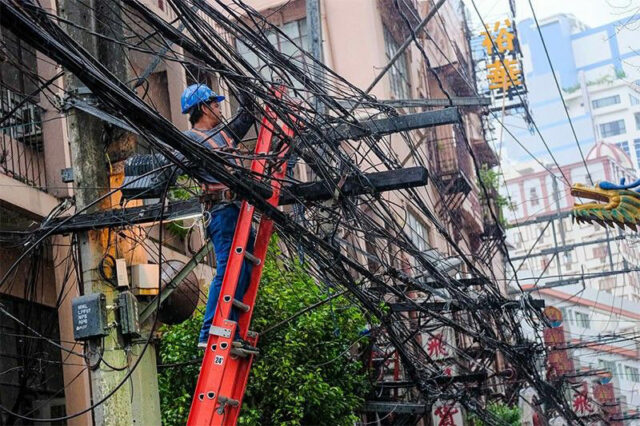
MANILA ELECTRIC CO. (Meralco) plans to install a 1,500-circuit-kilometer (km) underground cable system within its franchise area as part of its capital expenditure (capex) program through 2030 to improve power reliability and protect lines from weather-related disruptions.

The project will be implemented during the first regulatory period under the company’s multi-year capex program, Meralco First Vice-President and Head of Networks Froilan J. Savet told reporters last week.

The project will cover key areas such as financial districts, commercial centers, heritage sites, tourist destinations, and typhoon-prone zones.

At present, about 97% of Meralco’s cable network is still composed of overhead lines.

Existing underground lines are located in Bonifacio Global City in Taguig, SM Mall of Asia in Pasay, Rockwell Center in Makati, City Bridgetown on the Pasig-Quezon City border, Vertis North in Quezon City, and some parts of Pasay and Manila.

Mr. Savet noted that installing underground cables in brownfield areas is more complex due to existing structures and utilities.

“It can be done. It’s not impossible. But it’s a complex project. Doing it as a greenfield would really be better,” he said.

Underground lines are less prone to outages, although repairs can take longer when faults occur, he added.

Meralco is set to file its application for the first regulatory period covering 2027 to 2030 with the Energy Regulatory Commission by January next year.

The filing will include its forecast expenditures and proposed projects, which could result in rate adjustments.

Meralco’s controlling shareholder, Beacon Electric Asset Holdings, Inc., is partly owned by PLDT Inc. Hastings Holdings, Inc., a unit of PLDT Beneficial Trust Fund subsidiary MediaQuest Holdings, Inc., has an interest in BusinessWorld through the Philippine Star Group, which it controls. — Sheldeen Joy Talavera

Filipino student joins winners of 2025 FedEx/JA International Trade Challenge Asia-Pacific

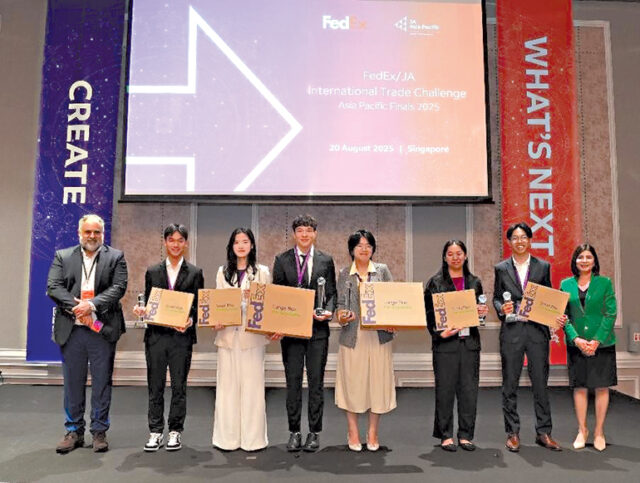
L-R: Maziar Sabet, president and CEO, JA Asia Pacific; the Top 3 winning teams; and Kawal Preet, president, Asia Pacific, FedEx

Federal Express Corp., one of the world’s largest express transportation companies, together with Junior Achievement (JA), announced the winners of the 2025 FedEx/JA International Trade Challenge Asia-Pacific finals in Singapore. Among the top six standout students were representatives from Vietnam, the Philippines, Hong Kong SAR, and Thailand.

This year’s competition attracted over 4,700 students from nine markets including Hong Kong SAR, Indonesia, Japan, Malaysia, Philippines, Republic of Korea, Singapore, Thailand, and Vietnam

A total of 54 students gathered in Singapore for the Asia-Pacific finals and were tasked to create a market entry strategy for an eco-friendly product that upcycles discarded textiles into sustainable consumer goods, with France being the target market. With growing discourse among consumers on how products affect the environment, and the role corporations can play in shaping a sustainable future, the challenge was particularly relevant. Students were paired into teams of two from different markets, to foster cross-cultural understanding. The student teams then pitched their idea to a panel of judges made up of Singapore’s leading entrepreneurs and small business owners.

“For nearly two decades, FedEx has proudly championed this program, empowering young entrepreneurs to think beyond borders and create solutions that address real-world challenges. In today’s interconnected economy, innovation goes hand in hand with building smarter, more resilient supply chains, and the next generation of business leaders will be at the forefront of this transformation. By fostering their creativity, determination, and global mindset, we’re investing in the future of commerce, one that is more connected, sustainable, and equipped to navigate the complexities of global trade,” said Kawal Preet, president, Asia Pacific, FedEx.

The first-place winners were Team Spicy Noodles, consisting of Jamie Smith from the Republic of Korea and Kathy Nguyen from Vietnam. They impressed the judges with their innovative concept of an eco-friendly upcycling brand that transforms discarded textiles into custom embroidered artwork.

The two runner-up teams were Team Innovement, composed of Janelle Anika S. Tan from the Philippines and Royden So from Hong Kong SAR, who developed a smart wall panel made from discarded textile waste; and Team ReTex, consisting of Panasarn Traithavil from Thailand and Lan Anh Phan from Vietnam, who proposed a new line of residential solar panels.

“The achievements of these young leaders from across Asia-Pacific show that the future of global trade and innovation is in capable hands. This year, we are especially proud to see a Filipino student excel alongside her peers from the region, proving that our youth have the ingenuity and determination to compete on a global stage,” said Maribeth Espinosa, managing director, FedEx Philippines.

“Each year, we’re always excited to witness students from different cultures converge and work together, a good indication of the future we can build, where young leaders will not only succeed in their own endeavors but also strengthen connections between nations and drive inclusive growth across the region.

The APAC winners will have an exclusive opportunity to deepen their understanding of global commerce by visiting FedEx operations facilities in their local markets and connecting directly with team members. This hands-on experience will offer invaluable insights into the complexities of global logistics and supply chain management, equipping them with practical knowledge to complement their entrepreneurial journeys.

The FedEx/JA International Trade Challenge program is jointly organized by FedEx and JA Asia Pacific, a member of JA Worldwide. In the last 19 years, over 50,000 students across Asia-Pacific have been introduced to the world of business, economics and international trade through this program which incorporates classroom learning and practical teamwork exercises. In addition to supporting young entrepreneurs through JA ITC, FedEx has been organizing the Small Business Grant Contest (SBGC) to support small and medium enterprises (SMEs) across Asia-Pacific.


SparkUp is BusinessWorld’s multimedia brand created to inform, inspire, and empower the Philippine startups; micro, small and medium enterprises (MSMEs); and future business leaders. This section will be published every other Monday. For pitches and releases about startups, e-mail to bmbeltran@bworldonline.com (cc: abconoza@bworldonline.com). Materials sent become BW property.

Kering nears sale of beauty unit to L’Oreal, sources say

MILAN/NEW YORK — French luxury group Kering, owner of fashion brand Gucci, is nearing a sale of its beauty division to L’Oreal, according to two people familiar with the situation.

One of the sources confirmed the deal would be worth around $4 billion, as per an earlier report by the Wall Street Journal, which was first to report the development.

L’Oreal, the world’s biggest dedicated cosmetics and beauty player, would acquire fragrance brand Creed and gain rights to develop beauty products tied to Kering’s fashion labels, including Bottega Veneta, Balenciaga, and McQueen, the WSJ reported, adding the deal could be announced this week.

Kering, controlled by the French Pinault family, launched its beauty division in 2023, the year it acquired high-end fragrance label Creed for €3.5 billion ($4 billion) in cash.

Kering declined to comment and L’Oreal did not immediately respond to a Reuters request for comment.

A sale would be a major step forward by new Chief Executive Officer Luca De Meo, who officially took office in September, to address a high-debt issue that had sparked investor anxiety.

Kering’s net debt was €9.5 billion at the end of June.

The company has struggled to reverse slowing sales at its largest brand Gucci as the luxury market has been hard hit by lower consumer demand, especially in China, which had led growth in the sector for more than a decade.

Since Kering announced Mr. De Meo’s appointment in mid-June, shares in the company have surged by around 60%.

L’Oreal has also been approached by representatives of Armani Group, Reuters reported this month, after the beauty conglomerate was named in the will of late designer Giorgio Armani as one of the preferred buyers for a minority stake in his fashion house. — Reuters

Fan Festa-stic

PHOTO BY KAP MACEDA AGUILA

We go to Japan to experience Mazda’s premier touchpoint

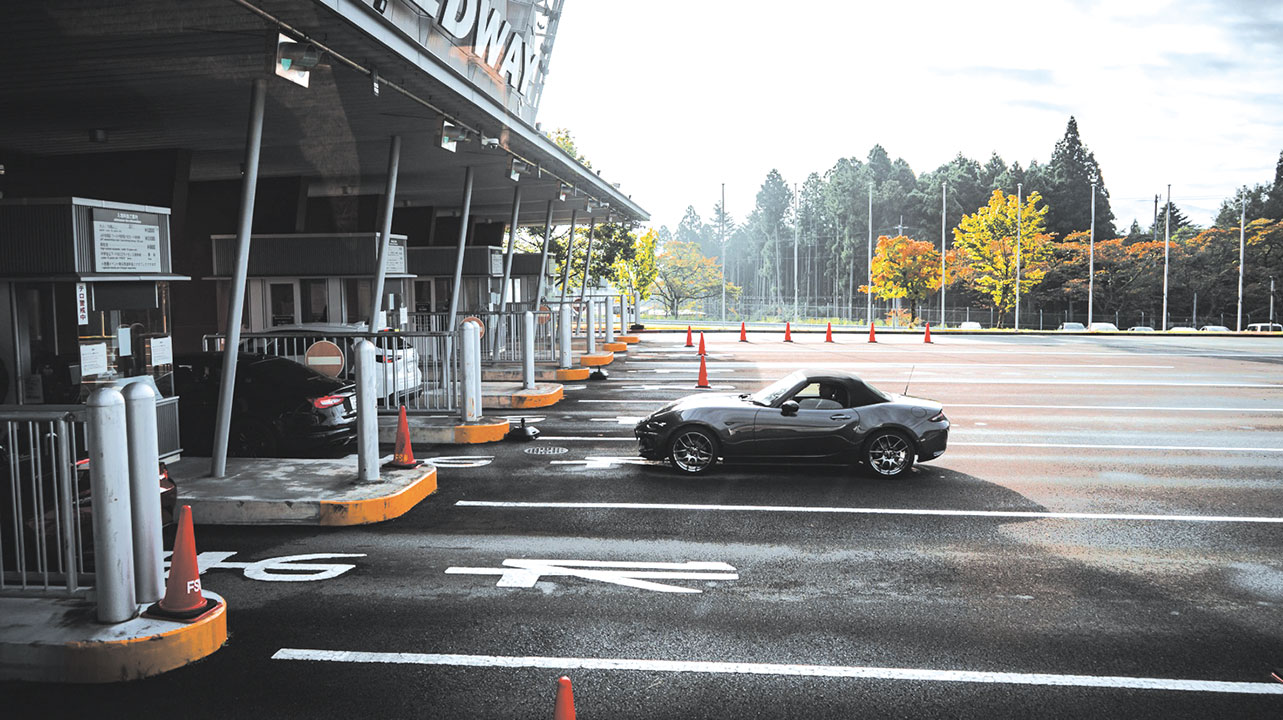
A BRIGHT SUN basks the verdant landscape of Oyama in the Suntō District of the Shizuoka Prefecture with a warm, reassuring glow. However, as we arrive by coach at the Fuji Speedway, the iconic Mt. Fuji after which the circuit is named still hides her majesty behind tufts of clouds. We do not get lucky this time.

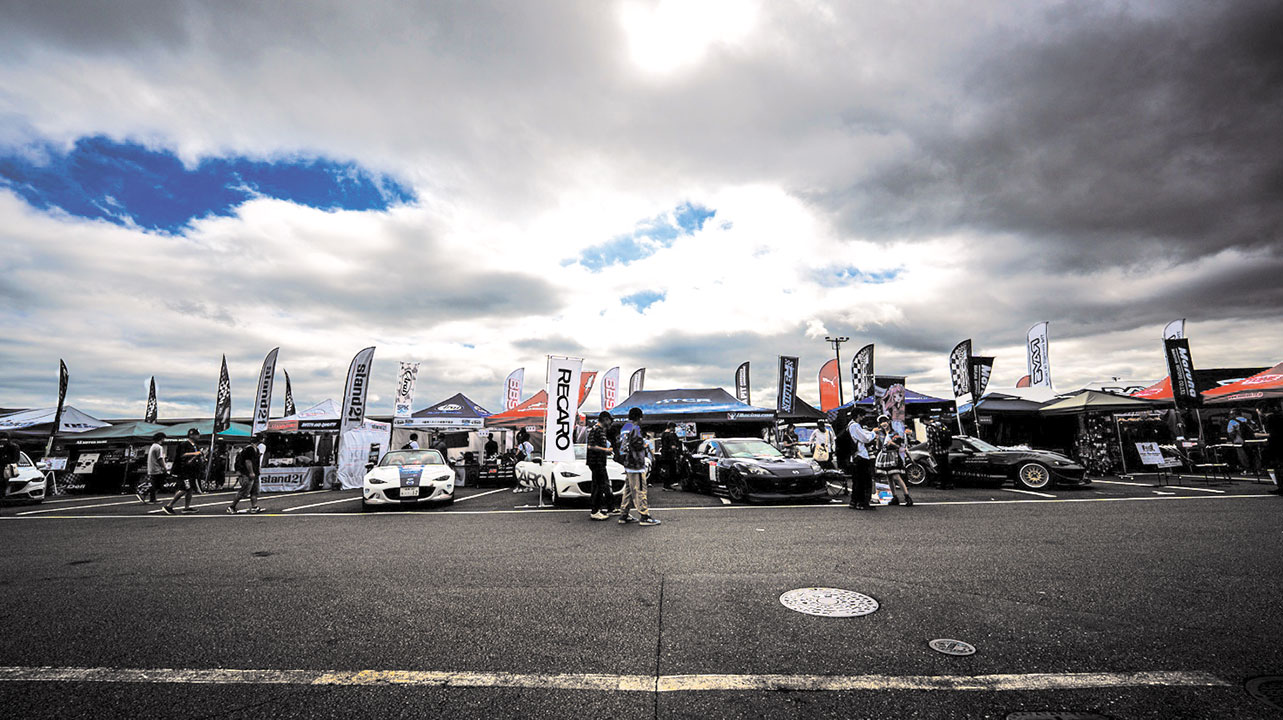
Nonetheless, our delegation of media practitioners, content creators, and select members of the Miata Club Philippines are fortuitous to be here to witness another staging of the Mazda Fan Festa — an annual gathering that makes this otherwise serene and sleepy part of Japan hum with life and activity. It’s everything Mazda here today. We arrive on a Sunday — the closing canto of the two-day spectacle — and there are still lots to take in and go through.

Even on the other side of the underground tunnel that gives us access to the track itself, we can hear the distinct brrap-brrap of Mazda’s legendary rotary engine — shelved for use in current vehicles but whose legend and lore are kept alive by the myriad of past sports cars onsite today. “It’s as characterful as it is inherently flawed,” says Top Gear Philippines Publisher Carlo Chungunco of the classic mill as we sit and catch our breath after doing a lot of walking to take photos and video as well as gawk at the goings on.

Primarily made for the Japanese domestic market, the Mazda Fan Festa was first staged in 2016 — a brainchild of Mazda Motor Corp. Brand Experience (or BX) Promotion Division General Manager Eri Fujimoto, who used to be the general manager of the CS Business Development Department.

Appointed to her new post in 2023, Ms. Fujimoto’s new area of focus is firmly predicated upon one of Mazda’s declared brand purposes, “(to) create and expand opportunities for customers to experience the Mazda brand globally to gain empathy for the ‘joy of driving’ set forth in the 2030 Vision and to enhance brand value.”

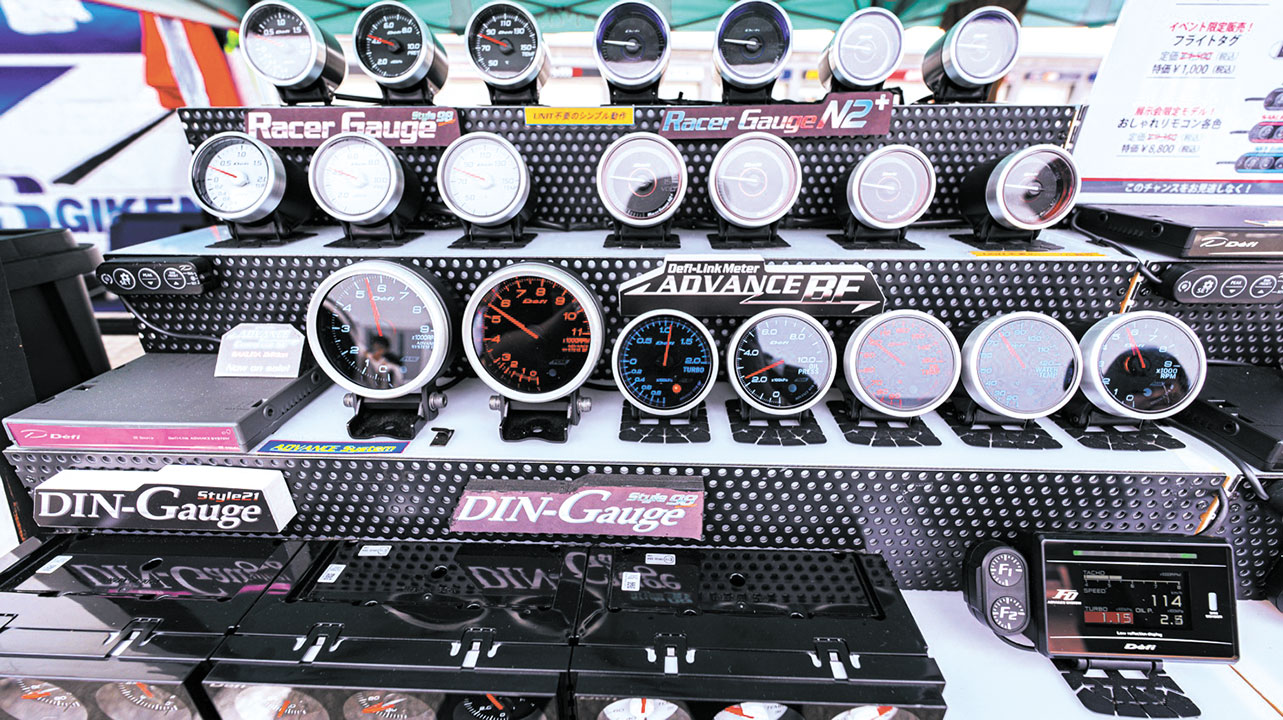
Fan Festa encapsulates the marque’s motorsport history through, yes, all sorts of races, and is highlighted by car displays, third-party exhibitors hawking everything from after-market parts or upgrades, fan merchandise, toys, services and, of course, delicious food. Fan Festa truly has everything for everyone at any age.

Mazda itself was established in 1920 in Hiroshima, starting as — believe it or not — a cork company, the Toyo Cork Kogyo Co., Ltd. with Shinhachi Kaizuka as its first president. The year after, Jujiro Matsuda took over. The firm only started to produce vehicles in 1931 with the introduction of the Mazda-Go “auto rickshaw,” a name for three-wheeled vehicles designed for both commercial and private use. The name “Mazda” is said to have come from the name of Ahura Mazda, the god of harmony, intelligence, and wisdom.

Today, Mazda is known for defining technologies and touches that have become hallmarks of its vehicles at one time or another. One is the aforementioned (piston-less) rotary engine designed by German engineer Felix Wankel and modified for increased commercial viability by fellow German Hanns-Dieter Paschke. Other standouts include the brand’s telltale Kodo Design language and SkyActiv platform — underpinned by a “human-centric design philosophy” and the so-called “Jinba-Ittai” or “horse and rider as one.”

We sit with Fujimoto-san for a brief question-and-answer session in one of Fuji Speedway’s conference rooms, facilitated by Mazda Philippines President Steven Tan, who accompanies and hosts us — the third time the country has sent a media delegation.

“Every year I come here, I get something new, and it’s better,” Mr. Tan addresses Ms. Fujimoto.

“Well, my motivation is to see our customers smile and enjoy to drive. It makes our staff happier as well… My motivation is to expand this culture (of Mazda) globally. Actually, you in the Philippines are moving faster,” she replies. Mazda Philippines has been staging its own Fan Festa since 2023 — the only other market outside of Japan to use the “Fan Festa” moniker.

Around 20 Mazda dealerships in Japan participate in Fan Festa, adds Ms. Fujimoto. This is in addition to Mazda Motor Corp.’s own executives and employees. Obviously, more than being a touchpoint for customers and fans of the brand, the event is a veritable team-building activity as well as an occasion for more personal interactions among stakeholders. “This is like a platform for interactions as well… How much more can you connect with the brand, its cars, its people, the team, in one weekend? It’s an enabler,” posits Mr. Tan.

I wonder how the Mazda Fan Festa fits into the company’s sales push. I ask Fujimoto-san if she has noticed a translation to increased sales (at least domestically) because of all the interest generated by Fan Festa. Also, what goals does she have for the event, aside from promoting the Mazda culture, its vehicles, and its rich history?

“Well, (for sales) not in the short term, midterm or long term. We are not targeting the business. We are targeting to increase the touchpoints to feel the joy of driving,” she begins. “Our mission and our work is make our customers feel the joy of a drive. So we would like to create experiences that will make people feel the love and joy of a drive. This is the place for that.”

She continues that, through Mazda Fan Festa, the company hopes to also keep its dealer network engaged and to motivate them by making them understand the mission and vision of the brand itself. “It all comes back to our mission,” Fujimoto-san insists.

“It’s a right question,” joined Mr. Tan. “Return is measured in several different ways. First is (engagement). Once you engage, it will then lead to retention… And typically, what happens is that retention becomes advocacy, so the stakeholders themselves become advocates for the brand. So it’s not just the customer but their friends, too. When they advocate, they become like ambassadors of the brand.”

Incidentally, Eri Fujimoto promises to come to the Philippines for the May 2026 staging of our own Mazda Fan Festa. There we made it formal, Fujimoto-san.

Later, we have a short session with legendary Japanese race driver Yojiro Terada — best known for his 24 Hours of Le Mans stints as well as for being Mazda’s factory driver in the ’90s as he participated in the World Sportscar Championship and All Japan Sports Prototype Championship.

The very first car that Terada-san owned was a Mazda R360 — a two-door four-seater kei car — but the vehicle he is most known for is the 787B, which Terada-san had worked on during its “primary stage of development.” A later version of the Mazda 787, the 787B is a Group C sports prototype racing car developed for the World Sportscar Championship, All Japan Sports Prototype Championship, and the 24 Hours of Le Mans. The 787 models have the distinction of being the last Wankel rotary-powered racing cars to compete in these events using Mazda’s R26B engine. In 1991, a 787B driven by Johnny Herbert, Volker Weidler, and Bertrand Gachot went on to victory in the 1991 24 Hours of Le Mans.

Today, Yojiro Terada continues to drive the 787B during Fan Festa and makes himself available to the adoring throng (this writer included) who flock to see — and even get selfies with — him. One can never be too old or too wet behind the ears for Fan Festa.

But better get earplugs for the younger ones. The fun can get loud.

The US has no China policy, no strategy, and no clue

STOCK PHOTO | Image Brgfx from Freepik

By Andreas Kluth

AS THE PRESIDENTS of the United States and China prepare to meet on the sidelines of an economic summit in South Korea — an encounter that may not actually happen — some foreign-policy strategists in Washington are not just worried but aghast. The two mightiest nations on Earth seem hell-bent on waging economic war up to and including “mutual assured destruction.” And at least one of the pair seems to have no plan, no expertise, and no clue.

“The first thing to understand is that there is no China policy” in the current US administration, Rebecca Lissner told me. She was a top adviser to Vice-President Kamala Harris and would now be in the National Security Council if Harris had won the 2024 election.

The Trump administration has no coherent strategy toward China, and the “trade stuff is worse than the markets believe,” I heard from Zack Cooper, a veteran Asia expert at the American Enterprise Institute. That must be bad indeed, because the stock markets have been see-sawing since April. One of his colleagues despairs over “nine months of policy whiplash” and a chronic case of “strategic schizophrenia.”

Attempting to summarize the chaos so far runs into the same limits of encapsulating, say, the story twists in Game of Thrones in one sentence. Roughly: Earlier this year, Donald Trump declared economic war on most of the world. Almost all countries sued for peace, but the most powerful, China, stared him down, matching tariffs on the way up (peaking at 145% at one point) and on the way down (hovering around 30% for a while). A few reversals, pauses and feints later, a new round of spikes is threatened for November.

But tariffs were just the overture, as Washington and Beijing, tit-for-tat, started going after each other in every other way. They’re slapping port fees on one another. They’re harassing each other’s tech companies — the US is squeezing Chinese firms that use American semiconductors; China has targeted America’s Nvidia, Qualcomm, and others. Everything, it seems, is now a bargaining chip, as the Trump administration keeps reversing itself. One minute it bans the sale of microchips to China, the next it partially lifts the ban again. Adding to the confusion, Trump has also thrown unrelated (and relatively trivial) matters into the mix, such as the fate of TikTok, a Chinese-owned video app.

One move has risen above the noise, however. Off and on, China has throttled, or threatened to stop, exports of rare earths, in which it has a global quasi-monopoly. This was entirely foreseeable — and yet seemed to take the Trump administration by surprise. Some of these 17 elements (which aren’t that rare, just very difficult to mine) are essential to make, say, the magnets that go into modern electronics, including those inside American cars and fighter jets.

Graham Allison at the Harvard Kennedy School, a doyen among international-relations scholars, concludes that “in the game of supply chain poker, China holds the high cards” and Trump has come to realize that he doesn’t. (The metaphor is cheeky, since Trump enjoys bullying others for not holding “the cards.”)

Cooper, at AEI, disagrees. “I don’t think the Chinese have all the cards,” he told me; “we have cards, we just haven’t been willing to play them.” For example, the US could cut Chinese banks out of dollar transactions in global financial markets, which is in its context as asymmetric as blocking exports of rare earths. (Most US banks don’t care about losing access to renminbi transactions, but Chinese banks “would fold,” Cooper thinks.)

One problem is that the White House has recently fired a lot of the China experts who have the deep technical knowledge to find and use such levers. One example is David Feith, who was purged for political reasons (or “loomered,” in the argot) just as the confrontation with China heated up.

Another problem is that Trump’s remaining advisers are at one another’s throats over what the US even wants out of China. Ryan Fedasiuk at Georgetown University describes three main camps: The economic nationalists love tariffs for their own sake. The hard-power realists care more about keeping China inferior to the US technologically and militarily. The transactional restrainers view tariffs and other measures merely as tools to extract concessions, such as a Chinese clamp-down on the chemicals used to make fentanyl. Meanwhile, Trump seems to be all over the map.

That’s what it means to have no strategy. The Trump administration has not answered, or seemingly even asked, fundamental questions, small or large, specific or general: Does the US want to attract Chinese investment, or to decouple the two economies? Does it want to sell its best semiconductors and software, or to hog them?

More broadly, does America want to keep China down, or share with it the burden of restoring order and peace in the world, from Ukraine to the Middle East? Is Taiwan (or the South China Sea, for that matter) a vital American interest to be defended, or a mere bargaining chip?* Is China an adversary the US will have to fight and defeat one day, or a difficult but unavoidable partner?

By the time the top guys take a seat at the same table, Lissner told me, “you don’t have the luxury of saying, we’re going to do trade, but not Taiwan, or we’re going to do fentanyl. But not the Philippines. That’s just not how it works.” The result is what she calls ADD diplomacy — negotiating with attention deficit disorder, in pursuit of no clear goal and guided by no compass.

“I just don’t think that the Trump folks believe you need a strategy to do things,” Cooper told me. Their narrative, he says, is that Trump is a “master negotiator, walks into the room, decides where he has leverage, uses it and walks out.” The problem is that the Chinese have prepared for this showdown for a long time, and their rare earths are just the start. They believe, Cooper says, that they’re “running circles around the Trump team. They feel really confident.”

If the meeting in South Korea doesn’t happen, the Chinese will blame it on logistics. (Getting both leaders to overlap is in fact tricky — Trump is also due to visit other Asian countries.) If it does happen, it’s unlikely that anything big will be resolved. There may be a tariff reprieve here, or a corporate deal there. But as to the most important relationship in and for the world, that between the US and China, nobody will be any wiser.

BLOOMBERG OPINION

*On Taiwan, too, Trump keeps sending mixed signals. Last month, and apparently in anticipation of the meeting with Xi, he withheld $400 million in military aid to Taipei. In July, he told Taiwan’s president not to stop in New York on the way to South America, also to avoid offending Beijing.

BSP debt yields continue to decline

BW FILE PHOTO

YIELDS on the Bangko Sentral ng Pilipinas’ short-term securities fell further on Friday as investors continued to show strong demand for the central bank’s liquidity management instruments.

Total bids for its reached P151.63 billion, exceeding its P100-billion offer though slightly below last week’s P171.6 billion in tenders for a P110-billion sale. The central bank fully awarded both the 28- and 56-day bills.

Bids for the 28-day securities reached P60.05 billion, above the P40-billion offer but less than the P84.1 billion in the previous week. Rates ranged from 4.8% to 5.23%, leading the average yield to decline by 5.72 basis points (bps) to 5.1793%.

Demand for the 56-day bills hit P91.58 billion, higher than the P60-billion offer and last week’s P87.5 billion in tenders for a P70-billion sale. The accepted rates ranged from 4.9% to 5.24%, pulling the average yield down by 6.78 bps to 5.1887%.

Both tenors were oversubscribed, with bid-to-cover ratios of 1.5 times for the 28-day bills and 1.53 times for the 56-day tenor, the BSP said.

The central bank uses the facility and term deposit auctions to absorb excess liquidity and align short-term market rates with its benchmark policy rate.

The BSP noted that the bills enhance price discovery for short-term debt instruments and strengthen monetary policy transmission. These securities are classified as high-quality liquid assets and may be traded in the secondary market.

About half of the BSP’s market operations now take place through its short-term securities. Governor Eli M. Remolona, Jr. earlier said the central bank plans to gradually reduce reliance on such debt to encourage greater activity in the domestic money market. — Katherine K. Chan

NFA pilot-testing 1-ton palay bagging system

DA.GOV.PH

THE National Food Authority (NFA) has launched a pilot program to bag palay (unmilled rice) in 1-ton sacks, saying the measure is designed to reduce storage costs and optimize warehouse capacity.

“This is part of our broader effort to upgrade NFA’s storage capacity at minimal cost to the government,” according to Agriculture Secretary Francisco P. Tiu Laurel, Jr., who also chairs the NFA Council. “By maximizing existing warehouse space, we can procure more palay from farmers and help address post-harvest losses,” he was quoted as saying in a Department of Agriculture (DA) statement.

According to NFA Administrator Larry Lacson, the pilot test will begin in at least three warehouses. “This trial will provide us with critical data to determine whether the technology is viable for broader implementation,” he said.

Some of the NFA’s over 300 warehouses are undergoing upgrades to accommodate larger volumes of palay and milled rice, and possibly corn if legislative amendments are passed.

The 1-ton bagging system is touted to reduce reducing storage and transport costs, with airtight bags helping preserve grain quality. It also simplifies segregation of grain types, enhances pest control, and reduces pressure on storage infrastructure.

Mr. Lacson estimates that the new system could boost warehouse capacity by up to 30%.

“There will also be savings in manpower, fumigation, and sack costs,” he added.

The NFA currently spends around P15 per printed sack and an additional cost per bag for labor. At full capacity, an NFA warehouse with maximum of eight piles can store up to 55,440 bags of 50-kg grain.

BPI shares rise on higher earnings, Singapore expansion

BANK OF THE PHILIPPINE ISLANDS

SHARES in Bank of the Philippine Islands (BPI) climbed last week after the Ayala-led lender reported higher nine-month earnings and announced the launch of its Singapore-based wealth unit.

BPI was the sixth most actively traded stock from Oct. 13 to 17, with P857.49 million worth of 7.97 million shares changing hands, data from the Philippine Stock Exchange (PSE) showed.

The stock gained 2.6% week on week to close at P109.20 apiece on Friday, outperforming the financial subindex’s 1.8% rise and the benchmark PSE index’s 0.9% advance.

Despite last week’s gain, BPI shares were still down about 10.5% year to date, underperforming the financial sector’s 4.6% decline and the PSEi’s 6.7% slip.

The bank’s nine-month net income grew by 5.2% year on year to P50.5 billion on the back of higher interest and fee-based income.

Revenues rose 13.2% to P142.3 billion, driven by a 16.2% increase in net interest income to P109.1 billion.

Non-interest income rose 4.2% to P33.3 billion as the bank booked stronger fees from credit cards and wealth management.

Its nonperforming loan (NPL) ratio stood at 2.3%, with an NPL coverage of 96.5%. Provisions reached P11.8 billion during the nine-month period.

Globalinks Securities and Stocks, Inc. Head of Sales Trading Toby Allan C. Arce said the results reflected “sustained loan growth and effective balance sheet management amid high rates,” supporting the stock’s gains.

“Expect near-term appreciation, particularly if the fourth quarter maintains this momentum,” he said in a Viber message.

First Resources Management and Securities Corp. Analyst Jash Matthew M. Baylon said earnings were “mainly driven by stronger margins and loan expansion despite lower benchmark rates.”

The Bangko Sentral ng Pilipinas cut its policy rate by 25 basis points (bps) to 4.75% on Oct. 10, marking a total reduction of 175 bps since August 2024.

BPI also launched BPI Wealth Singapore, a wholly owned subsidiary aimed at serving affluent and expatriate clients in Asia’s financial hub.

“Singapore is where next-generation wealth conversations are happening,” BPI Chairman Jaime Augusto Zobel de Ayala said in a statement.

Mr. Arce said the new unit could contribute 2-4% of BPI’s net income in the next two to three years.

For the full year, analysts expect the lender’s net income to reach about P66 billion, up 7% year on year, with share support seen between P100 and P108 and resistance around P115. — Pierce Oel A. Montalvo

Giorgio Armani group names long-time executive Marsocci as CEO

DESIGNER Giorgio Armani appears on the runway at the end of the Giorgio Armani Fall-Winter 2025/2026 menswear collection during Milan Fashion Week in Milan, Italy on Jan. 20. — REUTERS FILE PHOTO/ALESSANDRO GAROFALO

MILAN — Giorgio Armani has appointed deputy managing director Giuseppe Marsocci as chief executive officer (CEO) with immediate effect, the Italian fashion house said on Thursday, confirming media reports.

Mr. Marsocci, who has been at the company for 23 years, most recently as Global Chief Commercial Officer for the last six years, steps into the role previously held by founder Giorgio Armani, who died in September.

Mr. Armani kept a tight grip on the fashion empire he set up 50 years ago, but a new structure is emerging for its next phase.

Mr. Marsocci will oversee the planned sale of a 15% stake, with priority to be given to luxury conglomerate LVMH, beauty heavyweight L’Oreal, eyewear leader EssilorLuxottica, or another group of “equal standing,” as outlined in Mr. Armani’s will.

“His international professional experience, deep knowledge of the sector and the company, discretion, loyalty, and team spirit, together with his closeness to Mr. Armani in recent years, make Giuseppe the most natural choice to ensure continuity with the path outlined by the founder,” said Mr. Armani’s partner and head of men’s design Pantaleo Dell’Orco, who has taken on the role of company’s chairman.

Mr. Dell’Orco has also recently been appointed to chair the Giorgio Armani Foundation which controls 30% of the voting rights of his business empire. Mr. Dell’Orco already controls 40% of the luxury group’s voting rights.

The appointment of Mr. Marsocci, 61, was unanimously proposed by the Giorgio Armani Foundation, the luxury group said.

Giorgio Armani’s niece Silvana, head of women’s style, will be appointed as vice-president, according to the statement. — Reuters

Star power-up

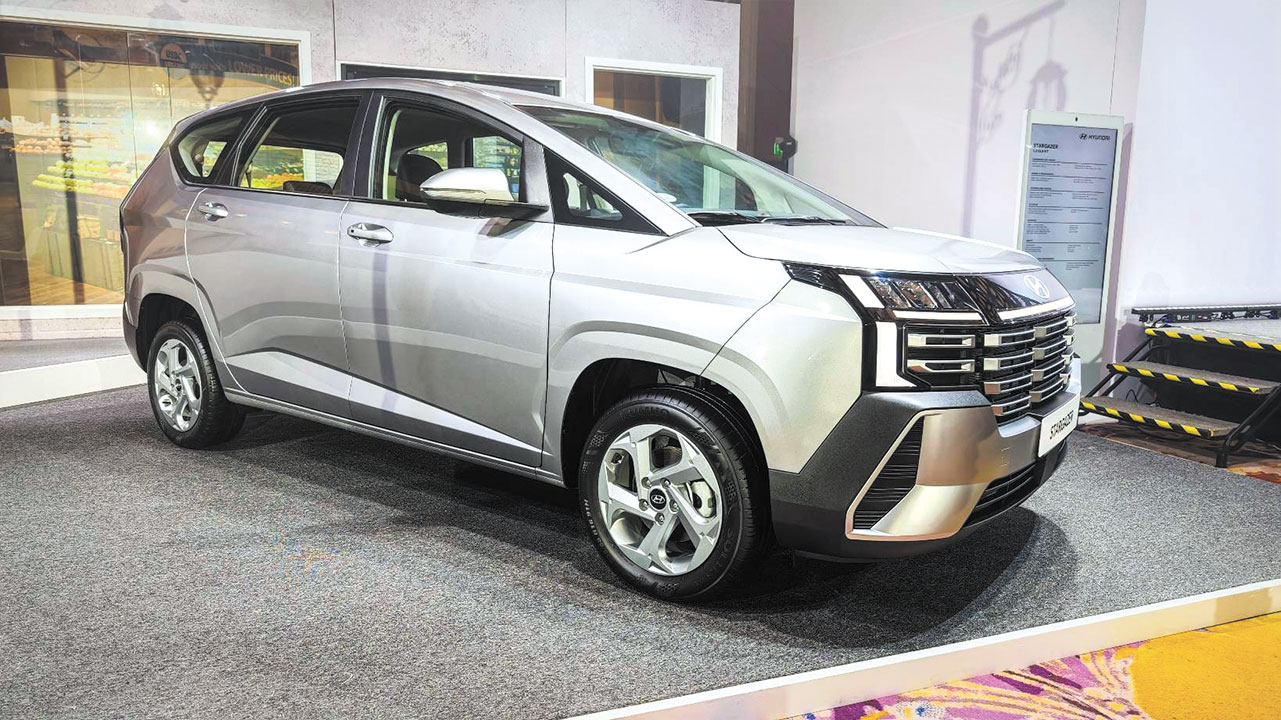
The updated Hyundai Stargazer X (left) and Stargazer — PHOTO BY PABLO SALAPANTAN

Hyundai Motor Philippines launches updated MPV model

By Pablo Salapantan

HYUNDAI MOTOR PHILIPPINES (HMPH) is trying to sustain its business momentum by launching two newly updated vehicles crucial to the brand’s success here in the country.

The Hyundai Stargazer and Stargazer X are the undisputed sales leaders for the Korean car maker ever since the model line’s launch a few years ago, capitalizing on buyers’ predilection for MPVs or multi-purpose vehicles.

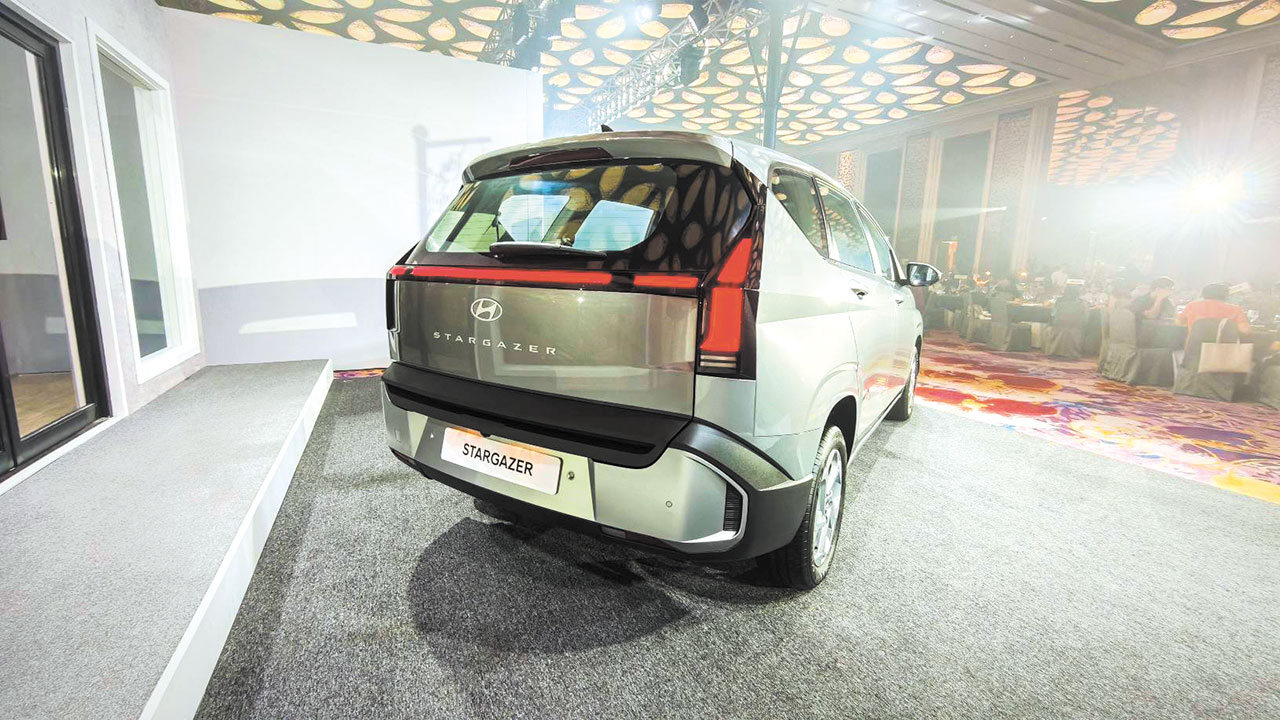
With the refresh, HMPH has made “stargazing” even more interesting. After all, the model’s ultra-futuristic design cues have always been one of its main draws. Carrying the torch for this face-lifted generation, both the Stargazer and Stargazer X have gone under the knife. Arriving with a revamped design that gives it a bolder, more SUV-esque look, the Stargazer receives a new form that takes after the latest Hyundai SUV design language. The new “Sheriff-style” front combination lights underscore the fascia, while the rear highlights a sharp refresh of the H-signature LED daytime running lights and bumper. An exclusive to the Stargazer X is a new functional bridge-type roof rail to complement active lifestyles. This can accommodate extra cargo storage of up to 100kg.

The wheelbase has also been somewhat increased in length to a class-leading 2,780mm, while standing confidently on 17-inch alloy wheels. Powering both the Stargazer and Stargazer X is the tried-and-tested, familiar, 1.5-liter gasoline engine mated to the very efficient Hyundai IVT transmission, the brand’s version of a CVT.

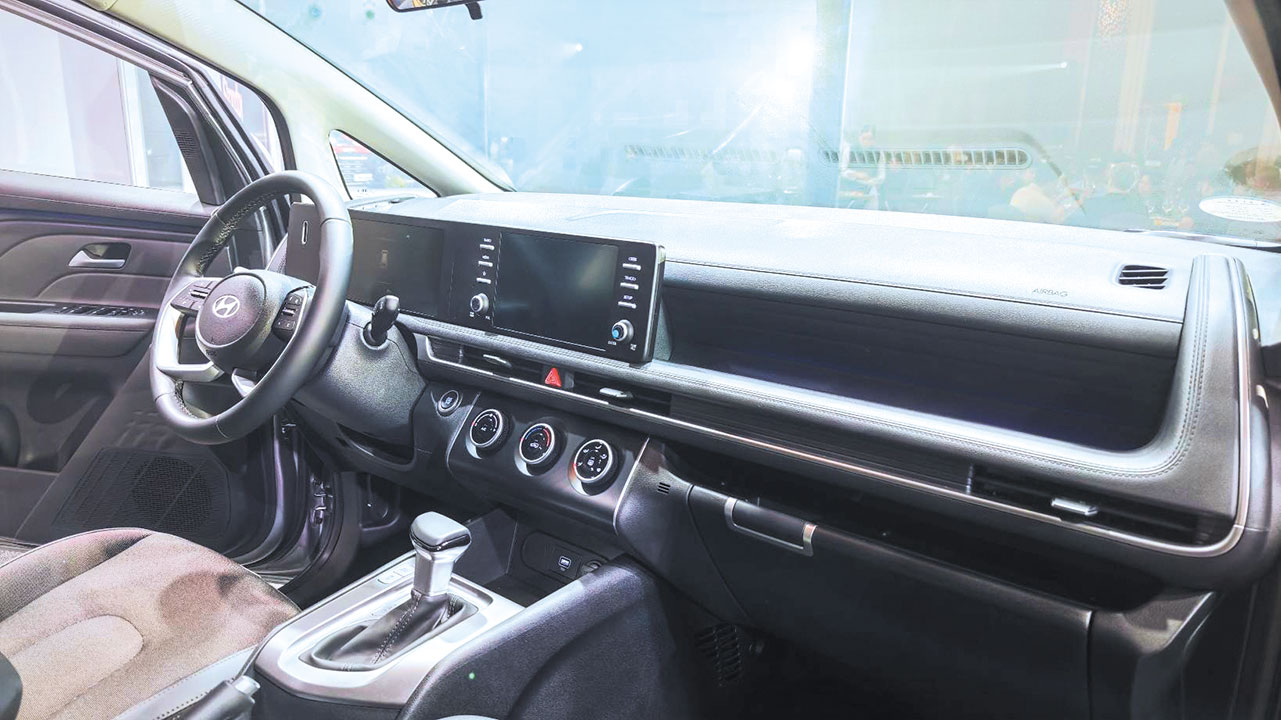
There have also been some updates for the interior: Gone is the bulky and controversial “housing” for the digital instrument cluster and infotainment screen. In its place is one seamless panel that contains both screens — with a “borderless” look that is much cleaner than before.

The new 10.25-inch digital instrument cluster features a tire pressure monitor; the integrated infotainment display supports Wireless Apple CarPlay and Android Auto. Comfort and convenience are further enhanced with a new automatic climate control system, wireless charging pad, and new ambient lighting. NVH (noise, vibration, harshness) levels have also been improved for an even smoother and quieter ride.

Safety has always been a priority for Hyundai, and the Stargazer models now get the updated SmartSense safety suite, which has Smart Cruise Control with Stop and Go, Forward Collision Avoidance Assist, Lane Following and Keeping Assist, and Blind Spot Collision Avoidance Assist.

The new Hyundai Stargazer is competitively priced against the competition: Stargazer 1.5 GL Plus IVT (P1.118 million), Stargazer 1.5 GLS IVT (P1.228 million), Stargazer X 1.5 GLS Plus IVT (P1.318 million), and Stargazer X 1.5 Premium IVT, P1.378 million). It comes in five different color options: Dragon Red Pearl, Magnetic Silver Metallic, Creamy White Pearl, Titan Gray Metallic, and Midnight Black Pearl. Meanwhile, the Stargazer X comes in exclusive two-tone colors (black for the roof) and a choice from the following: Creamy White Pearl, Magnetic Silver Metallic, and Dragon Red Pearl.

Funds for health still needed amidst massive corruption

STOCK PHOTO | Image from Freepik

The Tres Marias of the Liberal Party — Rep. Krisel Lagman of the first district of Albay, Rep. Leila de Lima of the Mamamayang Liberal (ML) Party-list, and Rep. Kaka Bag-ao of the lone district of the Dinagat Islands — have filed House Bill (HB) 5003, a measure seeking to improve sweetened beverage (SB) taxation to reduce the consumption of harmful sweetened drinks and fund health and nutrition programs. The first and only SB tax increase was legislated in the TRAIN Act of 2017 and implemented in 2018.

The proposal to raise sweetened beverage taxes was met with negative comments from online users and even journalists including Ted Failon. Their dislike for taxes could be understood in the context of the current corruption scandal, wherein politicians and their colluders have stolen taxpayers’ money. As the massive misuse of public funds continues to be exposed, many Filipinos are expressing their strong opposition to raising taxes.

In a similar vein, Rep. Nathaniel Oducado of the 1TAHANAN Party-list has filed his own health tax bill, House Bill 3887, specifically raising excise taxes on alcoholic beverages, including beer, distilled spirits, and pre-mixed alcoholic beverages or alcopops. Similar bills were later filed by Rep. Amben Amante of Laguna and Rep. Perci Cendaña of Akbayan Party-list.

Tax reforms are predictably unpopular at the moment that corruption is so pervasive and massive. It is a difficult position to take for reformers. Hence, we commend the Tres Marias, Rep. Oducado, Rep. Amante, and Rep. Cendaña for their courage and judiciousness in championing bills that go against the tide.

Especially addressed to the critics, please take note that health taxes are meritorious even in trying political circumstances. Their central objective is not necessarily to raise revenue, but to discourage consumption of unhealthy products like sugar-sweetened beverages and alcoholic beverages.

The drop in consumption will still be accompanied by an increase in revenues. The increase in the tax (and hence the price) will result in a proportionally smaller decrease in the demand for these harmful products. But we also need to know that the bill’s intent is to earmark the revenues from the health taxes for universal healthcare and nutrition. The earmarking means that the funds are strictly and exclusively designated or allocated for Philippine Health Insurance Corp. (PhilHealth), universal healthcare, and nutrition. The earmarking provision makes it illegal for the funds sourced from health taxes to be diverted to other programs, including those that are conduits for corruption and political patronage. Thus, earmarking should serve as a guardrail against corruption.

Even the Marcos administration, which is guilty of diverting PhilHealth’s earmarked funds, realized the gross violation when the President himself announced the return of P60 billion worth of PhilHealth funds, which the government diverted to the National Treasury in 2024. Advocates are also counting on the Supreme Court to soon come out with a decision to declare the transfer of PhilHealth funds unconstitutional. The Supreme Court already previously issued a temporary restraining order that stopped the further transfer of the last tranche worth P29.9 billion of PhilHealth funds to the national government.

Moreover, the earmarking from sin taxes will directly benefit the poor. For example, the earmarking of SB and tobacco excise taxes for PhilHealth subsidizes the contributions of PhilHealth’s indirect contributors, or those who do not have the ability to pay the premiums. These contributions, in turn, are used to maintain and expand PhilHealth benefits for all members and their dependents.

In a word, health taxes benefit the whole population by discouraging consumption of unhealthy, harmful goods and having the tax revenues earmarked for health and nutrition.

Health tax measures are meant to secure a better future — the well-being and productivity of our people and the attainment of sustainable development.

Further, health taxes will contribute to macroeconomic stability and will avert a fiscal, if not economic crisis resulting from the corruption, waste, and bad governance of the current administration. By pursuing reforms, we do not wish people to suffer now and in the future, even as we continue the relentless fight against corruption.

Winning reforms now have immediate gains for the people even as the transformative impact will be felt in the not-so-distant future.

Raising taxes and ensuring sound use of public funds (and making sure that the corrupt are held accountable) should be done at the same time, especially when health is on the line. Public health should not take a backseat and should not suffer as a result of massive greed and corruption.

By no means will the health tax reforms prop up a corrupt and crumbling regime; rather, they serve the grand and longer-term objective of transforming society and achieving prosperity for all.


Filomeno S. Sta. Ana III coordinates the Action for Economic Reforms. Pia Rodrigo is strategic communications officer at Action for Economic Reforms.

www.aer.ph

Philippine bond yields slip on BSP easing bets

By Lourdes O. Pilar, Researcher

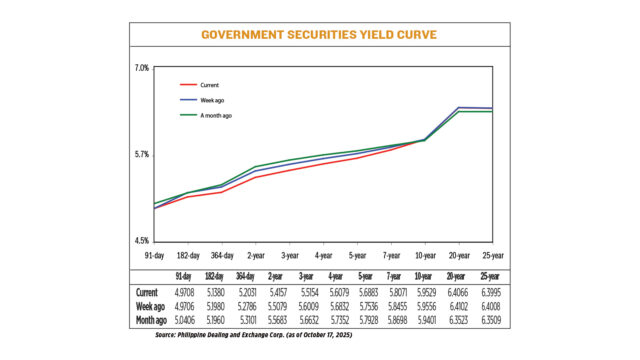
YIELDS on Philippine government securities fell last week as investors took profits after the Bangko Sentral ng Pilipinas’ (BSP) surprise rate cut and amid expectations of further monetary easing.

Government debt yields declined by an average of 4.54 basis points (bps) week on week based on PHP Bloomberg Valuation Service (BVAL) reference rates as of Oct. 17. Trading volume dropped to P50.28 billion on Friday from P148.2 billion a week earlier.

Yields fell across most tenors except the 91-day Treasury bill, which inched up by 0.02 bp to 4.97%. The 182- and 364-day T-bills slipped by 6 and 7.55 bps to 5.14% and 5.2%, respectively.

The two- to seven-year Treasury bonds also declined, led by the two-year debt at 5.42%. Ten-year to 25-year yields were little changed, edging lower to 6.4% at the long end.

“The local bond curve shifted lower, led by the front and belly, on firm demand and continued expectations of further BSP easing,” a bond trader said in a Viber message. Profit taking capped the rally as investors locked in gains.

The BSP unexpectedly cut its policy rate by 25 bps to 4.75% on Oct. 9 — the lowest in more than three years — citing weaker sentiment amid a corruption scandal involving flood control projects. Rates on the overnight deposit and lending facilities were also reduced to 4.25% and 5.25%, respectively.

Traders said the BSP might cut by another 25 bps in December and an additional 50 bps next year. “The BSP remains dovish and ready to provide support to the economy,” another trader said.

Demand for Treasury bills remained strong. The Bureau of the Treasury raised P22 billion as planned from its latest auction, with bids reaching P97.2 billion — more than four times the offer.

The average rate for 91-day bills dropped 10 bps to 4.88%, while 182-day and 364-day tenors fetched 5.07% and 5.12%, respectively.

Jonathan Ravelas, a senior adviser at Reyes Tacandong & Co., said the outlook for local rates remains “sideways to down,” supported by easing inflation and global rate cut prospects.

Traders expect the yield curve to steepen slightly this week, with short-term rates declining further while medium- to long-term yields edge higher.

ADVERTISEMENT
ADVERTISEMENT