Home Blog Page 8203

Century Pacific Food to help coconut farmers in Mindanao

CENTURY Pacific Food, Inc. (CNPF) has launched a project that enables consumers to help coconut farmers in Mindanao through the purchase of a bundle of the company’s plant-based products.

The listed food company said in a stock exchange disclosure on Monday that one coconut tree will be planted for every sold pack, which contains Coco Mama, Vita Coco, and UnMeat brands that will be made available during Earth Week 2021. CNPF partnered with non-profit organization Hope for the initiative.

“On top of expanding coconut supply in South Central Mindanao and helping augment the income of 16,000 farmers and their families, these new coconut trees are also expected to offset about 416,680 metric tons of greenhouse gas emissions, allowing CNPF’s coconut business to be ‘carbon neutral’ by 2028,” the company said.

Further, CNPF said proceeds from the sold bundles will also go to coconut farmer beneficiaries in Sarangani province. According to the company, the project is part of its sustainability program that seeks to provide Filipino farmers with 100,000 free coconut seedlings annually over the next five to eight years.

The company added that consumers can support the project by purchasing bundles of Coco Mama, Vita Coco, and UnMeat at its food stores in Shopee and Lazada until April 25. For 2020, CNPF posted a P3.9-billion net income, an increase of 24% year-on-year due to higher revenues from its branded business segment.

Its consolidated revenues improved 19% year-on-year to P48.3 billion. On Monday, shares of CNPF at the stock exchange increased 5.26% or P1 to finish at P20 per share. — Revin Mikhael D. Ochave 

Duterte signs order granting ECC pensioners P20K-one-time aid

PRESIDENTIAL PHOTO/ KING RODRIGUEZ

PRESIDENT Rodrigo R. Duterte signed an order giving a one-time financial assistance to pensioners of the Employees Compensation Commission (ECC).

Under Administrative Order No. 39, Mr. Duterte allowed the release of P20,000 to each pensioner.

The directive will benefit about 31,000 pensioners of the Social Security System (SSS) and Government Service Insurance System (GSIS).

Citing studies by SSS and GSIS, the order said the Social Insurance Fund can finance the one-time grant “without affecting its stability, and without requiring additional contributions.”

“The adverse effects of the pandemic on the economy, supplementary health necessities for the battle against the virus, and restrictions imposed on our mobility and social interaction, have increased the financial and health burdens experienced by EC pensioners,” the order read. — Kyle Aristophere T. Atienza

Delay in SSS rate hike among bills pending President’s signature

A TOTAL of 55 bills were passed into law during the second regular session of the 18th Congress, data from the Senate released on Monday showed, while seven measures are awaiting the President’s approval.  Among those pending at President Rodrigo R. Duterte’s table is the bill giving him authority to defer the scheduled increases in the contribution rate of the Social Security System (SSS) for up to a year during a declared national emergency or state of calamity. The measures that were signed by President Rodrigo R. Duterte include laws to address the pandemic and the Corporate Recovery and Tax Incentives for Enterprises Act (CREATE) that cuts corporate income tax rates.  Also passed into law were Republic Act 11521, which strengthens the Anti-Money Laundering Law, and RA 11506 that granted San Miguel Aerocity, Inc. a franchise to construct and maintain a domestic and international airport in Bulakan, Bulacan. Meanwhile, 67 bills are pending for second reading approval in the Senate, including the three economic bills easing foreign restrictions on businesses that were certified by the President as urgent. Congress is currently on session break and will resume on May 17 for the second regular session, which will adjourn on June 5. — Vann Marlo M. Villegas

242-bed modular hospital for COVID patients planned within NCMH

DPWH

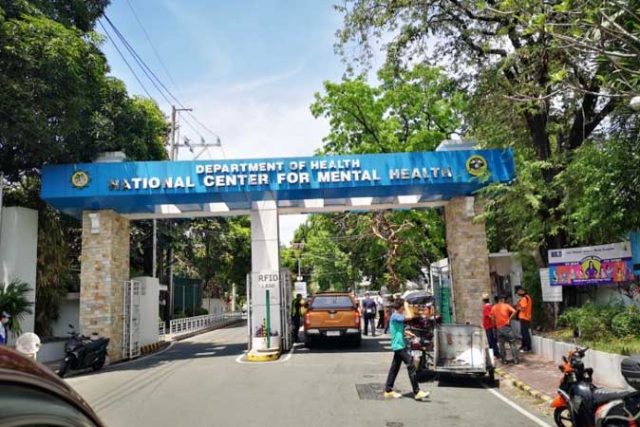
A 242-BED modular hospital that will handle coronavirus patients is being planned within the National Center for Mental Health (NCMH) compound in Mandaluyong City as other medical facilities in the capital continue to be overwhelmed by new positive cases, according to the Department of Public Works and Highways (DPWH). In a statement on Monday, the department said Undersecretary Emil K. Sadain recently met with NCMH chief Noel V. Reyes to discuss preparatory plans for the modular off-site hospital. “About 11 cluster units of makeshift hospital with 242 bed capacity dedicated to the treatment of coronavirus disease 2019 (COVID-19) patients can be put up by DPWH and to be managed by NCMH and DoH (Department of Health),” it said. DPWH is also proposing to construct off-site dormitories with 96 beds for the medical professionals who will be assigned at the NCMH facility.  Public Works Secretary Mark A. Villar, designated as czar for setting up isolation facilities, said they continue to coordinate with the DoH and government hospitals in Metro Manila on the possible use of vacant spaces for pop-up hospitals.  “Capacity expansion of major hospitals are on-going using prefabricated components to speed up the construction process,” Mr. Villar said.

HOTELS
Meanwhile, the Tourism department lauded the hotel industry’s continued support to the coronavirus response by serving as isolation and quarantine facilities.  As of April 18, the department said there are 21 hotels in Metro Manila and the neighboring provinces within the Calabarzon Region that have been converted into isolation facilities with more than 2,220 rooms. “The DoT (Department of Tourism) is one with the entire tourism industry to help mitigate the effects of this pandemic in any way it can. We are guided by our Bayanihan spirit, which has strengthened us since the on-set of the pandemic, in working together with the private and public sectors towards our nation’s recovery,” Secretary Bernadette Romulo-Puyat said in a statement.  Ms. Puyat also noted that tourism sites Nayong Pilipino and the Rizal Park will be used as vaccination sites through public-private partnership. — Marifi S. Jara 

The corporate governance principle of independence

FREEPIK

Principle 5 of the Corporate Governance (CG) Code for Publicly Listed Companies (PLCs) provides that “The Board should endeavor to exercise objective and independent judgment on all corporate affairs.”

Recommendation 5.1 provides that “The Board should have at least three independent directors, or such number as to constitute at least one-third of the members of the Board, whichever is higher.”

The Explanation for Recommendation 5.1 takes the position that the presence of independent directors (IDs) in the Board ensures the exercise of independent judgment on corporate affairs and proper oversight of managerial performance, including prevention of conflicts of interest and balancing of competing demands of the corporation. In addition, it explains that experts have recognized that there are varying opinions on the optimal number of IDs in the board. However, the ideal number ranges from one-third of the board’s members to a substantial majority.

Recommendation 5.2 provides that “The Board should ensure that its IDs possess the necessary qualifications and none of the disqualifications for an IDs to hold the position.” The Explanation then proceeds to enumerate the “ideal IDs” by enumerating the requisite qualifications and disqualifications.

Section 22 of the Revised Corporation Code of the Philippines (RCCP) provides that corporations vested with public interest shall have “IDs constituting at least 20% of such board.” Although the RCCP does not adopt the recommended “three IDs or one-third of the entire board, whichever is higher,” the Securities and Exchange Commission (SEC) has been given explicit authority under Section 179(m) of the RCCP to “Prescribe the number of IDs and the minimum criteria in determining the independence of a director.” We should therefore anticipate the SEC to later on change the rule for IDs of PLCs to constitute at least one-third of the Board.

Section 22 of the RCCP defines an ID as “a person who, apart from shareholdings and fees received from the corporation, is independent of management and free from any business or other relationship which could, or could reasonably be perceived to materially interfere with the exercise of independent judgment in carrying out the responsibilities as a director.”

Although the RCCP does not express in statutory form the peculiar qualifications and disqualifications for IDs, nothing prevents the SEC from adopting by formal regulation any and all the criteria covered in the Explanation of Recommendation 5.2 pursuant to its quasi-legislative power under Section 179(m) of the Revised Corporation Code, as well as by the express power granted under the last paragraph of Section 22, thus: “IDs must be elected by the shareholders present or entitled to vote in absentia during the election of directors. IDs shall be subject to rules and regulations governing their qualifications, disqualifications, voting requirements, duration of term and term limit, maximum number of board memberships and other requirements that the Commission will prescribe to strengthen their independence and align with international best practices.”

CG PRINCIPLE OF ‘WORKING AND PROPERLY COMPENSATED BOARD’
Principle 1 of the CG Codes for Publicly-Listed Companies, Public Companies (PCs), and Registered Issuers (RIs) provides that “The company should be headed by a competent, working Board to foster the long-term success of the corporation, and to sustain its competitiveness and profitability in a manner consistent with its corporate objectives and the long-term best interests of its shareholders and other stakeholders.”

In turn, Principle 3 of the CG Codes provides that “Board committees should be set up to the extent possible to support the effective performance of the Board’s functions, particularly with respect to audit, risk management, compliance and other key CG concerns, such as nomination and remuneration. …”

Under the original CG Code, one of the CG principles promoted was that of properly compensating directors or trustees, as well as Senior Officers, thus: “Levels of remuneration shall be sufficient to attract and retain the directors, if any, and officers need to run the company successfully.” It also provided that to protect the funds of the corporation, the SEC “may regulate the payment by the corporation to directors and officers of compensation, allowance, fees and fringe benefits in very exceptional cases, e.g., when a corporation is under receivership or rehabilitation.”

The CG Code for PLCs pursues the principle of “competent and properly compensated working Board,” under Recommendation 2.5, thus: “The Board should align the remuneration of key officers and board members with the long-term interests of the company. In doing so, it should formulate and adopt a policy specifying the relationship between remuneration and performance. Further, no director should participate in discussions or deliberations involving his/her own remuneration.”

The CG Code for PLCs explains the rationale behind Recommendation 2.5 in the following manner: “Companies are able to attract and retain the services of qualified and competent individuals if the level of remuneration is sufficient, in line with the business and risk strategy, objectives, values and incorporate measures to prevent conflicts of interest. Remuneration policies promote a sound risk culture in which risk-taking behavior is appropriate. They also encourage employees to act in the long-term interest of the company as a whole, rather than for themselves or their business lines only. Moreover, it is good practice for the Board to formulate and adopt a policy specifying the relationship between remuneration and performance, which includes specific financial and non-financial metrics to measure performance and set specific provisions for employees with significant influence on the overall risk profile of the corporation.”

Unfortunately, the RCCP does not embrace the principle that a competent Board must be properly compensated for its members’ invaluable service to the company. In fact, Section 29 of the RCCP has retained the rule that “In the absence of any provision in the bylaws fixing their compensation, the directors or trustees shall not receive any compensation in their capacity as such, except reasonable per diems; Provided, however, That stockholders representing at least a majority of the outstanding capital stock or majority of the members may grant directors or trustees with compensation and approve the amount thereof at a regular or special meeting.”

On the other hand, Section 34 of the RCCP institutes the CG principles of a “working Board” by inserting a new paragraph that provides: “The board of directors may create special committees of temporary or permanent nature and determine the members’ term, composition, compensation, powers, and responsibilities.” Section 34 of the RCCP therefore provides an opening by which to compensate working Board members when they discharge their duties and responsibilities in the Board committees to which they are appointed to. This legal position seems to be consistent with the ruling of the Supreme Court in Western Institute of Technology v. Salas, where it held that — This proscription, however, against granting compensation to directors/trustees of a corporation is not a sweeping rule. Worthy of note is the clear phraseology of [what is now Section 29 of the RCCP which states: “… The directors shall not receive any compensation, as such directors, …” The phrase as such directors is not without significance for it delimits the scope of the prohibition to compensation given to them for services performed purely in their capacity as directors or trustees. The unambiguous implication is that members of the board may receive compensation, in addition to reasonable per diems, when they render services to the corporation in a capacity other than as directors/trustees.  In the case at bench, resolution … granted monthly compensation to private respondents not in their capacity as members of the board, but rather as officers of the corporation, more particularly as Chairman, Vice-Chairman, Treasurer and Secretary of Western Institute of Technology.

When directors or trustees are properly entitled to receive compensation apart from reasonable per diems, the CG Code for PLCs explains that a key consideration in determining proper compensation should be that “no director should participate in deciding on his remuneration.” Section 29 of the RCCP now expressly provides that “Directors or trustees shall not participate in the determination of their own per diems or compensation.”

To corporate practitioners, the language of Section 29 seems incongruous on the following grounds:

Firstly, if directors cannot participate in the setting of their per diems, then no per diem can ever be set because all the directors would be disqualified to participate in the Board vote (the Board can only act as a body) in setting the per diem rates. What would happen would be to follow a proceeding whereby the per diem rate of the Board is set on a per member basis, without the interested member participating in the deliberation.

Secondly, it is unlawful for a director or trustee to participate in the determination of their compensation, because this is only upon an action by the shareholders or members. In other words, outside of the Western Institute of Technology doctrine and the compensation for committee positions under Section 34, there is no occasion by which directors or trustees may participate in the setting of their compensation, when the same is by a vote of the shareholders or members. Thus, in Central Cooperative Exchange v. Enciso, the Court held that since it is the shareholders who have the power to set Board compensation, therefore the resolution of the Board of Directors setting their compensation is void.

Finally, if the provision for compensation of directors or trustees is to be set-up through a bylaw provision, then it becomes indispensable that the Board must first adopt a resolution for the proper amendment of the bylaws, before the same is submitted to the shareholders or members for their ratification vote as required under Section 47 of the RCCP. 

This article reflects the personal opinion of the author and does not reflect the official stand of the Management Association of the Philippines or the MAP.


Attorney Cesar L. Villanueva is Chair of the MAP Corporate Governance Committee, Trustee of Institute of Corporate Directors (ICD), was the first Chair of Governance Commission for GOCCs (2011 to 2016), was Dean of the Ateneo Law School (2004 to 2011), and is the author of The Law and Practice in Philippine Corporate Governance and the National Book Board Award winning Profession, and a Founding Partner of Villanueva Gabionza & Dy Law Offices.

map@map.org.ph

cvillanueva@vgslaw.com

http://map.org.ph

The real vaccine crisis isn’t about J&J or AstraZeneca

FREEPIK

TO JUDGE by the headlines, you’d think the most critical immunization issue facing the world is the safety and hesitancy concerns over the AstraZeneca Plc and Johnson & Johnson vaccines.

That debate is genuinely important. Still, it shouldn’t distract from the biggest challenge the world will face over the coming months: the grossly unequal distribution of vaccines between rich and poor countries.

The development and ramp-up of preventive medicine for the coronavirus is a testament to the innovative power of the modern global economy. Counting only drugs that are already on the market, total manufacturing capacity this year should be sufficient to deliver 12 billion doses, according to a database compiled by the Duke Global Health Innovation Center.

In theory, that might be enough to bring the COVID-19 pandemic to an end. With single-shot vaccines making up 1.5 billion of those doses, that could deliver enough shots to immunize about 88% of the world’s population.

It’s a less rosy picture when you look at how many injections have actually been booked. So far there have been orders for just 6.96 billion doses, enough to achieve about 53% coverage globally, according to the Duke database. Even those are grossly skewed toward rich countries: While there’s sufficient medicine in order to fully immunize the population of high-income nations nearly two times over, in the lower middle-income ones, where the largest slice of the world’s population lives, coverage falls to just 12%.

That’s a familiar problem. Every drug maker in the world (even generics manufacturers, often treated as tribunes of the global south) wants to sell to rich countries, where the profit margins are highest. In the 1990s and early 2000s, HIV was ravaging sub-Saharan Africa just as the newly formed World Trade Organization was hammering out global regulations on the treatment of intellectual property. The question of pharmaceutical companies’ obligation to distribute their products sparked major reforms.

In theory, the setup that resulted ought to ensure equal access to medicines around the world. Countries that fail to strike affordable licensing deals with global pharmaceutical companies can essentially annul their patents, in a process known as compulsory licensing, so that local generic drugmakers can produce their own versions. Those that lack the manufacturing capacity can even buy medicines from other countries, such as India.

In practice, the system isn’t working. Compulsory licensing is barely invoked for new drugs these days. When it is, many of the instances in recent years have involved relatively wealthy countries using the framework as a tool to bargain down drug prices, rather than lower-income nations facing an absolute shortage of affordable supply.

The parameters under which compulsory licensing operates are slow and cumbersome, requiring rounds of negotiations between governments and pharmaceutical companies, and matching licenses by importing and exporting governments. Since such licenses are typically issued in defiance of the original developer, they usually depend on the ability of generics manufacturers to reverse-engineer the medicines, often without access to essential trade secrets. That’s a challenge wherever cutting-edge technology is being used, especially given the short timescales involved and the need for rapid safety approvals.

The situation we’re left with is failing the world. A 2016 study found that it typically takes between four years and seven years for medicines to be approved in sub-Saharan Africa from the point when the first regulatory steps are taken in rich countries.

While COVID has inspired regulatory shortcuts, such as the COVAX program to speed access to vaccines in low-income countries, the slow pace of deliveries outside of the wealthiest nations is grossly inadequate. That’s especially the case as the center of gravity of infections moves from rich nations and large emerging economies to a host of smaller countries less able to scale up domestic drug manufacturing.

The best hope for a breakthrough comes from the WTO’s new Director-General Ngozi Okonjo-Iweala, a former head of the United Nations-backed vaccine delivery partnership, who brought pharmaceutical companies, politicians, and public health officials together in Geneva last week to find a solution.

US Trade Representative Katherine Tai promised at the conference to “learn from, and not repeat, the tragedies and mistakes of the past.” Those words must now be put into action. One immediate solution — still being blocked by the governments of rich countries, including the US — would be a temporary waiver of the so-called TRIPS rules that govern trade in intellectual property. Such a waiver could be limited to COVID treatments and for the duration of the current public health emergency.

Beyond that, though, we need to recognize that the aspiration of a global trading system that would balance intellectual property protection with the health needs of all humanity has fallen short.

The promise of the early 2000s has given way to a world in which life-saving treatments are again out of reach for the world’s poorest, especially as the nature of disease changes thanks to the successes of modern medicine. Cancer now kills more people in Africa than HIV, but two-thirds of countries in the region lack the most basic treatment facilities for the condition. If we’re to protect ourselves against the next health crisis, we first need to reform the rules of global trade.

BLOOMBERG OPINION

Earth Day, Greenpeace and the renewable energy lobby

FREEPIK

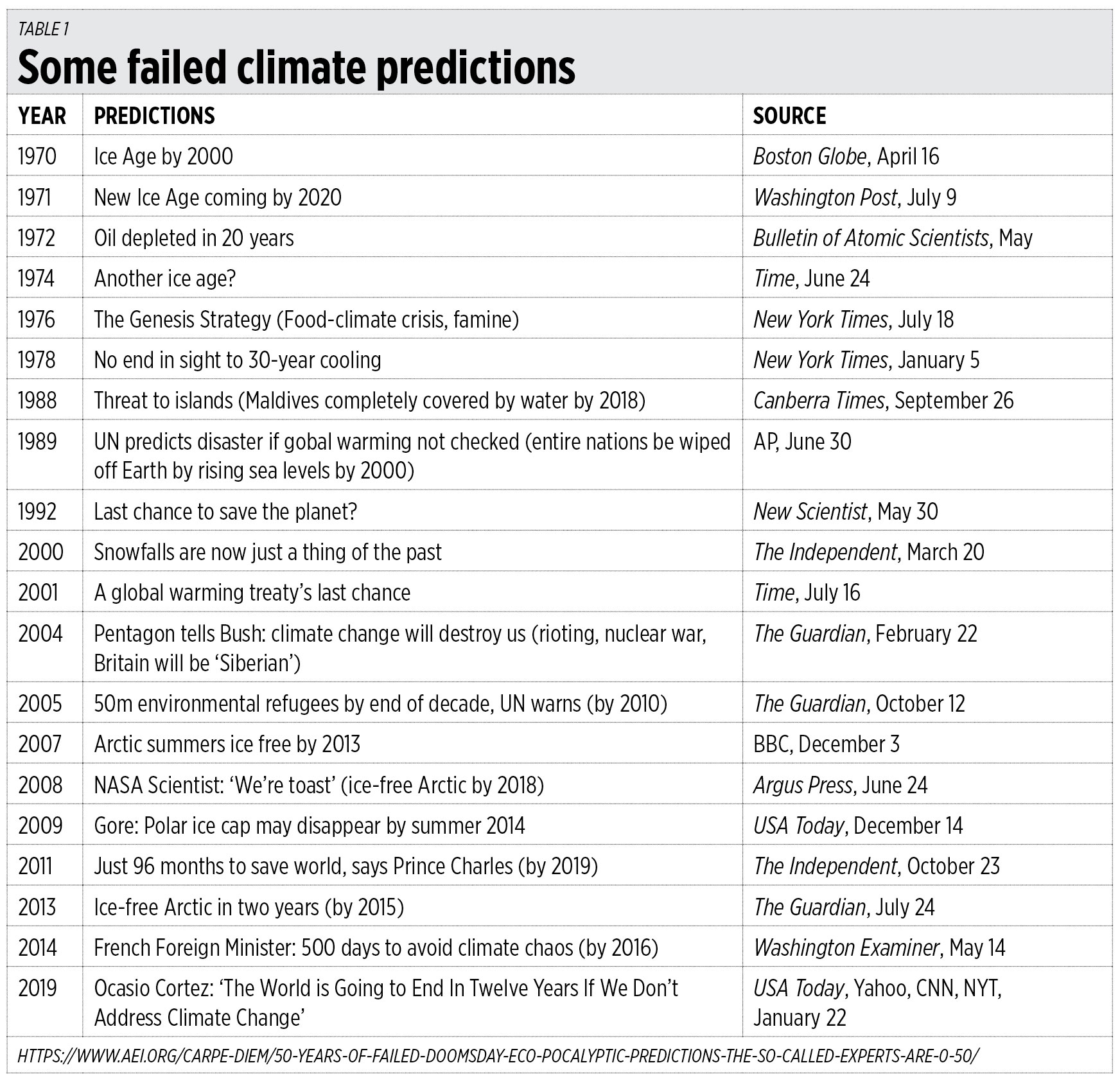
Earth Day was first celebrated on April 22, 1970, 51 years ago, to raise environmental awareness among Americans, and was later adopted in many countries around the world. What later followed were a series of scary climate predictions, all of which were just false alarms.

Below are some stories, headlines, and climate predictions which never materialized. Note that in the 1970s, people were scared of global cooling and a new ice age. This changed to fear of global warming and rising sea levels in the late 1980s, and in the 1990s the anthropogenic or man-made global warming/climate change was solidified. Among the latest climate Armageddon predictions came from US Rep. Alexandria Ocasio-Cortez (AOC) saying that the end of the world will be in 2031 (see Table 1).

The UN, former US Vice-President Al Gore, the World Wildlife Fund (WWF), and Greenpeace are among the big institutions and personalities that push climate alarm worldwide. They target global ecological central planning especially in energy, transportation, agriculture, and other sectors.

Before, big environmental groups like WWF and Greenpeace targeted National Governments for them to bow to their global agenda of “decarbonization” or moving away from fossil fuels (coal, gas, oil) to intermittent renewables (wind, solar, biomass, small hydro). Recently they changed tactics and targeted big corporations, harassing and shaming them if they do not bow to their global agenda.

Last week, Greenpeace launched its new report, “Decarbonizing Meralco,” co-written by the Center for Renewable Energy and Technology (CREST). It is an obvious wind-solar lobby — from cover to body there are lots of wind-solar farms shown. The ideological and emotional bias of the paper is captured by its Table F: PSA Price Forecasts for 2025, where the generation cost of wind and solar in 2025 are projected to be only one-half or one-third of 2019 costs.

Their figures are outlandish and far out. Wind and solar remain expensive and become “viable” only because of various mandates (like priority dispatch in the grid) and subsidies especially the feed-in tariff (FiT) or assured, guaranteed high price for 20 years. Intermittent wind and solar need large batteries to address their highly unstable and fluctuating output and such batteries are not cheap and add to their cost.

Aside from the high prices of wind-solar, their power generation is also very small, only 0.1% of total power generation in 2012, 2.2% of the total in 2019, and 3.8% in first quarter 2021. Table 2’s data on FiT rates come from the Energy Regulatory Commission (ERC), data on power generation mix from the Department of Energy.

In one of my recent columns (https://www.bworldonline.com/carbon-tax-is-not-good/, March 29), Table 1 there showed that “With few exceptions, countries that have retained a high coal share to total power generation — at least 30% — have also experienced fast growth: China, India, South Korea, Turkey, Poland, and Taiwan. And countries that significantly raised their coal share… also experienced fast growth: Indonesia, Malaysia, Vietnam, the Philippines. Countries that reduced their coal share experienced slower growth — the US, Canada, Australia, Germany, the UK, Italy, and Spain.”

So the corporate harassment strategy and “decarbonization” lobby of Greenpeace is based on false climate alarm as shown in Table 1, and on false price assumptions as shown in Table 2.

Meralco and other big energy companies in the Philippines and other countries should not bow to Greenpeace’s alarmist and wind-solar lobby agenda. There is no “climate crisis/emergency” and there is no need to embrace expensive, intermittent, unstable, unpredictable, weather- and battery-dependent energy.


Bienvenido S. Oplas, Jr. is the president of Minimal Government Thinkers

minimalgovernment@gmail.com

Diaz eyes gold medal at Tokyo Olympics

SCREEN GRAB FROM THE ASIAN WEIGHTLIFTING CHAMPIONSHIPS
FILIPINO weightlifter Hidilyn Diaz officially booked a spot in the Tokyo Olympic Games by competing in the Asian Weightlifting Championships in Uzbekistan. — SCREEN GRAB FROM THE ASIAN WEIGHTLIFTING CHAMPIONSHIPS

By Michael Angelo S. Murillo, Senior Reporter

IT took a while for Filipino weightlifter Hidilyn Diaz to book a spot in the Tokyo Olympics this year. So when it was made official that she had earned a spot in the quadrennial Games, she was very thankful.

Ms. Diaz, 30, officially booked a spot in the rescheduled Olympics by competing in the ongoing Asian Weightlifting Championships (AWC) in Uzbekistan. It was the last requirement needed for the Zamboanga City native to make the trip to Japan for the Summer Games happening from July 23 to Aug. 8.

Tokyo will be the fourth Olympics for Ms. Diaz after Beijing (2008), London (2012), and Rio (2016), where she won a silver medal.

“I’m very happy and thankful to be given the opportunity to qualify for my fourth Olympics despite the challenges and the delay because of the pandemic. It is an honor to represent the Philippines again,” said Ms. Diaz in an online interview with BusinessWorld on Monday following her bid in the AWC.

She went on to say that their road to qualifying for this year’s Olympics was tough as they in “Team HD” had to grapple with the limitations presented by the pandemic and make a lot of adjustments in her training and preparation with the Olympics being postponed in 2020.

Ms. Diaz, however, said that all did not go to waste as these provided many lessons for them moving forward.

“We learned a lot from what went through. All Olympics are special because all have their own struggles and challenges. This one is special in its own way. I’m focusing on it right now as I go for my dream of winning a gold medal,” said Ms. Diaz, whose team, which includes strength and conditioning coach Julius Naranjo and Chinese weightlifting coach Gao Kaiwen, is currently based in Malaysia.

In the AWC in Uzbekistan, Ms. Diaz narrowly missed a podium finish, ending up fourth in the women’s 55-kilogram category.

Ms. Diaz finished with a total of 212 kilograms, a kilogram down of bronze winner and hometown bet Muattar Nabieva.

She lifted 94kg in the snatch and 118kg in the clean and jerk.

China’s Liao Qiuyun and Li Yajun finished one and two in the competition. The former finished with a total of 222kg while the latter ended up with 221kg.

Despite falling short of landing on the podium, Ms. Diaz was not totally down on herself, looking at it as an opportunity to work on her game and get better.

“For me, it’s okay. The Asian Weightlifting Championships was a tune-up for us. If we had mistakes, we must address them so that come the Olympics, we have already adjusted and are ready,” she said.

The Olympic weightlifter said they will continue their training in Malaysia and head for China in the weeks leading to the Tokyo Games.

Ms. Diaz became the country’s seventh representative in Japan after pole-vaulter Ej Obiena, gymnast Caloy Yulo and boxers Eumir Felix Marcial, Irish Magno, Nesthy Petecio, and Carlo Paalam.

CONTINUED SUPPORT
Meanwhile, PLDT and Smart reaffirmed their commitment of support to Ms. Diaz and lauded her effort in booking a spot in the Olympics.

Ms. Diaz is a beneficiary of the MVP Sports Foundation (MVPSF), chaired by Manuel V. Pangilinan, who is also head of PLDT. The MVP Sports Foundation is an organization that supports Filipino athletes as they train to bring honor to the Philippines in their respective sports.

“We have always believed in the importance of sports in nation-building, and Hidilyn has given us another reason to be proud as Filipinos. We are continuously supporting her in her journey to the Olympics, as she joins the roster of Filipino athletes who will be representing the country in this much-awaited sporting event,” said Alfredo S. Panlilio, Smart Communications president and CEO and PLDT chief revenue officer, in a statement.

Top Euro clubs in breakaway Super League

Manchester United

MANCHESTER, ENGLAND — Twelve of Europe’s top football clubs announced on Sunday they were launching a breakaway Super League in the face of widespread opposition from within the game and beyond.

The move, which has been heavily criticized by soccer authorities and UK Prime Minister Boris Johnson and French President Emmanuel Macron, sets up a rival to UEFA’s established Champions League competition.

Six clubs from England’s Premier League — Manchester United, Manchester City, Liverpool, Arsenal, Chelsea and Tottenham Hotspur feature among the founding members, along with Spain’s Real Madrid, Barcelona and Atletico Madrid and Italy’s Inter Milan, Juventus and AC Milan, the organization, called Super League, said in a statement.

The league plans to launch “as soon as practicable” and the founding clubs will be given 3.5-billion euros ($4.19 billion) “to support their infrastructure investment plans and to offset the impact of the COVID pandemic,” the statement said.

“We will help football at every level and take it to its rightful place in the world. Football is the only global sport in the world with more than four billion fans and our responsibility as big clubs is to respond to their desires,” said Real Madrid President Florentino Perez, the new founding chairman of the Super League.

The league plans to add three more teams as founder members and then run a 20-team midweek league with five teams qualifying annually “based on their achievements in the prior seasons.”

A women’s Super League competition is also planned to be launched after the men’s league is up and running, the statement said.

The format of the competition would be two groups of 10 playing home-and-away fixtures with the top three in each group qualifying for the quarterfinals. A playoff involving fourth and fifth placed teams will complete the final eight.

Juventus President Andrea Agnelli, vice-chairman of the new league, said the move would secure the long-term future of the game.

“Our 12 founder clubs represent billions of fans across the globe and 99 European trophies. We have come together at this critical moment, enabling European competition to be transformed, putting the game we love on a sustainable footing for the long-term future, substantially increasing solidarity, and giving fans and amateur players a regular flow of headline fixtures that will feed their passion for the game while providing them with engaging role models.” — Reuters

E-Gilas Pilipinas on top of FIBA Esports Open in Southeast Asia once again

E-GILAS Pilipinas beat Indonesia in the FIBA Esports Open III finals on Sunday.

E-GILAS Pilipinas is once again the king of the International Basketball Federation (FIBA) Esports Open in Southeast Asia after winning the title in the third edition of the tournament at the weekend.

The Philippines swept familiar foe Indonesia in their best-of-three finals played on Sunday to rule the online tournament for the second time.

Tournament most valuable player Angelico “Shintarou” Cruzin showed the way for E-Gilas in the team’s finals sweep, providing clutch plays and motor to sustain their fight.

E-Gilas took Game One of the finals (60-53) before closing things out in Game Two (44-36).

The championship was a completion of a dominant showing of the Philippines in the tournament, which featured an expanded field.

E-Gilas won all its games in the group phase against Vietnam and Maldives in Group 1, then shut out Mongolia from Group 2 in their best-of-three crossover semifinals with scores of 95-35 and 64-58.

It was the second title for the Philippines in the FIBA Esports Open after taking the first edition in June where it swept Indonesia in their five-game series.

In the second edition in November, E-Gilas finished runner-up to Australia in the reconfigured Southeast Asia/Oceania conference. The E-Boomers swept the Filipinos in their best-of-three finals.

Being invested in the team, the Samahang Basketbol ng Pilipinas (SBP) expressed pride in seeing E-Gilas continue to do well in the FIBA Esports Open.

“E-Gilas continues to be a source of pride and joy during these tough times as well as inspiration for individuals who wish to pursue a career in gaming,” said SBP President Al S. Panlilio in a statement.

“After the last competition, the SBP saw how hungry E-Gilas was to reclaim the title. They worked hard on their game and have now regained their spot as the best in the region. Even as more competitors entered the field, E-Gilas stood all,” he added.

Apart from Shintarou, other members of the team were Arnie “El Chapo” Sison, Clark Banzon, Custer Galas, Ian Santiago, Philippe “Izzo” Herrero, and Rial Polog, Jr.

Head coach was Nite Alparas and the team manager was Richard Brojan.

Also winning their respective tournaments at the weekend were Egypt in the Africa conference and Saudi Arabia in the Middle East.

The North & Central America (Current Generation) and Europe (Current Generation) conferences are up next on April 23-25.

The Open concludes on May 7-9 with the North & Central America (Next Gen), Europe (Next Gen) and South America tournaments.

In coming up with the FIBA Esports Open, the world basketball governing body looks to add further dimension to it as an organization while also affording the basketball community more action amid the coronavirus pandemic. — Michael Angelo S. Murillo

Nets’ Durant injures thigh in loss to Heat; Knicks beat Pelicans

BROOKLYN NETS FB PAGE
BROOKLYN Nets star Kevin Durant sustained a left thigh contusion in the first quarter against the Miami Heat on Sunday and missed the remainder of the team’s 109-107 road loss. — BROOKLYN NETS FB PAGE

BROOKLYN Nets star Kevin Durant sustained a left thigh contusion in the first quarter against the host Miami Heat on Sunday and missed the remainder of the team’s 109-107 road loss.

Durant scored the Nets’ first eight points before exiting the game with 7:57 left in the first quarter after tangling with Heat forward Trevor Ariza on a drive to the basket.

Nets coach Steve Nash said afterward that Durant will be further evaluated on Monday.

“He’s sore,” Nash said. “But we don’t know how severe. We’ll see tomorrow how he wakes up and goes from there.”

Durant returned to the Nets’ lineup on April 7 after a 23-game absence due to a hamstring injury. Durant played in four of Brooklyn’s previous five games and averaged 23.8 points, 6.3 assists and 5.3 rebounds during that span.

Although Durant was still on a minutes restriction, Nash said prior to the game that the plan was for the 11-time All-Star to be able to play over 30 minutes on Sunday.

Guard Kyrie Irving said it was unfortunate for Durant to go down with another injury.

“Any time one of our teammates goes down, any time something like that happens, it’s definitely going to take a hit for us,” Irving said. “And he’s just gotten back. We just pray that it’s not too serious and he’s able to recover, but it definitely has a hit on our continuity, at times.”

Durant has played in just 24 of Brooklyn’s 57 games. He is averaging 27.3 points per game.

The Nets continue to play without James Harden (hamstring), who has sat out the last six contests.

Randle tows Knicks to win

Meanwhile, Julius Randle had 33 points and 10 assists as the hosts New York Knicks won their sixth consecutive game by defeating the New Orleans Pelicans (122-112) in overtime Sunday afternoon.

Randle added five steals, Derrick Rose scored 23 off the bench, RJ Barrett scored 18, Reggie Bullock had 15, and Nerlens Noel added 12 as New York beat New Orleans for the second time in its past three games. Barrett and Bullock both fouled out.

Zion Williamson had 34 points, nine rebounds and five assists for the Pelicans, while Eric Bledsoe scored 22, Brandon Ingram added 19 and Steven Adams had 10 points and 14 rebounds. New Orleans lost in overtime for the second consecutive game after falling at Washington (117-115) on Friday. — Reuters

Verstappen wins at Imola as Hamilton fights back

AUTODROMO ENZO E DINO FERRARI DI IMOLA FB PAGE
RED BULL’S Max Verstappen won a chaotic and crash-halted Emilia-Romagna Grand Prix at Imola on Sunday. — AUTODROMO ENZO E DINO FERRARI DI IMOLA FB PAGE

RED BULL’S Max Verstappen won a chaotic and crash-halted Emilia-Romagna Grand Prix at Imola on Sunday with Lewis Hamilton second for Mercedes and staying ahead in the championship by a single point.

The win, by a commanding 22 seconds at the checkered flag of the season’s second race, was the 11th of the Dutch youngster’s career.

“It was very challenging out there, especially in the beginning to stay on track to be honest, it was very slippery,” Verstappen said of an afternoon that started with most drivers on intermediate tires but some on full wets.

Hamilton, winner of the Bahrain season-opener, took a crucial bonus point for fastest lap on a rollercoaster afternoon for the seven-time world champion, whose race was almost wrecked by a rare mistake.

The Briton started on pole, his 99th, but dropped from second to ninth after skidding into the gravel and nudging the barriers at Tosa with his car at a standstill and a retirement looming.

He kept the engine running, reversed back out and returned to the pits, a lap behind, for a new front wing.

A huge collision between teammate Valtteri Bottas and Mercedes-contracted Williams driver George Russell on lap 32 of the 63 threw him a lifeline by bringing out red flags with debris strewn across the track.

The drivers blamed each other, with Russell asking the Finn whether he had wanted to kill them both.

With the field closed up again, Hamilton fought his way back to the podium with a stirring recovery drive and passed McLaren’s third-placed Lando Norris with two laps to go.

“On my side, it was not the greatest of days. It’s the first time I’ve made a mistake in a long time,” said Hamilton.

Norris’s podium completed an excellent day’s work for a driver whose deleted best lap in qualifying would have seen him start third rather than seventh.

Hamilton now has 44 points to Verstappen’s 43, with Norris on 27. Mercedes stayed top of the constructors’ standings with 60 points to Red Bull’s 53. — Reuters