Home Blog Page 82

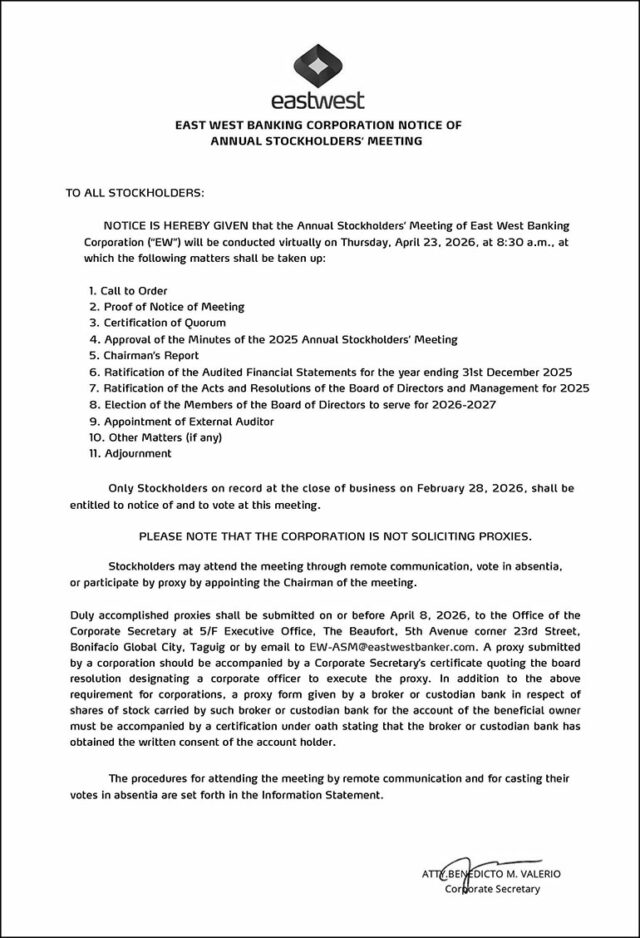
East West Banking Corp. discloses virtual Annual Stockholders’ Meeting on April 23


Spotlight is BusinessWorld’s sponsored section that allows advertisers to amplify their brand and connect with BusinessWorld’s audience by publishing their stories on the BusinessWorld Web site. For more information, send an email to online@bworldonline.com.

Join us on Viber at https://bit.ly/3hv6bLA to get more updates and subscribe to BusinessWorld’s titles and get exclusive content through www.bworld-x.com.

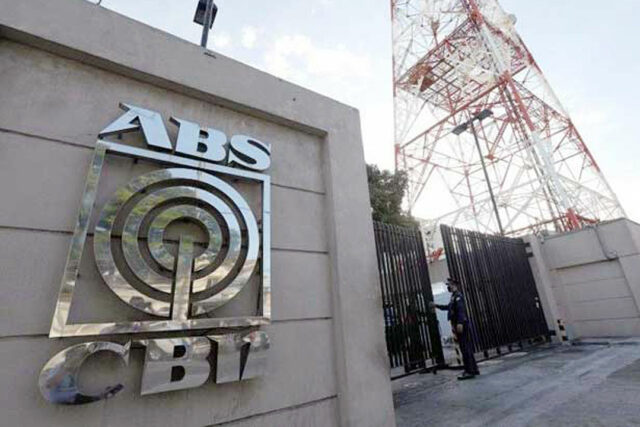
ABS-CBN describes reports on capital infusion, payouts as ‘baseless’

PHILIPPINE STAR/BOY SANTOS

ABS-CBN CORP. said it is not a party to a dispute involving the Lopez family and described reports of a proposed P2-billion capital infusion and alleged executive payouts as baseless.

The company issued the statement following reports of a dispute involving businessman Federico R. Lopez, who filed a lawsuit over his ouster as president and chief executive officer of Lopez, Inc. whose units include ABS-CBN, First Philippine Holdings Corp., and First Gen Corp.

“We wish to state that ABS-CBN is not a party to this case. We, however, wish to address two claims attributed to court records. First, on the claim of ‘unresolved audit findings.’ There were no audit findings. There is nothing to resolve. This claim is unfounded. Second, on the claim that the proposed capital infusion could go to ‘payouts for certain executives.’ No such payouts have been made. No such payouts are planned. This claim is equally baseless,” ABS-CBN said in a statement on Monday.

“Since losing its franchise in 2020, the company has faced challenges unlike any in its history. ABS-CBN has not stopped fighting to ensure its continued existence. It has not stopped serving. The last thing it needs is for its people to be misrepresented in a dispute it is not involved in,” it added.

At the local bourse on Monday, shares in ABS-CBN fell by 17 centavos, or 4.53%, to close at P3.58 apiece. — Ashley Erika O. Jose

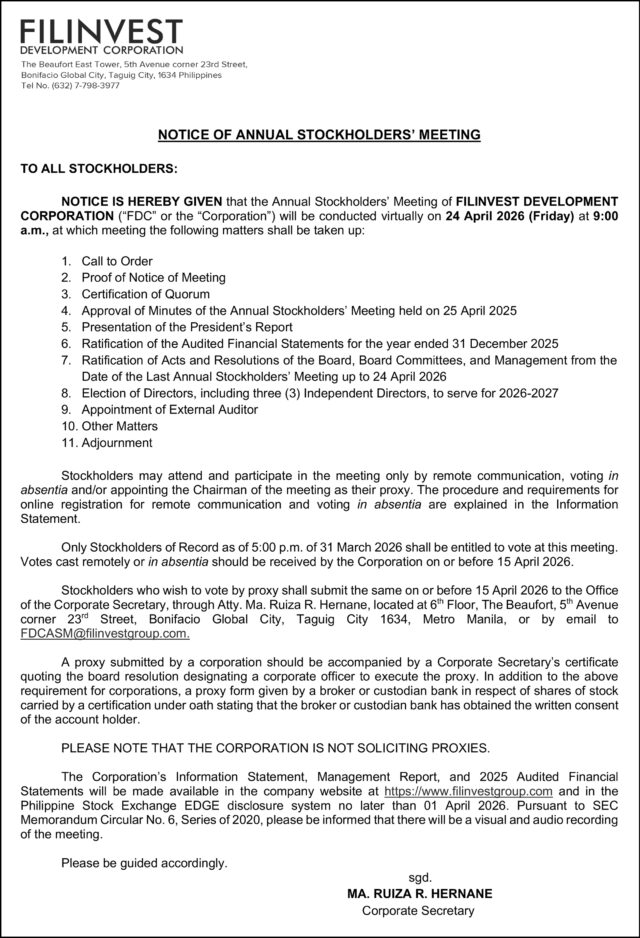
Filinvest Development Corp. to hold 2026 Annual Stockholder’s Meeting virtually on April 24


Spotlight is BusinessWorld’s sponsored section that allows advertisers to amplify their brand and connect with BusinessWorld’s audience by publishing their stories on the BusinessWorld Web site. For more information, send an email to online@bworldonline.com.

Join us on Viber at https://bit.ly/3hv6bLA to get more updates and subscribe to BusinessWorld’s titles and get exclusive content through www.bworld-x.com.

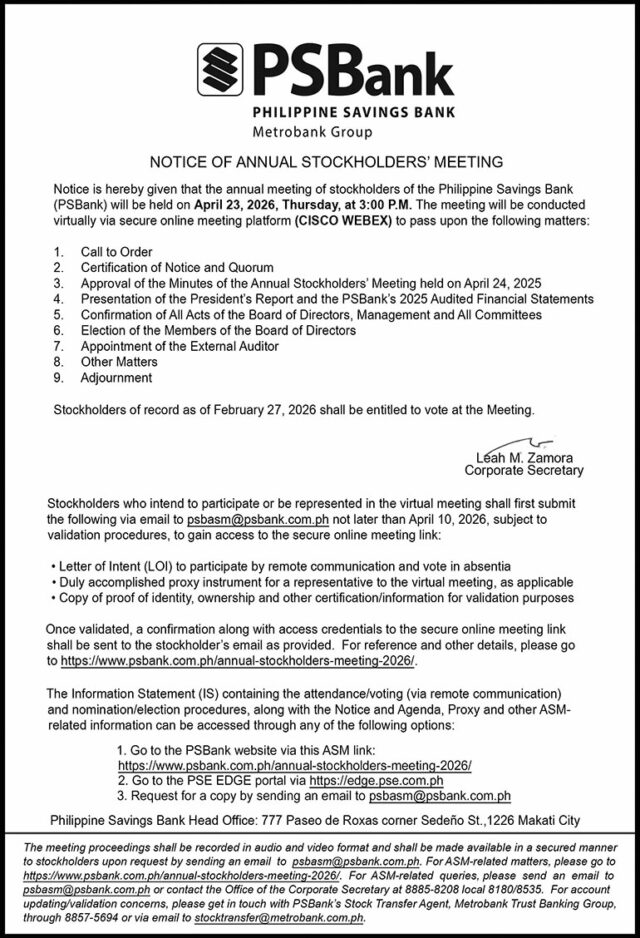
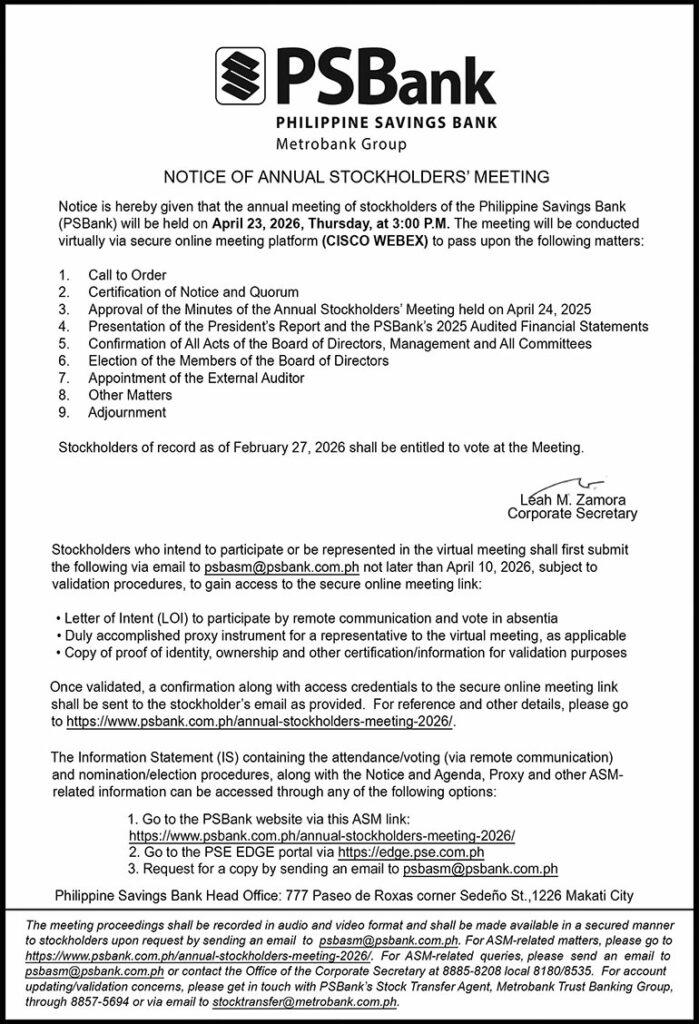
Philippine Savings Bank to hold virtual Annual Stockholders’ Meeting on April 23


Spotlight is BusinessWorld’s sponsored section that allows advertisers to amplify their brand and connect with BusinessWorld’s audience by publishing their stories on the BusinessWorld Web site. For more information, send an email to online@bworldonline.com.

Join us on Viber at https://bit.ly/3hv6bLA to get more updates and subscribe to BusinessWorld’s titles and get exclusive content through www.bworld-x.com.

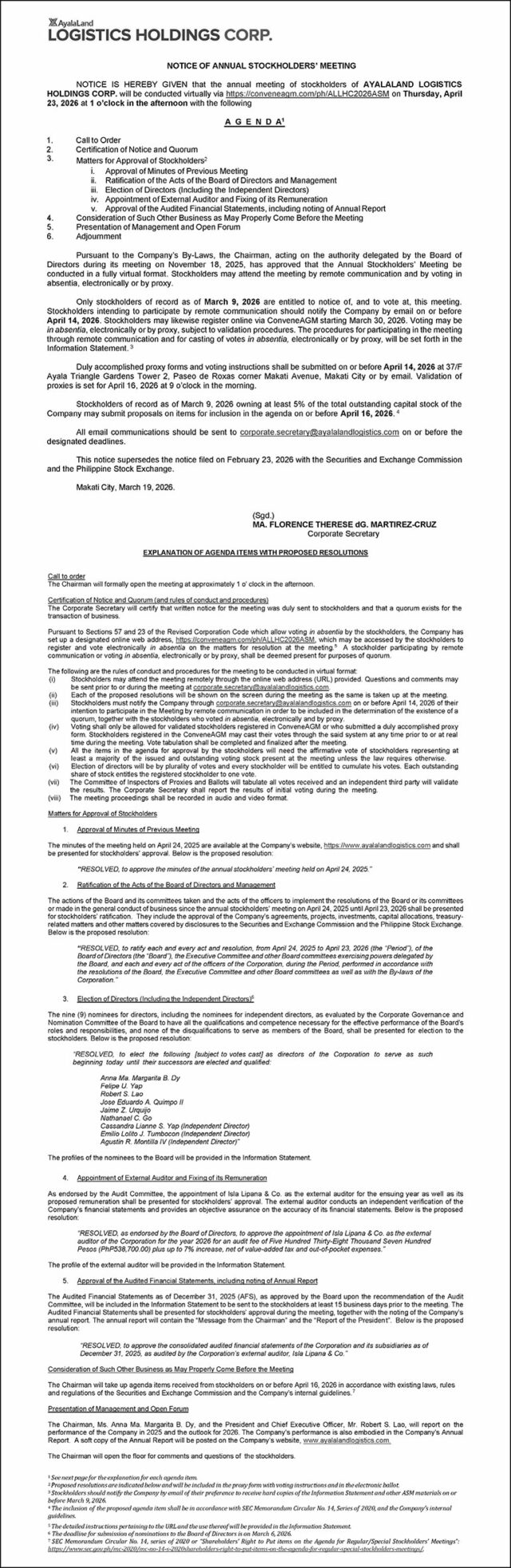
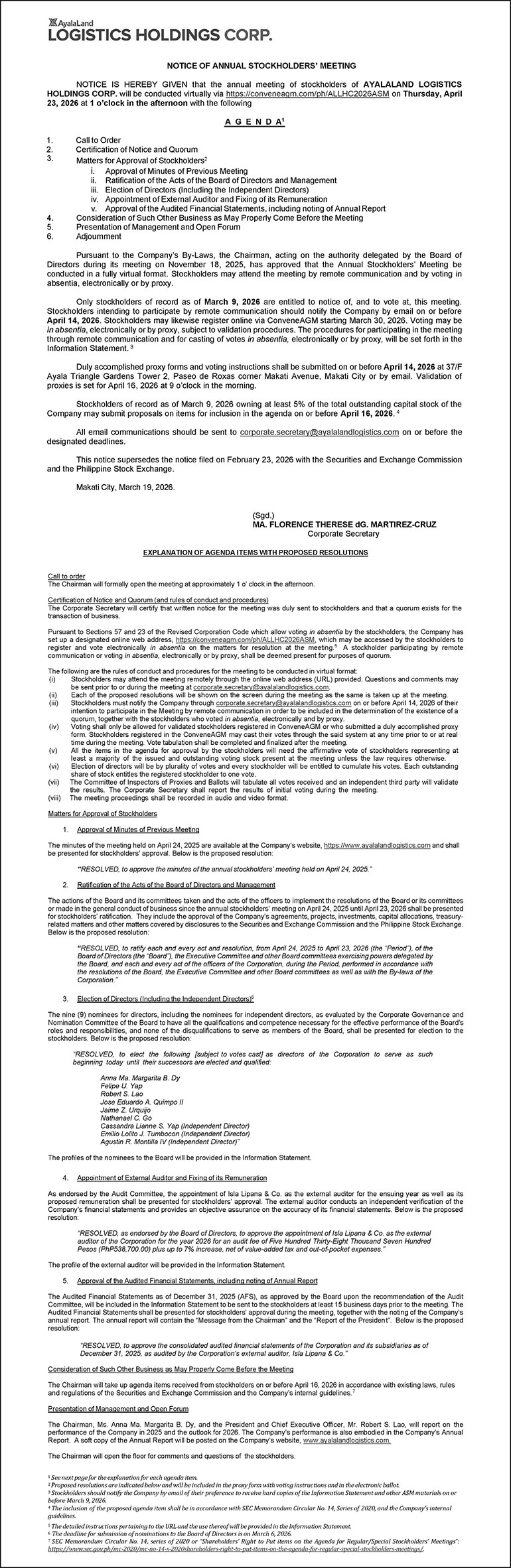
AyalaLand Logistics Holdings Corp. to hold virtual Annual Stockholders’ Meeting on April 23

Click to enlarge


Spotlight is BusinessWorld’s sponsored section that allows advertisers to amplify their brand and connect with BusinessWorld’s audience by publishing their stories on the BusinessWorld Web site. For more information, send an email to online@bworldonline.com.

Join us on Viber at https://bit.ly/3hv6bLA to get more updates and subscribe to BusinessWorld’s titles and get exclusive content through www.bworld-x.com.

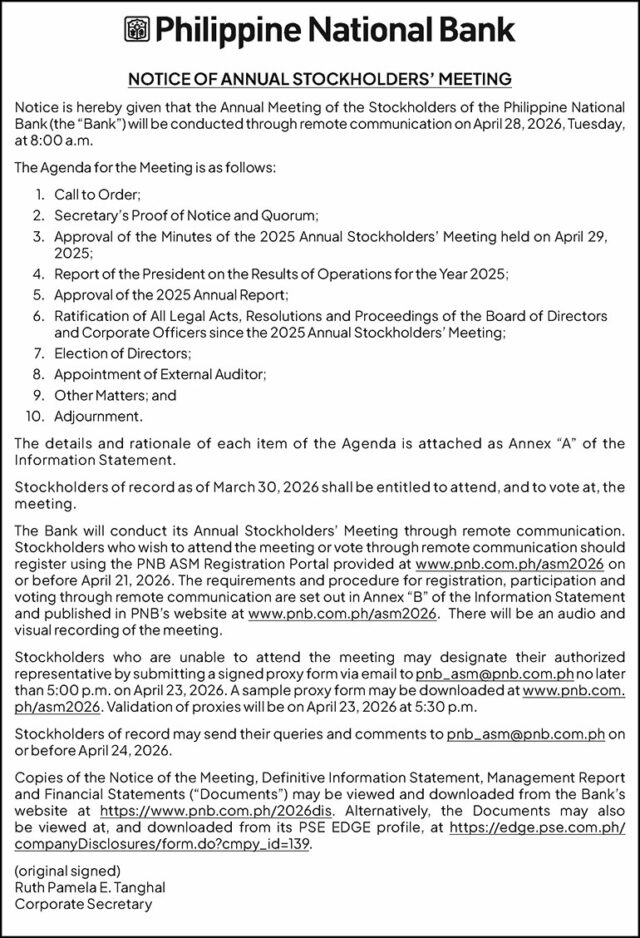
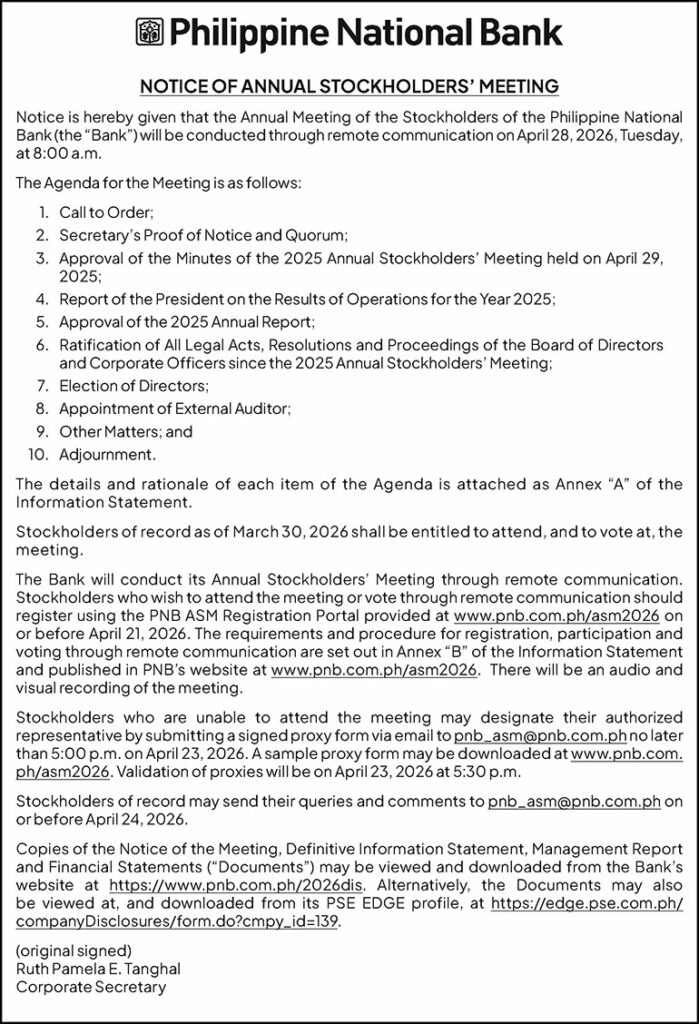
Philippine National Bank’s Annual Stockholders’ Meeting to be held on April 28 via remote communication


Spotlight is BusinessWorld’s sponsored section that allows advertisers to amplify their brand and connect with BusinessWorld’s audience by publishing their stories on the BusinessWorld Web site. For more information, send an email to online@bworldonline.com.

Join us on Viber at https://bit.ly/3hv6bLA to get more updates and subscribe to BusinessWorld’s titles and get exclusive content through www.bworld-x.com.

Philippines charts 32 years of internet growth

Vectorjuice | Freepik

Long before full internet access, Filipino computer enthusiasts in the 1980s built early online communities through bulletin board systems, or BBS, which allowed users to exchange messages and files using dial-up connections.

In 1986, the First-Fil RBBS became the country’s first public-access system, followed by the Philippine FidoNet Exchange in 1987, which linked multiple BBS networks across Metro Manila.

Efforts to build a national academic network followed. In 1990, a government-backed committee led by Arnie del Rosario studied plans to connect universities and state institutions. The proposal did not move forward, but it laid the groundwork for later initiatives.

At 1:15 a.m. on March 29, 1994, Filipino engineer Benjamin “Benjie” Tan established the country’s first direct internet connection at a network center in Makati, linking a Cisco router to a US-based provider through a 64-kilobits-per-second (Kbps) leased line.

Hours later, at 10:18 a.m., the connection was publicly confirmed during an international conference at the University of San Carlos in Cebu, where participants received the announcement: “We’re in.”

However, expansion in the mid-1990s faced constraints, including limited infrastructure and high costs. The telecommunications sector was dominated by a single major provider, and landline penetration remained low.

Access was also concentrated in urban centers and academic institutions, while technical expertise and local digital content remained limited. Such conditions kept internet use within a narrow user base during its early years.

In the following decade, commercial services began to take shape. In 2000, PLDT introduced its Asymmetric Digital Subscriber Line, or ADSL, expanding internet availability beyond institutions.

New players entered the market over time. For instance, Converge ICT Solutions, Inc. secured a congressional franchise in 2009 to build and operate telecommunications infrastructure, later expanding its network to compete with established providers.

Mainstreaming digital life

More than three decades after the first connection, internet use now spans daily life in the Philippines. Millions rely on online platforms for communication, business transactions, education, and public services.

The 2024 National Information and Communications Technology Household Survey reported that 48.8% of households now have internet access, up from 17.7% in 2019, or around 13.56 million households.

About 67.3% of Filipinos aged 10 and above, or more than 61 million people, use the internet. Most users access the internet through mobile phones, with 98.8% relying on these devices.

Metro Manila posted the highest household connectivity rate at 68.7%, followed by Central Luzon at 61.3%. In contrast, the Bangsamoro Autonomous Region in Muslim Mindanao recorded 27.7%, while the Zamboanga Peninsula posted 21.2%.

According to DataReportal, 99.7% of the Philippines’ total internet user base, regardless of age, used at least one social media platform in January 2024. Among social media platforms, Facebook still had the largest number of users at 86.75 million during the same period.

Meanwhile, connectivity intelligence firm Ookla reported that median fixed broadband speeds reached about 94.42 megabits per second (Mbps) in the second quarter of 2024, up 51% from 62.51 Mbps in 2022. Mobile speeds also increased, with a median of 27.75 Mbps in early 2024.

Regions in Luzon posted the fastest fixed broadband performance in the Philippines, with the top five areas all recording download and upload speeds above 90 Mbps. Region IV-A or CALABARZON recorded the highest median fixed download speed at 99.55 Mbps, while Eastern Visayas posted the lowest at 38.43 Mbps.

Addressing internet barriers

The World Bank noted that the Philippines only recorded 28 mobile towers per 100,000 people in 2022, about one-third of the Southeast Asian average. Telecom infrastructure investment also declined from 0.64% of gross domestic product in 2018 to 0.44% in 2022.

Cost continues to limit internet access for many households. Among those without internet, 58.3% cited high subscription fees as the main reason, while 41.7% pointed to both service and equipment costs.

Although average monthly spending dropped to P1,069.10 in 2024 from P1,280.59 in 2019, broadband remains expensive relative to income. Fixed broadband costs account for about 11% of per capita gross national income, about twice the Southeast Asian average.

According to the World Bank, outdated regulations remain a major barrier to addressing the digital divide. Laws governing telecommunications, including the 1931 Radio Control Law and the 1995 Public Telecommunications Policy Act, date back to 1931 and 1995 and have not kept pace with technological changes.

To address major internet challenges, the government has launched several initiatives, led by the Department of Information and Communications Technology (DICT). These include the National Broadband Program, the National Fiber Backbone project, the Free Wi-Fi for All program, and the Common Tower initiative.

The Marcos administration has also unveiled a P6-trillion National Digital Connectivity Plan aimed at accelerating internet expansion and improving service quality. The plan focuses on four pillars: governance, infrastructure investment, meaningful access, and network resilience.

In a statement, DICT Secretary Henry Rhoel R. Aguda said the connectivity plan, alongside the Konektadong Pinoy initiative, aims to provide affordable and resilient connectivity for every Filipino.

“Connectivity is no longer just a tech issue, it is an economic issue, a job issue, and an inclusion issue,” Mr. Aguda said. “Let us move with urgency, let us move with purpose and let us move together so no Filipino, no matter where they live, is left behind.”

President Ferdinand R. Marcos, Jr. also promised to continue pursuing reforms in the telecommunications sector so more Filipinos can access the internet.

“We have seen this progress take shape. The rollout of 5G networks, the deployment of fiber-optic cables, the growth of mobile broadband, and the rise of digital services have transformed how Filipinos communicate, how they study, do business, and engage with government,” he said during his speech at the Philippine Telecom Summit 2026.

At the same time, telecommunications companies are expanding fiber networks and upgrading technologies to improve service. Fiber deployment has increased significantly, with millions of households now within reach of fiber connections.

Fixed wireless access and satellite services are also emerging as alternatives, particularly in remote areas where fiber deployment is difficult due to the country’s geography of more than 7,000 islands.

Satellite internet services, including low-Earth orbit systems, have expanded, though performance and cost remain concerns compared to fixed broadband. — Mhicole A. Moral

What to Do on Holy Week


Watch Martir sa Golgota

THE musical Martir sa Golgota will be performed this week for free in various public venues. Produced by Tanghalang Santa Ana and directed by Lou Veloso, the show centers on characters such as Lazarus and Martha and delivers messages on love, faith, and transformation in line with the Holy Week. Its remaining shows this week are at the municipal plaza of General Trias, Cavite, on March 31, 8 p.m., and at Plaza Hugo in Santa Ana, Manila, on April 1, 7 p.m. Admission is free.


Lenten exhibit at Fisher Mall

THE FISHER MALL branch in Quezon Ave. Quezon City, in partnership with Veritas DZRV 846, has mounted a special Lenten-Holy Week exhibit titled Transitus: Journeying with Christ from the Cross to Eternal Life. It celebrates the 800th anniversary of the Transitus of St. Francis of Assisi, with the goal to allow visitors to reflect and deepen their faith. It features a variety of religious images. It is located at the Event Center on the upper ground floor of Fisher Mall, Quezon Avenue, and runs until April 5. Meanwhile, the mall is also the venue for the Hoppy Easter Wonder Land on Easter Sunday, April 5, 11 a.m., at the 4th floor hallway near Kids Paradise. It is open to children ages one to 12. Registration is now ongoing until April 4 at a booth on the Upper Ground Floor near the Event Center. To join present a P1,500 single or accumulated receipt. There will be an egg hunt, mascot appearances, face painting and DIY bunny mask painting, and a magic show.


Easter at Megaworld Malls

THIS Easter season, Megaworld Lifestyle Malls will have Easter-themed installations and experiences at their various malls. The biggest is a 24-foot bunny and 10-foot Easter egg serving as the visual centerpiece at Uptown Bonifacio, designed by florist Teddy Manuel with layers of pastel blossoms and sculptural accents. On April 5, the mall will have Easter Safari, a lineup of activities for children ranging from designing their own Easter eggs and making cupcakes, to watching magic tricks, musical safari performances, and puppet shows. There will also be a classic Easter egg hunt and face painting. Similar events will take place at Eastwood City, Venice Grand Canal, ForbesTown, McKinley West, Lucky Chinatown, Alabang West Parade, Southwoods in Laguna, Twin Lakes in Tagaytay, and Festive Walk Iloilo, all on April 5.


Free kids’ activities at Anko

TO KEEP children entertained, Australian home and lifestyle brand Anko is hosting free in-store activities and dropping an affordable Easter collection. On the weekend, from 2 to 5 p.m., Anko Club parents can treat their kids to Easter coloring sessions across all Anko stores. Little artists who post their works on social media will receive an exclusive Easter goodie bag. There will be a face painting activity at the Glorietta Activity Center in front of the mall’s Anko branch from April 4 to 5. Finally, at Anko stores, families can buy egg hunt gear and DIY kits.


Easter events at Araneta City

THIS Easter, Araneta City will be celebrating with their “Level Hop” lineup of events, all taking place on April 5, 2 p.m. onwards at the area’s various malls. At Gateway Mall 2’s Quantum Skyview, there will be a costume contest, an Easter spectacle performance, DIY tote bags, a kids’ coloring activity, a 360 photobooth, and loot bags. Over at Gateway Mall 1’s Activity Area, mallgoers can expect the “Hoppy Easter Fun Fest,” with giant inflatables, free gashapon toys, and loot bags. The Farmers Plaza Activity Area’s party will have face painting and giant inflatables while the Ali Mall Activity Area will host bunny ear and egg painting as well as a photobooth. Those who want to join the “Easter Level Hop Run” egg hunt should be ready in the morning, as it takes place from 5 to 9 a.m. at Smart Araneta Coliseum’s Green Gate.


Easter quest at Shang Plaza

THE traditional egg hunt will be turned into something more adventurous at Shangri-La Plaza mall. Named the “Super Easter Quest,” the mall-wide, game-inspired experience will let kids become players that must collect Golden Eggs, earn stars, and complete a quest across the mall. The young participants must follow a Quest Map and complete a series of challenges set up around the Grand Atrium on April 5. Each station unlocks a Golden Egg that brings them one step closer to finishing the quest and claiming their Super Star Prize Pack. Participation is open to children, with a registration fee of P2,000 per kid. Register via this link: https://eventsatshangri-laplaza.helixtickets.asia/.

The Velaris Residences North Tower: Living spaces that inspire an intentional life

One-and-a-Half Bedroom Suite’s Indoor Patio | Show Unit Image

More than providing basic living essentials in the best means possible, a liveable community creates an environment that can spark inspiration, excitement, and joy to its residents.

RHK Land, known for its signature intentional design philosophy, has put these considerations in mind with The Velaris Residences and its elegant North Tower.

For its second tower, the North Tower, RHK Land takes luxury to a whole new level. While rising to 40 storeys, the North Tower houses a limited collection of units, each masterfully designed to the minutest detail to reflect a lifestyle that melds together tasteful aesthetics, easy comfort, and quiet discretion.

All residences, which range from one- to four-bedroom units, are elegantly proportioned with generous floor plans. The four-bedroom, penthouse, and townhouse suites are of special note with their impressive double-volume ceilings. This bold architectural detail imbues these units with an airy grandeur, transforming them into inviting spaces that lend themselves naturally to both restful retreats and graceful entertaining.

4-Bedroom Suite’s Master Bedroom | Show Unit Image

One- and one-and-a-half bedroom units are equipped with spacious indoor patios, which enable residents to bring the outside in and create indoor oases that both calm and reinvigorate. The rest of the units feature balconies which bring the joys of outdoor living. A thoughtful approach to layouts that maximize natural light further enhances a feeling of brightness and openness in every unit.

The units are equipped with smart home features. Digital door locks with biometric fingerprint scan, PIN code, and RFID card access ensure security. Light and air-conditioning systems, which can be controlled remotely through smart devices, deliver convenience and energy efficiency. In addition, two-bedroom and larger units also have smart mirrors, which deliver news, weather reports, and even personal calendars to help residents prepare for and organize the rest of the day.

The private lifts for two-bedroom and bigger units, along with the two-units-to-one-elevator ratio on typical floors, provide North Tower residents with a high level of privacy.

These features are coupled with best-in-class amenities that are comparable to five-star hotel facilities. These include an indoor and outdoor Japanese Sento, a sculpture garden, a garden lounge with floating daybeds, a lifestyle gym with a dance studio and cycling studio, a badminton and pickleball court, a golf simulator studio, an Olympic-length infinity pool, a treetop playground, and camping grounds.

Acknowledging recent shifts in how people live and work, The Velaris Residences North Tower has a business lounge and a creative studio, both furnished for productive hybrid work arrangements.

Smart lockers and a secure mailroom, meanwhile, allow for convenient package deliveries with limited interaction.

4-Bedroom Suite’s Living Area with Double-Volume Ceiling | Show Unit Image

On top of these amenities, The Velaris Residences carries an exclusive Velaris SkyClub, which allows residents to immerse themselves in their interests and pastimes without having to take one step outside. Velaris SkyClub includes a private theater and game room for entertainment aficionados, a wine gallery and casual and gourmet dining areas for gourmands, and a cigar room for tobacco connoisseurs. The development can also host private gatherings with its SkyLounge, SkyBar, and SkyDeck areas.

Residents are also provided with a companion app to access property management services and updates. Through the app, residents can settle dues, send requests for maintenance, coordinate deliveries, and book amenities with just a few taps on their smartphones.

For such designs and features that elevate luxury living within the Metro, The Velaris Residences has achieved major recognitions at the 2025 PropertyGuru Philippines Property Awards, among them “Best Condo Development (Philippines)”, “Best Luxury Condo Development (Metro Manila)”, and “Best Condo Interior Design.”

The Velaris Residences sits in a prime spot in Bridgetowne, a 31-hectare mixed-use community that stretches across Pasig City and Quezon City. It is home to Opus Mall, the impressive Victor statue, grade A office buildings, a FIFA-preferred sports field, and the world’s biggest outdoor obstacle park. In the future, it will also feature hotels and schools. All these show that The Velaris Residences, while a thriving community in itself, is housed in a greater community that maximizes the best in urban living.

Know more about The Velaris Residences North Tower by visiting The Velaris Residences Show Gallery in Bridgetowne, calling the sales hotline at +63917 855 5033, or visiting thevelarisresidences.com.


Spotlight is BusinessWorld’s sponsored section that allows advertisers to amplify their brand and connect with BusinessWorld’s audience by publishing their stories on the BusinessWorld Web site. For more information, send an email to online@bworldonline.com.

Join us on Viber at https://bit.ly/3hv6bLA to get more updates and subscribe to BusinessWorld’s titles and get exclusive content through www.bworld-x.com.

Leadership in uncertain times: 5 priorities for business amid the Middle East crisis

STOCK PHOTO | Image by Tirachardz from Freepik

The crisis in the Middle East may ultimately prove more difficult for business than COVID-19.

During the pandemic, there was at least a clear response. Stay home. Get vaccinated. Shift work and commerce online. Governments, businesses, and households may have struggled, but there was a playbook.

This time, there is none.

The risk today is not a virus but rising oil prices, and oil touches every aspect of the economy. When fuel prices rise, transport costs increase. Logistics costs go up. Food becomes more expensive. Electricity, manufacturing, and even the cost of doing business increase. Unlike COVID-19, where the effects were immediate but contained by restrictions, this crisis moves quietly through the entire economy.

For the Philippines, which imports most of its fuel requirements, this is particularly serious. President Ferdinand Marcos, Jr. has already recognized the danger through Executive Order No. 110 declaring a national energy emergency. The concern is not only what happens in the Middle East in the coming days. It is what happens here at home in the coming months.

Even if the conflict de-escalates, the economic effects may linger. Oil prices may remain elevated. Supply chains may take time to normalize. Food inflation may persist. Consumers may cut back spending. The pressure will be felt most sharply by lower-income Filipinos, who comprise the majority of our population and who spend a larger portion of their income on transportation, food, and electricity.

Many people keep asking when the war will end. My answer is simple: we do not know, and from a management standpoint, that is the wrong question.

Business leaders should stop waiting, forecasting, or speculating over whether the conflict will end next week, next month, or next quarter. None of us can control that. What we can control is how prepared our organizations are if uncertainty lasts longer than expected.

We are no longer operating in a world where stability can be assumed. Geopolitical conflict, inflation, supply chain disruption, cyber threats, and economic volatility are now part of the business environment. The organizations that will survive and succeed are not those that make the best predictions. They are the ones that build the greatest resilience.

The task of management today is not to guess when conditions will improve. It is to create organizations that can continue to perform even if conditions do not.

That is why many companies are beginning to revisit the protocols they adopted before and during COVID-19. Work-from-home (WFH) arrangements are again being discussed. Rotating schedules, compressed workweeks, and virtual meetings are returning. Companies are preparing not because we are facing another pandemic, but because they recognize that a prolonged energy and inflation shock requires a similar level of discipline and flexibility. Thus, I believe there are five things every company should focus on today.

First, take care of your people.

The first and most immediate effect of this crisis will be felt by employees. Higher fuel prices will eventually mean higher food prices, higher transportation costs, and greater financial pressure on households. Many employees are already managing tight budgets. For those in lower income brackets, even a modest increase in the price of gasoline or rice can create significant strain.

Companies need to be proactive and sensitive. Review transportation allowances, meal subsidies, emergency assistance, and flexible work arrangements. If certain roles can be performed remotely, then WFH or hybrid work should be seriously considered. This is no longer simply an HR issue. It is an operational and economic response to changing conditions.

Equally important is communication. Employees need to know that management understands the situation and is responding. During difficult periods, people do not expect perfection from leadership. They expect clarity, empathy, and decisiveness.

Second, preserve cash.

The lesson from every crisis is the same: cash provides options.

During COVID-19, the companies that weathered the crisis best were not always the largest or the fastest growing. They were the ones that protected their cash position early, managed expenses carefully, and prepared for the possibility that the crisis would last longer than expected.

The same discipline is required now. Companies should review expansion plans, defer non-essential capital expenditures, reduce discretionary spending, and strengthen working capital. Large investments that can wait should wait. Growth is important, but survival and stability are more important.

This is not the environment for aggressive assumptions. Business leaders should prepare for a scenario where oil prices remain high for several months and consumer spending weakens. The companies that preserve liquidity today will be in the best position to respond tomorrow.

Third, rethink operations.

The operating model that worked six months ago may no longer be the right one today.

Businesses should look at whether rotating work schedules, compressed workweeks, staggered shifts, or WFH arrangements can improve efficiency and reduce cost. Companies should review energy consumption, logistics routes, delivery schedules, and supplier relationships.

Many organizations learned during COVID-19 that productivity does not always require everyone to be physically present every day. They also learned that digital tools can reduce travel, lower costs, and improve efficiency. Those lessons remain relevant.

This may also be the right time to revisit supply chains. Companies that rely heavily on imported materials or a single supplier may be more vulnerable if the crisis deepens. Building alternative suppliers and increasing local sourcing where possible may no longer be a matter of cost. It may be a matter of resilience.

Fourth, move sales and marketing back online.

If oil prices continue to rise, consumer behavior will change. Families will reduce discretionary spending. People may travel less, dine out less, and spend less time in malls. Retail traffic may soften, particularly in sectors dependent on physical visits.

That does not mean demand disappears. It means demand shifts.

During COVID-19, many companies accelerated their move to digital platforms because they had no choice. Today, they may need to do so again, not because stores are closed, but because consumers are becoming more cautious and more value conscious.

Sales teams should strengthen online selling, virtual presentations, and customer relationship tools. Marketing should move where consumers are spending more of their time: online, on social media, and on digital commerce platforms. Businesses that remain visible and accessible digitally will have a much greater chance of protecting sales in a weaker environment.

This is particularly important for SMEs. Many SMEs survived the pandemic because they learned how to sell through Facebook, TikTok, Viber, online marketplaces, and delivery platforms. Those capabilities should not be treated as temporary. They are now part of the permanent toolkit of doing business.

Fifth, focus on resilience, not simply survival.

The tendency, in times like this, is to focus only on the immediate problem. But good management requires looking beyond the next few weeks.

Every company should ask itself a few difficult questions. What happens if oil prices rise further? What if inflation persists through the rest of the year? What if consumer demand slows more than expected? What if supply chains are disrupted again?

The strongest companies will not be the ones that merely react. They will be the ones that prepare.

That means strengthening business continuity plans, building stronger balance sheets, diversifying suppliers, investing in digital capabilities, improving energy efficiency, and developing leaders who can make decisions in uncertain conditions.

The world today is more volatile than it was five or 10 years ago. Geopolitical conflict, inflation, climate events, cyber threats, and economic disruption can happen at the same time. Stability can no longer be assumed.

We all hope the conflict in the Middle East ends soon. But even if it does, the after-effects may remain. That is why businesses cannot afford to wait.

The challenge before us is not simply to survive another crisis. It is to build organizations strong enough to withstand one.


Dr. Donald L. Lim is the 2026 president of the Management Association of the Philippines. He is also president and COO of DITO CME Holdings Corp.

map@map.org.ph

donaldpatricklim@gmail.com

PAL suspends Manila-Riyadh flights until April 8 amid conflict

BW FILE PHOTO

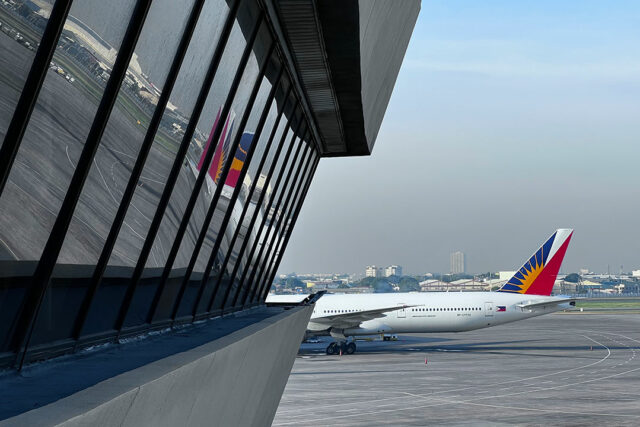
FLAG CARRIER Philippine Airlines (PAL) said it is suspending its Manila-Riyadh flights until April 8 due to the conflict in the Middle East.

“This precautionary measure is being taken considering the security situation affecting parts of the Middle East and the resulting operational uncertainties in certain regional airspace corridors and airport operations,” it said in a statement on Monday.

PAL said it will continue to monitor developments and coordinate with aviation authorities to determine when it can safely resume operations.

The airline said cargo operations on the affected routes are also disrupted and that it is exploring alternative routing options to ensure the movement of essential goods.

Meanwhile, PAL Holdings, Inc., the listed operator of Philippine Airlines, said its Ba2 rating from Moody’s Ratings is expected to expand its access to diverse funding sources, while validating gains in operational reliability and financial performance.

“This inaugural Ba2 rating is a powerful validation of progress we have made over the past five years — enhancing operational reliability, rebuilding our network with discipline, and improving our cost and capital structure,” PAL President Richard Nuttall said in a statement on Monday.

According to Moody’s March 27 rating report, the company was assigned a stable Ba2 corporate rating, reflecting its role as the national flag carrier and its consistent market share across domestic and international routes.

Moody’s said the stable outlook indicates PAL’s operating and financial metrics are expected to remain aligned with its rating over the next 12 to 18 months, allowing some flexibility to absorb potential downside risks.

“The table outlook reflects our expectations that PAL’s operating and financial metrics will remain commensurate with its rating over the next 12 to 18 months, with some flexibility to absorb potential downside risks. We also expect PAL to effectively expand its fleet and maintain or expand its market shares both for domestic and international travel,” Moody’s said.

PAL said the Ba2 rating reflects its creditworthiness and economic resilience, noting that it is three notches below the country’s sovereign credit rating of Baa2.

“Importantly, having this rating will strategically broaden our access to diverse funding sources and provide our stakeholders with independent assurance of PAL’s financial resilience in a complex global aviation landscape,” Mr. Nuttall said.

Moody’s said PAL benefits from a stable position in the aviation industry and could see a rating upgrade if it achieves significant improvements in its operating and financial profile.

“Alongside sustained or expanded market share. Demonstrated success in fleet expansion will also be necessary for an upgrade,” it said.

In January, PAL received its first Airbus A350-1000 aircraft and expects to take delivery of four more out of its nine remaining orders this year.

However, Moody’s said PAL’s rating could be downgraded if its operating and financial performance weakens, such as if its earnings before interest and taxes (EBIT) margin falls below 7%.

“The rating could also come under pressure if PAL’s domestic or international market shares deteriorate significantly or the company faces liquidity pressures. Any indication of fuel supply disruptions or restrictions could also pressure PAL’s credit profile,” it said.

Moody’s also cited risks including airport infrastructure constraints, exposure to fuel price volatility, weaker foreign exchange, and the company’s history of restructuring under Chapter 11.

“While PAL has limited direct exposure to the Middle East, it remains indirectly exposed to fuel price volatility and potential demand weakness arising from geopolitical and macroeconomic uncertainty,” it said.

At the local bourse on Monday, shares in PAL Holdings rose one centavo, or 0.29%, to close at P3.39 apiece. — Ashley Erika O. Jose

Bond market activity may slow as war drives up rates

PSE President and Chief Executive Officer (CEO) Ramon S. Monzon — PRESIDENTIAL PHOTOJOURNALISTS ASSOCIATION (PPA) POOL YUMMIE DINGDING

CORPORATE BOND issuances and trading could slow this year due to the Middle East war, which could stoke inflation and increase the possibility of monetary tightening here and abroad.

Philippine Stock Exchange, Inc. and Philippine Dealing System Holdings Corp. (PDS Group) President and Chief Executive Officer Ramon S. Monzon said reaching the record P15.9 trillion in secondary market trading volume recorded last year could be difficult amid the ongoing Iran conflict.

“Last year, we had very good trading because interest rates were going down. And now that BSP (Bangko Sentral ng Pilipinas) is talking about increasing rates, it might not be as healthy as last year,” he told BusinessWorld on the sidelines of an event last week.

“We hit about P15.9 trillion last year. So far, we’re still hitting the first three months. We’ve hit more than a trillion a month. So, it depends on where the rates go.”

He noted that no issuance has matched the P115 billion raised by BDO Unibank, Inc. via 1.5-year ASEAN Sustainability Bonds in July last year, which is the largest single corporate bond issue in the Philippines to date,

“Well, the biggest was the BDO [issue] last year. But so far, no indications of that,” Mr. Monzon said.

In 2025, trading volume at the secondary market hit a record P15.91 trillion, surging by 61% from 2024’s P9.89 trillion, as monthly volumes exceeded P1 trillion for 12 straight months, data from the PDS Group showed.

The primary market also saw 25 bond listings from 21 issuers worth P454 billion last year, up by 25% from P362.23 billion in 2024.

As of March 18, new bond listings and enrollments at the primary market reached P220.259 billion so far this year, with total tradeable corporate debt instruments now at P1.4 trillion, issued by 44 companies and made up of 168 securities. 

On Thursday, the BSP kept benchmark rates unchanged during a surprise off-cycle meeting as it sought to calm markets amid growing concerns over the impact of the Middle East war on the economy.

The Monetary Board kept the target reverse repurchase rate unchanged at 4.25% as BSP Governor Eli M. Remolona, Jr. said growth prospects remain weak and the emerging inflationary risks amid the war are largely supply-driven, “for which monetary policy has limited effectiveness.”

The central bank now expects headline inflation to average 5.1% this year — well above its 2-4% tolerance band. Annual inflation last breached the target in 2023.

Mr. Remolona said they would consider tightening their stance if it sees second-round inflation effects or if the global oil supply and price situation worsens.

The BSP last raised rates in October 2023.

The off-cycle meeting came ahead of the Monetary Board’s scheduled policy review on April 23.

Global oil prices have surged above $100 a barrel in the past weeks as the US-Israel and Iran war continues.

Secondary market yields have climbed steadily since the conflict began, with traders pricing in expectations of tighter monetary policy due to the war’s impact on energy trade.

The Asian Development Bank’s March 2026 Asia Bond Monitor report showed that outstanding Philippine local currency bonds shrank by 0.7% to $233 billion (about P13.89 trillion) at end-2025 from $237 billion as of September 2025. This was equivalent to 48.9% of gross domestic product.

This was worse than the 0.1% contraction in the previous quarter.

Year on year, the Philippine bond market expanded by 6%.

INITIAL PUBLIC OFFERINGS
Meanwhile, Mr. Monzon said he is still waiting for the applications for the planned initial public offerings (IPO) of Maya Innovations Holdings, Pte. Ltd. and GCash.

Both fintech firms are expected to launch their IPOs in the third quarter this year, with Maya eyeing a dual listing.

“I think Maya’s not going to do it here. They will do it abroad. They have not filed an application with us,” Mr. Monzon said. “I know GCash is the one that’s really working on it.”

Maya Chairman Manuel V. Pangilinan earlier said that the company is planning to list in the United States first before launching on the PSE by the second half of the year.

The PSE previously said it expects four IPOs this year, including GCash and Maya, as well as PNB Holdings Corp. — Aaron Michael C. Sy