Home Blog Page 808

How does the Philippines compare in mining contribution?

The Philippines fell a notch to 44th out of 110 countries with an index score of 54.8 out of 100 in the latest edition of the Mining Contribution Index (MCI) by the International Council on Mining and Metals (ICMM). The index, which used 2022 data, measures the relative importance of mining to national economies, ranking countries based on three equally weighted indicators which captures mining’s contribution to economic activity.

How does the Philippines compare in mining contribution?

Silver’s record run is being driven by solar power

https://www.freepik.com/free-ai-image/view-heavy-machinery-used-construction-industry_154036280.htm#fromView=search&page=1&position=1&uuid=3973d225-a05d-4f21-a27a-7d63311c103a&query=mining

By David Fickling

SILVER’s booms and busts are typically turbocharged by excitable investors. Sober industrialists bear their share of responsibility, though.

It’s worth reflecting on that fact, given the 67% run-up in spot prices so far this year. The precious metal’s current surge to a record $54.24 a troy ounce last week looks to be weakening as speculative enthusiasm subsides: It fell 7.1% on Tuesday. But anyone hoping for a return to levels below $30, which looked like a price ceiling until about 12 months ago, may be in for a long wait.

That’s because silver is an industrial metal in all but name. Coin and bullion investors consume barely a fifth of annual production, with jewelry and cutlery adding another fifth. The remainder goes into factories, where it has an array of uses.

Many of silver’s most notorious price spikes have been driven by this industrial demand. In 1979, three Texan oilmen managed to corner the market, driving up prices 62% between Christmas Eve and the first trading day of 1980 before a margin call sparked a wider financial panic. (That incident was the inspiration for the classic festive commodities comedy, Trading Places.)

It wasn’t pure speculation, though. Just as every conspiracy theory contains a grain of truth, every financial bubble contains a puff of genuine demand. The rise of color photography and simple electronic flashbulbs in the 1970s meant that people were taking more pictures than ever before — a boon for sales of silver-heavy photographic emulsion. Silver consumption for photography in the US rose nearly 60% between 1969 and 1979, until it took up close to half the market.

The same thing happened in 2011, when prices surged almost all the way to $50/oz as the nascent boom in solar power drew attention to a fresh usage for the metal. Silver is the best electrical conductor there is, and an ultra-thin paste printed onto the back of a photovoltaic cell ensures the maximum amount of electricity is generated.

That bubble was popped as panel factories got devastatingly efficient at minimizing their usage. Silver consumption per watt of installed solar this year looks to be running at barely 10% of where it stood in 2011. Unfortunately for manufacturers, panel prices have fallen by a similar amount, so precious metals are once again becoming a crippling expense.

At current prices, silver has overtaken the aluminum and glass in the frames and the polysilicon that generates the power to become the single biggest cost element of a solar panel, amounting to about 17% of what you spend, according to BloombergNEF. Making matters worse, we’ll install nearly six times more panels this year than were connected in 2019. No plausible efficiency savings would be sufficient to offset such an increase.

There’s also a host of other applications hungering for more silver as the world switches from fossil fuels to electrical energy. Many of the thousands of switches, connectors, and chips in our appliances and vehicles carry an infinitesimal load of silver. A battery-powered car uses about twice as much as one with an internal combustion engine. Even AI data centers are sucking up their share.

Supplies will struggle to keep up. The vast silver deposits of the Andes and Sierra Madre, which drove the Spanish conquest of the Americas, are increasingly tapped out. At the largest silver-only pit, Fresnillo Plc’s eponymous mine in southern Mexico, output that began soon after the death of conquistador Hernán Cortés in 1554 has fallen by about two-thirds since 2010. Along with many of Fresnillo’s other silver-only mines, it may barely outlast the decade.

About three-quarters of the world’s silver these days comes instead as a by-product from deposits producing zinc, lead, copper, or gold. Those supplies, too, are struggling. Mining of lead and zinc peaked a decade ago, when lead-acid batteries were more popular than lithium-ion ones for e-bikes, and galvanized steel for use in China’s construction industry was booming.

Glencore Plc’s silver production has fallen by about half since 2016, in line with declines in lead and zinc. In Australia, South32 Ltd.’s Cannington mine, once the world’s largest for lead and silver, may close by the early 2030s. One of the world’s largest lead smelters, the Port Pirie facility owned by Trafigura Beheer BV, is only running now thanks to a bailout by Canberra earlier this year.

Much of silver’s recent performance has been driven by the parallel run-up in gold, and its long-standing reputation as the cheaper bullion. Even when those speculators are gone, however, we’ll be left with a market where demand has outstripped supply for five straight years.

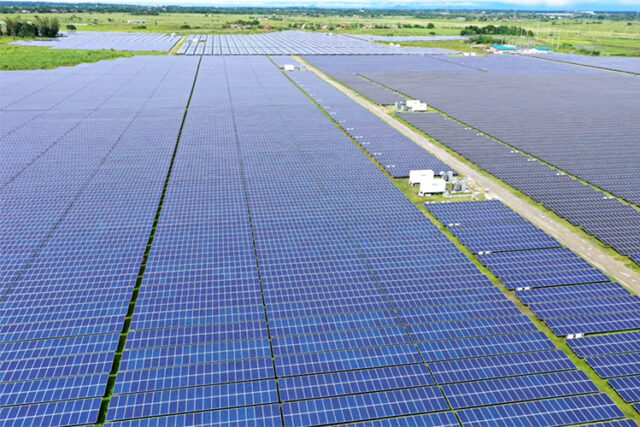
Miners probably need prices of at least $30/oz to stop output from falling still further. At some point, the magic of industrial efficiency will allow our electrical economy to use silver even more sparingly. For the moment, however, this boom will keep running on solar power.

BLOOMBERG OPINION

BSP, PDIC update agreement on bank examination

THE BANGKO SENTRAL ng Pilipinas (BSP) and the Philippine Deposit Insurance Corp. (PDIC) last week signed a revised agreement on bank examination for better coordination.

BSP Governor Eli M. Remolona, Jr. said the revised memorandum of agreement (MoA) they inked on Friday follows the passage of new laws boosting both institutions’ regulatory and supervisory powers to improve financial consumer protection.

This was the third update to their agreement, with the first MoA signed in 2005 and a second agreement inked in 2013.

“This new MoA strengthens our partnership by defining our division of labor more clearly,” Mr. Remolona said in a speech at the signing. “BSP focuses on credit, market (and) operational risks. PDIC focuses on deposit-related risks.”

Republic Act (RA) No. 11211 signed in 2019, which amended the New Central Bank Act, widened the BSP’s power to identify, correct, and resolve banking issues.

Meanwhile, RA 11840 enacted in 2022 updated the PDIC’s charter to give it clearer authority to intervene in cases involving fraud, unsafe practices or amid failed corrective actions.

Mr. Remolona cited a case wherein the PDIC reported the understated discrepancies of a bank, and the BSP required additional provisions.

“We have seen how this kind of coordination works in practice,” the BSP chief said.

“Because of this cooperation, the bank closed in an orderly manner — minimizing losses to depositors. This is the kind of teamwork we will see more of under this new MoA.” — Katherine K. Chan

Want a KPop Demon Hunters toy this holiday? Wait until next year, say toymakers

L-R: KPop Demon Hunters’ Zoey, Rumi and Mira as Funko Pops. — FUNKO.COM

NEW YORK — Fans of Netflix’s runaway hit KPop Demon Hunters will only be able to get their hands on branded toys well after the key holiday shopping season, a missed opportunity for Mattel and Hasbro that have won licensing deals from the streaming giant.

Netflix said on Tuesday that Mattel and Hasbro will make toys, collectibles, games, and role-play products based on the film that can be pre-ordered in the coming weeks, but most of those will not ship before January.

The toymakers had the chance to meet the year’s biggest toy-buying period, a person familiar with the matter told Reuters. However, they did not foresee the crossover appeal with Korean pop music and animé fans as well as casual viewers, so they declined to commit to a licensing deal before the film was released in June, the person said.

Since it typically takes major toymakers 12 to 18 months to win licenses, develop, manufacture, and ship products to the US, they collaborate with movie studios on scheduling product releases, planning to stock shelves with what they bet will be popular toys before the year-end holidays, when toymakers make nearly a third of annual sales, industry experts said.

Mattel and Hasbro declined to comment on whether they declined the licenses before the film was released.

In an interview on Tuesday, Ynon Kreiz, CEO of Mattel, said: “It does take time to develop product, especially at the quality that we do.”

“Here, we’re going to put (the toys) on a fast track given the strong demand,” Mr. Kreiz said.

MERCH LICENSING OPENS NEW NETFLIX REVENUE STREAM
KPop Demon Hunters tasted success at release. It topped streaming and became Netflix’s most-watched animated film ever by early July, while “Golden,” a song from the film hit No. 1 on Billboard Hot 100. Two months later, a theatrical sing-along release sold out at more than 1,300 theaters including in the US and UK.

To be sure, merchandise tied to movie hits or seen on celebrities can sell out no matter the time of launch. For instance, Labubus, the collectible plushie toys with a sharp-toothed grin, were first launched in 2015 but went viral a decade later after stars including BLACKPINK singer Lisa were seen carrying one.

But holiday sales this year are widely seen as even more important for a toy industry that has for years faced competition from mobile game makers and streaming firms, as US tariffs on imports have boosted costs.

For Netflix, merchandise licensing opens up a new revenue stream as its subscriber base matures — one that has brought enormous success to the likes of Walt Disney and Warner Bros. Discovery with movies such as Frozen and Barbie.

Netflix in January landed its first master licensing deal with Squishmallows-maker Jazwares to make toys and costumes for a collection tied to TV show Stranger Things. The company has since partnered with Lego to make building sets inspired by animé series One Piece.

THIS SEASON’S CANDIDATES FOR MOST POPULAR TOYS
Some US toymakers expect shortages of toys this season considering many supplies come from China, whose goods the US subjects to steep tariffs. They have also said major retailers have cut back on holiday orders because of rising costs and uncertainty about consumer spending. However, Adobe Analytics forecasts US consumers will spend about $8.8 billion on toys this holiday season, up from $8.2 billion last year.

Toys linked to Jurassic World: Rebirth, which was released in July, and Transformers 8: Rise of Unicorn, set for release in late December, are likely to be the most popular merchandise this year, said Greg Ahearn, CEO of trade group Toy Association.

Funko, which makes four-inch collector’s items called Funko Pops, announced a deal with Netflix in August to make $14.99 figurines inspired by KPop Demon Hunters characters. But these too will only ship by Jan. 30, the company’s website showed.

Funko did not immediately return a request for comment.

Mattel is manufacturing a pack of three dolls from the movie, while Hasbro is developing a branded Monopoly card game that will be available to ship on Jan. 1.

“We have a long relationship with Disney on Marvel and Star Wars, and so we know what the cadence of entertainment events is, and we plan accordingly to create products around those entertainment events,” Hasbro’s president of toys, games, licensing & entertainment, Tim Kilpin, told Reuters this month.

“But there are also times when a new property starts to break out. Those don’t happen very often but when they do it’s exciting, it’s a surprise,” he said. — Reuters

Trade deals seen promising relief to garment firms

Image via IndustriALL Global Union/Flickr/CC BY-NC-ND 2.0

THE Labor department said disruptions to the workforce stemming from the looming closure of a garment factory in Central Luzon could be temporary, and added that the government is working on trade agreements that will improve the industry’s prospects.

“The Department of Labor and Employment (DoLE) has been and will always be seriously concerned about any worker displacement, be it due to lay-offs but more so if it’s closure,” Labor Secretary Bienvenido E. Laguesma told BusinessWorld via Viber.

“I do hope it’s isolated and temporary in nature, as there are ongoing efforts to enhance trade with existing partners and develop new ones.”

The US began imposing a 19% tariff on Philippine-made goods on Aug. 17, putting the Philippines at par with regional rivals with lower cost bases.

The US accounted for $12.14 billion in Philippine exports last year.

Mr. Laguesma said that while rising wages may have contributed to the pressure on the industry, it should not be viewed as the primary cause of closures.

“Workers deserve fair wages,” he said. “There could be other operational costs and issues — from power and logistics to regulatory challenges — that influence these decisions.”

He said DoLE can immediately activate programs like the Tulong Panghanapbuhay sa Ating Disadvantaged/Displaced Workers, the DoLE Integrated Livelihood Program, and the Adjustment Measures Program to provide emergency employment and livelihood support to affected workers. 

He added that Technical Education and Skills Development Authority offers upskilling and retooling initiatives that can help workers transition to other industries, while youth employability programs such as the Special Program for the Employment of Students, Government Internship Program, and JobStart Philippines Program could be extended to dependents of displaced employees.

Assistant Professor Benjamin B. Velasco of the University of the Philippines School of Labor and Industrial Relations said the Central Luzon case may be an isolated incident, but it highlights structural weaknesses in the export economy.

“For now, the possible factory closure in Central Luzon is an outlier event as unemployment is low and economic growth is robust,” Mr. Velasco said via Messenger. “Still, exporters shutting down is always a risk for an economy.

He said the government should adopt both short-term safety nets and long-term structural reforms to ensure resilience.

“In the short term, there must be programs to transition affected workers — from social security and emergency work to job reskilling. For the long term, we need to move away from export orientation to creating domestic demand through an industrial policy and asset redistribution,” he added.

Mr. Velasco added that high wages, while often seen as a disadvantage for exporters, could strengthen the domestic economy by stimulating consumption.

“High wages are a disadvantage for commodity exporters but a boon for domestic producers since it creates higher demand,” he said.

Jose G. Matula, president of the Federation of Free Workers (FFW), called the closure threat a “wake-up call” for both the government and industry.

“The threat of factory closures in Central Luzon shows how fragile our manufacturing jobs are — when global trade trembles, workers suffer first,” Mr. Matula said via Viber. “This is not just a labor issue, but an economic one that demands collective action.”

Mr. Matula urged DoLE, the Department of Trade and Industry, and the Department of Economy, Planning, and Development, to convene a national tripartite dialogue with employers’ groups such as the Employers Confederation of the Philippines and the Philippine Chamber of Commerce and Industry, alongside major labor centers including NAGKAISA, the Trade Union Congress of the Philippines, and the FFW, to develop coordinated strategies to safeguard jobs and sustain the industrial base.

He also pointed to the high cost of doing business — including power rates, logistics, and red tape — as deeper issues requiring solution.

While trade disruptions may disrupt operations, Mr. Matula said the episode highlights the importance of giving workers a greater voice in shaping industrial policy.

In a statement, the Philippine Independent Garment and Leather Association (PIGLAS) called for urgent action to rescue the struggling garment industry, warning that the crisis demands more than bailouts.

The group said government intervention should provide a lifeline for both businesses and the workers sustaining them.

PIGLAS said that any proposed rescue package must include workers in the decision-making process. It said employers and workers should jointly come up with proposals that address not only business survival but also employment stability and worker welfare.

The group also pushed for reforms to the Electric Power Industry Reform Act, arguing that high electricity costs continue to burden manufacturers and weaken competitiveness.

Lowering power rates, PIGLAS said, is critical to preserving jobs and sustaining production. — Chloe Mari A. Hufana

Basic Energy, ACMobility partner to set up EV charging hubs

ACMOBILITY.PH

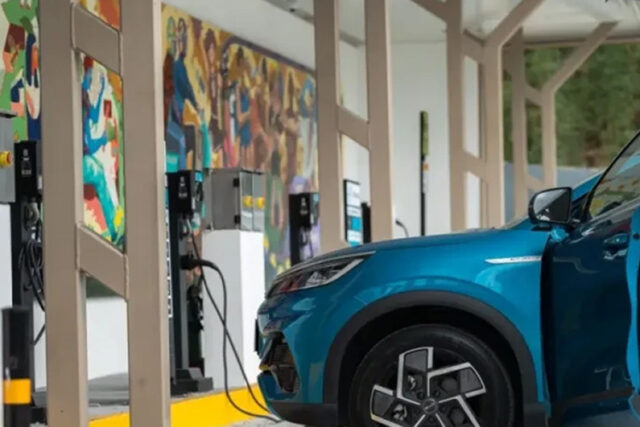
BASIC ENERGY RENEWABLE Corp. (BERC), a subsidiary of Basic Energy Corp. (BEC), has partnered with Ayala-led ACMobility to install and operate electric vehicle (EV) charging stations powered by renewable energy.

In a statement on Thursday, BEC said the pilot rollout will begin at fuel stations in Laguna, Pampanga, and Mandaluyong.

These include the Total stations along the South Luzon Expressway in Sta. Rosa, Laguna; the North Luzon Expressway in Apalit, Pampanga; and the Ecooil station along EDSA in Mandaluyong City.

BEC Chief Executive Officer Oscar L. de Venecia, Jr. said the partnership reflects the company’s “strong commitment to advancing clean energy and sustainable transport.”

ACMobility, the Ayala group’s mobility platform, said the collaboration combines its charging infrastructure and digital mobility capabilities with BERC’s renewable energy expertise.

“By combining forces with Basic Energy, we’re accelerating the rollout of a charging network that supports the real needs of Filipino EV drivers,” ACMobility Head of Mobility Infrastructure Carla Buencamino said, adding that the network will be accessible through its Evro app.

BEC holds a 60% stake in Filoil Energy Co., Inc., which has joint ventures with Total Marketing Services, the Philippine subsidiary of TotalEnergies.

Basic Energy is a holding company engaged in renewable energy, alternative fuels, and oil and gas exploration and development. — Sheldeen Joy Talavera

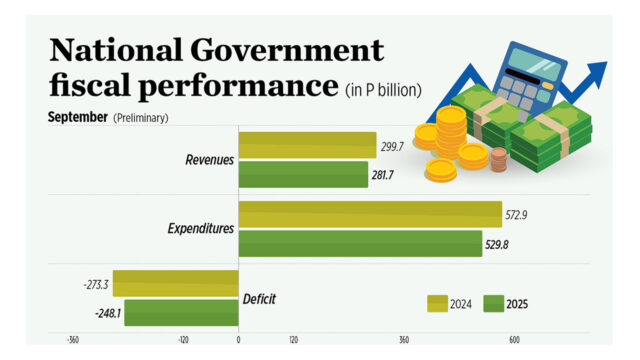
National Government fiscal performance

THE Philippines’ budget deficit narrowed in September, the Bureau of the Treasury (BTr) said on Thursday, as corruption probes into flood control projects slowed government spending. Read the full story.

National Government fiscal performance

The exercise paradox: Why workouts aren’t great for weight loss but useful for maintaining a healthy body weight

STOCK PHOTO | Image by Cookie_studio from Freepik

The basic principle of weight loss is straightforward: if you consume fewer calories than you burn, you’ll lose weight. In practice though, this isn’t usually so easy or simple.

Alongside counting calories or eating smaller portions, many people add exercise into the equation when trying to lose weight to help tip the balance. Yet research shows that exercise may only have modest effects on weight loss.

But before you ditch your workouts, it’s important to note that exercise still plays a really important role when it comes to health — perhaps especially in keeping the pounds off after reaching your goal weight.

There are several processes that help explain why exercise doesn’t always result in huge amounts of weight loss.

Exercise can stimulate appetite, leading to increased food intake. People may also subconsciously move less throughout the rest of the day after doing a workout, which means exercise may have less impact on their overall calorie deficit.

The body also becomes more efficient over time — burning fewer calories while doing the same activity. This process, sometimes called “metabolic adaptation,” reflects the body’s tendency to defend against weight loss.

From an evolutionary perspective, conserving energy during periods of intense physical activity probably protected our ancestors from starvation. But in today’s world, metabolic adaptation is one of many factors that can make weight loss difficult.

THE IMPORTANCE OF EXERCISE
Although exercise may not be the main driver of weight loss, it seems it might play a role in maintaining weight loss.

In a study of over 1,100 people, physical activity was shown to have little effect on the amount of weight a person initially lost. However, doing higher levels of activity after losing weight was strongly linked to maintaining the weight loss.

It’s worth noting that exercise was also associated with measurable health improvements — including better cholesterol, lower inflammation, better blood sugar control and insulin sensitivity, all of which are associated with lower risk of health problems, such as heart disease and type 2 diabetes.

These many health benefits show just how important it is to exercise both while losing weight and maintaining weight loss.

Evidence also suggests that combining exercise with weight loss drugs (such as Saxenda), may help people maintain their weight loss better than using the drug alone.

WHY EXERCISE WORKS
It may seem confusing that exercise isn’t especially effective for losing weight but can help prevent regain. The reasons behind this paradox aren’t fully understood, but several mechanisms may offer an explanation.

The first has to do with our resting energy expenditure (the amount of calories our body burns when doing nothing).

When we lose weight, our resting energy expenditure decreases by more than you would expect for the amount of weight lost. This is thought to contribute to weight regain. But exercise raises total daily energy expenditure, which can help to partially offset this.

A second factor relates to muscle mass.

Weight loss usually results in the loss of both fat and muscle. Losing muscle lowers resting energy expenditure, which can contribute to weight regain.

But exercise, especially resistance training (such as Pilates or lifting weights), can help preserve or even rebuild muscle mass. This can boost our metabolism, which may aid in long-term weight maintenance.

Physical activity also helps our body to maintain its ability to burn fat. After losing weight, the body often becomes less efficient at using fat for energy.

But intense exercise can improve fat burning and metabolic flexibility — the ability to switch between burning carbohydrates and fat depending on what’s available. This helps the body continue burning fat even when calorie intake is low or weight is lost.

Exercise improves insulin sensitivity as well. This reduces the amount of insulin required to regulate blood sugar. This is beneficial as higher insulin levels can promote fat storage and reduce fat breakdown.

Exercise has many indirect effects on us that can aid in weight maintenance. For instance, exercise can improve sleep, mood, and reduce stress levels. These all reduce levels of the stress hormone cortisol, which could lower the amount of fat the body stores.

Regular activity can also help regulate appetite and blood glucose, which may help reduce cravings and limit overeating.

It’s important to acknowledge that everyone is different. This means we all respond differently to exercise in terms of how many calories we burn or whether a workout makes us feel hungrier later in the day.

Different types of workouts also confer their own benefits when it comes to health and weight maintenance.

Aerobic exercise (such as brisk walking, cycling, or running) burns calories and, at higher intensities, may also enhance the body’s ability to burn fat for fuel.

Resistance training, on the other hand, helps build and preserve muscle mass. This supports a higher resting energy expenditure, aiding long-term weight maintenance.

Exercise may not be the most powerful tool for losing weight, but it could help sustain hard-earned weight loss. Perhaps most importantly, it offers many physical and mental health benefits that go far beyond the numbers on the scale.

THE CONVERSATION VIA REUTERS CONNECT


Rachel Woods is a senior lecturer in Physiology at the University of Lincoln.

Louvre chief blames CCTV gaps for $102-M jewelry heist

LOUVRE Museum — WIKIPEDIA

PARIS — The Louvre’s cameras failed to detect burglars in time to prevent their audacious daylight heist of some of France’s crown jewels, the museum’s director said on Wednesday, amid growing anger directed at officials over major security lapses.

The thieves broke into the world-famous Paris museum on Sunday using a crane to smash an upstairs window, then stole jewels worth an estimated €88 million ($102 million) before escaping on motorbikes. News of the robbery reverberated around the world, and prompted soul-searching in France over what some viewed as a national humiliation.

Laurence des Cars, the Louvre director, told senators that she had offered her resignation, but it had been refused by Culture Minister Rachida Dati, who has also come under fire as recriminations flew after the robbery.

SECURITY EFFORTS ‘DEFEATED’
“Despite our efforts, despite our hard work every day, we were defeated,” Ms. Des Cars told a Senate committee.

Many in France and around the world have been baffled by how four hooded assailants were able to drive up to the world’s most visited museum, smash a second-floor window and make off with a handsome booty without getting caught. Ministers have admitted serious security lapses occurred.

“We did not detect the thieves’ arrival early enough,” Ms. Des Car said, blaming it on the fact that there were not enough cameras outside monitoring the perimeter of the Louvre.

The exterior security cameras do not offer full coverage of the museum’s facade, she said, adding that the window through which the thieves broke in was not monitored by CCTV.

Ms. Des Cars said she had repeatedly warned that the centuries-old building’s security was in a dire state. “The warnings I had been sounding came horribly true last Sunday.”

She pledged to establish no-parking perimeters in areas around the Louvre, upgrade the CCTV network and ask the interior ministry to set up a police station inside the museum.

4 OTHER FRENCH MUSEUMS ROBBED RECENTLY
The heist, on a Sunday morning after the Louvre had already opened to visitors, has prompted an assessment of security at museums across the country. Paris is home to some of the world’s best-known cultural institutions, including museums like Orsay, Pompidou, and Quai Branly which help sustain booming tourism.

At least four French museums have been robbed over the last two months, according to media reports.

On Tuesday, prosecutors said they had charged a Chinese-born woman over the theft of six gold nuggets worth about €1.5 million ($1.75 million) from the Museum of Natural History in Paris last month. She was arrested in Barcelona while trying to dispose of some melted gold, they said. — Reuters

Convincing workers to take a medical exam

We average 40% compliance on workers taking the annual physical and medical exam. They give various reasons, from being too busy to lack of interest, claiming they’re not feeling any symptoms of ill health. What can we do? — Marvelous Mike.

You’ll be dismayed to learn that many organizations face the same challenge every year. People nod when notified, while others ignore the notice completely.

The reasons behind low participation rates are not limited to task overload or lack of interest. Sometimes it could be fear, inconvenience, or the mistaken belief that they’re healthy.

As part of management, HR’s role isn’t limited to announcing the exam schedule, but to lead the workers in understanding why it matters for their total well-being. It’s not about mere compliance. HR could announce it a hundred times, but without emotional buy-in, attendance will still be lukewarm.

In the Philippines, employers are legally allowed to conduct medical examinations. This mandate is rooted in occupational safety and health regulations. The basic law is Article 162 of the Labor Code, which seeks to ensure a safe and healthy work environment.

This alone should prompt team leaders, line supervisors, managers, and HR leaders to play a crucial cultural role: framing the medical exam as a wellness benefit and not just a requirement.

SUBTLE, BUT COMPELLING
A “subtle but compelling” approach means persuading workers without forcing them. It could be done via little nudges, not threats. Instead of lecturing them about compliance, show what’s in it for them: peace of mind, early detection of illness, and reduced hassle in the long run.

Pair practical support with gentle encouragement. Explain that a short checkup today can save them months of stress tomorrow. It’s like reinforcing responsibility without fear, by appealing to their well-being rather than following a legal requirement.

When workers feel cared for instead of being commanded, compliance becomes a choice they want to make, not something they reluctantly agree to. Here are some examples of things to try:

One, management must lead by example. People follow behavior more than instructions. When employees see department heads taking the exam early (and talking about it in a casual, positive way), the impression is clear: “I just finished mine. It was quick process.

“Now, I have peace of mind. I encourage you to take yours too.” Small shift. Big difference.

Two, change the situation from “company benefit” to “personal benefit.”

Compliance sounds like paperwork. Wellness sounds like self-care. When we frame the exam as something done for employees rather than to them, resistance drops.

People aren’t convinced by strict policies. Instead, they are persuaded by their significance to their welfare.

Three, eliminate inconvenience. Participation improves dramatically when the process is short and easy. Some ways to help include having a continuing schedule, having on-site testing when possible, assigning time slots per department, or even making a schedule for birthday celebrants.

The most important approach, however, is allowing them paid half-day time off.

Four, practice social proof, instead of pressure. Employees don’t like being singled out, but they don’t like being left behind either. “80% of our team members have completed theirs. Join the rest!” This fuels positive, bandwagon behavior.

If they feel everyone else is doing it, the hesitation drops.

Five, soften the message with a positive note. Instead of circulating a stiff memo filled with policy reminders, managers should talk to their teams in ordinary, reassuring language.

Something like: “This isn’t about finding who is sick. It’s about keeping everyone well.”

That one sentence can prevent weeks of avoidance.

Six, appeal to individual responsibility. A healthy employee supports not just the company, but their family. Many employees think, “I’m too busy to get checked.” But the real risk is being too busy until something goes wrong.

That simple shift reframes the exam as a responsibility, not an obligation.

Seven, recognize, but do not punish. Some companies mistakenly use threats like withholding medical benefits. This may produce compliance but never commitment. Instead of penalties, recognize participation — even small acknowledgements work.

One example is by recognizing the department with the highest compliance. This reflects on the positive image of the concerned head.

CULTURE OF SELF-CARE
Employees resist because of stiff regulations and unwarranted management action. Management frontliners and HR leaders should address these issues. Your job is not to push people toward the clinic; your job is to help them choose it for themselves.

When participation is seen as healthy empowerment, not bureaucracy, compliance rises naturally. Convincing employees to join the annual exam isn’t about enforcing a rule. It’s about promoting a culture of self-care inside the workplace.

When leaders show sincerity, convenience is provided, and the purpose is well-communicated, people participate not out of fear, but out of taking responsibility for their health. At the end of the day, compliance is temporary, but wellness is long-term.


Have a free consultation with Rey Elbo on your people management issues. E-mail elbonomics@gmail.com or DM Facebook or LinkedIn. Anonymity is guaranteed.


Solar Philippines transfers 10.83 billion SPNEC shares to Leviste in internal restructuring

SOLARPHILIPPINES.PH

SOLAR PHILIPPINES Power Project Holdings, Inc. (SPPHI) has transferred 10.83 billion common shares of SP New Energy Corp. (SPNEC) to its founder Leandro Antonio L. Leviste, now Batangas first district representative, through a special block sale worth P6.32 billion.

In a stock exchange disclosure, SPNEC said the transfer was implemented through the Philippine Stock Exchange on Oct. 22 and “did not change Mr. Leviste’s beneficial ownership in the company.”

SPPHI is wholly owned by Mr. Leviste, who serves as a substantial shareholder of SPNEC. The transfer effectively moves the shares under his personal ownership from his private holding company.

Earlier, SPPHI announced plans to sell part of its SPNEC shares to Meralco PowerGen Corp. (MGEN), which had agreed to acquire a total of 14.6 billion shares for about P18.26 billion.

SPNEC, through its subsidiary Terra Solar Philippines, Inc., is developing the P200-billion MTerra Solar Power Project, which spans 3,500 hectares across Nueva Ecija and Bulacan.

On Wednesday, SPNEC shares rose by 1.74% or 2 centavos to close at P1.17 apiece. — Sheldeen Joy Talavera

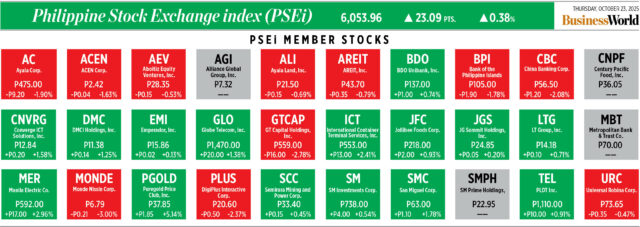
How PSEi member stocks performed — October 23, 2025

Here’s a quick glance at how PSEi stocks fared on Thursday, October 23, 2025.


ADVERTISEMENT
ADVERTISEMENT