Home Blog Page 8026

Ayala group backs climate-related disclosures

SIX Ayala-led business units have committed to support the international Financial Stability Board’s Task Force on Climate-related Financial Disclosures (TCFD) as the group prepares for the country’s shift to a low-carbon economy.

The TCFD gives recommendations for better disclosures, which may promote more informed investments, and credit and insurance underwriting decisions, and in turn, help stakeholders understand climate-related risks.

Listed conglomerate Ayala Corp. said in a press release on Wednesday that its units Ayala Land, Inc., Bank of the Philippine Islands, Globe Telecom, Inc., AC Energy Corp., Manila Water Co., Inc., and Integrated Micro-Electronics, Inc. will undergo a “gap analysis” based on the TCFD’s pillars — governance, strategy, risk management, and metrics and targets.

The six Ayala companies join over 1,800 TCFD supporters across the world, marking another milestone for the group since it started reporting on TCFD disclosures in 2019.

Each business unit will give disclosures based on the TCFD’s recommendations and come up with strategies that adhere to the four pillars. Adopting these suggestions will help firms develop a more resilient financial system, the group said.

“This decisive effort of the Ayala group to collectively support TCFD is in line with our aspiration to be a regional leader in the field. This is a common ground for our largely diversified group, one that speaks of our continued commitment to transparency and accountability,” Fernando Zobel de Ayala, president and chief executive officer of Ayala Corp., said in a statement.

Aside from showcasing the company’s longevity and resilience, the adoption of the globally recognized suggestions will help the conglomerate navigate through the country’s financial landscape as it prepares for the shift to a low-carbon economy.

Ayala Land President and CEO Bernard Vincent O. Dy said the TCFD’s recommendations will help provide a clear framework on disclosing material climate-related information.

“By adopting TCFD recommendations, the company will have a more thorough understanding of climate risks and opportunities. We can then continue to align our future investment strategies so that we can effectively transition to a lower-carbon economy,” he said.

Ayala energy platform AC Energy said that it is on its way to shifting to a low-carbon portfolio.

“The company will be divesting all its coal assets by 2030 and scaling up renewable investments, which is expected to exceed 5 GW (gigawatts) by 2025,” said AC Energy President and CEO Eric T. Francia.

The TCFD, chaired by founder of Bloomberg L.P. Michael R. Bloomberg, was established by the Financial Stability Board. The board is an international body that monitors and makes suggestions on the global financial system.

Shares of Ayala Corp. improved by 3.2% or P23 to finish at P742 apiece in the local bourse on Wednesday. — Angelica Y. Yang


What is ‘Other’ in my iPhone storage, why is it taking up so much space and how do I clear it?

TRUSTPAIR.COM

IF you’re an iPhone user, check your storage now by selecting Settings, then General and then iPhone Storage.

You’ll probably see a lot of recognizable categories eating up your storage — apps, photos, and so on. But there is one, often rather large category, that may raise concerns: “Other.”

It’s shaded light grey and often represents a significant proportion of the overall storage available.

For more detail, scroll down and tap the “Other” category (right at the end). It doesn’t say much — just that it includes caches, logs and other resources in use by the system. Not very illuminating.

Logs are records of actions undertaken on, or by, our phones. A phone may, for example, log that it connected to a Wi-Fi network, established a Bluetooth connection with a device, backed up some data or opened a web page. In most cases, the log files are simple records that do not occupy much space — often only a few megabytes.

Caches, however, can be a much greater problem for clogging up your “Other” storage.

When we stream media such as movies and music on an iPhone, the phone will download as much of the content as possible. One of the main reasons for this is to minimize the dreaded spinning wheel you see when content is buffering.

All this content (referred to as a “cache”) needs to be stored somewhere and it rapidly fills up your device.

This cached content extends to a wide range of applications including your web browser (such as Safari, Chrome or Firefox) and apps like Facebook, Instagram, Twitter, and TikTok.

While cached data may not seem to need much space, it is surprising how large streamed media content can be — not to mention the image-rich social media apps we love so much.

Looking through the list of apps and their storage allocations will quickly show how storage is being consumed. In this screenshot above, for example, you can see Facebook is consuming 2.17 gigabytes.

However, if we look on the App store, it says the Facebook app only requires 255.4 megabytes. So somehow the app is occupying an additional 1.9GB. Where is this extra 1.9GB coming from? It’s likely caches of images, videos and other content your phone had to store in its own memory storage so you could scroll through Facebook without encountering the dreaded “buffering” spinning wheel.

The most effective solution is also the most radical. To truly minimize “Other” storage, you would need to back up your phone, reset it and, finally, restore your phone from the backup.

This process will remove most of the “Other” storage being used on your iPhone, but takes a bit of time and effort.

Unfortunately, cached files will be recreated with most common iPhone usage. But there are some things you can do to reduce storage consumption.

If you’re not keen to reset, try exploring the apps using up cache space on your iPhone.

Social media apps are a good starting point as they often cache lots of images and videos. While most don’t provide an option to delete their cached data, removing and reinstalling the app will remove all cache files.

Another likely culprit is your web browser (typically Safari on most iPhones).

From the Settings menu, scroll down to Safari and select “Clear History and Website Data”. This will remove most cached data associated with your web browser.

If you’re using another browser, such as Chrome or Firefox, repeat the steps with that browser in Settings.

If you want to keep going, consider removing old SMS and iMessages.

Standard written text messages occupy minimal storage, but photos and videos shared between family and friends can consume significant storage over time.

Under Settings, scroll down to Messages, then to the Message History option. The default is to keep messages “forever”. Changing this to a shorter duration can reduce space requirements considerably.

A final option is to consider offloading apps. Modern iPhones let you remove infrequently used apps. While this will not necessarily reduce your use of cache storage, it can free up valuable space.

There is no simple solution to managing iPhone storage usage. Minimizing photos and videos will help, but there is a lot of space allocated to apps and their cached data.

But with careful tending, we can try to keep on top of unexpected storage usage without having to wipe our devices. — Reuters

Dining In/Out (05/27/21)

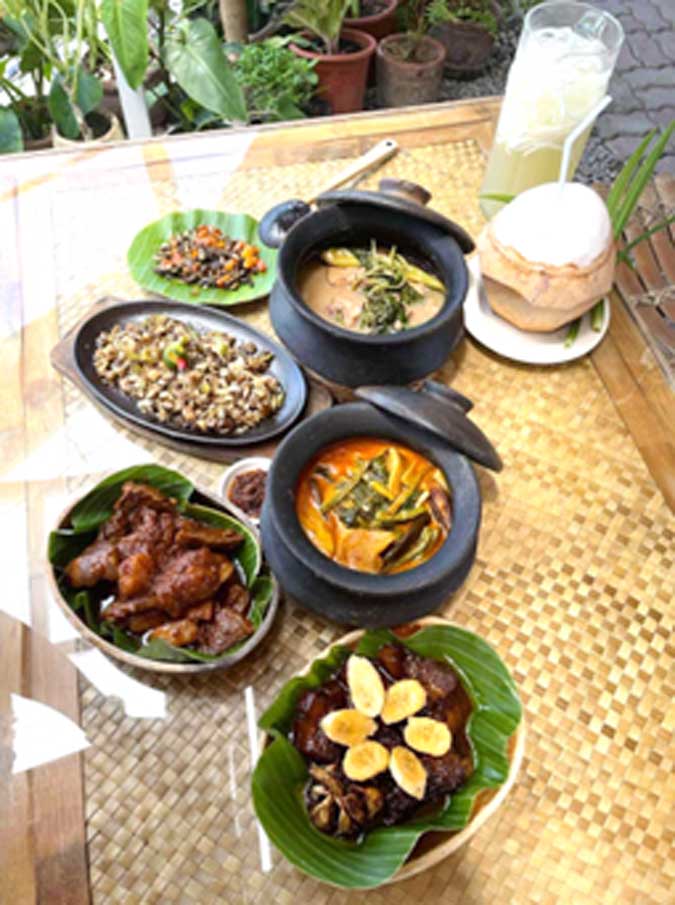
‘Flavors of Pampanga’ opens at Clark

THE DEPARTMENT of Tourism (DoT) presents the food festival Flavors of Pampanga: Manyaman!, a showcase of the diverse culinary heritage and rich food history of the region, particularly in Pampanga, often called the Culinary Capital of the Philippines. It will be held on May 28 in Clark, Pampanga and will feature cooking demonstrations by culinary experts, including chef de cuisines from hotels in Clark. The event will be broadcasted live and streamed online through the DOT-Region III official Facebook page, and the public is invited to be part of it. The DoT, through its Central Luzon Regional Office, is also organizing ¡SABROSO! — A Filipino and Spanish Food Fair, which will highlight and showcase Filipino dishes that were influenced by the Spanish people. Such dishes will be prepared and demonstrated by celebrity chefs from Central Luzon. This event is expected to be held in November. The DoT is also developing a Farm, Food and Pilgrimage Tour covering the provinces of Pampanga, Tarlac, and Nueva Ecija. The DoT-Region III will also launch the “Slow Food, Slow Travel Caravan” featuring Slow Food of Bacolor, Lubao, and Sasmuan heirloom recipes in Pampanga. Leisure travel is now allowed in the Province of Pampanga, following the health protocols. Pampanga and Clark are open to all. However, Metro Manila, Bulacan, Cavite, Laguna and Rizal, known as NCR Plus, is under general community quarantine “with heightened restrictions” until May 31. Only essential travel is allowed in and out of NCR Plus.

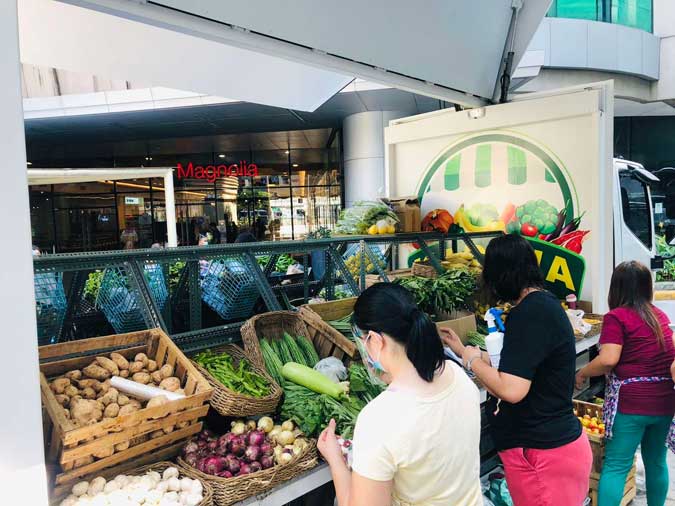
Locally Sourced trade fair returns to Robinsons Malls

AFTER a brief hiatus, Locally Sourced, a homegrown trade fair organized by Robinsons Malls and the Department of Agriculture, is back in several Robinsons Malls till May 30 — and this time it’s on wheels. Fresh produce from farmers will now be sold “on wheels” allowing the caravan to hop from one Robinsons Mall to another. The next stops will be Robinsons Place Manila on May 27-28, and Forum Robinsons on May 29-30. There will be vegetables, fruits, seafood, and more sold at pocket-friendly prices.

TWG celebrates International Tea Day

WHILE International Tea Day falls on May 21, that does not mean the celebration can’t continue by exploring TWG Tea’s collection of exclusive tea blends for different times of the day. Start your morning with a stimulating cup of English Breakfast Tea (P1,895 for Loose-Leaf Haute Couture Tea and P1,255 for Cotton Teabags), which was originally blended as an accompaniment to the traditional English breakfast. Strong and full-bodied with light floral undertones, this TWG Tea broken-leaf black tea is perfect with morning toast and marmalade. In the afternoon, take a pause with a cup of Sweet France Tea (Sweet France Tea, P1,255 for Cotton Teabags), a graceful TWG Tea blend combining green tea with exotic flowers that is reminiscent of the elegance and refinement of France. Unwind in the evening with a soothing cup of White Sky Tea (White Sky Tea, P1,355 for Cotton Teabags). Yin Zhen white tea leaves lend their crystalline flavor to this blend, while Ylang Ylang flowers impart their exquisite and fragrant oil to this fruity blend. An ideal tea that calms the body before bedtime, white tea is known to have the highest concentration of polyphenols and anti-oxidants which lower your body temperature and stimulate the immune system. The blends are available in all TWG Tea Boutiques in the Philippines and on the TWG Tea LazMall Flagship Store. TWG Tea Boutiques are in Greenbelt 5, Central Square, Alabang Town Center, and Ayala Center Cebu.

Supporting the F&B industry amidst the pandemic

MORE than a year since quarantine restrictions were imposed across the country due to the coronavirus disease 2019 (COVID-19) pandemic, many of the bars and restaurants continue to face challenges because of the stringent measures on capacity, social distancing, liquor bans, curfews, or outright restriction on operations. Conscious of the pandemic’s impact on the F&B sector across the country, the Alcoholic Beverages Alliance of the Philippines (ABAPI) reached out to its bar partners to provide subsidies for affected employees. ABAPI is comprised of the leading international alcohol beverage producers, as well as importers and distributors in the country such as Diageo, Pernod Ricard, Moët Hennessy and Brown-Forman — owners of alcohol brands such as Johnnie Walker, Absolut Vodka, Hennessy and Jack Daniels. Over 700 employees of 45 bars such as The Spirits Library, The Belle and Dragon, Oto, Polilya, Futurist, Kondwi, Ms. Gee, LIT, Versus Barcade, Nokal, Kampai, Bank Bar, Rue Bourbon, Sage Bar, Yes Please, Dillinger, Tipsy Pig and Reserve Fort received a subsidy from ABAPI in the form of vouchers from Grab worth over P2,000 each. From being an economic driver pre-pandemic with revenues hitting an estimated P1 million in 2019, the F&B sector faces an unprecedented situation. To revive the sector, ABAPI members support measures that will enable the sale re-opening of bars and restaurants with adherence to social distancing and safety guidelines.

Grab offers P1 Deals for new users in select cities

THE GRAB app is offering P1 deals — from P1 delivery to P1 meal flash sales — for the whole month of May in select cities nationwide. Running until June 30, new Grab users can avail of a P1 delivery fee promotion. They can order from in-demand restaurants and have the food delivered for only a peso, with no minimum fee. This promo is open to all new Grab users from Cebu, Pampanga, Davao, Bacolod, Iloilo, Baguio, Cagayan De Oro, Lipa, Dumaguete, Tarlac, Olongapo, and Zamboanga. Meanwhile, regular GrabFood user can avail of GrabFood’s Piso Weekends with P1 delivery fees every weekend in May. Then there is Grab’s Piso Festival with McDonald’s and Chatime. For a minimum order of P400 from May 27 to 30, customers at McDonald’s in Bacolod, Baguio, Cagayan de Oro, Davao, Cebu, Pampanga, Dumaguete, Iloilo, Lipa, Zamboanga, and Olongapo will get a burger for free. Meanwhile, Chatime customers in Bacolod, Baguio, Cebu, Iloilo, Lipa, Olongapo, Pampanga, and Tarlac will get a large pearl milk tea for free for a minimum order of P350 from May 24-27. Watch out for more Grab Piso Deals by following Grab Philippines on Facebook, Instagram, and Twitter.

McDonald’s offers Minions-inspired shake and fries

MCDONALD’S has introduced a new Minions-approved limited-edition Banana Caramel Shake and Garlic Cheddar McFlavor Fries. The new Garlic Cheddar McFlavor Fries gives a quirky twist with a balanced blend of creamy cheese relish and garlic aioli dressing. Meanwhile, the Banana Caramel Shake is made with creamy soft serve, combined with milk and topped with Banana Caramel syrup. Pair the Banana Caramel Shake with the Garlic Cheddar McFlavor Fries in the Minions Combo which starts at P145. Available in all McDonald’s stores nationwide via dine-in, take out, drive-through, pick-up, McDelivery, and via GrabFood and foodpanda.

Wall Street watchdog sees little need to ramp up banks’ capital

WALL STREET’S new watchdog said he’s generally comfortable with big bank capital levels, signaling he won’t erode earnings by cranking up demands.

Michael Hsu, who this month became acting head of the Office of the Comptroller of the Currency (OCC), said he has no plans to “open it up and do a bunch of surgery” on rules that dictate the amount of capital and liquid assets that lenders must stockpile to protect against losses. Such regulations are crucial to the industry because they determine how much of firms’ profits can be returned to shareholders through dividends and stock buybacks.

Mr. Hsu, who was hand-picked by Treasury Secretary Janet Yellen, is the OCC’s third temporary leader this year. While some of his predecessors have pursued aggressive policy agendas, the former Federal Reserve official said his main focuses will be making sure the agency is doing its job and rethinking some of the actions implemented during the business friendly Trump administration.

“I don’t believe in dilly-dallying, but I do believe in being measured and deliberative,” Hsu said in a Monday interview. “I’m not coming in here and shooting off a bunch of directives.”

The OCC, an independent bureau of the Treasury department, is powerful because it regulates the national banking operations of JPMorgan Chase & Co., Citigroup, Inc. and other lending giants. Hsu’s calculated approach might frustrate progressives, as they’ve been been eager for President Joe Biden to appoint financial watchdogs who will dramatically tighten Wall Street’s leash.

But Mr. Hsu’s stated plans to largely leave capital and liquidity rules intact could also disappoint banks. Their lobbyists have been pushing regulators to dial back Wall Street’s so-called capital surcharge — a capital requirement that only the largest and most complex banks face.

While Mr. Hsu is the first head of a banking regulator installed by the Biden administration, he said he’s not doing its bidding. Mr. Hsu said he’s had no communications with the White House and also hasn’t discussed significant policy issues with Treasury. Still, he said his priorities include combating financial inequality and climate change, goals that are in-line with the administration’s.

Mr. Hsu, who demurred about whether he’d be interested in a permanent OCC appointment, said he’ll behave as if the job is short-term. That means he will focus on the most pressing matters, which include the government’s approach to regulating cryptocurrencies and financial technology firms.

Banking regulators have launched a small “sprint team” to assess how banks should handle digital tokens, Hsu said. The team met for the first time on May 21, he said, and it’s designed to move fast because trading of virtual currencies has exploded during the pandemic.

“There’s no time,” said Mr. Hsu, adding that behaviors that normally would have evolved over several years changed in just one during the global lockdowns.

Mr. Hsu laid out a four-point agenda when he testified last week before the House Financial Services Committee: examine whether banks have grown too complacent about potential hazards, protect the financial system from risks posed by global warming, encourage more lending to underserved communities and respond to the rise of digital finance.

In the interview, he said battling complacency may prompt regulators to revisit a crackdown on Wall Street bonuses, “because it gets to the incentives around risk-taking.” — Bloomberg

ICTSI unit concludes acquisition of additional 10% stake in Congo terminal

LISTED port operator International Container Terminal Services, Inc. (ICTSI) announced on Wednesday that its unit, ICTSI Africa B.V., has concluded the acquisition of an additional 10% stake in International Container Terminal Services, Inc. – DR Congo (IDRC).

The transaction took place on May 25, ICTSI said in a disclosure to the stock exchange.

“The 10% was acquired from another shareholder, La Societe D’Investissement et de Placement SARL,” the company said.

The acquisition increased ICTSI Africa’s ownership of IDRC from 52% to 62%.

IDRC is in Matadi, Democratic Republic of Congo.

ICTSI announced recently that it targets to spend about $250 million this year, mainly on its ongoing and new expansion projects, equipment acquisitions and upgrades, and maintenance requirements.

The company said it has a yard expansion project at IDRC.

ICTSI’s 2020 capital expenditures, excluding capitalized borrowing costs, reached $198.7 million, exceeding the reduced capex budget of $160 million.

The company saw a 51% increase in its attributable net income for the first three months of the year, owing to the improvements in its terminals and “significant” contributions from new shipping lines and services.

ICTSI’s net income attributable to equity holders for the first quarter reached $90.1 million, up from $59.6 million in the same period in 2020. — Arjay L. Balinbin

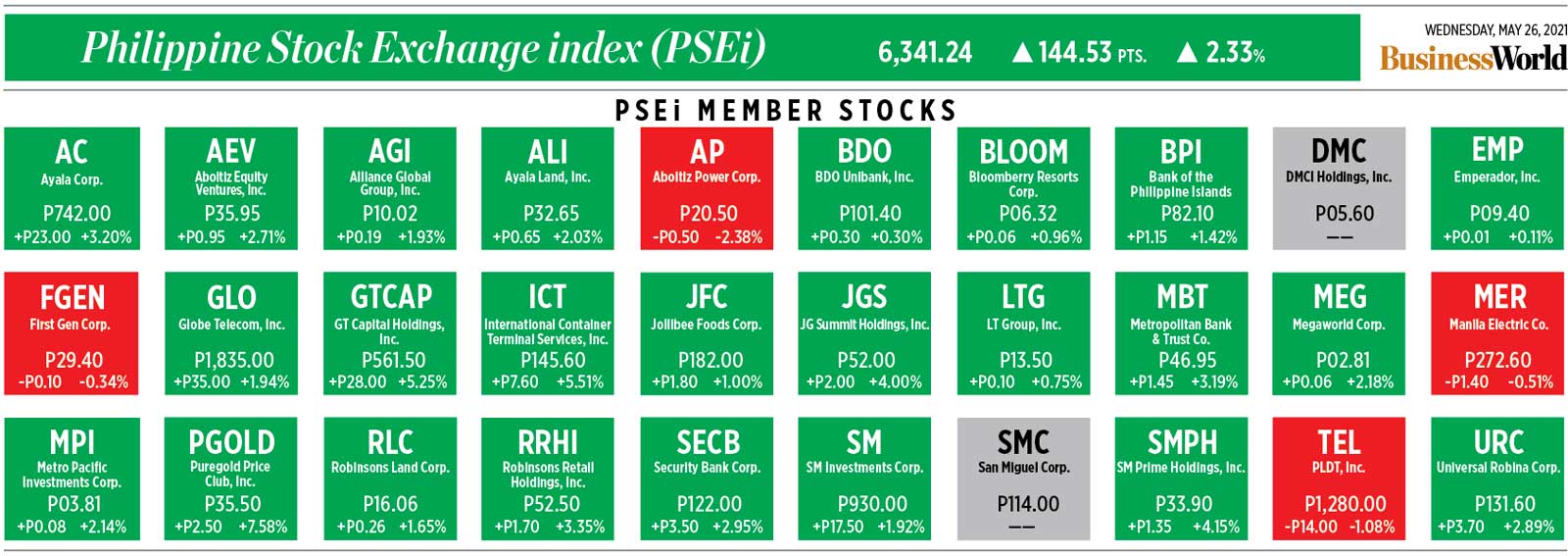
How PSEi member stocks performed — May 26, 2021

Here’s a quick glance at how PSEi stocks fared on Wednesday, May 26, 2021.


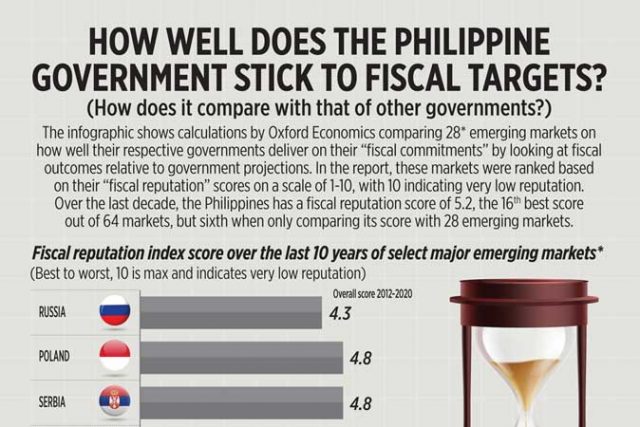
How well does the Philippine government stick to fiscal targets?

THE PHILIPPINE government’s adherence to its fiscal targets over the past 10 years was seen to be among the best across 64 emerging markets, think tank Oxford Economics said. Read the full story.

How well does the Philippine government stick to fiscal targets?

Peso drops further on foreign outflows

BW FILE PHOTO

THE PESO dropped further against the greenback on Wednesday as foreigners exited the local stock market and on expectations of improved US data, which could hasten the US Federal Reserve’s policy tightening.

The local unit closed at P48.15 versus the dollar on Wednesday, weakening by 1.5 centavos from Tuesday’s finish of P48.135, data from the Bankers Association of the Philippines’ website showed.

This was the peso’s worst close in three weeks or since its April 29 finish of P48.315 per dollar.

The peso opened Wednesday’s session at P48.125 against the dollar. Its intraday best was at P48.10, while it dropped to as low as P48.175 versus the greenback during the trading session.

Dollars traded went down to $746.88 million on Wednesday from the $1.039 billion seen on Tuesday.

“The peso [was] weaker after the large net foreign selling at the local market today amounting to $134.6 million from the $1.8 million on Tuesday,” said Rizal Commercial Banking Corp. (RCBC) Chief Economist Michael L. Ricafort in a text message on Wednesday.

Rising global oil prices also continued to affect the peso, he said.

Oil was little changed as traders weighed expectations of improving demand in the US against the possibility of new supply from Iran. Global benchmark Brent crude was up 5 cents at $68.70 and US crude fell 3 cents to $66.04 per barrel, Reuters reported.

Meanwhile, a trader said peso weakened due to market expectations of strong US economic data, which could cause the Fed to taper its bond purchases soon.

Federal Reserve policy makers have begun to acknowledge they are closer to debating when to pull back some of their crisis support for the US economy, even as they say it is still needed to bolster the recovery and employment, Reuters reported.

This suggestion that talking about tapering could become appropriate is a shift from just a month ago when Chair Jerome Powell said it was “not yet” time to even contemplate having that conversation.

Since their April meeting, two regional Federal Reserve bank presidents have publicly urged that the discussion begin soon, and others have highlighted the risks should a current round of price increases become a more embedded cycle of inflation.

The Fed has promised it won’t raise rates until the economy is back to full employment and it sees inflation reach 2% and poised to rise above that level.

The US central bank will get new inflation data on Friday, with forecasters expecting that prices for personal consumption goods excluding food and energy rose at a 2.9% annual rate in April. That would be the highest reading since June 1993 and beyond the Fed’s 2% inflation target.

The Fed meets next on June 15-16.

For Thursday, the trader expects the peso to move between P48.05 and P48.25 versus the dollar, while RCBC’s Mr. Ricafort gave a forecast range of P48.10 to P48.20. — IBC with Reuters

PSEi climbs on expected easing of restrictions

BW FILE PHOTO

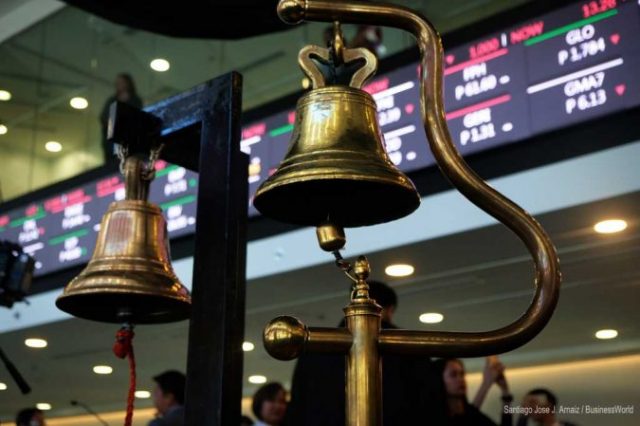
THE Philippine Stock Exchange index (PSEi) closed in the green on Wednesday on hopes of a further easing in current restrictions amid cases of coronavirus disease 2019 (COVID-19) in the country, with the country’s vaccination program also progressing.

The benchmark PSEi went up by 144.53 points or 2.33% to close at 6,341.24 on Wednesday. The broader all shares index also improved by 64.61 points or 1.68% to 3,899.39.

“Market rebounded strongly [on Wednesday] in anticipation of further easing announcement from the government starting next month as infection rates continued on the downtrend, though health-care system [is] still [overwhelmed] with [the] double-digit death rate,” Aniceto K. Pangan, equity trader at Diversified Securities, Inc., said in a text message.

Meanwhile, AAA Southeast Equities, Inc. Research Head Christopher John Mangun said the market “roared back to life”, recording its biggest daily jump in the past three months.

“This is the first time that investors were willing to come in at higher prices after just supporting most issues as they went lower in the last three months,” Mr. Mangun said in an e-mail.

“Investors may start to gain confidence and finally appreciate the positive vaccine developments,” he added.

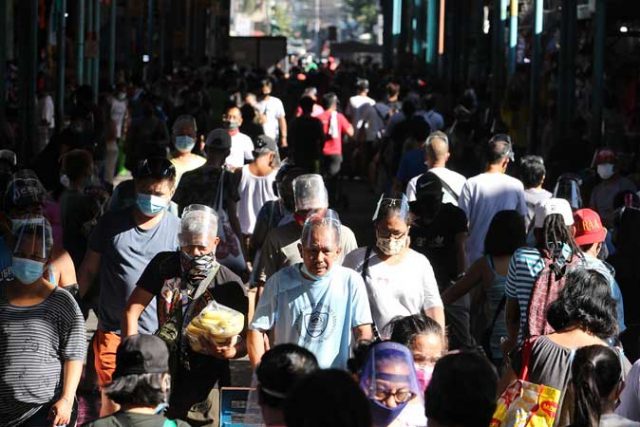
The Health department reported 5,310 new COVID-19 cases on Wednesday, bringing the country’s total infections to 1.19 million. Active cases stood at 46,037, with a positivity rate of 13.5%.

Meanwhile, 150 deaths were logged on Wednesday, bringing the country’s death toll to 20,169. The Health department also reported 7,408 new recoveries, which brought the total to 1.13 million.

President Rodrigo R. Duterte was set to address the nation on Wednesday evening and was expected to announce new quarantine measures as current restrictions are only in effect until this week.

All sectoral indices posted gains on Wednesday. Property climbed by 89.35 points or 3.01% to 3,052; holding firms went up by 151.60 points or 2.44% to finish at 6,344.26; services improved by 31.61 points or 2.18% to 1,478.71; mining and oil gained 134.76 points or 1.46% to 9,332.64; financials moved up by 18.36 points or 1.33% to 1,394.56; and industrials increased by 66.32 points or 0.77% to end at 8,601.42.

Advancers outperformed decliners, 140 against 74, while 47 names closed unchanged.

Value turnover soared to P13.09 billion on Wednesday with 1.26 billion shares switching hands, from the P6.02 billion with 1.16 billion issues traded on Tuesday.

Net foreign selling ballooned to P6.48 billion on Wednesday from the P88.89 million in net outflows logged on Tuesday.

“The big question is whether this is the beginning of a new rally or if it is just window dressing for the end of the month,” Mr. Mangun said. “The next few trading days will reveal this to us.” — KCGV

Metro needs 52M vaccines for herd immunity

PHILIPPINE STAR/ MICHAEL VARCAS

By Vann Marlo M. Villegas and Kyle Aristophere T. Atienza, Reporters

ABOUT 250,000 coronavirus vaccines should be given to residents of Metro Manila and eight priority areas daily to achieve herd immunity by November, according to a research group from the country’s premier university.

At least 51.8 million vaccine doses are needed to vaccinate 70% of the population in these areas, or about 25.9 million adults, the OCTA Research Group said on Wednesday.

It would take 17 months to achieve herd immunity if 100,000 doses were given daily, eight months for 200,000 doses daily, and almost six months for 300,000 doses daily, OCTA research fellow Nicanor Pier Giorgio Austriaco told an online news briefing.

The government seeks to achieve herd immunity — when a majority of the population becomes immune from an infectious disease, either through vaccination or a previous infection, indirectly protecting those without immunization — by Nov. 27.

“If we are going to be doing this in the six-month period, we need to have 250,000 to 275,000 doses administered per day on the average of this six month period,” Mr. Austriaco said.

“The risk for a surge is substantially diminished as we approach containment,” he added.

Also part of the priority areas aside from the capital region are Metro Cebu, Metro Davao and the provinces of Bulacan, Batangas, Cavite, Laguna, Pampanga and Rizal.

OCTA said prioritizing these areas for vaccination would “optimize the scarce vaccines to give the maximum impact.”

Mr. Austriaco said this would build “an immunity wall” around international entry ports in Manila and Cebu. This will also revitalize the economy and restart domestic tourism.

The Health department on Tuesday said it supports President Rodrigo R. Duterte’s order to prioritize Metro Manila and the eight other areas. It said 67% of the vaccine supply is given out in Metro Manila, the Calabarzon region, Central Luzon Central Visayas and the Davao region.

EASING TREND
Meanwhile, OCTA research fellow Fredegusto Guido P. David said coronavirus infections in Metro Manila had fallen by 80% since a surge that started in March.

He said the daily infection average in Metro Manila in the past seven days stood at 1,099, lower than 5,550 during the peak in late March to April.

“This is a significant improvement and obviously we want to sustain this,” he told the same briefing. “We should remind everyone that even though we have made significant improvements, the National Capital Region will always be at risk of another surge.”

Mr. David said the capital region had a virus reproduction rate of 0.53, lower than more than two at the peak in July and August last year. A reproduction rate of 1 means an infected person can infect one more. 

He also recommended that the general lockdown be retained in June. “We should try to retain the general community quarantine at this time because the cases are still significant.”

He said Metro Manila had about 400 cases daily in February, when it  was still under a general lockdown.

“It also gives us the wrong messaging to the people,” he said about relaxing the quarantine. “We want to avoid situations where people become very complacent because they feel that the situation has improved significantly.”

Mr. David said the heightened restrictions could be relaxed by increasing the capacity in businesses that have been following protocols, while making sure that transmissions do not occur. Social gatherings should also be avoided.

Meanwhile, at least a million Filipinos have been fully vaccinated against the coronavirus since the government’s vaccination drive started on March 1, Health Undersecretary Myrna C. Cabotaje told a separate online news briefing.

Of the total, 581, 797 were health workers, while 195,952 were seniors. More than 250,000 seriously ill people and 535 essential workers had also been fully vaccinated, she added.

Ms. Cabotaje said about 3.4 million people have not completed their vaccination, having received only their first dose.

About 22.4 million people were essential workers whose vaccination would start next month, she said, citing data from the National Economic and Development Authority.

About 8.5 million people were considered poor, she added.

The government earlier said essential workers and indigents would be vaccinated once the country’s supply of vaccines stablizes.  

Rabindra Abeyasinghe, the World Health Organization’s representative in the Philippines, earlier said the country would take delivery next month of as many as two million doses of the vaccine made by Pfizer, Inc. under a global initiative for equal access.

About two million doses of the vaccine made by AstraZeneca Plc would also arrive in June, he said.

The Philippines may receive next month about 4.5 million more doses of the vaccine made by Sinovac Biotech, Ltd., vaccine czar Carlito G. Galvez, Jr. earlier said.

Meanwhile, Ms. Cabotaje said more than a million doses of the two million AstraZeneca vials that the Philippines received earlier this month under the global initiative had been given out.

About 500,000 doses that will expire on July 30 would be given as second doses. The vials reserved as first doses will expire on June 30.

House OK’s easing ‘Cha-cha’ ownership limits

The House of Representatives on Wednesday night approved on second reading a resolution seeking to ease economic restrictions in the 1987 Constitution.

Congressmen will amend the three-decade-old Charter by inserting  the phrase “unless otherwise provided by law” in clauses that limit foreign ownership in some sectors.

This will give lawmakers the leeway to pass laws that will lift the Charter change (Cha-cha) limits.

The House committee on constitutional amendments endorsed the measure in plenary in January. Congressmen have prioritized idebates on the measure since sessions resumed on May 17 after a two-month recess. — Gillian M. Cortez

5,310 more people get infected; total deaths at 20,169, says DoH

THE Labor department has declared COVID-19 as a compensable disease through ECC Board Resolution 21-04-14. — PHILIPPINE STAR/ MICHAEL VARCAS
PHILIPPINE STAR/ MICHAEL VARCAS

THE DEPARTMENT of Health (DoH) reported 5,310 coronavirus infections on Wednesday, bringing the total to 1.19 million.

The death toll rose by 150 to 20,169, while recoveries increased by 7,408 to 1.13 million, it said in a bulletin.

There were 46,037 active cases, 1.7% of which were critical, 92.5% were mild, 2.1% did not show symptoms, 2.2% were severe and 1.51% were moderate.

It said six duplicates had been removed from the tally, four of which were tagged as recoveries. Eighty-six recoveries were reclassified as deaths. Four laboratories failed to submit data on May 24, DoH said.  About 12.3 million Filipinos have been tested for the coronavirus as of May 24, according to the agency’s tracker website.

The coronavirus has sickened about 168.5 million and killed 3.5 million people worldwide, according to the Worldometers website, citing various sources including data from the World Health Organization.

About 150.1 million people have recovered, it said.

Meanwhile, a suspect in the illegal sale of vaccines and vaccination slots in Mandaluyong City was surrendered by his father, a village councilor, to Mandaluyong City Mayor Carmelita Aguilar Abalos.

Ms. Abalos and her husband, Metropolitan Manila Development Authority Chairman Benjamin de Castro Abalos, Jr. presented the suspect to media at a news briefing on Wednesday.

Hours earlier, the Criminal Investigation and Detection Group and the Anti-Cybercrime Group identified the suspect as 22-year-old Kyle Bonifacio, who allegedly offered vaccines and a vaccine slot to his high school friend through social media.

The suspect said he was innocent. “I have no connection to the local government unit because I am just a young student,” he told the news briefing in Filipino.

The suspect will be turned over to police for further investigation, the MMDA chief said.

Also on Wednesday, national police chief Guillermo T. Eleazar said he would summon people involved in the illegal sale of vaccination slots in the capital region. — Vann Marlo M. Villegas and Kyle Aristophere T. Atienza

ADVERTISEMENT
ADVERTISEMENT