Home Blog Page 7911

Ivory Coast says chocolate traders failing to pay farmers living wage premium

REUTERS

ABIDJAN — Major chocolate traders in Ivory Coast are failing to pay a $400-per-ton premium on beans aimed at curbing farmer poverty, the country’s cocoa regulator said in a draft letter seen by Reuters Friday.

The Coffee and Cocoa Council (CCC) said companies including Mondelēz International, Inc. were offsetting the Living Income Differential (LID) by offering a negative country differential — normally a premium of 70 to 150 pounds ($99-$212) per ton to reflect the quality of Ivory Coast’s beans.

Mondelēz said it was paying the full LID. “(Mondelēz) does not offer or have any influence over negative country differentials,” the company said in a statement to Reuters.

Buyers have been pressing for the country differential to be turned into a country discount, so farmers receive the extra cash but prices stay globally competitive.

“In recent weeks, when we have seen an upturn in economic activity and therefore in demand, the major groups have refused to pay the LID,” CCC said.

The world’s top cocoa producer has been locked in talks with exporters over the price of its beans as a bumper crop and weak global demand caused by the coronavirus pandemic, coupled with the introduction of the LID, pushed down sales.

“(We will) stop all the sustainability and certification programs of Mondelez that are ongoing with Cargill, and all the other exporters,” said an official at CCC who asked not to be identified.

In November, Ivory Coast and Ghana suspended Hershey Co.’s cocoa sustainability schemes in their countries for six days, accusing the US-based chocolate maker of trying to avoid paying the LID.

“Unlike Hershey, this time we are going to be tough on chocolate makers who want to bypass the LID. For us this is unacceptable,” the CCC official said. — Reuters

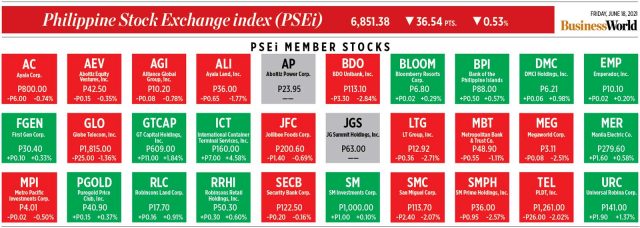
How PSEi member stocks performed — June 18, 2021

Here’s a quick glance at how PSEi stocks fared on Friday, June 18, 2021.


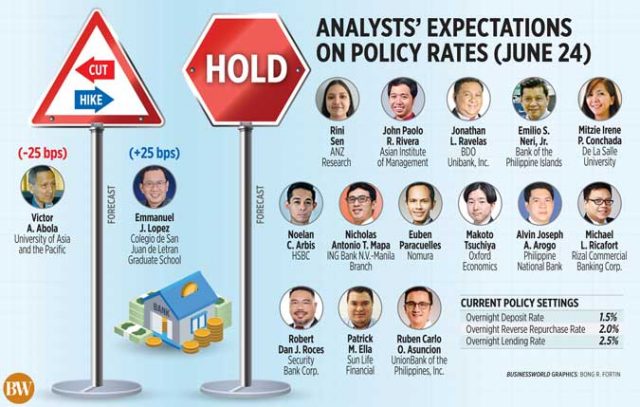
Analysts’ Expectations on Policy Rates (June 24)

THE BANGKO SENTRAL ng Pilipinas (BSP) will likely keep benchmark interest rates steady on Thursday to support the “fragile” economic recovery, with inflation improving on the back of government initiatives to ease supply issues. Read the full story.

Analysts’ Expectations on Policy Rates (June 25)

Stronger peso expected before rate pause

BW FILE PHOTO

THE PESO is likely to appreciate versus the greenback as the market expects the Philippine central bank to keep benchmark interest rates at record lows at its meeting on Thursday.

The currency on Friday lost five centavos to close at P48.43 a dollar from a day earlier, according to data posted on the Bankers Association of the Philippines website. It weakened by 73 centavos from a week earlier.

Ruben Carlo O. Asuncion, chief economist at UnionBank of the Philippines, Inc. traced the depreciation to market volatility after the US Federal Reserve said policy tightening could come earlier.

US central bank officials on Wednesday said rate increases could come a year earlier in 2023. Thirteen of 18 policy makers foresaw a “liftoff” in borrowing costs that year and 11 expected two quarter-percentage-point rate increases, Reuters reported.

Seven of the officials said they expected rates to start increasing next year.

Fed Chairman Jerome Powell said they had started initial discussions about when to pull back on the Fed’s $120 billion in monthly bond purchases.

The government’s move to continue reopening the economy was also a major factor that led to the depreciation of the peso, Michael L. Ricafort, chief economist at Rizal Commercial Banking Corp. said in a text message. This could boost imports and demand for the dollar, he pointed out.

Mr. Ricafort expects the peso to trade from P48.30 to P48.50 against the dollar this week, while Mr. Asuncion expects it to move between P48.20 and P48.50.

President Rodrigo R. Duterte on Monday relaxed the lockdown in Metro Manila and Bulacan province due to easing coronavirus infections.

Investor sentiment, which could affect foreign exchange trading, would be affected by the central bank’s policy meeting, Mr. Asuncion said.

A BusinessWorld poll last week showed 14 out of 16 analysts expecting the central bank to keep rates unchanged to support the economy.

The market would also be watching the latest budget deficit data, Mr. Ricafort said. The Bureau of the Treasury is set to release the data on June 22.

The budget deficit fell to P44.4 billion in April from P273.9 billion a year earlier and from P191 billion in March. It was the lowest deficit in three months. — LWTN

Stocks may take cue from govt’s vaccine rollout

COURTESY OF PHILIPPINE STOCK EXCHANGE, INC.

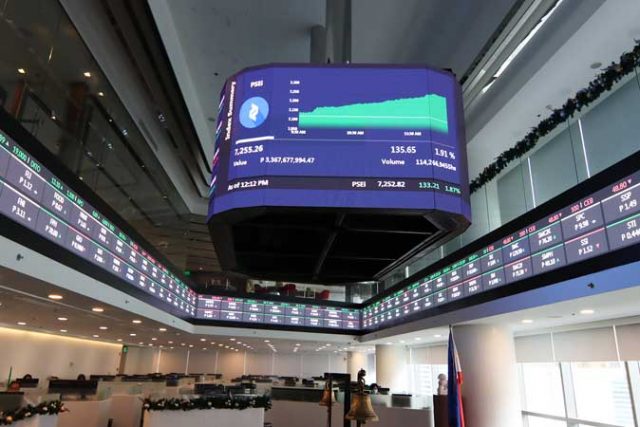
PHILIPPINE shares would probably take their cue this week from the government’s continued rollout of coronavirus vaccines and further lockdown easing, analysts said at the weekend.

Stocks may also move based on expectations of easing inflation, they said.

The Philippine Stock Exchange index (PSEi) could breach 7,000 points with “more positive news in both the vaccine supply and speed of vaccination, and inflation tempering,” Cristina S. Ulang, head of research at First Metro Investment Corp. said in a Viber message.

The stock index on Friday shed 0.53% or 36.54 points to close at 6,851.38, while the all-share index fell by 0.43% or 18.06 points to 4,166.90. It lost 56.41 points from a week earlier.

The index rose before June 15 as investors expected the government to ease quarantines amid falling coronavirus infections, Aniceto K. Pangan, a trader at Diversified Securities, Inc. said in a mobile phone message.

But the growth outlook turned sour as investors took profits after the US Federal Reserve signaled future benchmark interest rate increases, he added.

The US central bank delivered a strong message on Wednesday when Fed Chairman Jerome Powell said officials have discussed tapering bond buying. Fed officials also added two rate increases to their 2023 forecast, where there was none before.

Ms. Ulang said the Fed statement had triggered a “correction from the top.” The mild correction suggests that the market needs good news on the vaccine and inflation fronts for the index to go above 7,000 she added.

The Philippine central bank would probably keep a loose monetary stance to support economic recovery as inflation risks subside by next year, Monetary Board Member Felipe M. Medalla said on June 12.

The inflation spike was temporary, he said, adding that inflation would be close to 3% from more than 4% now. May inflation was unchanged at 4.5% for the third straight month.

The policy-setting Monetary Board is set to meet on June 24. It maintained the key policy rate at a record low of 2% on May 13.

The government eased the lockdown in Metro Manila and Bulacan last week, putting it under a general community quarantine with some restrictions until the end of the month. The provinces of Rizal, Laguna and Cavite remained under a general lockdown with heightened restrictions.

About 1.5 million more doses of CoronaVac arrived from China on Thursday, the third delivery this month. Another batch of 24 million doses is expected to arrive on June 24.

Meanwhile, the arrival of 250,000 doses of the vaccine made by Moderna, Inc. was delayed to June 25.

The country will also receive about two million doses of the vaccine from AstraZeneca Plc and 150,000 shots of Sputnik V from Russia. 

The government has given out more than 8 million coronavirus vaccine doses since its vaccination drive started in March.

“The arrival of more vaccines and the pickup in the vaccination drive in some local government units will refocus investors to the promise of local reopening and improving growth prospects,” FMIC’s Ms. Ulang said.

The Health department reported 6,959 coronavirus infections on Saturday, bringing the total to 1,35 million.

“We may see investors continue their profit taking mode next week, with the index immediate support at 6,700 and the psychological resistance at 7,000,” Mr. Pangan said. — Keren Concepcion G. Valmonte

DoE weighing green energy auction delay beyond June

BW FILE PHOTO

By Angelica Y. Yang, Reporter

THE Department of Energy (DoE) is considering delaying the first round of the green energy auction (GEA), with the auction committee continuing to compile data, an official said last week, noting that any new findings may have an impact on the design of the offer.

The department had announced earlier that it may conduct the auction for green energy suppliers this month.

The GEA allows qualified renewable energy developers to supply a portion of the electricity generated by their facilities to eligible customers who may, in turn, enjoy power prices below market rates.

“The Green Energy Auction Committee is still firming up and finalizing its calculations and this may affect auction design and framework,” Renewable Energy Management Bureau Director Mylene C. Capongcol told BusinessWorld in an e-mail Friday.

“As to the conduct of the first round of auction this June, the GEA Committee also recommended that the scheduled auction in June this year be deferred to a later date,” she said.

Ms. Capongcol said the changes will be presented to stakeholders as soon as they are finalized.

She said that the DoE chose to remove the GEA from the program of the Luzon Energy Investment Information, Education, and Communication (IEC) event on July 8 “because the effects of the pandemic changed the numbers on the demand side.”

The IEC did not mention the GEA in its list of breakout sessions for the event.

Separately, DoE Spokesman Felix William B. Fuentebella said in a virtual briefing Friday that the GEA’s “numbers have changed due to the pandemic” thus requiring recalculation.

“We also need to align with our targets towards the Clean Energy Scenario. Hence, it may not be ready for an information education campaign,” Ms. Capongcol said.

In July 2020, the department released a circular which detailed the guidelines for the conduct of the GEA. Projects eligible for the auction are those covered under the renewable portfolio standards.

Qualified participants from on-grid areas can be from the biomass, wind, solar, hydro, ocean, geothermal, and waste-to-energy industries.

Gov’t proposal to return to power generation viewed as admission EPIRA has failed

THE government’s proposal to once again take part in power generation is an admission of failure for a two-decade-old law that reformed the industry by privatizing most of it, and will impose a heavy burden on public funds, an energy analyst said.

“I do not agree that the government should now go back and be allowed to go into limited power generation,” Nicanor S. Villaseñor III, who teaches energy engineering at the University of the Philippines Diliman, told BusinessWorld in a video call over the weekend.

“By doing so, it sets a precedent. You will have to change the legislation. In short, you’re saying that the spirit of EPIRA (Electric Power Industry Reform Act of 2001), of privatization has failed,” he added.

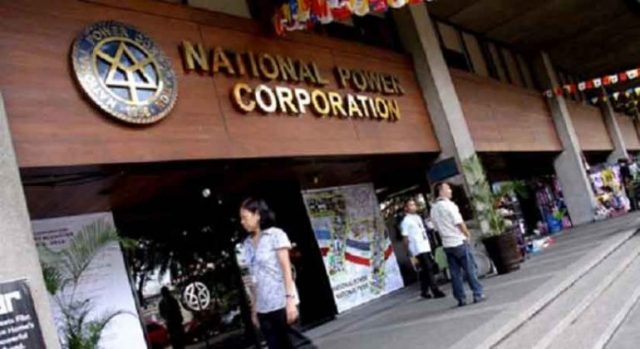
EPIRA, signed into law during the Arroyo administration, sought to “restructure” the power industry while allowing for the sale and transfer of the National Power Corp.’s assets to private entities.

The government will also need to look for funds to finance its proposed initiatives in power generation, Mr. Villaseñor said.

Earlier this month, Energy Secretary Alfonso G. Cusi asked the Senate Committee on Energy to consider letting the government engage in “limited” power generation — not to compete with private firms but to provide emergency energy when needed.

He added that government-owned power plants can supply their reserves to the power grid, calling this measure an “antidote” to the grid operator’s failure to comply with the minimum contracted requirement for reserves, known as ancillary services (AS).

“They have to fund the facilities and fund the operation. That will be a financial burden to the government,” Mr. Villaseñor added.

For Mr. Villaseñor, the Department of Energy (DoE) proposal is not “the best solution,” adding that it should focus instead on implementing its interruptible load program (ILP).

The DoE works in coordination with distribution utilities and electric cooperatives to implement the ILP, which calls on large users with their own generating facilities to voluntarily not draw power from the grid during periods of tight supply.

“The inconvenience will not be that much and it’s a cheaper cost of addressing the issue because you don’t have to finance a (power generation) facility just for reserves… If the DoE strictly enforces (the ILP), then they can pressure NGCP to perform and fulfil its obligations. (With) proper enforcement, then (the DoE) will send a strong message to the generators,” he said.

Chairperson of the Philippine Solar and Storage Energy Alliance (PSSEA) Ma​. Theresa C. Capellan says it’s not practical for the government to build and operate power generating facilities.

“If ‘engaging’ means (that the) government will finance, build, and operate, PSSEA believes this is not the practical solution to the problem… Creating a strong incentive for the private sector to build ancillary services is the more practical way forward,” Ms. Capellan told BusinessWorld via Viber last week.

She said that the government should prosecute “those that failed to comply with the obligation to supply reserves, while offering incentives to the private sector who can finance, build, operate and maintain AS.”

“(The) government enjoys tremendous regulatory and fiscal powers. It can prosecute violators or cancel the franchise or concession if it finds an entity wanting in its obligation to the public. It can also deploy capital (like the feed-in tariff) to provide infrastructure that will promote consumer welfare or comply with its international obligations,” Ms. Capellan said.

In a June 11 interview with ANC Headstart, Senate Committee on Energy Chairman Sherwin T. Gatchalian expressed reservations about the government returning to the power sector.

“I have a lot of reservations about the government stepping back into business because when the government steps into business, corruption ensues, that’s for sure. And the reason why the government moved out of the power sectors is because of corruption,” he said.

He said the NPC was “saddled” with trillions of pesos of debt because of corruption.

The Senate Committee on Energy has held two hearings to seek long-term solutions to power supply shortages during the dry months. Earlier this month, rotating outages hit portions of Luzon when its grid was placed under red alert for three consecutive days. — Angelica Y. Yang

Coal plant phaseout seen accelerating shift to sustainable energy

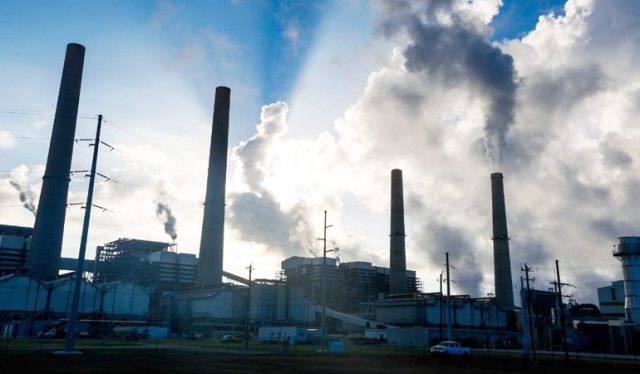
THE phasing out of coal-fired power plants and the repurposing of current  plants will fast-track the shift to a sustainable energy future, the University of the Philippines Institute for Maritime Affairs and Law of the Sea (UP IMLOS) said last week.

“We need legislation that lays out very clearly a schedule and system for the phaseout of brownfield coal plants and prohibition of greenfield coal plants, repurposing and conversion of these coal plants and the phaseout, eventually, of fossil fuel pass-through costs,” Jay L. Batongbacal, IMLOS director, said at a virtual event on June 18.

He said that the Asian Development Bank and the Department of Finance are currently in talks to repurpose and convert coal plants into facilities generating cleaner energy so it “would be good to prepare for such a possibility through legislation.”

The phasing out of coal plants is one of the measures included in the IMLOS’ proposed legal design highlighting the actions required to facilitate the energy transition.

Other key measures needed to accelerate the shift include subsidies for ocean energy development, the removal of public listing requirements for generation companies, and incentives for clean transport technologies and electric vehicles, among others, according to a proposed blueprint prepared by IMLOS.

Mr. Batongbacal said that the blueprint, which was turned over to the Senate and House Committees on Energy on June 18, provides a transition framework which can help the country achieve decarbonization, decentralization and digitalization in the energy industry.

“Right now, our centralized, carbonized and analog systems are very vulnerable to… environmental conditions (along) with climate change. You also need to sort of reinforce (the Philippine energy system) against those changes,” he said.

Manila Observatory Energy Collaboratory Director and Senior Fellow on Climate Change Antonio G.M La Viña, who attended the event as a reactor, said the blueprint details the particulars of how the energy sector can contribute to achieving the nationally determined contributions (NDCs) for reducing greenhouse gases.

The government-approved NDC calls for reducing greenhouse gas emissions by 75% by 2030. The five-page document covers the modernization of the industry and the pursuit of low-carbon and resilient development for the agriculture, waste, industry, transport and energy sectors.

“What’s missing in the NDC is that there are no particulars. The blueprint, I think, if implemented, gets us to that, you know, nearer to that 75% (target). Certainly, if we implement everything in that blueprint, we can do a lot even without climate finance from outside the Philippines,” Mr. La Viña said.

NDCs are a component of the Paris Agreement on Climate Change, which aims to limit the global temperature rise to below 1.5 degrees Celsius. NDCs also detail the efforts of countries in reducing emissions and adapting to the impacts of climate change. — Angelica Y. Yang

Partner benefits, neutral restrooms seen as key to inclusive workplace

REUTERS

TELUS International Philippines (TIP) said it is exploring inclusive-workplace initiatives like health benefits for employees’ same-sex partners, domestic partners and dependents, and has implemented restrooms better suited to employees’ gender preferences.

TIP Vice-President of Brand, Marketing and Culture Warren Tait, who sponsored diversity consultant Spectrum Philippines in conducting gender-sensitivity training within the company, said “Diversity is a strength we continuously nurture. By enabling our team members to come to work and be their whole selves, we create a workplace that better facilitates a wider exchange of ideas, promotes better talent retention, and inspires creativity and innovation.”

TIP and Spectrum conducted online sessions within the company on Sexual Orientation and Gender Identity Expression (SOGIE) in celebration of Pride Month, the company said in a statement.

“Gender plays a huge role in the workplace. It is one thing to be gender sensitive but another thing to be gender responsive. Throughout human history, there has been a struggle not only for women but also for the members of the LGBTQIA+ community when it comes to equal opportunities in the workplace,” according to managing director of public relations firm Castro Communications Janlee Dungca, a guest speaker at the sessions and a member of the LoveYourself Foundation.

“It all starts with empathy and the willingness to listen, because there’s so many arguments that we can use when we talk to people, especially when we want to win people over,” she said. “If there is a genuine desire to [really be] an ally, then that’s where it starts empathic listening, and really being interested in knowing our stories, our struggles, and having informed opinions about the things that we experience.”

To make workplaces safer for LGBTQIA+ employees, Ms. Dungca suggests that creating gender neutral restrooms, conducting gender sensitivity sessions in the company, and implementing gender diverse and inclusive policies.

TIP said Spectrum has encouraged the company to introduce benefits that are more inclusive, such as extending HMO coverage to dependents, domestic partners and same-sex partners of team members. Sharing their insights with the human resources and leadership teams has led to changes, such as the introduction of gender neutral, self-identified male, and self-identified female restrooms at all of TIP’s sites.

TIP and Spectrum have an ongoing fundraising effort for the benefit of the LoveYourself Foundation and its education efforts about HIV/AIDS for the LGBTQI+ community and the Filipino youth. — Michelle Anne P. Soliman

Time for CEOs to redefine their growth paradigm

(Second of two parts)

In the “new normal,” it is imperative for CEOs and business leaders to consider how they should reimagine, redesign and redefine their growth strategy. The COVID-19 pandemic has triggered widespread and systemic disruptions in every country, industry and sector, and has resulted in significant economic downturns globally. However, as countries begin the road to rebuilding and recovery, there arises an opportunity for companies to likewise transform and redirect their energies to purpose-driven growth.

In the first part of this article, we discussed the current environment and some of the considerations as discussed in a recent article on ey.com, The CEO Imperative: Rebound to more sustainable growth. We began the discussion on some key themes that CEOs may wish to consider as they lead their organizations into post-pandemic recovery. We started off talking about the importance of trust and sustainability. Now we will discuss other aspects, such as trade, technology and people.

TRADE IS VASTLY DIFFERENT
When the pandemic began spreading, it exposed underlying vulnerabilities in the areas of trade, supply chains and logistics. This situation has been compounded by turbulent geopolitical conditions that further hamper how CEOs can manage their global business operations in the face of complexities they cannot control. Examples include the tensions between the US and China, post-Brexit complications between the UK and EU, and unrest and severe COVID numbers in parts of Asia and East Asia.

With the heightened uncertainty, CEOs and business leaders are under constant pressure to revisit their supply chains, talent development and other enterprise resilience considerations. Where previously globalization was considered inevitable to drive business growth, several countries seem to be becoming increasingly nationalistic as they close borders to both trade and travelers to limit the spread of the virus in their respective demesnes. Some governments are also encouraging the reshoring of investments into certain key activities and for domestic companies to invest in self-sufficiency, particularly in the areas of basic pharmaceuticals, vaccines, energy and industrial materials.

Given this, CEOs may need to put a greater emphasis on managing supplier risk. Numerous organizations are already trying to find ways to shorten their supply chains by identifying more near-shore or even on-shore sources. As supply chains become increasingly fragmented and geographically diverse rather than globally integrated, CEOs need to consider how to make supply chains more resilient to weather geopolitical events as well as the limitations created by the pandemic. This will be particularly important when economies reopen. Companies with a purpose-led growth strategy can more agilely adjust to new opportunities, including possibly reducing or consolidating asset portfolios and exploring new technology-driven directions to growth. With a clear purpose, CEOs can better decide whether to transform/develop existing assets to support entry into new market opportunities, or whether to acquire assets for faster entry.

WILL TECHNOLOGY SWING THE BALANCE?
When the pandemic struck in 2020, many companies were caught off-guard and found themselves scrambling to not only acquire sufficient technology assets to support a dramatic and unexpected business transformation, but many also had to hastily evaluate whether their digital infrastructure was strong enough to support the business. Having to suddenly transition to remote working also made many companies re-evaluate their operational agility and resilience. Moving forward, companies will need to consider whether their post-pandemic operations will return to traditional on-site work conditions, retain remote working, or develop a hybrid of both. Regardless of the format, future working conditions will make it even more imperative to be purpose-led — which means leaders will also need to identify how to effectively and consistently inculcate their purpose into their people and align them to the company’s long-term goals.

Because of what happened last year, which is still happening today, CEOs are now considering data and technology investment as priority areas for the coming year. Many have been suddenly forced to consider how technology and innovation can support their business — and many are also suddenly seeing the benefits of incorporating digital throughout the enterprise.

One very important consideration to investing and upgrading technology, however, is to evaluate the human-technology interface in one’s operations. There has been increasing public awareness of the ethical, privacy and security risks of technology, and many customers still do not trust companies with their personal data. CEOs will need to not only consider whether they need to upgrade the technology competencies of their people, but also how to build up the trust of their customers in their digital ecosystem while ensuring the safety and security of their digital systems.

PEOPLE AT THE CENTER
One thing that remains true regardless of whether we look at the “old” or “new” normal is the reality that people are still central to any strategy. This is particularly true for purpose-led growth strategies where actions need to constantly be measured by their impact on people — not just on employees, but also customers, stakeholders and partners. Even businesses that are almost wholly digital still need the right people, talent, and competencies to thrive. Human values will always be needed to underline and drive ethical, purposeful innovation. This is a critical consideration in today’s environment when the pandemic may be forcing some organizations to consider taking shortcuts to ensure business viability.

CEOs and leaders need to understand the value of empathy towards people, not only putting themselves into the shoes of their employees and customers, but also sincerely engaging with people by applying emotional intelligence, compassion as well as adherence to shared values. They also need to understand the experience and motivations of their clients and customers, and how their personal and consumer behaviors have changed due to the pandemic.

WHAT WILL YOUR NEW GROWTH PARADIGM LOOK LIKE?
As the world continually moves toward eventual resurgence and recovery, CEOs and business leaders need to understand that new opportunities to build a sustainable future will likewise arise. By focusing on building trust, emphasizing sustainability and ESG considerations, understanding new trade challenges, evaluating technological opportunities and always keeping people central to every action plan, companies can be prepared for a strong, purpose-led drive to recovery. Certainly, the time is ripe for organizational reflection.

This article is for general information only and is not a substitute for professional advice where the facts and circumstances warrant. The views and opinions expressed above are those of the author and do not necessarily represent the views of SGV & Co.


Marie Stephanie C. Tan-Hamed is a Strategy and Transactions Partner of SGV & Co.

Gov’t seals deal for 40M doses of Pfizer vaccine

US EMBASSY PHOTO RELEASE

THE PHILIPPINES has sealed a deal for 40 million doses of the vaccine made by Pfizer, Inc., the country’s vaccine czar announced on Sunday, calling it the biggest order secured for this year.

Secretary Carlito G. Galvez, Jr. said deliveries are expected “after eight weeks starting August.”

“We are very happy to report that the government and the management of Pfizer have finally concluded our negotiations. (Health) Secretary (Francisco T.) Duque and I signed yesterday the supply agreement for the biggest and most decisive deal we had for 2021,” Mr. Galvez said in a press release by the National Task Force Against COVID-19 (coronavirus disease 2019).

The procurement of the 40 million Pfizer doses will be financed through a multilateral arrangement with the Asian Development Bank, Mr. Galvez said.

The loan “follows a direct disbursement scheme wherein payments are paid directly by the fund manager to the vaccine manufacturer,” he said.

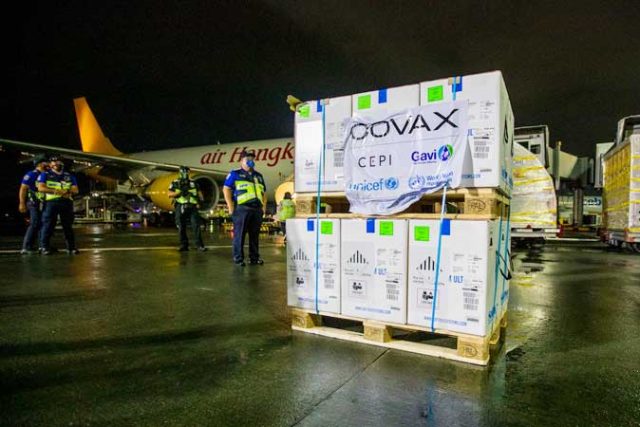
Mr. Galvez said a global facility for equal vaccine access has also committed to deliver about 44 million vaccine doses to the country this year.

With the latest supply commitments, Mr. Galvez said the country has now secured 157 million doses of coronavirus vaccines, including 26 million from Sinovac Biotech Ltd., 10 million from Russia’s Gamaleya, 20 million from Moderna, Inc., and 17 million from AstraZeneca, Plc.

“The vaccines from Pfizer will significantly boost our national immunization program and will enable us to realize our goal of achieving herd immunity by yearend,” Mr. Galvez said.

The Philippines aims to vaccinate 70 million Filipinos this year to achieve herd immunity.

As of June 18, data from the National Vaccination Operations Center show more than eight million doses have been given out. Of the total, more than 5.9 million were given as first doses, while more two million were administered as second doses, the task force said in a press release.

CASE COUNT
The Department of Health reported 5,803 coronavirus infections on Sunday, bringing the total to 1.36 million.

The death toll rose by 84 to 23,621, while recoveries increased by 7,652 to 1.28 million, it said in a bulletin.

There were 57,679 active cases, 1.3% of which were critical, 91.9% were mild, 3.7% did not show symptoms, 1.8% were severe and 1.29% were moderate.

The agency said eight duplicates had been removed from the tally, six of which were tagged as recoveries and one was tagged as death.

A total of 115 recoveries were reclassified as active cases, while 59 cases previously tagged as recoveries were reclassified as deaths. Two laboratories failed to submit data on June 18, the agency said.

About 13.5 million Filipinos have been tested for the coronavirus as of June 18, according to the Health department’s tracker website.

PROTOCOLS
Meanwhile, Senator Panfilo M. Lacson on Sunday urged the government to fast-track the implementation of standard quarantine protocols for vaccinated Filipinos.

In a statement, Mr. Lacson said he fully supports the national task force’s move to have a standard quarantine protocol for Filipinos vaccinated here and abroad, noting the “economic recovery cannot afford to wait.”

“Please make it sooner, not later. Mind the economy for a change,” Mr. Lacson said in a social media post.

The senator previously pushed for a vaccine passport system that will make travelling to the country easier for vaccinated people, especially returning migrants and foreign investors.

He also urged the inter-agency task force to “fine-tune” protocols to address these problems and ensure that they are in line with those of other countries.

Presidential Spokesperson Herminio L. Roque, Jr. early this month said the task force has approved the shortening of quarantine protocols for returning Filipinos who received their shots in the country. The policy takes effect June 22.

The returning migrants will only be subjected to a swab test if they show symptoms within seven days, he said.

On the other hand, those who got vaccinated overseas must quarantine for 10 days at a facility and continue isolation for another four days at home.

He said this is in consideration of the full rollout of the validation process of vaccine certificates. — Kyle Aristophere T. Atienza and Vann Marlo M. Villegas


Analysts see Duterte leaving VFA as unfinished business

C7F.NAVY.MIL

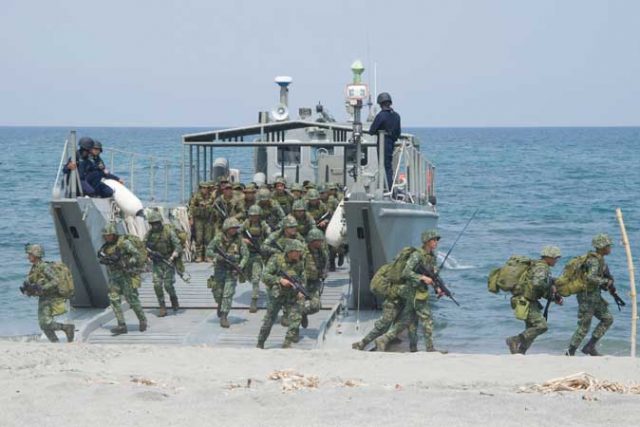
PRESIDENT Rodrigo R. Duterte may simply leave the fate of the military pact with the United States to the hands of his successor and maintain the administration’s current relations with both America and China, according to analysts.

Foreign Affairs Secretary Teodoro L. Locsin, Jr. announced last week that the President suspended for another six months the termination the visiting forces agreement (VFA) between the US and Philippines, which allows the entry of American troops in the country for joint drills.

Michael Henry Ll. Yusingco, research fellow at the Ateneo Policy Center, said Mr. Duterte may choose not to make a final decision on whether the VFA should be terminated.

“I am not particularly confident that President Duterte will make a firm decision on the fate of the VFA before his term ends. I think more than likely, he will just let the next President take on this matter in his term,” he told BusinessWorld via email. 

“I think delaying the abrogation of the VFA, while at the same time insisting on his personal appeasement policy stand with regards to our troubles in the West Philippine Sea, is a delicate balancing act which he has been successful at doing. So why change tactics so close to the elections, right?” he added.

Renato C. de Castro, international studies professor at the De La Salle University, said there are chances that Mr. Duterte would again extend the suspension by another six months in November.

“It will be up to his successor to determine whether we will sign or of course do away with the visiting forces agreement. So, he’s leaving it to his successor,” he said in a phone interview.

‘PERSONAL DISLIKE’
Mr. De Castro said the President may have a “personal dislike” of the US, and he may be afraid the country would be dragged in a conflict between China and the US, but other factors come into play in making such policy decisions.

“On the other hand, he cannot simply terminate the agreement because the military and the foreign affairs department want to maintain the agreement,” he told BusinessWorld in a phone interview. “Because the military and of course the foreign affairs department are still wary of China.”

Mr. Yusingco cited other factors such as the need to strengthen diplomatic and trade relations with Asian neighbors as well as the pressure on the part of the government to assert national sovereignty in the West Philippine Sea. 

“It is pretty clear that the foreign relations cluster of the administration is struggling with the evolving geopolitics in our region,” he said. “And the fact that it is being delayed indicates that our government does not have a coherent and firm foreign policy plan yet in light of the changing geopolitics in Asia.”

Meanwhile, Marlon M. Villarin, political science professor at the University of Santo Tomas, said the government is still studying the risk and opportunities of the pact.

He said the extensions on the suspension order “is a politically and diplomatically calibrated stance to bargain” their issues and concerns on the benefits from the VFA. 

Mr. Villarin also said that the extension would allow the executive and legislative branches to collaborate before the government decides on the VFA’s fate. “I think the President is playing a queen’s gambit to strategically ensure that should he decide to extend VFA, the Philippine government will practically benefit and that transparency and accountability issues that cloud VFA is addressed at the same time,” he said in a Viber message.

Mr. Duterte in February last year said he would terminate the agreement after the US Embassy canceled the visa of Senator Ronald M. de la Rosa, one of his closest allies. 

He suspended the abrogation for six months in June 2020, noting the heightened tensions in the region and the global coronavirus pandemic. It was suspended again for another six months in December.   

Philippine Ambassador to the US Jose Manuel G. Romualdez said in a briefing early this month that the two countries have discussed how to improve the pact and the agreement is “kind of a bigger picture of our relationship, especially in our Mutual Defense Treaty.” — Vann Marlo M. Villegas
ADVERTISEMENT
ADVERTISEMENT