Home Blog Page 7895

Cebu governor concedes to national gov’t on quarantine rules, but meeting still set with Health chief

CEBU Governor Gwedolyn F. Garcia said she and members of the provincial board are still scheduled to meet with the Health secretary next week even after agreeing to abide by the national policy on quarantine period for returning overseas Filipinos.

In a video message released by the province’s information group on Tuesday, Ms. Garcia announced that arriving international passengers in Cebu will now go through the 10-day quarantine period in a certified hotel or facility.

At the same time, she said they are keeping the provincial government’s swab-upon-arrival policy, instead of on the 7th day as required under the national guidelines.

Ms. Garcia said the decision to concede is in deference to President Rodrigo R. Duterte, who announced Monday night in a televised talk that the national government will cover the quarantine costs of all arriving Filipinos from abroad, not just overseas workers.   

“Allow me to thank President Rodrigo Roa Duterte for recognizing the wisdom of my plea that we give human consideration to the OFWs (overseas Filipino workers) and ROFs (returning overseas Filipinos) who come home mostly not for leisure, but for the greater majority of them they come home for family emergencies,” she said.

This cost will be among the issues to be discussed in the June 28 meeting with Health Secretary Francisco T. Duque III.

“We shall await, hopefully, a win-win solution after this meeting between the provincial board and Secretary Duque and these technical advisers. For this is what, after all, we seek to find common ground in order to reach a solution that considers all factors,” the governor said.

Cebu’s insistence on applying its own protocols based on a local ordinance prompted the national government to order the diversion of international flights bound for Mactan Cebu International Airport to Manila from May 29 to June 12. When flights resumed on June 13, the provincial government maintained its own rules. — MSJ

SC affirms dismissal of cases vs Mayor Gatchalian, 2 others over Kentex fire

THE SUPREME Court (SC) has affirmed the dismissal of the administrative and criminal cases against Valenzuela City Mayor Rexlon T. Gatchalian and two other local officials over the Kentex factory fire in May 2015 that killed 72 people and injured several others.

In the decision dated Feb. 10 and published on Tuesday, the High Court said the rulings made by the Court of Appeals and the anti-graft court Sandiganbayan “correctly dismissed the cases for lack of probable cause.”

The two other local government workers cleared were Renchi May M. Padayao and Eduardo Y. Carreon, both of the city’s Business Permits and Licensing Office.

The Office of the Ombudsman and the Department of the Interior and Local Government filed the cases against the three Valenzuela City officials, citing liability for the issuance of a business permit to Kentex Manufacturing Corp. without a Fire Safety Inspection Report (FSIC) from the Bureau of Fire Protection.            

The Supreme Court upheld the other court rulings that the city government merely followed procedures provided under various national and local issuances that allow the issuance of business permits before an FSIC is released to streamline systems and ease the delivery of government services. — Bianca Angelica D. Añago

Migration and financial stability: A model on how to get there

In the past weeks, I have attempted to explain and revisit the research on why the poor are poor, why they end up forced to migrate, and the most perplexing of it all: why are they remaining poor despite migrating? I highlighted how the poor often suffer a triple whammy: low incomes, volatility of these incomes, and lack of access to financial products and how migration can address these. Remittances multiply the amount of the income, are largely stable, and can act as proxy financial products like insurance, an education fund, or a housing loan. To answer why they remain poor despite migrating is a bigger question, especially since we have some findings already that the poor are excellent money managers and constantly save.

To answer this question, I interviewed 15 OFWs living in Paris between November 2015 until December 2016 which supplemented my work as an adjunct professor of the Ateneo School of Government where I was teaching financial literacy to OFWs to students whom I also administered surveys. I was also an active participant in the Filipino community: I attended church group meetings, park get-togethers, and family gatherings wherein I had a clear glimpse of the lives of the Filipinos in Paris.

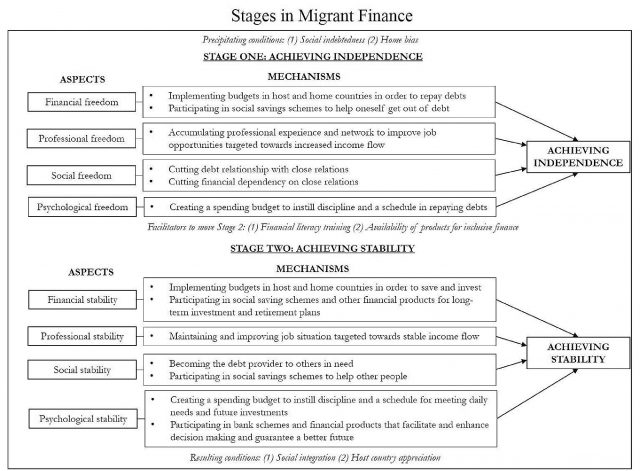
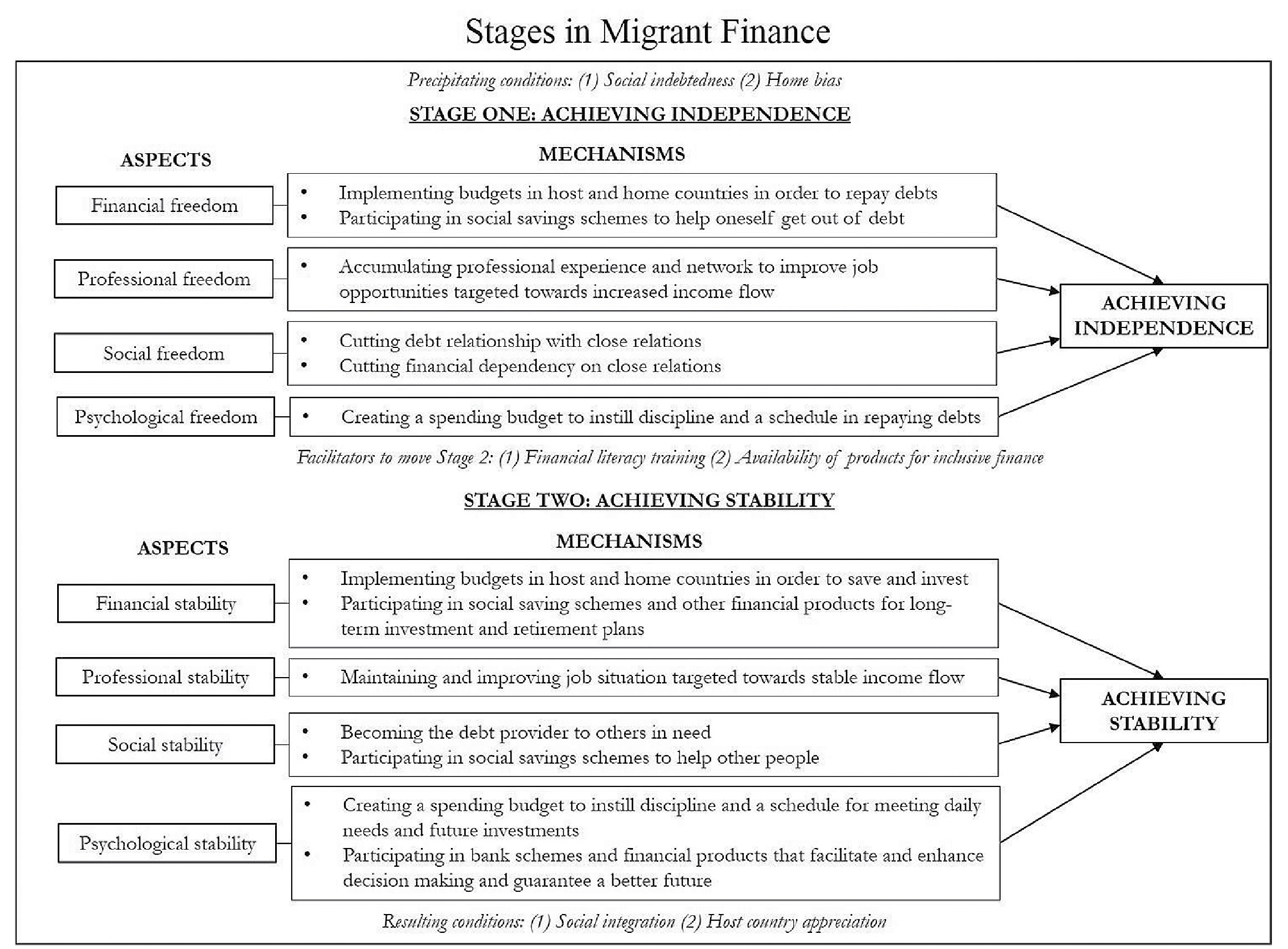
As my interviews progressed, I began to see patterns in responses and interesting questions that led me to a theoretical model. I uncovered two stages in Migrant Finance, namely Stage 1: Achieving Independence, and, Stage 2: Achieving Stability — and nuanced the precipitating conditions, aspects, mechanisms, facilitators, and resulting conditions. Figure 1 illustrates my model. We will get to the Stages in later columns but today I would like to explain the precipitating conditions to Migration: Home Bias and Social Indebtedness.

THE GRASS IS ALWAYS GREENER AT HOME
It is easy to believe that migrants have always dreamt of living abroad and that this is generally considered a success, especially for poorer families. I learned very quickly that this is a big misconception. Very few OFWs actually had the “European dream” or had known earlier on that they were going to go abroad. Instead, most went abroad simply because an opportunity arose and because doing so made sense given the overall situation of their lives. Going abroad meant making sacrifices, most importantly, the sacrifice of being far away from loved ones. But this sacrifice comes with the reward of being able to financially provide and improve the lives of these same loved ones. One of the most interesting things I uncovered was that most of them were not only simply happy where they were but also did not dream of a luxurious life but rather of a comfortable life having “just enough.”

“For me, you know, because I wasn’t born that my life was prosperous, do you know what I always pray for? That even if we have just enough, you know, if so blessed, if there could hopefully be a way where we could all be together again with my children, that they could study, that no one would get sick. That’s already fine with me.” (Eduard)

Filipinos have a love for home that was evident in the interviews. Forty-four percent of survey respondents said that they had planned to come home within five to10 years and 41% had planned to come home within one to five years. It is important to understand that migration was primarily a strategy to be able to eventually go home to a better, more stable, and more comfortable life. Further, most migrants did not want their children to have to go through the same thing they did and thus initially planned to keep their children in the Philippines to benefit from remittances until they themselves could return. Many interviewees felt that apart from their financial situations, their personal lives were generally happy. Thus, if they could have found this comfort at home, they would not have opted to migrate. As (Evelyn) points out, “Yes, it was really just an opportunity. That’s it. It was not in my dreams.”

THE INDEBTED ROAD TO MIGRATION
A second commonality of migrants was that they were laden with debt at the onset. The amount of this is staggering. The typical costs of travel — transportation, visa costs, passport fees, and the like are not the fees we are talking about here. Rather, the fees to migrate for a poor household are linked to the fact that the person in question needs to illustrate financial capacity to migrate. Meaning: a poor household can never get a working visa or tourist visa because they would not have the financial capacity to travel and would therefore not be eligible. They thus need to go through the agents who find loopholes in the system and recreate a situation for them on paper that would allow them to present themselves as financially capable. Such services range from opening a bank account with “show money,” registering a dummy enterprise, finding a sponsor abroad to fabricate a close relationship to the migrant, or creating and implementing a travel itinerary to nearby countries in order to accumulate passport stamps. These agency fees can range from P200,000 to P600,000! To pay these exorbitant fees, the migrant gathers all possible sources of funding — from relatives, friends, loan sharks, and the agents themselves. They then spend the first few years of their lives abroad repaying this. Still, instead of feeling cheated, they considered this debt as investment capital. Being indebted was necessary for success. It was the way in which they become motivated to step out of their comfort zones and do the seemingly impossible.

“And my debts, I remembered them. (I thought) ‘Everything I spent for this — how will I be able to pay that in the Philippines, when our (money) is just so much.’ So I said: ‘I need to have guts’.” (Joy)

Unlike a financially stable household, a migrant’s debt is not that of a loan from a bank but is often provided by relatives or close friends, which ends in utang na loob. I found that instead of this being comforting, this to them was the equivalent to being imprisoned — not just financially but, more importantly, professionally, socially, and psychologically. They thus engage in specific mechanisms to free themselves in these four aspects, which comprise the first stage of Migrant Finance: Achieving Independence.

(To be continued.)


Daniela “Danie” Luz Laurel is a business journalist and anchor-producer of BusinessWorld Live on One News, formerly Bloomberg TV Philippines. Prior to this, she was a permanent professor of Finance at IÉSEG School of Management in Paris and maintains teaching affiliations at IÉSEG and the Ateneo School of Government. She has also worked as an investment banker in The Netherlands. Ms. Laurel holds a Ph.D. in Management Engineering with concentrations in Finance and Accounting from the Politecnico di Milano in Italy and an MBA from the Universidad Carlos III de Madrid.

Property valuation reform

FREEPIK

As the government lowered income tax rates for individuals and corporations, without a corresponding increase in tax compliance, and more robust economic activity, tax collection will surely dwindle. Then couple this with a large budgetary support for COVID-19 interventions, rising cost of military and police pension, and a Supreme Court ruling giving local governments a bigger share in revenues collected by the National Government.

These may yet turn out to be the elements of a fiscal disaster, especially with the economy in the doldrums until who knows when. In this line, one cannot blame the government for looking at urgently rationalizing real property valuations nationwide, and with this, increase real property tax collections. A bigger take from local land taxes can help ease the pressure on the National Government to financially support provinces, cities, and municipalities.

The issue is timing, however. With the 2022 elections just 11 months away, I doubt if the Senate will urgently move on the proposed Real Property Valuation and Assessment Reform Act, which was already passed by the House in late 2019. One can always blame the pandemic for the delay of one-and-a-half years. But the political reality is that any national legislator up for reelection in 11 months will always be hesitant to support any initiative that will either impose a new tax or raise old ones.

The thing is, if the Senate misses the boat this Congress, which reopens next month for its third and final session, then the bill will have to be refiled in the next Congress, and under a new administration. It remains uncertain whether such an initiative will still be a priority in 2022. Perhaps this was one of the reasons why the Finance department was keen on hiring a new publicist, to help advocate the remaining priorities in its list before this administration ends.

The Department of Finance (DoF) is reportedly looking at boosting to about P113 billion the real property tax collection nationwide by 2024. It has even sought the assistance of the Asian Development Bank (ADB) for this, through a $31.49-million Local Governance Reform Project that will help local governments improve their capacity to raise their own finances.

Niño Raymond Alvina of the Bureau of Local Government Finance has noted that local governments have the potential to increase their revenues by around 30%, but 64% of them maintain outdated property valuations. Also, in 2019, 98 out of 146 cities and 46 out of the 81 provinces failed to comply with their mandate to revalue properties every three years.

But the ADB project is just an administrative calibration. While it can help train city assessors on how to improve property tax collection efficiency, without the Senate approving the proposed Real Property Valuation and Assessment Reform Act, then this effort will be lopsided, at best. The reform legislation is long overdue, but passing it comes with the obvious unavoidable risk of further burdening taxpayers with higher tax rates.

In a joint press statement, the American Chamber of Commerce of the Philippines, Inc., the Australian-New Zealand Chamber of Commerce Philippines, the Canadian Chamber of Commerce of the Philippines, the European Chamber of Commerce of the Philippines, the Japanese Chamber of Commerce and Industry of the Philippines, Inc., the Korean Chamber of Commerce Philippines, the Foundation for Economic Freedom, the Philippine Chamber of Commerce and Industry, the Philippine Institute of Environmental Planners, the Rural Bankers Association of the Philippines, and Social Watch Philippines have all expressed strong support for the Senate’s immediate approval of the Real Property Valuation and Assessment Reform Act.

Their statement read: “We collectively agree with the intent of Package 3 in promoting the development of a just, equitable, and efficient real property valuation system through the introduction of the following reforms: adoption of a uniform valuation standard based on international valuation practices; establishment of a single valuation base for taxation and for other purposes; establishment of a comprehensive database to support real property valuation functions; centralization of the approval of the Schedule of Market Values (SMVs); and strengthening of the valuation functions of the Bureau of Local Government Finance.”

They support the call for a uniform valuation standard and a single valuation base, to correct multiple and overlapping real property valuation that result in conflicting land values; and, the development of a central database of land transactions for updating the Schedule of Market values and to support land use planning and zoning. They believe that “widening” the tax base will increase tax collection without imposing new taxes.

In a webinar in late April, Bureau of Local Government Finance’s Ma. Pamela P. Quizon also noted that the existing real property tax system suffered from overlapping valuations, outdated rates, lack of a single oversight agency, and absence of a real property electronic database. “LGUs fail to update and revise SMVs despite statutory requirement because it is unpopular. There is a fear of political backlash. They lack technical capacity and [their budgets cannot cover] costs of revaluation,” she added.

Transportation Undersecretary for Railways Timothy John R. Batan told the same webinar that “the measure of the public wealth of the country is largely in its land assets, and if we can unlock that, then four to five more times [infrastructure] projects we need to build can find its financing from internally generated (revenues through) land value creation.”

There is no arguing that property valuation reform is urgently necessary. However, my support for the initiative is limited to its establishment of a uniform, consistent, transparent, and accountable system for setting land values and appropriate land taxes. Again, the idea is to widen the tax base of local government units, and improve their tax collection from property owners as a result, rather than raising land tax rates across-the-board nationwide.


Marvin Tort is a former managing editor of BusinessWorld, and a former chairman of the Philippine Press Council

matort@yahoo.com

Bread and political rights

PHILIPPINE STAR/ MICHAEL VARCAS

Several weeks ago, retired senior associate justice of the Supreme Court Antonio Carpio, forwarded to me on Viber, the speech of Dambisa Moyo on TED Talks, the highly popular online conference in which ideas are discussed by knowledgeable and authoritative resource persons.

Moyo, a Zambian-born international economist who comments on significant global events, was educated at American University in Washington, DC (BS, MBA), Harvard (MPA), and Oxford for her Ph.D.

In the 15-minute talk, Moyo described the success of China in pulling about 300 million people out of poverty over a 30-year period. Moyo credits the Chinese “new system” of combining state capitalism and the primacy of economic rights over political rights.

There was a deprioritization of political rights in emerging markets, and developing nations are more concerned with their governments providing food, education, healthcare, and other essential needs rather than worrying whether their leaders are voted into power.

Moyo compares the American/European system that has been successful over close to 250 years by combining liberal democracy with private capitalism.

Moyo quotes Patrick Henry, who would later become governor of Virginia, as having declared in 1775, defiance of British colonizers. “Give me liberty or give me death,” Henry would proclaim. The phrase would later become one of the most stirring and powerful exhortations of people’s yearning for freedom. For America and the rest of the developed world, freedom is a most cherished value. I hasten to add, however, that the desire for freedom and liberty is ingrained in all human beings.

The combination of liberal democracy and private capitalism and free markets, has, generally, worked well and is therefore the proper formula for prosperity. Why, Moyo asks, would this model not be preferred as evidence of prosperity is in capitalist economies: High incomes, vibrant civil society, luxuries and conveniences.

In contrast, totalitarian and authoritarian societies from the 1920s to the present, have to still, for the most part, provide basic necessities and those luxuries to their populations.

The then-USSR, in the 1920s, which was around the time that Joseph Stalin came to power, envious of the material prosperity of the United States and the rest of Europe, tried to rapidly transform itself from an agrarian economy to an industrialized society, a la America and the West. The USSR launched a massive and bloody collectivization of farm lands. Private lands. Peasants were forced to put all their farm lands in a collective or common farm area. Millions were either killed or died of starvation in this attempt by the USSR to inject steroids into a system which neither had the absorptive capacity nor the natural enthusiasm to follow the wishes of their masters.

The fact is that a totalitarian system which had an ideology which could be forced upon the community only through use of force, resulted in the death of about 11 million non-combatants.

Russia would later on experiment, starting in 1985, with free markets or perestroika (openness and doing away with central planning) and glasnost (being more transparent) during the presidency of Mikhail Gorbachev.

Gorbachev was followed by the alcoholic Boris Yeltsin. The Berlin Wall was torn down in 1989 and the Russian republics broke away from the Soviet Union and formed independent republics like Lithuania, Latvia, Estonia and a number of Central Asian republics like Kazakhstan, Uzbekistan and Azerbaijan.

The experiment of Gorbachev, encouraged and supported by the Reagan Administration, failed because of factionalism and several other factors. Gorbachev wanted openness but had hoped to have the Communists remain firmly in control.

In 1998, Yeltsin left the Russian presidency and his chosen successor was colonel Vladimir Putin, a low-profile intelligence officer who served as president up to 2008. In 2008, Putin became prime minister to take over from Dimitri Medvedev who became president. Musical chairs.

In 2012, Putin reassumed the presidency and is likely to occupy the presidential seat up into the 2030s when he will be close to 80. In the meantime, the Russian economy is in shambles despite (again, or because of) Putin’s total control of Russia and its terror apparatus. That’s an example of a failed attempt to provide economic benefits provided political rights are totally absent.

So, the Russians lost both their economic and political rights. The only time the Russians enjoyed some kind of prosperity was early in Putin’s first term, courtesy of favorable oil prices.

Before China got to where it is now, it had the luxury of learning from the murderous and tyrannical rule of Mao Zedong who launched, in 1958, the so-called Great Leap Forward. The five-year program which was almost a carbon copy of Russia’s forced collectivization. It was meant to transform China into an industrial and agricultural paradise by terrorizing and killing people. Various estimates show that anywhere from 30 to 40 million Chinese perished either through execution, starvation, and other atrocities. The economy also went into tailspin. The total deaths in the USSR’s and China’s failed collectivization are estimated at 51 million (40 million in China and 11 million in the USSR). To compare, the population of the Visayas and Mindanao per latest population count is 44 million: 25 million in Mindanao including island groups and 19 million in the Visayas.

Going back to the rapid growth of China purely on the basis of economic metrics, one can say that state capitalism is a tremendous advantage, especially because it is not, by and large, enjoyed by liberal democracies. The country’s willingness to challenge and ignore international norms and proprietary rights and international rulings make the Chinese system an unusual one and a formula for increasing international disagreements and tensions.

At the end of the day, we have no problem following the recommendation of Moyo. Liberal democracies and private capital will cooperate and compete with China. We have been doing that anyway, especially in regional groupings like ASEAN. We cooperate but we compete. We are, however, guided by the firm belief that you can have both political and economic rights and that you need not lose one to have the other.

In 1983, the Philippine economy was at its worst. Marcos declared martial law and promised bread and freedom. We lost our bread because the parties who were supposed to protect our political rights took them away from us too. Look at what happens when you lose both. Its goodbye for some.


Philip Ella Juico’s areas of interest include the protection and promotion of democracy, free markets, sustainable development, social responsibility and sports as a tool for social development. He obtained his doctorate in business at De La Salle University. Dr. Juico served as Secretary of Agrarian Reform during the Corazon C. Aquino administration.


Big shoes to fill

IS THE MENTION of shoe size appropriate when accepting the leadership position of a high-profile listed company? Of course. It is almost obligatory to project both modesty in being the “chosen one” and gratefulness to the predecessor for the newly appointed to acknowledge that he has “big shoes to fill.” More so, if the faintly beaming former chief still retains the power to move the pieces in this chess game.

This reference to big shoes to fill hints at “game-changing” accomplishments of the predecessor (no details need to be given) and the daunting challenge of following his footsteps. This is all metaphorical, of course. It does not matter that in fact the successor is much taller, and has obviously bigger feet, and already wearing bigger shoes anyway. It gets complicated when you take these things literally.

The new leader needs to walk in his own shoes moving forward. He needs to invoke some new objectives like customer delight or new niche markets to chase, to walk his own path. It’s a way of blazing new trails and shucking off other people’s shoes.

Only in succession plans do references to “big shoes to fill” ever come up. In politics where term limits are fixed and succession is bestowed by elections, inaugural speeches seldom refer to predecessors and their oversized shoes. Even in monarchies where succession is ordained, there is no mention of footwear. In England, for instance, the incumbent wears heels, and her designated successor, if he gets to sit, can’t refer to shoes other than his.

Shoes as paradigms of status have done a bit of walking.

We refer to wealthy people as “well heeled.” This is probably due to the number of shoes they have so that they can discard those that have been scuffed at the heels too much. So, their opposite number are those that are “down at the heels” from too much walking in just one pair of shoes. Are those who are barefoot in a worse situation? Yes… unless they’re walking on the beach.

Isn’t the symbol of unbridled corruption the discovered shoe closet of the former First Lady? The thousand or so shoes, many still in their boxes, have become a cliché for extravagance. In the musical on her life, Here lies love, there was intentionally no song alluding to her shoes. This would have been too predictable.

In this time of subliminal campaigning, advisers ask their candidates to address the poor, consisting the majority of voters. They counsel — Put yourselves in their shoes. This image of empathy may miss the point, as slippers are the more common footwear for the underprivileged. It is no wonder that one late mayor and cabinet secretary wore rubber slippers to relate to his constituents. The same symbol was adopted by his widow, though not that successfully.

Glitzy places need not post a sign on their doors banning slippers and those who wear them from entering their premises. They will however allow the absence of socks as part of footwear, as this style in the ’80s somehow attached to the wealthy eccentric exuding radical chic. Maybe this sockless look has since lost its appeal from complaining foot masseuses. More acceptable now is the kooky sock. Or the more ubiquitous kicks.

Of course, this whole discussion on shoes and what they symbolize have become slightly irrelevant with the pandemic. Staying at home in slippers or barefooted have made shoe metaphors a bit passé. Still, shoes, in parties and meetings in person, will surely come back with a vengeance. And then we’re back to stepping up the tempo.

Even as we studiously avoid names in our pieces, there are those who can feel alluded to, and not in a favorable light. The lack of definite attributions saves us from digital word searchers and news clippers who work for the rich and famous. Also, there are anyway many who skip these pages for more sensational fare served by more biased opinion mongers and spokespersons.  There is of course the one trying out which shoes are best for running. He’s still looking for the right shoelaces.

Anyway, there is a piece of shoe advice too for those who are put off by vague allusions. If the shoe fits, wear it. And don’t forget the socks.


Tony Samson is Chairman and CEO of TOUCH xda

ar.samson@yahoo.com

PBA bracing for decision on Season 46’s start

THE PHILIPPINE Basketball Association is waiting with much anticipation for the decision on the start of its Season 46 from government authorities. — PBA IMAGES

THE Philippine Basketball Association (PBA) is waiting with much anticipation for the decision on the start of its Season 46 from government authorities.

The league early this week submitted its position papers to the Inter-Agency Task Force for the Management of Emerging Infectious Diseases (IATF-EID) and has been told that the PBA’s request will be tackled by the body in its next meeting.

“We have to be ready as we may be called to be heard anytime soon,” PBA Commissioner Willie Marcial was quoted as saying by the league website.

The PBA’s push is anchored on its successful staging of its “bubble” tournament in Clark, Pampanga, last year which was done under strict health and safety watch.

Among the papers submitted by the league to the IATF is a nine-page set of protocols that it will be implementing for its new season, beginning with the All-Filipino Philippine Cup.

Unlike last year where it only had one tournament because of the pandemic, the PBA this season is hoping to stage two conferences so as to “give fans more basketball action.”

It is angling to begin its new season at the latest in early July.

In the event it gets the nod, the PBA is looking to hold the games under a closed-circuit setup, and not the more costly full bubble, where teams’ movements are practically confined to home-gym-home.

Two venues are being eyed for it, namely, the Ynares Center in Antipolo City, which has hosted PBA games in the past, and the Ynares Sports Arena in Pasig City, home of the PBA D-League.

As the league waits for the start of its new season, the 12 competing teams have been training for weeks now so as to be ready come tournament start.

The teams though are working out in facilities in Batangas, Pampanga and Ilocos Norte as prevailing quarantine restrictions in the National Capital Region still prevent them from doing their on-court work within Metro Manila.

The league said the teams are sacrificing a lot by going outside of the NCR but that they are committed to making it happen so as to have the action going at the soonest possible time. — Michael Angelo S. Murillo

Eumir Marcial among five boxers to watch at the Tokyo Olympics

THE 25-year-old middleweight Eumir Marcial hoping to earn the Philippines its first ever Olympic gold medal. — BW FILE PHOTO

FIVE boxers to watch out for at the Tokyo Olympics:

EUMIR MARCIAL (PHILIPPINES)
The 25-year-old middleweight qualified for Tokyo last year and will be hoping to earn the Philippines its first ever Olympic gold medal.

Marcial has inevitably drawn comparisons with his country’s greatest boxer, Manny Pacquiao, and has been preparing under the tutelage of the multiple world champion’s trainer Freddie Roach after turning professional last year.

JULIO CESAR LA CRUZ (CUBA)
Whether he ends up fighting at light-heavyweight or heavyweight in Tokyo, La Cruz is always worth watching for the distinctive defensive technique that earned him the nickname ‘La Sombra,’ or ‘the Shadow.’

The elusive 31-year-old, who won gold in Rio and four amateur world titles at light-heavyweight, drops his guard and invites his opponents on before using his athleticism to swerve out of the way of the punches that come his way.

SHAKHOBIDIN ZOIROV (UZBEKISTAN)
Zoirov won flyweight gold as Uzbekistan topped the boxing medals table in Rio and after winning the 2019 world title and his first three professional fights will be back in the Olympic ring to defend his title. Southpaw ‘Shakho,’ who tries to emulate his hero Muhammad Ali with his footwork and ringcraft, fires quick body-head combinations before making a swift exit out of range.

MC MARY KOM (INDIA)
The face of the campaign to get women’s boxing into the Games and flyweight bronze medalist at London 2012, the 38-year-old mother of four is set for her Olympic swansong.

The pint-sized boxer is one of the most decorated women fighters in the amateur game with a record six world championships titles, the last of which came in 2018. She has also won gold medals at the Asian Games and Commonwealth Games.

LAUREN PRICE (BRITAIN)
The reigning world and European Games heavyweight champion, Price is determined to follow in the footsteps of trailblazer Nicola Adams by winning boxing gold for Britain.

A former world champion kickboxer and international soccer player for Wales, the 26-year-old makes up for her relatively short stature by using clever footwork and fast hands to score points on the counter. — Reuters

Fate of SEA Games in Vietnam to be known

THE Southeast Asian (SEA) Games Federation meets on Thursday to decide on whether to push through with the staging of the biennial sporting meet in November in Vietnam or postpone it to next year.

This was shared by Philippine Sports Commission official Ramon Fernandez during his session on the online Philippine Sportswriters Association Forum on Tuesday.

Mr. Fernandez is also the chef de mission of the country’s delegation for the Hanoi Games set for Nov. 23 to Dec. 2.

“They are going to meet on June 24 to discuss the matter,” said Mr. Fernandez.

He, however, said that is the most they know at the moment and everything is up in the air as far as the staging of the SEA Games.

Mr. Fernandez went on to say that they are just going to wait for the result of the key meeting, which will have Philippine Olympic Committee President Abraham Tolentino and other National Olympic Committee (NOC) officials in the region attending.

The idea to postpone the Vietnam Games was broached in a meeting among NOC members two weeks ago.

The host country proposed the postponement because of the new virus outbreak there, which has Hanoi and 11 other locations at the center.

The development, Vietnam said, has hampered considerably its ability to prepare for hosting the best way it can.

During said SEA Games Federation meeting, the majority of the competing countries voted against the postponement.

They were the Philippines, Brunei, Cambodia, Indonesia, Malaysia, Singapore, Thailand and Timor-Leste.

Vietnam and Myanmar supported the proposal to postpone while Laos abstained.

The countries which wanted to push through, however, recognized that the final decision on the matter was still with the Vietnam government.

In the event the SEA Games is postponed, it will be the second time in its history, the first in 1963 when political unrest in Cambodia prevented the event from being staged.

Amid the uncertainty, Mr. Fernandez expressed hope that the SEA Games pushes through because the athletes are really looking forward to competing there after the forced break because of the pandemic. But he also understands the predicament Vietnam is in.

“It will be hard for sure for the athletes if the SEA Games is postponed because they have been looking forward to this but we just have to understand if ever,” he said.

“As of now, we’ll just continue training and preparing. The official training starts on July 1 although others have already begun,” added Mr. Fernandez, saying the preparations are also geared for other international events.

The Philippines, defending overall SEA Games champion, intends to send 626 athletes who will be competing in 39 sports in Vietnam.

Vaccination of national athletes is currently ongoing so as to adhere to the “no vaccine, no participation” policy that will be in effect in the Games. — Michael Angelo S. Murillo

Tokyo Olympic Games-bound shooter Jayson Valdez takes aim at gold medal

FILIPINO shooter Jayson Valdez — JAYSON VALDEZ FB PAGE

ONE of the last athletes to qualify for his event in the Olympic Games in Tokyo, shooter Jayson Valdez has become more determined to go for the gold.

Mr. Valdez earned qualification for the Summer Games in the men’s air rifle 10-meter event through the quota system implemented by the International Shooting Sports Federation.

It all came just when he thought his Olympic push was over, especially when the quadrennial event was postponed last year.

But as it turned out, from his participation in the World Cup and Asian qualifying tournaments previously, he met the minimum qualifying scores to earn a ticket to the Games.

Now in a position to showcase what he can do in the Olympics, Mr. Valdez said he will do everything he can to have the best possible showing.

“This is a great opportunity for me. We’ll see. Anything is possible at that stage,” said Mr. Valdez during his session on the online Philippine Sportswriters Association Forum on Tuesday.

“In the Olympics, my immediate goal is to beat my personal record [of 630]. If I could do that, I’m sure I’ll enter the Top Eight and go to the medal round. From there, everybody’s back to zero,” he added, noting that some of his possible opponents in the Olympics own personal best of either 631 or 632.

Added motivation for Mr. Valdez is for his father Julius’ Olympic dream to live through him.

“He always wanted to be an Olympian but he was not able to,” he said of his father who won three gold medals and a silver in the 1987 Jakarta Southeast Asian Games.

Now, the elder Valdez and veteran Tac Padilla, a five-time gold medal winner in the SEA Games, are helping him prepare.

Mr. Valdez is the latest Filipino shooter to qualify for the Olympics after Paul Brian Rosario, who competed in men’s skeet as a wild card entry in London 2012.

Prior to receiving his Tokyo qualification notice, Mr. Valdez was already set to enter the military. He said he is postponing it for now and concentrate first on his Olympic quest. — Michael Angelo S. Murillo

Judoka Watanabe and sprinter Knott also through to Olympics

IT’S now 15 and counting as far Filipino athletes qualifying for the Tokyo Olympic Games.

Filipino-foreign athletes Kiyomi Watanabe of taekwondo and Kristina Knott of athletics have officially earned their spots in the rescheduled Olympics kicking off next month.

Judoka Watanabe qualified by way of the continental quota in the women’s -63kg class as released by the International Judo Federation on Wednesday.

It was announced around the same time as Filipino-American Knott received university places in the women’s 200m from World Athletics.

The two’s Olympic qualification came a day after professional golfer Juvic Pagunsan also booked his spot as among the top 60 players in the rankings. He is currently ranked 49th.

Both Filipino-Japanese Watanabe and Ms. Knott are making their Olympic debuts in Tokyo.

Unfortunately for 25-year-old Knott, she tested positive for COVID-19 as she received news of her Olympic qualification. She, however, is asymptomatic and is fully vaccinated.

The Philippine Athletics Track and Field Association in a press conference on Wednesday said Ms. Knott is now in isolation and that it is confident that she will be fully recovered in time for the Tokyo Olympics.

Apart from the two and Mr. Pagunsan, Filipino athletes who have qualified earlier are pole-vaulter EJ Obiena, gymnast Caloy Yulo, boxers Eumir Felix Marcial, Irish Magno, Nesthy Petecio and Carlo Paalam, weightlifters Hidilyn Diaz and Erleen Ann Ando, rower Cris Nievarez, taekwondo jin Kurt Barbosa, skateboarder Margielyn Didal, and shooter Jayson Valdez.

The total qualified athletes to date has already surpassed the 13 that saw action at the 2016 Olympics in Rio.

The rescheduled Olympic Games happens from July 23 to Aug. 8. — Michael Angelo S. Murillo

Juan Gomez de Liaño heading to Japan league

GILAS PILIPINAS and University of the Philippines player Juan Gomez de Liaño will play for EarthFriends Tokyo Z in the second division of the Japan B.League. — FIBA

GILAS Pilipinas and University of the Philippines player Juan Gomez de Liaño is heading to Japan to play in the second division of the B.League.

In an announcement made on Wednesday, the EarthFriends Tokyo Z club said it has signed the explosive guard to play for the team in their upcoming season.

That makes Mr. Gomez de Liaño the latest homegrown Filipino player to sign and play in the Japanese league after brothers Thirdy and Kiefer Ravena, although the latter’s move is on hold because of his commitment with the Philippine Basketball Association.

The former Fighting Maroon said he is very excited to take his talent to the B.League and help EarthFriends Tokyo Z bounce back after a rough season.

“I am honored to be part of the EarthFriends Tokyo Z Team. I am very excited to battle it out with you guys and to be part of this journey,” Mr. Gomez de Liaño said in the official team statement.

“I am looking forward to meeting you all soon. I hope I can count on your continuous support through the challenges ahead. Let’s get it!”

EarthFriends Tokyo Z finished last season with a 13-46 record.

Mr. Gomez de Liaño played for the Gilas national squad in the first two windows of the just-concluded FIBA Asia Cup Qualifiers. — Michael Angelo S. Murillo

ADVERTISEMENT
ADVERTISEMENT