Home Blog Page 7742

Gov’t urged to pursue more PPP projects amid growing fiscal burden

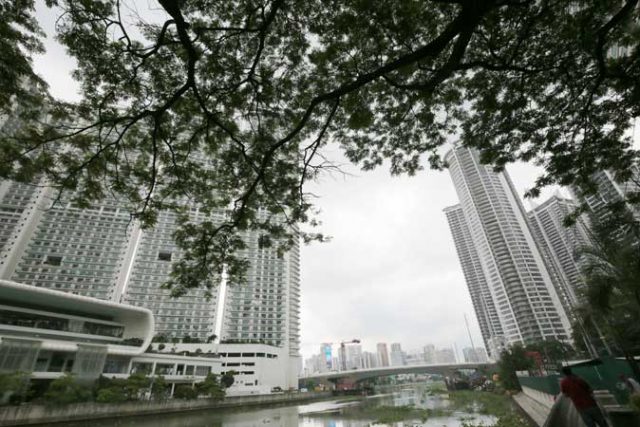
PHILIPPINE STAR/ MICHAEL VARCAS
THE GOVERNMENT aims to spend P1.02 trillion for infrastructure projects this year. — PHILIPPINE STAR/ MICHAEL VARCAS

By Beatrice M. Laforga, Reporter

THE PHILIPPINE government should consider more public-private partnership (PPP) infrastructure projects as it faces increasing fiscal constraints due to the pandemic, experts said.

Experts from international organizations, ASEAN+3 Macroeconomic Research Office (AMRO), Asian Development Bank (ADB), and the International Monetary Fund (IMF) acknowledged that well-designed PPPs can accelerate the country’s “Build, Build, Build” program.

“The Philippines has made considerable progress in infrastructure investment in recent years… PPPs play an important role in infrastructure programs. Well-designed and properly implemented PPPs can supplement government-funded projects by mobilizing private capital and bringing in the private sector’s construction and managerial capacity,” IMF Representative to the Philippines Yongzheng Yang said in an e-mail last week.

The Duterte-led government had previously steered clear of PPPs due to allegedly disadvantageous provisions such as subsidies and guarantees.

Mr. Yang said the state needs a sound PPP framework and build enough capacity to manage fiscal costs and risks like contingent liabilities that could emerge from such an approach.

Ernesto M. Pernia, a former socioeconomic planning secretary under the Duterte administration, said the government should tap the private sector to help with its massive infrastructure drive, without adding more pressure on its fiscal standing.

“I have always tended to favor smartly chosen PPP projects… they can ease the burden on the government’s fiscal position, while making sure the costs and benefits are well balanced between public and private sectors such that it’s a win-win arrangement for both. More PPP projects should be encouraged, which is also ADB’s policy stance,” Mr. Pernia said in a text message on Friday.

In an e-mail, Byunghoon Nam, a senior economist at AMRO, said he sees no reason why the Philippines cannot take advantage of PPP-type projects, “as long as proper safeguards are in place to ensure that they are well designed and implemented.”

When the pandemic hit last year and state resources were stretched thin, economic managers last year signaled their willingness to be more open to PPPs as a funding option for its infrastructure push.

Fitch Ratings earlier this month flagged growing fiscal risks faced by the Philippines, as it revised the outlook for the sovereign rating to “negative.”

The credit rater projected the country’s general government debt will rise drastically to 54.5% of gross domestic product (GDP) in 2022 from just 34.1% in 2019 as it increased borrowings for its pandemic response.

Fitch Ratings said it will continue to “monitor the evolution of the fiscal deficit and debt levels, as the balance between fiscal consolidation and ongoing government spending to support economic recovery will be an important consideration for the (credit) rating.”

ADB Philippines Country Director Kelly Bird said the PPP program was “reinvigorated” by the administration of the late President Benigno S.C. Aquino III, allowing the government to pursue more infrastructure projects.

“But because of the scale of the infrastructure gap, private sector and PPPs will be both inadequate and insufficient to fill the funding gap. Public spending is necessary for large, complex projects especially in mass public transportation,” Mr. Bird said.

He emphasized the need for a balanced mix of funding sources to provide sustainable support for the massive pipeline of infrastructure projects.

“Government’s optimal infrastructure financing strategy must include a combination of public financing through the national and LGU (local government unit) budgets, private sector financing, and PPPs. ODA (official development assistance) is also another key support for infrastructure financing,” he added.

The Duterte administration’s priority list of 112 flagship infrastructure projects worth P4.687 trillion includes 20 unsolicited PPPs with a total estimated cost of P1.505 trillion.

This made PPP as the second-biggest funding source, next to foreign loans or ODA, which accounts for 54 projects worth P2.612 trillion.

Other 10 projects worth P336 billion were funded through a mix of PPP and other funding sources like ODA and the state’s coffers.

WTO’s holiday from vaccine equity talks draws calls for action

REUTERS 

AN URGENT global effort to rebalance the inequity between rich, vaccinated nations and poor nations sliding further into pandemic misery is colliding with an immovable calendar conflict: the European summer holiday.

Next week World Trade Organization (WTO) delegates are planning to depart Geneva for their August break and, in doing so, pause their fractious debate over a proposal to waive intellectual-property protections for coronavirus disease 2019 (COVID-19) shots until the second week of September.

Before they leave, members will adopt a report that acknowledges they’ve made scant headway on the proposal aimed at making doses more widely available, which the world’s top health expert says is critical to ending a “moral failure.”

“With so many lives on the line, profits and patents must come second,” World Health Organization Director-General Tedros Adhanom Ghebreyesus said during a virtual summit last week.

WTO Director-General Ngozi Okonjo-Iweala previously urged ambassadors to shorten their usual six-week summer holiday to focus on pressing issues like the waiver. Nevertheless, members aren’t planning to reconsider the matter until the week of Sept. 6, according to officials familiar with the planning.

“August doesn’t matter in Geneva; it doesn’t matter if people are dying around the world,” said Shailly Gupta, a spokesperson at Médecins Sans Frontières. “We hope members will move at a faster pace.”

Disagreement persists on the fundamental question of whether a waiver is the “appropriate and most effective way” to address the shortage of vaccines, according to a draft status report produced by Dagfinn Sørli, the chairman of WTO council on Trade-Related Aspects of Intellectual Property Rights or TRIPS.

That split could sink prospects for an ambitious vaccine waiver because WTO decisions must be taken on the basis of consensus — which means any of the 164 members can veto a final agreement for any reason.

Proponents of the waiver had hoped to conclude their negotiations by the end of July and are now criticizing the European Union and other developed nations for sandbagging the talks.

‘NOT INTERESTED’
The European Commission, which opposes a WTO TRIPS waiver, has proposed a series of measures that it argues will create greater legal certainty for nations to leverage existing trade tools in order to expand their production capacities.

“The EU (European Union)is not interested,” Gupta said. “Switzerland, Norway and the United Kingdom are not engaging. They’re saying: ‘This or that won’t work; the waiver won’t work.’ There is no intention of engaging.”

A spokesman for the EU mission in Geneva declined to comment.

Critics counter that the proposal from Brussels is a distraction to redirect focus from India and South Africa’s earlier waiver proposal and to prevent members from engaging in more detailed negotiations.

“The EU’s actions are incredibly cynical and dangerous,” said Lori Wallach, the founder of Public Citizen’s Global Trade Watch. “They have submitted a paper that basically conflicts with the text-based negotiations by saying ‘We don’t want a waiver.’”

The US, meanwhile, has taken a back seat in the process and enthusiasm about Washington’s engagement on the issue has begun to wane in the three months since Trade Representative Katherine Tai announced American support for a waiver.

Though Ms. Tai’s surprise announcement briefly knocked shares of Moderna, Inc., Pfizer, Inc., and BioNTech SE, the stocks quickly rebounded and all are now trading at or near their highest levels of the year.

“People feel that message from Ambassador Tai is not playing out on the ground or being implemented in a meaningful way,” said Thiru Balasubramaniam a managing director at Knowledge Ecology International in Geneva.

A spokesman for the US Trade Representative’s Office in Washington didn’t respond to a request for comment..

DRAWBACKS
Most nations producing the vaccines oppose a blanket waiver to the WTO’s intellectual property (IP) rules because they say it would harm innovation, do little to expand access to vaccines and may even backfire.

Specifically, opponents to the waiver say it would create a chaotic patchwork of laws, unravel existing industry partnerships, lead to a supply crunch for scarce vaccine inputs and inject even more uncertainty into already complex arrangements.

There’s also the possibility that an IP waiver could result in the production of counterfeit and substandard medicines, which could increase vaccine hesitancy that’s already pervasive in even the world’s wealthiest nations.

“Everybody knows IP isn’t the problem and there is no quick fix to vaccinating the world with the latest technology,” said Robert Grant, a senior director at the US Chamber of Commerce. “Most governments know this but due to the political sensitivities they won’t say it publicly.”

Indeed, the waiver debate is a politically explosive issue for nations with high vaccination rates because they don’t want to be seen as standing in the way of getting life-saving drugs to poor nations whose citizens are suffering at disproportionate rates.

To date, 75% of vaccines have been administered in just 10 countries and only 1% of people in low-income countries have received at least one dose, according to WHO statistics.

Drug manufacturers say they are working every day to address the real bottlenecks and are on track to deliver 11 billion vaccines by yearend — enough to innocluate the world’s entire adult population.

While diplomats go on holiday, the process of getting the vaccines out there hasn’t stopped, said a spokeswoman for the International Federation of Pharmaceutical Manufacturers and Associations. — Bloomberg

New plant boosts Meralco profit

BW FILE PHOTO

MANILA Electric Co. (Meralco) posted a core net income of P11.4 billion in the first half, up by 8% year on year, on the back of higher revenues from its joint venture project San Buenaventura Power Ltd.

“We ended the first half of 2021 with consolidated core net income of P11.4 billion, about 8% better than last year. Our reported net income was close to P10 billion, 45% better than 2020,” Meralco Senior Vice-President and Chief Finance Officer Betty C. Siy-Yap said on Monday during the firm’s virtual briefing on its financial and operating results.

Separately, Meralco said in a regulatory filing that its core net income was higher because of higher volume and contributions from San Buenaventura Power, which has developed a 500-megawatt power plant in Mauban, Quezon.

The firm added that its reported net income, which excludes one-off items, increased in the months ending June since there were previous recorded impairments in equity investments.

“Last year, we recognized a full impairment of the balance of the carrying costs of our investment in PacificLight [Power Pte Ltd.], which amounted to P2.7 billion,” Ms. Siy-Yap said, referring to its unit’s investment in the Singapore-based electricity retailer.

Gross revenues for the first half climbed by 8% to P149.1 billion.

Ferdinand O. Geluz, Meralco first vice-president and chief commercial officer, noted that consolidated energy sales were up by 7% in the first semester.

Residential households accounted for 37% or 8,370 gigawatt-hours (GWh) of the sales mix. Commercial and industrial establishments made up 33% or 7,440 GWh, and 30% or 6,781 GWh, respectively.

Mr. Geluz said during the briefing that Meralco “saw [the] continuing trend of stay-at-home and working-from-home [arrangements] in residential, and the strong optimistic growth in industrial,” which he said was back to pre-pandemic level.

“So, it’s better than our 2019 numbers,” he said.

Meanwhile, Meralco spent P13.1 billion for capital expenditures (capex) during the six-month period.

The company said that of the total networks capex of P7.3 billion in the first half, 65% covered new connections and load growth, 26% went to asset renewals and the balance was spent to support the government’s Build, Build, Build projects and Meralco’s electrification program.

Meralco Chairman Manuel V. Pangilinan said that although he was “quite concerned” about the recent spread of the delta variant of the coronavirus disease, which could lead to more lockdowns, he remains “optimistic” about the firm’s revenues.

“I think we’re quite optimistic that profits will be ahead,” he said during the briefing.

The company earlier announced that it is on track to achieve 100% electrification in its franchise area, adding that it was able to hit its target of powering up more than 530 priority sites.

Meralco said that it had allotted at least P1 billion for its electrification program, with the majority allocated for the southern portion of its coverage area.

The company’s shares inched down by 0.74% or P2 to finish at P267 apiece on Monday.

Meralco’s controlling stakeholder, Beacon Electric Asset Holdings, Inc., is partly owned by PLDT, Inc. Hastings Holdings, Inc., a unit of PLDT Beneficial Trust Fund subsidiary MediaQuest Holdings, Inc., which has interest in BusinessWorld through the Philippine Star Group, which it controls. — Angelica Y. Yang

Property sector pins recovery hopes on PHL infrastructure push

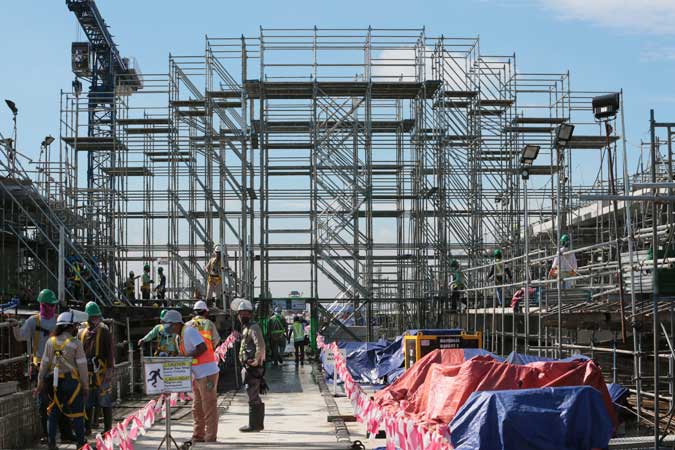
THE construction of the Estrella-Pantaleon bridge is now on its final phase. — PHILIPPINE STAR/ MICHAEL VARCAS

By Jenina P. Ibañez, Reporter

THE PROPERTY sector’s recovery is hinged on how quickly the government can build the infrastructure it promised, according to industry heads.

Some segments of the industry are somewhat looking up after pandemic-related contractions in 2020, with Leechiu Property Philippines indicating the return of office space demand on the back of a vaccination rollout.

“If we want to transform the country, there’s no other choice but to build more infrastructure at a faster pace,” DMCI Holdings Chairman and President Isidro A. Consunji said.

He said in an e-mail that President Rodrigo R. Duterte’s administration, in its final year, should avoid right-of-way delays for its “Build, Build, Build” infrastructure program. DMCI has interests in real estate, construction, power, and mining.

“All contractors were hit hard by the pandemic,” Mr. Consunji said. “The lockdowns and quarantine restrictions drained their productivity and capital. Government should speed up its infrastructure modernization program to help the industry recover faster.”  

The government last month announced that it dropped two infrastructure projects worth P38 billion, but at the same time added 13 worth P523 billion under a revised list of flagship infrastructure projects. The government has revised this list several times to prioritize projects that could be implemented within the administration. 

The flagship list now has 112 projects worth a total of P4.687 trillion. With 29 projects targeted to be completed before the end of the administration, 51 projects are ongoing and 28 are in the pipeline. Four were completed.

David T. Leechiu, chief executive officer of real estate services firm Leechiu Property Consultants, said that the Duterte administration has comparatively sped up infrastructure projects by using his political capital.

But beyond speed, real estate sector heads are also looking at a need for resilient infrastructure. To them, the property industry must be sustainable.

Mr. Leechiu said in an online video interview that the administration must invest in renewable energy and build more infrastructure surrounding sewage systems, which he said would support the tourism segment.

“You cannot have tourism without clean environment,” he said. 

Romolo Valentino Nati, chief executive officer of Italpinas Development Corp., said that climate change threats will continue to be urgent even as the pandemic wanes. 

“Under the next administration, I hope that environmental awareness continues to influence the way we choose to live and consume. I think that the Philippines can play a major role in the green economy in Southeast Asia,” he said in an e-mail.

Foreign investment should also be a priority for the Duterte administration, Mr. Leechiu said, highlighting a need for Asian investment links.

“I think we have to go through this balancing act of courting Chinese investments while asserting our geopolitical rights, as what Thailand, Singapore, Vietnam have done. If other countries have been able to do it, I’m sure we will be able to do it,” he said.

Mr. Consunji, however, said that the 100% foreign ownership of construction firms should be deferred. 

“While large contractors can directly compete with these firms, the same cannot be said for small- and medium-sized Filipino contractors,” he said.

According to the CEOs, a faster vaccine rollout will aid their sector’s recovery, with Mr. Nati saying that the vaccines will support a return to “normalcy.”

“I think that improvements not only in vaccination, but also in other modes of pandemic-mitigation, like public awareness and preparedness, will benefit all industries,” he said.

Filinvest Land plans expansion in Cebu

Filinvest Land-logo

FILINVEST Land, Inc. is planning to expand its presence in Cebu via office and township developments, as it sees opportunities in the growing business process outsourcing (BPO) industry in the area.

“Cebu is the top-of-mind metropolitan city next to Metro Manila and the center of urban growth in the Visayas. High-potential land is available at lower investment costs, so BPO companies are relocating there,” Filinvest Land Executive Vice-President and Chief Strategy Officer Tristaneil D. Las Marias said in a statement on Monday.

The company is hopeful especially with the completion of infrastructure projects in Cebu, like the Cebu Cordova Link Expressway, and as more entertainment hubs in the area emerge.

In 2009, Filinvest Land purchased land and entered into an agreement with the Cebu City government for a 50.6-hectare property within the economic zone in South Road Properties (SRP). The company said it has since become the biggest central business district landowner in SRP after buying additional land in the area.

It is also looking at the growth of its 1.2-hectare property adjacent to Cebu IT Park in Lahug City, Cebu. One of its 17 properties in its real estate investment trust (REIT) portfolio is Cebu Tower 1.

Filinvest Land said its office and township developments projects in Cebu “could potentially be added” to the portfolio of its REIT vehicle, Filinvest REIT Corp. (FILREIT).

FILREIT is currently going on its offer period, which will last until Aug. 3. Its debut on the Philippine Stock Exchange is tentatively set on Aug. 12.

On Monday, shares of Filinvest Land closed unchanged at the stock market at P1.11 each. — Keren Concepcion G. Valmonte

Gov’t makes full award of T-bills at mixed rates amid virus fears

BW FILE PHOTO

THE GOVERNMENT made a full award of the Treasury bills (T-bills) it offered on Monday, with rates ending mixed amid fears of the economic impact of the Delta variant of the coronavirus disease 2019 (COVID-19).

The Bureau of the Treasury (BTr) raised P15 billion as planned via the T-bills on Monday as the offer was nearly three times oversubscribed, with tenders reaching P43.027 billion. The demand, however, was slightly lower than the P45.74 billion in bids seen at last week’s auction.

Broken down, the BTr borrowed the programmed P5 billion via the 91-day T-bills on Monday from P18.327 billion in bids. The three-month debt papers fetched an average rate of 1.05%, down by 3.2 basis points (bps) from the 1.082% seen last week.

It also accepted P5 billion as planned via the 182-day instruments as tenders for the tenor hit P13.75 billion. The average yield on the six-month papers inched up by 0.6 bp to 1.407% from 1.401% previously.

Lastly, the Treasury made a full P5-billion award of the 364-day securities even as the tenor attracted just P10.95 billion in bids. The one-year T-bills were quoted at 1.638%, a tad higher than the 1.629% fetched for the tenor last week.

National Treasurer Rosalia V. de Leon said T-bill rates moved sideways amid growing concerns that the continued spread of the Delta variant could result in stricter lockdown measures.

Despite this, she said “liquidity is still very much around looking for a home,” hence the demand for the short-term government papers.

The government on Friday placed Metro Manila and the provinces of Ilocos Norte, Ilocos Sur, Davao de Oro and Davao del Norte under general community quarantine “with heightened restrictions” until the end of the month to stem the spread of the virus.

The Health department on Sunday reported 55 new cases of the Delta variant of COVID-19 in the country, bringing the total to 119 infections so far.

Overall, there were 5,479 new COVID-19 infections reported that day, which brought the country’s active cases of the virus to 54,262.

Meanwhile, a bond trader said by phone that the yields fetched for the T-bills on Monday fell within market expectations, noting that the rate of the 91-day papers inched down amid strong demand.

Moving forward, the trader said T-bill rates could continue moving sideways as the market is waiting for leads, particularly from the upcoming two-day meeting of the Federal Open Market Committee this week.

The Federal Reserve meets on Tuesday and Wednesday and, while no change in policy is expected, Fed Chair Jerome Powell will likely be pressed to clarify what “substantial further progress” on employment would look like, Reuters reported. The Fed is likewise expected to discuss the timing of its stimulus tapering.

On Tuesday, the BTr will auction off P35 billion in reissued seven-year Treasury bonds (T-bonds) with a remaining life of six years and eight months.

The Treasury is looking to raise P235 billion from the local market this month: P60 billion via weekly offers of T-bills and P175 billion from weekly auctions of T-bonds.

The government wants to borrow P3 trillion from domestic and external sources this year to help fund a budget deficit seen to hit 9.3% of gross domestic product. — Beatrice M. Laforga with Reuters

PHL cold storage sector capacity to grow by 10%

MORE COLD STORAGE facilities such as this one owned by PharmaServ Express are expected to be built in the country. — PHILIPPINE STAR/ MICHAEL VARCAS

REAL ESTATE services firm Santos Knight Frank said the cold storage sector will be the next popular sector for those investing in the property industry, with a 10% increase expected in the country’s cold storage capacity this year.

“In the Philippines, more investors are looking to place significant capital into the industrial sector, including cold chain logistics,” Santos Knight Frank Head of Investment and Capital Markets Kash Aristotle Salvador said in a webinar.

The real estate firm noted how the demand for vaccine storage, food, and import goods are increasing the need for cold chain logistics.   

It also said this is complemented by the expansion of the country’s industrial and logistics sectors, despite the shift in the property sector brought by the pandemic.   

The Cold Chain Association of the Philippines (CCAP) forecasts a 10% growth in the country’s cold storage industry capacity this year, with 50,000 new pallets to be added to the country’s existing 500,000.   

Over half or 60% of the additional capacity will be located in Luzon, while 40% will be in Mindanao.   

The government has named two agro-industrial business corridors, which include the Taguig Agro Industrial Hub and the New Clark City Agro Industrial Hub.  

“Cold storage is one of the most resilient industries. Whatever happens in the economy, there will always be a need for food,” said Anthony S. Dizon, president of CCAP. — K.C.G. Valmonte 

Jollibee opens in Wales

JOLLIBEE opens at the corner of Queen Street and Charles Street in Cardiff, the capital of Wales.

JOLLIBEE Foods Corp. recently opened its first restaurant in Wales, marking the company’s sixth store in the United Kingdom.

The company said in a statement on Monday that the new restaurant is situated at the corner of Queen Street and Charles Street in Cardiff, the capital of Wales.

“Opening our first Jollibee in Wales is part of our continued commitment to expand across Europe and bring our delicious Chickenjoy to more people around the world,” Jollibee Chief Executive Officer Ernesto Tanmantiong said in the statement.

The Cardiff branch is housed in a two-story corner building “painted deep purple, with one side of the building showing a wall mural in line with the brand’s colorful new store design.”

“With people returning to restaurants and relishing face-to-face encounters, restaurants will provide great solace to make up for those special moments they may have missed during the lockdown,” said Dennis Flores, president of Jollibee Europe, Middle East, Asia, and Australia.

According to Jollibee, Wales is one of the four countries comprising the UK which has a $1.4-billion fried chicken market.

It added that the branch in Cardiff is part of the company’s goal to open 50 stores across the UK and Europe within five years.

Some of the products that will be offered in the Cardiff restaurant are Chickenjoy and new menu items such as Spicy Chicken Burger, Sriracha Chicken Loaded Fries, Chicken Wrap, and the summer-exclusive Peach and Mango Drink.

“With a growing culinary landscape and increased demand for new cuisines, we knew Cardiff had to be one of the tops in our list. We are keen to introduce our delicious menu to locals and welcome them into our cool new central location,” Jollibee Europe Business Head Adam Parkinson said.

Shares of Jollibee at the stock exchange dropped 2.22% or P4.40 to finish at P193.60 per share on Monday. — Revin Mikhael D. Ochave

BDO, American Express to offer virtual card with flexible limit

BW FILE PHOTO
BDO UNIBANK, Inc. has teamed up with American Express Co. to offer a virtual credit card. — BW FILE PHOTO

BDO UNIBANK, Inc. has partnered with American Express Co. to offer a virtual card with an adjustable credit limit targeted towards those making online transactions.

The virtual card will be linked to a client’s primary card and will include an additional layer of account information security, the Sy-led lender said in a statement on Monday.

“With the BDO American Express Virtual Card, we are offering our cardmembers a product that addresses their reservations about online credit card payments and gives them the assurance they can shop online confidently,” BDO Senior Vice- President and Consumer Banking Marketing Head Nannette R. Regala said in a statement.

Aside from the flexible credit limit that they can set based on their online purchasing needs, the virtual card also allows its users to track their transactions.

Cardholders can also earn reward points for every transaction with the same value as their primary credit card.

Applying for the virtual card is free for BDO American Express cardmembers.

“We understand some customers feel more comfortable using a separate credit card number for their online transactions. We are always looking to expand and improve our products and services to support the evolving payment needs of our customers — and the virtual card does just that,” American Express Vice-President and General Manager, Global Network Services – South East Asia and South Pacific Sanjiv Malhotra said.

BDO cited a study by audit and consulting firm PwC Global, which showed that preference for e-commerce continues to grow, even as in-store shopping is still preferred by consumers.

A separate report by Bain & Co., Google, and Temasek Holdings said the gross merchandise value of the Philippine digital economy could reach $28 billion by 2025, translating to a 30% compound annual growth rate as more consumers try shopping online.

BDO’s net income increased by 19% to P10.4 billion in the first quarter.

Its shares went down by P3.30 or 3.13% to close at P102.30 apiece on Monday. — LWTN

Ridgewood Premier Hotel to open in 2023

NOVEL RESIDENTIAL Concepts, Inc. has introduced an innovative investment package for Ridgewood Premier Hotel, which is set to open by early 2023.

The 168-room hotel will rise along C-5 Road in Fort Bonifacio, Taguig.

Roberto Alvarez, Jr., president of Residential Concepts, said the company will be fully in charge of the management and maintenance of the units at Ridgewood Premier Hotel, not the investors or staff.

“We want our investors to dedicate their valuable time to their businesses and other endeavors. Here at Ridgewood Premier Hotel, we promise to make their money work for them every step of the way. They can just await their earnings in their bank accounts or other methods they prefer to receive their income,” he said. 

He said investors will get a 6% annual return on investment, as well as a 6% performance bonus per annum based on hotel occupancy.

Ridgewood Premier Hotel offers units, ranging from a standard suite to a two-bedroom suite. The price for a 24.8-square meter (sq.m.) standard suite, with furnishings, is at P3.54 million, while the 55.7-sq.m. two-bedroom suite is at P6.92 million. 

Linggo ng Musikang Pilipino holds 2nd online edition

FACEBOOK.COM/PINOYSINGERS

ONLINE platforms and streaming performances have allowed performing artists to continue their craft amidst the long coronavirus disease 2019 (COVID-19) lockdown. Even music festivals have gone digital, with Linggo Ng Musikang Pilipino (Philippine Music Week) going the online route for the second time as it continues to promote Filipino artists from all over the world through social media platforms.

Organized and produced by the Organisasyon ng Pilipinong Mang-aawit (OPM) and the National Commission for Culture and the Arts (NCCA), 2021 marks the annual music festival’s 7th year.

This year’s celebration has the tagline “Ituloy Ang Awitan” (Continue the Singing). The virtual events of Linggo Ng Musikang Pilipino (LMP) are currently ongoing and will run until Aug. 1, streaming live via OPM’s Facebook page and the Kumu mobile application.

LMP Project Manager Gab Cabangon noted that collaboration was an important factor for the success of last year’s online celebration.

“One thing that we learned is that things can be bigger through collaborating with more partners,” Mr. Cabangon said at the online press launch on July 22 held via Zoom. “That’s why we reached out to Kumu this year,” he said, stating that artists are also able to interact with fans on the app. “And since LMP is about celebrating Filipino music, what better way [to do this than] to partner with a locally created app to feature Filipino artist.”

The programs include online performances on #DigiGigs, #LMP2021Sessions, and #LMPConcertSeries.

This year’s online concerts will feature performances from Noel Cabangon, Christian Bautista, Sandwich, 6cyclemind, Gracenote, Bayang Barrios, Cookie Chua, PhilPop Grand Champions and Chud Festejo, Miss Ramonne, and artists from Warner Music Philippines.

LMP has also partnered with AmiananPop, MinPop, Kadasig & Artist Ko, and Soupstar Music to ensure that artists with different backgrounds and from different regions are given equal opportunities to perform and engage with the community.

“We wanted there to be a balance between independent artists and mainstream/signed artists from all over the country and to try to cover as many styles and genres as possible. OPM already has a large roster of artists and we wanted to be able to feature as many as we can from the organization. We took into consideration their music and styles as well as the platforms that they are active in for the artists performing [in] the LMP DigiGigs,” singer Christian Bautista, who returns as one of this year’s performers, said in a statement.

Aside from the online concerts, LMP and the theater group Philippine Educational Theater Association (PETA) will present a special online showcase featuring the songs from Rak of Aegis. PETA’s very successful musical about a flood features songs from the local jukebox band Aegis.

Other activities include a music industry lecture series on July 28 to 31, 6 p.m., by the Filipino Society of Composers, Authors and Publishers, Inc. (FILSCAP) with songwriters Louie Ocampo, Kitchie Nadal, Yeng Constantino, and Moira Dela Torre.

Ang mga programang ganito ang tumutulong para hikayatin ang bawat Pilipino na mahalin natin ang ating musika (Programs like these help encourage each Filipino to love our music),” singer, songwriter, and OPM board member Noel Cabangon said.

Bagamat may paborito tayo na mga musikang banyaga na naririnig natin, bigyan din natin ng puwang ang mga musika na likha dito sa atin. Patuloy tayong nagpapayabong. Marami ang nasusulat hindi lamang sa Wikang Pambansa kung hindi maging sa mga wika sa iba-bang rehiyon (Event though we have favorite foreign music that we listen to, let us give room to music created here. We continue to enrich it. Many songs are written not only in the national language but also in the various regional languages),” he added.

For more information and the full schedule of performances, webinars, and masterclasses, visit www.lmp.com.ph/ and www.facebook.com/PinoySingers/. — Michelle Anne P. Soliman

MacroAsia approves deal for Palawan mine

MACROASIA Corp. said on Monday that its board of directors had approved an agreement that would allow Calmia Nickel, Inc. to explore a nickel mine of its subsidiary.

In a stock exchange disclosure, MacroAsia said its board cleared the signing of a memorandum of agreement between its mining unit MacroAsia Mining Corp. (MMC) and Calmia Nickel.

“Once signed, Calmia Nickel, Inc. shall be allowed to explore and operate the mining tenement of MMC in Brooke’s Point, Palawan,” the company said in the disclosure.

It did not disclose details about Calmia Nickel. The signing of the agreement took place during a special board meeting on July 23.

In April, MacroAsia disclosed that MMC received an order from the Department of Environment and Natural Resources (DENR) approving the deeds of assignment for two mineral production sharing agreements (MPSA).

The company said MPSA No. 220-2005-IVB and MPSA No. 221-2005-IVB will be recorded in the name of MMC.

The MPSAs are located in Brooke’s Point, Palawan and grant exclusive rights to explore, develop, and commercially utilize nickel, chromite, iron, and other associated mineral deposits within the contract area.

MacroAsia reported a P284.36 net loss for the first quarter, a reversal of the P17.58-million net income it had in the same period last year, due to effects of the coronavirus disease 2019 (COVID-19) pandemic to its business units.

On Monday, shares of MacroAsia at the stock exchange fell 1.92% or nine centavos to close at P4.60 apiece. — Revin Mikhael D. Ochave

ADVERTISEMENT
ADVERTISEMENT