Home Blog Page 7688

Ecozone firms seen keen on switching to natgas

LOCAL manufacturing and agro-industrial firms in special economic zones (SEZs) are open to shifting to natural gas (natgas) for heat-intensive activities, according to a study published last month on Elsevier.

Forty firms out of the 105 entities surveyed in 2019 considered the compatibility of machines and equipment as their top consideration in switching to natural gas, according to the journal article “Gauging the market potential for natural gas among Philippine manufacturing firms.”

“This gives us an indicator that the use of natural gas is more feasible among firms that operate boilers and other heating equipment in their production process. Firms which mainly depend on electricity for their operations are unlikely to shift to natural gas,” the study said.

The results are based on an online survey conducted among manufacturing and agro-industrial firms located in SEZs under the Philippine Economic Zone Authority in the third quarter of 2019. These zones are in Laguna, Batangas, Cavite, Cebu, Pampanga, Benguet, Bulacan, and Metro Manila.

“Most of these firms are using the more expensive diesel as fuel for their burning or heating process [but using] natural gas as fuel is cheaper. [Natural gas] can potentially lower the cost of their product (or) whatever they’re producing,” Majah-Leah V. Ravago, the lead author of the study and an associate professor of economics at Ateneo de Manila University, told BusinessWorld last week.

The study’s findings also showed that 18 firms considered price and 17 firms pointed to environmental concerns as their top reasons for considering natural gas in their operations.

The study said its ideal sample size for its survey is 91.

The report also identified SEZs in Metro Manila’s Pasay City as having “very high” chance of switching to natural gas, while ecozones in Carmona, Cavite; Calamba, Laguna; and Bauan and Malvar, Batangas have “high” likelihood of switching to the fuel source.

“While we cover only manufacturing and agro-industrial firms in ecozones, the results indicate that markets for natural gas outside of electricity generation exist… From a policy point of view, our results suggest a potential growing market for LNG (liquefied natural gas) in the Philippines in addition to the requirement to fill the gap due to the depletion of Malampaya [gas field],” it read.

According to the report, SEZ exports accounted for around 85% of the country’s total exports in the first quarter this year.

Ms. Ravago said that in order for the Philippines to position itself as an LNG hub in Asia and attract investors, it must find other uses for the fuel aside from electricity generation.

“Based on what we’ve read, the Philippines only uses natural gas for electricity generation because we are just [getting it from] our indigenous source [or the Malampaya gas field]. But other countries like Japan are importing LNG and using it to heat their homes,” she explained.

The published study is supported by the Gas Policy Development Project, and funded by the US Department of State and the University of the Philippines’ Emerging Interdisciplinary Research Program.

The authors of the study said that the funding entities were not involved in the preparation and writing of the article.

The country’s LNG industry is still in its infancy stage. This as the reserves of the offshore Malampaya field is set to be completely depleted in 2027, based on estimates from the Energy department.

Still in its infancy stage, the country’s LNG industry relies solely on the reserves at the Malampaya offshore gas field, which the Energy department estimates to be completely depleted by 2027.

In March, the Department of Energy (DoE) urged investors to consider LNG investment opportunities in the country as it promoted the Philippines as an LNG hub that can serve the energy needs of Southeast Asia.

This comes a few months after DoE Secretary Alfonso G. Cusi tagged LNG imports as the best option to address the country’s power needs in the coming years. — Angelica Y. Yang

Philam Life to rebrand as AIA Philippines

THE Philippine American Life and General Insurance Co., also known as AIA Philam Life, will rebrand as AIA Philippines as it eyes to expand its reach and offer new products.

“We didn’t make the change [to the brand name in 2009] because Philam Life is a great brand, the company is doing well. We recognize that and we think we need to slowly introduce the AIA brand so that people get to know about it first before we change completely to the AIA company,” AIA Philippines Chief Executive Officer Kelvin Ang said at a briefing last week.

In 2009, Philam Life was brought by Hongkong-based AIA Group Ltd. from American International Group following the global financial crisis in 2008.

The company included AIA in its local brand name three years ago, preferring to retain the Philam brand as it is already a household name in the Philippines, Mr. Ang said.

The company’s chief executive noted that rebranding in the middle of the coronavirus crisis is not easy due to the change in operating environment.

“We think that rebranding will clearly signify that we are making change, too. And that’s not just the way we deliver our service [during the pandemic], but also the way we represent ourselves now in the Philippines,” Mr. Ang said.

“It is important to ensure that their insurance company will still be around,” he added.

Meanwhile, AIA Philippines Chief Marketing Officer Leonardo T. Tan, Jr. said the rebrand will also allow their clients to have access to more products, including investment funds that are part of the AIA Group.

“So will there be global access to different types of funds? It’s a hot topic now — technology stocks, bank stocks, Facebook, Amazon, Netflix, Google, ESG (environmental, social, governance) bonds, green bonds, sustainable index investing — so a lot of these will be made available,” Mr. Tan said.

He said AIA Philippines will also boost its customer and distribution channels as customers are starting to prefer online over offline transactions due to the pandemic.

AIA Philippines recorded the largest assets among life insurers last year with P291 billion, based on data from the Insurance Commission.

The insurer also ranked second in terms of net income that year with P4.52 billion, and fourth in terms of net premiums, logging P16.77 billion. — LWTN

Misamis Oriental to host P500-M coconut processing facility

PHILSTAR FILE PHOTO

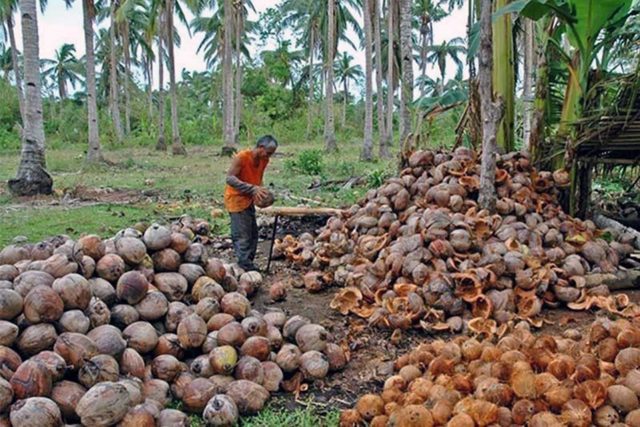
A COCONUT processing facility worth P500 million will soon be established in the town of Claveria, Misamis Oriental, according to the Mindanao Development Authority (MinDA).

MinDA Chairperson Emmanuel F. Piñol said in a Facebook post over the weekend that the facility is planned on the site of a former Virginia tobacco drying facility owned by Philip Morris International.

The drying facility was recently donated to the provincial government after Philip Morris halted operations in Claveria.

According to Misamis Oriental Governor Yevgeny Vicente B. Emano, the facility will help improve the coconut industry of the province, which has 10 million productive trees.

The six-hectare site will be equipped with 150 steam drying chambers with 17-ton capacity each and a fully automated greenhouse nursery. Mr. Emano said the plant will produce at least 11 types of high-value products and is expected to raise the buying price to P25 per nut from farmers.

“The drying chambers will be used to produce clean white copra with the husks processed into coconut fiber and coconut peat and the shells into coconut charcoal briquettes. Other high-value products include coconut syrup, coconut sugar and coconut alcohol,” Mr. Emano said.

Mr. Piñol said the facility will be equipped with a locally-designed and fabricated biomass boiler to bring down power costs in steam generation for the drying chambers and make the project viable.

Philippine Coconut Authority Administrator Benjamin R. Madrigal, Jr. has urged businesses to invest in the coconut industry to boost exports and improve the incomes of coconut farmers.

Mr. Madrigal said the investment environment has become more favorable with the passage of Republic Act No. 11524 or the Coconut Farmers and Industry Trust Fund Act, which sets up a P75-billion fund that will support various industry upgrade programs. — Revin Mikhael D. Ochave

LRMC says LRT-1 Cavite Extension 60% finished

THE Cavite extension project of the Light Rail Transit Line 1 (LRT-1) is now 60% complete, its private operator Light Rail Manila Corp. (LRMC) said.

“The current progress for the Cavite extension is that it has reached about 60% completion,” LRMC President and Chief Executive Officer Juan F. Alfonso said at a recent press briefing of the Metro Pacific Investments Corp. (MPIC).

“The viaduct construction is now crossing from the Parañaque River, crossing Cavitex (Manila-Cavite Expressway) and going to Roxas Boulevard,” he added.

LRMC is scheduled to complete the viaduct by the end of the year.

“Afterwards, we will start with the electromechanical works — the laying of the rails and the installation of the electrical system as well as the stations,” Mr. Alfonso said.

The P64.9-billion LRT-1 Cavite extension project, a public-private partnership (PPP) venture that the National Economic and Development Authority board approved in November 2013, aims to add an 11.7-kilometer Baclaran-Bacoor, Cavite segment to the current 18.1-kilometer train line. The new stretch will have eight stations.

The first phase of the extension consists of a seven-kilometer stretch with five stations between the Redemptorist Church area in Baclaran and Dr. Santos Ave. in Parañaque.

The Baclaran-Dr. Santos segment is expected to start partial operations in the first quarter of 2024, the Transportation department said. The government plans to conduct trial runs in March 2023.

The Cavite extension is expected to be fully operational by the second quarter of 2027.

Once completed, the Transportation department expects daily ridership along the entire line to increase to 800,000 passengers from 500,000, and Baclaran-Bacoor travel time to be cut to 25 minutes from up to two hours.

LRMC is the joint venture of Ayala Corp., Metro Pacific Light Rail Corp. and Macquarie Infrastructure Holdings (Philippines) Pte. Ltd. It holds the P65-billion, 32-year PPP contract to operate LRT-1 and build its extension to Cavite.

MPIC is one of three Philippine subsidiaries of Hong Kong’s First Pacific Co. Ltd., the others being PLDT, Inc. and Philex Mining Corp. Hastings Holdings, Inc., a unit of PLDT Beneficial Trust Fund subsidiary MediaQuest Holdings, Inc., maintains an interest in BusinessWorld through the Philippine Star Group, which it controls. — Arjay L. Balinbin

Mercedes-Benz A 180 AMG Line: The state of A

PHOTO BY MANNY N. DE LOS REYES

Driving Mercedes-Benz’s first-ever front-wheel-drive sedan

IT’S HARD to believe I was just raving about the brilliant fourth-generation Mercedes-Benz A-Class hatchback last year. And now it’s gone.

Well, not really gone. It’s just no longer available in the Philippine market — a victim of the Filipino preference for sedans and SUVs to showcase their automotive bling. With the exception of the Mini Cooper, the local market seems to have relegated hatchbacks to the budget genre — not something to show off at their high school reunion.

Thankfully, A-Class fans — I’ve been one since the third-generation W176 that was produced from 2012 to 2018 — now have a first-ever sedan model to marvel at.

It’s the fourth-generation A-Class (W177) sedan that was launched globally in 2018 (together with the hatchback) and which became available locally last year. The A-Class sedan is a fabulous way to start up the Mercedes-Benz ladder of stately sedans. The A-Class, after all, stands right at the beginning of Mercedes’ alphabetical nomenclature.

Which begs the question: With Mercedes-Benz’s century-long experience in perfecting the art of the rear-wheel-drive sedan, is a front-wheel-drive version from Stuttgart still a legitimate Mercedes?

Is the Toyota Supra a Japanese BMW Z4? Yes!

Aside from having the power delivered to the front wheels instead of the rear, the new A-Class sedan bristles with all the sensory values you would expect from the three-pointed star brand. The car has been designed and engineered by Germans and made in Germany (in Mercedes-Benz’s Rastatt plant, to be exact). It didn’t get its platform from another brand. The only other cars that the A-Class shares its Modular Front Architecture (MFA) platform with are its CLA and GLA siblings.

I got to test-drive the currently sole variant available — the P2,950,000 A 180 AMG Line — and it proved exhilarating enough in everyday driving, thanks mostly to the generous and very accessible turbo-boosted torque and the responsive seven-speed gearbox with paddle shifters. Under the sloping hood is a 1.3-liter turbocharged inline-four generating 136hp at 5,500 rpm and a more-than-adequate 200Nm available from as low as 1,460 rpm.

Ride and handling can be tweaked from Eco, Comfort, Sport, to Individual. The A-Class is targeted toward the younger set and will superbly deliver the goods for singles, couples with small kids, or even empty nesters who are happy to be relieved of the need to always be behind the wheel of a van or SUV.

Where the new A-Class will deliver universal appeal is with its head-turning styling. It retains its predecessor’s low-slung, ground-hugging profile as well as its aggressive predatory front end. The compelling face boasts a low hood, mean-looking LED headlamps, and a fabulously detailed diamond grille with chrome pins, a single louvre, and a huge three-pointed star taking centerstage. The sharp character lines of the third-gen have given way to cleaner yet well-defined side surfaces on the new model. With its sloping roofline that gracefully flows down onto the front and rear fenders, the new A-Class sedan is arguably the most sensuous small Mercedes-Benz sedan this side of the coupe-like CL models.

The A 180’s AMG Line package automatically comes with an AMG front apron with front splitter in chrome, AMG side sill panels, and an AMG rear apron with chrome trim and beautifully integrated dual chrome tailpipes. The front brake calipers sport Mercedes-Benz branding while a chrome strip adorns the beltline and windowline.

More AMG Line trim comes from the comfort suspension with lowering function, AMG brushed stainless steel pedals with rubber studs, floor mats in black AMG lettering, black fabric roof liner, three-spoke flat-bottom multifunction steering wheel in Nappa leather with perforated grips, folding armrest, black air vents with chrome surround, double cupholder, luggage nets on front seat backrests, and a net in the front passenger footwell.

The beautifully crafted interior of the A 180 Sedan is a revolution with its modern, avantgarde look. The new sedan comes with the brand’s high-resolution Widescreen Cockpit with touchscreen control — a new standard in the segment. It features an all-digital instrument panel that can be switched to different styles from Classic, Understated, and Sport mode. The Widescreen Cockpit is completely freestanding and, for the first time, have absolutely no cockpit cowls above the instruments.

Belying its entry-level status, the new A-Class was also the first Mercedes-Benz model to feature the brand’s completely new infotainment system, MBUX (Mercedes-Benz User Experience). At the heart of MBUX is a virtual assistant, which is activated by pressing a button in the steering wheel or by simply saying, “Hey Mercedes.” It responds to voice commands for infotainment functions such as destination input, music selection, climate control, and ambient lighting. The MBUX comes with a natural speech recognition program that helps it to recognize and understand nearly all sentences from the fields of multimedia and vehicle operation. It’s cool and fun to use, especially when you’re demonstrating it to new passengers. Siri users will be right at home.

Like all Mercedes-Benz vehicles, the new A-Class is loaded with world-class safety features such as Active Brake Assist, Active Bonnet, Attention Assist, dual front air bags, windowbags, knee air bag for the driver, Brake Assist, adaptive brake lights flashing, ABS, ESP, Acceleration Skid Control (ASR), tire pressure loss warning, crash-responsive emergency lighting, Hill-Start Assist, central locking with crash sensor and emergency opening function, reversing camera, and anti-theft with interior motion sensor.

All things considered, the A-Class is one superb and irresistibly priced small sedan whose extensive features list and legendary engineering easily live up to its illustrious brand name. In the rarified world of status symbols, you can’t say that about too many other luxury products.

Filipino lifestyle shopping (and more) platform launched

A NEW e-commerce platform launched on July 31 focuses on the Filipino through a shopping experience, but also through entertainment, travel, and lifestyle options.

Go Shopping Philippines was founded by entrepreneur Neil La-as, who has a background in immigration business development and real estate. He was quite impassioned during a press conference late last month, describing the reasons why he founded Go Shopping Philippines (GSP). “For so long a time, our country has been governed by international or foreign-owned e-commerce sites. These are the giants of the industry,” he said. “It’s going to be the first Filipino-owned corporation offering a huge e-commerce business.”

Edith Sola, Director of Strategy and Communications, emphasizes the Filipino ownership of the company. “We cannot give you all our shareholders’ names here. But you see the team in front of you right now.” she said during the press conference. “We do not have any foreign investment in GSP. This is an all-Filipino app. We would like to compete globally, when the time comes, as a Filipino brand.”

Also the owner of a skincare brand (Bakku2Basik Skin), Mr. La-as said that one of the reasons why he founded the platform was because of negative experiences within other shopping platforms. “I was once a seller on their platforms. I could tell you, there is no protection inside the platform.” He mentioned “bogus” buyers and sellers and the proliferation of fakes as part of his experience. Because of this, GSP has stricter policies when it comes to vetting both sellers and buyers. “GSP talks to direct owners; we’re not meddling with third parties or suppliers… we make sure that they comply with the requirements needed to ensure their legitimacy and the authenticity of their products.” These include presenting Food and Drug Administration (FDA) certifications, business concept, product listings, and business permits.

On another note, the platform places an emphasis on local Small to Medium Enterprises (SMEs) specifically with the platform’s Go National component. On the buyers’ side, they will have to prove their identity by submitting IDs and consenting to a call confirming their identity.

Mr. La-as emphasizes the many ways one can use the app. Aside from its 12 shopping zones (categories: Fashion Hall, Food and Beverages, Beauty and Wellness, Specialty Store, Home Store, Sports and Lifestyle, Electronics and Gadgets, E-Services, Department Store, Pharmacy, Supermarket, and Hardware), it will also offer streaming services through Go Cineplex, GFlix, and Go Live! Mr. La-as said that they have also planned programs on their streaming channels for lifestyle and travel, and news and current affairs.

According to him, GSP will have programs developed in cooperation with the Department of Education and the Philippine Drug Enforcement Agency, and other government agencies “who would like to give vital information to the public.”

“GSP is not just going to be a shopping and retail [experience]. It’s going to be for your information and for public advisory, and so on,” he said.

The app is available for download on the App Store and Google Play Store.

S-Presso Club formally accredited by Suzuki Philippines

Some of the online attendees of the formal recognition ceremony of the Suzuki S-Presso Club of the Philippines. — IMAGE FROM SUZUKI PHILIPPINES, SUZUKI S-PRESSO CLUB

SUZUKI PHILIPPINES, INC. (SPH) officially welcomed the Suzuki S-Presso Club of the Philippines (SSCP) last Aug. 5 through a recognition event held online. The activity was attended by members of the SPH team and the SSCP.

SPH Automobile Division Vice-President and General Manager Keiichi Suzuki led representatives of the company, including members of the marketing team. The Suzuki S-Presso Car Club was headed by its president, Jasper Jerome Handog.

The Suzuki S-Presso was launched in March 2020 and was warmly received by the market with 3,897 sold units as of July this year. On July 12, the SSPC was established with only four members. Today, it boasts 616 members, with two active chapters in Bicol and Cavite. The club was created with the aim of providing special perks for members, local partner businesses and/or car dealerships, while in turn, promoting Suzuki’s popular and unique compact hatchback.

Said Mr. Suzuki, “As we are truly delighted to officially have the Suzuki S-Presso Club (members) on board as our brand ambassadors, I am very much amazed as to how we continuously expand and grow the Suzuki family over the years. Together, as one family, we will continue to find avenues to champion the ‘Suzuki way of life!’”

A Certificate of Recognition was awarded to SSCP during the virtual recognition event, with SPH promising additional support to the club’s future plans, including continuous support for SSCP events and activities, annual Christmas party events, digital promotions, and service referrals to Suzuki dealerships. Additionally, SSCP members were able to enjoy Japanese food together with the SPH Marketing team and Suzuki merchandise sent to them during the event in lieu of the usual get-together.

For daily updates on Suzuki, like the Suzuki Auto Ph Facebook page at https://www.facebook.com/SuzukiAutoPh and follow on twitter at https://twitter.com/SuzukiAutoPH and Instagram at @suzukiautoph.

Retail coffee prices to climb as frost and freight costs bite

REUTERS

LONDON — The most devastating frost in decades in top coffee producer Brazil and record freight costs sparked by COVID-19 causing massive shipping logjams are expected to push retail prices to multi-year highs in the coming weeks.

A hike in coffee prices will further raise the cost of a basket of shopping following increases for other items such as bread, vegetable oils and sugar. The United Nations food agency’s index of world food prices for July showed a year-on-year rise of 31% at a time when many consumers are struggling financially due to the pandemic.

The worst cold snap in Brazil since 1994 sent the price of green coffee beans to the highest level in almost seven years and is expected to pass through to consumers when they purchase roasted beans or ground coffee in supermarkets.

Arabica coffee on the ICE Futures US exchange has doubled in price over the last 12 months with crops in Brazil already wilting after the worst dry spell in 91 years.

The extent of the damage is still being assessed but in areas where coffee trees have not survived it may take up to seven years for production to fully recover.

Shipping disruptions, caused partly by a surge in demand for consumer goods and not enough ships as people stayed home due to the global coronavirus pandemic, has also led to a sharp rise in the cost of transporting beans to major consuming countries in North America and Europe.

Traders believe while consumers will soon have to pay more to purchase coffee from supermarkets, the cost of a latte or Americano at high street coffee chains may not follow suit in the short term.

“Roast and ground (coffee in supermarkets) has only coffee and a bit of packaging. Your coffee at Starbucks might not go up (as much) cause you pay more for the shop, the WiFi, the experience,” he added.

Data issued by the US Bureau of Labor Statistics show average ground coffee prices rose to a peak of $4.75 per lb in April, up 8.1% from a year earlier and the highest level since July 2015, as drought took an initial toll on Brazil’s crops.

The rise in arabica coffee prices on the ICE Futures US exchange accelerated rapidly, however, after the recent frost and retail prices appear certain to increase in response. In Brazil, the world’s number two consuming nation after the United States, roast and ground coffee prices increased 3.4% in June, according to statistics office IBGE.

They are set to rise further. After the July frosts, Brazil’s coffee industry group Abic told roasters to analyze their costs and adjust prices accordingly, to preserve the sustainability of their businesses.

Abic estimates that green coffee prices for roasters in Brazil increased around 80% from December to late July.

“Some companies, including market leaders, have already announced price increases,” Abic said in a letter to associated roasters seen by Reuters.

JDE Peet’s, whose brands include Douwe Egberts, Kenco and Peet’s, noted that there had been a sharp rise in ingredient, freight and other costs in the last 12 months.

“Historically, significant fluctuations in green coffee prices have been reflected in the market (retail prices) and we expect that precedent to continue,” the company said. 

TRANSPORT COSTS
The rise in transport costs, linked to a shortage of shipping containers, could play a major role in driving up prices. Coffee is normally shipped in containers, in contrast to commodities such as grains which are transported in bulk carriers.

Many coffee companies find it easier to withstand a rise in the cost of beans, at least in the short term, than increasing shipping costs as they often fix the price of their purchases several months in advance.

“We have hedging here in place for a good percentage of our coffee needs for the rest of this year and even for part of next year so I’m not short-term worried about that,” Nestlé Chief Executive Mark Schneider said during a recent conference call, adding this was not the case with transportation costs.

Carlos Santana, coffee head trader for Eisa Interagricola, a unit of ECOM Trading, said it was very challenging to ship coffee, particularly in the Americas.

“It is almost not economical to use this route right now. The ports in the US are full, shipping companies do not want to take more cargoes to there, so they charge more. Prices are more than three times higher than they were before the pandemic,” he said.

Thiago Cazarini, a coffee broker in Brazil’s Minas Gerais state, said that even paying up the much higher prices to secure a container, exporters are having problems trying to load them into the ships.

He said the problem is widespread, impacting all players.

“Brazil is such a mess logistically right now. I have coffees that were supposed to arrive two months ago and I haven’t got them yet,” one US coffee importer said.

Julian Thomas, managing director of Maersk Brazil, part of the world’s biggest container shipping line, said the “current bottlenecks from measures to contain the pandemic and a strong demand are also impacting supply chains in and out of Brazil.”

“We are still servicing our customers and can attend to their growing demand,” he told Reuters.

German container shipper Hapag Lloyd added that there were delays for shipping goods, “but not only coffee.”

Brazil accounts for an estimated 30% of global exports and its peak shipment season has already kicked off. — Reuters

REITs remain attractive due to dividend — analysts

DESPITE concerns over the Delta variant of the coronavirus disease 2019 (COVID-19), analysts said real estate investment trusts (REITs) remain attractive because of their guaranteed dividend.

Measures taken up by the government, such as implementing lockdowns and continuing its vaccination drive will help drive market interest.

Last week, Del Monte Pacific Ltd. announced the deferment of the P44-billion initial public offering (IPO) of subsidiary Del Monte Philippines, Inc. (DMPI) due to “volatile market conditions” brought by the recent surge in COVID-19 infections.

“The postponement of DMPI’s listing definitely has to do with investor appetite. We have seen mammoth IPOs one after the other and liquidity may be tapped out as of the moment,” AAA Southeast Equities, Inc. Research Head Christopher John Mangun said in an e-mail on Friday.

DMPI’s IPO plan in 2018 was also shelved due to market conditions.

“DMPI has been patient as it wants to get the best valuation, which is understandable,” Mr. Mangun said.

The company’s decision to temporarily stay on the sidelines and delay its listing on the Philippine Stock Exchange (PSE) could make REIT firms reassess their listing schedules, analysts said. However, the guaranteed dividend yield of REITs will still make its offers attractive to investors, they added.

Filinvest Land, Inc.’s unit Filinvest REIT Corp. (FILREIT) is slated to make its debut at the PSE on Thursday, Aug. 12. The company is expecting to raise up to P12.6 billion from the offer.

FILREIT’s initial portfolio has 17 building, 16 of which are located in Filinvest City in Alabang and one Cebu-based office tower with a retail component. The company said around 88% of its tenants are business process outsourcing (BPO) firms. It is banking on “millennial and retail investors” as well as “investors tracking sustainability initiatives” for the success of its listing.

Meanwhile, two more REIT companies separately sponsored by Megaworld Corp. and Robinsons Land Corp. are also preparing to conduct their respective IPOs later this month.

Megaworld’s MREIT, Inc. plans to list at the PSE on Sept. 6, with an offer period for its P27.3-billion IPO expected to run from Aug. 23 to 27. It has 10 office, retail, and hotel assets in its initial REIT portfolio, most of which are also occupied by BPO companies.

Robinsons Land’s RL Commercial REIT, Inc. (RCR), on the other hand, is targeting a PSE debut on Sept. 20. It plans to conduct its P26.7-billion IPO from Aug. 31 to Sept. 8. RCR’s initial portfolio includes 14 real estate assets, with the BPO industry also “the core of RCR’s tenant base.”

“As long as their offer quality and yield [are] good, I think the market may want to take a look and a test,” COL Financial Group, Inc. Chief Technical Analyst Juanis G. Barredo said in a separate Viber message on Friday.

“If their offer is just at par with the rest or lower, the market may opt to stay defensive and not take the chance on heavy involvement,” he added.

With the reimposition of lockdown restrictions, the demand for office spaces is also expected to slow down.

“The immediate term may see some real estate commitments deferred later this year or early next year which would keep vacancy levels elevated in Metro Manila,” JLL Philippines Head of Research and Consultancy Janlo de los Reyes said in an e-mail on Friday, adding that the vacancy level in the first half of the year stood at 16%.

Mr. de los Reyes added that there might be changes in headline rental income in some offices with high vacancies as well as changes in terms granted by landlords to tenants.

“The REIT market is not exempt from downside risks from the pandemic, but this is mitigated by secured long-term leases to protect rental stream, profile of tenants where flight and exit risk is minimized, and portfolio diversification where we’re seeing the introduction of industrial assets under existing and planned REIT vehicles,” he added.

For the country’s pioneer REIT firm, AREIT, Inc., the company said it is not expecting to be impacted by the lockdown as it expects its business locators to keep operating.

It noted that while an industry-wide vacancy is expected to increase by 12% to 15% by the end of the year due to closures of Philippine offshore gaming operators (POGO), AREIT will not be affected.

“We don’t expect AREIT to be directly impacted because AREIT has no POGO tenants,” AREIT, Inc. President and Chief Executive Officer Carol T. Mills said in an e-mail on Friday. “AREIT buildings are also 99% leased on a long-term basis and we do not have major expirations in the next two to three years.”

“Delta variant spread and resulting lockdown are dampeners to sentiment, but the fact that foreign buying was evident when the PSEi (Philippine Stock Exchange index) touched the 6,100-6,200 areas indicates that valuation is a key attraction to funds wanting to diversify away from the more expensive markets like the US,” First Metro Investment Corp. Head of Research Cristina S. Ulang said in a Viber message on Friday.

Analysts said investors should still look at these “short-term bursts of weakness” as an opportunity to collect stocks at a discount.

“When we went into the first lockdown in March 2020, the market did go up quite a bit after acclimatizing with the realities of COVID-19 — something we may have to build into our lives as it becomes endemic,” COL Financial’s Mr. Barredo said. — Keren Concepcion G. Valmonte

If you’re shopping for a new swimsuit, try a recycled one

THOUGHT CATALOG UNSPLASH

By Margaret Rhodes

IN THE FIRST half of the year, before the specter of the Delta variant arose, consumers were in a liberated mood. Along with airline tickets and high heels, swimsuits became must-haves for shoppers eager to escape quarantine. Globally, consumers spent $2.7 billion on swimwear in the first half of 2021 — a 19% jump from the same period in 2019, according to industry analysts at NPD Group.

For decades now, most swimsuits have been made with Spandex, which was invented by materials scientists at DuPont in 1959 as a lighter, more breathable alternative to rubber. The petroleum-based material quickly became standard in the apparel industry, and in 1972, Speedo became the first company to sell Spandex swimwear. As of 2017, polyester and Spandex make up about 65% of the fabrics used in the swimwear market, according to Allied Market Research.

As new bikinis, one-pieces, and briefs rotate into people’s wardrobes, the worn-out ones typically wind up in landfills. “Spandex is a very difficult material to recycle,” says Shannon Bergstrom, sustainability brand manager at Recycle Track Systems. The synthetic fibers are too short for mechanical processes to sort, and no effective chemical methods yet exist to recover the used material. Consumers can always donate or resell used suits, but there’s no guarantee anyone will buy them, even if they’re new with tags. “I’m hopeful that companies will pick up the bill to create solutions,” Ms. Bergstrom adds.

Some are trying. The Lycra Company’s EcoMade line includes fibers drawn from pre-consumer Spandex scraps as well as blends of recycled polyethylene terephthalate, a common plastic. Speedo sells souped-up performance suits in chlorine-resistant Spandex and Lycra’s Xtra Life fiber, which promises to last longer than conventional fibers, thereby creating less waste. Perhaps the most popular among boutique and fashion-oriented swimwear lines is Econyl, made by the decade-old Aquafil, which recovers fishing nets from oceans and industrial carpets from landfills to spin into yarn.

“Swimwear is our biggest challenge,” says Dana Davis, head of sustainability at the eco-conscious brand Mara Hoffman. The company designs its suits with Econyl and Repreve, a performance fiber made from recycled materials such as plastic bottles, and will soon work with another recycled nylon called Q-Nova. “We’re not taking virgin fossil fuels,” Davis says, “but let’s be honest, this isn’t the end all be all. There’s no way to take a swimsuit and recycle it into another swimsuit.” Plus, Davis points out, these recycled plastic suits release microplastics into the water supply just like brand new Spandex.

The brands using Econyl and Repreve hope those products’ parent companies figure out how the materials can be further reused, and soon. “We’re e-mailing them quite often to find out when we can recycle these materials,” says Abigail Lorick, creative director at sustainable swimwear line Ansea. “Our big goal for 2021 is to figure out how we can start taking back end-of-life swimwear.” — Bloomberg

Yields on gov’t debt fall

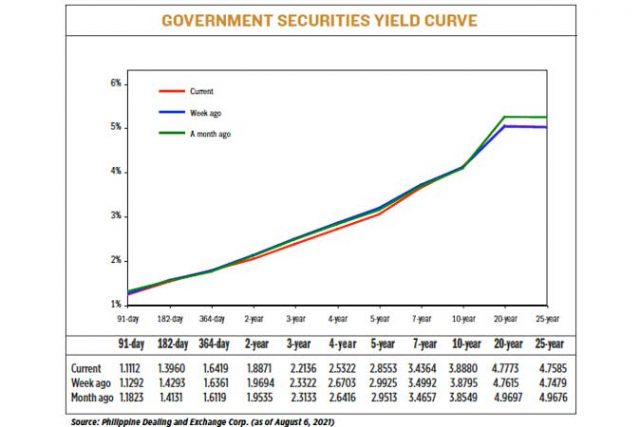
YIELDS ON government securities (GS) at the secondary market went down last week following the release of July inflation data and the government’s reimposition of strict lockdown measures in Metro Manila and nearby provinces.

GS yields, which move opposite to prices, fell by an average of 5 basis points (bps) week on week, based on the PHP Bloomberg Valuation Service Reference Rates as of Aug. 6 published on the Philippine Dealing System’s website.

At the short end of the curve, yields on the 91- and 182-day Treasury bills (T-bills) slipped by 1.8 bps and 3.33 bps, to 1.1112% and 1.3960%, respectively. On the other hand, the rate of the 364-day paper inched up by 0.58 bp to 1.6419%.

At the belly, the rates of the two-, three-, four-, five-, and seven-year Treasury bonds (T-bonds) fell by 8.23 bps (1.8871%), 11.86 bps (2.2136%), 13.81 bps (2.5322%), 13.72 bps (2.8553%), and 6.28 bps (3.4364%), respectively.

Rates of the long-dated papers climbed, with yields on the 10-, 20-, and 25-year T-bonds rising by 0.85 bp (3.888%), 1.58 bps (4.7773%), and 1.06 bps (4.7585%), respectively.

“Local GS yields dropped, led by strong buying interest on the short and belly end of the curve, on the back of easing inflation expectations onshore after the release of July CPI (consumer price index) print,” a bond trader said via Viber message.

“The drop in local bond yields was also due to the re-imposition of the strictest lockdown measure in Metro Manila from Aug. 6 to 20 to stem the spread of the Delta variant, thereby prompting market players to reassess their bets of a strong economic recovery for the year,” the trader said.

The bond trader added that the Bangko Sentral ng Pilipinas’ (BSP) hints of a possible cut in banks’ reserve requirement ratio was the “icing on the cake.”

“[Last week’s performance] was primarily driven by inflation and the launching of ECQ (enhanced community quarantine), which is expected to dampen economic growth, depending on how long the ECQ will last,” Security Bank Corp. Chief Investment Officer for Trust and Asset Management Group Noel S. Reyes said in a phone interview.

Metro Manila and its nearby provinces are under ECQ from Aug. 6-20 to help curb a surge in COVID-19 cases due to the more transmissible Delta variant.

Meanwhile, the BSP said lowering the reserve requirement ratio (RRR) remains “on the table,” Bloomberg reported on Wednesday.

The reserve requirement for big banks is currently at 12%, still one of the highest in the region. The central bank last cut big banks’ RRR in April 2020 with a 200-bp reduction.

In July 2020, it likewise slashed the reserve requirements of thrift and rural banks by 100 bps to 3% and 2%, respectively.   

The BSP’s Monetary Board will have its next policy-setting meeting on Thursday. However, it has adjusted its RRR outside these meetings in the past.

On the other hand, headline inflation eased to a seven-month low of 4% in July, the Philippine Statistics Authority reported on Thursday. This marked the first time since December 2020 that it settled within the BSP’s 2-4% target.

The July result brought year-to-date inflation to 4.4%, still above this year’s target and the central bank’s 4% forecast for this year.

For this week, yield movements will be driven by auctions of government securities as well as the release of data on the economy’s performance in the second quarter.

“We will start the week with the T-bill auction, which will guide direction for yields on the short dates [before] moving on to the seven-year auction and second-quarter Philippine GDP (gross domestic product) print [on Tuesday], which will dictate yield direction for the rest of the curve. Market will also be vigilant and will watch for clues for Thursday’s Monetary Board meeting,” the bond trader said.

The Treasury will auction off P15 billion in T-bills today and P35 billion in fresh seven-year T-bonds tomorrow.

Meanwhile, Security Bank’s Mr. Reyes expects yields to move sideways for the entire duration of the two-week ECQ due to the “ghost month.”

The ghost month is a period in the Lunar calendar when some Asian investors refrain from doing big investments or decisions that coincides with the vacation of fund managers in the West, thereby resulting in lower trading volumes. For this year, it starts on Aug. 8 and ends on Sept. 6. — B.T.M. Gadon

The Argentine river that carries soybeans to the world is drying up

REUTERS

SNAKING its way through thousands of miles of South American rainforest and pampas and past sprawling soybean and corn farms, the Parana River is the main thoroughfare for Argentine commerce. Some 80% of the country’s crop exports flow through its muddy waters en route to the Atlantic Ocean.

So when the river’s levels fell to the lowest since the 1940s — the result of years of scorching drought that scientists attribute to climate change — it deepened the strains on an economy that was already struggling to recover from its pandemic collapse.

Grains traders suddenly found themselves forced to scale back how much they pile onto cargo ships, afraid to get them stuck in the river’s shallow banks, and then either add to their load once they reach deeper sea ports or contract out more vessels. Both are expensive, time-consuming options that have hamstrung an industry that pulls in more than $20 billion annually from exports. Gustavo Idigoras, head of Ciara-Cec, a crop export and processing group whose members include Cargill, Inc. and Glencore Plc, called it an “emergency situation” that will likely last through the end of the year.

There’s been a financial toll on the imports side, too: Low river levels mean less hydro power and, as a result, more money that has to be shelled out for shipments of diesel to fuel electricity plants. Diesel imports have jumped to their highest since 2018 as the Yacyreta dam, which usually supplies about 14% of Argentina’s power from its northern river border, operates at just a third of capacity.

The combination of slowing exports and rising imports is cutting into the country’s trade surplus and adding to a slew of factors that are driving down the peso, the worst-performing currency in emerging markets this year. This has prompted the central bank to step back into foreign-exchange markets in recent days and sell dollars to prop up the peso and try to prevent inflation from spiraling even further out of control. Running at 50% a year, inflation is already a major drag on economic growth as it eats away at the purchasing power of tens of millions of Argentine consumers.

“If the shallowness of the Parana persists in the medium term, it’s a problem” because crops are Argentina’s biggest source of coveted export dollars to shore up the peso, and the country has already been slipping dangerously back to becoming a net importer of energy, said Belen Rubio, an economist at MAP, a consultancy firm in Buenos Aires.

The dried-up Parana has exposed a lack of long-term logistics planning in Argentina, she added, with the agriculture industry clamoring for a deeper shipping channel and where dams account for 28% of electricity generation capacity.

The setbacks to Argentine exports have global implications. The nation is a powerhouse of oilseed and grain production, the world’s No. 1 shipper of soybean meal for feeding livestock and soybean oil for cooking and biofuels. It’s the third biggest exporter of corn.

On the domestic front, the ebbing river levels are shaving dollars off the value of Argentina’s sales abroad, with Argentine soy meal premiums trading at record lows versus rival Brazil. Premiums paid for September shipment are about 25 dollars a ton cheaper than in its neighbor, and, even worse, many meal buyers are flocking to Brazil to avoid the higher shipping costs altogether.

The Parana’s situation has gotten so dire that Argentina even declared a water emergency in seven riverside provinces on July 24, which allows the government to take special action to mitigate the impact of the drought and keep businesses and industry going.

The drought has been fiercest at the source of the river in Brazil, largely sparing Argentina’s farm belt 1,500 miles south. In Brazil itself, meanwhile, the dryness has destroyed crop yields.

As for the rising diesel imports, they’re a fraction of the country’s trade surplus, yet still closely watched because they can have an outsize impact.

“Argentina has a hard-currency shortage so even a minimal outflow of dollars to import additional energy adds uncertainty,” said Marcelo Elizondo, an Argentine consultant who specializes in trade. “The question is how long this lasts for.” — Bloomberg

ADVERTISEMENT
ADVERTISEMENT