Home Blog Page 7615

TikTax-ing social media influencers

Over the past decade, we have seen exponential growth in number of social media users. Social media users are now the equivalent of 57% of the world’s population, and it is expected that this figure will continue to increase. Social media also influences consumer spending. Studies show that more than 50% of social media users use such online platforms to research products and more than 60% are likely to purchase products and services based on social media referrals.

Accordingly, more companies are now veering away from traditional advertising and moving to social media, relying on influencers to promote their products and services. Influencer marketing has become a vital part of overall marketing strategy and is considered an effective means to communicate with a brand’s target audience to improve awareness. Hence, social media influencers can earn substantial amounts from sponsorships and ad revenue, among others. 

Social media influencers have built reputations for their knowledge, expertise, and/or interest in specific topics. They make regular posts on their preferred channels, such as YouTube, Instagram, Facebook, Snapchat, and TikTok, and generate a large number of followers. Influencers are not limited to celebrities. Even an average person, and even children (also known as “kidfluencers”) can be influencers on social media.

Just like any other person or corporation who earns income, influencers are also subject to tax. The Bureau of Internal Revenue (BIR), however, has noted that some of these influencers are not even registered with the BIR or are not paying the correct amount of taxes. Thus, the BIR issued Revenue Memorandum Circular (RMC) No. 97-2021 to remind these influencers of their obligations under tax law and the possible consequences of their failure to pay taxes.

As stated in RMC 97-2021, influencers, other than corporations and partnerships, are classified for tax purposes as self-employed individuals or persons engaged in trade or business as sole proprietors. They are required to register with the BIR Revenue District Office (RDO) having jurisdiction over the place where the head office is located or over the taxpayer’s place of residence. In case, however, they are already registered with the BIR but only as employees, they need to update their registration information with the RDO where they are registered, specifying therein any change in type and other taxpayer details.

Influencer incomes are generally considered business income subject to regular income tax, except those subject to final tax or exempt from tax under existing laws. Business income subject to regular income tax includes, among others, any amount received, whether in cash or in kind, from YouTube partner programs, sponsored social and blog posts, display advertising, becoming a brand representative/ambassador, affiliate marketing, co-creating project lines, promoting own products, photo and video sales, digital courses, subscriptions, e-books, podcasts, and webinars. To constitute gains or profits from the conduct of trade or business, payments must be received by influencers in consideration for services rendered or to be rendered, irrespective of the manner or form of payment.

Influencers are subject to a graduated income tax rate of 0% to 35% based on net taxable income (income less business expenses), except those considered non-resident aliens not engaged in business in the Philippines (NRANEBs) which are subject to 25% tax based on gross income. For citizens and resident alien taxpayers who are registered as non-VAT, if the total gross sales receipt does not exceed P3 million during the taxable year, they may choose to avail of the 8% tax based on gross sales or receipts, including other income, subject to compliance with the current tax regulations. Such tax is in lieu of the graduated tax and percentage tax. The option to be taxed at 8%, however, must be made in the first quarter income tax return or on the initial quarter return of the taxable year after the commencement of a new business. Such election is irrevocable and no amendment of option may be made for the taxable year. Hence, if they have filed their first quarter return and the option to avail of itemized deductions has been made, they may no longer avail of the 8% tax. Note that whether a taxpayer is using the graduated or the 8% rate, the first P250,000 is not subject to income tax under the TRAIN Law.

Resident citizens (RC) are taxable based on their worldwide income, i.e., income earned within and outside the Philippines. Non-resident citizens (NRCs), resident alien (RAs), and non-resident aliens (NRAs), on the other hand, are taxable only on their income earned within the Philippines.

In addition to income tax, an influencer is also subject to business tax of either the 3% percentage tax or the 12% value-added tax. The 3% percentage tax may apply if the total gross receipts and other non-operating income for the year does not exceed P3 million. Otherwise, the 12% VAT is applicable. The applicable percentage tax rate is 1% from July 1, 2020 until June 30, 2023. It will then revert to 3% of quarterly sales/receipts after this period.

Another option influencers may consider, if they qualify, is to register as Barangay Micro Business Enterprises (BMBEs) pursuant to Republic Act (RA) No. 9178. A duly registered BMBE is entitled to exemption from income tax for two years, which may be renewed. BMBEs’ total assets, including those arising from loans but exclusive of the land on which the particular business entity’s office, plant, and equipment are situated, cannot exceed P3 million. A BMBE may be a sole proprietor or a corporation. Services rendered in connection with the practice of a profession by a person duly licensed by the government after having passed a government licensure examination are not qualified to register as BMBEs.   

As self-employed taxpayers, influencers are also considered withholding agents. Hence, they are required to withhold creditable/expanded withholding tax, final tax on compensation of employees, and other withholding taxes, if applicable.

Other than filing the required tax returns and paying taxes, influencers are also required to register and maintain their books of account and comply with other requirements imposed by the BIR, as failure to do so may result in significant penalties.

I believe many of our countrymen are willing to help the government by paying the right taxes. Some taxpayers, however, are discouraged because of the tedious process of registering and complying with requirements. Regardless of the size of business, tax compliance requirements are, in general, the same for all taxpayers. Hence, different groups have long been advocating for more simplified tax filing and reportorial requirements, particularly small to medium enterprises.

To address these concerns, the BIR is embarking on a digital transformation program to improve its services and achieve efficient collection performance. The digitalization of services has been in the pipeline even before the pandemic, after it recognized the need to adapt to and take advantage of the fast-evolving digital economy. Last year, the BIR issued Revenue Memorandum Order No. 27-2020 to outline its digital transformation roadmap for 2020-2030, streamlining tax filing and collection. As more people are now transacting digitally, there is renewed hope that the BIR will move forward with its digitalization program. 

While the BIR is exerting efforts to address taxpayer questions and concerns, let us also do our share by complying with tax laws, rules, and regulations. Influencers can support our country not only by complying but also by encouraging their followers to pay much-needed taxes to fund government projects.

Let’s Talk Tax is a weekly newspaper column of P&A Grant Thornton that aims to keep the public informed of various developments in taxation. This article is not intended to be a substitute for competent professional advice.


Edward L. Roguel is a partner of Tax Advisory & Compliance division of P&A Grant Thornton, the Philippine member firm of Grant Thornton International Ltd.

pagrantthornton@ph.gt.com

Peso strengthens further on lower oil prices 

THE PESO rose against the dollar on Monday on the back of lower global oil prices. 

The local currency appreciated by 10 centavos to close at P50.27 versus the greenback on Monday from its P50.37 finish on Friday, data from the Bankers Association of the Philippines showed. 

The local unit opened the session at P50.30 against the dollar. It peaked at P50.15, while its intraday low was at P50.33 versus the greenback. 

Dollars traded dropped to $717.65 million yesterday from $977.6 million on Friday. 

The peso strengthened to hit its strongest level in over two weeks on the back of lower global oil prices, Rizal Commercial Banking Corp. Chief Economist Michael L. Ricafort said via Viber. 

“Lower global crude oil prices could reduce the country’s import bill and the demand for US dollar to pay for oil imports,” Mr. Ricafort said. 

Brent crude inched up by 1.9% to $66.41 per barrel on Monday to recover from its $64.60 level each when it hit its lowest point since May 21, Reuters reported. 

Mr. Ricafort said the peso was also supported by the progress of the country’s vaccination program. 

The Philippines has administered 30.39 million doses of coronavirus disease 2019 (COVID-19) vaccines as of Aug. 22, based on the latest data compiled by Our World in Data. 

Meanwhile, a bond trader said the peso climbed on weaker demand for dollars. 

“The local currency might appreciate further amid likely weaker US manufacturing sector report for August 2021,” the trader said. 

Both Mr. Ricafort and the trader expect the peso to range from P50.15 to P50.35 per dollar on Tuesday. — BML 

Shares decline on profit taking as infections rise

SHARES declined on Monday due to profit taking as rising coronavirus disease 2019 (COVID-19) infections in the country soured market sentiment.

The benchmark Philippine Stock Exchange index (PSEi) declined by 41.55 points or 0.62% to close at 6,591.67 on Monday, while the broader all shares index went down by 12.76 points or 0.3% to end at 4,110.96.

“With infection rates running high over the weekend, deaths nearing 400, and vaccine rollout slow due to discontinued supply, [the] market will continue to experience restrictions that will continue to hamper economic activity all over the country thus profit taking prevailed today,” Diversified Securities, Inc. Equity Trader Aniceto K. Pangan said in a text message.

“Investors continued cashing in profits at the 6,600 to 6,700 PSEi resistance levels and that’s in the face of uninspiring news in the health front, [with] elevated [infections] and budget controversies,” First Metro Investment Corp. (FMIC) Head of Research Cristina S. Ulang said in a Viber message.

“But foreign investors are buying the sell-down, taking notice of the government’s infrastructure budget ramp-up next year to P1.18 trillion or 5.4% of GDP (gross domestic product) submitted to Congress for legislation,” Ms. Ulang said.

The Health department reported 16,044 new COVID-19 cases on Sunday, bringing the country’s tally to 1,839,635 with 125,900 active cases. The positivity rate stood at 25.5%.

The country also logged 398 COVID-19 fatalities on Saturday and an additional 215 on Sunday.

Meanwhile, several government agencies have been flagged by the Commission on Audit because of deficiencies, underspending, and lapses in using state funds.

On the other hand, the Budget department on Monday submitted its proposed P5.024 trillion spending plan for 2022 to the House of Representatives.

Majority of sectoral indices declined on Monday except for services, which went up by 8.74 points or 0.53% to finish at 1,644.67, and industrials, which gained 20.19 points or 0.2% to finish at 9,669.21.

Meanwhile, property declined by 76.60 points or 2.45% to 3,043.07; holding firms shed 43.65 points or 0.66% to 6,566.04; mining and oil lost 31.69 points or 0.34% to close at 9,117.97; and financials inched down by 1.43 points or 0.1% to 1,427.89.

Value turnover inched down to P6.29 billion with 1.94 billion issues switching hands on Monday, from the P6.30 billion with 2.04 billion shares traded on Friday.

Decliners outnumbered advancers, 105 versus 87, with 45 names closed unchanged.

Foreigners turned buyers anew with 105.79 million in net purchases on Monday from the P175.12 million in net outflows logged on Friday.

Diversified Securities’ Mr. Pangan expects the PSEi to continue trading between the 6,300 to 6,700 range in the coming days. — Keren Concepcion G. Valmonte

Philippines posts record daily COVID-19 cases

PHILIPPINE STAR/ MICHAEL VARCAS

THE PHILIPPINES reported 18,332 coronavirus infections on Monday, the highest daily tally since the pandemic started last year.

This brought the total to 1.86 million, 7% or 130,350 of which were active cases, the Department of Health (DoH) said in a bulletin.

The death toll rose to 31,961 after 151 more patients died, while recoveries increased by 13,794 to 1.7 million.

Of the active cases, 94.8% were mild, 2.5% did not show symptoms, 1.2% were severe, 0.92% were moderate and 0.6% were critical, the agency said.

DoH said 321 duplicates had been removed from the tally, 316 of which were recoveries. Sixty-eight recoveries were tagged as deaths. Three laboratories did not submit data on Aug. 21.

The Health department also reported 466 new cases of the Delta variant, bringing the total to 1,273. It said 442 were local cases, 14 were returning migrant Filipino workers and 10 were still being verified.

One patient was still active, eight have died, while 457 have recovered, it said.

Meanwhile 90 more people have been infected with the Alpha coronavirus variant first detected in the United Kingdom, bringing the total to 2,322.

The agency said the country now had 2,588 cases of the Beta variant after 105 more Filipinos got infected with the virus first detected in South Africa.

Health Undersecretary Maria Rosario S. Vergeire said the highly contagious Delta coronavirus variant was now roaming freely in Metro Manila and Southern Tagalog, the country’s two most populous regions.

“It seems like there is already a community transmission,” she told a virtual news briefing in Filipino, adding that they need more evidence to officially declare a community transmission.

A community transmission occurs when there is a clustering of cases and there are no links between the cases, Ms. Vergeire said, citing the World Health Organization.

Philippine Genome Center Executive Director Cynthia P. Saloma earlier said the Delta variant had become dominant.

Health workers have threatened to resign en masse as more hospitals get overwhelmed by a fresh surge in infections.

The Health department said it would get P311 million from its contingency fund to pay for the special risk allowance of more than 20,000 health workers.

SPUTNIK LIGHT
Meanwhile, the local Food and Drug Administration (FDA) has approved the emergency use of the single-dose vaccine made by Russia’s Gamaleya Research Institute of Epidemiology and Microbiology, it said.

Russia’s Sputnik Light coronavirus vaccine was approved for emergency use on Friday, FDA Director General Enrique D. Domingo said in a Viber message.

Sputnik Light, a recombinant human adenovirus vaccine, was 79.4% effective against the coronavirus when it was first used in Russia in May.

It was given as part of Russia’s mass vaccination program from Dec. 2020 to April 2021, according to the Russian Direct Investment Fund. The single-dose vaccine must be stored at temperatures of 2-8 degrees Celsius.

The vaccine is different from the two-dose Sputnik V, which was approved for emergency use in the country in March.

The coronavirus vaccine made by Johnson & Johnson’s Janssen Pharmaceuticals is the other single-dose shot being used in the Philippines. 

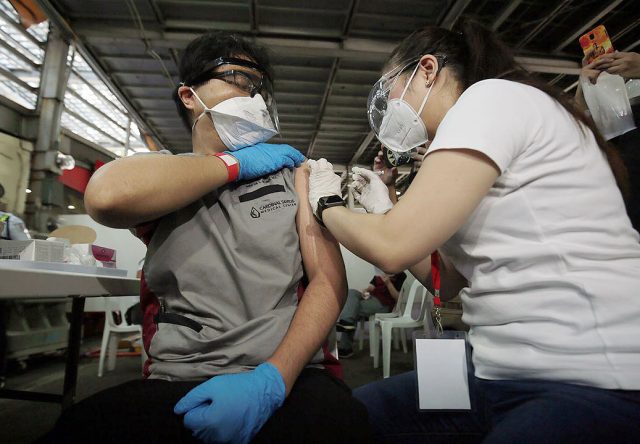
More than 30 million doses of coronavirus vaccines have been given out in the Philippines, presidential spokesman Herminio L. Roque, Jr. said.

More than 13 million people or 12% of the Philippine population have been fully vaccinated against the coronavirus, he told a televised news briefing on Monday.

Three-quarters or 7.4 million residents of the capital region’s 9.8-million population have received their first dose, while 43.5% have been fully vaccinated, Metro Manila Development Authority chairman Benjamin de Castro Abalos, Jr. told the same briefing.

“By the end of the month, we could easily reach 50% of the eligible population,” he said.

Mr. Abalos said more local governments in Metro Manila, including Mandaluyong, San Juan and Pateros have begun to open their vaccination program to nonresidents.

Of 21,765 active coronavirus cases in Metro Manila, 70% or 15,130 were unvaccinated, he said.

President Rodrigo R. Duterte last week relaxed the lockdown in Metro Manila after placing it under an enhanced community quarantine for two weeks until Aug. 20.

The increase in Metro Manila’s coronavirus cases was 48% two weeks ago and 72% three weeks ago, the OCTA Research Group from the University of the Philippines said on Sunday. The seven-day positivity rate was 22%.

Health authorities have said the effects of the strict lockdown in the capital region would not be felt immediately. — Kyle Aristophere T. Atienza

Fast-track payment of claims from hospitals, palace tells PhilHealth

THE PRESIDENTIAL palace on Monday urged the Philippine Health Insurance Corp. (PhilHealth) to fast-track the payment of claims from private hospitals, which have threatened to cut ties with the state insurer.

PhilHealth’s failure to pay the claims would deprive Filipinos’ access to healthcare services, presidential spokesman Herminio L. Roque, Jr. said at a televised briefing on Monday. “Pay what is due,” he added.

Private hospitals said they would cut ties with the state insurer after it refused to pay hospital claims under investigation worth P13.8 billion.

Mr. Roque also asked PhilHealth chief Dante A. Gierran why only one official was removed over fraudulent hospital claims. “That is unbelievable.”

Mr. Gierran, who used to head the National Bureau of Investigation, was appointed PhilHealth chief last year after the state corporation was accused of paying billions of pesos in anomalous hospital claims.

Meanwhile, Senators Mary Grace Poe-Llamanzares and Christopher Lawrence T. Go asked PhilHealth and hospital groups to reach a middle ground.

“PhilHealth must not resort to a sweeping mechanism that could further delay the settlement of legitimate obligations,” Ms. Llamanzares said in a statement.

Mr. Go said that the government insurer should work with hospital groups to resolve the issues.

Ms. Llamanzares said a number of hospitals are reeling from financial distress due to unpaid claims, putting in peril their capacity to serve Filipinos covered by the state health insurance. “The delays or nonpayment of claims are also sapping the resources of hospitals to pay their medical frontliners.”

Also on Monday, Party-list Rep. Bernadette Dy-Herrera said PhilHealth had “overstepped its powers” in suspending the payments. She said the payment suspension would have serious repercussions for the government’s COVID-19 response efforts.

Jaime A. Almora, president of the Philippine Hospital Association, told a House of Representatives hearing on Aug. 17 PhilHealth had denied P13.8 billion out of P86.08 billion worth of claims by private hospitals.

Ms. Herrera urged PhilHealth to discuss the issue with healthcare providers and consider the welfare of its members who will be affected by the suspension.  Kyle Aristophere T. Atienza, Alyssa Nicole O Tan and Russell Louis C. Ku

Former budget exec summoned to Senate probe on health funds 

PCOO

THE SENATE Blue Ribbon Committee has summoned a former Budget official to Wednesday’s hearing on the Health department’s alleged mishandling of the anti-coronavirus funds. 

Senator Richard J. Gordon, chair of the committee, issued a subpoena to Lloyd Cristopher Lao, former Department of Budget and Management (DBM) undersecretary, who was in charge of funds used to purchase allegedly overpriced face masks and face shields last year.   

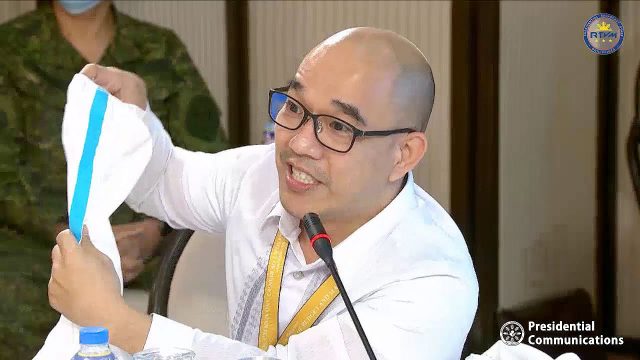
Mr. Lao, who resigned in June as head of the Procurement Service under DBM, said in a Malacañang briefing last week that the bulk purchase of masks and shields, respectively costing P27.72 and P120 per piece, were the “cheapest” at that time.   

He said he will be appearing before the Senate committee. “I believe in the objectivity of the Senate Blue Ribbon Committee that is fair and just. It is a proper and appropriate avenue for me to shed light on what actually transpired.”  

Mr. Gordon said in a statement, “He will be asked to explain the circumstances of such procurement. It is important that he appears because there are so many questions that need answers.” 

The senator also noted that DBM Undersecretary Tina Rose Marie L. Canada said that Mr. Lao was previously investigated “over procurement of overpriced medical supplies and equipment.” — Alyssa Nicole O. Tan 

Proposal to improve private sector health workers’ benefits submitted to Malacañang 

PHILIPPINE STAR/EDD GUMBAN

A PROPOSAL for better pay and benefits to all healthcare workers in the private sector was set for submission to Malacañang Monday, according to Labor Secretary Silvestre H. Bello III.  

The recommendations are intended to make private sector rates “similar to that of healthcare workers in the public sector,” he said in a news briefing Monday afternoon.    

Around 200,000 nurses, doctors, medical technologists, and other workers in private medical facilities are expected to benefit from the proposal.   

“Private hospitals can shoulder these additional funds as they are generating income especially now during the coronavirus disease 2019 (COVID-19) pandemic,” he said in Filipino.    

The proposal was jointly drafted by of the Department of Labor and Employment (DoLE), Health, and Trade and Industry, Mr. Bello said.  

He added that the proposal is also intended to urge the government, upon recommendation of the national task force handling the coronavirus response, to certify as priority a measure to increase the minimum wage of nurses in private hospitals. 

The legislative measures are contained in House Bill 7569 and Senate Bill 1837.  

Mr. Bello further said that DoLE, along with the Philippine Nurses Association, Department of Health, and the Professional Regulation Commission, are still assessing calls to increase the deployment cap on nurses “to make sure that our country is not deprived of nurses.”   

He said the Philippines has already reached its current limit of 6,500 nurses allowed to be deployed to other countries. The cap does not include deployments to the United Kingdom and Germany due to government-to-government agreements with the two countries. — Bianca Angelica D. Añago  

Bill to assist vulnerable learners filed in Senate 

PHILIPPINE STAR/ MIGUEL DE GUZMAN

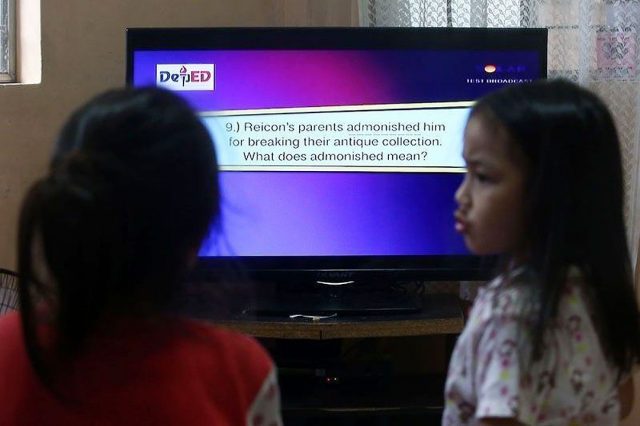
A SENATOR has filed a bill that seeks to give struggling learners access to a free remedial program that will help address the negative impact of the prolonged school closure due to the coronavirus pandemic.   

Senate Bill No. 2355 or the Academic Recovery and Accessible Learning (ARAL) Program, filed by Senator Sherwin T. Gatchalian, aims to provide nutritional, social, emotional, and mental health support to affected students in grades 1 to 10.  

The target beneficiaries are those who were unable to enroll in schoolyear 2020-2021 and those lagging academically.  

“Through the ARAL program that we are promoting, we can avoid the students’ delay in knowledge and help them catch up with their studies. This will be part of the rise of the education sector from the damage caused by the pandemic,” Mr. Gatchalian, chair of the Senate Committee on Basic Education, Arts and Culture, said in Filipino in a statement.   

The Department of Education (DepEd), in collaboration with local government units, will implement the program.   

The proposed measure will also mandate public telecommunication entities to provide learners and tutors free access to the DepEd’s online educational platforms, digital libraries, and other online knowledge hubs. — Alyssa Nicole O. Tan 

Fishers’ group lament P9.8-B unused agri funds 

A FISHERS’ group lamented the reported P9.8-billion unused fund under the Agriculture department’s 2020 budget, saying this could have been spent for production subsidies to farmers and fishers amid the coronavirus pandemic.  

Pambansang Lakas ng Kilusang Mamamalakaya ng Pilipinas (PAMALAKAYA) said in a statement on Monday that the Agriculture department could have aided at least 653,000 farmers and fishers with a P15,000 subsidy each.  

The Commission on Audit, in its 2020 report, said P9.8 billion of the Department of Agriculture’s (DA) P59-billion budget for 2020 was unspent and remitted back to the National Treasury.   

PAMALAKAYA National Chairperson Fernando L. Hicap said the subsidy could have boosted the output of the country’s food producers.     

“This also means that unstable food supply and prices in the market could have been avoided if only the government heeded the demand of the country’s food security front liners for livelihood subsidy and aid,” Mr. Hicap said.   

PAMALAKAYA and other rural-based progressive groups have been calling for a P15,000 subsidy for livelihood and production expenses.   

According to the group, the subsidy proposal was filed by the Makabayan bloc in the House of Representatives under House Bill 9192.   

“The agricultural production subsidy for fishers will be apportioned mostly for fuel expenses which eat up almost 80% of a regular fishing trip,” the group said.    

Meanwhile, PAMALAKAYA reiterated its call for the DA to explain to the public the cited “irregularities” in the budget spending.   

The group added that the Agriculture department should maximize its remaining budget for this year to improve production by distributing subsidies.  

“Apart from the explanation, the DA is morally and mandatorily compelled to strengthen local food production via support on farmers and fishers to ensure domestic food security amid the public health crisis,” Mr. Hicap said.    

Agriculture Secretary William D. Dar recently issued a statement saying that the DA did not commit any irregularities and do not tolerate corruption.   

“As per DA Undersecretary for Administration and Finance Roldan G. Gorgonio, we received the CoA report on July 2, 2021. Therefore, we still have until Sept. 2, 2021, to satisfy the CoA’s observations through our categorical replies. Since July, we have been consolidating the respective reports from our concerned DA offices and operating units, and we will submit them promptly to CoA, on or before Sept. 2,” Mr. Dar said.    

“We assure our clientele… that we, at the OneDA Family do not and will not tolerate corruption, as we try to comply with all government accounting and auditing procedures and requirements, and continuously pursue aboveboard our planned programs and initiatives to increase the productivity and incomes of farmers and fisherfolk, and attain a food-secure and resilient Philippines,” he added. — Revin Mikhael D. Ochave   

Lapid is 7th senator to contract COVID-19

SENATE.GOV.PH

SENATOR MANUEL “Lito” M. Lapid has tested positive for coronavirus, his chief-of-staff, Jericho Acedera, said on Monday.  

“As this happened when the Senate is not holding sessions, no member of our staff has been considerably exposed except for his personal and close-in employees,” said Mr. Acedera in a statement.   

Two of those who came in close contact with the senator tested negative.  

Mr. Lapid is classified as a “mild to moderate” case and is currently admitted at the Medical City Clark.  

He is the seventh senator to have been infected by the virus, after Senators Juan Miguel F. Zubiri, Juan Edgardo M. Angara, Aquilino Martin “Koko” L. Pimentel III, Ronald M. dela Rosa, Ramon B. Revilla Jr., and Richard J. Gordon, all of whom have recovered.  

The Senate resumed plenary sessions on Monday with limited employee attendance. — Alyssa Nicole O. Tan 

95% of workers in Metro Manila hotels vaccinated  

DOT

A TOTAL of 27,708 or 95% of the 29,066 workers in hotels within Metro Manila used as quarantine facilities or for leisure have been fully vaccinated, the Department of Tourism (DoT) reported on Monday.   

“The DoT hails this important milestone in vaccinating our tourism stakeholders. The inoculation of our tourism frontliners is a big step towards the recovery of the industry,” Tourism Secretary Bernadette Romulo-Puyat said in a statement.    

Majority of the hotel personnel covered at 19,350 are health service frontliners, the department said.   

“We shall continue our close collaboration with the National Task Force   against COVID-19 (coronavirus disease 2019), local government units, and relevant public and private agencies in securing vaccine doses to expedite the inoculation of more tourism workers, especially those in destinations that rely heavily on tourism,” Ms. Puyat said.     

Among the destinations that have received vaccine allocations particularly for tourism workers include Boracay, Bohol, and Palawan.   

Meanwhile, 2,778 of the 4,565 registered workers of DoT-accredited restaurants in 13 cities in the national capital region have received their coronavirus vaccines.  

Immigration posts to be automated starting Sept.  

BI FB PAGE

IMMIGRATION POSTS in air and sea ports will have an automated travel control system starting September, which will ease the processing of registered foreigners.  

The system will be pilot-tested at the Ninoy Aquino International Airport  terminal 3 before the nationwide rollout, Immigration Commissioner Jaime H. Morente said in a news release on Sunday.   

He explained that under the new system, data contained in alien certification of registration identity cards (ACR I-Card) will be integrated into the bureau’s border control information system.  

An ACR I-Card is issued by the Bureau of Immigration to all foreigners holding immigrant and non-immigrant visas whose stay in the country have exceeded 59 days.   

“With this project, the time our officers at the airports consume in processing foreign passengers will be shortened and these passengers will be assured of a hassle-free experience when traveling in and out of the country,” Mr. Morente said. — Bianca Angelica D. Añago  

ADVERTISEMENT
ADVERTISEMENT