


Higher oil prices cause peso to drop

THE PESO declined against the dollar on Wednesday as oil prices edged higher even as the Organization of the Petroleum Exporting Countries and its allies (OPEC+) said it would hike output.
The local unit closed at P47.82 versus the dollar on Wednesday, down by six centavos from Tuesday’s finish of P47.76, data from the Bankers Association of the Philippines’ website showed.
The peso opened Tuesday’s session at P47.76 against the dollar, which was its strongest showing for the day. Meanwhile, it dropped to as low as P47.87 versus the greenback.
Dollars traded went down to $1.044 billion on Wednesday from the $1.124 billion recorded on Tuesday.
The peso retreated versus the dollar due to higher global oil prices, Rizal Commercial Banking Corp. Chief Economist Michael L. Ricafort said in a text message.
Crude oil prices rallied again after closing above $70 a barrel for the first time in two years, aided by investors wagering that the economic recovery would lift energy demand and that supply would fall behind, Reuters reported.
Brent futures added 0.6% to $70.65 per barrel and US West Texas Intermediate crude added 0.56% to $68.10 per barrel, despite the OPEC+ alliance agreeing to hike output in July.
OPEC+ oil producers agreed on Tuesday to stick to the existing pace of gradually easing supply curbs through July, as they sought to balance expectations of a recovery in demand against a possible increase in Iranian supply.
Meanwhile, a trader attributed the peso’s weakness to better-than-expected US manufacturing data.
US manufacturing activity picked up in May as pent-up demand amid a reopening economy boosted orders, but unfinished work piled up because of shortages of raw materials and labor, Reuters reported.
The Institute for Supply Management (ISM) survey on Tuesday found companies and their suppliers “continue to struggle to meet increasing levels of demand,” noting that “record-long lead times, wide-scale shortages of critical basic materials, rising commodities prices and difficulties in transporting products are continuing to affect all segments” of manufacturing.
The ISM’s index of national factory activity increased to a reading of 61.2 last month from 60.7 in April. A reading above 50 indicates expansion in manufacturing, which accounts for 11.9% of the US economy.
For Thursday, the trader expects the peso to move between P47.70 and P47.90 versus the dollar, while RCBC’s Mr. Ricafort gave a forecast range of P47.80 to P47.90. — IBC with Reuters
Shares rise as House approves 3rd stimulus bill
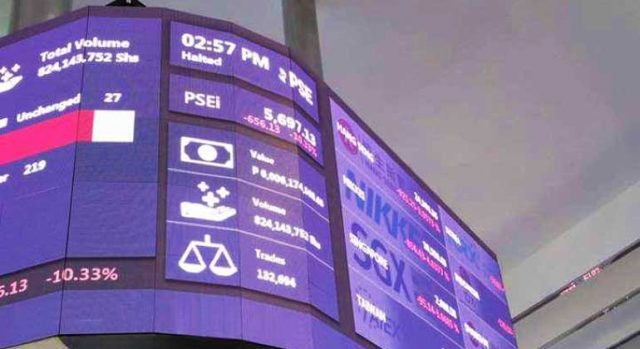
PHILIPPINE shares closed higher on Wednesday on the House of Representatives’ approval of a third stimulus package amounting to more than P400 billion to help boost the economy amid the coronavirus pandemic.
The bellwether Philippine Stock Exchange index (PSEi) improved 214.26 points or 3.23% to end at 6,841.69 on Wednesday, while broader all shares index rose 94.68 points or 2.35% to close at 4,117.98.
Philstocks Financial, Inc. Research Associate Claire T. Alviar said in a mobile phone message that the market improved due to positive investor sentiment on the approval of House Bill No. 9411 or the Bayanihan to Arise as One Act on third and final reading.
Ms. Alviar added that the decision of the government to keep Metro Manila and its nearby provinces of Bulacan, Cavite, Laguna, and Rizal under general community quarantine also affected sentiment.
AAA Southeast Equities, Inc. Research Head Christopher John Mangun said in an e-mail that the market closed in positive territory on the slight improvement in the country’s Manufacturing Purchasing Managers’ Index (PMI).
IHS Markit said on Tuesday that the country’s manufacturing PMI reached 49.9 in May, a slight uptick from 49 in April but still below the 50 neutral mark that delineates contraction from expansion.
“We expected more downside as inventors were taking profits from last week’s rally, which was what we have been seeing in the last few trading days,” Mr. Mangun said.
“The lack of selling pressure in [Wednesday]’s session was a clear sign that most investors were willing to hold on longer instead of locking in their profits. This drew buyers back into the market which ultimately pushed prices a lot higher,” he added.
All sectoral indices closed higher on Wednesday. Property went up 144.35 points or 4.4% to 3,420.50; holding firms increased by 238.62 points or 3.58% to 6,887.42; industrials climbed 225.10 points or 2.54% to 9,087.78; services gained 35.15 points or 2.36% to 1,521.69; financials inched up by 12.93 points or 0.9% to 1,447.33; and mining and oil rose by 74.86 points or 0.81% to end at 9,320.12.
Advancers beat decliners, 153 against 52, while 49 names ended unchanged.
Value turnover on Wednesday reached P9.51 billion with 1.90 billion issues switching hands, down from the P14.78 billion with 4.08 billion issues logged in the previous trading day.
Net foreign buying rose to P1.82 billion on Wednesday from the P341.37 million recorded on Tuesday.
“The rally is starting to look like what we saw back in October and if continues like this, we are going to see substantially higher valuations in the short-term,” Mr. Mangun said.
“The sentiment is improving as hopes for economic recovery are rising, thus, we expect further upside but only up to 6,900 or the market’s resistance level,” Philstocks Financial’s Ms. Alviar added. — Revin Mikhael D. Ochave
9M COVID-19 vaccines to arrive this month

THE PHILIPPINES will take delivery this month of about nine million doses of coronavirus vaccines, according to the country’s vaccine czar, as the government struggles to reach its vaccination targets.
About 4.5 million doses of CoronaVac, made by China’s Sinovac Biotech Ltd., are expected to arrive this month, vaccine czar Carlito G. Galvez, Jr. told ABS-CBN News on Wednesday. He added that 2.2 million doses of the vaccine made by Pfizer, Inc. and two million doses from AstraZeneca Plc are also coming in.
Several hundreds thousands of vaccine doses made by Moderna, Inc. and Russia’s Gamaleya National Research Center of Epidemiology and Microbiology are also due this month, he said.
Mr. Galvez said a number of economic frontliners would get vaccinated against the coronavirus once the shots from SinoVac and Pfizer arrive. The Pfizer vaccines were obtained under a global initiative for equal access.
“More or less, we will have five million doses this coming mid-June,” he said.
The government earlier said the vaccination of the country’s workforce would start in the capital region and other areas experiencing a fresh surge in infections, such as Metro Cebu, Metro Davao, Pampanga, Bulacan, Cavite, Laguna, Rizal and Batangas.
Teodoro J. Herbosa, a special adviser to the government’s pandemic task force, told a televised news briefing the vaccination of 28 million workers under the fourth priority group would probably extend until November.
DAILY TALLY
The Department of Health (DoH) reported 5,257 coronavirus infections on Wednesday, bringing the total to 1.24 million.
The death toll rose by 146 to 21,158, while recoveries increased by 6,266 to 1.17 million, it said in a bulletin.
There were 52,132 active cases, 1.5% of which were critical, 93.1% were mild, 2.3% did not show symptoms, 1.9% were severe and 1.32% were moderate.
It said eight duplicates had been removed from the tally, six of which were tagged as recoveries. Eighty-six recoveries were reclassified as deaths. Three laboratories failed to submit data on May 31, the agency said.
About 12.6 million Filipinos have been tested for the coronavirus as of May 31, according to DoH’s tracker website.
The coronavirus has sickened about 171.9 million and killed 3.6 million people worldwide, according to the Worldometers website, citing various sources including data from the World Health Organization.
About 154.4 million people have recovered, it said.
The Philippines took delivery of about 50,000 more doses of Sputnik V made by Gamaleya on Sunday night.
The vaccines would be given out in areas experiencing a fresh surge in infections, presidential spokesman Herminio L. Roque, Jr. said on Monday. The government has received 80,000 Sputnik V doses from Russia, he said.
The government had also taken delivery of about 193,000 doses of the Pfizer vaccine. Thousands of Filipinos flocked to vaccination sites in Manila, the capital and a nearby city last month to get the Pfizer shot, which many Filipinos supposedly prefer.
President Rodrigo R. Duterte earlier ordered health authorities to give the Pfizer vaccines to indigent Filipinos. He also barred local governments from announcing available vaccine brands to avoid crowding at vaccination sites.
Mr. Galvez has said the country’s vaccine portfolio would include vaccines made by AstraZeneca, Moderna and Gamaleya.
His deputy Vivencio B. Dizon said the government seeks to vaccinate as many as five million Filipinos this month.
Mr. Galvez earlier said more than five million Filipinos have received their first dose.
Meanwhile, Mr. Roque said the World Health Organization’s approval of CoronaVac for emergency use would boost vaccine confidence in the Philippines.
“Another institution has said the Sinovac vaccine, of which we have a lot in the Philippines, is safe and effective,” he told state television PTV4 in Filipino.
The World Health Organization validated CoronaVac for emergency use after reviewing the latest clinical data on the vaccine’s safety as well as the company’s manufacturing practice.
“Vaccine efficacy results showed that the vaccine prevented symptomatic disease in 51% of those vaccinated and prevented severe COVID-19 and hospitalization in 100% of the studied population,” it said in a statement.
The WHO said a vaccine must be included in its emergency use listing to be eligible for the global vaccine sharing program and international procurement. It also allows countries to expedite their own approval to import the vaccine.
The inactivated vaccine has “easy storage requirements” which makes it very manageable and particularly suitable for low-resource settings, the WHO said.
CoronaVac, the first vaccine to arrive in the country, was approved for emergency use by Philippine drug regulators in February.
Local health authorities initially did not recommend CoronaVac for health workers at risk of exposure to the coronavirus and seniors due to efficacy issues.
The Chinese shot’s efficacy rate is 65% to 91% for people aged 18 to 59, according to the evaluation made by the local drug regulator. It is 50.4% and 51% effective for health workers and seniors, respectively.
Filipinos preferred CoronaVac over other vaccines, according to a poll by the Social Weather Stations. It was most preferred in the southern and central parts of the country, it said.
About five million doses of CoronaVac have arrived in the country. — Kyle Aristophere T. Atienza and Vann Marlo M. Villegas
House OK’s measure that seeks to regulate parking fees, standards

THE HOUSE of Representatives on Tuesday unanimously approved on third and final reading a bill that seeks to regulate parking fees and standards.
The measure, passed by 253 congressmen who mostly voted online, will regulate parking rates while still giving parking operators a fair return on their investments, lawmakers said.
The bill also sets standards for all government-owned and privately owned covered and open area parking establishments.
The proposed law will apply to all types of vehicles as well as bicycles and motorcycles.
“I am glad that the bill is one step closer to becoming a law despite some misgivings of the owners of retail and commercial establishments and independent parking operators,” Deputy Speaker for Trade Weslie T. Gatchalian said in a statement on Wednesday.
Under the measure, confined and out-patients may use hospital parking facilities for free. Visitors will be charged P20 per hour.
The bill also proposes free parking for customers in hotels, motels, hostels, inns and resorts, as long as they can present proof of their transactions. Non-customers will be charged P20 per hour.
Parking fees at restaurants will be free for the first two hours for customers, who will then be charged P20 per hour for the succeeding hours. Non-customers will also be charged P20 per hour. Parking at malls, supermarkets and other retail shops will be free for customers for the first two hours as long as they can present proof transactions worth at least P1,000. Non-customers will be charged P20 an hour and as much as P100 a day.
Meanwhile, open parking areas may charge P30 for the first three hours and P20 per succeeding hour, while multilevel parking enterprises may charge P40 for the first three hours and P20 per succeeding hour. The rates for both parking spaces must not exceed P100 a day.
Street parking will be charged P50 per hour, while overnight parking and lost parking ticket fees must not exceed P150 per vehicle.
The bill will also order parking businesses to observe safety standards by installing CCTV cameras and employing security guards. — Bianca Angelica D. Añago
Drug war records have no security aspect — opposition lawmaker
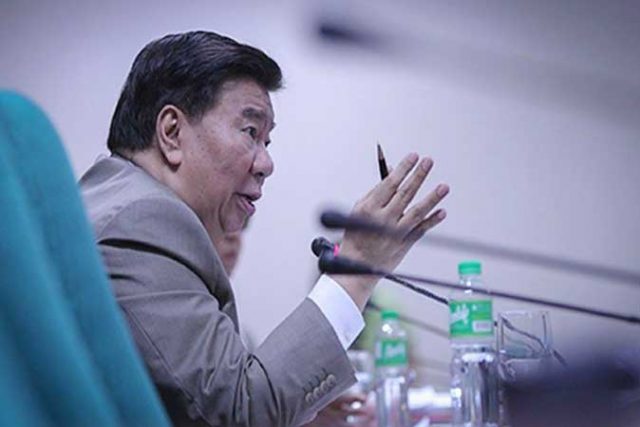
RECORDS of President Rodrigo R. Duterte’s deadly war on drugs do not have national security implications, a senator said on Wednesday, citing a Supreme Court ruling in 2018.
“In the words of the Supreme Court, drug war records ‘do not obviously involve state secrets affecting national security,’” Senator Franklin M. Drilon said in a statement.
“That is, plain and simple, a police blotter,” he said. “This is public record and people have the right to know the truth,” he added in Filipino.
Mr. Drilon said police are “walking on a thin line between following the high court’s order or keeping the records under wraps.” “But they must abide by the court ruling.”
The Supreme Court ruling said drug war records “do not involve rebellion, invasion, terrorism, espionage, infringement of our sovereignty or sovereign rights by foreign powers, or any military, diplomatic or state secret involving national security.”
“To claim that it involves national security is unfounded,” Mr. Drilon said. “By any stretch of imagination, I could not think how a single poorest of the poor Filipino, who was killed in an anti-narcotic operation, planned to overthrow the government.”
The Philippines won’t give full access to records on its deadly war on drugs and anti-insurgency drive, Mr. Duterte said on Monday night, citing national security concerns.
The Philippine National Police (PNP) on May 25 said it would let the Department of Justice, which is leading a probe of drug-related deaths, access the records of 61 investigations against policemen in anti-drug operations.
A human rights group has said these make up less than 1% of more than 7,800 drug-related deaths.
National police chief Guillermo Lorenzo T. Eleazar on Monday said the PNP would soon turn over 53 out of 7,884 cases of extrajudicial killings, including those involving policemen, after the cases are authenticated. — Vann Marlo M. Villegas
DoST proposes P2-B budget to establish virology institute

THE DEPARTMENT of Science and Technology (DoST) has proposed a P2-billion budget for the establishment of the proposed Virology Institute of the Philippines, which will conduct research and development on diagnostics, vaccines, and therapeutics.
In a meeting of the House of Representatives health committee on Wednesday, DoST Industrial Technology Development Institute Director Annabelle V. Briones said the budget will cover about P156 million for personnel services, P824 million for maintenance and operation, and P1 billion for equipment and construction.
The committee approved the proposal, contained in House Bill 9559, on second reading.
In the same meeting, Philippine Society of Allergy, Asthma and Immunology’s Michelle Joy B. De Vera announced that they will be conducting a study to evaluate the effectiveness and benefits of combining different anti-coronavirus vaccine brands.
The study will be conducted for 18 months, or from June 2021 to Nov. 2022, with an approved budget of P133.4 million.
Ms. De Vera said the results of the study will help the government “address vaccine supply shortages…(and) offer flexibility in the administration of the second dose of vaccines.”
The University of the Philippines Manila will also conduct a parallel research to evaluate the safety of combining different coronavirus disease 2019 (COVID-19) vaccine brands. — Bianca Angelica D. Añago
Tourism department resumes COVID-19 testing subsidy for local travel
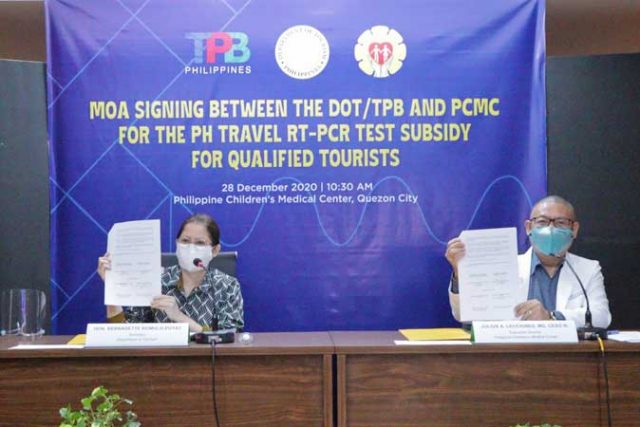
THE DEPARTMENT of Tourism announced Wednesday that it is resuming the subsidy program for coronavirus testing for domestic leisure trips after travel restrictions were lifted between the NCR-Plus and areas under a modified general quarantine level.
Residents of NCR-Plus (National Capital Region), composed of the capital Metro Manila and nearby provinces, are now allowed to go on a point-to-point trip to destinations under modified general community quarantine.
A negative Reverse Transcription Polymerase Chain Reaction or RT-PCR test result is required for travel to most local destinations.
Tourism Secretary Bernadette Romulo-Puyat in a statement said the subsidy will help boost tourism spending. “The subsidy aims to encourage domestic travel by aiding the tourists in fulfilling the RT-PCR test requirement, and to enable them to visit their destination of choice at a lesser cost,” Ms. Puyat said.
A P35.17-million budget under the Tourism Promotions Board has been allocated for the subsidies this year.
Subsidized tests are available at the University of the Philippines-Philippine General Hospital (UP-PGH) in Manila and the Philippine Children’s Medical Center (PCMC) in Quezon City.
The Tourism department said while the current partnerships with the two testing laboratories runs from January to June, the board plans to ink a new agreement with the PCMC to extend the program to December.
Tourism revenues last year dropped 83% to P81.4 billion after pandemic-related restrictions prompted a significant decline in foreign visitors. — Jenina P. Ibañez
Energy department says ensuring backup sources to protect vaccines

THE ENERGY department on Wednesday said it is already monitoring whether distribution utilities are ensuring reliable and stable supply of energy in cold storage facilities for coronavirus vaccines.
Energy Undersecretary Felix William B. Fuentebella told a televised news briefing that the agency is also making sure that power distributors have placed diesel generators in areas where vaccine warehouses are located.
“We are looking at the distribution utilities, if they are giving focus and protecting the vaccines,” he said in mixed English and Filipino.
Philippine pandemic officials earlier said no coronavirus vaccines were spoiled during the rotational brownouts in several parts of Luzon that started Monday.
National pandemic plan deputy chief implementer Vivencio B. Dizon on Tuesday said vaccines were stored in warehouses that have backup power. He added that local governments were required to have power generators before they were authorized to store vaccines.
Vaccine czar Carlito G. Galvez, Jr. has said the country was prepared for potential storage problems as simultaneous drills were conducted before vaccines arrived in the country.
The National Electrification Administration has already asked electric cooperatives to ensure power supply in vaccine warehouses.
The Energy department earlier told a Senate committee that there would be no power interruptions during the rollout of coronavirus vaccines. — Kyle Aristophere T. Atienza
Local governments required to set up holding areas for arrested health protocol violators
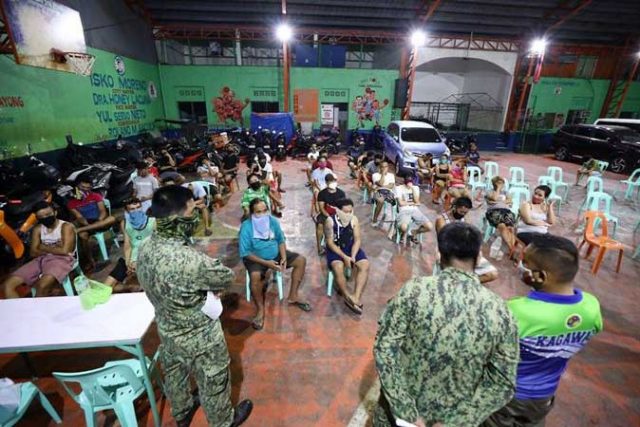
LOCAL government units are now required to set up holding areas for arrested violators of health protocols, based on the new guidelines jointly released by three agencies.
The guidelines, mainly a compilation of existing rules on pandemic-related arrests, was released Tuesday night by the Department of Justice (DoJ), Department of the Interior and Local Government (DILG), and the Philippine National Police (PNP).
The local government-designated holding area is intended to separate health and safety standard violators from jail detainees to avoid overcrowding and the possible transmission of coronavirus disease 2019 (COVID-19), DILG Secretary Eduardo M. Año said in a press conference Tuesday.
For the DoJ clause in the guidelines, prosecutors are allowed to conduct inquest proceedings physically or online, and must finish inquests “on the same day of the endorsement of the case” to ensure that violators are not held up for an extended period.
If additional evidence is needed, prosecutors are instructed to first release the detainee pending further investigation.
The DILG reported 125,587 violators of minimum public health standards who were arrested from May 17 to 30.
Of the total, 95,357 were apprehended for improperly wearing face masks, 1,697 for mass gathering violations, and 28,533 were caught violating physical distancing rules. — Bianca Angelica D. Añago
Storm Dante leaves at least 3 dead as it veers west over Luzon mainland
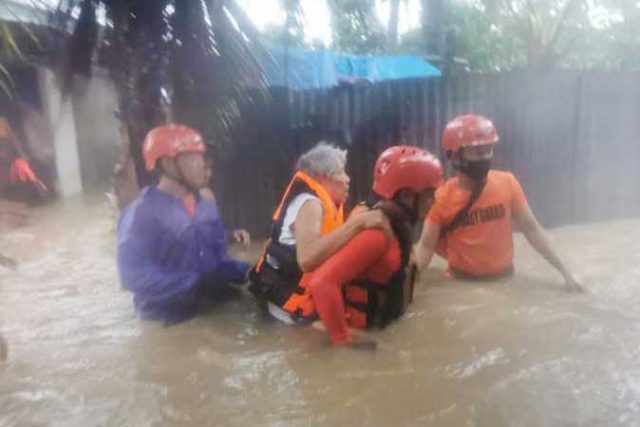

THREE people were reported dead while one was missing as tropical storm Dante struck several parts in the southern and central parts of the country, according to the national disaster council.
Of the deaths, two were recorded in Davao Region while the other one was reported in the Soccsksargen Region, both in Mindanao, the National Disaster Risk Reduction and Management Council (NDRRMC) said in its report on Wednesday.
Two people were injured in Davao while one was reported missing in Soccsksargen, it said.
The casualties were mainly due to flashfloods and landslides following heavy rains dumped by Dante, with international name Choi-wan.
As of morning of June 2, there were 566 households affected, including 160 families who were still in evacuation centers.
NDRRMC said the typhoon left at least P8 million worth of agricultural damage.
Palace spokesman Herminio L. Roque, Jr., said the NDRRMC has already issued necessary warnings and reminders to local governments as Dante approached the eastern coast of Mindoro as of Wednesday.
“We continue to monitor tropical storm Dante as it moves northwestward towards the southwestern portion of Batangas, northeastern portion of Oriental Mindoro,” Mr. Roque said, citing the weather bureau.
He said the Social Welfare department has “standby funds amounting to P1.105-B, including P113-M worth of 222,382 family food packs.”
“Clearing operations to severely affected areas have likewise been conducted,” Mr. Roque said.
As of 4 p.m. Wednesday, the storm was located over the coastal waters of Calapan, Oriental Mindoro with maximum sustained winds of 65 kilometers per hour (kms/h) near the center and gustiness of up to 90 kms/h, weather bureau PAGASA said.
The typhoon, the fourth to enter the Philippine area this year, made six landfalls as it veered northwest over mainland Luzon. It was expected to make a 7th landfall over Bataan Wednesday night.
PAGASA forecasts Dante to weaken into a tropical depression by Wednesday night or Thursday morning as it heads over the West Philippine Sea. — Kyle Aristophere T. Atienza
Maynilad installs solar power farm at La Mesa pumping station
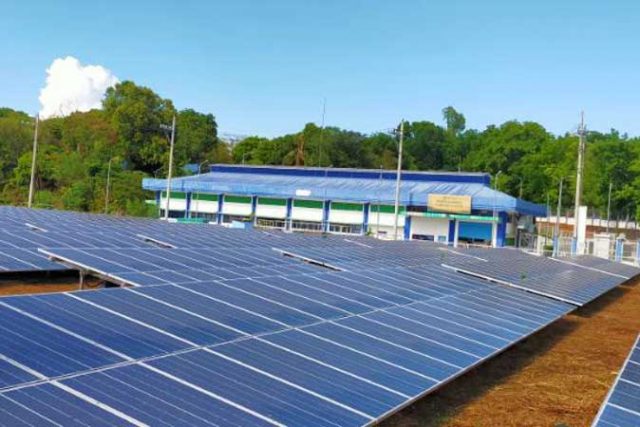
MAYNILAD Water Services, Inc. recently launched its new 1-megawatt solar power farm located inside the La Mesa Compound in Quezon City.
The west zone water provider said in a statement on Wednesday that the P100-million green energy source, which spans 8,250 square meters, is designed for optimal use for at least 40 years.
Maynilad said the solar farm is estimated to generate 10% in terms of yearly cost savings on the electricity consumption of the pumping station, which is operating 24/7.
“We operate a lot of facilities to ensure non-stop delivery of water and wastewater services. This new solar farm provides a renewable energy source that will enable us to generate energy savings and also decrease our greenhouse gas emissions,” Maynilad President and Chief Executive Officer Ramoncito S. Fernandez said.
Maynilad provides water to areas in the west zone of the National Capital Region as well as parts of Cavite province including Bacoor, Imus, Kawit, Noveleta, and Rosario.
Metro Pacific Investments Corp., which has a majority stake in Maynilad, is one of three Philippine units of Hong Kong-based First Pacific Co. Ltd., the others being Philex Mining Corp. and PLDT, Inc.
Hastings Holdings, Inc., a unit of PLDT Beneficial Trust Fund subsidiary MediaQuest Holdings, Inc., has an interest in BusinessWorld through the Philippine Star Group, which it controls. — Revin Mikhael D. Ochave