Home Blog Page 7555

Teaching children about basic pet welfare

PETS are considered members of the family, playmates for the kids, and, often, their best friends. For children stuck indoors — thanks to the continuing pandemic — pets can be good companions outside their time in front of laptop and tablet screens.

“Owning a household pet is associated with fewer social emotional problems in young children” and “positive child social outcomes” according to a study published in the Journal of Pediatrics (February 2020) on the association of pet ownership with peer problems and emotional symptoms, and better prosocial behavior. “Positive child social outcomes” included relationships with peers and the ability to form friendships and be well liked which was evident among children without siblings. (https://www.jpeds.com/article/S0022-3476(20)30025-1/pdf).

Mars Petcare Philippines, a pet care services provider and pet food maker, teamed up with the Animal Kingdom Foundation, Inc. (AKF), an animal welfare organization, on an online pet education program called “Peptalk” which is aimed at students aged six to 12.  It is part of an initiative launched by “Better Cities for Pets” with an aim to create pet-friendly communities for all dogs and cats.

ON PETS AND CHILDREN
“There are lots of benefits when you introduce pet ownership in very young children. At the very early stage, they learned how to care for animals and then also their environment,” Dr. Saza Curaming, Mars Pet Nutrition Technical Adviser told BusinessWorld in an interview via Zoom in August.

“Children who are exposed to taking care of pets at a very young age understand the concept of responsibility and then they also learn empathy, which is very important nowadays,” she added.

Ms. Curaming pointed to the 3-3-3 Rule in pet acquisition (three days, three weeks, and three months which is specifically for dogs) which is meant to give pets time to adjust to their new environment. It is important, she explained, to allot the first three days after bringing a pet home to the pet’s “become comfortable in their new surroundings,” three weeks “to adapt to the new home or new environment,” and three months “to build a relationship with the members of the family.”

Ms. Curaming said that parents may introduce children to pets as young as age six.

PET CARE EDUCATION
For the project’s pilot session, the first Peptalk session on June 18 involved 300 students from Buting Elementary School in Pasig City. The session included kid-friendly discussions on animal welfare, the five basic freedoms of pets, how to keep dogs and cats safe from rabies, pet nutrition, and exercise. The students also had an opportunity to introduce their pets via a virtual show and tell.

In the same Zoom interview, AKF Program Director Heidi Marquez said that the partnership with Mars Petcare was a way to continue their organization’s Pet Education Program which was postponed due to pandemic restrictions.

“Since we cannot go to the barangay or the local government units, the school is the best forum to educate the children,” Ms. Marquez said.

The children’s modules teach basic animal welfare concepts like dog bite prevention, pet care and nutrition.

“We would love them to showcase their pets and their share their experiences. It’s more challenging online with the kids because they are all very excited, and it’s part of the fun,” Ms. Marquez said of the experience. “We relate that to their practical experiences at home.”

The pet education program is also offered to companies. This program is focused on animal welfare with respect to the law, the environment, and the relationship of animal welfare with the environment.

“We [provide] more details [on] responsible pet ownership, and, of course, liability in in case of neglect. There are topics like emotional support and topics like how to respond to emergencies and how to respond to complaints about animal cruelty,” Ms. Marquez said of the program’s broader topics.

Aside from its education programs, AKF also spearheads Project SNAP (Spay, Neuter, and Adopt Program) and the We Feed As One project, which was initiated during the lockdown to feed stray cats and dogs and supply animal food to struggling shelters.

As for the online series with schools, Ms. Curaming said, “We would like to have hopefully to have more Peptalks in Metro Manila moving forward.”

For inquires and more information, visit https://www.bettercitiesforpets.com/ and http://akf.org.ph/ or https://www.facebook.com/AKFanimalrescue/. — Michelle Anne P. Soliman

Metro Pacific Hospitals aids in expansion of Bohol private hospital

METRO Pacific Hospital Holdings, Inc. (MPHHI) has partnered with the Ramiro family-owned private hospital in Bohol to further expand and improve its facilities.

“Together, we will work towards fast-tracking the completion of its ongoing expansion and renovation projects, and upgrading its lineup of medical equipment, to propel Ramiro Community Hospital (RCH) to a stronger multi-specialty tertiary hospital to serve the growing population of Tagbilaran and its adjacent municipalities,” MPHHI Chairman Manuel V. Pangilinan said.

Through the partnership, RCH recently launched its expanded 20-seat Dialysis Center and Business Office. The Ramiro family and MPHHI entered a partnership just before lockdown restrictions were implemented in the country in March last year.

“This is just the start of other improvements we are doing to our hospital, to include expanding the Critical Care Complex, equipping the OR / DR Complex, upgrading its medical equipment and renovating other services to complete the facilities for the growing needs of our community,” the Ramiro children said in an e-mailed statement on Sunday.

RCH is a 118-bed Level 2 hospital in Tagbilaran City in Bohol. It was founded by family patriarch Dr. Luther Z. Ramiro in 1975, which was then a 10-bed facility.

Dr. Ramiro first served as a resident surgeon in Graham Memorial Hospital, before joining Bohol Medical Center in 1960. He eventually led Bohol Medical Center in 1971, with the help of his wife Dinah Lumain-Ramiro who was then the hospital administrator.

The couple launched their own family hospital four years later after being pressed by their patients.

MPPHI said RCH is the 17th hospital in its 18-hospital portfolio across the country, with eight in Metro Manila, four more in Luzon, two in the Visayas including RCH, and four in Mindanao. The Pangilinan-led company also has two healthcare colleges, six cancer care radiotherapy centers, and one central laboratory. — Keren Concepcion G. Valmonte

Corn industry roadmap expected this month

PHILSTAR

THE CORN industry development roadmap is expected to be completed this month, with the industry’s critical role in providing feed for farm animals to be the focus, the Department of Agriculture (DA) said.

Agriculture Assistant Secretary Liza G. Battad said the plan is still subject to further consultations.

“We hope it will be completed and approved on or before the end of September 2021,” she said, adding that the consultations are being carried out by the corn industry roadmap development team, which is composed of technical experts from academic institutions as well as members of the industry, including the Philippine Maize Federation, Inc. (PhilMaize), which represents corn farmers’ groups,” Ms. Battad said in a statement over the weekend.

Agriculture Secretary William D. Dar said the development roadmap will also deal with mechanizing farm operations to increase production, and the construction of postharvest facilities to reduce losses.   

 “The corn sector, being a major input to the poultry and swine industries, should be given more importance and (subject to long-term planning) to ensure its sustained contribution to the meat value chain and, in general, to the Philippine food systems,” Mr. Dar said.

The ultimate targets are “increased average yield per hectare, and cost-efficiencies in the corn-feed-meat value chain, making it more competitive,” he added.   

Milo D. Delos Reyes, DA corn program director, said the basis for the revised roadmap will be the current regulatory framework for the corn industry and previous government initiatives.

“One of the key features that will be considered in the new roadmap will be the need for the private sector, like seed producers, feed millers, and commercial feed manufacturers to engage in more joint ventures or direct marketing linkages with organized corn farmers’ cooperatives and associations,” Mr. Delos Reyes said.

Mr. Delos Reyes said the DA will focus on improving the output of major corn-producing areas such as the Cagayan Valley region, Northern Mindanao region, and Soccsksargen (South Cotabato, Cotabato, Sultan Kudarat, Sarangani, and General Santos), and providing postharvest facilities to clustered farms.   

“The consultations with the private sector, corn farmers and processors, other industry stakeholders, and consumers is undertaken to craft an industry roadmap over the short-term (2021-2025), medium-term, (2025-2030), and long-term (2030-2040),” Mr. Delos Reyes said.

According to Mr. Delos Reyes, the country’s current national average yield of yellow corn is at 4.18 metric tons per hectare (MT/ha).

However, he said the total average yield will drop to 3.18 MT/ha if combined with white corn, while the average yield of hybrid corn is at least 8 MT/ha. — Revin Mikhael D. Ochave  

A firm purpose for disruptive times

By Adrian Paul B. Conoza, Special Features Assistant Editor

THE CORONAVIRUS DISEASE 2019 (COVID-19) pandemic has brought big disruptions across industries. Priorities had to be changed as much as work modes have. Yet, amid the shifts, purposes and duties have largely remained the same.

This is very true of the media, as its duty to deliver truthful information has become more crucial at these critical times.

While having its own share of changes in covering stories and closing every issue, BusinessWorld remains resilient in its purpose as it continues to help the public — especially the business community — make sense of the daily local and global narratives of the pandemic and the “now normal.”

Wilfredo G. Reyes, BusinessWorld’s editor-in-chief (EIC), noted that the Editorial staff has been primed for disruption as they have worked largely in the field and at times have been in the midst of natural and man-made calamities like floods and coups d’etat.

“That enabled us to just focus on ensuring the safety of back-office and support staff who could not work from home, and that is just a fraction of our total manpower,” Mr. Reyes added.

Cathy Rose A. Garcia, managing editor of BusinessWorld, recalled that the Editorial team made preparations before the quarantines began to ensure that operations will not be affected.

“We implemented a system that would allow editors, reporters, researchers, and other staff to work from home,” Ms. Garcia said in an interview, adding that keeping communication lines always open was ensured to make up for the lack of face-to-face interaction.

“In the past, new reporters would undergo one-month training under Research. Reporters also had more time to talk to their editors to discuss the story and how it was edited,” the managing editor also shared. “Since this was now impossible, we implemented online training modules for the new hires. We also had online briefings to prepare them for the tasks at hand.”

While there were inevitable growing pains, she observed, everyone was quick to adapt to the new system.

“I’m particularly grateful to the staff who continued to go to the office despite the challenges. Our operations will not run as smoothly without the people at the office,” Ms. Garcia added.

While many in the team have already been doing work remotely before the pandemic, the past months have seen more shifting to work-from-home (WFH). Alicia A. Herrera, one of BusinessWorld’s associate editors, noted such move.

“Editors are now working from home, which has been a major change for some of us who used to lay out our own pages, as has been the BWorld tradition from the start,” Ms. Herrera shared. “Now the layout artist does the layout, sending us PDF copies to check and approve.”

“It is difficult for me to have less control over my pages. I used to do my own layout, and now I rely on the work of the layout artist,” she added. “So, the adjustment was relaxing and ceding control to someone else.”

Joy D. Dagun, an art director of BusinessWorld, also observed the shift in the process. “Unlike the pre-pandemic days, communication is done by telephone, and file exchange is via the office local area network. Also, we have to stay in the office over time if it is required,” Ms. Dagun said.

The art director, who is hands-on in laying out the paper’s Special Features and Velocity sections, also noted that ready-to-print files are now sent to the printing plant coordinator, instead of submitting raw files to proofreaders, who then submit the proofread files to the printing coordinator.

ONE MAJOR CHALLENGE
Even with its perceived conveniences, remote work has been the main challenge for the staff who close BusinessWorld’s pages.

For Bettina Faye V. Roc, also an associate editor of the paper, the main adjustment she had to make is ensuring efficiency.

“That included finding a suitable daily work station and making sure my internet connection has a backup,” Ms. Roc said. “It was also important to establish a routine, since working from home also means more distractions. For me, I mainly stuck to how I went about my work days pre-pandemic, minus the commute to the office.”

Communicating with colleagues, in particular, has become quite complex.

“Issues that used to be resolved by simply walking to someone’s desk for a conversation that lasted less than a minute now entail a multitude of messages via e-mail or text or one of the messaging apps,” Ms. Herrera shared. “Again, I have had to develop more patience — and cut down on my coffee — to manage these.”

What appeared to be an experiment among workplaces before the pandemic is now becoming a fixed practice. Yet, before it became a trend at present, BusinessWorld has somehow pioneered telecommuting at the turn of the century, as the paper’s Mindanao Bureau Chief, Marifi S. Jara, shared.

“In the years just before 2000, there were already WFH editors and in the early 2000’s, BusinessWorld Online’s Mobile Media Project deployed teams around the Philippines to survey the country’s internet readiness by testing where and how it was possible to deliver stories and photos online, ideally in real time,” she recalled.

While the work-from-home veteran hardly had to make adjustments since the pandemic, Ms. Jara noted that the challenge was on the part of reporters, especially the new ones who could not physically go to their beats, personally interact with sources, and get an overall vibe of what they are covering.

“For editors, this meant more hand-holding was needed, and mentoring is not always a smooth ride,” she said. “For the older reporters, connectivity was and is not always easy, and it can be very stressful given the daily deadline that is part of the job.”

CHANGES IN COVERAGE
Among reporters, covering stories have definitely shifted further into online.

Arjay L. Balinbin, a senior reporter of BusinessWorld, shared that it has become challenging figuring out how to get a full picture of reality beyond phone or Zoom interviews and documents or data.

“Covering events physically offers details you can’t get from online press briefings or phone interviews. You can’t see how politicians’ hands move or shake when they talk, or how press relations officers guide their bosses when answering sensitive questions. You don’t get a complete sense of their paralanguage, which is important when detecting lies and deceptions,” Mr. Balinbin shared.

For Michael Angelo S. Murillo, BusinessWorld’s senior reporter covering sports, nothing beats being at game venues. “Being at the moment as things, even history, unfold and being able to talk to your sources face-to-face — I prefer that kind of dynamics, and I miss those things,” he said.

Given the limitations in covering sporting events due to COVID-19, different ways to find stories must be sought. “These days, social media platforms are very important to get leads for stories apart from, of course, your regular sources,” Mr. Murillo said.

Jenina P. Ibañez, meanwhile, finds that as coverages have gone online reporters have to exert more effort in reaching sources.

“We don’t bump into potential sources at events now, so we definitely have to be more active in reaching out to people,” BusinessWorld’s trade and foreign investment reporter said.

OPPORTUNITIES
In spite of the challenges, opportunities have emerged.

For Associate Editor Timothy Roy C. Medina, the crisis opened an opportunity to educate reporters about the history of economic crises, as well as gear them up for what to expect when the economy rebounds, through monthly webinars.

“I was determined to make sure that the writing staff was well-briefed on topics like the stimulus, the vaccine rollout, social policy and vaccination, booms, busts and bubbles, and industries that have been badly affected by the crisis,” Mr. Medina shared.

Moreover, the past months have further opened the opportunity for reporters to transcend from putting stories to print and get involved in BusinessWorld’s digital platforms.

“I’m proud that I belong to a news organization that’s agile and innovative. When change is necessary and the organization is actively working on it, there is no reason not to support it,” Mr. Balinbin, who has moderated several BusinessWorld Insights fora and Economic Forum sessions, shared.

“I’m used to facilitating discussions because I’m an educator by profession; but speaking before an audience I can’t see when I’m on screen was hard to imagine,” he continued. “I gave it a shot anyway, and it just felt like I was in a classroom again. It’s fascinating to see how some untapped skills can be put to use on a new task.”

Ms. Ibañez, meanwhile, enjoys getting to talk to sources in a more in-depth manner through BusinessWorld’s online fora and the B-Side podcast. “It’s a chance to ask them to explain in more detail or tell stories to concretize what they’re talking about,” she said.

Mr. Murillo, meanwhile, is among the first reporters to be a part of the B-Side podcast when it has just launched before the pandemic.

“I consider myself ‘old school’, not technology-inclined in large part, so you could just imagine my apprehension at the start in doing podcasts. But, again, you psych yourself in doing things like that considering the prevailing conditions with the pandemic,” he shared, adding that he sees the platform’s value as another channel to communicate stories now and moving forward.

PURPOSE-DRIVEN
In spite of the current challenges, BusinessWorld continues to excel in economic journalism as its people continue to be driven by the values it upholds, as well as the purpose it has been fulfilling since its first issue 34 years ago.

Mr. Balinbin, who has been with BusinessWorld for four years, regards it as another privilege to cover stories for a well-trusted newspaper that is read by policy makers who make decisions, businessmen who fuel industries, and academics who shape minds.

“I am inspired by the fact that in some ways we make an impact, especially in this time of crisis, by helping our readers make informed decisions,” he said.

Mr. Murillo, now with the paper for more than two decades, remains eager to do his share as a sportswriter in a media company that continues to evolve amid disruptions.

“I’ve seen it evolve and hurdle many challenges throughout the years. What we have now is another one, albeit this one with the pandemic is unprecedented. But I’m confident that the company can survive this and forge ahead,” he said.

Noting the purpose the paper continues to fulfill, Misses Dagun and Herrera noted the particular roles they still fulfill.

BusinessWorld has been a big part of my career life. This has been my longest stay in a company,” Ms. Dagun said. “Though there are struggles, as many others are facing nowadays, staying is one way of giving back to the company that helped me improved my craft.”

“[I]t is the feeling of being useful through all this,” Ms. Herrera shared. “In the midst of an incredible explosion of what some people insist on calling ‘fake news’… I find satisfaction in that I am working in an organization that counters the lies with the truth, with news, with facts that are, hopefully, helpful to our readers as they try to understand the world we are in right now.”

Besides, at BusinessWorld’s core is its firm belief that “A Newspaper is A Public Trust.”

“In today’s media environment, there’s news 24/7 from Twitter, Facebook, websites, and other social media channels. There is still a need for objective, contextualized, and deep business reporting, and that’s where BusinessWorld comes in,” Ms. Garcia said.

Mr. Reyes, who has been with the publication for nearly 30 years, pointed out that the paper’s firm belief has served as its guiding principle on responding to specific situations, even trying periods; and so this even makes the job simpler.

“Some people think that is passe and corny. Try lasting in this job without that conviction to hold on to,” the EIC said.


Style (09/06/21)

ABSORBENT SANITARY SHORTS

UNIQLO launching absorbent sanitary shorts

GLOBAL APPAREL retailer UNIQLO will be launching AIRism Absorbent Sanitary Shorts, feminine care innerwear to support women during their menstrual cycle. UNIQLO’s Femcare innerwear line, which includes front-open innerwear and maternity items, has continued to expand and evolve with unique technologies based on customer feedback. AIRism Absorbent Sanitary Shorts will be available at UNIQLO Philippine’s Online Store, uniqlo.com/ph, and the UNIQLO app starting Sept. 27. The liquid-absorbing sanitary shorts feature three-layer construction — a quick-drying and odor control layer that keeps the surface against the skin comfortable, an absorbent layer able to hold up to 30-40 ml of liquid, and a water-resistant layer made of laminated water-repellent fabric. The absorbent layer only covers the crotch area, while the water-resistant layer extends across the back up to the waist, keeping the rear dry while reducing unpleasant stiffness. The use of AIRism fabric in a seamless construction provides comfort; the gusset portion in the crotch has a bonding finish that crimps the fabric to minimize leakage from the seam needle holes. The AIRism Absorbent Sanitary Shorts will be available in sizes S to XL for P990. The UNIQLO Femcare Innerwear line includes the maternity shorts and leggings series which help women stay comfortable from the early to late stages of pregnancy.

Lalique launches new Gaïa 2021 collection

LALIQUE came up with a new 2021 collection with nature as its major source of inspiration. The new Gaïa by Lalique collection is named after the nurturing goddess from Greek mythology, Gaïa. The collection features four colors: amber, fuchsia, black, and gold-stamped crystal. The collection includes the Merles & Raisins design in two sizes of vases and a bowl; the Versailles wine decanter with a design of grapes and vine leaves throughout, crowned with a stopper carved in the same motif; the Mûres (Blackberries) vase of satin-finished crystal, available in fuchsia and black, in limited editions of 188 pieces per color; and, the Merlot glass and wine decanter in a satin finish with a vine motif that adorns the stopper of the decanter. There are also complementary objects in the image of Greyhounds, Kitten (in different colors, with limited editions of 188 pieces per color), and Lions (a limited edition of 12 pieces).

Rustan’s Beauty Addict celebrates its 9th year

MARKING its 9th year, Rustan’s The Beauty Source presents the Rustan’s Beauty Addict Event, which aims to promote beauty as not just about looking good on the outside, but also about thinking good, feeling good, and doing good. The celebration features a series of special online events, which feature inspiring guests who embody the message. On Sept. 10,  Tim Yap hosts a talk with Vanessa Matsunaga-Sunga, a model and entrepreneur; Bella Manzano, a photographer, filmmaker, and entrepreneur; Stephanie Zubiri, editor-in-chief of Tatler Homes Philippines; Elvira “Tootsy” Angara, TV executive and mother of three; and Paolo Valenciano, musician and live events director. The three-part event will be held at 4 p.m., live on Rustan’s The Beauty Source’ Facebook page. It will include a performance from Kiana Valenciano, with games and discussions. On Sept. 15, 5 p.m., watch author and wine enthusiast Stephanie Zubiri will prepare an easy, healthy, and guilt-free recipe while giving tips on how to be beautiful inside and out, while helping others. This will be shown on her Instagram account (@stephaniezubiri) to promote Rustan’s Feel & Do Good campaign. Throughout September, there will be exclusive offers and more as part of Rustan’s Beauty Addict Event 2021. Available only on Sept. 10 are the following specials: Beauty Addict members can get the TALI Cristina Clutch for a minimum purchase of P10,000, and a Viajecito Splashkit Sport Set for a minimum spend of P20,000 at Rustan’s The Beauty Source and through Personal Shopper on Call, plus earn x10 Beauty Addict points on every purchase; from Sept. 1 to Nov. 30, Beauty Addict members can get a Viajecito Splashkit Sport Set for a minimum purchase of P20,000, x5 points on all purchases in all Rustan’s Stores and through our Personal Shopper on Call from Sept. 1-9 and Sept. 11-30; there will be more deals and exclusive offers when shopping at Rustan’s The Beauty Source from Sept. 11-26; the Beauty Addict Raffle promo will run from Sept. 3 to Oct. 31, with every purchase of P2,500 entitling the buyer to one electronic raffle entry with a grand prize of a shopping spree worth P50,000 at Rustan’s The Beauty Source. Promos are applicable in all Rustan’s Stores, Personal Shopper on Call, and online at Rustans.com. For details visit bit.ly/RTBSTranscendDeals. This is in partnership with Metrobank, whose cardholders can enjoy an additional 10% off, on top of all existing promos by using the promo code MBRTBS10 plus the first six digits of their Metrobank card number.

Bragais Footwear steps up global presence

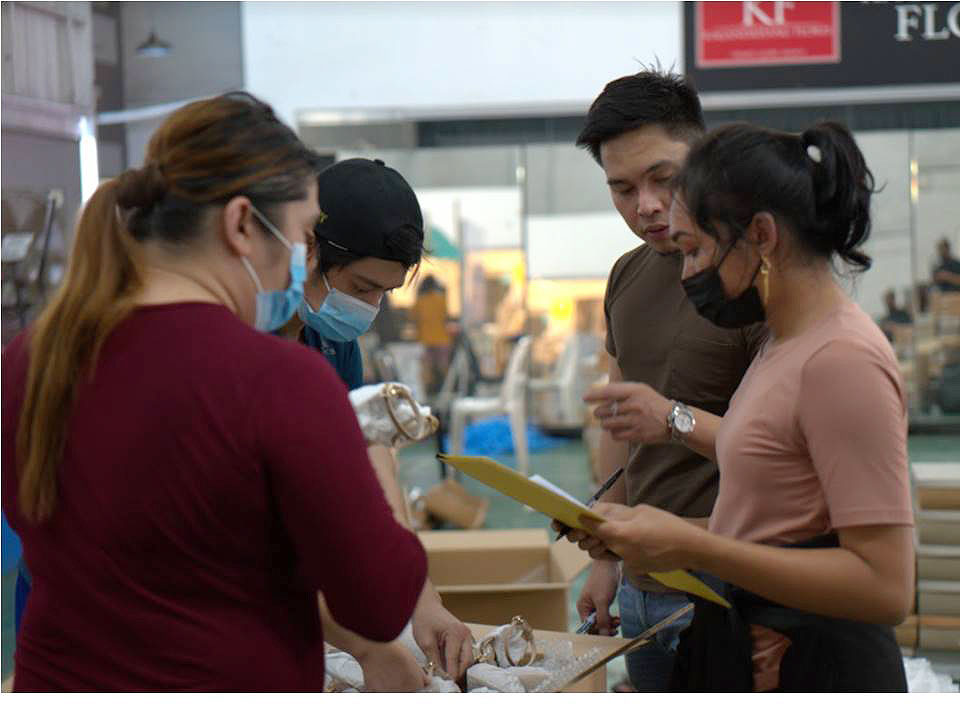
Filipino shoemaker Jojo Bragais chose to work with FedEx Express to deliver his signature pieces to Florida for the recently held 69th Miss Universe pageant. The pageant was an opportunity not only to showcase Filipino talent but also grow the brand and further expand their global market. Locally, the Jojo Bragais brand gained recognition for offering expertly designed shoes that combine style and comfort, which is why many Filipino beauty pageant winners swear by the shoes. According to the designer, “Our pieces should be able to reliably carry the wearer whether on stage, the runway, or when they go out and perform their duties.”  Prior to the pandemic, there were plans of setting up mall-based stores, but he laid these aside since, through an e-commerce platform, he was able to continue showcasing Bragais shoes to an even wider market, counting on FedEx to deliver his signature pieces to customers across the world. For the Miss Universe Pageant, “Together with my team of 60 craftsmen, we had to design and create 300 pairs of shoes all in a span of 10 days. And when it came to shipping the items to Florida, USA, the fast and reliable shipping solutions of FedEx enabled me to meet the tight deadline,” said Mr. Bragais.

Yields on government debt end flat

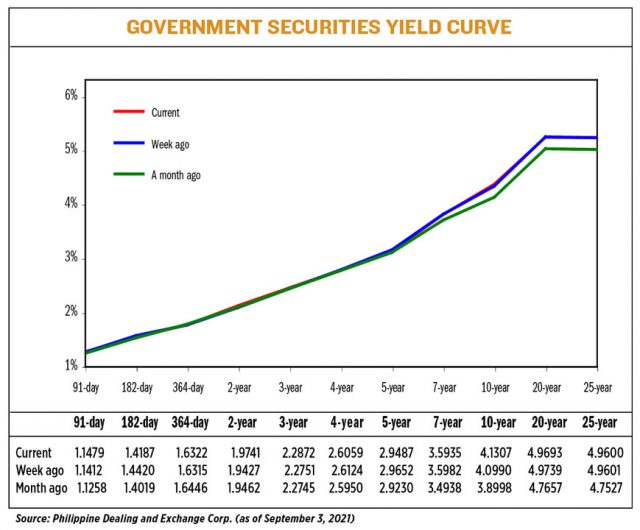
YIELDS ON government securities (GS) ended flat on Friday from their week-ago levels as investors wait for fresh leads.

GS yields inched up by an average of 0.24 basis point (bp) week on week, based on the PHP Bloomberg Valuation (BVAL) Service Reference Rates of Sept. 3 published on the Philippine Dealing System’s website.

Yield movements were mixed at the secondary market. At the short end of the curve, the 91- and 364-day Treasury bills (T-bills) inched up by 0.67 bp and 0.07 bp to yield 1.1479% and 1.6322%, respectively. Meanwhile, the 182-day paper saw its rate fall by 2.33 bps to 1.4187%.

At the belly of the curve, the rates of the two- and three-year Treasury bonds (T-bonds) increased by 3.14 bps to 1.9741% and 1.21 bps to 2.2872%, respectively. Meanwhile, yields on the four-, five-, seven-year papers dipped by 0.65 bp (to 2.6059%), 1.65 bps (2.9487%), and 0.47 bp (3.5935%), respectively.

At the long end of the curve, the 10-year T-bonds climbed 3.17 bps to 4.1307%. On the other hand, yields on the 20- and 25-year T-bonds edged down by 0.46 bp and 0.01 bp to 4.9693% and 4.96%, respectively.

“GS yields increased…after the BSP (Bangko Sentral ng Pilipinas) projected a higher domestic inflation for August 2021 [at] between 4.1% to 4.9%. However, the increase was limited as [US Federal Reserve Jerome H. Powell] failed to provide a clear policy guidance on a potential asset taper plan during his speech in the Jackson Hole meeting,” a bond trader said in an e-mail.

In a separate e-mail, Security Bank Corp. Chief Economist Robert Dan J. Roces  said yields were flat due to a “lack of local catalysts” and some relief on the back of Mr. Powell’s dovish comments. He added that the five-year T-bond auction was “well-received.”

Mr. Powell on Aug. 27 said they are not in a hurry to hike interest rates. He also did not hint on a specific timing for their plan to taper asset purchases, although he said they could start by this year.

Meanwhile, BSP Governor Benjamin E. Diokno last week said inflation likely rose by 4.1%-4.9% in August, exceeding the central bank’s 2-4% target, as prices of food staples and utility rates rose.

Inflation averaged 4.4% in the first seven months. The BSP expects it to average 4.1% this year.

The Philippine Statistics Authority will release August inflation data on Tuesday.

On the other hand, the Bureau of the Treasury on Wednesday raised P35 billion as planned via its offer of reissued five-year T-bonds, which have a remaining life of four years and seven months.

The notes attracted total tenders worth P76.167 billion, more than twice as much as the initial offer and slightly higher than the P75.72 billion in bids recorded when the bond series was last offered on May 6. The reissued five-year bonds fetched an average rate of 2.746%, dropping by 54.9 basis points from the 3.295% logged in the previous auction.

“Local yields might move slightly higher amid likely strong GDP (gross domestic product) growth reports from Japan and the Eurozone,” the bond trader said.

“Domestic yields might also increase from expectations of a higher Philippine inflation report for August 2021. However, the increase in yields might be capped by lingering worries over the global and local COVID-19 (coronavirus disease 2019) situation,“ the trader added.

The Health department logged 20,019 new COVID-19 cases on Sunday for a 27.5% positivity rate. The country’s case tally now stands at over 2.08 million, with 157,438 active infections.

COVID-19 infections in the country crossed the two-million mark after the Health department reported 14,216 more cases on Wednesday. — Lourdes O. Pilar

Rabbit growers hope to thrive amid pork shortage

REUTERS

THE RABBIT meat industry said it is seeing increased demand because of the scarcity and expense of pork products due to the African Swine Fever (ASF) outbreak.

Artemio C. Veneracion, Jr., Association of Rabbit Meat Producers, Inc. president, said in a mobile phone interview with BusinessWorld that acceptance for the alternative meat is growing, adding that Chinese restaurants are the main market.  

“If you are going to compare the acceptance of people years ago from the present, there are already a lot of people eating rabbit. Even in social media, people are selling rabbit meat. Back then, you would get bashed in social media if you post about rabbit meat,” Mr. Veneracion said.

Mr. Veneracion said another potential market is tourism destinations such as Baguio and Boracay.

“I think the industry is ready to supply rabbit meat. Maybe not in big quantities, but I think we can start small and increase the supply as we move forward,” Mr. Veneracion said.

With the economic impact of the coronavirus disease 2019 (COVID-19) pandemic, Mr. Veneracion said people are seeking sources of alternative income.

“Production is quick since it only takes three months to raise a rabbit. It has a huge potential especially with the ASF outbreak in the hog industry,” Mr. Veneracion said.

He said the association currently has 355, with 70 new members added so far this year.

“Some of them (have) no experience, while others came from other industries such as poultry and hog. We have members that currently have a rabbit population of 4,000,” Mr. Veneracion said.

He said Central Luzon accounts for the highest number of rabbit raisers, with Calabarzon (Cavite, Laguna, Batangas, Rizal, and Quezon), Nueva Vizcaya, Pampanga, Cebu, and Zamboanga also well-represented.

According to Mr. Veneracion, the initial investment needed to start production is about P46,000 for 14 female rabbits, known as does, and 2 male rabbits, or bucks.

At such an investment, production is estimated at 30 rabbits per month and profits can range from P8,000 to P14,000 per month, depending on marketing expenses and packaging costs.  

“The current farmgate price of rabbit is P450 per kilogram (/kg), with the production cost at around P310 to P320/kg.,” Mr. Veneracion said.

Mr. Veneracion said he is hoping that the government holds off on importing rabbit meat after the Department of Agriculture (DA) issued a memorandum circular on Aug. 25 laying out guidelines for rabbit imports.

“We are not against importation, per se. We need that eventually. But we are hoping that they hold off on imports first,” Mr. Veneracion said.

“The growing awareness and local acceptance of rabbit meat as an alternative source of protein amid the rising prices of major livestock commodities such as pork and poultry meat have ignited a subsequent increase in sanitary and phytosanitary import clearance requests for meat-type rabbit breeds,” according to the circular.  — Revin Mikhael D. Ochave

Ayala Land edges lower on MSCI rebalancing, lockdown extension

AYALA Land, Inc. (ALI) dipped last week after the rebalancing of the MSCI index and news of extended lockdowns, but analysts say the stock remains attractive to market players.

The property firm was the sixth most actively traded stock last week with a total of 41.17 million shares worth P1.38 billion traded from Aug. 31 to Sept. 3, data from the Philippine Stock Exchange showed.

Week on week, ALI shares inched down by 1.2% to P33.10 apiece on Friday from its Aug. 27 closing price of P33.50. Compared with the first trading day of the year, the stock’s price fell by 21.2%.

“ALI’s share price movement this week was mostly attributable to the MSCI rebalancing which took effect last Sept. 1,” Regina Capital Development Corp. Equity Analyst Anna Corenne M. Agravio said in an e-mail interview.

ALI was among other blue-chip stocks dragged by the rebalancing, which prompted the “outflow of passive funds and an inevitable downturn in share prices,” she said.

“Nonetheless, this meant that the downturn was not born out of fundamental reasons,” Ms. Agravio added.

The Morgan Stanley Capital International (MSCI) Index is designed to measure the performance of the large and mid-cap segments of a local market. The index is reviewed quarterly — in February, May, August, and November — to reflect change in the underlying equity markets in a timely manner, while limiting undue index turnover.

Some fund managers track the MSCI index composition to realign their portfolios. The MSCI Philippines Index is composed of 17 constituents, covering 85% of the country’s equity universe.

As of Sept. 3, ALI has an index weight of 10.49%, second only to SM Prime Holdings, Inc.’s 13.66%.

Globalinks Securities and Stocks, Inc. Head of Sales Trading Toby Allan C. Arce said in a separate e-mail interview that anticipating the MSCI rebalancing “allows smaller shareholders to take in profits made (if any) on one stock, and pick up to make new gains on another.”

For Mr. Arce, ALI’s share price was negatively impacted by the modified enhanced community quarantine implemented by the Duterte administration until Sept. 7.

“Also, in view of the continuing effects of the [coronavirus disease 2019] pandemic and mobility restrictions on business operations, ALI has to spend P1.45 billion, representing the proceeds from the acquisition of Teleperformance Cebu by AREIT, before Oct. 7 as part of its reinvestment plan under its AREIT initial public offering,” Mr. Arce added.

AREIT, Inc., the real estate investment trust (REIT) firm of ALI, bought Teleperformance Cebu on Sept. 15, 2020 from ALO Prime Realty Corp. for P1.45 billion.

According to its reinvestment plan as of Aug. 31, ALI has to disburse the amount to AREIT until Oct. 6.

ALI’s attributable net income to its shareholders rose by 33.7% year on year to P6.04 billion in the six months to June.

Mr. Arce expects ALI to grow significantly over the next three years.

“ALI’s forecast earnings and revenue growth of 44.2% and 23.3% per year, respectively, are seen to surpass the market’s earnings and revenue growth at 21.9% and 12.2% per year, respectively,” he said.

“ALI has always had quality earnings. But the pandemic and the movement curbs that came along with it, cut the company’s net profit margins to 9.9% from 17.7% last year,” he added.

Mr. Arce sees the property firm to net P14.6 billion this year and P23.3 billion in 2022.

“ALI is still a stable company and an attractive stock that provides strong growth potential,” Ms. Agravio said.

It “is highly likely” to post a strong growth this year, considering the previous year’s significant low base, she said.

“ALI will likely continue trading between the range of its support and resistance at P32.00 and P35.20, respectively,” Ms. Agravio added.

Mr. Arce sees the stock to range between P33.05 and P32.35 for its support level, with resistance level at P34.35 to P35.20. — Ana Olivia A. Tirona

Expanding BusinessWorld’s presence in the virtual world

By Chelsey Keith P. Ignacio, Special Features Writer

THE VIRTUAL WORLD has vast capacities. As more people explore such space for information, especially at the onset of COVID-19 lockdowns, BusinessWorld maximizes several of those digital platforms to reach more audiences, partner with more advertisers, and connect the business community.

The changes brought by the pandemic have motivated the media company to find new or enhance different ways to deliver stories and engagement. “Under the changed scenario, this has inspired us to make our content even more accessible and creating new avenues of content for the business community to discover and deep dive,” said Lucien C. Dy Tioco, executive vice-president of BusinessWorld.

“Our shift to digital did not require us great lengths to adjust because it made perfect sense for us to quickly adapt to how the business community has been dealing with the crisis,” he added.

Among the platforms that BusinessWorld began to tap on at the start of the pandemic is BusinessWorld Insights. This online forum series provides a medium for local and international experts from various sectors to have insightful discussions on dealing with and recovering from the crisis.

One year since its first session, BusinessWorld Insights has evidently gathered more audience, as BusinessWorld’s Facebook followers have propelled by 513%.

Yet, aside from social media users, BusinessWorld Insights has also attracted and worked with various brands to produce special sessions.

Such partnership with brands, for Brand Marketing Supervisor Sharlitte Iza M. Cordero, has affirmed how the program dominated the online forum world.

“The successes of BusinessWorld Insights sessions are products of collective efforts — from ideation to activation,” Ms. Cordero said.

“Looking back on our first series, mounting a webinar was an untraversed path. None of us knew how things must be done, and I can still vividly remember how I used to stress over putting together one webinar,” she added.

“Fast-forward to more than a year now, it gives me pride and joy to take part in making these BusinessWorld Insights discussions happen. It’s my pleasure to be part of something that is of value for the Philippine business scene.”

Aside from this series, BusinessWorld also held the One-on-One Interview Series and the Virtual Economic Forum as venues for intelligent discussion with top executives.

Earlier this year, the One-on-One has interviewed leaders such as Bangko Sentral ng Pilipinas Governor Benjamin E. Diokno and Asian Development Bank Chief Economist Yasuyuki Sawada, among others.

Meanwhile, the Special Edition of the Virtual Economic Forum, held last May, gathered several executives such as Ayala Corporation’s President and CEO Fernando Zobel de Ayala and Google Philippines Country Director Bernadette Nacario to envision and discuss the emerging digital economy of the Philippines.

Discourses on significant and relevant matters do not stop at online forums as BusinessWorld has also ventured into podcasting.

Through the BusinessWorld B-Side podcast, the paper’s reporters get to have in-depth conversations with various sources, as well as to discuss their stories beyond what’s on print and even on the paper’s website.

“B-Side allows you to hear the voices behind the printed bylines and names. It gives reporters an additional platform to speak with sources who can illuminate the issues of the day or share offbeat stories that they think we should know about,” BusinessWorld Multimedia Editor Sam L. Marcelo, who is among the podcast’s producers, said.

One of the recent episodes of B-Side invited Olympic gold medalist Hidilyn F. Diaz, who shared to BusinessWorld about going for gold and training amid the pandemic.

Launched back in February 2020, B-Side is still a work in progress, Ms. Marcelo noted.

“We didn’t know anything about audio when we started, but we knew that we had to meet BusinessWorld readers where they were online — the podcast space being one of them,” she shared.

“When we need a morale boost, I tell the team to compare our early episodes to the ones we’re working on now — you can hear the improvement.”

Aside from reaching audiences through virtual talks, BusinessWorld also provided information online in written format apart from its website. In partnership with global digital news stand Magzter, the company has launched BusinessWorld In-Depth, a specialized digital magazine.

With the help of the Editorial and Special Features teams of BusinessWorld, In-Depth gives readers a deeper look at various topics, industry reports, and the Top 200 Corporations, among others.

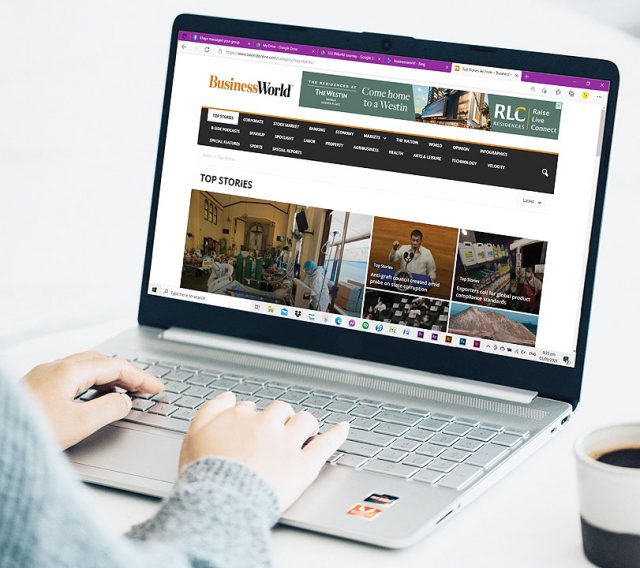
While BusinessWorld leverages new digital platforms to provide the audience with stories told in multiple ways, its website remains to be a strong platform for readers to access news on the stock market, the economy, the nation, and more.

The website also has a SparkUp section that publishes news and knowledge for the startup community, including younger generations or aspiring entrepreneurs.

Aside from news, BusinessWorld’s website also offers a space for advertisers through Spotlight, a venue for them to share about their products, services, events, or initiatives.

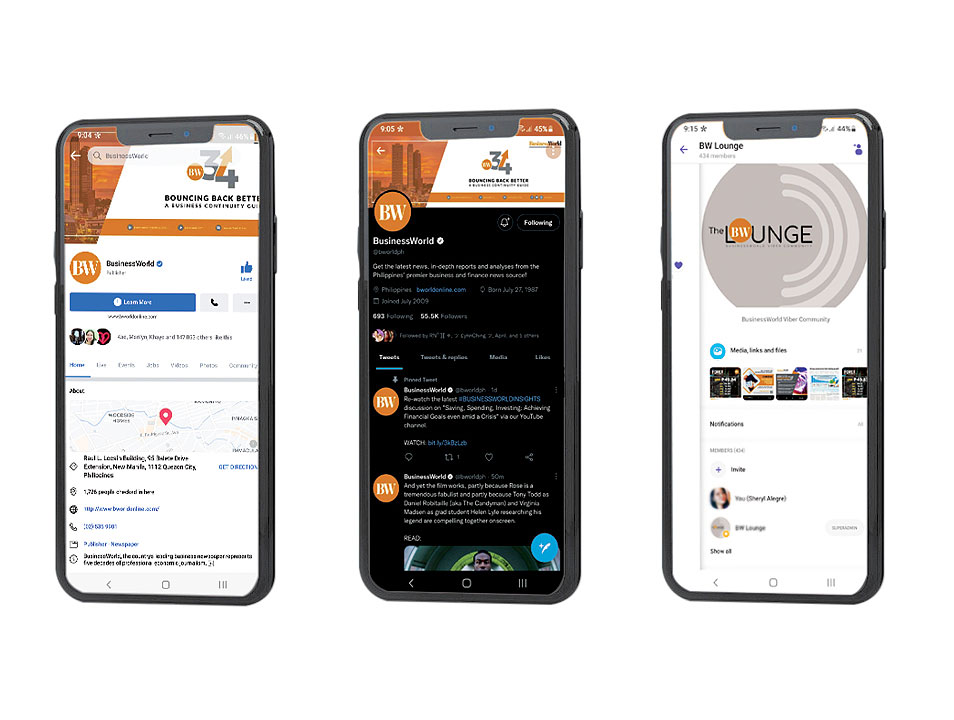
Accompanying BusinessWorld Online are the Facebook, Twitter, and Instagram accounts of BusinessWorld, which serve as channels for social media users to access reports from the website and through other digital formats such as art cards, videos, and even tweets. From the previous year, BusinessWorld has grown its social media community by over 254%.

To further use communication platforms to inform and engage the business community, the BW Lounge was also released on Viber earlier this year.

With over 400 members as of press time, BW Lounge currently shares some news similarly circulated on social media. But soon, BusinessWorld would open it as well for its growing community. 

“BW Lounge is created to establish a new channel to promote events and programs but other than that, the team is positioning BW Lounge as an open platform where business people, investors, brands, startups can interact and meet each other,” said Mark Julian P. Cunanan, BusinessWorld Group Sales Lead for Digital.

Programs to be launched on the BW Lounge like Story Time would allow the audience to share stories about particular topics. The Viber community will also hold a free-flowing discussion through the program Open Room. BW Lounge’s Meet-Up program, meanwhile, will give startups a way to connect with investors and pitch their ideas.

“The goal is to establish a new community of digital users for BusinessWorld outside of the usual social media and website,” Mr. Cunanan said.

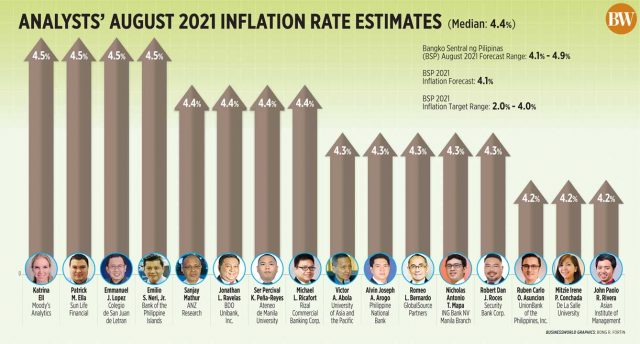
Analysts’ August 2021 inflation rate estimates

INFLATION likely quickened in August and settled above the central bank’s official target range anew, as a weaker peso pushed food prices up, according to analysts. Read the full story.

Analysts’ August 2021 inflation rate estimates

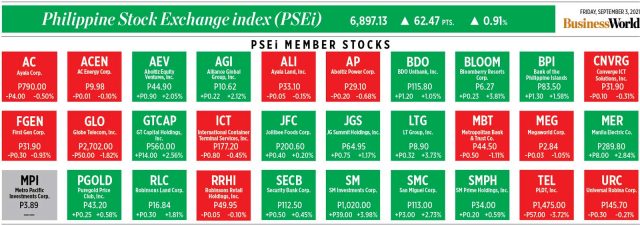
How PSEi member stocks performed — September 3, 2021

Here’s a quick glance at how PSEi stocks fared on Friday, September 3, 2021.


Peso may drop on expectations of faster inflation

BW FILE PHOTO

THE PESO is expected to weaken versus the greenback this week on expectations that inflation accelerated and went beyond the central bank’s target last month.

The local unit closed at P49.84 per dollar on Friday, shedding 1.5 centavos from its P49.825 finish on Thursday, data from the Bankers Association of the Philippines showed.

Meanwhile, it gained 11.5 centavos against its closed of P49.955 versus the greenback a week earlier.

The peso’s slight depreciation from its Thursday close was due to cautiousness ahead of the release of the August US jobs report, Rizal Commercial Banking Corp. Chief Economist Michael L. Ricafort said.

Data from the US Labor department released after trading hours on Friday showed non-farm payrolls rose by 235,000 in August, which was its smallest increase since January, Reuters reported. This was also much weaker than the 750,000 new jobs estimated by analysts in a Reuters poll.

Meanwhile, UnionBank of the Philippines, Inc. Chief Economist Ruben Carlo O. Asuncion attributed the peso’s week-on-week gain to dovish signals from the US Federal Reserve chief during the central bank’s annual Jackson Hole symposium.

Fed Chairman Jerome H. Powell said asset purchases could be reduced this year if the US economy continues to improve as anticipated. However, he did not give details on the timing and pace of the central bank’s plan to wind down bond purchases and hike interest rates, a message interpreted by the market as being dovish.

For this week, Mr. Asuncion said peso-dollar trading will take its cue from the US jobs data released on Friday as the weaker-than-anticipated report fanned expectations that the Fed will push back its tapering and rate hikes to support the recovery of the world’s largest economy.

Meanwhile, Mr. Ricafort said the market will look at latest data on inflation and trade due for release this week for leads.

The Philippine Statistics Authority (PSA) will report the August consumer price index (CPI) on Sept. 7 and the July trade balance data on Sept. 9.

A BusinessWorld poll of 16 analysts yielded a median estimate of 4.4% for August inflation. If realized, headline inflation will again go beyond the central bank’s 2-4% target following the 4% print in July and will be faster than the 2.4% logged in August 2020.

Inflation averaged 4.4% in the first seven months. The Bangko Sentral ng Pilipinas expects the CPI to average 4.1% this year.

On the other hand, latest PSA data showed the country’s trade deficit stood at $2.83 billion in June, slimmer than the $3.17-billion gap in May but wider than the $1.42-billion shortfall a year earlier.

This brought the first-half trade gap to $17.44 billion, wider than the $11.37-billion deficit in the same period of 2020.

For this week, Mr. Asuncion gave a forecast range of P49.70 to P50.20 per dollar, while Mr. Ricafort expects the peso to move within P49.60 to P50.10. — LWTN with Reuters

ADVERTISEMENT
ADVERTISEMENT