Home Blog Page 7466

Globe Telecom’s ‘aggressive’ 5G expansion lures investors

AGGRESSIVE fifth generation (5G) technology expansion drove much of Ayala-led Globe Telecom, Inc.’s stock activity last week.

Globe was the tenth most actively traded stock last week with P649.91 million worth of 333,720 shares traded from July 5 to 9, according to data from the Philippine Stock Exchange.

Globe shares finished at P1,965 apiece on Friday, up by 4.2% from a week ago. Year to date, the stock has edged down by 2.6%.

“A possible rotation from reopening plays into COVID-proof stocks likely supported Globe’s share price last week. The index as a whole was sold down but Globe managed to maintain a stable consolidation range,” Luis A. Limlingan, head of sales at Regina Capital Development Corp., said in an e-mail.

He added that investors turned to Globe, seeing that its operations are “relatively less affected by the pandemic.”

“There remains strong demand for data-related services in the country, particularly home broadband — a segment that Globe is still aggressively expanding,” he said.

Timson Securities, Inc. Equity Trader Darren Blaine T. Pangan said investors may have reacted positively as Globe expects double-digit growth in 5G subscribers this year.

“Market participants may have opted to position themselves in the company after its aggressive management guidance reports,” he said in a Viber message.

Last June 23, Globe took a P12-billion long-term loan — P5 billion from China Banking Corp. and P7 billion from Philippine National Bank — to finance its capital expenditures.

It also expects P70 billion in capital expenditures this year to support its network modernization, and 5G and fiber technology expansion nationwide.

The company said last month that it had at least 88% 5G outdoor coverage in the National Capital Region, with Bonifacio Global City central business district (CBD) and Ortigas CBD having the highest coverage at 97%, followed by Makati CBD with 96% and Pateros with 92%.

Globe announced further expansion of its roster of 5G-ready international partner companies ahead of the travel industry’s gradual recovery from the COVID-19 pandemic.

The telco partnered with Bulgaria’s Vivacom, Vietnam’s Viettel, and China’s China Mobile to provide customers traveling in these locations with 5G roaming services. By August, it will also partner with Tele2 of Sweden and Vivo of Brazil.

During the first three months of the year, Globe’s revenues went up by 2.5% year on year to P37.31 billion. Its attributable net income jumped by 11% to P7.31 billion in the same period.

Mr. Limlingan expects “significant growth” in Globe’s data-related services and increasing contribution to its top line.

Data accounted for nearly 60% of Globe’s service revenues during the first quarter, while broadband had almost 20% share.

“Total service revenue growth could hit the high single-digits this year if everything is at optimal level,” Mr. Limlingan said.

Mr. Limlingan placed the stock’s support and resistance levels this week at P1,920 and P2,000, respectively.

“With Globe rallying briefly from its base above the P1,000 area, the stock seems to have consolidated for a few days above the P1,930 level, with P1,970 being the closest resistance area,” Mr. Pangan said.

“We’ll see if support at P1,930 holds in the coming days,” he added. — Nadine Mae A. Bo

Toyota PHL, AutoPerformance Ph partner anew for 2021 Vios Cup

PHOTO FROM AUTOPERFORMANCE PH

TOYOTA MOTOR Philippines (TMP) and AutoPerformance Ph, official Philippine distributor of Brembo Brakes, renew their collaboration for the 2021 race season of the Vios Cup (which kicked off over the weekend). This entails each participating race car to be fitted with Brembo Premium Ceramic brake pads.

Since the start of the one-make-race in 2014, Brembo has been the official brake pad brand.

“We believe in the vision set by Toyota Motor Philippines, who continue to make automotive and motorsport history in the Philippines,” said AutoPerformance Ph President Francis Aguila. “Our long-term partnership with them has made it clear to Filipinos that Brembo has a strong presence in the market, with products that are not just meant for supercars and luxury vehicles, but also the country’s best-selling car. The exact same Brembo brake pad in the Vios Cup race car is also installed in thousands of Toyota Vios units around the country, and available in over 140 Brembo official dealers nationwide.”

Added TMP Vice-President for Marketing Services Elijah Marcial, “We are very excited for the comeback of the Vios Cup this 2021. Now backed by the Toyota Gazoo Racing brand, expect even more thrilling and heart-racing action as we put the Vios to the test on the tracks of the Clark International Speedway. With a bigger and better online event this year, motorsports fans from anywhere in the country can witness the thrill of the tracks real time and right at the safety of their own homes. We are pleased to have Brembo join us again to continue our legacy of bringing the fun and excitement of motorsport to more Filipinos.”

The Toyota Gazoo Racing Vios Cup will have three legs this year, enforcing strict health and safety protocols for all the participants and organizers. While spectators will not be allowed at the race vanue, the entire event can be viewed free of charge through Toyota Motor Philippines’ Facebook page.

Brembo Premium Ceramic brake pads start from P3,000, and have applications for most popular vehicle makes and models. Visit the www.autoperformanceph.com or the AutoPerformance Ph Facebook page for more information.

Philippines drops eight spots in global passport rankings, lowest since 2006

Philippines drops eight spots in global passport rankings, lowest since 2006

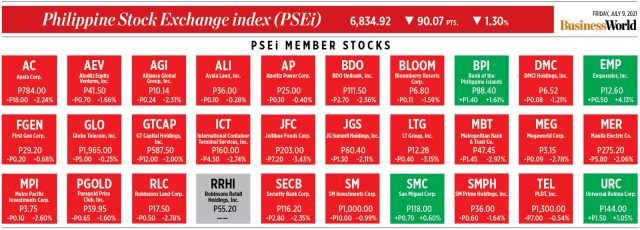
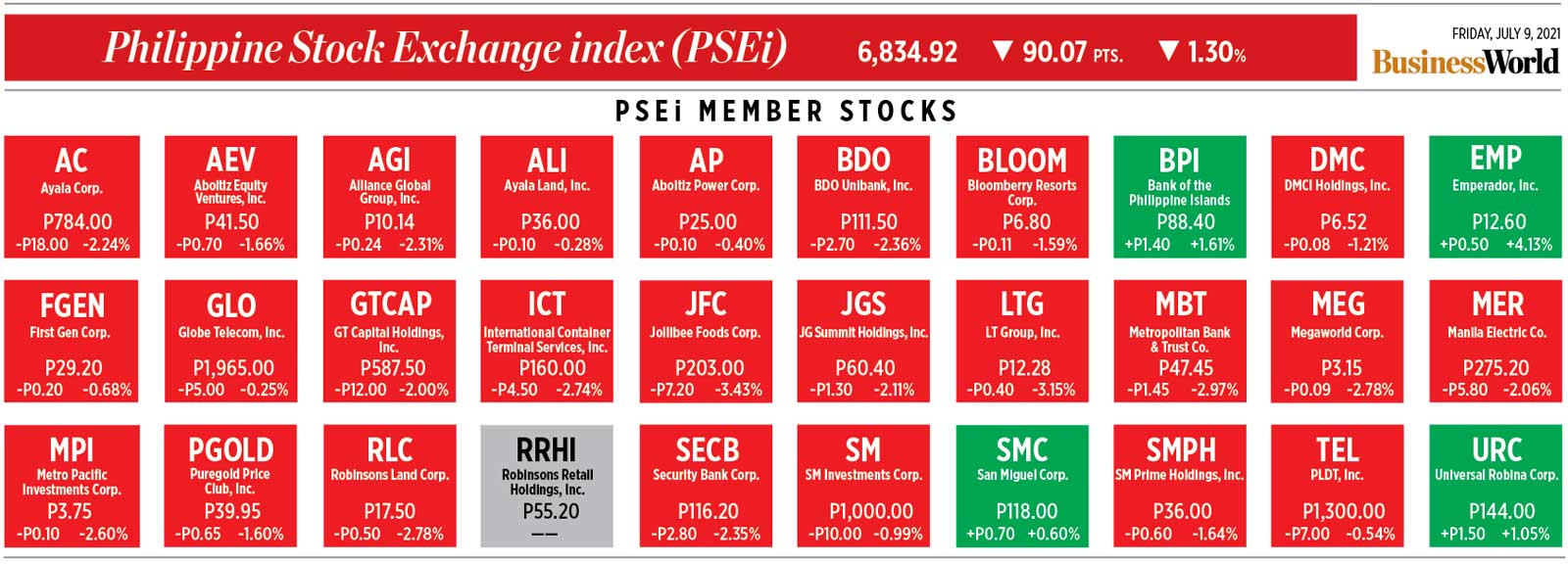
How PSEi member stocks performed — July 9, 2021

Here’s a quick glance at how PSEi stocks fared on Friday, July 9, 2021.


Shares to move sideways ahead of Q2 earnings

COURTESY OF PHILIPPINE STOCK EXCHANGE, INC.

PHILIPPINE SHARES are expected to trade sideways this week as investors await companies’ earnings reports for the second quarter (Q2)  and as the country continues its coronavirus disease 2019 (COVID-19) vaccination program.

Bargain hunting is also expected in the coming days following the heavy selling activity seen last week.

The bellwether Philippine Stock Exchange index (PSEi) declined by 90.07 points or 1.3% to close at 6,834.92 on Friday, while the broader all shares index lost 40.12 points or 0.93% to 4,234.54.

Week on week, the index shed 167.34 points from its 4,234.54 finish on July 2.

“The week started on a good note as investors bought shares ahead of the release of the country’s latest inflation data. However, the bourse trended lower due to a lack of fresh positive catalysts in the local scene,” Timson Securities, Inc. Trader Darren Blaine T. Pangan said in a Viber message on Saturday. “Losses were tempered by last-minute bargain hunters last Friday.”

“The market ended lower for the week and has been in the red for the past four sessions amid recovery jitters,” AB Capital Securities, Inc. Junior Equity Analyst Lance U. Soledad said in a separate Viber message on Friday.

“Negative news [last] week include reports that some LGUs (local government units) suspended first dose vaccinations due to supply problems, as well as concerns over new COVID-19 variants,” he added.

The Health department said on Friday that as of July 8, around 3.2 million Filipinos have been fully vaccinated against the disease or 4.53% of the country’s population. Over 12.70 million jabs have been administered so far.

The Philippines received COVID-19 jabs developed by AstraZeneca Plc last week. Japan’s donation of one million doses arrived on Thursday, while 2.028 million vaccines arrived from the World Health Organization’s COVAX facility on Friday.

Meanwhile, 132,200 Sputnik V vaccines from Russia’s Gamaleya National Research Center of Epidemiology and Microbiology arrived on Friday night and 37,800 more doses arrived on Saturday evening.

“Once vaccinations resume with the recent arrival of supply…then sentiment will improve,” First Metro Investment Corp. Head of Research Cristina S. Ulang said in a Viber message on Friday.

Investors are also expected to pick up bargains this week.

“As we march on with July, bargain hunters might come in to pick up heavily battered shares from the selling activity experienced last week,” Timson Securities’ Mr. Pangan said.

He expects the PSEi to trade between 6,800 to 7,060, while AB Capital Securities’ Mr. Soledad placed the market’s resistance level at 7,000.

“We expect sideways trading for now as investors await second quarter earnings season,” Mr. Soledad said. — Keren Concepcion G. Valmonte

Peso to drop further on concerns over virus variants

BW FILE PHOTO

THE PESO is likely to weaken further against the greenback this week as more infectious variants of the coronavirus disease 2019 (COVID-19) continue to spread.

The local unit closed at P50.08 a dollar on Friday, retreating by 20.5 centavos from its P49.875 finish on Thursday, data from the Bankers Association of the Philippines showed. This was its weakest close in more than a year or since June 23, 2020’s P50.19-per-dollar finish.

The peso also weakened by 88 centavos from its P49.20 close on July 2.

The peso weakened further following the release of the country’s trade data showing a sustained recovery in imports, which could mean increase demand for the dollar, Rizal Commercial Banking Corp. Chief Economist Michael L. Ricafort said.

The country’s trade deficit stood at $2.76 billion in May, narrower than the $3.08-billion shortfall in April but still wider than the $1.31-billion gap seen a year earlier, based on data released by the Philippine Statistics Authority on Friday. Imports climbed by 47.7% to $8.65 billion in May from a year earlier. Meanwhile, exports increased by 29.8% to $5.89 billion.

Meanwhile, a trader attributed the peso’s depreciation to rising risk aversion due to new COVID-19 variants as these “could trigger outflows from the regional markets.”

A JPMorgan analysis that found emerging market economies including the Philippines, Thailand, Peru, Colombia, and South Africa are among the most vulnerable to the impact of the Delta variant due to their low vaccination rates, Reuters reported. The analysis looks at spread of the variant versus the pace of vaccination, which in some countries is not accelerating enough to offset higher rates of transmission.

COVID-19 cases in the Philippines rose by 5,675 on Saturday, bringing the active infections to 49,968. The country’s tally reached 1.391 million.

The Philippines has administered 12.489 million vaccine doses so far. but only 3.089 million people have received their second doses, equivalent to just 2.86% of the population, based on latest data from Johns Hopkins University’s vaccine tracker.

This week, investors will continue to monitor developments in the country’s COVID-19 situation and the emerging variants of the virus, Mr. Ricafort said.

He added that peso-dollar trading this week will also track upcoming remittances data.

Meanwhile, the trader said dollar bulls will continue to support the peso at the P50-per-dollar range this week.

The trader expects the peso to move within the P50 to P50.50 band versus the dollar this week, while Mr. Ricafort gave a forecast range of P49.70 to P50.30. — L.W.T. Noble with Reuters

Bidders sought for 4 Quezon City stations of Metro Manila subway

THE TRANSPORTATION department has started seeking bidders for four Quezon City stations of the first phase of the Metro Manila Subway Project.

The department started issuing bid documents for contract package (CP) 102 which covers the Quezon Avenue and East Avenue underground stations and tunnels on July 8, according to an invitation for bids posted on its official website.

Another package offered is the CP 103, which covers the Anonas and Katipunan underground stations and tunnels.

Both contracts include designing, supplying, installing, constructing, testing, commissioning and training for the underground tunnels and stations.

International competitive bidding will be conducted through the Japan International Cooperation Agency’s procedures.

The department said the eligible nationality of the suppliers should be Japan in the case of the prime contractor and all countries in the case of sub-contractors. 

“In a case where the prime contractor is a joint venture, such joint venture will be eligible provided that the nationality of the lead partner is Japan, that the nationality of other partners are in Japan and/or the Republic of the Philippines, and that the total share of work of Japanese partners in the joint venture is more than 50% of the contract amount,” it added.

A pre-bid conference will be conducted for both contract packages on Aug. 8.

The cost of bid documents for each package is P50,000.

Bids should be submitted on or before 10 a.m. on Oct. 8 accompanied by a bid security of 600 million yen for CP 102 and 800 million yen for CP 103.

Bids will be opened in the presence of bidders’ representatives on Oct. 8 at 10 a.m. at the Office of Procurement Service, Department of Budget and Management in Paco, Manila.

The Philippines and Japan signed in March 2018 the first tranche of the P355.6-billion loan for the project.

The government broke ground on the first three stations in February 2019 after the Transportation department signed a P51-billion deal with the Shimizu joint venture, which consists of Shimizu Corp., Fujita Corp., Takenaka Civil Engineering Co. Ltd., and EEI Corp.

While the public will have to wait until 2025 for full operations of the 17-station subway, the government is planning to launch partial operations, covering the first three stations by 2022.  — Arjay L. Balinbin

CIC credit reports requested by institutions to be priced wholesale

THE CREDIT Information Corp. (CIC) in August will adopt a wholesale pricing scheme in which bulk rates will be charged on credit reports sought by financial institutions.

Under the new scheme approved by the Securities and Exchange Commission (SEC), credit report inquiries will have a wholesale price of P10 each when financial institutions pre-purchase a million reports annually, the CIC said in a statement Saturday. The retail price is P15 for all other attempts to access the CIC database. 

“The new pricing scheme is intended to provide incentives to accessing entities and drive volume consumption of the CIC basic credit reports while ensuring improved revenue flow to sustain operations and enhance service quality,” CIC President and CEO Ben Joshua A. Baltazar said in his letter proposing the scheme to the SEC sitting en banc. 

The wholesale price scheme will take effect between August and the end of January.

The current introductory price of P10 per credit inquiry is in force until July 31. This price is offered for both the CIC’s Accessing Entities and Special Accessing Entities (SAEs).

Basic credit reports expire 18 months from the date of purchase.

Through the new scheme, CIC will also implement a “no hit, no pay policy” in which financial institutions will not be charged for data subjects found to have no credit history.

Mr. Baltazar said the CIC is also looking into developing a service that will certify a subject has no credit history, which will be beneficial for individuals who are new to borrowing, including new graduates and young professionals. 

“It is only right that newcomers to credit should be given a boost when they are assessed for their creditworthiness when they apply for a loan or other financial services for the first time,” Mr. Baltazar said.

Financial institutions will still have the option to access credit scoring services through SAEs such as CIBI Information, Inc., CRIF Philippines, and TransUnion Information Solutions. Consumer credit scores can be accessed directly through CIBI Information, Inc.’s myScore web portal.

The CIC has 603 submitting entities and 117 accessing entities which include major universal and commercial banks, rural and thrift banks, microfinance institutions, and lending and financing companies. — Luz Wendy T. Noble

Exporters back open access bill for ISPs to improve broadband

EXPORTERS are backing the passage of a bill that would ease the entry of internet service providers (ISPs) into the broadband market, which they said would help bridge connectivity gaps.

The proposed Open Access in Data Transmission Act filed as House Bill No. 8910 and Senate Bills No. 45 and 911 are pending.

“An Open Access Law will allow the private sector, including internet service providers and value-added service providers, especially those operating in the rural areas, to connect to the government’s National Broadband Plan infrastructure, which will extend the benefits of the Plan to the Filipino consumer,” Philippine Exporters Confederation, Inc. (Philexport) said in a statement Friday.

Philexport has said that smaller exporters were left behind during the pandemic due to the digital divide, even though they were allowed to operate during the lockdowns. Smaller businesses accounting for the bulk of the industry have fewer resources to help on-site employees, the group said.

“The policy and regulation we use for internet connectivity are anchored on analog-era fixed telephone and radio broadcast services,” Philexport said.

“It is indeed high time that we pass laws that reflect how people connect and communicate in the Digital Age, an imperative that President Duterte himself has repeatedly raised.”

Philexport added that the bill would promote connectivity technologies, including mobile, wired, wireless and satellite, by qualified providers.

“It will provide a consultative mechanism for distributing and managing spectrum for internet use to ensure that more communities, and not just the highly commercial or urbanized areas, will benefit from wireless connectivity.”

Foreign business groups in a statement in May also supported the passage of House Bill 8910, noting that it will lower the barriers and cost to enter the data transmission market and improve connectivity services.

Represented by foreign chambers including those of the United States, Canada, Japan, and Europe, the groups, however, asked Congress to reconsider the retention of the franchise requirement for international cable landing stations, which they consider to be a barrier to entry in the broadband sector. — Jenina P. Ibañez

Energy department to hold public consultations on new rules for green energy auction this month

PHILSTAR

THE ENERGY department plans to hold a public consultation on the green energy auction program (GEAP) this month, ahead of revisions to the rules and framework governing the program.

The Department of Energy (DoE) had originally planned to hold the auction in June

“We are changing the framework of the GEAP… By July, we’ll be doing the public consultation on the revised rules, the terms of reference and some other instruments that we will be using (for) the green energy auction,” Renewable Energy Management Bureau Director Mylene C. Capongcol said during a briefing held by the German-Philippine Chamber of Commerce and Industry, Inc. last week.

She said there was a need to simplify the auction in order to ensure immediate availability of supply to the power grid.

“Initially it was intended for all the mandated participants, particularly the distribution utilities (DUs)… (but) being a DU, there are a lot of regulations and study that have to be undertaken because (there will be) a pass-on rate eventually,” she said, referring to additional costs that may be passed on to consumers in the franchise areas of DUs.

The GEAP allows eligible renewable energy (RE) developers to supply a portion of the electricity generated by their facilities to qualified customers who may, in turn, enjoy power prices below market rates.

The auction aims to pool an initial 2,000 megawatts of RE capacity from brownfield and greenfield projects, Ms. Capongcol said.

She said regulators are hoping to launch the auction with the revised framework in October.

In July 2020, the department released a circular which detailed the guidelines governing conduct of the GEAP.

Projects eligible for the auction are those covered under the renewable portfolio standards. Qualified participants from on-grid areas can come from the biomass, wind, solar, hydro, ocean, geothermal, and waste-to-energy sectors. — Angelica Y. Yang

Zero hunger seen attainable by 2030 with 7% agri output growth

PHLSTAR FILE PHOTO

THE GOAL of attaining zero hunger by 2030 is achievable if agricultural production grows much faster than current levels, officials said.

In a recent dialogue organized by the Department of Agriculture (DA) on responsible agricultural investment in food, an official with the Department of Agrarian Reform’s Bureau of Agrarian Reform Beneficiaries Development, Director Baltazar T. Cruz, said the

agriculture sector should sustainably grow by at least 7% per annum, boosted by investment programs from both the government and the private sector.

“Enabling policies and laws that would enable the private sector to participate very comprehensively are necessary conditions for us to achieve this sufficiency in food and lessen the impact of hunger and poverty,” Mr. Cruz said.

Hendel P. Cabral, Pilmico Foods Corp. vice-president for Farm Sales and Meat Operations, said the zero-hunger goal will be achieved by making food accessible and affordable to consumers.

“My take on it is that food must be affordable, but many things are at play with affordability. It has to be affordable so that the average Filipino can pay for it,” Mr. Cabral said.

Elyjean D. Portoza, Board of Investments’ Legal and Investment Compliance Service director, said the government should encourage investment in agri-fishery production processing, support services like nurseries, and supporting infrastructure.

“As long as we continue what we are doing, building our infrastructure, our farm-to-market roads, providing the necessary government interventions in terms of educating farmers, maximizing what our lands can offer, and reducing food waste — all these things should be done before we achieve zero hunger in 2030,” Ms. Portoza said.

Nestlé Philippines, Inc. Vice-President and Corporate Affairs Executive Ruth P. Novales said the hunger eradication goal should be a shared effort between the private sector and government.

“Everyone should (help determine priorities for) what and where to plant,” Ms. Novales said.

Shandy M. Hubilla, national deputy project director for the DA’s Philippine Rural Development Project, said the goal can be achieved by improving the productivity and income of farmers.

“When we look at the 17 (United Nations) sustainable development goals, we know that all of them are interlinked. It is contingent on a lot of factors. In the case of the DA, our competence is in sustainable food systems, on the supply side of the food chain. We could agro-industrialize by consistently increasing productivity and increase farmer income,” Mr. Hubilla said.

The DA will hold a national dialogue on food systems on July 13-14 ahead of the United Nations Food Systems Summit (UNFSS) scheduled in September.

The national dialogue aims to address the five action tracks which will be tackled during the UNFSS, such as ensuring access to safe and nutritious food for all; moving to sustainable consumption patterns; improving nature-positive production; promoting equitable livelihoods; and building resilience. — Revin Mikhael D. Ochave

Climate advocate calls for ban coal-fired plants to extend to pending projects

THE DEPARTMENT of Energy (DoE) needs to expand its moratorium on coal-fired power plants to include more facilities, including those that have secured prior approval and those that are under construction, an environment policy expert said.

In October, Energy Secretary Alfonso G. Cusi announced a halt on greenfield or new coal-fired power plants to make way for a more flexible power supply mix.

“I think they need to expand (the coal moratorium) to all those that have not yet been built. It only covers greenfield, but it does not cover those under construction or that have received approval. We should not have a single coal power plant in place already given the kind of experience we’re now having on climate change,” Manila Observatory Energy Collaboratory Director and Senior Fellow on Climate Change Antonio G.M La Viña told BusinessWorld by phone on July 5.

He said that coal-fired plants will eventually have to be shuttered, since there was “no economic reason for them” to continue operating.

“The economics doesn’t work already for coal-fired power plants in the Philippines… They’re not efficient. They’re not economically good for the society and for people, and there are (other) options,” Mr. La Viña said.

He said companies can convert a coal-fired plant into a facility that runs on renewables or “transition” fuels such as natural gas, which will incur costs but will expedite the shift to a renewable-energy based system.

Mr. La Viña, who was formerly an Environment department undersecretary, added that the government should not allow proponents to build any more coal-fired plants, while implementing a 10- to 20-year closure plan for current facilities.

President of Center for Renewable Energy and Sustainable Technology Riedo A. Panaligan welcomed the DoE moratorium, but said that the country has yet to see the ruling’s impact on the department’s policies and plans.

“It remains a publicity stunt until we see that it impacts the agency’s future energy policy and planning agenda,” Mr. Panaligan told BusinessWorld in an e-mail on July 9.

“As of March 31, the DoE remains committed to put up 3.8 gigawatts (GW) of new coal by 2028 and an additional indicative 4.4 GW of coal before the decade ends,” he added, citing data from the Energy department.

Asked to comment on what companies should do with their coal-fired projects, Mr. Panaligan said that they should “retire” their existing plants without extension or rehabilitation, and move away from building new coal-fired facilities.

He said a favorable market for renewable energy may “force many existing coal-fired projects to halt their operations before reaching their life expectancies.”

Terry L. Ridon, convenor of public policy think-tank Infrawatch PH, said the moratorium lacks detail about auditing existing coal-fired plants for compliance with emissions standards.

“Further, there was no mention of a scheduled retirement of these existing plants,” he told BusinessWorld by e-mail over the weekend.

“An audit of existing coal-fired power plants needs to be made to compare their emissions with current technology-neutral proposals, as this includes those with supposed emissions capture technology, to determine the power sector’s actual emissions contribution to global warming,” he said. — Angelica Y. Yang