Home Blog Page 7389

PAL unveils long-haul flights for peak season

Flag carrier Philippine Airlines, Inc. (PAL) on Friday announced its long-haul routes and flight offerings for the peak season.

“These flights will serve the U.S. and Canadian East and West Coast as well as Europe and Hawaii,” PAL said in a statement.

The offerings are for the “upcoming ‘winter’ schedule that begins in late October and encompasses the usual holiday peak season,” it noted.

There will be 10 to 12 weekly flights between Manila and Los Angeles.

PAL will also operate daily flights between Manila and San Francisco, two to three weekly flights between Manila and New York, twice monthly special flights between Manila and London, two to three weekly flights between Manila and Honolulu, three to four weekly flights between Manila and Vancouver, and once weekly flights between Manila and Toronto.

The airline said its special flights between Manila and London are set for Oct. 5 and 26, Nov. 9 and 23, and Dec. 7 and 14.

Two more flights between Manila and London are set for Jan. 4 and 11 next year.

“We are heeding the call for more flights to and from the US Mainland, Canada, and the UK to serve many of our fellow Filipinos who want to rejoin their families in time for the Christmas holidays. As travel restrictions ease in coming months, our nonstop global links can help the Philippines stage a comeback in tourism,” PAL Senior Vice-President and Chief Strategy and Planning Officer Dexter C. Lee said.

The flag carrier has launched services between Manila and Seattle (Washington) as well as Las Vegas (Nevada) and Portland (Oregon) via Honolulu with its interline partner Hawaiian Airlines.

“We are broadening airline partnerships in order to provide our customers a convenient way to fly to these major cities in the Pacific Northwest and Sunbelt regions of the United States, or from these areas to the Philippines. We urge

travelers to enjoy a free overnight stay in Honolulu on the westbound flight to Manila, a package which includes land transfers and free baggage allowance,” PAL Senior Vice-President for Sales and Marketing Oscar A. Reyes said. — Arjay L. Balinbin

JFC’s Smashburger opens Chicago, NY stores

Smashburger, a company owned by listed Jollibee Foods Corp. (JFC) via its wholly owned subsidiary Bee Good!, Inc., has opened two new stores in the United States.

The US-based fast-casual hamburger restaurant “recently opened two new stores in Chicago and New York, respectively,” JFC said in an e-mailed statement on Friday.

Smashburger plans to open at least 20 new stores this year, it added.

The Jollibee group aims to become among the top five restaurant companies in the world, according to JFC.

“We are hoping to make Smashburger a part of the Chicago North Mayfair and New York Queens communities and be able to serve not only mouthwatering burgers, but also delicious breakfast for families of all ages,” Smashburger President Carl Bachman said.

“Residents should not have to leave their neighborhood for a quality burger which is why we are so thrilled to be bringing our Smashburger menu variety to North Mayfair and Queens,” he added.

JFC shares closed 2.38% lower at P205 apiece on Friday. — Arjay L. Balinbin

Shares decline on last-minute profit taking

Philippine Stock Exchange index

PHILIPPINE shares finished lower on Friday as market investors went on a last-minute profit taking before the end of the trading week.

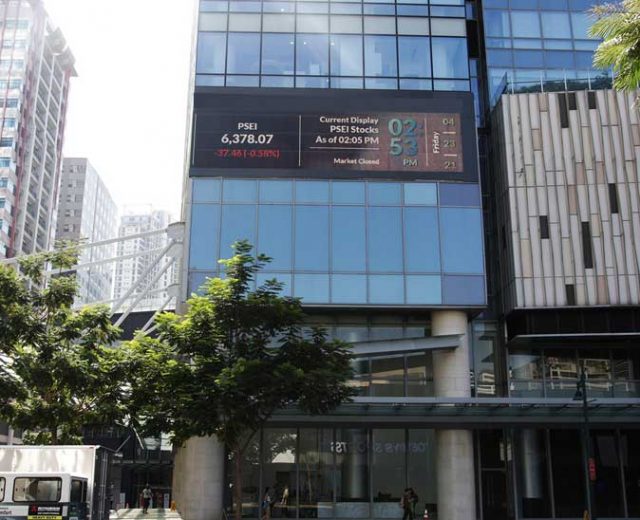
The benchmark Philippine Stock Exchange index (PSEi) fell 44.44 points or 0.63% to close at 6,906.86 while the broader all shares index declined 0.37% or 16.33 points to finish at 4,338.52.

Japhet Louis O. Tantiangco, Philstocks Financial, Inc. senior research and engagement supervisor, said in a mobile phone message that the local bourse closed lower on last minute profit taking.

“Prior to the last minute sell-off, the market was in the green territory, reaching as high as 7,076.01 due to the positive spillovers from Wall Street,” Mr. Tantiangco said.

“First Gen Corp. was the top index gainer, jumping 5.07% to P29.00. Converge Information and Communications Technology Solutions, Inc. remained as the main laggard, plunging 10.40% to P33.60,” he added.

On Thursday, the Dow Jones Industrial Average increased by 337.95 points or 0.98% to 34,754.94; the S&P 500 index climbed 36.21 points or 0.83% to 4,399.76; and the Nasdaq composite improved 151.11 points or 1.05% to 14,654.02.

“Philippine stocks were sold down at market on close to make way the latest rebalancing addition, Wilcon Depot Inc., while equities in other regions extended their gains for the third consecutive day ahead of the jobs data on Monday,” Regina Capital Development Corp. Head of Sales Luis A. Limlingan said in a mobile phone message.

It was previously announced that Wilcon Depot will replace First Gen in the main index effective Oct. 11.

On Friday, more than half of the sectoral indices declined. Services dropped 35.53 points or 1.81% to 1,918.5; holding firms retreated 72.80 points or 1.05% to

6,800.18; property went down 5.48 points or 0.17% to 3,061.85; and industrials decreased 10 points or 0.09% to 10,361.44.

In contrast, financials increased 23.14 points or 1.6% to 1,467.23 while mining and oil rose 124.75 points or 1.29% to 9,726.4.

Value turnover on Friday amounted to P25 billion with 1.9 billion shares switching hands, higher than the P13.17 billion with 1.4 billion shares traded the prior trading day.

Net foreign buying reached P1.47 billion, a turnaround from the net foreign selling worth P1.47 billion on Thursday.

Advancers bested decliners, 105 against 83, while 46 names closed unchanged. — Revin Mikhael D. Ochave

Budget dep’t pilot program digitizes release of cash allocation notices

The Department of Budget and Management (DBM) launched a pilot program to digitize the process of releasing the Notice of Cash Allocation (NCA).

“The transition to digital release of DBM action documents through the Action Document Releasing System (ADRS) is expected to eliminate the unnecessary steps of printing, physical signing and forwarding of documents within the department, and releasing of printed action documents to authorized Department/Agency liaison officers,” the DBM said in a statement Friday.

It added the initiative will also allow for safety for DBM employees and the agencies they transact with during the public health crisis.

The pilot launch will allow 14 agencies access to the system: the DBM; the Commission on Audit; the Departments of Environment and Natural Resources, Education, Finance, Health, Information and Communication Technology, Interior and Local Government, National Defense, Public Works and Highways, Science and Technology, and Social Welfare and Development; as well as the National Commission for Culture and the Arts and the Presidential Communications Operations Office.

These agencies have finished training on the use of ADRS and will now be able to download their Special Allotment Release Orders and Advice of Notice of Cash Allocation, as well as corresponding schedules and attachments, through the system.

The ADRS is expected to be fully implemented by the first quarter of 2022, the DBM said.

“The DBM remains committed to its mandate to promote the sound, efficient and effective management and utilization of government resources (i.e., technological, manpower, physical and financial) as instruments in the achievement of national socioeconomic and political development goals,” it added. – Luz Wendy T. Noble

PHL sugar imports projected at 100,000 MT in 2021/2022

SUGAR imports for marketing year (MY) 2021/2022 are projected at 100,000 metric tons (MT), according to the United States Department of Agriculture (USDA).

In a report, the USDA’s Foreign Agricultural Service said the current import estimate represents a downgrade from its previous estimate of 150,000 MT.

“This reflects the decision to not allocate any sugar production to exports; traders will therefore not be allowed to import refined sugar in an export replenishment program,” the USDA said.

The Sugar Regulatory Administration’s (SRA) Sugar Order No. 1 classified all domestic sugar outputs as “B” sugar, intended for the domestic market.

As a result, the Philippines will have zero exports during the marketing year.

“In recent years, the United States has been the sole export market for Philippine raw sugar. Exports to the United States in MY 2020/21 reached 112,000 MT,” the USDA said.

The USDA said Philippine raw sugar production for MY 2021-2022 is estimated at 2.1 million MT, lower than the 2.14 million MT recorded in the previous year. It added that the area planted to sugarcane for the marketing year is 390,000 hectares.

“The decline is attributed to the recently announced La Niña expected in October or November 2021. This coincides with the start of peak milling, when excess water will result in lower sugar recovery,” the USDA said.

In terms of consumption, USDA said sugar demand will hit2.3 million MT, upgrading its previous estimate by 100,000 MT.

“Consumption will modestly increase as the economy recovers from the pandemic, which will drive the food and beverage manufacturers to increase production and sugar usage. As the economy reopens, businesses will resume operations, particularly the institutional buyers such as restaurants and hotels which were severely affected by the coronavirus disease 2019 (COVID-19),” the USDA said. — Revin Mikhael D. Ochave 

Farmers back NIA transfer to Agri dep’t 

JAPAN INTERNATIONAL COOPERATION AGENCY

A FARMERS’ organization has expressed its support for the proposed transfer of the National Irrigation Authority (NIA) to the Department of Agriculture (DA), and away from its current parent organization, the Office of the President (OP).

Raul Q. Montemayor, Federation of Free Farmers (FFF) National Manager, said NIA needs to be under DA jurisdiction since all of its activities concerned food production.

“The agency’s investment priorities and program strategies must be closely aligned and synchronized with the DA’s plans and targets,” Mr. Montemayor said in a statement Friday.

“The design and allocation of irrigation facilities must jibe with the DA’s intention to promote diversified instead of mono-crop farming, while also addressing risks from droughts, typhoons and other calamities that are expected to intensify because of climate change,” he added.

The DA recently issued a statement announcing that the Department of Finance (DoF) and the National Economic and Development Authority (NEDA) have expressed their support for NIA’s transfer.

In April, Agriculture Secretary William D. Dar submitted a letter to President Rodrigo R. Duterte requesting the transfer, saying that it “will support better integration and enhance coordination to maximize available resource to improve the productivity of Philippine agriculture.”

The FFF also warned the government against “ill-conceived and ill-timed” transfers of DA agencies to other departments, adding that there is a need to fully consult stakeholders before the transfers are finalized.

Asked to comment, NIA Administrator Ricardo R. Visaya said in a mobile phone message to BusinessWorld that the proposed transfer to the DA is “no big deal.”

“We can still be as effective as we are now even if we will be with the DA. What is important is to continuously improve our services to the farmers particularly in water delivery to their farms efficiently and effectively,” Mr. Visaya said.

“The DA and NIA have a common objective of ensuring food security in our country. So, I am sure that joining the DA will never hamper our mission objectives. Instead, it may even enhance food production nationwide,” he added.

The Philippine Crop Insurance Corp. (PCIC) was recently transferred to the DoF by Executive Order (EO) 148. The PCIC had been an arm of the DA since 2002.

The NIA was an OP agency upon its creation in 1963. It was transferred to the Department of Public Works, Transportation, and Communication in 1972, and was attached to the Department of Public Works and Highways (DPWH) and DA in 1987.

In 1992, the NIA returned to OP and was transferred again to the DA. In 2014, NIA was moved to the OP by EO No. 165.  – Revin Mikhael D. Ochave 

Journalists in the Philippines and Russia win 2021 Nobel Peace Prize

PHILSTAR

OSLO — Maria Ressa, who won the Nobel Peace Prize on Friday with Russian journalist Dmitry Muratov, said she was stunned by the news.

“I am in shock,” Ms. Ressa told a live broadcast by Rappler, the online news website she co-founded.

The two journalists whose work has angered the authorities in Russia and the Philippines were awarded the Nobel Peace Prize, honoring the right to free speech which the prize-giving committee described as under threat around the globe.

Ms. Ressa and Mr. Muratov were given the award “for their courageous fight for freedom of expression in the Philippines and Russia,” Chairwoman Berit Reiss-Andersen of the Norwegian Nobel Committee told a news conference.

“At the same time, they are representatives of all journalists who stand up for this ideal in a world in which democracy and freedom of the press face increasingly adverse conditions,” she added.

The prize is the first for journalists since the German Carl von Ossietzky won it in 1935 for revealing his country’s secret post-war rearmament program.

“Free, independent and fact-based journalism serves to protect against abuse of power, lies and war propaganda,” Ms. Reiss-Andersen said.

The Nobel Peace Prize will be presented on Dec. 10, the anniversary of the death of Swedish industrialist Alfred Nobel, who founded the awards in his 1895 will. — Reuters

Taiwan to launch new ‘Southbound’ trade push focused on healthcare

TAIWAN will launch its New Southbound policy 2.0, a program to promote its healthcare industry to regional neighbors in the wake of the pandemic.

The policy was launched in 2016 targeting stronger economic ties with the Association of Southeast Asian Nations (ASEAN), South Asia, New Zealand, and Australia. The Philippines, signed a partnership with Taiwan in 2017 and is among its seven main countries collaborators.

Health and Welfare Vice Minister Chung-Liang Shih said during the Yushan forum in Taiwan, which began Friday, that the focus next year will be greater coordination of health efforts with partner countries.

Taipei is planning a presence in each partner country, with the goal of “provid(ing) international patients better access to Taiwan’s healthcare services,” he said

The program will also seek to harmonize health care policy and smooth out the supply chain for healthcare products. — Alyssa Nicole O. Tan

BSP raises P100 billion via one-month bills

BW FILE PHOTO

The Bangko Sentral ng Pilipinas (BSP) raised P100 billion from short-term securities Friday, with rates rising amid increasing oil prices and following the retail dollar bond (RDB) offering of the national government.

The central bank fully awarded its 28-day bills which attracted bids of P147.84 billion, making the offer 1.48 times subscribed. Demand was also higher than the P139.55 billion in tenders a week earlier.

The average rate of the one-month securities was 1.7832%, up from 1.767% previously. Banks sought yields of between 1.74% and 1.825%, a narrower range than last week’s 1.7050% to 1.9676%.

Both the BSP bills and the term deposit facility are used to mop up excess liquidity in the financial system and guide market rates.

“The continued strong interest in the 28-day bills from eligible market participants remains in line with stable market conditions amid sustained ample liquidity in the financial system,” BSP Deputy Governor Francisco G. Dakila, Jr. said in a statement.

Rates on the central bank’s bills rose amid an increase in global oil prices, Rizal Commercial Banking Corp. Chief Economist Michael L. Ricafort said in a Viber message.

Reuters on Friday reported that fuel prices increased nearly 5% this week after some industries started switching to oil from gas. There was also uncertainty whether the US government would release oil from its strategic reserves.

Mr. Ricafort said another factor for higher rates was likely the latest RDB issue “that siphoned off some of the excess liquidity in the financial system”.

The government sold $1.593 billion in RDBs. The offer ran between Sept. 15 and Oct. 1. – Luz Wendy T. Noble

BSP reiterates parent must apply for LYKA payments license

BW FILE PHOTO

The Bangko Sentral ng Pilipinas (BSP) confirmed its decision to deny an operator of payments (OPS) license to the marketing arm of social media platform LYKA, saying the parent organization must be the one to register with the BSP.

The central bank said in a statement Friday that it upheld the cease-and-desist order (CDO) issued against Digital Spring on July 23. It said a letter has been sent confirming the denial of the Digital Spring application.

“The CDOs against LYKA/Things I Like Co. Ltd. and Digital Spring are affirmed and shall remain effective until Lyka properly registers as an OPS in accordance with law and regulations,” the BSP sai.

Through the Gift cards in Electronic Mode or GEMS on its platform, LYKA allows users to purchase, exchange, and pay for goods and services with selected merchants.

“These activities make LYKA an OPS and, therefore, its registration is required before it can continue with these activities,” the central bank said.

BSP Deputy Governor Mamerto E. Tangonan said the situation is akin to a pilot who must personally obtain a flying license.

“Digital Spring applying for registration, instead of LYKA/TIL itself, is like saying the airline ticketing office can apply for a flying license on behalf of the pilot. It is the pilot who must apply for the license,” Mr. Tangonan said.

The central bank urged the public to only patronize registered OPS. LYKA has yet to register as an OPS to date, the BSP said.

According to its database, the BSP has granted OPS licenses to 164 entities as of Oct. 1. Meanwhile, nine companies have secured provisional certificates of registration from the BSP.

“For its continuous protection, the public is reminded to only use the payment services of a registered OPS,” the BSP said.

Cash-in service providers, bills payment service providers, and entities such as payment gateways and merchant acquirers fall under the OPS classification if they enable sellers of goods and services to accept payment in cash or digital form.

In July, the BSP told financial institutions to stop engaging in transactions with LYKA as it remained unregistered with the BSP.

LYKA is a social media platform run by a Hong Kong which was heavily promoted by various celebrities. – Luz Wendy T. Noble

Surigao’s Cantilan Bank launches ADB/IFC-backed app

Surigao-based Cantilan Bank, Inc. has launched an app backed by international development institutions which is expected to expand the reach of financial services in rural communities.

The app facilitates bill payment, fund transfer, and load top-up for prepaid services. Through the platform, merchants can also offer Code Cash In and Cash Out services.

The project was supported by the Asian Development Bank (ADB) and the International Finance Corp. (IFC)

“Cantilan Bank demonstrated that a small rural bank can also be innovative and technologically-adept,” ADB Chief of the Finance Sector Group Junkyu Lee said in a statement Friday.

IFC provided advisory services to the bank to develop its omni-channel mobile banking and payment services.

“We look forward to supporting the team in their next steps, which will involve providing the next level of innovation in mobile banking in a sustainable and relevant manner to the communities that they serve,” IFC Global Digital Finance Specialist Lowell Campbell said.

The bank has secured a license and approvals from the Bangko Sentral ng Pilipinas to operate as an Electronic Money Issuer – Bank, to engage in agency banking services, and to offer electronic payment and financial services.

Cantilan Bank has a network of 46 branches and branch lines in the Visayas and Mindanao.

It had total assets of P2.3 billion at the end of December. – Luz Wendy T. Noble

Peso weakens ahead of US jobs data

BW FILE PHOTO

The peso retreated against the dollar on expectations of upbeat US employment data and as oil prices continued to rise.

The peso closed at P50.58 to the dollar Friday, weaker than its P50.56 finish Thursday, according to the Bankers Association of the Philippines.

It was stronger than its P50.79 close a week earlier.

The peso opened the session at P50.50. The low was P50.61, while the high was P50.37.

A trader attributed the peso’s weakening to cautious sentiment ahead of the US employment report.

“Fed taper views are likely to strengthen amid market expectations of a strong US labor report,” he said in an email.

The US Labor Department will release jobs data for September on Friday.

A Reuters poll put economist expectations at 200,000 to 700,000 jobs added in September. In August, 235,000 jobs were added.

Rizal Commercial Banking Corp. Chief Economist Michael L. Ricafort said in a Viber message that the peso’s weakness was also caused by safe-haven demand for the dollar as oil prices increased.

Reuters on Friday reported that fuel prices increased nearly 5% this week after some industries started switching to oil from gas amid uncertainty whether the US government would release oil from its strategic reserves. — Luz Wendy T. Noble

ADVERTISEMENT
ADVERTISEMENT