Home Blog Page 72

Megawide to start Baguio terminal construction next year

THE BAGUIO CITY Integrated Terminal project involves leasing, operating, and maintaining an intermodal terminal to serve provincial buses arriving from outside Baguio City. — BAGUIO CITY PUBLIC INFORMATION OFFICE OFFICIAL FACEBOOK ACCOUNT

MEGAWIDE Construction Corp. is targeting the first quarter of 2027 to begin construction of its P1.19-billion Baguio City transport terminal project, a company official said.

“The next step is the design phase. So, now, we are starting that process. It is very challenging because of the terrain. We are finding the most efficient way to design it,” Megawide Chief Business Development Officer Jaime Raphael C. Feliciano told reporters on the sidelines of an event on March 11.

In January, the company signed a lease agreement with the Baguio City Government to implement the project, following the receipt of the notice of award last year.

“We are hoping by Q1 of next year we can start (construction). We just have two challenges right now,” he said.

Mr. Feliciano said one challenge is the transfer of the waste-sorting facility at the site, which the city must relocate after identifying a new location.

Megawide is also arranging temporary housing for about 27 families who will be affected by the project.

“We will provide them temporary housing or shelter. We will also find ways for them to be able to work in the project, for example construction or supervisors or whatever their skill sets allow them,” he said.

The project is expected to be operational by the second half of 2028, Mr. Feliciano added.

The Baguio City Integrated Terminal is designed to handle up to 25,000 passengers daily and will initially serve seven southbound routes, including La Union, Pangasinan, Tarlac, Pampanga, Bulacan, Metro Manila, and Cavite via the planned South Luzon Integrated Terminal Exchange.

The terminal will be built on a five-hectare property in Barangay Dontogan, about five kilometers from Baguio City proper.

The project is expected to ease traffic congestion in the city by relocating provincial buses and UV Express vans outside the central district. — Ashley Erika O. Jose

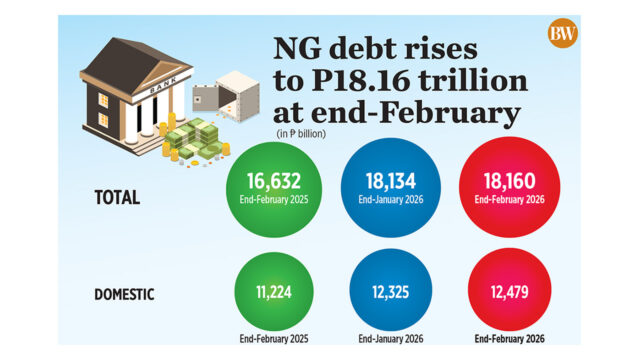
NG debt rises to P18.16 trillion at end-February

THE National Government’s (NG) outstanding debt hit a fresh high of P18.16 trillion as of end-February, reflecting a stable and well-managed debt position, the Bureau of the Treasury (BTr) said on Wednesday. Read the full story.

Peso may stay above P60 on prolonged Iran conflict

REUTERS

THE PESO could hold above the P60 line versus the US dollar this week on continued preference for the safe-haven currency due to the prolonged Middle East conflict.

On Wednesday, the local unit jumped by 58.8 centavos to end at P60.16 against the greenback from its all-time-low P60.748 finish on Tuesday, data from the Bankers Association of the Philippines showed. This came following signals from US President Donald J. Trump on a possible end to Iran war.

Week on week, the peso surged by 39 centavos from its P60.55 finish on March 27. Philippine markets were closed on April 2 and 3 for Holy Week.

For this week, the peso could see some pressure in catch-up trading after the two-day break as Mr. Trump again made fresh threats towards Iran, causing renewed market volatility and flight to the safe-haven greenback.

“[Market players] will continue to monitor developments in the Iran war,” a trader said by phone.

The US’ continued military operations in Iran despite talks of a ceasefire will keep the peso weak, Rizal Commercial Banking Corp. Chief Economist Michael L. Ricafort added in a Viber message.

Meanwhile, the release of March Philippine inflation data on Tuesday (April 7), which likely showed a faster print due to the war’s impact on domestic fuel prices, would also provide the market with leads, the trader added.

A BusinessWorld poll of 18 analysts yielded a median estimate of 3.8% for March headline inflation, faster than the 2.4% in February and 1.8% in the same month a year ago. This is close to the upper end of central bank’s 3.1%-3.9% forecast for the month and its 2%-4% annual target.

If realized, the headline print would be the fastest in 20 months or since the 4.4% seen in July 2024.

The trader sees the peso moving between P60 and P60.50 per dollar this week, while Mr. Ricafort expects it to range from P59.90 to P60.40. — Aaron Michael C. Sy

Cyberattack targeted Italy’s Uffizi but nothing stolen, museum says

EAST CORRIDOR (FIRST CORRIDOR) — UFFIZI.IT

ROME — Florence’s Uffizi Galleries said on Friday they had been hit by a cyberattack earlier this year, but denied a newspaper report that the incident caused a major security breach or theft of data.

The statement came after Corriere della Sera daily reported that the attack had emptied the Uffizi’s servers and prompted the emergency transfer of valuable jewels to the Bank of Italy.

The Uffizi said it had been targeted by a cyberattack on Feb. 1, but added that nothing had been stolen and no information lost. It also denied that the hackers had obtained security maps or that employees’ phones had been infiltrated.

The Uffizi Galleries display some of Italy’s most celebrated artwork, including Botticelli’s Birth of Venus and Primavera paintings, along with Michelangelo’s Doni Tondo.

The museum said the only disruption caused by the attack was linked to the time needed to restore backups, adding that it had released a statement about the incident after it had happened.

Corriere reported that hackers had infiltrated the network of the Uffizi, Palazzo Pitti, and the Boboli Gardens, had taken control of the photographic server and sent a ransom demand to the personal phone of Uffizi director Simone Verde.

The Uffizi said a full backup of the photo server existed.

It also said the closure of a section of the Palazzo Pitti and subsequent removal of valuables to the Bank of Italy was tied to renovation work planned last autumn and had nothing to do with the cyberattack.

The Uffizi added that the replacement of its surveillance cameras mentioned in the article had been recommended by the police in 2024. The upgrade was accelerated after thieves last year targeted Paris’ Louvre Museum, stealing jewels worth $102 million that are still missing, it added.

“The cameras had been in the process of being replaced for a year. The situation was not at all like the Louvre’s. The Galleries did have cameras, but they were analog and are now digital,” the Uffizi said.

In March, three paintings by French masters Pierre-Auguste Renoir, Paul Cezanne, and Henri Matisse were stolen from a museum in northern Italy. — Reuters

Humans have found the keys to Mother Nature’s R&D lab

STOCK PHOTO | Image from Freepik

By Gautam Mukunda

INSIDE National Geographic’s March issue is the photo of a tractor tire dangling from a thread. Not metaphorically, but literally, because the thread is spider silk — five times stronger than steel but produced by genetically engineered silkworms. As National Geographic put it, this “supersilk” is “poised to upgrade far more than our clothing.” They’re right, but the real story is much bigger.

The next wave of economic impacts from the biotech revolution’s isn’t going to come from medicine, but rather the $6-trillion global chemical industry. Tools built to fight disease turn out to be even more powerful when they’re aimed at manufacturing.

Biotechnology was initially all about medicine. Treating cancer or fixing genetic disorders requires altering living systems. Because you can’t do that with a wrench (well, not productively), naturally the first industry to invest heavily in biological engineering was the one that does it every day. And doing anything in the life sciences was initially really hard and expensive since the basic tools had to be invented from scratch.

Pharma was just about the only industry that could afford to keep throwing money against the wall until some of it stuck. Large pharmaceutical companies report gross profit margins around 76%, roughly double the S&P 500 average. Those margins exist because people will pay almost anything for a drug that saves their life. And the industry needed every penny of that cushion. Only about 7% of drugs entering Phase I clinical trials ever reach the market. The other 93% are write-offs.

The failure rate isn’t because pharmaceutical scientists are incompetent. It’s because living systems are almost inconceivably complicated. The human body may be the most complex system in the known universe. Your body contains roughly 37 trillion cells, each running an estimated billion chemical reactions per second. We can predict eclipses millennia in advance and land a robot on a specific crater on Mars. But we can’t reliably predict what a new molecule will do inside humans.

For example, Merck & Co. ran a major clinical trial of its Vioxx drug to prove the painkiller was gentler on patients’ stomachs than older alternatives. Instead, the trial revealed that Vioxx patients had twice the rate of serious cardiovascular events. A second trial, designed to test whether Vioxx could prevent colon polyps, confirmed the cardiac risk. An estimated 88,000 Americans had heart attacks from taking the drug. A painkiller meant to reduce suffering in one organ system was silently destroying another, and nobody saw it coming. This is what happens when you try to engineer a system you don’t really understand.

Decoding human physiology is the Everest of science. But when you’ve been training to climb Everest, normal mountains get a lot easier. Crispr technology has made gene editing fast, cheap, and precise. The cost of reading a human genome has fallen from billions of dollars to about $200, and the cost of writing DNA has dropped by more than a factor of a thousand, following what’s called Carlson’s Curve and outpacing Moore’s Law. (Biotechnologists are the only people in the world who look at Silicon Valley and ask, “Why are you so slow?”)

These tools were developed to fight disease. But an enzyme doesn’t know whether it’s working inside a human body or a fermentation tank. And that’s what opens the door to the chemical industry. Because once you take the human body out of the equation, everything gets easier.

Gaurab Chakrabarti was doing PhD research on a pancreatic cancer drug at UT Southwestern in Dallas when he started talking to Sean Hunt, a chemical engineer at the Massachusetts Institute of Technology, about what biological tools could do outside of medicine. Ten years later — or about the time it would take a pharma company to bring a single drug to market — their company, Solugen, Inc., converts corn sugar into industrial organic acids using enzymes instead of petrochemical processes. They’ve broken ground on a factory in Minnesota that will produce up to 120,000 tons of chemicals a year, backed by a $214-million Department of Energy loan guarantee. In a steel tank, you control the environment, tuning temperature, pH, and inputs. Mistakes stay in the reactor. You don’t need FDA approval. Nobody dies if a batch goes wrong.

The industrial biotech opportunity goes well beyond replacing petrochemicals. Evolution has spent billions of years optimizing biological materials, and some of them have extraordinary properties. Spider silk is just one example. Tooth enamel is harder than steel, ranking above iron, nickel, and silver on the Mohs hardness scale, but built at body temperature from calcium and phosphate. No forge required. The cartilage in your knee has friction 10 to a 100 times lower than ice sliding on ice.

We cannot predict which of these materials will prove commercially valuable first. But making materials that are tougher, slicker, and stronger has been a central endeavor of human science since cavemen first polished rocks. As our ability to engineer biology improves, the catalog of materials that evolution has already prototyped becomes available for industry to exploit.

You don’t need to go to a lab to see the proof of concept. It’s sitting right under your rib cage. Your liver synthesizes proteins, metabolizes toxins, regulates glucose, produces bile, and manages cholesterol, all at the same time, at body temperature, running on nothing but what you eat and drink. No factory on earth can match it. The biotech revolution spent decades trying to harness that kind of power for medicine. The next chapter is harnessing it for everything else. Nature has been running the world’s most advanced R&D lab for billions of years. We’re just now figuring out how to use the results.

BLOOMBERG OPINION

Food security task force to monitor supply, prices during emergency

PHILSTAR FILE PHOTO

THE Department of Agriculture (DA) said it established a food security task force to monitor supply and price disruptions during the energy emergency.

Agriculture Secretary Francisco P. Tiu Laurel, Jr. said in a statement that the task force institutionalizes what had previously been an ad hoc monitoring system within the agency.

“Since the start of the war, we’ve been operating on an ad hoc basis. Now we are formalizing the task force so reports are standardized and more detailed, enabling faster and better decision making,” he said.

The task force will oversee developments in the supply and pricing of essential commodities, as well as track imports and exports. It is expected to produce daily briefings for submission to Congress and the Office of the President.

He said earlier monitoring efforts were conducted on an informal basis following the onset of geopolitical disruptions.

The task force will also assess the impact of shipping disruptions, particularly in the Middle East, on major agricultural exports such as bananas and pineapples.

To mitigate the impact, the DA said it is working with financial institutions, including the Land Bank of the Philippines, to extend assistance to affected exporters.

The DA is also exploring alternative export markets in Africa, Australia, Europe, and Southeast Asia. — Vonn Andrei E. Villamiel

New players, new rules

Market disruptor: SUV chasses on the move in China — PHOTO BY KAP MACEDA AGUILA

Emerging global brands are rewriting the PHL automotive playbook

WHEN I LEFT the Philippines to live in Switzerland back in 2021 at the height of the pandemic, the local automotive landscape still felt familiar — predictable, even. The usual hierarchy held firm, shaped by decades of brand loyalty, and defined by a handful of dominant players.

Returning home in late 2023 however, I was surprised to find an automotive scene that was already significantly different. What had once been a predictable, exclusive sales field among established Japanese, Korean, and European marques had transformed into something far more dynamic — dare I say, even far more crowded. Upon my arrival, I remember noticing showrooms that carried names that were unfamiliar to me. Billboards introduced car brands that just a few years prior would have drawn blank stares from even the most engaged enthusiasts.

Among those leading this new wave are global entrants such as BYD, Jetour, Lynk & Co., VinFast, Omoda, and Jaecoo — each arriving with distinct identities, aggressive strategies, and a clear intent to capture market share. MG, which had already established its presence before my departure, has only strengthened its foothold, evolving from a curiosity into a legitimate volume player, cracking the list of top 10 auto marques in sales. And BAIC’s own trajectory in the Philippines has also taken a notable turn for the better, following a change in its official Philippine distributorship. The brand has begun to reposition itself with a more upscale sensibility while bringing in a more thoughtfully curated model lineup that signals a clear departure from its earlier, more basic market approach.

It seems that this is not simply an age of a strong influx of new brands but a special period of fundamental shifts in the structure of the Philippine automotive industry. For those of us who have observed it over time, the transformation is as striking as it is consequential.

Walk through any major car trade show today and the changing of the field is impossible to ignore. New entrants have arrived with full model lineups from day one, backed by their global manufacturing scale and deep capital reserves. And the ambition of these new players extends beyond niche participation; they are here to compete across multiple segments simultaneously.

For VinFast, the Philippine market represents part of a broader regional expansion strategy, using affordable electric mobility as both its identity and differentiator. BYD, on the other hand, leverages its position as one of the world’s largest electric vehicle (EV) and battery manufacturers to introduce highly reliable electrified vehicles at unprecedented price points.

Meanwhile, the multi-brand strategy of Chery — through Jetour, Omoda, and Jaecoo — allows it to target distinct demographics with greater precision, from practical family buyers to design-conscious urban consumers and even lifestyle off-roaders.

Perhaps one of the most important changes to note is that there has been some major pricing disruption. What truly distinguishes this new generation of entrants is not just their origin, but their pricing philosophy.

For years, Filipino car buyers operated within a clearly defined value equation. Affordability meant compromise, while premium features required a significant financial leap. That equation is now being actively rewritten.

These days, sub-P1-million crossovers are being marketed with features once reserved for higher segments. These can now have large infotainment screens, advanced driver-assistance systems, and elevated interior appointments. Electrified vehicles, from hybrids to BEVs (battery electric vehicles), are being priced within striking distance of their internal combustion counterparts. And it sure is a nice marketing proposition to dangle the benefit of number-coding exemptions on Metro Manila’s public roads.

There is well-thought strategy in all of this. The new entrants are now undercutting established players while actively overdelivering on their product features. They are also accelerating consumer adoption of these new energy vehicles by capitalizing on perceived value. And in doing so, they are compressing traditional pricing tiers — forcing legacy manufacturers into uncomfortable recalibration.

Unlike previous waves of new entrants, many of today’s players are not attempting to outcompete incumbents on their strongest ground. Instead, they have chosen to redefine the battlefield by using electrification as their gateway. Maybe for brands like VinFast and BYD, the Philippines presents a relatively open landscape where no single player has yet established unshakable dominance in the EV space. This creates a rare opportunity to shape consumer perception, define their expectations and build loyalty in a category that is fast changing and still in its formative years. In this sense, one can look at electrification as a form of competitive reset, rather than just a technological shift.

Moreover, I think we can point out that gone are the days of cautious, incremental expansion. Today’s new entrants are moving with speed and intent, fast establishing their dealership networks, forging partnerships with major local conglomerates and investing in after-sales and support infrastructure quite early in their market lifecycle. And for EV-focused brands, this extends to better charging solutions, improving ownership ecosystems, and pushing for greater digital integration.

As a common denominator, the modern automotive proposition is no longer defined solely by the vehicle, but it is also increasingly shaped by the total ownership experience.

So, of course there is pressure on legacy brands. The arrival of these aggressive new competitors is triggering industry-wide reassessment because the Philippine automotive market — long characterized by stability — is now evolving into a far more fluid and cutthroat space. And perhaps this shift is advantageous because it may be gradually tilting the power toward the Filipino consumer.

Having said all that, the road far ahead is still far from guaranteed for these new entrants. After all, the Philippine market has historically rewarded not just innovation, but consistency. Durability, reliability, and after-sales support remain critical to long-term success. For new auto brands to prosper, their early momentum must still be sustained by the tangible Filipino ownership experience. But regardless of individual outcomes, their collective impact has already reshaped the competitive automotive landscape.

What remains to be seen is which players — old and new — will adapt quickly enough to define what comes next.

First Gen says deals vetted amid Lopez, Inc. row

FIRSTGEN.COM.PH

POWER PRODUCER First Gen Corp. said its deals undergo “transparent and rigorous evaluations” and are approved by its board, amid disputes within the Lopez family’s holding company.

“First Gen would like to emphasize that it enters into contracts and agreements only after conducting transparent and rigorous evaluations, and only upon thorough review and approval by its Board of Directors,” the company said in a statement on Sunday.

The statement comes as the 71% majority of Lopez, Inc. — the ultimate parent company of the Lopez Group — raised concerns over transactions carried out under the leadership of the group’s president and chief executive officer, Federico “Piki” R. Lopez.

A court order temporarily blocked his ouster and allowed him to remain in his post.

Lopez, Inc. is the Lopez Group’s private holding company and parent of businesses including publicly listed firms Lopez Holdings Corp. and First Gen.

Mr. Lopez currently serves as chairman of First Gen, the largest clean and renewable independent power producer in the Philippines.

As a publicly listed company, First Gen said it strictly follows the law to ensure all stockholders have equal access to material information. This includes infrastructure deals with Enrique K. Razon, Jr., which were unanimously approved by the entire board, First Gen said. — Sheldeen Joy Talavera

Aboitiz says Laguindingan airside operations upgraded

PHILSTAR FILE PHOTO

ABOITIZ InfraCapital, Inc. (AIC) said it has carried out airside upgrades at Laguindingan International Airport (LIA) to improve safety and operational efficiency.

“While these improvements take place behind the scenes, they play a critical role in delivering a seamless passenger journey at Laguindingan International Airport,” AIC Vice-President and Head of Airports Rafael M. Aboitiz said in a media release on Sunday.

The company, the infrastructure arm of the Aboitiz group, upgraded the airport’s apron — the paved area for aircraft parking — to provide clearer guidance for aircraft and ground personnel.

“These improvements help streamline aircraft movement on the ground, contributing to more efficient turnarounds and minimizing potential delays,” AIC said.

“These latest airside upgrades build further on recently completed runway works at LIA, which have included the repainting of apron bollards and pedestrian lanes, as well as runway inspections, rubber removal, and crack repairs to ensure optimal surface conditions for aircraft operations,” it added.

AIC also operates the Bohol-Panglao International Airport. — Ashley Erika O. Jose

Gov’t debt yields go down on de-escalation hopes

YIELDS on government securities (GS) mostly went down last week as market sentiment improved slightly after US President Donald J. Trump said they could end their attacks on Iran within two to three weeks.

GS yields, which move opposite to prices, fell by an average of 4.77 basis points (bps) week on week at the secondary market, according to PHP Bloomberg Valuation Service Reference Rates as of April 1 published on the Philippine Dealing System’s website.

Philippine financial markets were closed on April 2 and 3 for the Holy Week break.

At the short end, yields were mixed. Rates of the 91- and 182-day Treasury bills (T-bills) rose by 0.43 bp to 4.9897% and 5.58 bps to 5.1253%, respectively. Meanwhile, the 364-day tenor slipped 1.02 bps to yield 5.1803%.

Rates at the belly declined across the board, with the two-, three-, four-, five-, and seven-year Treasury bonds (T-bonds) dropping 5.17 bps (to 5.9636%), 7.53 bps (6.2524%), 8.33 bps (6.4624%), 8.63 bps (6.6218%), and 12.28 bps (6.7919%), respectively.

At the long end, the rate of the 10-year tenor went down by 18.86 bps to 6.8308%, while yields on the 20- and 25-year debt papers rose by 2.09 bps to 7.0237% and 1.27 bps to 7.0168%, respectively.

GS volume traded dropped to P69.43 billion last week from P73.59 billion previously.

“The week started with a defensive tone in the GS market, reflecting global uncertainty and elevated risk premiums. However, sentiment gradually shifted to a more constructive stance. This was driven by ‘risk-on’ positioning following headlines suggesting Donald J. Trump may push for a resolution to the Middle East conflict,” Lodevico M. Ulpo, Jr., vice-president and head of fixed income strategies at ATRAM Trust Corp., said in a Viber message.

“As a result, investors began to price in potential easing of geopolitical risks, which supported bond prices and pulled yields lower toward the latter part of the week.”

However, higher oil prices and uncertainty about inflation kept investors cautious, he said.

The US rescued an airman missing from one of two warplanes downed in Iran, two US officials said, as Mr. Trump and Israel stepped up pressure on Iran to open the strategic Strait of Hormuz or face attacks on energy facilities, Reuters reported.

The airman was the second member of a two-person crew of an F-15 jet that Iran said on Friday was brought down by its air defenses. Reuters reported on Friday that the first member of the crew had been recovered.

Mr. Trump has sent mixed messages ranging from hints of diplomatic progress to threats to bomb the Islamic Republic “back to the Stone Ages” since the US and Iran launched the war on Iran on Feb. 28.

The war has killed thousands, sparked an energy crisis and threatens lasting damage to the world economy after Iran virtually shut the ​Strait of Hormuz, which usually carries about a fifth of global oil and liquefied natural gas.

Meanwhile, the Bangko Sentral ng Pilipinas (BSP) on Tuesday said it expects March inflation to settle within 3.1% to 3.9% due to higher costs for fuel, rice, and electricity and a weakening peso.

At the upper end of the forecast, inflation may have accelerated to its fastest pace in over two years or since the 4.1% in November 2023. It would also match the headline inflation logged in May 2024.

Meanwhile, the lower end would be the quickest print in 19 months or since the 3.3% clip in August 2024.

A BusinessWorld poll of 18 analysts yielded a median estimate of 3.8% for the March consumer price index in March, faster than the 2.4% in February and 1.8% a year ago.

The Philippine Statistics Authority is scheduled to release March inflation data on Tuesday (April 7).

“BSP’s guidance that inflation stayed above target kept short-term yields firm as rate cuts remain delayed,” Jonathan L. Ravelas, a senior adviser at Reyes Tacandong & Co., said.

“Oil prices, Middle East risks, peso weakness, and government borrowing also drove markets.”

Mr. Ulpo and Mr. Ravelas added that US Federal Reserve Chair Jerome H. Powell’s wait-and-see stance on the impact of the Iran war on inflation in the world’s largest economy also affected the market.

“The emphasis on monitoring inflation risks, particularly those stemming from the Middle East conflict kept global yields elevated,” Mr. Ulpo said.

For this week, they said the market will continue to monitor developments in the conflict.

“The yield curve is likely to remain sensitive to external developments, particularly geopolitical news flow and movements in global oil prices. These factors will continue to influence inflation expectations and, in turn, global yield direction,” Mr. Ulpo said.

He said the upcoming maturity of five-year bonds on April 8, which will free up P240 billion in liquidity, “could provide technical support to the market as reinvestment flows come into play.”

“We see a mildly flatter curve — front-end rates sticky, longer tenors supported — with investors focused on inflation data, the peso, and any shift in Fed or BSP messaging,” Mr. Ravelas added. — Isa Jane D. Acabal with Reuters


Philippines’ Manufacturing PMI hits three-month low in March

PHILIPPINE FACTORY activity in March slumped to a three-month low in March as output and new orders declined amid the war in the Middle East, S&P Global said on Wednesday. Read the full story.

Style (04/06/26)


Rustan’s has summer scent suggestions

RUSTAN’S has a number of scent suggestions for summer. For fragrance there is Seductive Blue for Women Eau de Toilette from Guess, a floral fruity scent. Crisp pear and Italian bergamot open the fragrance, followed by a heart of dewy peony petals, upcycled rosewater, blue freesia, and cyclamen, finishing with plum, silky musk, amber, and patchouli from Indonesia. Meanwhile Tommy Eau de Toilette from Tommy Hilfiger blends lavender and citrus with a heart of apple and cinnamon, finished with a woody patchouli base. Moonlight Cherry Eau de Parfum from Van Cleef & Arpels explores a contrasting composition centered on cherry, layered with bitter almonds, rum accord, black coffee, vanilla, and musk. Kenzo Parfums presents L’Eau Pure Eau de Parfum, blending Italian mandarin and lemon with Provençal white lavender, musk, and Australian sandalwood, all set around the aquatic molecule Aquozone. Replica Never-ending Summer Eau de Toilette from Maison Margiela is a solar citrus fragrance featuring a refreshing spritz accord layered with bitter orange, vetiver, and spicy ginger essence. For updates, follow @RustanMarketingCorp on Facebook and Instagram.


COS unveils S/S 2026 collection in Korea

COS RETURNED to the runway for its first show in Korea, presenting the house’s Spring/Summer 2026 collection in Seoul, following itinerant shows across Europe and four consecutive appearances on September’s New York Fashion Week schedule. Exploring the language of cinematic beauty, each piece reflects a balance of 1980s and ’90s nostalgia. Forty distinctive looks revealed a palette of slate greys, warm browns, creams, and whites, establishing tonal harmony and a sense of understated uniformity. Accents of blue and deep oxblood red punctuated the collection with richness and depth. Leather and technical fabrications carry a subtle sheen, emphasizing intentional drape and sculptural form; paper-like surfaces introduce crinkled tactility, while linen adds textural depth. In womenswear, a distilled simplicity reminiscent of ’90s minimalism clarifies the silhouette, softened by fine, sheer ribbed knits across dresses and coordinating styles, while strong shoulders introduce a subtle nod to ’80s power dressing. Signature tailoring is reimagined through fluid fabrics and controlled draping, as trompe l’oeil denim, rendered in silk, offers a modern interpretation of set dressing. Silk recurs throughout the collection: softly pleated in the atelier, sculpted into an off-shoulder gown, and expressed through a signature shirt. Material manipulation continues throughout softly gathered looks, elegantly draped on the stand, while transitional outerwear creates a contrast between classicism and modernity, innovation and artistry. The looks are completed with supple leather plimsolls, architecturally heeled mules, and bags crafted in complementary fabrications. In Menswear, transitional outerwear evokes a sense of modern heritage, while relaxed tailoring, cut in slimmer silhouettes, captures skillful construction. Pared-back utility references emerge through functional detailing, while tonal ensembles inspired by ’80s styling offer a fresh interpretation of the contemporary uniform. Suede introduces a quiet yet assured sense of luxury to warm-weather dressing. Accessories finish the looks with timeless soft leather sandals and effortless loafers. A selection of the show items is available immediately at COS stores and on cos.com.


LA Dodgers, Uniqlo announce partnership

THE Los Angeles (LA) Dodgers and global apparel retailer Uniqlo have agreed to a historic partnership, which includes a display of the name “Uniqlo Field at Dodger Stadium” in the ballpark. Under the agreement, Uniqlo will have naming displays in various stadium locations including above the batter’s eye in center field, on the facade beneath the press box, and on the grass along the baselines. With a scope wider than typical sports sponsorships, the new partnership includes: An in-stadium event that will be hosted early in the coming season at Uniqlo Field at Dodger Stadium. This will be a large-scale event, introducing Uniqlo to thousands of Dodgers fans with giveaways of Uniqlo LifeWear items. Uniqlo also plans to create dedicated in-store spaces at select locations in California, with a focus on the Los Angeles area, to showcase and promote the partnership. Uniqlo and the Dodgers are also now working on a range of community-impact initiatives that specifically benefit the citizens and communities of Los Angeles, with a key focus on the next generation. Details will be announced around May.

ADVERTISEMENT
ADVERTISEMENT