Ikea opened its biggest store in the world in the Philippines, with the new 730,000 square foot facility in Manila a cornerstone of the home-furnishings giant’s expansion plans in Asia.
Thursday’s opening was feted with an event held at the store’s cafeteria attended by Philippine trade secretary Ramon Lopez and foreign minister Teodoro Locsin, where Ikea’s cult-favorite Swedish meatballs were served to some attendees. They were accompanied for the big day by a special Philippine twist — adobo sauce.
Ikea is sticking to COVID-19 protocols after the store’s opening was delayed amid the pandemic, with an online booking system that’s full for the next two weeks, according to store manager Georg Platzer. Customers have to wear masks and observe distancing.
The spread houses a two-level 270,000 square foot store, dining area and showroom; warehouses; an e-commerce facility; and a call center. It’s on property leased out by SM Prime Holdings Inc.’s Mall of Asia.
Its opening comes as Ikea has expanded its e-commerce presence — which proved timely during the pandemic — with online orders now accounting for 26% of its global sales. The company, which has more than 460 physical stores in about 60 markets, is planning to add nearly 60 more locations in the current financial year. And it’s not just looking toward Asia: It will take its first step into South America this spring, opening a branch in Santiago, Chile.
Platzer said the Philippines had “been the right spot on our map for the longest time.”
“It was always a plan to come to the Philippines,” he said. “It’s a very good growing economy, growing middle class and domestic environment that’s good for us as a home furnishing retailer. I think it’s about time to open it, finally.”
Household spending fueled the Philippine economy’s recovery last quarter, with consumption expected to grow further in the fourth quarter as virus curbs are eased in time for the holidays. However, output isn’t expected to return to pre-pandemic level until the latter half of 2022.
The Manila store was initially scheduled to open in 2020, but faced delays due to COVID-induced movement restrictions and the disruption of construction material supplies. It’s part of a move to expand in Asia, with the brand recently unveiling its second store in India.
The Philippine debut comes despite Ikea forecasting a more difficult year ahead in 2022, due to logistics logjams and price spikes of raw materials brought about by the pandemic.
Local government officials and employees during the ribbon cutting ceremony.
Despite the supply crunch and challenges keeping stores and warehouses stocked, the company managed to report record sales last year. Chief Executive Officer Jon Abrahamsson Ring of Inter Ikea, the brand’s worldwide franchiser, told Bloomberg in October that his vision was to make Ikea “even more affordable” by shifting a larger share of new products to a lower price segment. — Bloomberg
The metaverse will soon be a place to not just buy virtual goods and meet avatars, but to also get essential public services, as governments prepare to enter the rapidly expanding digital world despite concerns about privacy and other rights.
The city of Seoul and the island nation of Barbados earlier this month said they will enter the metaverse to provide administrative and consular services, respectively.
Other cities and countries may follow suit if the technology becomes more mainstream, analysts say.
The statements came amid a flurry of announcements from companies including Facebook — now named Meta — saying they would invest in the metaverse, an online realm that uses augmented and virtual reality (VR) to help users interact.
“It is in the best interest of governments to know about this universe intimately because the virtual world will replicate life and business,” said Keith Carter, an associate professor at the National University of Singapore’s School of Computing.
Metaverse — a term first coined in science fiction — is a combination of the prefix “meta,” meaning beyond, and “universe.”
It has been used to describe a range of shared worlds accessed via the internet, from fully-immersive VR spaces to augmented reality accessed through devices such as smart glasses.
The global metaverse market is expected to reach about $6 billion this year and nearly $42 billion by 2026, according to research firm Strategy Analytics, helped by increased interest in virtual spaces for work and leisure during the pandemic.
There will be new roles for governments in this space where jurisdiction isn’t as clearly defined, said Steve Benford, a professor of computer science at the University of Nottingham.
“Cybersecurity, freedom and protection of information, and online safety are issues that governments are already interested in, and this list can be expected to grow if and when the metaverse becomes an everyday experience for people,” he said.
“Governments are already shaping policies that will impact the metaverse, so arguably they have a duty to be visibly present in it for reasons of accountability,” said Mr. Benford, who co-founded the Mixed Reality Laboratory at the university, which studies and creates interactive technologies for daily life.
CIVIL COMPLAINTS
Seoul is the first major city to announce its entry into the metaverse, with the Seoul Metropolitan Government (SMG) building a “metaverse ecosystem for all administrative services regarding the economy, culture, tourism, education and civil complaints.”
Metaverse Seoul, a platform for public services, is scheduled to be complete by the end of next year. A virtual city hall, where citizens can meet avatars of public officials and file complaints, will be set up in 2023, it said in a statement.
Barbados will open what it says will be the world’s first metaverse embassy in the virtual reality platform Decentraland, with embassies on other platforms also planned.
“We are a small island nation — this gives us a way to expand our diplomatic footprint without adding dozens of physical embassies, which is not feasible for us,” said Gabriel Abed, who is leading the Caribbean nation’s metaverse strategy.
“It gives us diplomatic parity with larger nations, and a fully immersive way to showcase our culture and business opportunities, while being fully in control of our environment,” said Mr. Abed, who is also ambassador to the United Arab Emirates.
Smaller nations have a lot to gain in the metaverse, he said, noting that Barbados was also quick to embrace a digital currency, like other small nations including Malta, the Bahamas, and El Salvador.
“COVID really shook up the world. Who knows when the next pandemic or lockdown will come — we cannot afford to not try out new technologies that can help us overcome these limitations,” he told the Thomson Reuters Foundation.
LIMITED OPPORTUNITIES
While it is unclear whether a full replication of real life is possible in the metaverse, or even how long it will take to build, tech and legal experts are divided on who will wield control, and how much cities and national governments can gain.
Users are pushing for an open, decentralized universe, and it is possible that the metaverse might “eventually become its own constituency or jurisdiction, with its own representatives and civil service,” said Mr. Benford.
But governments will have a presence, too, he added.
“Where else will the citizens of the metaverse stage a future protest?”
Governments may also make the metaverse more inclusive, with Seoul saying it will have “numerous services for the vulnerable, including the disabled,” for their safety and convenience. It is also training older citizens to help navigate the virtual world.
But the current technology is not good enough, or cheap enough, so cities “face big costs and no guarantee on returns,” said Tony Matthews, a senior lecturer in urban and environmental planning at Australia’s Griffith University.
“I doubt many cities will be rushing to set up in the metaverse … the opportunities right now are limited and very expensive,” he said, noting that people have been quite resistant to VR since it became mainstream a few years ago.
When the technology gets good enough to encourage widespread uptake, however, major, permanent virtual cities may emerge with their own economies and markets, he said.
In some years, “we might all be as familiar with the cities of the metaverse as London, Paris and Tokyo. That could truly be transformative for real-world cities and their virtual siblings.” — Rina Chandran/Thomson Reuters Foundation
WASHINGTON — The number of Americans filing new claims for unemployment benefits dropped to a 52-year low last week, suggesting economic activity was accelerating as a year ravaged by shortages, high inflation and an unrelenting pandemic draws to a close.
The plunge in claims reported by the Labor Department on Wednesday was, however, exaggerated by difficulties adjusting the data for seasonal fluctuations this time of the year. Still, the labor market is tightening, with jobless rolls shrinking in mid-November to the smallest since March 2020 when the economy was in the grips of the first wave of coronavirus disease 2019 (COVID-19) infections.
The economy’s strengthening tone was confirmed by other data showing strong consumer spending in October as well as business orders for equipment, excluding transportation. The goods trade deficit narrowed sharply last month as exports surged.
But prices remained stubbornly high, with annual inflation jumping by the most in nearly 31 years. The raft of solid reports ahead of Thursday’s Thanksgiving holiday prompted economists to boost their fourth-quarter growth estimates to as high as an 8.6% annualized rate.
“There might be some seasonal adjustment problems, but the handwriting is on the wall and all the anecdotal reports on how companies cannot find the help they need are true,” said Christopher Rupkey, chief economist at FWDBONDS in New York.
“The economy will finish the year with a bang, there is lots to give thanks for.”
Initial claims for state unemployment benefits tumbled 71,000 to a seasonally adjusted 199,000 for the week ended Nov. 20, the lowest level since mid-November 1969.
Economists polled by Reuters had forecast 260,000 applications for the latest week.
Unadjusted claims rose 18,187 to 258,622 last week amid a surge in Virginia, which offset declines in California, Kentucky and Missouri. More volatility is likely over the holiday season.
“The claims series can be noisy and especially choppy around holidays like Thanksgiving when the seasonal factors anticipate large swings in the underlying data,” said Daniel Silver, an economist at JPMorgan in New York. “But even so, initial claims fell by more than a half million over the year through Nov. 20, both before and after seasonal adjustment.”
Claims have declined from a record high of 6.149 million in early April 2020, and are now viewed as consistent with a healthy labor market, though an acute shortage of workers caused by the pandemic is hindering faster job growth.
But there is hope for an expansion of the labor pool. The number of people continuing to receive benefits after an initial week of aid dropped 60,000 to 2.049 million in the week ended Nov. 13, a 20-month low, the claims report showed.
There were 10.4 million job openings as of the end of September. The workforce is down 3 million people from its pre-pandemic level, even as generous federal government-funded benefits have expired, schools have reopened for in-person learning and companies are raising wages.
Stocks on Wall Street fell. The dollar gained versus a basket of currencies. US Treasury prices rose.
BRIGHTENING PICTURE
Signs the economy was regaining momentum after hitting a speed bump in the July–September quarter as coronavirus cases flared up over summer and shortages became more widespread could result in the Federal Reserve quickly winding up its bond-buying program.
Indeed, minutes of the US central bank’s Nov. 2–3 policy meeting published on Wednesday showed some Fed officials would be open to doing so.
“We see the Fed accelerating tapering in January to clear the runway for a September rate liftoff,” said Lydia Boussour, lead US economist at Oxford Economics in New York.
A separate report from the Commerce Department on Wednesday showed gross domestic product rose at a 2.1% rate in the third quarter. That was a slight upward revision from the 2.0% pace estimated in October, but was still the slowest in more than a year. The economy grew at a 6.7% rate in the second quarter.
But that is all in the rear-view mirror. A third report from the Commerce Department showed consumer spending, which accounts for more than two-thirds of US economic activity, jumped 1.3% in October after rising 0.6% in September.
Consumers, buoyed by rising wages and massive savings, bought motor vehicles and traveled, showing no signs yet of holding back because of high inflation.
Global economies’ simultaneous recovery from the pandemic, fueled by trillions of dollars in relief money from governments, has strained supply chains, unleashing inflation.
President Joseph R. Biden. Jr., announced on Tuesday that the United States would release 50 million barrels of crude from the US Strategic Petroleum Reserve to help cool oil prices, in coordination with China, India, South Korea, Japan and Britain.
The personal consumption expenditures (PCE) price index, excluding the volatile food and energy components, increased 0.4% last month after gaining 0.2% in September. In the 12 months through October, the so-called core PCE price index accelerated 4.1%. That was the largest gain since January 1991 and followed a 3.7% year-on-year advance in September.
The core PCE price index is the Fed’s preferred inflation measure for its flexible 2% target.
Adjusted for inflation, consumer spending rose a solid 0.7%.
In another boost to the economy, orders for non-defense capital goods excluding aircraft, a closely watched proxy for business spending plans, rose 0.6% last month, the Commerce Department said in a fourth report.
With corporate profits hitting a record high last quarter, businesses are likely to keep spending.
More goods were exported in October, sharply narrowing the goods trade deficit by 14.6% to $82.9 billion. If the trend holds, trade could contribute to GDP growth this quarter.
Wholesalers continued to rebuild inventories last month though motor vehicle shortages stymied progress by retailers, a fifth report showed.
Inventory accumulation, the key driver of GDP growth last quarter, will likely continue to support the economy. The strong data flow led the Atlanta Fed to raise its fourth-quarter GDP growth estimate to an 8.6% rate from an 8.2% pace. JPMorgan boosted its forecast to a 7.0% pace from a 5.0% rate. — Lucia Mutikani/Reuters
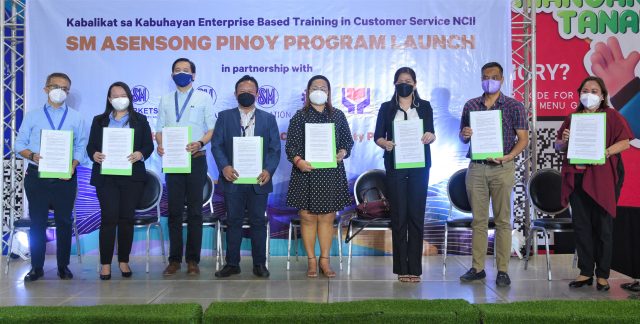
SM Foundation, in partnership with TESDA, DOLE, DSWD, SM Supermalls, and SM Markets, launched the first ever National Certificate (NCII) training program for Customer Service at SM City Pampanga last November 19, 2021.
SM Foundation (SMFI), in partnership with TESDA. DOLE. DSWD. SM Supermalls and SM Markets launched the first ever National Certificate (NC) training program for Customer Service at SM City Pampanga on November 19, 2021. Dubbed as the SM Asensong Pinoy Program, the project aims to strengthen the qualifications of the Filipino workforce and ultimately address various employment issues in the customer service sector.
The program’s curriculum is designed to produce industry efficient retail under the supervision of SM Markets. The first batch of qualified apprentices will train in SM Supermarket, Pampanga, San Fernando, Savemore, Malhacan, Baliwag, SM Hypermarket Clark and Marilao. Those who successfully complete the training course will undergo TESDA’s Customer Care NCIl assessment and passers will be offered an opportunity to continue employment with SM. From there, SM and partner agencies will evaluate the program’s eligibility for expansion to other regions.
“Since 1994, our training programs in TESDA have been giving opportunities to Filipinos to obtain the essential skills they need to get employed. Through the years, we have designed various courses that help prepare hard working individuals perform properly in their chosen fields. Today, we add another program designed to produce an adept essential worker for a high-demand retail job. And SM, known for its expertise in Customer Care Services will strengthen the qualifications of the Filipino workforce and help address unemployment and job-skills mismatch” said Regional Director Balmyrson M. Valdez.
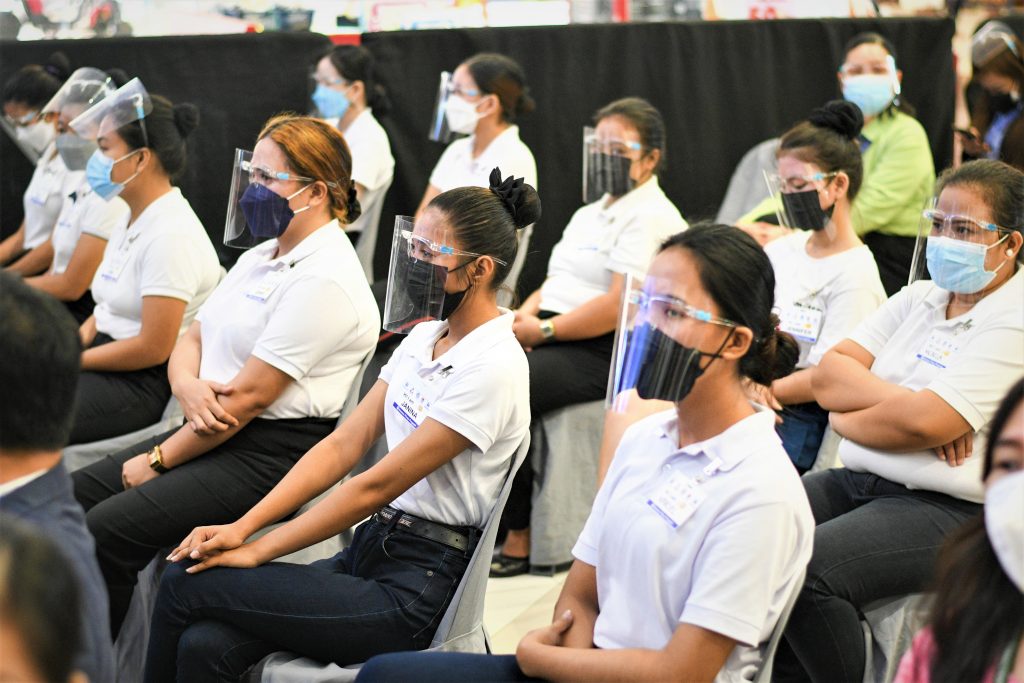
The program is open to 18-28 years old females who have completed at least senior high or 2nd year college levels of education. Trainees under the program will undergo technical, values formation, and hands on training for eight hours a day, six days a week. They are to receive a minimum wage allowance as well as accident insurance coverage, and free NCIl assessment fees. Those who successfully complete the program will receive an SM Partnership Certificate of Training and TESDA’s NCII Certificate of Completion, as well as the opportunity to get hired in by the SM Retail group. The certification will also make them eligible for other local and international employment opportunities in the future.
“Customer Care is one of the most important functions of retail operations and we are very happy to be partnering with TESDA, DOLE and DSWD in sharing our training capabilities to interested individuals. We believe that nurturing the skills of our Filipino workforce will be very beneficial to the whole industry as we all work together to jumpstart our economy.” said SM Supermarket President Jojo T. Tagbo.
While the program is the first of its kind, SM Markets has been a venue for other skills training programs not just for frontline service but also for farmers under SM Foundation’s Kabalikat sa Kabuhayan program and for persons with autism in partnership with Autism Society Philippines. SM Markets continues to serve various sectors by finding opportunities to share its business expertise and unlocking more livelihood opportunities for different communities.
Furthermore, TESDA Secretary Isidro Lapeña expressed his gratitude to SM for this social good collaboration, “One of our long time partners is SM foundation. They have been with us in delivering programs in the communities. Today’s event is another testament to SM’s unwavering commitment in helping the Filipinos through the enterprise-based training apprenticeship program with TESDA Region III.”
“Through this program, our learners will not only expand their skills and knowledge but will also be confident enough to explore bigger opportunities as soon as they complete their training,” he further added.
Aside from bringing sustainable farming skills and agri-opportunities in communities, SMFI, through its Kabalikat sa Kabuhayan, continues to partner with key agencies—both in the private and public sectors—to expand its reach and provide stakeholders from grassroots communities with livelihood opportunities.
Spotlight is BusinessWorld’s sponsored section that allows advertisers to amplify their brand and connect with BusinessWorld’s audience by enabling them to publish their stories directly on the BusinessWorld Web site. For more information, send an email to online@bworldonline.com.
BRUSSELS/PRAGUE — Coronavirus infections broke records in parts of Europe on Wednesday, with the continent once again the epicenter of a pandemic that has prompted new curbs on movement and seen health experts push to widen the use of booster vaccination shots.
Slovakia, the Czech Republic, the Netherlands and Hungary all reported new highs in daily infections as winter grips Europe and people gather indoors in the run-up to Christmas, providing a perfect breeding ground for coronavirus disease 2019 (COVID-19).
New cases have jumped 23% in the Americas in the last week, mostly in North America, in a sign that region might also face a resurgence of infections.
The disease has swept the world in the two years since it was first identified in central China, infecting more than 258 million people and killing 5.4 million.
The European Centre for Disease Prevention and Control (ECDC), the EU public health agency, recommended vaccine boosters for all adults, with priority for those over 40, in a major shift from its previous guidance which suggested the extra doses should be considered for older frail people and those with weakened immune systems.
“Available evidence emerging from Israel and the UK shows a significant increase in protection against infection and severe disease following a booster dose in all age groups in the short term,” the ECDC said on Wednesday.
Many EU countries have already begun giving booster doses but are using different criteria to prioritize them and different intervals between the first shots and boosters.
ECDC head Andrea Ammon said boosters would increase protection against infection caused by waning immunity and “could potentially reduce the transmission in the population and prevent additional hospitalizations and deaths.”
She advised countries with low vaccination levels to speed up rollouts and warned of high risks of a further spike in deaths and hospitalizations in Europe in December and January if the recommended measures are not introduced.
World Health Organization chief Tedros Adhanom Ghebreyesus, acknowledging that Europe was again at the epicenter of the pandemic, warned against a “false sense of security” over the protection offered by vaccines.
“No country is out of the woods,” he told reporters, adding that he hoped a consensus can be found at a World Trade Organization ministerial meeting next week for an IP waiver for pandemic vaccines.
Sweden will begin gradually rolling out boosters to all adults, government and health officials said. Booster shots of mRNA vaccine have been offered to people aged 65 or above, with an eye to eventually extending the shots to other groups.
“We are faced with an uncertain winter,” Health Minister Lena Hallengren told a news conference. “You can contribute by staying home if you’re sick or by getting vaccinated if you haven’t already, and taking your booster when you’re offered it.”
Slovakia reported its highest daily rise in cases on Wednesday when the government approved a two-week lockdown to curb the world’s fastest surge in infections.
Restaurants and non-essential shops will close and movement will be limited to trips for essential shopping, work, school, or medical visits.
“The situation is serious,” Prime Minister Eduard Heger said, “We got here because the [existing] measures were not observed.”
VACCINATION RESERVATIONS
Neighboring Austria has already locked down this week for at least 10 days, becoming the first to reimpose such restrictions. It will also require the whole population to be vaccinated from Feb. 1, infuriating many in a country where skepticism about state curbs on individual freedoms runs high.
The Czech Republic reported its highest daily rise in infections, with cases surpassing 25,000 for the first time. The government is looking to institute mandatory vaccines for people over 60 and some professions, like healthcare workers.
Prime Minister Andrej Babis said on Wednesday the cabinet would debate more measures on Friday.
The Netherlands recorded more than 23,700 coronavirus infections in 24 hours, the highest number since the start of the pandemic, and the government will announce new measures on Friday.
Hungary reported a record 12,637 new daily COVID-19 cases.
Prime Minister Viktor Orban’s government, which opposes further lockdowns for fear of stifling the economy, launched a vaccination campaign this week, offering shots without prior registration.
Authorities in Russia, where daily coronavirus-related deaths are near record highs, said they were scouring social networks and media websites to find people spreading false claims about the dangers of vaccination.
France will announce new COVID measures on Thursday, while Italy is tightening curbs on people who have not been vaccinated, preventing them from going to cinemas, restaurants and sports events in new restrictions that come in from Dec. 6.
Portugal, one of the world’s most vaccinated countries, will give booster shots to a quarter of its population by end-January. Cases there reached a four-month daily high Wednesday.
Deaths remain far below January levels, however, and the infection rate is far lower than in most of Western Europe. — Francesco Guarascio and Jason Hovet/Reuters
Northwin Global City is poised to become Bulacan's first highly urbanized, world-class business district.
By Santiago J. Arnaiz
Last month, property giant Megaworld announced its latest township project, Northwin Global City, a P98-billion, 85-hectare development that aims to transform areas across Marilao and Bocaue, Bulacan into a thriving new global business district. As the company’s 28th township project to date, Northwin Global City promises to set a new golden standard for liveable, sustainable, and green global cities.
Strategically located along the North Luzon Expressway, less than an hour’s travel from many of Metro Manila’s primary business and transportation hubs, Northwin Global City caters first and foremost to the rising demand for commercial real estate in the country. Even as the nation continues on its slow recovery from the ongoing pandemic, businesses seeking to rebound following the rolling lockdowns and community quarantines have driven demand for office space in the Philippines to unexpected heights. According to data from Statista, the second quarter of 2021 saw office space demand in the country rise to 169,000 square meters, presenting a 39% increase in demand year on year.
Much of this demand, driven primarily by the information technology and business process management sector, is clustered around the city of Taguig, which accounts for the highest share of the country’s supply of office space. But while data shows businesses returning to workplaces in earnest as early as 2024, Kevin L. Tan, Megaworld’s chief strategy officer, expects that at least some of them won’t be flocking back to Metro Manila’s congested streets any time soon.
“We envision huge multinational companies to be operating [in Bulacan] once our commercial district and our office towers are completed,” he said. “Northwin Global City’s close proximity to Metro Manila, its ideal location just along the North Luzon Expressway, and the major transport infrastructure will be very favorable for the future locators and residents of this township.”
Catering to the holistic needs of a bustling community of professionals, Northwin Global City will also host residential condominiums, hotels, malls, mixed-use commercial buildings, educational institutions, and state-of-the-art office towers for BPOs and corporate headquarters. Beyond amenities, however, Megaworld’s vision for their latest township is a fully-realized, metropolitan hub for the world’s most innovative businesses. Equipped with the latest smart city technologies and designed to cater to the holistic wellbeing of its professional population, Northwin Global City aims to be a truly liveable city, presenting businesses with fertile grounds to build their futures.
“[We are] building a new city that will put the province of Bulacan on the global business map,” Mr. Tan said. “Finally, our vision of having a truly modern and global business district for Bulacan is coming to a reality.”
A new business hub on the rise
While Mr. Tan expects their new integrated urban township to be completed in the next 15 to 20 years, work is already under way on the development’s central business district, Northwin Main Street.
Patterned after New York City’s Fifth Avenue, the future beating heart of Bulacan’s new global city will see corporate buildings, shophouses, hotels, and commercial towers lining pedestrian-friendly streets and well-curated gardens and parks.
But unlike Manhattan’s sky-blotting skyline, Northwin Main Street will offer a more classical, breathable business district. Inspired by French architecture, the district’s shophouses will be built up to three-storey high, with lot sizes ranging from 250 square meters to 550 square meters. These would house retail, food and beverage outlets such as cafes, restaurants and bars, boutique hotels, and even outpatient clinics. Each shophouse may also offer residential or office space on its top floors.
Meanwhile, commercial buildings, with lot sizes ranging from 450 square meters to 750 square meters, may be built up to five-storey high. These would be exclusively for commercial establishments such as offices or boutique hotels.
Altogether, Megaworld plans to develop 145 prime shophouse and commercial lots across the 16 hectares of green spaces allocated for Northwin Main Street. The company projects sales from this project to reach around P6 billion.
According to Mr. Tan, Northwin Global City’s greenscapes play a pivotal role in their strategy for this latest township. More than pleasant scenery, the gardens and parks of the new global business district speak to a deeper strategy Megaworld has drafted for its vision of the future of business and lifestyle.
A breath of fresh air
As the nation gears up for a post-pandemic economic rebound, Megaworld believes that in order for workforces to deliver their best possible work, they need the best possible workplaces — spaces that provide not only comfort, but cater to the holistic wellness of its professional population. With its abundance of green spaces, Northwin Global City offers precisely that.
Amidst the New York-inspired thoroughfares and European architecture, nearly half of the city’s central business district will be allocated for green and open spaces. Wide, eight-lane main roads and avenues will be flanked by beautiful greenery. City blocks will be connected by promenades and walking parks designed for pedestrians on a stroll or on-the-go. All-in-all, forty percent of the entire township development will be dedicated to these green and open spaces — a massive boost to the Greater Metropolitan Manila’s glaring lack of natural spaces.
In 2019, data from the Department of Environment and Natural Resources showed that out of Metro Manila’s roughly 56,000 hectares, only 12,152 hectares of green space remained in the national capital region, representing 21.7%. In the capital city of Manila, that number was significantly lower, measuring only 3.7%. Studies show that a lack of green and open spaces pose a number of risks to a population’s holistic health, ranging from dangerous heat levels to mental health aggravators.
According to a 2019 report from the World Health Organization, Filipinos businesses lose over P100 billion in absenteeism and presenteeism costs associated with poor employee health. It’s a staggering figure largely shaped by the working environments most companies have little control over.
The scenic vistas along the North Luzon Expressway will transform as Northwin Global City rises.
Megaworld’s plans for a greener city promise a healthier future for its eventual tenants. The World Health Organization found that urban green spaces not only cool down notoriously hot metropolitan areas, called Urban Heat Islands, but also provide safe means of transportation for pedestrians, while promoting healthy physical and social activities among people. At 40 percent, Northwin Global City boasts green spaces even higher than that of world-renowned garden city Singapore. The island state currently has 30% of their land mass covered in greenery.
Amidst a growing mental health epidemic sweeping workplaces, green spaces “can reduce health inequalities, improve wellbeing, and aid in the treatment of mental illness,” the organization said. “Some analysis suggests that physical activity in a natural environment can help remedy mild depression and reduce physiological stress indicators.”
Megaworld’s commitment to building the metropolitan business hub of the future goes beyond green spaces as well. As part of its “iTownship” suite of innovations for sustainable modern living, Northwin Global City will also be fitted out with fiber optic and underground cabling systems for utilities, solar-powered LED street lamps for power efficient lighting, a modern sewage treatment plant, a central material recovery facility for waste recycling, an Intermodal Transport Terminal, and biking network facilities to integrate with its city-wide bike lanes.
Similarly, a state-of-the-art stormwater detention facility will be integrated into Northwin Global City’s infrastructure, to ensure the city’s year-round protection from annual floods. Earlier in July, continued rains saw work suspended and families displaced across Bulacan due to flood waters rising up to three meters. The floods affected 79 villages in the province, including 13 in Bocaue. With this latest township, Megaworld sees Northwin Global City as an opportunity to present the region’s most ambitious companies with a truly modern, resilient global city they can thrive in for decades to come.
Centrally located, infinitely accessible
Megaworld’s new township imagines a future they believe businesses will embrace wholeheartedly, both due to the promise it holds as a holistically designed global city and the convenience it offers with its central location, accessible to many of the infrastructural projects cropping up over the next few years.
“Since the township is just conveniently located along the North Luzon Expressway, and just 20 kilometers away from Metro Manila, this will be the nearest business district outside of the capital where companies and businesses can build their shops and offices,” said Noli D. Hernandez, Megaworld’s executive vice-president for sales and marketing. “We also encourage entrepreneurs to become part of this global business district, which will soon be just 20 minutes away from the much-anticipated New Manila International Airport in Bulacan.”
The new global business district will also host the Marilao-Bagong Ilog station of the Manila-Clark Railway project, the multibillion peso railway project expected to be fully operational by 2024. Future residents, locators, and visitors will be able to easily travel to Northwin Global City from not only Metro Manila but also areas as previously difficult to reach as Clark International Airport.
In fact, by the time it’s completed, Northwin Global City’s strategic location places it within easy travel distance from three international airports — in Bulacan, Clark, and Metro Manila — making it the perfect hub for multinational companies operating across regions.
Commuters will be able to travel to Northwin Global City by taking the Marilao Exit along the North Luzon Expressway, just five minutes away from the Philippine Arena. From the Ninoy Aquino International Airport, Makati Central Business District, and Bonifacio Global City, Northwin Global City can also be easily accessed via the Skyway 3. Under normal traffic conditions, commuters can expect travel times of less than an hour.
With this latest development, Megaworld is making a big bet on Bulacan, and for good reason. With its suite of “iTownship” innovations, abundance of green space, and central location, Northwin Global City promises to be both a shining addition to its impressive portfolio of township projects, as well as an exciting new setting for innovators and incumbents to build the future of business in the Philippines and beyond.
Spotlight is BusinessWorld’s sponsored section that allows advertisers to amplify their brand and connect with BusinessWorld’s audience by enabling them to publish their stories directly on the BusinessWorld Web site. For more information, send an email to online@bworldonline.com.
INFRASTRUCTURE SPENDING in September went up by 25% as the government ramps up construction activities before the election ban on public works in March next year, preliminary data from the Department of Budget and Man-agement (DBM) showed.
Infrastructure and other capital outlays rose to P71.2 billion in September from P56.9 billion in the same month last year. The figure is also a tad higher than the P70.9 billion posted in August 2021.
Higher infrastructure spending can be attributed to preparations for the May elections, especially in anticipation of an election ban on some public works starting in March, Rizal Commercial Banking Corp. (RCBC) Chief Econo-mist Michael L. Ricafort said in a Viber message.
He said this further increases the infrastructure spending done to stimulate economic recovery from the effects of the pandemic.
The Commission on Elections (Comelec) said public works ban for the May national elections will run from March 25 to May 8, 2022. The public works ban covers disbursement and spending as well as construction activity. This is aimed at preventing politicians from using state resources for their election campaign.
UnionBank of the Philippines, Inc. Chief Economist Ruben Carlo O. Asuncion said the coming elections is the major reason for the spending spike.
“I am assuming that with 2021 almost done, infrastructure spending is being pushed harder. Plus, the current administration is soon stepping out and infrastructure development, its major policy centerpiece, is being maxim-ized,” he said in a Viber message.
In the first nine months of the year, infrastructure and capital outlays spending increased by 42.1% to P641.5 billion from P451.5 billion last year. This is also 8.86% higher than the programmed P589.3 billion.
In the third quarter alone, infrastructure spending went up by 39.9% to P214.9 billion from P153.5 billion last year. Third-quarter spending was also 26.6% higher than the programmed P169.7 billion.
“Growth could still be sustained as the elections draw closer, as well as to further pump-prime the economy to speed up the creation of more jobs and help expedite the economic recovery,” Mr. Ricafort said.
Infrastructure spending growth would likely continue its pace in the coming months, Mr. Asuncion said.
The government set a P1.02-trillion infrastructure budget for this year, which represents around 5.1% of the gross domestic product (GDP).
The Development Budget Coordination Committee raised the spending cap on the infrastructure program to P1.29 trillion or 5.8% of GDP for 2022.
Under the proposed 2022 national budget approved by the House of Representatives, P1.18 trillion was set aside for infrastructure.
THE PHILIPPINES’ balance of payments (BoP) position stood at a $1.141-billion surplus in October, the biggest surfeit in six months, according to the central bank.
Data released by the Bangko Sentral ng Pilipinas (BSP) on Tuesday evening showed the BoP surplus narrowed by 66.8% from the $3.435-billion surfeit in October 2020. This was the widest since the $2.614-billion surfeit in April, and a reversal of the $412-million gap in September.
“The BoP surplus in October 2021 reflected inflows arising mainly from the National Government’s net foreign currency deposits with the BSP and the BSP’s income from its investments abroad,” the central bank said in a state-ment.
The narrower trade surplus in October compared with a year ago shows that trade and investment have yet to return to their pre-pandemic levels, UnionBank of the Philippines, Inc. Chief Economist Ruben Carlo O. Asuncion said.
“Note that BoP is still consistent with the BSP’s humongous gross international reserves (GIR) and government borrowings,” Mr. Asuncion said in a Viber message.
In the first 10 months of 2021, the BoP position posted a $476-million surfeit, significantly lower than the surplus worth $10.313 billion seen in the same period of 2020.
Security Bank Corp. Chief Economist Robert Dan J. Roces said the BoP data suggests the economic recovery, as seen through trade, is still at its early stages.
He also pointed out that the October surfeit reflected the peso’s relative rebound versus the greenback during the month.
The local unit ended trading at P50.415 on Oct. 29, appreciating by 1.15% or 58.5 centavos from its P51 finish on Sept. 30. However, it was still weaker by 4.98% than the P48.023 close seen on Dec. 29, 2020.
“Against the backdrop of the nascent recovery, we expect the BoP to end the year in a small surplus and pointing to a weakening of the peso,” Mr. Roces said in a Viber message
At its end-October position, the BoP reflects the country’s GIR of $107.89 billion, increasing by 1.2% from the $106.6 billion as of end-September.
This level of foreign exchange buffers is enough to cover 7.9 times the country’s short-term external debt based on original maturity and 5.5 times based on residual maturity, the central bank said.
It is also equivalent to 10.8 months’ worth of imports of goods and payments of services and primary income.
Based on BSP projections, the BoP is expected to reach a $4.1-billion surplus by the end of this year. — Luz Wendy T. Noble
THE PHILIPPINES is poised to end the year with a stronger economic growth, after a better-than-expected third quarter, experts said at the BusinessWorld Virtual Economic Forum (BW VEF) on Wednesday.
However, questions remain whether the country’s economic rebound is gaining solid traction as experts cited elevated inflation, growing debt and industry losses as risks to growth.
“Given the new third-quarter GDP (gross domestic product), it looks like growth could be a little bit higher than what we were expecting, so probably somewhere between 5% to 5.5% [this year],” Sagarika Chandra, director for Asia-Pacific Sovereigns at Fitch Ratings said at a panel discussion on the first day of the BW VEF.
Fitch’s latest GDP outlook is more bullish than its 4.4% estimate given in October, and the 4-5% full-year growth target of the government.
Moody’s Analytics Chief Asia-Pacific Economist Steven Cochrane said the GDP forecast for this year “will be up a little bit” from its earlier estimate of flat 4% GDP growth.
“We actually were looking at 2023 [for the GDP to return to its pre-pandemic level. But then the improvement in the third-quarter number has improved the outlook, enough to bring this back to the end of next year,” he said during the same panel discussion.
Iluminada T. Sicat, senior assistant governor at the Monetary Policy Subsector of the Bangko Sentral ng Pilipinas, said the country’s resilient banking industry will help to boost recovery through improved credit activity.
“The banking system is reasonably well-capitalized and well-provisioned. Hence, banks will continue to be in a position to continue lending to support the economy,” she said.
The Philippine economy expanded by 7.1% year on year in the July to September period, beating market expectations. It also rose by 3.8% quarter on quarter.
In a statement sent Tuesday evening, the Finance department cited the wide range of third- quarter GDP growth estimates of 26 private economists it was tracking as a sign of current uncertainty.
The statement quoted Finance Undersecretary Gil S. Beltran, the department’s chief economist, as noting that the analysts’ closest projection of 6.5% was still off by 0.6 percentage point from the third quarter’s actual 7.1%. “The wide range of outlook… shows high level of uncertainties,” Mr. Beltran said.
He said that better management of COVID-19 risks through more directed local lockdowns and increased vaccination “should be able to help in the safe and gradual reopening of the economy and bring back investor confidence.”
The third-quarter growth rate, he added, show “sustained recovery” despite two weeks of strict lockdowns in Metro Manila and adjacent provinces in the same period.
Still, experts warned that it is too early to say if the country is headed for a sustained, solid recovery.
Changyong Rhee, director of the Asia-Pacific Department at the International Monetary Fund, said that medium-term scarring stands out in many emerging and developing economies in Asia.
“The divergence between Asian advanced economies and emerging and developing economies is deeply affected by differences in policy support and vaccination coverage,” Mr. Rhee said in his keynote speech at the BW VEF.
Moody’s Analytics’ Mr. Cochrane said it might take until 2026 for the Philippines to return to its pre-pandemic growth trend, reflecting the economic scars from the pandemic.
Meanwhile, Fitch’s Ms. Chandra said the Philippines saw the steepest decline in terms of investments in the region, which is crucial to economic growth.
In July, Fitch downgraded its outlook to the country’s “BBB” rating from “stable” to “negative,” citing the impact of the prolonged pandemic crisis.
“We’re still a bit cautious on our internal forecasts. It might have just been a bump, just the base effect,” she said.
The economy shrank by a record 9.6% in 2020.
SUSTAINABILITY IS KEY
Meanwhile, some of the country’s top CEOs are optimistic that 2022 will be a better year for the business sector, as they see sustainability as a driver of economic growth and long-term profitability.
“For our business clients, we aim to accelerate their ESG (environmental, social, and governance) awareness and we together we hope to achieve growth and profitability through the adoption of these principles and another E for economic growth,” Bank of the Philippine Islands President and Chief Executive Officer (CEO) Jose Teodoro “TG” K. Limcaoco said at a separate panel discussion at the BW VEF.
“Businesses should be making sure that profitability is not the only thing they are looking out for, it’s making sure that people are taken care of,” he added.
While he has a positive outlook for next year, Mr. Limcaoco noted some caution should still be applied as there are still COVID-19 cases and there is a need for booster shots.
Joseph Sigelman, chairman and CEO of the AG&P Group, said the company is now “above pre-pandemic levels” in terms of infrastructure rollout and construction business.
“I think we see a very, very strong pipeline for all sorts of infrastructure development, which lays the foundation for future growth,” he said.
Jaime T. Azurin, president and CEO of Meralco PowerGen Corp., noted energy consumption is now nearer the pre-pandemic level.
“In the power generation business, it will take decades for us to be able to switch into a sustainable energy. We have to ensure in just affordable and orderly transition, because investments are huge, and we have to continu-ously provide electricity to a growing economy like the Philippines,” he said.
Raoul Antonio E. Littaua, president and CEO of Insular Life Assurance Co., Ltd., said he hopes the pandemic has made policy makers realize the need to incorporate financial education in schools.
“There’s the threat of new variants and even new pandemics… I think the number one concern next year is to more effectively reach the 90% of Filipinos who are either uninsured or under insured,” he said.
Miguel G. Belmonte, president and CEO of BusinessWorld, in his opening remarks said the road to the country’s full recovery will be “full of bumps and turns (but) experts see many signs of hope, the so-called light at the end of the tunnel.” — Luz Wendy T. Noble
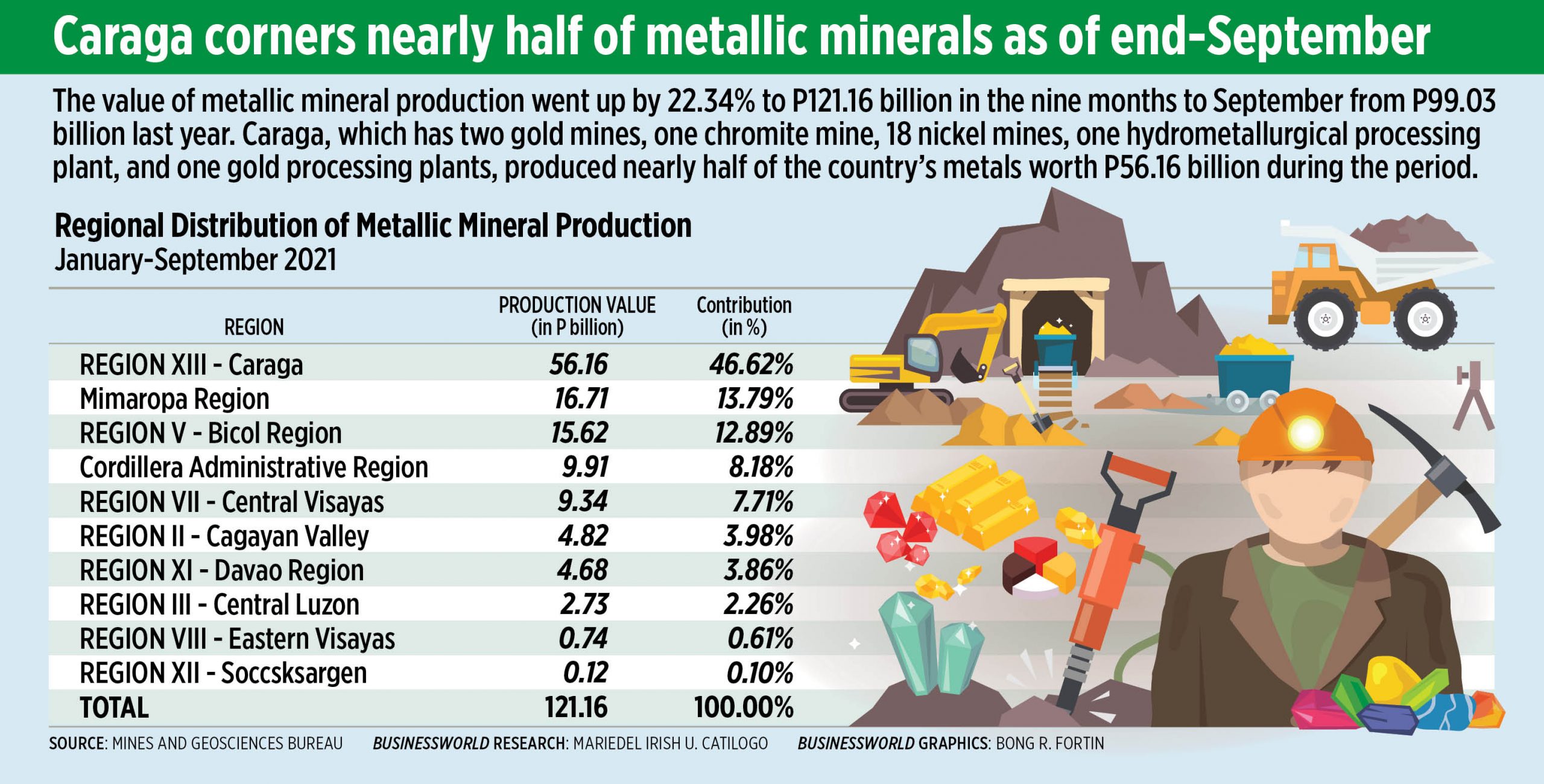
THE VALUE of the Philippines’ metallic mineral production jumped by 22.34% to P121.16 billion in the first nine months of 2021, thanks to strong metal prices and higher production of select metals, according to the Mines and Geosciences Bureau (MGB).
“The strong metal price coupled with the better mine production of nickel ore during the review period was the vital factor for this development,” the MGB said in a report on Wednesday.
MGB data showed nickel and its other by-products had the biggest share in terms of overall production value at 58.5% or P70.83 billion. Gold accounted for 31.2% or P37.75 billion, while copper made up 9.7% or P11.74 billion. The combination of silver, chromite, and iron ore accounted for less than 1% or P840.76 million.
Production volume of nickel direct shipping ore went up by 29% year on year to 325,848 metric tons (MT) and was valued at P46.05 billion.
The nine-month average price of nickel rose by 38% year on year to $18,035.15 per MT compared with $13,059.28 per MT last year.
“In terms of mine regional production, Caraga Region, the nickel capital hub of the Philippines, accounted for 76% with 248,001 MT, followed by Mimaropa with 17% or 54,936 MT, while Regions III and VIII accounted for 6% or 18,939 MT and 1% or 3,971 MT, respectively,” MGB said.
Gold production for the nine-month period inched up by 3% year on year to 13,356 kilograms from 12,973 kilograms last year.
MGB noted the average gold price during the nine-month period went up by 3.8% year on year to $1,801.97 per troy ounce versus $1,735.39 per troy ounce in 2020.
Among provinces, the Bicol Region accounted for 40.89% or 5,462 kilograms, followed by Cordillera Administrative Region (CAR) at 15.10% or 2,017 kilograms, and Caraga Region at 14.91% or 1,991 kilograms.
In contrast, copper output dropped by 18% year on year to 38,025 MT from 46,520 MT after the deficit recorded by Philex Mining Corp. and Carmen Copper Corp.
However, the decline in copper production was offset by the 57% year on year increase in its average price to $9,187.81/MT.
“Another optimistic development is the renewal of the Financial or Technical Assistance Agreement (FTAA) of OceanaGold (Phils), Inc. last July 2021. Its re-entry to the production stream will naturally boost not only copper but also gold and silver output,” MGB said.
Silver output also slipped by 5% year on year to 16,875 kilograms, but the average silver price rose by 34.2% to $25.77 per troy ounce.
Production of chromite declined by 59% to 10,816 dry metric tons (DMT) while iron ore output fell 33.5% to 28,474 DMT.
Meanwhile, MGB said the total area covered by mining tenements as of end-October is at 2.48% or 745,685.48 hectares out of the country’s total land area of 30 million hectares.
There are 313 approved mineral production sharing agreements (MPSA) to date, following the issuance of Executive Order No. 130 that lifted the moratorium on new mining projects, the MGB said. These MPSAs cover a land area of 576,482.65 hectares.
“MGB is working diligently on the formalization and declaration of the new Minahang Bayan (MB). At this time, 43 MBs have already been declared all over the country with 170 pending applications,” it said. Of the declared MBs, there are 13 in Luzon, three in Visayas, and 27 in Mindanao.
Sought for industry comment, Chamber of Mines of the Philippines Chairman Gerard H. Brimo said opportunities for the mining industry will continue to outweigh risks in 2022.
“We see opportunities will continue to outweigh risks in 2022 as governments invest in stimulus activities to revive economies battered by the pandemic and as the drive to transition to clean energy alternatives accelerates,” Mr. Brimo said in a mobile phone message.
“We look forward to further policy pronouncements, such as the lifting of the ban on open-pit mining, which will help maximize the Philippine mining industry’s growth potential and attract more foreign and domestic invest-ments. We also remain hopeful that business and investment policies going forward will be more stable,” he added.
Calixto V. Chikiamco, Foundation for Economic Freedom president, said the mining industry faces a brighter future following the acceleration of economic digitalization amid the pandemic.
“There is increasing demand for electronic products and the metals inside them. Moreover, with most governments pushing for an electronic vehicle (EV) future, there will be an increased demand for metals which are compo-nents of EV batteries. Copper, nickel, lithium, and cobalt are critical for battery production,” Mr. Chikiamco said in a mobile phone message.
“Also pushing up mineral prices are the low interest rates and easy money, which are causing investors to shelter their money from inflation by investing in metals,” he added.
THE PHILIPPINES is one of the countries most exposed to climate change physical risks, particularly floods and storms, according to Fitch Ratings.
Based on Fitch’s Climate Change Physical Risk Exposure Heatmap rankings released on Wednesday, the Philippines ranked fourth in terms of risks arising from floods and storms.
The Philippines trailed Mozambique (1st), Vietnam (2nd), and Bangladesh (3rd) in the ranking of countries most vulnerable to floods and storms.
In a report, Fitch said climate change will lead to higher physical risks from higher temperatures, intense droughts, storms, floods, rising sea levels, among others.
“As the impact of secular climate change builds and extreme weather events strike, they will have a net negative effect on economic activity and public finances, and may trigger political shocks… Undiversified economies in harm’s way of adverse climate trends, with weak buffers and limited adaptation capacity are most vulnerable,” it said.
Fitch assessed the physical risk exposures using a range of current indicators and climate model projections for 2040-2059 using a scenario that involves a rise in global temperature of 2.4 Celsius above the pre-industrial average by 2100.
Fitch said it expects climate change physical risks to lead to some rating downgrades of the “most vulnerable” sovereigns.
“The climate is changing and this will have an increasing effect on sovereign creditworthiness. Fitch aims to capture this in sovereign ratings, as it does for all factors that it believes are relevant and material for creditworthi-ness,” it said.
Based on the report, the Philippines already had the fifth-highest average annual rainfall from 2011 to 2020, next to Malaysia, Costa Rica, Indonesia, and Guatemala. An average of 20 typhoons or storms hit the Philippines every year.
“Flood risk is complex and reflects many other factors, including peak events within wet months, rainfall in areas upstream of major rivers, storm surges, and the effectiveness of infrastructure, such as flood defenses and drainage,” Fitch said.
The report also showed the Philippines is the second-most exposed to risk of storms, after Japan but ahead of South Korea and China.
“The countries suffering the most damage from storms relative to gross domestic product (GDP) were Mozambique, Jamaica, Oman, El Salvador, the Philippines and Vietnam,” Fitch said.
The Philippines, alongside China, the United States and India, saw the highest number of climate-related natural disasters and extreme weather events in the past 20 years.
By 2100, Fitch warned that risks from climate change could mean losses of about 8% to Philippine GDP per capita.
“Climate change physical risks will have an adverse effect on GDP in some [of the world’s] regions through business disruption, damage and higher cost; a reduction in capital and labor productivity; shifting prices, terms of trade and economic rents; adverse health outcomes; and making some activities such as agriculture unviable,” Fitch said.
Fitch in July downgraded its outlook to the country’s “BBB” rating from “stable” to “negative,” citing the impact of the prolonged pandemic crisis. — LWTN
THE PHILIPPINES will likely return to its pre-pandemic growth track by the end of next year as business confidence improves and the government ramps up infrastructure spending, First Metro Investment Corp. (FMIC) and University of Asia and the Pacific (UA&P) said in a joint report Wednesday.
The stronger-than-expected economic recovery in the third quarter renewed business confidence, FMIC and UA&P said in their November market call.
“Looser COVID-related restrictions throughout the country, especially in Metro Manila+, should add fuel to the warming business and consumer sentiment.”
Third quarter gross domestic product (GDP) rose 7.1% year on year, far exceeding the median growth estimate of 4.7% in a BusinessWorld poll conducted a week before data release.
The third quarter outcome was weaker than the revised 12% growth posted in the second quarter after the government placed Metro Manila under an enhanced community quarantine (ECQ) for two weeks in August to curb a surge in the Delta variant of the coronavirus.
Socioeconomic Planning Secretary Karl Kendrick T. Chua said pre-pandemic nominal GDP levels could be revisited by 2022, “even as early as the first quarter.”
FMIC and UA&P said infrastructure spending will likely increase in the fourth quarter “as election spending simmers with lineups firming up by end of the year.”
Public-private partnerships in infrastructure projects will also likely continue with fewer impediments, the two institutions said.
“The economy will likely get back into its previous growth path by the end of 2022, even as inflation eases especially in (the first quarter of) 2022.”
The improving performance of the manufacturing and construction sectors will add to industrial output gains in the fourth quarter, they said.
IHS Markit on Tuesday said the Philippines Manufacturing Purchasing Managers’ Index was at 51 last month from 50.9 in September. — Jenina P. Ibañez