Home Blog Page 714

Garmin Instinct Crossover AMOLED hybrid smartwatches now in PHL

credit to Garmin

GARMIN’S latest lineup of hybrid smartwatches, the Instinct Crossover AMOLED, are now available in the Philippines.

The Instinct Crossover AMOLED has a suggested retail price of P36,990 and comes in the colors charcoal and bronze/sunburst, while the Instinct Crossover AMOLED–Tactical Edition is priced at P43,490 and comes in black.

The watch features mechanical watch hands and an AMOLED display to offer readability even in tough conditions, allowing users to easily monitor their health and wellness data and activities. It also has a built-in LED flashlight and a new scratch-resistant sapphire lens.

It has a battery life of up to 14 days in smartwatch mode and 18 days in battery saver mode, the brand added.

“From a day on the hiking trail to a night on the town, Instinct Crossover AMOLED offers the best of both worlds. With traditional analog hands highlighted on an even brighter display, adventurers can achieve a sophisticated look without sacrificing the durability they need when pursuing their passions,” said Susan Lyman, Garmin vice-president of Consumer Sales and Marketing.

The Instinct Crossover AMOLED’s RevoDrive technology also ensures the time stays accurate by automatically detecting and recalibrating misaligned hands in case of impact, Garmin said.

“The watch is built to MIL-STD-810 for thermal and shock resistance and includes a dual-layered metal bezel, making it strong enough to endure the toughest adventures,” it said.

“With the ability to track in challenging conditions, users can navigate confidently thanks to multi-band GPS with SatIQ technology.”

The Tactical Edition of the watch also offers additional features like an applied ballistics solver, stealth mode, and night vision goggle compatibility.

“Engineered on the inside for life on the outside, Garmin products have revolutionized life for adventurers, athletes, off-road explorers, road warriors and outdoor enthusiasts everywhere. Committed to developing products that enhance experiences, enrich lives and help provide peace of mind, Garmin believes every day is an opportunity to innovate and a chance to beat yesterday.” — Bettina V. Roc


Rolling Stones guitars, jackets on offer in auction of collector’s memorabilia

HERITAGE AUCTIONS, HA.COM

LONDON — From Brian Jones’ guitar to Mick Jagger’s jacket, Rolling Stones memorabilia from a private collection heads to auction next month in a sale that could raise around $1.3 million.

Some 185 items, including posters, stage-worn outfits, and tickets, will go under the hammer at Dallas-based Heritage Auctions’ “Satisfaction: The Rolling Stones Treasures from the Ali Zayeri Collection” on Dec. 4, with late Roll-ing Stones’ co-founder Jones’ Harmony Stratotone electric guitar leading the sale with an estimate of $200,000-$400,000.

“It was his first electric guitar and it’s what he played at their very early gigs, on their demos and even on their first single, a cover of Chuck Berry’s ‘Come On,’” Charles Epting, director of consignments, pop culture, and historical at Heritage Auctions, said.

“This is not a high-end instrument. This is what… somebody working class in the early sixties would have been able to afford, so it’s a very humble, modest instrument that paved the way for one of the greatest bands of all time.”

Many of the sale items stem from the group’s early years, Mr. Epting said. Other items belonging to Jones, who left the group in 1969 and died soon after, include a fringed suede jacket he wore for his final live performance with the band as well as a childhood book. Also for sale are jackets worn by lead singer Jagger and guitarist Keith Richards as well as drummer Charlie Watts’ signed drumsticks.

“The high estimate on the sale is just north of 1.3 million (dollars). Obviously, certain key pieces like (Jones’) guitar, the jackets we hope will find new homes and could potentially push that price even higher,” Mr. Epting said.

“I think collector interest will be high from all parts of the world because there are few bands that transcend language, borders, anything like the Rolling Stones.”

Highlights of the sale are on show at Heritage Auctions’ London office until Nov. 28. — Reuters

Maxicare Group unifies health plans, clinics, and insurance businesses under one brand

COMPANIES carrying the Maxicare brand have been integrated into a health and wellness ecosystem under the Maxicare Group name.

Health maintenance organization (HMO) Maxicare Healthcare Corp., Maxicare Health Services, Inc., which operates its Maxicare Primary Care Clinics, and life insurer Maxicare Life Insurance Corp. are now synergized under this brand, it said on Wednesday.

“Uniting our health plans, clinics, and insurance under the Maxicare Group is just the first step to make healthcare simpler, accessible, and tailor-fit for every Filipino, enabling them to live their best lives,” Raymond Hernandez, chief customer officer of Maxicare Group, said in a statement on Wednesday.

The group said this reinforces its commitment to deliver both proactive and preventive care and improved financial security to individuals, families, and companies.

“As a trailblazer in the healthcare industry, Maxicare Group’s consistent innovation in its products and services affirms its commitment to advocating for Filipinos’ healthcare needs. The start of synergizing the health plans, clin-ics, and insurance aligns with their mission of delivering quality healthcare to the public and, at the same time, helping them secure their finances, being with them at every stage of their lives,” it said.

The Maxicare Group also unveiled a refreshed logo as part of its rebranding, which it said this represents its mission as an HMO focused on care and well-being.

“The use of royal blue reflects trust, professionalism, and stability, which are essential values in the healthcare industry. At the center of the logo, the letter “X” is creatively formed as a human figure, symbolizing vitality, life, and the people Maxicare Group serves,” it said.

“This new design choice underscores the brand’s human and customer-centric approach and its commitment to supporting every individual’s health journey with compassion and reliability.” — A.M.C. Sy

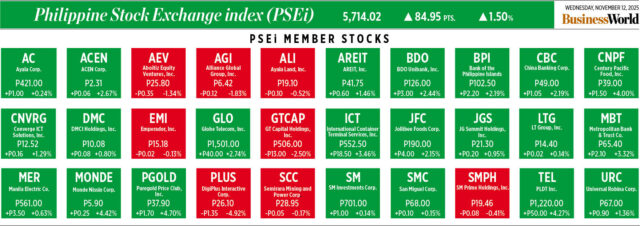
How PSEi member stocks performed — November 12, 2025

Here’s a quick glance at how PSEi stocks fared on Wednesday, November 12, 2025.


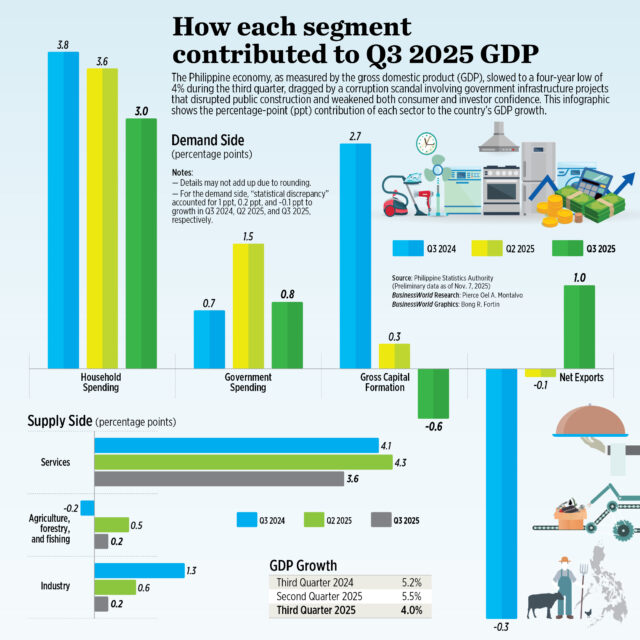
How each segment contributed to Q3 2025 GDP

The Philippine economy, as measured by the gross domestic product (GDP), slowed to a four-year low of 4% during the third quarter, dragged by a corruption scandal involving government infrastructure projects that disrupted public construction and weakened both consumer and investor confidence.  This infographic shows the percentage-point (ppt) contribution of each sector to the country’s GDP growth.

The power of paper: Documenting tax compliance

As the Halloween season ends, the Philippines continues to be haunted by “ghosts,” manifested in the form of ghost projects or ghost receipts. While these issues may seem unrelated, they share a common challenge in en-suring that transactions are properly documented. Adequate documentation is crucial in preserving an audit trail that validates the construction of infrastructure and the payment of taxes, establishing transparency and ac-countability that are imperative for economic stability and governance.

The Bureau of Internal Revenue (BIR) has taken significant steps against ghost receipts through its Run After Fake Transactions (RAFT) program. This initiative has resulted in the filing of multiple criminal and civil cases against those who have allegedly bought and sold fake receipts to illegitimately inflate their expenses or claim undue input VAT credits. The proliferation of fake receipts unjustly reduces the income tax and VAT liabilities of those who use them. While cracking down on fake receipts addresses tax leakages caused by overstated expenses, it may not be as effective in tackling leakages through understated revenue.

There are multiple ways to fight understated revenue. Tax auditors usually compare the differences between financial statements and tax returns to help identify misstatements and underreporting. Since financial statements are presumed to fairly present the financial position of the taxpayer, any irreconcilable discrepancies in the revenue reported in the financial statements with that reported in tax returns are indications of possible understatement.

The BIR may also resort to using third-party information under the BIR’s Reconciliation of Listings for Enforcement (RELIEF) System, where any inconsistencies reported by the taxpayer and those by third parties are as-sumed to indicate possible under-declaration of revenue. Theoretically, every transaction results in revenue on the part of the seller and expenses on the part of the buyer. While buyers have the option to claim a lower ex-pense, more often than not, buyers are likely to report their expenses in full to offset against revenue and reduce tax liabilities. This information may then be compared against the revenue reported by the seller. In such cas-es, the seller is usually left with the burden of reconciling differences based on the disclosures of other taxpayers.

In theory, the RELIEF system is a valuable tool in ascertaining a taxpayer’s tax liabilities. However, it is not without downsides. Since the taxpayer is often not privy to the facts behind the third-party information, it is gen-erally unable to accurately address the discrepancies identified. Moreover, RELIEF effectively assumes that the third-party information is accurate while the disclosures of the taxpayer being audited are not. As repeatedly held by our courts, tax assessments should not be based on mere presumptions no matter how reasonable or logical such presumptions may be. The presumption of correctness cannot be made to rest on another presump-tion. Thus, findings primarily based on RELIEF can be refuted solely on this ground, unless further supplemented by other information which will give the taxpayer sufficient information to provide a reconciliation.

Intense enforcement operations have been implemented by the BIR through its Oplan Kandado program, which imposes administrative sanctions for non-compliance with essential requirements such as the issuance of receipts, filing of returns, declaration of taxable transactions, among others. This is primarily implemented through covert surveillance, overt surveillance, or short-duration surveillance. In case the taxpayer is found with certain violations, such as the non-issuance of receipts of a VAT registered taxpayer, the BIR may ultimately order the closure of the establishment for not less than five days, to remain in force until the violation is rectified.

Aside from the usual audit, technological innovations like the Electronic Invoicing/Receipting System (EIS) aim to ensure the reliability of sales and purchase data, which may further reduce opportunities for tax evasion. Un-der the EIS, taxpayers engaged in the export of goods and services, electronic commerce, and large taxpayers are required to issue electronic receipts and invoices, which allow the transmission of sales data directly to the BIR. Strengthening the integrity and reliability of sales data should provide a more accurate way of investigating tax liabilities. However, implementation of the EIS has been a bit slow.

More interesting measures have been implemented in other countries such as Taiwan’s receipt lottery system. Instead of imposing penalties and empowering the tax agency with broader audit functions, Taiwan has approached the issue more positively. The receipts issued by establishments contain lottery numbers. This encourages consumers to ask for receipts, ensuring that a paper trail is available for tax purposes. The lottery ticket embedded within the receipt is claimed to incentivize tax compliance passively, by embedding it in consumer behavior. Similar campaigns have been launched by the BIR in the past which require the registration of the receipt through Short Mes-saging System (SMS) to qualify as a valid entry. Given the success of the previous campaigns, it may be worthwhile to consider incorporating a similar program during the development of the Electronic Invoicing System.

Ideally, there should be no need to coerce or incentivize people to pay their taxes. However, it is equally understandable why some hesitate when trust in the system is compromised. The power of paper is clear; it can either be a conduit of corruption or a catalyst for progress. When taxpayers truly feel the benefits of their contributions, compliance feels less like an obligation and more like a civic duty.

The views or opinions expressed in this article are solely those of the author and do not necessarily represent those of Isla Lipana & Co. The content is for general information purposes only and should not be used as a sub-stitute for specific advice.


Marvin Joseph Manuel is a senior manager at the Tax Services department of Isla Lipana & Co., the Philippine member firm of the PwC network.

+63 (2) 8845-2728
manuel.marvin.joseph@pwc.com

UST defeats listless UE, leads pack for UAAP S88 fourth seed

PHOTO CREDITS: UAAP/Julius Domondon

Games on Saturday

(Smart Araneta Coliseum)
7:30 a.m. – UST vs ADMU (U16)
9:30 a.m. – UE vs NUNS (U16)
11:30 a.m. – UE vs NU (Women)
1:30 p.m. – UE vs NU (Men)
4:30 p.m. – UST vs ADMU (Men)
7 p.m. – UST vs ADMU (Women)

UNIVERSITY of Santo Tomas (UST) scored a wire-to-wire 109-97 win over the listless University of the East (UE) and created a slight separation from the pack for the coveted fourth seed in the UAAP Season 88 men’s basketball on Wednesday at the Mall of Asia Arena.

The UST Growling Tigers broke the gates wide open at 33-16 and never relaxed from there en route to their first but much-needed win in the second round that propelled them to a solo fourth place for now with a 5-5 slate.

Santo Tomas, which waxed hot early with a 5-1 start after big wins against top contenders University of the Philippines (UP) and De La Salle University, snapped a four-game skid for a momentary breather from Ateneo de Manila University (ADMU) (5-5), Adamson University (5-6) and Far Eastern University (4-6) in a mad scramble to the Final Four with three games to go.

“It was a tough stretch for us with four straight losses. We stuck together,” said assistant coach Japs Cuan as the Growling Tigers brace for a crucial outing against the ADMU Blue Eagles right behind them this Saturday.

Nic Cabañero scored a game-high 19 points in only 23 minutes of play, including 11 in the second half, while Collins Akowe hauled down a 16-16 double-double for Santos Tomas in a repeat win over UE after an almost similar 111-99 win in the first round.

Gelo Cristostomo, Forthsky Padrigao and Amiel Acido had 14, 11 and 10 points, respectively, as all but one of 15 Growling Tigers racked up the scoring board in the coast-to-coast win.

Licking the wounds of a stinging 89-88 defeat to reigning champion UP, Santo Tomas imposed its will right from the get go and went cruise control with a 27-point lead in the third quarter before needing one last hurrah to fend off any comeback left from the hungry UE out to post a maiden triumph.

The UE Red Warriors came to as close to 83-92 on a 23-10 rally in the last three minutes but the Growling Tigers were quick to restore order on an 8-0 retaliation capped by Mark Llemit’s triple on their way to a 12-point win.

Wello Lingolingo posted 18 points while Dylan Despi and Precious Momowei tallied 17 points apiece to lead the also-ran Red Warriors (0-11), who absorbed their 18th straight defeat dating back to the second round last season after an impressive 5-2 start.

In women’s basketball, Kent Pastrana rifled in a career-high of 35 points as Final Four-bound Santo Tomas (11-0) moved closer to a season sweep after a 125-50 trashing of UE (0-11), which slid to its 22nd straight loss since ending a 40-game skid last season. — John Bryan Ulanday

The Scores:
First Game
UST 109 – Cabañero 19, Akowe 16, Crisostomo 14, Padrigao 11, Acido 10, Paranada 7, Llemit 6, Estacio 5, Buenaflor 5, Danting 5, Calum 4, Manding 3, Bangco 2, Laure 2, Bucsit 0 UE 97 – Lingolingo 18, Despi 17, Momowei 17, Jimenez 15, Lagat 13, Cruz-Dumont 9, Datumalim 7, Distrito 1, Tañedo 0, Mulingtapang 0, Malaga 0, Robles 0

Quarterscores: 33-16, 57-41, 87-67, 109-97

Xi pitches closer ties to Spanish king as Madrid courts Chinese investment

Spain’s King Felipe VI and Chinese President Xi Jinping walk pass honor guards during a welcome ceremony at the Great Hall of People in Beijing, China, Nov. 12. ANDRES MARTINEZ CASARES/Pool via REUTERS

BEIJING — China’s President Xi Jinping told Spain’s King Felipe VI on Wednesday that the world’s second-largest economy seeks to work with Madrid to boost the global influence of both nations, as the heads of state met in Beijing ahead of a signing ceremony.

Felipe is the first Spanish monarch in 18 years to make a state visit to China, as Madrid leads the European Union (EU) in courting Beijing and seeks to expand its diplomatic footprint across the Asia-Pacific region.

China, for its part, is eager to move past trade tension with the 27-strong bloc over its heavily subsidized electric vehicles industry, as US President Donald J. Trump’s tariffs weigh on exports.

CHINA SUGGESTED RESUMING INVESTMENT TALKS
Last week China proposed the resumption of investment talks frozen since 2021.

“The world needs more constructive forces dedicated to peace and development,” Mr. Xi told Felipe during their meeting in Beijing’s Great Hall of the People, flagging change and turbulence in the international situation.

“China stands ready to work hand in hand with Spain to build a comprehensive strategic partnership,” Mr. Xi added, saying such ties would be more strategically steady, more dynamic, and more influential globally.

State broadcaster CCTV said Mr. Xi and Felipe attended a document signing ceremony after the talks, but gave no details.

MADRID STEPS UP ECONOMIC ENGAGEMENT
Madrid has stepped up economic engagement with Beijing after the EU’s decision to impose tariffs on Chinese-made electric vehicles in June 2024.

It has sent Prime Minister Pedro Sanchez twice to promote Spain as an investment destination, particularly in automotives, green technologies and other emerging industries.

But as Europe’s largest exporter of pork products, Spain finds itself caught in the middle of tension between China and the European Commission, which handles the bloc’s trade policy, as the pork items face retaliatory tariffs of up to 62.4%.

As China’s top pork supplier, Spain sells it about $1.2 billion worth of meat cuts and byproducts each year, contributing roughly a fifth of its imports.

PATH OF SUBTLE DIPLOMACY
The king offers Madrid another path, that of the subtle diplomacy a constitutional monarch can wield, delivering messages that need not be pinned to the elected government when ties are strained or politically sensitive.

“The friendship between Spain and China undoubtedly benefits both peoples and is consistent with two countries with a long history and a global vocation,” Felipe told his host.

“A relationship of trust has been forged,” he added.

In April the United States likened Spain’s decision to pursue closer commercial ties with China to “cutting your own throat,” while the European Union, as a whole, remains concerned about trade imbalances and Beijing’s rela-tionship with Russia. — Reuters

Shipbuilding holds potential to employ 100,000 — ambassador

PHILSTAR FILE PHOTO

By Justine Irish D. Tabile, Reporter

LARGE-SCALE shipbuilding in the Philippines has the potential to create 100,000 skilled jobs, Danish Ambassador to the Philippines Franz-Michael Skjold Mellbin said.

“We have this great shipbuilding initiative, which is aimed at bringing large-scale shipbuilding back to the Philippines,” Mr. Mellbin told reporters on the sidelines of a seminar on Wednesday.

“We’re very excited about that. We believe we can create maybe up to 100,000 jobs in the Philippines through shipbuilding. This is the most important initiative we have. And it will also bring new kinds of technology to the Philippines,” he added.

He said the Philippines remains an attractive destination for shipbuilding due to its skilled labor and geographical location, serving as an alternative to shipbuilding in China.

“We actually have several Danish companies that are here either to demonstrate their skills, to share their technology, or actually to cooperate with Filipino companies on building ships here in the Philippines,” he said.

“On the naval side, we have a shipbuilding company looking at the possibility of building ships together with our Filipino partners,” he added.

However, he said the country needs to take more steps to attract more investment.

“I think it’s absolutely essential that on the regulatory side, the government improves the opportunities for doing business here. But there’s a lot of work to do,” he said.

“There are many steps on the way… but what we are happy about is that the government agencies have come together,” he added.

He said corruption is a concern for Danish investors.

“Denmark is the least corrupt country in the world, and the first thing that investors ask me about is good governance and corruption. Unfortunately, there are challenges here in the Philippines, which are well known,” he said.

“I’m happy to see that the president and the government have said that they’re going to take specific steps to try to improve the situation. This is necessary. Good governance and anti-corruption measures would help improve doing business in the Philippines a lot,” he added.

Government agencies are banking on the passage of the Shipbuilding and Ship Repair (SBSR) Development bill to drive investment in the industry amid increasing interest from Europe.

“Yes, this is really very important. In fact, this is being stressed also by our President Ferdinand R. Marcos, Jr.,” Transportation Assistant Secretary for Maritime Villamor Ventura S. Plan said.

“Nakikita niya ’yung importansya ng maritime industry natin dito. Ang daming mga effects nito sa ating economy kasi (He sees the importance of the maritime industry, which will have substantial impact on the economy),” he added.

He said versions of the bill were filed at the House of Representatives. No similar bill has been filed with the Senate.

“We also have the commitments of several ambassadors from the European Union who will try to visit our legislators to push for this … (For our part) we will be submitting an endorsement letter also,” he added.

Anti-Red Tape Authority (ARTA) Secretary Ernesto V. Perez said the agency is strongly advocating for the passage of the SBSR bill.

“ARTA strongly advocates for the passage of the SBSR Development Act,” he said.

He said incentives will likely adhere to the framework of the Corporate Recovery and Tax Incentives for Enterprises to Maximize Opportunities for Reinvigorating the Economy (CREATE MORE) Act, with investors also qualified for the Green Lane for Strategic Investments.

“Without the passage of this bill, we can still move forward because there are enough incentives … These are all in place for availment by our industries,” he added.

MARINA Administrator Sonia B. Malaluan said four versions of the bill were filed with the House of Representatives.

“I hope after all the flood control investigations and the budget hearings, the committee will start deliberating on bills filed,” she said.

“There should be a good, consolidated version once the committee starts work. We still need more awareness and information dissemination for people to recognize how shipbuilding in the Philippines is very important and es-sential to our economy and nation building,” she added.

Salvador and JRU beat EAC to stay in race for NCAA quarters berth

Sean Salvador — NCAA

Games on Thursday

(Filoil EcoOil Arena)
9:30 a.m. – CSB vs Letran (Jrs/Srs)
2:30 p.m. – Mapúa vs UPHSD (Srs/Jrs)

JOSE RIZAL University (JRU) rode on Sean Salvador’s career performance as it repulsed Emilio Aguinaldo College, 69-66, on Wednesday to stay in the race for an outright quarterfinal berth in NCAA Season 101 at the Filoil EcoOil Arena.

Mr. Salvador came off the bench to unleash his best effort to date as he fired 24 points including a pair of clutch free throws that helped seal the JRU Bombers their sixth win against five defeats.

It also pushed JRU half a game closer from catching up with College of St. Benilde and Colegio de San Juan de Letran, which are tied at No. 2 with 6-4 cards in Group B.

San Beda University leads the bracket with a 7-3 slate.

The EAC Generals stumbled to 4-6.

Earlier, Arellano University turned back San Sebastian College-Recoletos, 78-71, to remain at No. 3 in Group A with a 4-6 record.

T-Mc Ongotan had an all-around effort with 25 points, six rebounds, two assists, two steals and a block while Renzo Abiera chipped in 20 points that helped AU fortify its place at third in its bracket.

Of course, making it in the top three in the group would seal it an outright quarterfinal entry while eluding the more dangerous possible position, a spot in the do-or-die play-in.

“Our target is to at least get No. 3 if we couldn’t get to No. 2,” said AU coach Chico Manabat.

It was also a result that snapped the Stags’ two-game streak and sent them reeling to an eighth defeat against three wins. — Joey Villar

The scores:

First Game
AU 78 – Ongotan 25, Abiera 20, Hernal 9, Geronimo 6, Valencia 4, Vinoya 4, Borromeo 2, Demetria 2, Camay 2, Cabotaje 2, Acop 2, Libang 0, Buenaventura 0, Langit 0, Anama 0

SSC-R 71 – Castor 19, Ricio 14, Segovia 11, Dela Rama 11, Felebrico 5, Cabilla 5, Gabat 4, Lumanag 2, Cuajao 0, Dimaunahan 0

Quarterscores: 22-20; 40-38; 63-55; 78-71

Second Game
JRU 69 – Salvador 24, Laurenaria 15, Argente 12, Garupil 8, Panapanaan 4, Duque 3, Herrera 2, Sarmiento 1, Benitez 0, Catapang 0, J. Castillo 0 EAC 66 – Ochavo 19, Oftana 12, Bagay 11, Quinal 8, Shanoda 5, Angeles 4, Doria 3, EJ Castillo 2, Tolentino 2, Loristo 0, Omandac 0, Lucero 0, Bacud 0, Villarente 0, Jacob 0
Quarterscores: 20-22; 35-35; 45-41; 69-66

Tokyo protests Russia’s wider entry ban over Ukraine sanctions

PHILIPPINE STAR/EDD GUMBAN

TOKYO — Japan decried as “absolutely unacceptable” on Wednesday Russia’s extension of an entry ban to 30 more citizens, among them a foreign ministry spokesperson, after Tokyo’s sanctions over Moscow’s nearly four-year-old war in Ukraine.

Following similar moves by Western nations, Japan had placed additional sanctions on Russian companies, individuals and other entities in September, while lowering its cap on Russian seaborne crude.

Russia’s foreign ministry issued on Tuesday a list of Japanese added to those facing “indefinite” prohibition. The new names included the spokesperson, Toshihiro Kitamura, as well as journalists and academics.

Japan has protested against the “regrettable” move, Chief Cabinet Secretary Minoru Kihara told a briefing on Wednesday, adding that people-to-people exchanges between the two countries remain important.

He accused Moscow of shifting the blame for its invasion of Ukraine.

Moscow has taken similar measures against Japanese officials and civilians in retaliation for sanctions.

Japan, however, continues to import energy from the far-eastern Russian island of Sakhalin, despite calls by the United States for allies to sever ties to pressure Moscow.

Asked how Britain’s ban on insurance for Russian gas shipping would affect energy from Sakhalin and whether Tokyo would increase sanctions on Moscow, Mr. Kihara declined to comment.

Japan will take appropriate steps to achieve peace in Ukraine while securing its national interests, he added. — Reuters

DA farm-to-market road takeover expected to cut costs 20%, accelerate completion

DPWH.GOV.PH

THE Department of Agriculture (DA) said it expects to speed up construction and save at least 20% once it takes over the farm-to-market road (FMR) program from the Department of Public Works and Highways (DPWH) next year.

Agriculture Secretary Francisco P. Tiu Laurel, Jr. was quoted in a statement as saying the savings could allow the DA to build more rural roads with its funding, helping farmers and fisherfolk cut production costs, reach markets faster, and ultimately lower food prices.

The DA said in a statement that building a kilometer of paved, two-lane FMR currently costs around P15 million. With improved internal management and the use of soil stabilizers, the DA aims to reduce the cost to P12 million or less.

The DA’s master plan identifies about 131,000 kilometers of potential FMRs, with around 70,000 kilometers already completed.

At the current pace, completing the network could take 60 years, but the DA said it could cut the timeline in half with stronger coordination and smarter spending.

The government initially proposed P16 billion for FMR projects in 2026, enough to construct around 1,000 kilometers of rural roads. The House of Representatives doubled the allocation to P32 billion, following President Ferdinand R. Marcos, Jr.’s directive to redirect flood control funds to priority farm infrastructure. — Vonn Andrei E. Villamiel

ADVERTISEMENT
ADVERTISEMENT