Home Blog Page 6947

BSP fully awards short-term bills

By Luz Wendy T. Noble, Reporter 

The central bank fully awarded P100 billion worth of 28-day bills on Friday, as rates fell due to concerns about rising coronavirus infections and after the central bank again lent to the National Government. 

The auction was oversubscribed 1.94 times as bids reached P194.7 billion, but demand fell from a week earlier. Rates for the debt reached 1.7% to 1.749%, narrower than last week. 

This brought the average rate of the short-term bills to 1.7298%, 3.68 basis points lower than at the Jan. 7 auction. 

The Bangko Sentral ng Pilipinas (BSP) uses its short-term securities and term deposit facility to mop up excess liquidity in the financial system and guide market rates. 

The average yield on the BSP bills declined as concerns remained due to increasing infections, Michael L. Ricafort, chief economist at Rizal Commercial Banking Corp., said in a Viber message. 

COVID-19 cases in the Philippines rose by 34,021 coronavirus infections on Thursday — a fresh record — while active cases reached 237,387, also the highest since the pandemic started. 

Mr. Ricafort said investors had also factored in the National Government’s cash position, which increased after it got a P300-billion loan from the BSP. 

Central bank Governor Benjamin E. Diokno said the zero-interest loan was approved on Dec. 16. It will be payable in three months and may be extended for another quarter. 

The direct advance is smaller than previous ones because the central bank is gradually unwinding support measures rolled out during the pandemic. 

Dovish BSP could hit peso

BW FILE PHOTO

The Philippine central bank’s accommodative stance amid policy tightening by the US Federal Reserve could weigh the peso down in the coming months, Fitch Solutions Country Risk & Industry Research said. 

It said it expects the peso to average at P51.80 a er dollar this year, weaker than its P49.29 average in 2021. 

“The Bangko Sentral ng Pilipinas’ (BSP) near-term dovish stance, loose fiscal policy and a worsening current account balance outlook will all weigh on the unit, alongside US Fed monetary tightening,” Fitch Solutions said in a note on Friday. 

The peso closed at P50.999 on Dec. 31, 6.2% weaker than a year earlier. 

Fitch Solutions cited central bank Governor Benjamin E. Diokno’s statement that the BSP was unlikely to raise interest rates in the first half because they want to see at least four to six quarters of solid economic growth and an improving labor market. 

“The statement can be seen as the BSP’s willingness to support growth at the cost of some peso weakness, which we expect to materialize as the US Fed begins its hiking cycle,” it said. 

“We expect this gradual depreciatory trend to persist over the near term as investors favor emerging currencies with higher carry and more hawkish central banks, against the backdrop of US monetary tightening,” it added. 

Fed officials said they expect as many as three rate increases this year, noting they are ready to respond to elevated inflation. 

Meanwhile, Fitch Solutions said they don’t expect the peso to be affected much by this year’s elections, taking into account the peso’s performance in the weeks leading to the presidential election in 2016. 

But the market would regard a win by Ferdinand “Bongbong” R. Marcos, Jr., the only son and namesake of the late Philippine dictator, as negative, they said, since this could signal a possible return to authoritarianism. 

“We do not anticipate a significant divergence from the strongman leadership style of the incumbent president, Rodrigo Duterte, and as such, expect only modest volatility around the elections,” Fitch Solutions added. — Luz Wendy T. Noble 

Customs boosts collections with X-rays

ICTSI

The Bureau of Customs (BoC) collected more duties last year, while enforcing stricter border control using X-rays, it said in a statement on Friday. 

The bureau collected P113.721 billion in duties and taxes using its X-ray machines, 13% higher than a year earlier. 

The agency said it bought four more machines last year, bringing the total to 124. Scanned containers rose by almost three-quarters last year to 847,950, it said. 

Customs seized illegal drugs and smuggled goods worth P363.1 million using the X-ray machines, it said. 

“The BoC stays committed in working effectively to minimize unnecessary delays in trade and to collect appropriate revenue for the government while securing the nation’s borders, especially during the ongoing pandemic,” it said. 

Last year, the agency collected P645.77 billion, which was 4.7% more than its target and 20% higher than in 2020. It expects to collect P671.7 billion this year. — Luz Wendy T. Noble 

Philippine COVID cases hit record

PHILIPPINE STAR/ MICHAEL VARCAS

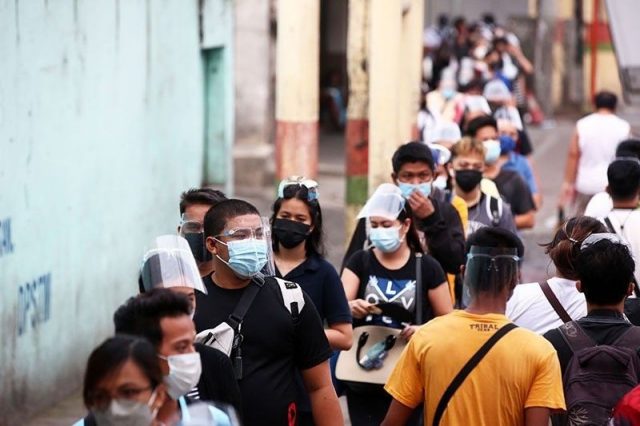
Coronavirus infections in the Philippines hit another record on Friday at 37,207, as the country struggles to contain a fresh surge in cases spurred by the highly mutated Omicron variant. 

This brought the total to 3.13 million, while the death toll increased by 81 to 52,815, the Department of Health (DoH) said in a bulletin. Recoveries rose by 9,027 to 2.81million 

President Rodrigo R. Duterte kept the alert level for Manila, the capital and nearby cities at No. 3 until Jan. 31, his spokesman Karlo Alexei B. Nograles told a news briefing. 

The agency said 47.3% of 81,737 samples on Jan. 12 tested positive for the coronavirus, way above the 5% threshold set by the World Health Organization (WHO). 

Of the active 265,509 cases on Friday, 8,325 did not show symptoms, 252,502 were mild, 2,913 were moderate, 1,469 severe and 300 were critical. 

DoH said 98% of the infections occurred from Jan. 1 to Jan. 14. The top regions with new cases in the past two weeks were Metro Manila with 16,824, Calabarzon with 8,580 and Central Luzon with 4,052 infections. It added that 26% of deaths occurred in January, 6% in December and 17% in October. 

It said 104 duplicates had been removed from the tally, 67 of which were reclassified as recoveries and two were tagged as deaths. Fifty-eight recoveries were relisted as deaths. Eight laboratories failed to submit data on Jan. 12. 

The Health department said 46% of intensive care unit beds in the country had been used, while the rate for Metro Manila was 55%. 

Mr. Nograles said Metro Manila would remain under Alert Level 3 because its healthcare use had not hit 71%, the threshold required for Alert Level 4. “We are avoiding Alert Level 4 because that would mean that our healthcare utilization rate is high.” 

New infections in Metro Manila were not accompanied by a rise in severe COVID-19 cases and deaths likely due to the region’s high vaccination rate, Health Undersecretary Maria Rosario S. Vergeire told the same briefing. Omicron was also milder than other early variants, she added. 

“We saw a phenomenon called decoupling in the National Capital Region,” she said. “This is when a rise in cases does not translate to a rise in the number of people who get hospitalized from severe or critical illness and death.” 

OCTA Research Group fellow Fredegusto P. David said Metro Manila’s virus reproduction number had fallen to 3.77 on Jan 10 from 6.12 a week earlier. 

“We are not out of the woods yet, and data in the next few days will clarify the trends,” he said in a report posted on Twitter. “Efforts from the public must be sustained so that the National Capital Region’s (NCR) new case reports will start decreasing.” 

The government earlier placed 28 other areas under Alert Level 3 starting Friday. Alert Level 3 bars face-to-face classes for basic education unless approved by the government. 

Meanwhile, Mr. Nograles said the government has placed Antigua and Barbuda, Aruba, Canada, Curacao, French Guiana, Iceland, Malta, Mayotte, Mozambique, Puerto Rico, Saudi Arabia, Somalia, Spain and US Virgin Islands under the country’s travel red list from Jan. 16 to 31. Foreign travelers from these territories will be barred entry, he said. 

On the other hand, Filipinos from red-listed or high-risk countries may now come home via commercial flights and not just through so-called Bayanihan flights, he said. 

Also on Friday, the Supreme Court rescheduled the 2020/2021 bar exams to Feb. 4 and 6 from Jan. 23 and 25. 

“Given the current infection rate and quarantine situation of bar personnel, 16 of the 31 teams that will be deployed will be critically understaffed if the current schedule were maintained,” it said in a statement. — Kyle Aristophere T. Atienza 

Gov’t to use transport marshals

PHILIPPINE STAR/ MICHAEL VARCAS

The government would deploy “mystery passengers” to monitor compliance with its no vaccination, no ride policy in public transportation starting Jan. 17, according to the Transportation department. 

“That’s how we can implement this program on a daily basis without them knowing really that there’s an enforcer,” Transportation Assistant Secretary Mark Steven C. Pastor told an online news briefing on Friday. 

Transportation Secretary Arthur P. Tugade on Jan. 11 issued an order limiting public transportation access to vaccinated people in the National Capital Region (NCR) under Alert Level 3 or higher. 

The policy applies to all public domestic travel within Metro Manila by land, sea and air. 

The policy does not apply to people who have not been vaccinated against the coronavirus for medical reasons. 

Passengers must show physical or digital copies of their vaccine cards issued by their local governments or by the Department of Health. — Arjay L. Balinbin 

Another lawmaker seeks ‘hacking’ probe

Another resolution has been filed at the House of Representatives that seeks to investigate the alleged data breach at the Commission on Elections (Comelec). 

Cavite Rep. Elpidio F. Barzaga, Jr. filed a resolution on Jan. 12 that also called on the election body to examine the automated election process. 

The congressman asked the Comelec to patch its network and systems, train its workers on cyber-security and adopt measures to address data breaches. — Jaspearl Emerald G. Tan  

Most businesses complied with COVID rules

PHILIPPINE STAR/MICHAEL VARCAS

Most establishments in Metro Manila have complied with minimum public health standards against the coronavirus, according to the Department of Trade and Industry (DTI). 

More than 94% or 4,121 out of 5,267 businesses observed health protocols last year, the agency said in a statement on Friday, citing its Fair Trade Enforcement Bureau. 

But 1,146 business establishments who failed to follow protocols were ordered to correct their actions, 590 of which complied. DTI said 292 were endorsed to local governments for further investigation. 

Most violations involved the absence of contact tracing and health declaration forms, thermal scanners, floor markings for physical distancing and the regular service maintenance of air-conditioning units, it said. — Revin Mikhael D. Ochave 

GSIS offers loans to typhoon victims

DAMAGED houses in the province of Dinagat Islands, where tropical cyclone Odette (international name: Rai) made its second landfall on Dec. 16, 2021. — DINAGAT ISLANDS PIO

The Government Service Insurance System (GSIS) on Friday said it was now offering emergency loans to members hit by Typhoon Rai, locally named Odette. 

The financing will be available to active members residing or working, as well as old-age and disability pensioners living in the Mimaropa region, Western, Central and Eastern Visayas, Northern Mindanao and Caraga, it said in a statement. 

GSIS President and General Manager Rolando G. Macasaet said members may apply for a loan online that will have a tenor of three years that can be paid in monthly installments at 6% interest. 

Qualified members who do not have existing emergency loans may apply for as much as P20,000 in financing. Borrowers with existing emergency loan may borrow as much as P40,000 to pay off their previous loan balance and still receive a maximum net amount of P20,000. 

Meanwhile, Party-list Rep. Bernadette R. Herrera-Dy urged the Pag-IBIG Fund, also known as the Home Development Mutual Fund, to lend to Odette victims for home repairs. 

The agency should find ways to extend low-interest loans for house repairs and rebuilding and give the typhoon victims cash aid, she said in a statement. 

Ms. Dy also asked the Trade department’s Small Business Corporation to help typhoon survivors whose jobs have been affected by the disaster. — Luz Wendy T. Noble and Jaspearl Emerald G. Tan 

Treasury says sustainable finance framework validated by outside consultant

NEDA

The Bureau of the Treasury said the government’s sustainable finance framework, completed in October, has been validated by an outside consultant and will guide its future green bond issues.

“The framework lays out the process that will be used to ensure transparency and disclosure of the use of proceeds, as well as the expected environmental and social impact of eligible green and social projects, in keeping with international best practices,” the Treasury said in a statement.

The Treasury said it tapped Vigeo Eiris, an affiliate of Moody’s Corp. and a global provider of environmental, social and governance (ESG) solutions, to provide a Second Party Opinion on the framework. The assessment confirmed that the national government’s Sustainable Finance Framework and Eligible Expenditures Portfolio are in line with international standards on green bonds, social bonds, as well as green and social loan principles.

Standard Chartered Bank and UBS Group AG served as joint structuring advisors for bonds issued under the framework, the Treasury said.

Proceeds from sustainable financing are for use in projects that seek to achieve sustainable development goals as set by the United Nations, it said.

The government will also ensure that use of proceeds is in accordance with the Philippine Development Plan 2017-2022 and Public Investment Program 2017-2022.

The Treasury said that sustainable financing instruments demonstrate the government’s support for climate change commitments, including the commitment to reduce greenhouse gas emissions by 75% by 2030.

The Department of Finance (DoF) and the Bangko Sentral ng Pilipinas (BSP) approved the sustainable finance roadmap in October. The scheme hopes to harness public and private investment to support the transition to a clean, sustainable and climate-resilient economy.

Finance Secretary Carlos G. Dominguez, III has said that his department worked with the Securities and Exchange Commission (SEC) to gear up the capital markets for green investments. — Luz Wendy T. Noble

Peso weaker on hawkish Fed signals, record infections

PHILIPPINE STAR/ MIGUEL DE GUZMAN

The peso weakened Friday after hawkish policy signals from the Federal Reserve, and as Philippine COVID infection numbers continued to rise.

The peso ended trading at P51.11 to the dollar Friday, against its P51.04 Thursday close, according to the Bankers Association of the Philippines.

It was stronger compared to its P51.35 finish a week earlier.

The peso opened Friday at P51.14. The low was P51.15, while the high was P50.98.

Dollar trading volume fell to $760.5 million Friday from $917.25 million Thursday.

A trader said in an email thatthe peso’s weakness was prompted by risk-off sentiment after hawkish signals were made by Lael Brainard, a member of the Fed’s Board of Governors.

Ms. Brainard, who is President Joseph R. Biden’s pick to become the vice chair of the US central bank, said the Fed is ready to quell inflation by raising interest rates, Reuters reported.

“We do have a powerful tool and we are going to use it to bring inflation down over time,” Ms.  Brainard told the Senate Banking Committee in her confirmation hearing Thursday.

If confirmed, Ms. Brainard would replace Vice Chair Richard Clarida who was appointed by former President Donald J. Trump.

Earlier this week, US inflation rose 7% year-on-year in December, the highest level since June 1982.

Rizal Commercial Banking Corp. Chief Economist Michael L. Ricafort said in a Viber message that the peso’s weakness was due to caution over rising infections.

New active cases hit a new record of 37,207 Friday to bring the active total to 265,509, according to the Department of Health (DoH). — Luz Wendy T. Noble

Recovery seen hampered if more areas move to stricter health protocols

THE expanded number of areas covered by Alert Level 3 will hinder the economic recovery, according to Presidential Adviser for Entrepreneurship Jose Ma. A. Concepcion III.

Mr. Concepcion said during a Laging Handa briefing Friday that stricter quarantine protocols will slow the momentum of the country’s economic recovery, whether the quarantine setting is Alert Level 3 or 4.

“Siyempre, ma-affect yan kasi maski tinaas sa Alert Level 3 or Alert Level 4, mismong yung mga consumer ayaw lumabas. Ayaw kumain sa labas. Talagang matumal ang Negosyo (Of course, it will have effect. Whether it is Alert Level 3 or Alert Level 4, consumers themselves will not want to go out. They won’t want to dine out. It will really impact businesses),” Mr. Concepcion said.

On Friday, the President’s Acting Spokesman and Cabinet Secretary Karlo Alexei B. Nograles announced that Metro Manila will remain under Alert Level 3 between Jan. 16 and Jan 31 amid a sharp increase in coronavirus disease 2019 (COVID-19) cases.

Other areas that will be under Alert Level 3 for the period include Baguio City, Ifugao, Mountain Province, Dagupan, Ilocos Sur, Rizal, Batangas, Cavite, and Laguna.

On Jan. 12, the government also placed 28 areas under Alert Level 3 between Jan. 14 and Jan. 31, such as Cagayan de Oro City, Davao City, Bacolod City, and Cebu City.

Mr. Concepcion said experts like Octa Research Group are expecting the COVID-19 surge to peak within a few weeks.

“We have seen it in other places. The COVID-19 cases peak and then it stabilizes and starts goes down. I’m optimistic by maybe the end of the month or I think in February, hopefully we should see in National Capital Region, eventually this (will be) moving lower now,” Mr. Concepcion said.

“But in the other areas, (COVID-19 cases) might surge since many individuals are still unvaccinated in provinces across the Visayas and Mindanao, and other parts of Luzon. We need to focus our vaccines in these areas,” he added. – Revin Mikhael D. Ochave

VP candidate calls for review of feed tariffs to curb meat prices

Senator Francis Pancratius N. Pangilinan called for a review of agricultural tariffs to keep pork and chicken prices in line with those of other Asian countries.

“Mahigit doble and presyo ng baboy natin kaysa sa Vietnam, at halos triple ang presyo ng manok natin kumpara sa Thailand (The price of pork in the Philippines is more than double compared to Vietnam, and the price of chicken is almost triple the price in Thailand.)” Mr. Pangilinan said in a statement Friday.

Mr. Pangilinan said that the average price of pork per kilo is the equivalent of P125 in Vietnam, P159 in Thailand, and P205 in China. The price of pork in Philippine wet markets is P276.

Meanwhile, the price of chicken is equivalent to P76 per kilo in Thailand, P125 in Vietnam, and P162 in China. In the Philippines, the average is P180.

“Kaya rin nating pababain ang presyo ng mga pagkain dahil nagawa na natin yan noon, specifically sa presyo ng bigas. Kailangan lang tutukan pareho ang production side at ang importation ng pagkain. Kailangan din walang smuggling (We can bring down the price of food, which we have done in the past with rice. We need to focus on both the production and import side. There should also be no smuggling),” he added.

According to the statement, Mr. Pangilinan made the proposal following a Senate hearing Thursday, in which a Department of Agriculture (DA) former senior adviser, Karlo S. Adriano, discussed the price disparities with Thai and Vietnamese pork prices.

Mr. Adriano said the problem is similar in poultry.

At the hearing, the DA attributed the high cost of pork to the high cost of producing corn, which is used in animal feed.

“Clearly, the biggest (cost) of producing (and growing) our livestock is feed. Ang biro nga: huwag kang magtayo ng babuyan, pumasok ka na lang sa negosyo ng feeds dahil doon ka kikita (The joke among farmers is not to raise hogs, but to go into feed, which makes more money),” Mr. Pangilinan said.

High pork prices were also blamed on “unorganized and backward small-scale operation, as well as fragmented government support structure,” according to the DA. – Luisa Maria Jacinta C. Jocson

ADVERTISEMENT
ADVERTISEMENT