Home Blog Page 6941

‘Upside down again’: Omicron surge roils US small businesses

IMAGE VIA THE PORT OF LOS ANGELES

LUBBOCK, Texas — Phillip Howard pointed toward a stack of black ski pants piled atop a counter in his winter sports shop as evidence of the hurdles small business owners still face as the pandemic drags on. 

The pants were supposed to arrive by August at Troy’s Ski Lubbock shop in west Texas — well before his five-month hot season of selling that kicks off in October. Instead, they came from China the first week of January, delayed by supply-chain failures. 

“Late-arriving product really kills us,” Mr. Howard said this week, noting that several other items had also arrived late, missing his pre-holiday sales season. “I’ve been in this business for almost 20 years, and I’ve never encountered anything like this.” 

As the pandemic enters its third year, many small businesses across the United States are besieged on three fronts: deepening supply chain issues; periodic staffing shortages; and fewer customers showing up in some areas, fearing the Omicron spike in coronavirus disease 2019 (COVID-19) cases. 

This week the Federal Reserve released its latest collection of anecdotes about the state of the economy from businesses, labor groups, and others nationwide, showing that the fast-spreading Omicron variant was exacerbating difficulties, especially for hiring and inflation. 

US retail sales fell 1.9% in December amid the shortage of goods and surging infections, the Commerce Department said on Friday. 

Though federal aid and the economy’s overall recovery have kept failure and bankruptcy rates for small businesses far lower than expected, day-to-day management has become a challenge. Census surveys conducted since early in the pandemic show concerns steadily shifting from dwindling cash reserves and a hunt for financing to challenges with supply chains and rising costs. 

“I’m placing orders for next year now, and we’re looking at double-digit inflation,” Mr. Howard said. “It’s probably 10% across the board for almost everything that I’m having to order.” 

‘UPSIDE DOWN AGAIN’ 

Staffing shortages forced Gage & Tollner, a 19th-century chophouse in Brooklyn, New York, to close for five days in late December. 

Co-owner St. John Frizell estimates about 30% of the nearly 60 people working at the restaurant have had COVID-19 in the last month. Owners wanted staff to have a negative coronavirus test before returning to work, but that often meant employees spent hours waiting in lines to get swabbed. 

“We just need tests, lots and lots of tests,” he said. 

He welcomed the proposal this month by Governor Kathy Hochul that New York should permanently allow restaurants and bars to sell cocktails “to go,” an emergency provision first brought in when establishments were forbidden from seating customers inside in 2020. 

Just down the road at Junior’s Restaurant and Bakery — renowned for its cheesecakes — owner Alan Rosen said he had suffered with supply chain issues and staffing shortages. He has sometimes had to rope off entire sections of his restaurants when there were not enough servers to go around. 

“Our costs of goods are through the roof, there’s inflationary pressure, supply chains are a mess,” Mr. Rosen said. 

Amy Glosser shifted BYKlyn, her cycling studio, to new outdoor premises in the summer of 2020 to keep the Brooklyn business afloat. But Glosser said she and her two dozen employees agreed they could not do another winter outdoors, so she moved the business to a temporary indoor space on Dec. 1. 

Then the Omicron variant hit New York City hard, and about 40% of the gym’s 200 members said they wanted to cancel or pause their memberships. 

“People are nervous to come inside and sweat together,” Ms. Glosser said. 

Randy Peers, president of the Brooklyn Chamber of Commerce, said he’s worried about small businesses being evicted after New York state’s pandemic-era evictions moratorium ended on Saturday, noting that about a third of businesses in the Chamber owe back rent. 

Peers said optimism grew over the summer and early fall, with the city’s high vaccination rates and many restrictions lifted. That lasted through Thanksgiving. 

“Then Omicron just threw everything upside down again,” he said. 

‘HOLDING OUR BREATH’ 

Small businesses in states where COVID restrictions have been far looser than New York say customers are still coming out, but other pandemic issues continue to plague them. 

Mark Pectol, who owns four Zesty Zzeeks Pizza & Wings shops in the Phoenix metro area, said he never dreamed his biggest nightmare as a small business owner would come in the form of supply chain issues. 

“I don’t know if I’m going to have pizza boxes at the end of the week,” he said. “If I don’t have pizza boxes — I’m going out of business. We’re just holding our breath.” 

Even if he can get pizza boxes, Mr. Pectol said he’s already getting warnings about a possible flour shortage next. 

That would be cruelly ironic. In the first year of the pandemic, when grocery stores could not keep flour on shelves, Mr. Pectol said he could still buy it in bulk from his supplier. While his stores were closed under pandemic restrictions, he kept money coming in by selling 140,000 pounds of flour to the public. 

Now, the fickleness of the supply chain failures may be turning on him. 

“My distributor told me they have flour for me for a month. But this week, they didn’t get any flour in at all,” he said. “If I can’t get it from a big distributor, where will I get it?” — Brad Brooks and Jonathan Allen/Reuters

[B-SIDE Podcast] PHL digital economy: $40 billion by 2025, despite Omicron

Follow us on Spotify BusinessWorld B-Side

The Omicron surge doesn’t dampen expectations that the Philippine internet economy will hit $40 billion in terms of gross merchandise value (GMV) by 2025.

“We don’t look at our estimates from an event point of view because we can’t forecast individual events like Omicron and who knows what’s going to happen next,” said Willy Chang, associate partner at Bain & Company. “It’s based on foundational views.”

In this B-Side episode, Mr. Chang explains the e-Conomy SEA Report 2021 by Google, Temasek, and Bain & Company to BusinessWorld reporter Revin Mikhael D. Ochave.

He identifies “pockets of opportunity” for small and medium enterprises and how they can become part of Southeast Asia’s fastest-growing digital economy: “The headroom for growth is tremendous.”

TAKEAWAYS

E-commerce is driving the growth of the PHL internet economy.

“In terms of the billion gross merchandise value (GMV) in the future, if we look at what’s driving it, most of this growth will actually come from e-commerce. It is one of the biggest sectors not only for the Philippines but also for the region,” Mr. Chang said.

“The Philippines is the fastest-growing market this year between 2020 and 2021, about 93% growth year on year — highest around the region, and primarily driven by two factors, the first being Philippines saw the largest proportion of new users since COVID-19 started. About 20% of all digital consumers, or people who have used at least one service online, have joined since 2020 and into 2021,” Mr. Chang said.

He also mentioned that the estimated GMV can be reached by the Philippines in 2025 due to improving internet access and its large headroom in terms of potential growth.

“[The] Philippines belongs in the category of where online penetration is a little bit behind, and as a result, the headroom for growth is tremendous. If you look at this year’s report, about 68% of internet users consume online services in the Philippines. This is lower than the other markets such as Indonesia and Singapore,” Mr. Chang said.

“If you look at the internet economy today, as well as what is happening in the Philippines, we do see a lot of very fast-growing adoption of digital payments, not only e-wallets like GCash and PayMaya but also Pesonet and Instapay,” he added.

To take advantage of opportunities, SMEs should deepen digital financial services.

“From an SME and from a [digital] platform point of view, I think the first one is continuing to onboard more and more merchants not just on e-commerce but also on food delivery, etc. There is still a lot of room to grow,” Mr. Chang said.

“The second one is deepening into financial services not just accepting payments. But there is also opportunity for merchants to offer things like buy now, pay later. At the same time, once they start adopting digital payments, they have transactions recorded digitally, they build credit assessment data and that will potentially allow them to access digital banking services or digital lending,” he added.

Mr. Chang also added that SMEs can also tap digital tools to help their productivity not just in marketing but in areas such as accounting, for example.

“[There are] many pockets of opportunity … that will benefit the SMEs and also deepen the relationship between platforms and SMEs,” Mr. Chang said.

As Omicron rages on, not all sectors in the digital economy will flourish. (Winners: e-commerce, food delivery. Losers: ride-hailing, on-demand transportation, online travel.)

Mr. Chang said not all sectors will be able to cope with the COVID-19 pandemic, especially with the Omicron variant, despite the surge in the internet economy and digital adoption.

“We probably expect e-commerce and food delivery to benefit. But ride-hailing, on-demand transportation, as well as online travel will be muted,” Mr. Chang said.

“If we look at some of the enablers, environmental, social, and governance (ESG), sustainability, data regulation, and privacy, I think these are some of the tough policy questions that need to be addressed collectively by digital insurgents themselves: regulators, businesses, merchants, even consumers. Depending on how some of these factors could evolve, they could affect how different sectors will evolve,” he added.

Recorded remotely on Nov. 30, 2021. Produced by Paolo L. Lopez and Sam L. Marcelo.

Follow us on Spotify BusinessWorld B-Side

Philippine election body dismisses petition to bar Marcos from election

PHILSTAR

MANILA – The Philippines poll commission on Monday threw out a petition seeking to bar the son of the late dictator Ferdinand Marcos from running in this year’s presidential election.The Commission on Election’s (COMELEC) second division dismissed the complaint seeking to cancel Ferdinand Marcos Jr’s candidacy papers, the lawyers in the petition said.The case is just one of several filed with COMELEC seeking to disqualify the late dictator’s son from running in this year’s election. — Reuters

Perfect tile inspirations to match the interior trends of 2022

When you’re starting to do home makeover plans this year, you have to design with the hottest home interior design trends in mind. If you want a seamless looking style, luxurious hues, bold and intricate patterns, or warm neutral spaces at home, you can achieve the look that complements the 2022 home interior trends with these tile design inspirations and ideas from Wilcon Depot.

Classy plain-looking tiles

The most versatile and top choice for your flooring is plain-looking tiles for an extra minimalist interior. This classic type of tile is ideal for wide space flooring concepts that allow you to style your home and make your space look bigger. It exudes elegance like no other while bringing a light and neat ambiance around your room.

Cifre Glaciar Pulido
Ecoceramica Alaska

Retro Floral patterned tiles

When talking about extraordinary wall tiles, retro floral patterned tiles are among the top finds for tile designs. When you’re looking for ways to spruce up your bathroom vibe, you can opt for a retro style. The mixture of beautiful vintage-inspired styles, embossed textures, striking colors, as well as intricate shapes and patterns goes harmoniously, creating a stunning statement on your walls.

Herberia Smart Decoro Lovely
Cifre Bulevar Warm

Wooden finish tiles

Wood-looking tiles are one of the most popular options that are subtle yet can extravagantly add aesthetic value to your home. You can give an elegant look to your space that creates a homier and more organic-looking. It is also perfect for a nature-inspired set up in your home. Add a classic touch to your home with these wood-looking tiles.

Sol Ceramica Julien Ambar
Gardenia Orchidea Beige Chiaro

Bright-colored tiles

In making your space stand out, you can accentuate it by having bright and vibrant-looking tiles on your walls and floors. These glossy and bright-colored tiles can add a pop of character and make your space attractive to the eyes. Colorful tiles invoke harmony and a happy vibe to your home, but settling for a monotonous color palette will help you style your space and keep it classy as well.

Cifre Royal Rojo
Novabell Ravello Ametista

Unique carpet tiles

When you want to have a comfortable workspace at home, you can achieve it using the easy to install carpet tiles that can completely transform your space in only a few hours. These carpet tiles are DIY-friendly and come in different yet unique patterns and colors that you can mix and match. Carpet tiles can add warmth and texture to your home office, and in addition, these tiles are low maintenance and hypo-allergenic.

Shop for Carpet Tiles

You can quickly start your home makeover plans with the one-stop shop for all your tiling needs, Wilcon Depot. Shop now at any Wilcon Depot store with 73 store locations nationwide or shop online at Wilcon Online Store by visiting shop.wilcon.com.ph.

Explore the limitless product selections that Wilcon offers, ranging from Tiles, Sanitarywares, Plumbing, Furniture, Home Interior, Houseware, Outdoor Living, Building Materials, Hardware, Electrical, Appliances, Tools, Automotives, Paints & Sundries, and other DIY items.

To ensure a safe and convenient shopping environment in all Wilcon stores, the company continuously implements safety protocols for the health and well-being of both employees and valued customers.

You can also shop through your Personal Shopper with the Browse, Call, and Collect/Deliver service. For the list of participating stores with their pick-up and delivery contact details, click this link: www.wilcon.com.ph/content/328-bcc-branches.

Another shopping alternative is the Wilcon Virtual Tour. An online shopping option wherein customers can contact the nearest Wilcon store via Facebook Messenger App. Customers can contact the nearest stores, and the Wilcon team will take you on a virtual tour where you can explore the available products inside their physical stores.

Wilcon also provides contactless payment options to its customers like bank transfers, GCash, PayMaya, InstaPay, PesoNet, WeChat, and Alipay for customers’ convenience.

For more information about Wilcon, you can log on to www.wilcon.com.ph or follow their social media accounts on Facebook and Instagram. Subscribe and connect with them on Viber Community, LinkedIn, and YouTube.


Spotlight is BusinessWorld’s sponsored section that allows advertisers to amplify their brand and connect with BusinessWorld’s audience by enabling them to publish their stories directly on the BusinessWorld Web site. For more information, send an email to online@bworldonline.com.

Join us on Viber to get more updates from BusinessWorld: https://bit.ly/3hv6bLA.

SM: Piloting towards recovery and a sustainable future

SM has supported the vaccination program of various local governments with over 7.8 million doses of the COVID-19 vaccine administered in 71 SM malls around the country.

Concerted efforts from both public and private sectors are pivotal in emerging in a post-pandemic normal

This sentiment is clear for companies like SM Investments Corporation (SM), the country’s leading conglomerate, which has helped bolster the national government’s recovery plan at the onset of the coronavirus disease (COVID-19) through several health and community initiatives.

“We are always committed to serving the community better. We use the synergies across our businesses and mobilize resources using our broad network to provide wide support around the country,” said SM Investments President and Chief Executive Officer Frederic C. DyBuncio.

Helping Drive Vaccinations

At the forefront of broad vaccination and health efforts, SM ordered over 500,000 doses of COVID-19 vaccines for its employees and in support of national needs.

Across the group, about 130,000 SM employees have been vaccinated to date as the company continues to push for enhanced health and protection among its people.

SM offered its facilities as vaccination sites across the country to aid local government units (LGUs) to inoculate their respective communities safely and conveniently. SM Supermalls has supported the vaccination program of various local governments with over 7.8 million doses of the COVID-19 vaccine administered in 71 malls around the country.

For its staunch commitment to the vaccination campaign, the Inter-Agency Task Force for the Management of Emerging Diseases (IATF) gave special recognition to SM for having administered COVID-19 vaccines nationwide.

Reinforcing Resiliency

SM Prime is on the front lines of UN ARISE, a Private Sector Alliance for Disaster Resilient Societies, which calls for a collective effort to incorporate disaster resilience as a core business strategy. It also promotes private-public partnerships to share global best practices in building disaster-resilient cities and communities.

SM Prime allocates 10% of its capital expenditure to integrate disaster-resilient features in its property designs. This has proven successful in enabling it to operate safely during calamities and even serve as a safe haven for communities who are affected.

When Typhoon Odette (Rai) struck, SM malls in Cebu, Iloilo, Cagayan de Oro, Butuan and Puerto Princesa provided temporary shelter to customers and nearby residents by offering free Wi-Fi, charging stations, drinking water, light snacks, overnight parking and help desks ready to serve customers affected by the typhoon.

In times of disasters, SM swiftly mobilizes the immediate distribution of relief goods using its broad footprint and through its foundations. It also provides critical mobility for essential equipment and goods through its logistics firms. It gives shelter and connectivity to those affected by the typhoon in its malls and activates its banks and malls as collection points for donations while keeping open its stores, banks and malls whenever it could to provide essential public service.

SM also quickly reopened essential stores to provide for the immediate needs of the people after the devastating typhoon. It also opened its banks to assist customers’ transactions needs.

Adopting Renewable Energy

“Above and beyond the pandemic, climate change is a serious threat to the planet, and the Philippines is one of the most vulnerable countries. We recognize the part we need to play in addressing our own energy needs sustainably and supporting the development of renewable energy for the country,” Mr. DyBuncio said.

SM Prime Holdings, SM’s property company, announced it aims to increase its use of renewable energy sources to more than 50% across all its business segments in 2022, well ahead of the national goals to be 35% renewable by 2030.

Its diversification of energy suppliers’ program will highlight the company’s use of solar roof decks in its various properties that will support the electricity requirements of its business operations.

BDO has accelerated efforts in sustainable finance.

BDO Unibank recently disclosed plans to raise P5 billion through the issuance of peso-denominated fixed-rate sustainability bonds. This will diversify the bank’s funding sources and finance or refinance eligible assets under its Sustainable Finance Framework. This is the first time the bank will be issuing such bonds to both institutional and retail investors after its US$150-million green bond in 2017 with the International Finance Corporation as the sole investor.

In over a decade of pursuing Sustainable Finance, BDO has financed 2,184 megawatts of the country’s total installed renewable energy capacity.

Sustaining MSMEs

SM continued to support business continuity of MSMEs.

Through its SM StartUp Package (www.smsupermalls.com), SM is offering start-up packages to MSMEs to boost their initial entry into retail markets. These include start-up friendly rental rates and use of kiosks or carts free of charge; marketing assistance to give the brand free exposure in SM online assets and ad spaces inside malls; financial assistance with BDO Unibank; and mentorship from SM experts on operations and marketing. SM Supermalls launched the first batch of MSME shops through the SM StartUp Markets in 13 malls nationwide.

BDO Network Bank is also dedicated to providing MSMEs and the beneficiaries of Overseas Filipinos with businesses access to additional funds. The MSME Loan or Kabuhayan Loan was designed to assist small business owners in need of extra funding to increase their inventory of stocks, purchase business equipment and assets, and pursue plan of expansion.

Building a Sustainable Future

SM promotes sustainable practices through water recycling. In 2020, SM was able to recycle 28.9 million cubic meters of water.

To help protect communities during disasters, SM Prime has constructed 22 rainwater catchments nationwide, helping reduce flooding in communities, particularly those most vulnerable.

With city mobility affected by COVID-19 restrictions, SM also created a bike-friendly network in its integrated lifestyle cities and facilities to meet the growing needs of cyclists going to work, helping lower carbon footprint while promoting health.

Meanwhile, NEO, a part of SM Investments’ equity investments portfolio, was cited as the first company in the world to be certified as EDGE Zero Carbon for all their buildings by the International Finance Corporation. NEO is also the first office portfolio in Southeast Asia to achieve the WELL Health-Safety Seal. Its entire portfolio is certified 5 Stars under BERDE (Building for Ecologically Responsive Design Excellence), the country’s national voluntary green building rating tool.

SM is taking further actions to address climate action. Both SM Investments and SM Prime Holdings signed on as supporters of the Task Force on Climate-related Financial Disclosures (TCFD), an international framework on Environmental, Social and Corporate Governance (ESG) reporting.

SM has also consistently taken the sustainable development agenda as an integral part of its business strategy, sealing its commitment in March 2019 when SM Investments enlisted as a signatory of the United Nations Global Compact.

To show its commitment, SM established a group-wide Sustainability Office to ensure best-in-class standards, drive initiatives and support all the SM businesses to help promote a sustainable brand for everyday Filipino life.


Spotlight is BusinessWorld’s sponsored section that allows advertisers to amplify their brand and connect with BusinessWorld’s audience by enabling them to publish their stories directly on the BusinessWorld Web site. For more information, send an email to online@bworldonline.com.

Join us on Viber to get more updates from BusinessWorld: https://bit.ly/3hv6bLA.

Holcim Philippines continues innovation, sustainability push to drive biz growth, positive impact

Holcim Philippines accomplished a number of sustainability and innovation initiatives in 2021 to raise its business performance and contributions to development such as an agreement to have its cement plants in Luzon run on solar energy.

Leading building solutions provider Holcim Philippines, Inc. aims to build on its remarkable 2021 accomplishments anchored on innovation and sustainability to further drive business performance and support the country’s progress.

Holcim Philippines President and CEO Horia Adrian: “Despite the challenges in 2021, our Company’s commitments remain solid. We pushed on with key initiatives that will contribute to our long-term success and enable us to have a more positive impact on the country’s development. We are excited to continue our innovation and sustainability programs in line with our mission to help build progress in the Philippines.”

The Company had several notable achievements to make its operations more respectful of the environment and beneficial to society. In May, Holcim Philippines published its first Integrated Annual Report which follows the sustainability disclosure standards of the Global Reporting Initiative.

In July, Holcim Philippines signed an agreement with Sinoma CBMIPH Construction Corp. to upgrade its cement manufacturing facilities in La Union and Misamis Oriental to reduce the fuel consumption, raw materials and carbon footprint of operations.

Furthermore, Holcim Philippines appointed in August Zoe Sibala, former Vice President of Strategy to Senior Vice President of Sustainability, and expanded the role of Richard Cruz, Vice President of Health, Safety, and Security, to include the Environment portfolio.

In September, the Company completed storage and processing facilities at its Bulacan plant to increase usage of alternative fuels and raw materials in cement production through its waste management arm Geocycle. It is also participating in the rehabilitation of the Manila Bay through the Circular Explorer, a solar-powered catamaran sent by the Holcim Group that can collect up to four tons of plastic litter daily and advance marine research.

Finally, the Company signed in November a 20-year power purchase agreement with Blueleaf Energy, a leading renewable energy company, to deliver solar power to its Bulacan and La Union plants. This will make Holcim Philippines’s cement plants the first in the country to be powered by solar energy.

Aside from these, the Company is leaning on digitalization to raise its sustainability performance. The Company is participating in the Holcim Group’s Plants of Tomorrow Initiative and incorporating data analytics in logistics to make operations more efficient and further reduce its environmental footprint.

Holcim Philippines also took steps to have a more positive social impact particularly on the affordable housing front. It forged closer ties with shelter organization Habitat for Humanity, with a cement supply partnership for housing projects in Metro Manila and Negros Occidental and a number of virtual forums on addressing the country’s housing gap. The Company also continued to support the United Nations Human Settlement Programme’s housing project in Marawi and assisted the GMA Kapuso Foundation in building education facilities for indigenous communities in Cagayan.

On the commercial side, Holcim Philippines ramped up product innovations with the launch of new building solutions for specific building applications. In January, it unveiled Holcim Multifix, an easy-to-use and multipurpose mortar product that can help contractors and masons improve the quality of walls, floors, and tile installation in their building projects. The Company followed this up with in March with Holcim Aqua X, the country’s first ever water-repellent cement that protect structures against excess moisture. It capped the year off with the launch in November of Holcim ECOPlanet, its most environment-friendly product with more than 30% lower carbon footprint than other ordinary Portland cement.

ECOPlanet is a global range of green cement developed by the Holcim Group. Holcim Philippines will offer ECOPlanet as a general purpose blended cement ideal for structural applications that delivers equal to superior construction performance while lowering the carbon footprint of buildings.


Spotlight is BusinessWorld’s sponsored section that allows advertisers to amplify their brand and connect with BusinessWorld’s audience by enabling them to publish their stories directly on the BusinessWorld Web site. For more information, send an email to online@bworldonline.com.

Join us on Viber to get more updates from BusinessWorld: https://bit.ly/3hv6bLA.

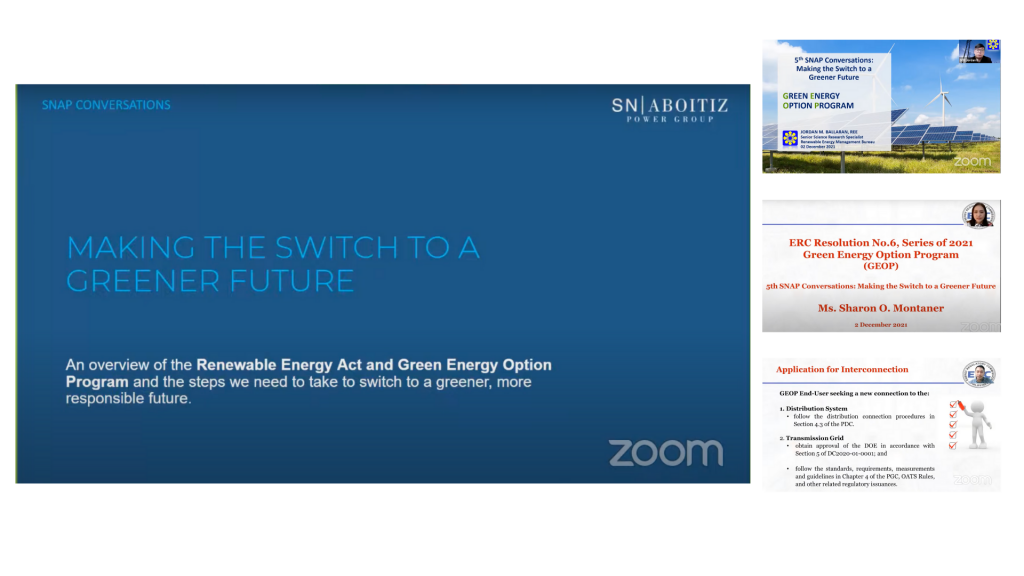
SNAP hosts webinar on RE and Green Energy Option Program

SN Aboitiz Power Group hosted “Making the Switch to a Greener Future,” a virtual talk on renewable energy and the Green Energy Option Program (GEOP) in December as part of its ‘SNAP Conversations’ webinar series.

The online event, which was supported by the Nordic Chamber of Commerce of the Philippines, featured industry experts from the Department of Energy (DOE) and the Energy Regulatory Commission (ERC) who presented the program features and policies of GEOP.

In his opening remarks, SNAP President and CEO Joseph Yu noted that climate action has become a critical issue for the energy sector. “Reducing emissions or getting to zero requires long-term planning on the part of both developers and for consumers, and we’ve seen that both the public and private sectors are increasingly and equally committed to achieving these goals. SNAP is well-positioned to support the steady rise in demand for RE. Our goals are to expand our portfolio to include other forms of renewable energy, and support our customers as they transition to responsible, renewable energy.”

Jordan Ballaran, Senior Science Research from the DOE’s Renewable Energy Management Bureau, discussed the agency’s efforts to attain the objectives of the Renewable Energy Law to accelerate the development of RE resources, achieve energy self-reliance, and mitigate the effects of climate change. “The DOE is studying a lot of policies to support RE [and] to achieve our clean energy scenario,” Ballaran said.

One such initiative is the Green Energy Option Program, a voluntary policy mechanism that provides electricity end-users consuming at least 100 kilowatts of power the option to source their supply from renewables.

The ERC’s Sharon Montañer, Director of Market Operations Service; Jayson Corpuz, Head of the Renewable Energy Division; and Liza Lagman, Head of the Contestable Market Division, presented the details of the GEOP regulatory framework. GEOP rules took effect on September 3, with a transitory period of three months, and full implementation began on December 3.

With the launch of GEOP, Ballaran said they expect commercial and industrial consumers to come in, as well as micro, small and medium enterprises (MSMEs), while Corpuz added that companies with ‘green’ or sustainable advocacies may look to switch to GEOP. Through policy mechanisms and initiatives such as GEOP, consumers can contribute to the country’s energy sustainability goals.


Spotlight is BusinessWorld’s sponsored section that allows advertisers to amplify their brand and connect with BusinessWorld’s audience by enabling them to publish their stories directly on the BusinessWorld Web site. For more information, send an email to online@bworldonline.com.

Join us on Viber to get more updates from BusinessWorld: https://bit.ly/3hv6bLA.

AIA Philippines underscores importance of effective governance to sustainability

Amid the challenges due to the pandemic, recently rebranded AIA Philippines took a bold step and shifted its approach to corporate social responsibility by adapting AIA Group’s Environmental, Social, and Effective Governance (ESG) Strategy. AIA Group is AIA Philippines’ Hong Kong-based parent company.

Effective Governance, one of pillars of the AIA Group ESG Strategy, recognizes the importance of strong corporate governance to deliver sustainable value and maintain a culture of business integrity.

AIA Philippines Chief Executive Officer Kelvin Ang further explains: “By adopting sound and effective governance practices, we are able to operate at the highest standards of responsible business practices. These, in turn, guide us as we work towards operating sustainably, effectively managing risk, while driving innovation.”

Strong Corporate Governance

With integrity and transparency at the core of its corporate governance standards, AIA Philippines cultivates a sustainable culture, guiding its Board of Directors towards achieving long-term value for all its stakeholders, while strengthening confidence in the Company.

“AIA Philippines, through our Board of Directors, maintains a governance program benchmarked against international best practices to ensure business integrity and sound decision-making,” says AIA Philippines Chief Legal Officer and Corporate Secretary Atty Carla Domingo. “To ensure balance in its decision-making, our Board is composed of executive and non-executive directors with diverse backgrounds who bring their expertise and experience to the table, and guide the company towards the achievement of its business plans.”

Managing Risk and Employing Responsible Business Practices

In a business where risk is inherent and must be managed carefully, AIA Philippines relies on a clear and effective Risk Management Framework (RMF) where the primary risk owner in all business areas is defined so risks are identified and mitigated as soon as they emerge.

“We anchor our business practices on our Operating Principle of doing the right thing, in the right way, with the right people, and this permeates across the entire business and encompasses all stakeholders,” remarks AIA Philippines Chief Risk and Compliance Officer Kitten Samaniego. “We expect integrity and reliability from all our people and partners, so we can maintain the same level of trust that our customers have given us for the past 74 years. In the same way, our partners can expect reciprocity from AIA Philippines in their dealings with us.”

Employees are indoctrinated upon employment of the various policies and the business conduct expected of them. Annually, they undergo a refresher course on the AIA Code of Conduct, which details the standards of integrity and ethics expected of an AIA employee, the Anti-Fraud Policy, and the Anti-Corruption and Anti-Bribery Policies.

To protect the Company from becoming an instrument for money laundering, AIA Philippines has an Anti-Money Laundering and Counter Terrorist Financing Program in place.

Witnesses of misconduct by anyone within or connected to AIA Philippines are encouraged to come forward under the Whistleblower Protection Program. The program ensures the whistleblower who reported suspected wrongdoing in good faith that s/he will be protected from retaliation.

When it comes to customers, clear guidelines on treating them fairly and securing their data are in place to ensure their protection. Market Conduct Guidelines and the Sales Code of Discipline, on the other hand, are the handbook to guide its agency force and agency distribution employees on the conduct of business.

Policies are also in place for engagement with vendors. A local Sourcing Policy supplemented by the Sourcing Practice Guide establishes standardized sourcing procedures. The same applies to the selection of suppliers and vendors, which are chosen on the basis of performance and merit in accordance with a fair and transparent process.

The scope of Effective Governance involves all the policies concerning the company’s business practices and stakeholders to ensure all roles, responsibilities, functions, and operations are fulfilled and aligned with the goal of achieving a sustainable future for AIA Philippines. “Our vision is always for the long term. By adhering to the highest standards of governance, we are able to assure our customers that AIA Philippines will be here decades from now, able to meet our commitments to them and their families, helping them live Healthier, Longer, Better Lives,” states Ang.

Click here for more information on AIA Philippines.


Spotlight is BusinessWorld’s sponsored section that allows advertisers to amplify their brand and connect with BusinessWorld’s audience by enabling them to publish their stories directly on the BusinessWorld Web site. For more information, send an email to online@bworldonline.com.

Join us on Viber to get more updates from BusinessWorld: https://bit.ly/3hv6bLA.

Gross borrowings hit P2.78 trillion

BW FILE PHOTO

GROSS BORROWINGS by the National Government reached P2.78 trillion as of end-November as it continued to source funding for the pandemic response, preliminary data from the Bureau of the Treasury (BTr) showed. 

In the first eleven months of 2021, gross borrowings declined by 8.9% from the P3.05 trillion raised in the same period in 2020.

In November alone, the Treasury borrowed P26.7 billion, down by 81.7% from the October figure.

Local borrowings, which accounted for the bulk of the total, stood at P16.6 billion, plunging by 87.6% compared with the P133.73 billion logged a month earlier.

There were a net redemption of Treasury bills worth P53.4 billion in November, while a total of P70 billion in Treasury bonds were sold.

The government logged P16.5 billion in net local borrowings after making P98 million in amortization payments.

Meanwhile, gross foreign borrowings reached P10.1 billion in November, slipping by 16.2% from the P12.05 billion a month earlier.

The November total consisted entirely of project loans, recording no foreign program loans.

With P6.95 billion in amortization payments, the government recorded P3.15 billion in net external borrowings.

For the 11-month period, gross domestic borrowings hit P2.25 trillion, or 8.83% lower than a year earlier.

Broken down, local borrowings consisted of P1.26 trillion in T-bonds, P463.32 billion in retail treasury bonds, and P540 billion in short-term borrowings from the central bank. The government also recorded the P97.33-billion redemption in T-bills.

Net local borrowings reached P2.19 trillion after the Treasury paid P53.58 billion in maturing obligations.

Meanwhile, gross external borrowings in the 11-month period reached a total of P528.8 billion, down by 9.39% from the same period a year earlier.

Broken down, the bureau raised P146.17 billion from global bonds, P121.97 billion from euro-denominated notes, and P24.19 billion in Japanese yen-denominated securities.

It also recorded P139.98 billion in program loans along with P96.5 billion in project loans.

The government repaid P230.88 billion of its outstanding foreign debt, resulting in P297.9 billion in net external borrowings.

The government borrows from local and foreign sources to plug a budget deficit seen to hit 9.3% of gross domestic product (GDP) in 2021.

Economic managers are planning to scale down borrowings starting this year as part of its debt consolidation plan.

Fitch Ratings earlier warned that rising levels of public debt could lead to a credit rating downgrade for the Philippines in the next few years. — J.P. Ibañez

Senate to focus on priority bills, RCEP

BW FILE PHOTO

By Alyssa Nicole O. Tan, Reporter

THE SENATE is focusing on the approval of several priority measures and international agreements including the Regional Comprehensive Economic Partnership (RCEP) within the next three weeks before Congress goes on a break on Feb. 4 for the upcoming elections.

Congress resumes session on Monday, with the Senate still yet to approve at least 12 bills that have already been passed on final reading by the House of Representatives.

“We urge the Senate to expedite the deliberations and approval of these measures so we can pass them into law before the campaign period,” House Speaker Lord Allan Jay Q. Velasco said in a statement.

Mr. Velasco said these measures include the Internet Transactions Act, and the Government Financial Institutions Unified Initiatives to Distressed Enterprises (GUIDE) Act.

Senate Majority Leader Juan Miguel F. Zubiri said there will be a caucus to determine the chamber’s priorities on Monday.

“To be practical about it, these three weeks are really risky for major contentious bills,” he said in a mix of English and Filipino via Viber.

Senate Minority Leader Franklin M. Drilon said Congress should “not allow election fever get in the way of legislation.” The national and local elections are scheduled to be held on May 9.

Senator Mary Grace Natividad S. Poe-Llamanzares, who chairs the Public Services Committee, in a Viber message to BusinessWorld, said the Senate has been able to pass “almost all of its priority bills, so now all that is left to do is to ratify the bicameral versions.”

“On my end, we are due to ratify the consolidated version of the Public Service Act (PSA) Amendments, SIM Card Registration Act, and the National Transportation Safety Board,” she said.

The amendments to the PSA would allow 100% foreign ownership in telecommunications, air carriers, domestic shipping, railways and subways, and canals and irrigation.

Despite the objections to the PSA bill, Ms. Poe expects the Bicameral Conference Committee to come up with a final version within the week.

“Debates in the Senate were very extensive. We agree on many provisions passed by the House. Knowing full well the importance of this bill, I am confident we can reach an agreement and have it ratified by both Houses before sessions adjourn in February,” she said.

Ms. Poe also expects the Senate to act swiftly on the remaining pandemic-related measures such as the vaccine passport program, the creation of a disease center, and the funding for allowances of healthcare workers.

Senator Aquilino Martin “Koko” dela L. Pimentel III, who chairs the Foreign Relations Committee, told BusinessWorld in a Viber message that the Senate has to tackle three treaties — the RCEP, Treaty to Reduce Statelessness, and Arms Trade Treaty (ATT) — before the break.

Business groups have urged the Senate to give its concurrence to the ratification of the RCEP as soon as possible, warning that delays would risk the Philippines missing out on market opportunities.

The RCEP was ratified by President Rodrigo R. Duterte on Sept. 2, 2021, and is now pending in the Senate for concurrence. It took effect on Jan. 1, 2022 for 11 countries, namely: Brunei, Cambodia, Lao PDR, Singapore, Thailand, Vietnam, Australia, China, Japan, South Korea, and New Zealand.

Meanwhile, the House of Representatives is expected to approve the proposed Rural Financial Inclusion and Literacy Act, and a measure amending the Omnibus Election Code that aims to strengthen the field offices of the Commission on Elections (Comelec).

Mr. Velasco also said they will also try to finalize the Magna Carta for Barangay Health Workers, the National Housing Development Act and the bill that assigns health workers to every barangay in the Philippines.

“We only have three weeks or nine session days to finish some priority measures before we adjourn for the election period,” he said.

Meanwhile, Senator Ronald M. dela Rosa, who chairs the Public Order and Dangerous Drugs Committee, said he wants to see the passage of the following: Marawi Compensation bill, Philippine Center for Disease Control and Prevention bill, the Department of Disaster Resilience bill, the Private Security Services bill, and the COVID-19 Benefits for Health Workers Bill.

“The Expanded Solo Parents Welfare Act is a priority, and it looks like we will be able to pass this bill as we are routing the bicam report as we speak,” said Senator Ana Theresia N. Hontiveros-Baraquel, who chairs the Women, Children, Family Relations, and Gender Equality Committee, in a Viber message to BusinessWorld.

She also expressed hope the House of Representatives will also pass the Anti-Online Sexual Abuse and Exploitation of Children Law, which has been approved by the Senate.

Diokno sees fuel prices stabilizing as OPEC increases production

REUTERS
Oil barrels are seen in front of dollar banknotes in this illustration taken on May 25, 2020. — REUTERS/DADO RUVIC/ILLUSTRATION

THE DECISION of major oil producers to stick with their plans to raise crude production in February would likely bring down fuel prices, which in turn could keep inflation within target, Bangko Sentral ng Pilipinas Governor (BSP) Benjamin E. Diokno said.

“Unlike in 2021, where the oil industry was in deficit position (demand exceeded supply), in 2022 the industry will be in surplus position (supply exceeds demand),” Mr. Diokno said in a Viber message.

A group of producers comprising the Organization of the Petroleum Exporting Countries and its allies (OPEC+) are pushing through with a planned increase of 400,000 barrels per day for February. OPEC+ is scheduled to meet again on Feb. 2.

“The increase in production by OPEC will help temper fuel prices and enable the Philippines to dampen inflationary pressures moving forward,” Department of Finance Chief Economist Gil S. Beltran said in a text message.

Mr. Diokno also noted demand for aviation fuel will likely drop as international travel takes a hit from the ongoing Omicron-driven surge in coronavirus disease 2019 (COVID-19) infections worldwide.

“Most advanced economies and many emerging economies are facing persistently elevated inflation; those with oil reserves — for example, US, UK and other countries — maybe compelled to release their oil reserves,” he added. 

Amid recent developments, the BSP chief said a hike in transport fares is “unlikely” as public transportation capacity will be raised alongside easing mobility curbs.

“By and large our inflation forecast will hold (threshold is $95 a barrel for two years), hence no change in existing outlook. This does not mean that there will be no adjustment in the current accommodative monetary policy in the next two years. There might be, but it will be based on other factors, not higher oil prices,” Mr. Diokno said.

In 2021, Philippine inflation averaged 4.5%, which is above the 2-4% target by the central bank and much faster than the 2.6% in 2020. The elevated inflation was attributed mainly to low supply of meat and higher global oil prices.

ING Bank N.V. Senior Economist Nicholas Antonio T. Mapa said the OPEC’s announcement reflects how global oil prices are not only moved by supply and demand but by politics as well, noting the production increase is helpful for net importers like the Philippines.

“As of the moment, oil prices remain quite elevated but the latest announcement may help energy costs to moderate in the near term, which in turn could bode well for energy importers such as the Philippines,” Mr. Mapa said in an e-mail.

As of Jan. 11, gasoline, diesel, and kerosene prices rose by P2.60, P3.50, and P2.75 year to date.

Mr. Mapa said inflation could return to within the 2-4% target range this year due to base effect, the rebasing of the consumer price index, and the likely moderation in oil prices.

However, he noted inflation could pick up pace in the first two months as food prices reflect the impact of Typhoon Odette.

In December, the headline inflation eased to 3.6% from 4.2% in November.

The central bank expects the consumer price index to increase by 3.4% in 2022 and by 3.2% in 2023.

The BSP’s inflation projection is based on the assumption that Dubai crude oil will average $72.66 per barrel in 2022 and $68.74 per barrel in 2023.

Reuters on Friday reported Brent crude futures settled at a 2-½-month high of $86.06 a barrel, up by 5.4% week on week.

Last week, Mr. Diokno said the central bank is unlikely to raise interest rates in the first half of 2022 to support recovery. — L.W.T. Noble

Investors search for safe havens as Omicron takes hold in Asia

REUTERS

THE THREAT of the Omicron variant is becoming real for many of Asia’s biggest countries just as it looks set to subside in some Western nations, and that’s complicating investors’ search for winning share bets in the region.

The problem is that Asian governments are carrying out widely diverging coronavirus policies, with strategies ranging from China’s pursuit of COVID Zero to Australia’s move to live with the virus, and almost everything in between. The speed of vaccinations and the strength of healthcare systems also vary greatly in the region.

It’s another example of how COVID is forcing investors to face new challenges, though many remain positive about Asia’s ability to weather the storm as its best-performing nations kept deaths from the pandemic at levels far lower than elsewhere. Asian stocks have done better than their European and US counterparts so far this year, after underperforming both of them in 2021.

“Asia will be better braced to cope with Omicron waves, which may prove to be more short-lived,” said Wai Ho Leong, a strategist at Modular Asset Management. “Markets that are better vaccinated and have timely social distancing curbs are also likely to recover faster from this wave.”

That, he says, points to Singapore, South Korea, Taiwan, China and Malaysia as potential winners, with India, Thailand and the Philippines just starting to see surges. Consumer discretionary, autos and banks are among the sectors to bet on, he said.

Western countries from Switzerland to Spain and the UK have suggested that the coronavirus pandemic may be shifting to an endemic phase. In Asia, the Omicron variant wave is starting to pounce, with cases surging in Australia, a jump in Tokyo infections prompting authorities to raise the COVID alert, and Hong Kong extending social restrictions.

‘RICH-COUNTRY NARRATIVE’
Exhausted by lockdowns, European countries have largely eschewed a return to onerous curbs. Many countries in Asia are “refusing to buy into the rich-country Western narrative that it is milder and will have a lower net impact,” wrote Jeffrey Halley, senior market analyst for Asia-Pacific at Oanda, in a Jan. 10 report.

The region’s two largest markets are among them. For some, China’s proven success in stamping out the virus when found means investors there have little to worry about from Omicron.

“While isolated lockdowns could disrupt a certain location temporarily, it is likely to have little impact on the economy as a whole,” said Jian Shi Cortesi, investment director for China and Asia growth equities at GAM Investments in Zurich. “China’s economy has adapted to zero-COVID measures, with most sectors operating normally. For most people it’s life as usual.” 

But others are wondering how long that strategy can be maintained. Morgan Stanley cut estimates for Hong Kong’s economy as the city again turns to strict curbs, likely delaying a reopening with the mainland. China’s lockdowns remain local but could become more widespread.

“The odds of a China growth shock because of Omicron and COVID Zero are steadily rising by the day,” Oanda’s Mr. Halley wrote.   

Japan was among the first countries to attempt a “living with the virus” strategy in 2020, but under the administration of Prime Minister Fumio Kishida, COVID policy has grown more cautious despite 80% of the country having had two vaccine shots.

“Japan is now the most strict country in the free world” in terms of border control, said Richard Kaye, a portfolio manager at Comgest Asset Management Japan Ltd., which oversees about $10 billion in Japanese equities. Conversely, he says the strictness makes it the ideal reopening play.

“We can invest in the reopening story with a much bigger, greater visibility than we have in other major economies,” he said. Mr. Kaye sees airlines, airport operators, railroads and retail likely to benefit when eventually the strict borders are opened.

So far this year, Japan’s blue-chip index Nikkei 225 has underperformed the Asia benchmark by about three percentage points. — Bloomberg

ADVERTISEMENT
ADVERTISEMENT