Home Blog Page 693

Del Monte Pacific profit soars on strong sales in PHL, int’l markets

Bugo cannery workers in Cagayan de Oro — DELMONTEPACIFIC.COM

DEL MONTE PACIFIC Ltd. (DELM) said its net profit for the second quarter of fiscal year 2026 surged nearly seven-fold to $16.8 million from $2.3 million a year ago.

In a press release on Monday, the food and beverage producer said net profit for the first half of fiscal year 2026 also climbed to $22.3 million from $2.7 million last year, backed by stronger sales and expanded margins.

Sales in the same period rose 11% to $438.6 million, driven by a 16% increase in fresh pineapple sales and 10% growth in the Philippines.

“Sales in the Philippines in the second quarter rose 9% in peso terms to $121.7 million on higher volume and better pricing,” the company said.

Growth in Philippine sales was driven by strong demand for packaged pineapple and the expanded, year-round use of mixed fruits. Nutrition-focused initiatives promoting pineapple as a daily superfruit helped increase consumer preference for natural, immunity-boosting options, it noted.

International sales increased 7% to $90.6 million, driven by higher volumes of fresh pineapple, NFC juice, and frozen pineapple.

According to the company, the fresh fruit segment led this growth, expanding 23% due to continued strong sales of the Deluxe variety and better pricing. NFC juice sales rose 49%, mainly from increased demand in China and Europe, while frozen pineapple sales increased 21% on the back of a favorable product mix and firm pricing.

The Group introduced the Del Monte Halo-Halo Mix in Australia last September.

At the local bourse on Monday, DELM shares closed 21.56% higher at P3.89 apiece. — Alexandria Grace C. Magno

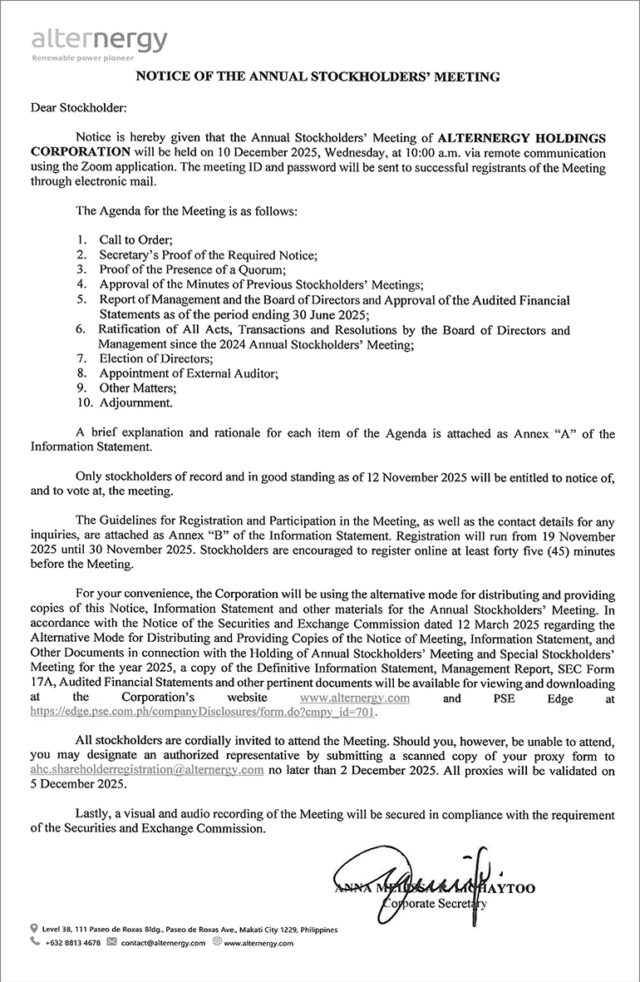
Alternergy Holdings Corp. to hold Annual Stockholders’ Meeting on Dec. 10 via Zoom


Spotlight is BusinessWorld’s sponsored section that allows advertisers to amplify their brand and connect with BusinessWorld’s audience by publishing their stories on the BusinessWorld Web site. For more information, send an email to online@bworldonline.com.

Join us on Viber at https://bit.ly/3hv6bLA to get more updates and subscribe to BusinessWorld’s titles and get exclusive content through www.bworld-x.com.

Entertainment News (11/18/25)


HK Disneyland holds Christmas concert series

AS PART of its 20th anniversary celebration this year, Hong Kong (HK) Disneyland is inviting guests to step into Christmas festivities from Nov. 14 to Jan. 6, 2026. As part of the Disney Live in Concert series, the park is presenting Disney Legend Live in Concert, featuring Lea Salonga in a one-night-only performance on Jan. 10, 2026, under the lights of the Castle of Magical Dreams. She will be joined by other Disney Princesses performing timeless Disney classics, accompanied by the Hong Kong Philharmonic Orchestra and the Hong Kong Disneyland Band, conducted by Gerard Salonga.


TOMORROW x TOGETHER holds virtual reality concert

GEN Z boy group TOMORROW X TOGETHER has announced their virtual reality (VR) concert, <TOMORROW X TOGETHER VR CONCERT: HEART ATTACK>. It will be shown in Manila exclusively at Gateway Cineplex from Dec. 8 to 24. Tickets will be available starting Nov. 22 at noon via TicketNet.com.ph and TicketNet outlets. The show, presented by Wilbros Live, is set against the backdrop of a real-world fantasy that begins on a campus and traverses diverse spaces and times.


Soupstar Music closes 25th year with caps, concert

SOUPSTAR is celebrating its 25th year in the Philippine music industry with a partnership with global lifestyle brand New Era. The result is a limited-edition cap which aims to bridge music, street culture, and contemporary Filipino lifestyle. Soupstar will also hold a thanksgiving concert in Eton City, Sta. Rosa, Laguna, on Nov. 29. It will be headlined by Moonstar88, who also celebrated the 25th anniversary of their iconic hit “Torete” this year. The band is gearing up to release new material in 2026.


Romance Surely Tomorrow to premiere on Prime Video

PRIME VIDEO has officially announced the premiere of Surely Tomorrow, a new Korean romance series starring Park Seo-jun and Won Ji-an. Directed by Lim Hyun-ook and written by Yu Young-ah, it promises to explore the complexities of love, timing, and fate. Set to debut on Dec. 6, the series will be available in over 240 countries and territories, with new episodes released every Saturday and Sunday.


Mamoru Hosoda’s Scarlet in cinemas in December

JAPANESE filmmaker Mamoru Hosoda, known for artistic and emotional animated films like Summer Wars and Mirai, will be releasing his new film this December. Scarlet, a time-bending tale about a princess seeking revenge for her father’s death and who awakens in a mysterious afterlife, will blend different art styles to complement the themes of traveling to different timelines. It arrives in Philippine cinemas on Dec. 10 via Columbia Pictures.


OPM stars headline New Year’s Eve countdown

NEWPORT World Resorts’ New Year’s Eve celebration — The Grand Countdown to 2026 — will have a star-studded lineup led by global and homegrown superstars: Jessica Sanchez, Sarah Geronimo, Bamboo, Matteo Guidicelli, Cup of Joe, Amiel Sol, Earl Agustin, Janine Teñoso, GAT, and Raya. The show will be hosted by Billy Crawford. Tickets, priced from P15,000 to P25,000, are now available online via tickets.newportworldresorts.com/products/the-grand-countdown-to-2026 and at the Newport World Resorts Box Office.


The Good Doctor gets adapted for Filipino audience

CREAZION STUDIOS, in collaboration with MediaQuest, is bringing a Filipino adaptation of the globally acclaimed medical drama The Good Doctor which will air exclusively on TV5 in 2026. It will star Iñigo Pascual in the titular role. Originally produced by the Korean Broadcasting System, The Good Doctor has been adapted for several countries, including the US, Japan, Turkey, and Hong Kong.


First sensory lab opening at SM Supermalls

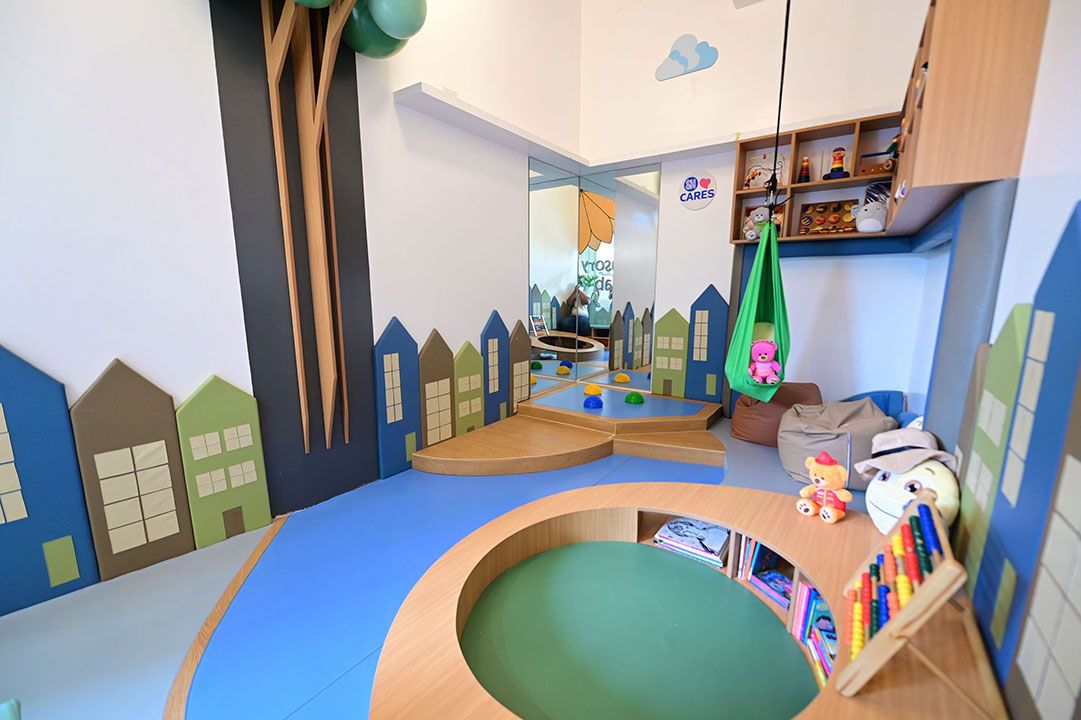
IN LINE with its mission to create a mall for all, SM Supermalls will soon open the first-ever SM Sensory Lab at the SM Mall of Asia in Pasay City. This is a dedicated space designed to provide a calm and comfortable environment for individuals with sensory sensitivities, including those with autism spectrum disorder, sensory processing disorder, and anxiety disorder. It is part of SM Cares’ advocacy for persons with disabilities.


Spotify hosts IV OF SPADES fan experience

SPOTIFY was involved in the most recent big reunion in Philippine pop music, the return of IV OF SPADES with their latest album, Andalucia. The event was a mix of immersive in-app storytelling and an exclusive premium fan experience. It included a “Hall of Memories,” a walkthrough of the band’s most popular eras, with four creative rooms inspired by each member of the group. IV OF SPADES also performed many songs from their new album. Spotify led up to this with “TV of Spades,” an interactive experience in the app.

World’s top YouTuber MrBeast launches Saudi theme park

RIYADHSEASON.COM

RIYADH — Cristiano Ronaldo. Naomi Campbell. Sofia Vergara.

And the latest celebrity brought to Saudi Arabia in the kingdom’s push to become a global entertainment destination: MrBeast, the most popular YouTuber on the planet.

The online sensation hit 100 billion views this month and is in Riyadh to launch Beast Land, a theme park modelled on his videos that put people through elaborate endurance challenges to win large cash prizes.

“It’s probably one of the best days of my life,” the 27-year-old, whose real name is James Donaldson, told Reuters ahead of the launch on Thursday, in one of at least nine interviews conducted as part of his Saudi PR blitz.

“One of the top requests I get is: I want to be in a MrBeast video… So now (we are) creating that in real life where you guys can come visit it and experience what it is like,” he said.

CHANGING TIMES IN ONCE ULTRA-CONSERVATIVE KINGDOM
Over the past decade, once ultra-conservative Saudi Arabia has rapidly developed entertainment options as part of Crown Prince Mohammed bin Salman’s Vision 2030 to diversify the country away from oil and transform society.

Young Saudis grew up with few avenues for fun, with cinemas and concerts effectively banned. Outsiders saw the kingdom as stuck in time. Both perceptions have shifted.

The Saudi capital is now the scene of Riyadh Season, running almost half the year with near-daily events from boxing and slap contests to house music parties and sports competitions.

Lit up in neon-blue, Beast Land combines theme park attractions like rollercoasters with Mr. Donaldson’s American Gladiator-style challenges, such as a game where the last player to slap a button when it lights up falls to cushioned doom.

Mr. Donaldson says 70% of his fans are outside the US and Saudi Arabia was also a natural choice due to easily accessible studio space to film his latest season of videos.

“I’d say give it a try, it’s much more developed than you’d think,” he said.

The kingdom has been known to attract international talent with massive compensation: Cristiano Ronaldo’s contract with Saudi Arabia’s Al Nassr is estimated to be worth more than $200 million.

MrBeast has at times stirred controversy, with Mexico in May filing suit against a firm they say worked with him after he produced a video at the nation’s ancient Maya pyramids. — Reuters

PetroEnergy Q3 income drops 45% on oil revenue dip, expansion costs

PETROENERGY.COM.PH

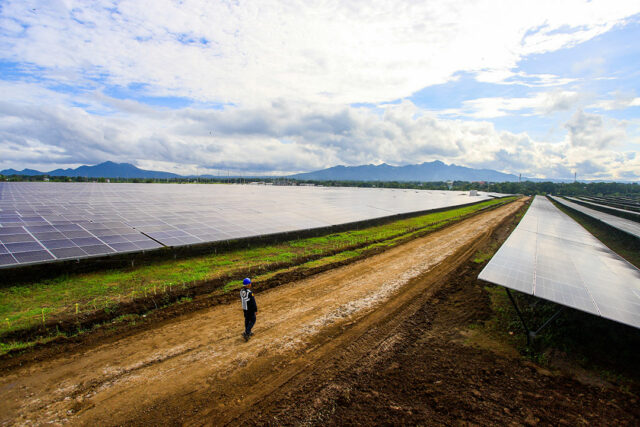
YUCHENGCO-LED PetroEnergy Resources Corp. posted a 44.9% drop in third-quarter net income to P46.5 million, as lower oil revenues and higher costs from new solar projects weighed on earnings.

For the three months ending September, the listed energy company recorded gross revenues of P843.93 million, down 4.9% from P887.44 million in the same period last year.

For the nine-month period, PetroEnergy posted an attributable net income of P297.54 million, a decrease of 26.37% from P404.09 million in the comparable period a year ago.

Its gross revenues fell by 7.72% to P2.93 billion from P2.72 billion, while combined expenses rose by 16.24% to P2.29 billion from P1.97 billion in the same period last year.

The company said it reported higher electricity sales for the period ending September at P2.33 billion, which it attributed to the company’s consistent growth in renewable energy.

However, the decline in Gabon oil revenues pulled down its consolidated net income, the company said, with oil revenues also dropping due to lower global crude oil prices — from an average of $81.69 per barrel to $69.72 per barrel.

The company also said that higher power sales, along with increased financing costs and expenses, were due to the 27-megawatt direct current Dagohoy Solar Power Project in Bohol, which started commercial operations in July 2025, as well as its other solar power projects.

At the stock exchange on Monday, shares in the company fell by 19 centavos, or 5.29%, to end at P3.40 each. — Ashley Erika O. Jose

Building a culture of honesty, integrity and accountability to combat systemic corruption

STOCK PHOTO | Image by Jcomp from Freepik

Rebuilding from the roots — this advocacy is to implant the culture of honesty and integrity in the hearts and minds of the populace to eradicate the embedded culture of corruption in our beloved country.

Our beloved country is facing one of the most challenging crises in its history — a crisis born of widespread, government-driven corruption. This tragedy is felt most deeply by the marginalized and disadvantaged populations, whose hopes are stolen every time public resources meant for their welfare are diverted for personal gain. Corruption denies them quality of education, decent healthcare, an honest livelihood, and the dignity that comes from fair opportunity. This is all the more painful when we remember that the Philippines stands as the largest Christian nation in Asia and the 5th largest in the world — a nation whose values should be rooted in honesty, service, and love for neighbor, especially the marginalized and underserved.

Today, the pervasive social norm is that “corruption has become a rule rather than an exception.” A belief that many people embrace based on a belief that “if everybody is doing it, I might as well do it too.” Thus, corruption is deeply embedded in the hearts and minds of the populace, from the bottom of the pyramid to the top.

The core advocacy is to commence implantation of honesty and integrity in the world of the academe, starting from kindergarten, through to high school, college, and post-graduate levels. Today, these measures of enhancing the culture of honesty and integrity hardly exist in the world of the academe.

In every level, from kindergarten to post-graduate, the framework of honesty and integrity must be tailored fit according to the age and degree of knowledge and perceptions.

If corruption can be learned, so can integrity. And if dishonesty can spread through a nation, so can honesty, accountability, and moral courage — beginning with us, and the way we lead our institutions in government, business, education, and the church.

THE HOPE WE CAN BUILD
Over the long term, the students graduate and enter into the professional fields working in either the private or public sectors with hearts and minds encased in the culture of honesty and integrity.

Upon their assumption as parents, in turn, they cascade the same culture upon their beloved descendants, their children and grandchildren.

Upon entering organizations as employees and eventually becoming leaders in both private and public organizations, they all adhere to the golden principles of honesty and integrity.

This is the essence of sustainable nation-building: when honesty and integrity cease to be exceptions and become the rule. By embedding these virtues in education and family life, we can gradually dismantle the culture of corruption and give rise to a new generation of Filipinos whose integrity is their legacy and whose honesty is their strength.

What is a priority is for the Department of Education and the Commission on Higher Education to integrate values formation programs that teach honesty and integrity at every level of the academe, from kindergarten to post-graduate.

If we are to heal our nation, we must begin by transforming ourselves and the way we lead. Change will not come from new slogans or policies alone — it must begin with a renewed conscience, a reawakening of integrity in every Filipino heart.

And where better to begin this transformation than in our schools? Education shapes not only minds but also moral character. From the earliest years to higher education, schools must become living laboratories of honesty, integrity, and accountability — where these values are not just taught in words but demonstrated in action. When learners grow in an environment that rewards truth, fairness, and responsibility, they carry these values into their future professions, communities, and families.

By nurturing integrity through education, we lay the foundation for a generation that will no longer tolerate corruption — a generation that will lead our nation toward justice, trust, and genuine progress. This formation begins at home, where parents model honesty and responsibility; it is strengthened in our schools, where teachers cultivate moral discernment and ethical behavior; and it matures in the workplace, where these same values guide our young professionals in leadership and service. When families, schools, and institutions work together to uphold honesty, integrity, and accountability, these virtues become a living legacy — passed from one generation to the next, shaping a nation built on trust and moral strength.

HOW TO START THE MOVEMENT
Integrate Values Education — Schools and universities should embed ethics, civic responsibility, and integrity in the curriculum; engage students in discussions on accountability, honesty, and social responsibility; and encourage critical thinking about ethical dilemmas, real-life case studies, and decision-making.

Strengthen Family Foundations — Values are first learned at home. Parents and guardians should consistently model honesty, fairness, and responsibility.

Lead by Example — School leaders must themselves exemplify honesty, transparency, and accountability. Teachers are more likely to adopt positive values when they see them consistently demonstrated by school administrators and senior staff.

Empower Teachers as Role Models — Teachers should be encouraged to incorporate honesty and integrity into their teaching practices — in interactions with students, student assessment, classroom management.

Recognize and Celebrate Integrity and Honesty — Systems where ethical behavior is recognized and reinforced should be established; teachers who demonstrate ethical leadership, fairness, and honesty in their work must be publicly acknowledged; awards or recognition programs that highlight exemplary role models for students and colleagues should be created.

Build a Supportive Network — Peer groups, mentorship programs, or “integrity circles,” where members support each other in ethical behavior, must be established.

Let us begin today by teaching our children, guiding our students, and living with integrity in every choice we make. When honesty takes root in the heart of every Filipino, we will witness a nation reborn — honorable, just, and truly free — a nation where corruption finds no home, where trust is restored, and where every citizen, from the smallest village to the highest office, can stand with pride and dignity.

This is our calling. This is our legacy. Let us lead, let us teach, let us live the change we wish to see. The time is now. The responsibility is ours. And the future is within our hands.

When honesty takes root in the heart of every Filipino, we will see a nation reborn — honorable, just and truly free from any form of corruption.


Dr. Reynaldo “Regie” T. Casas is chair of the Management Association of the Philippines’ Environment Committee. He is a board member of the Southeast Asia Interdisciplinary Development Institute (SAIDI), Graduate School of Organization Development.

map@map.org.ph

rtcasas0211@gmail.com

www.map.org

T-bills upsized as investors position for rate cut

BW FILE PHOTO

By Aaron Michael C. Sy, Reporter

THE GOVERNMENT increased the volume of Treasury bills awarded on Monday despite softer demand, with mixed yields reflecting expectations of another rate cut by the Bangko Sentral ng Pilipinas (BSP) next month.

The Bureau of the Treasury (BTr) raised P25 billion from the auction, above its P22-billion program. Total tenders reached P84.015 billion, more than four times the offer, though below P98.311 billion at the auction last week.

The Auction Committee fully awarded bids across all tenors as average yields landed below secondary market levels, the Treasury said.

The 91-day T-bill fetched an average rate of 4.842%, up 2.1 basis points (bps) from a week earlier, with the government accepting P7 billion as planned. Demand reached P26.19 billion, with accepted yields ranging from 4.825% to 4.854%.

The Treasury increased its award for the 182-day tenor to P10.5 billion from P7.5 billion after tenders hit P29.47 billion.

The BTr doubled its noncompetitive bucket for the tenor to P6 billion. The average rate declined by 1.1 bps to 4.97%, with accepted bids ranging from 4.923% to 5%.

For the 364-day T-bill, the BTr raised P7.5 billion as planned as demand reached P28.355 billion. The one-year paper averaged 5.017%, down 3.7 bps week on week, with accepted yields at 5% to 5.028%.

Ahead of the auction, the 91-, 182-, and 364-day T-bills traded at 4.8914%, 5.0425%, and 5.1082%, respectively, based on PHP Bloomberg Valuation (BVAL) service reference rates.

A trader said the decline in overall bids reflected weaker market activity amid political tensions that prompted several government agencies to shift temporarily to work-from-home arrangements.

The trader added that market participants were also returning from the Money Market Association of the Philippines’ annual convention at the weekend.

Rizal Commercial Banking Corp. Chief Economist Michael L. Ricafort said T-bill yields have been trending slightly lower for most of the past five months, except for the shortest tenor this week.

He noted that short-term PHP BVAL yields fell by 0.03 bp to 0.07 bp week on week, helping pull auction rates lower.

He said the slowdown in GDP growth to 4% in the third quarter — the weakest in more than four years — and benign inflation at 1.7% support another 25-bp BSP cut on Dec. 11.

The policy priority is to shore up growth while inflation remains within manageable levels, he added.

Finance Secretary and Monetary Board member Ralph G. Recto earlier told BusinessWorld that a 25-bp cut before yearend is likely. He also floated the possibility of a 50-bp move while ruling out an off-cycle adjustment.

The BSP cut its benchmark rate by 25 bps last month, bringing the policy rate to 4.75%. The central bank has now cut a total of 175 bps since August last year. The final policy meeting for 2025 is set for Dec. 11.

Mr. Ricafort said lower crude prices, subdued inflation pressures globally and expectations of further US Federal Reserve easing offer added room for the BSP to reduce rates.

He said the peso’s stability would remain a key factor, with the currency hovering near its record low of 59.26 a dollar.

He added that recent gains in the local bond market and lower yields might have attracted some foreign inflows, helped by market speculation that Philippine debt could enter the JPMorgan Global Emerging Market Bond Index.

The Treasury will offer P35 billion in bonds on Tuesday — P20 billion in 10-year debt with six years and 10 months remaining, and P15 billion in 20-year securities with 18 years and six months left.

The government plans to raise P158 billion from the domestic market this month, including P88 billion in T-bills and P70 billion in bonds. It relies on local and foreign borrowing to fund its budget deficit, capped at P1.56 trillion or 5.5% of gross domestic product this year.

Labubu movie in the works for the big screen, report says

POPMART.COM

LOS ANGELES — The popular Labubu dolls that have ignited a global frenzy may light up movie screens in the future, the Hollywood Reporter said on Friday.

Sony Pictures closed a deal last week to develop a movie based on the toothy monsters, the media outlet reported. The film is in the early stages of development and it has not yet been decided whether it will be live-action or animation.

Sony had no comment.

Labubus, sold by China’s Pop Mart, became a phenomenon this year. They were carried by celebrities including Rihanna and singer Lisa from South Korean group Blackpink. Shoppers lined up to buy the dolls in “blind boxes” that keep the exact model secret until opened.

Sony has produced the Jumanji movies as well as animated Netflix hit KPop Demon Hunters. — Reuters

Citicore Q3 income climbs 18% on higher electricity sales

PHILIPPINE STAR/NOEL B. PABALATE

LISTED Citicore Renewable Energy Corp. (CREC) saw its third-quarter (Q3) attributable net income rise by 18.21% to P242.02 million.

For the three months ending September, CREC logged gross revenues of P1.15 billion, down by 11.54% from P1.30 billion in the same period a year ago.“Our performance in the first nine months highlights the effectiveness of our disciplined approach as an end-to-end renewable energy solutions provider. We are working tirelessly to sustain this momentum as we continue advancing toward our goal of energizing 1 gigawatt per year in five years,” Citicore President and Chief Executive Officer Oliver Y. Tan said in a media release on Monday.

For the nine months ending September, CREC’s attributable net income surged 44.39% to P685.38 million from P474.66 million in the comparable period a year ago.

“At CREC, we don’t just build renewable energy facilities, we create a holistic positive impact anchored on our innovation and approach to nation-building. Our Batangas solar plant, with its battery energy storage system and also equipped with our pioneering AgroSolar Initiative, proves that reliable, round-the-clock renewable power is possible in the Philippines,” Mr. Tan said.

Gross revenues for the January-to-September period increased to P3.82 billion, up 13.02% from P3.38 billion in the same period a year ago.

CREC attributed its revenue growth for the period to a P410.65 million increase in electricity sales and P25.89 million from service fees. Electricity sales rose 14% due to an expanded customer base.

“As we continue to energize new assets and roll out additional capacities, we are building the base for a more robust revenue stream in the long run. We continue to support the government in its clean energy transition and remain resolute in being one of the leading renewable energy companies in the country, ultimately providing lasting value for the Filipino people,” he said.

For this year, CREC has allocated a capital expenditure (capex) budget of more than $1 billion, with the majority of the funds earmarked for its first gigawatt (GW) of solar power projects.

CREC aims to add 1 GW of capacity annually to the Philippines’ energy mix, focusing on ready-to-build or under-construction projects over the next five years, targeting a total of approximately 5 GW by 2028.

At the local bourse, shares in CREC closed unchanged at P4.15 each. — Ashley Erika O. Jose

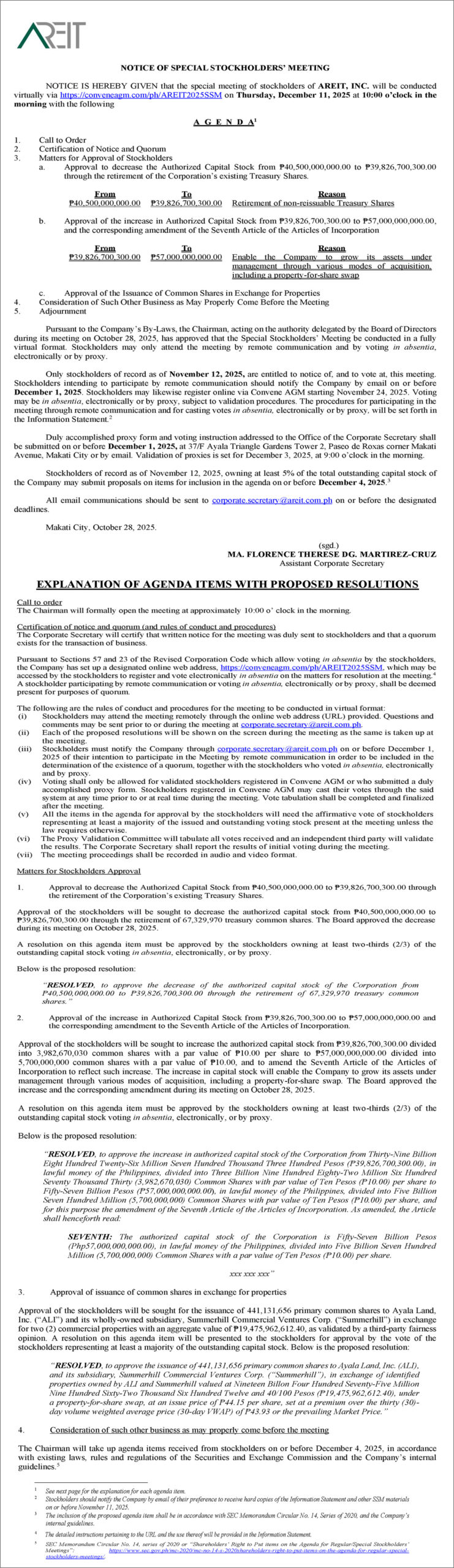
AREIT, INC. to conduct Special Stockholders’ Meeting virtually on Dec. 11


Spotlight is BusinessWorld’s sponsored section that allows advertisers to amplify their brand and connect with BusinessWorld’s audience by publishing their stories on the BusinessWorld Web site. For more information, send an email to online@bworldonline.com.

Join us on Viber at https://bit.ly/3hv6bLA to get more updates and subscribe to BusinessWorld’s titles and get exclusive content through www.bworld-x.com.

A truth commission can help our country move forward with honesty and moral clarity

MILITANT GROUPS and families of extra judicial killings held a protest rally at Welcome Rotonda. — PHILIPPINE STAR/EDD GUMBAN

If there is an Independent Commission for Infrastructure (ICI) to investigate corruption in flood control projects, there should also be a Truth Commission to investigate extra-judicial killings.

On March 29, 2023, President Ferdinand Marcos, Jr. joined the leaders of the United States and 72 other nations in declaring:

“We the leaders of the Summit for Democracy, reaffirm our shared belief that democracy — government reflecting the effective participation and will of the people — is humanity’s most enduring means to advance peace, prosperity, equality, sustainable development, and security. Democracy is necessary to ensure that every voice is heard, that the human rights of all are respected, protected, and fulfilled, online and offline, and that the rule of law is upheld. We recognize that democracy can take many forms, but shares common characteristics, including free and fair elections that are inclusive and accessible; separation of powers; checks and balances; peaceful transitions of power; an independent media and safety of journalists; transparency; access to information; accountability; inclusion; gender equality; civic participation; equal protection of the law; and respect for human rights, including freedoms of expression, peaceful assembly, and association.

“We commit to fight against impunity and promote accountability for violations of international law, particularly genocide, war crimes, the crime of aggression and crimes against humanity, including where such crimes involve sexual and gender-based violence. We acknowledge the important role played by the ICC as a permanent and impartial tribunal complementary to national jurisdictions in advancing accountability for the most serious crimes under international law.”

President Marcos Jr. botched the opportunity to do something great for the country when he subsequently disassociated himself from the Declaration’s reference to the International Criminal Court (ICC). He reiterated the stance that the ICC has no jurisdiction over the country and declared that his administration would not cooperate with the ICC’s investigation of the extra-judicial killings in the Philippines. He stated that the Philippines has a functioning judicial system capable of investigating and prosecuting any alleged crimes, making the ICC’s intervention unnecessary and an infringement on national sovereignty.

The dissociation made President Marcos Jr.’s affirmation of his belief in democracy duplicitous. In January of that year, the ICC pre-trial chamber reopened its investigation into the extra-judicial killings under former president Rodrigo Duterte’s bloody war on drugs because it was not satisfied with the efforts of the country’s social justice system to probe the human rights abuses during Mr. Duterte’s term as mayor of Davao City and during his presidency.

Human Rights Watch had found out that since taking office on June 30, 2016, President Duterte carried out a “war on drugs” that had led to the deaths of over 12,000 Filipinos, mostly urban poor. At least 2,555 of the killings were attributed to the Philippine National Police (PNP). Duterte and other senior officials instigated and incited the killings in a campaign that could amount to crimes against humanity. Human Rights Watch research found that police were falsifying evidence to justify the unlawful killings.

Amnesty International has vehemently condemned former president Duterte’s “war on drugs,” stating that the widespread and systematic extrajudicial executions constitute “crimes against humanity.” The organization has extensively documented how the campaign targeted poor and marginalized communities, resulting in thousands of deaths with rampant impunity.

Amnesty International says that police and individuals linked to them killed thousands of alleged drug offenders, often fabricating incident reports to claim the victims resisted arrest. The police operations, particularly Oplan Tokhang, have been equated with these extrajudicial killings, where police worked from unverified “drug watch lists” to target individuals, including children.

Amnesty International continues to call on the Philippine government to investigate all unlawful killings and ensure justice and reparations for victims’ families. But the Marcos administration has not filed any case against any of the principals behind the war on drugs.

Now President Marcos Jr. is being given the opportunity to still do something great for the country by affirming his belief in democracy. Cardinal Pablo Virgilio David has asked him to create a special body that will investigate the killings during President Duterte’s war on drugs. In a letter to President Marcos Jr. dated Nov. 7, Cardinal David, president of the Catholic Bishops Conference of the Philippines (CBCP), pointed out that the body could provide victims and witnesses a safe venue, review unresolved cases, and recommend reparations, support, and institutional reforms to prevent future abuses.

“They deserve closure. Our institutions deserve restoration. Our nation needs healing,” the Cardinal said. He explained in the letter that the aim of the body is not for revenge but for truth, accountability, and compassion, and to help our country move forward with honesty and moral clarity. “Silence breeds resentment and fear, truth restores dignity, trust, and moral coherence to our democracy,” he added.

The Cardinal said the creation of the body would also send “a powerful message” that the country chooses “courage over fear, accountability over impunity, and reconciliation over silence. It would reaffirm a principle that lies at the heart of our democracy and our shared faith traditions: that every human life has dignity and worth,” he said.

He has explicitly called for the creation of a Philippine Truth and Reconciliation Commission distinct from the International Criminal Court to investigate extrajudicial killings (EJKs). He drew a parallel between the alleged corruption in flood control projects currently being investigated and the “corruption” that led to thousands of EJKs, suggesting that if the government can investigate financial corruption, it should also investigate the corruption that resulted in loss of life.

Many countries have established truth commissions, which are part of transitional justice processes and are created after dictators had been ousted and civil wars ended to investigate human rights abuses and to promote accountability and reconciliation. Among the countries that have created truth commissions are: Chile, South Africa, Argentina, Rwanda, Sierra Leone, and Guatemala.

As bishop of the diocese of Kalookan, Cardinal David actively worked to support and protect drug users and the families of victims during the Duterte administration’s war on drugs,” advocating for a rehabilitative approach instead of the “killings” espoused by the government. His actions included:

• Establishing community-based rehabilitation programs;

• Documenting extrajudicial killings;

• Providing sanctuary and legal assistance;

• Advocating for human rights and justice;

• And offering psychosocial support.

His actions angered President Duterte, who publicly criticized and threatened the bishop with accusations of involvement in illegal drugs and stealing church donations.

The call of the Cardinal is timely. The arrest and surrender of former President Duterte to the ICC in March this year raised several legal questions, among them the jurisdiction of the ICC over Philippine citizens. However, the case has become moot as Mr. Duterte is now in the custody of the ICC in The Hague.

But in reaction to reports that the ICC has also issued a warrant of arrest against him, Senator Ronald “Bato” dela Rosa, is invoking the Philippines’ sovereignty to argue against the ICC jurisdiction. He contends that any cooperation with the ICC, such as surrendering him or providing information like Congressional hearing transcripts, would recognize the ICC’s authority over the country.

His legal team has asked the Supreme Court to block any potential surrender or assistance to the ICC, asserting that Philippine laws do not provide a legal basis for surrendering citizens to an international tribunal.

This principle provides that States have the primary responsibility to investigate and prosecute international crimes, and only when they are inactive, unwilling or unable to genuinely investigate and prosecute, may the ICC exercise its jurisdiction.

Complementarity could have prevented the ICC from trying former president Duterte if a genuine case was brought against him in the Philippines if that case related to the same crimes as those charged at the ICC. But no case was ever brought against him.

Fr. Flaviano Antonio L. Villanueva, SVD, was among those given the Ramon Magsaysay Award this year. He was cited for his Paghilom (Healing) program which organized the exhumation, cremation, and inurnment of victims of the drug war, providing families a place of remembrance and healing at the Dambana ng Paghilom (Shrine of Healing), among his other charity programs. The Ramon Magsaysay Award, established to perpetuate the memory of former Philippine President Ramon Magsaysay, has been referred to as the Asian counterpart of the Nobel Prize.

Maria Ressa was awarded the Nobel Peace Prize for merely standing up to President Duterte. President Marcos Jr. may win the Nobel Peace Prize by creating a Truth Commission and thus bring justice to the victims of President Duterte’s war on drugs.


Oscar P. Lagman, Jr. has been a keen observer of Philippine politics since the 1950s.

Peso strengthens as investors look past flood scandal

BW FILE PHOTO

THE PHILIPPINE PESO strengthened against the dollar on Monday as investors shifted focus from a widening corruption scandal linked to state flood control projects.

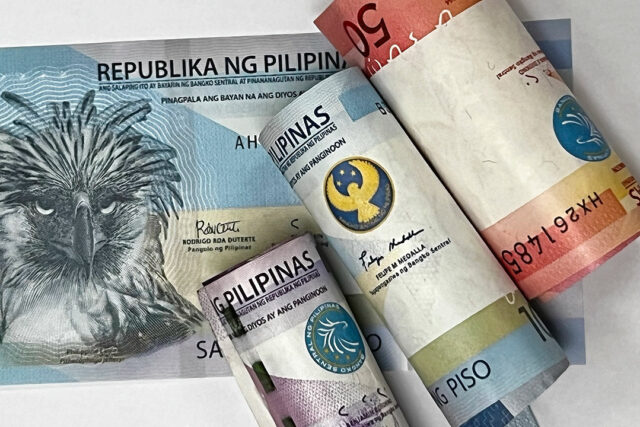
It closed at P58.931 a dollar, up 13.4 centavos from Friday’s P59.065 finish, according to Bankers Association of the Philippines data posted on its website.

The peso opened at P59.055 and traded from P58.91 to P59.199 during the session. Turnover fell to $1.316 billion from $1.837 billion on Friday, reflecting a more cautious market.

“We are seeing sentiment moving on from the recent corruption issues, trending upward toward the close today,” a trader said by telephone.

The rally followed allegations at the weekend by former Party-list Rep. and Appropriations Committee Chairman Elizaldy S. Co that President Ferdinand R. Marcos, Jr. had ordered P100 billion in project insertions in the 2025 budget. The claims were rejected by the Presidential Communications Office and Budget Secretary Amenah F. Pangandaman.

Stronger remittances added support to the peso. Cash remittances rose 3.7% to $3.12 billion in September from a year earlier, Rizal Commercial Banking Corp. Chief Economist Michael L. Ricafort said in a Viber message.

Year-to-date, remittances through banks increased 3.2% to $26.03 billion, bolstering consumer spending and providing a cushion for the currency ahead of the holiday season.

Traders expect the peso to move from P58.90 to P59.20 on Tuesday, while Mr. Ricafort forecasts a range of P58.80 to P59.05.

Meanwhile, MUFG Global Markets Research said the peso could remain near the P59 level until the first quarter of next year as sentiment continues to be influenced by corruption concerns and their impact on government spending.

“We are nonetheless hesitant to be too bearish on PHP at current levels and hence look for it to come off gradually toward the P58 mark, helped over time by a weaker dollar and some eventual improvement in government spending from the first half of 2026,” MUFG analyst Michael Wan said.

He cited the corruption allegations around flood control projects as the most significant macroeconomic driver for the peso, noting the negative spillovers to public spending.

Additional support may come from US tariff exemptions on selected Philippine exports, including coconut oils. President Donald J. Trump rolled back tariffs on more than 200 food products, including coffee, beef, bananas and orange juice in response to rising US grocery costs, Reuters reported.

Framework trade deals announced last week are expected to further reduce tariffs on goods from Argentina, Ecuador, Guatemala and El Salvador once finalized, with the possibility of additional agreements before yearend.

The peso’s performance is also underpinned by the country’s strong gross international reserves, which exceeded $109.7 billion, equivalent to more than seven months’ worth of imports. Seasonal inflows from overseas Filipino workers and conversion of US dollars ahead of Christmas spending are expected to continue providing support in the near term. — A.M.C. Sy

ADVERTISEMENT
ADVERTISEMENT