Home Blog Page 692

Philippines cash remittances up 3.7% in September to $3.1 billion

Money sent home by overseas Filipino workers (OFWs) rose by 3.1% to $16.75 billion in the first six months of the year. — REUTERS

MANILA – Cash remittances rose 3.7% to $3.1 billion in September from a year ago, the Philippine central bank said on Monday.

The figure brought cash remittances through banks in the first nine months of the year to $26.03 billion, up 3.2% from the same period last year.

“The United States remained the top source of remittances to the Philippines during January-September 2025, followed by Singapore, and Saudi Arabia,” the Bangko Sentral ng Pilipinas (BSP) said in a statement. — Reuters

Australia rules out co-hosting climate summit with Turkey

REUTERS

SYDNEY — Prime Minister Anthony Albanese said on Monday that Australia would not co-host the COP31 climate summit with Turkey amid an ongoing stalemate between the two countries.

Turkey has proposed jointly leading next year’s UN climate summit with Australia and the discussions on the hosting standoff remain unresolved, Turkish diplomatic sources told Reuters on Sunday.

“No, we won’t be co-hosting because co-hosting isn’t provided for under the rules of the (United Nations Framework Convention on Climate Change),” Mr. Albanese said during a media briefing in Melbourne.

“So that’s not an option and people are aware that it is not an option, which is why it has been ruled out.”

Australia and Turkey both submitted bids in 2022 to host COP31 and neither has withdrawn, leading to an attention-sapping impasse that must be overcome at this year’s COP30 meeting currently taking place in Belem, Brazil.

The annual COP, or Conference of the Parties, is the world’s main forum for driving climate action. But it has grown over the years from diplomatic gatherings into vast trade shows where host countries can promote economic prospects.

The host matters because they set the agenda and lead the diplomacy needed to reach global agreements.

Mr. Albanese this month wrote to Turkish President Tayyip Erdogan in an attempt to resolve the tussle as he pushes to host the summit with Pacific island nations for the first time.

A regional diplomatic bloc of 18 countries, the Pacific Islands Forum, is backing Australia’s bid. Several Pacific island nations are at risk from rising seas. — Reuters

Trump says US may open talks with Venezuela’s Maduro

VENEZUELAN FLAG flutters outside the Torrejon de Ardoz Air Force Base outside Madrid, Spain, Sept. 8, 2024. — REUTERS

PRESIDENT Donald Trump said on Sunday that the United States may open talks with Venezuelan President Nicolas Maduro, who faces escalating pressure from Washington amid a massive US military buildup in the Caribbean.

It was one of the first signs of a possible path toward defusing an increasingly tense situation in the region as the US wages a campaign of deadly strikes against suspected drug trafficking boats off the Venezuelan coast and in the eastern Pacific Ocean.

“We may be having some discussions with Mr. Maduro, and we’ll see how that turns out,” Mr. Trump told reporters on Sunday in West Palm Beach, Florida, before getting on a flight back to Washington. “They would like to talk.”

Mr. Trump offered no further details about the possibility of talks with Mr. Maduro, whom the US has accused of ties to the illegal drug trade, which Mr. Maduro denies.

Senior Trump administration officials held three meetings at the White House last week to discuss options for possible military operations against Venezuela, including land strikes inside the country, officials said, speaking on condition of anonymity.

Mr. Trump said on Friday that he “sort of made up my mind” on Venezuela, suggesting that a decision could come soon.

The Venezuelan communications ministry did not immediately respond to a request for comment on Mr. Trump’s latest remarks.

Earlier on Sunday, Secretary of State Marco Rubio said the US would designate an alleged drug organization, Cartel de los Soles, as a “foreign terrorist organization,” which makes it a crime for anyone in the US to provide material support to the group.

US officials have accused Cartel de los Soles of working with the Venezuelan gang Tren de Aragua, which Washington previously designated a foreign terrorist organization, to send illegal narcotics to the US

The Trump administration has alleged that Mr. Maduro leads Cartel de Los Soles, which Mr. Maduro also denies.

Asked if Mr. Rubio’s announcement means the US could strike Mr. Maduro’s assets and infrastructure in Venezuela, Mr. Trump said: “It allows us to do that, but we haven’t said we’re going to do that.”

Asked what it means that Mr. Maduro was interested in talking, Mr. Trump, who had called off diplomatic engagement with Venezuela in early October, said he didn’t know, but added: “I talk to anybody.”

Mr. Trump suggested, however, that he would keep up the pressure on Mr, Maduro, who has been in power since 2013 and is not recognized by the US as Venezuela’s legitimate president.

“We’re stopping drug dealers and drugs from coming into our country,” Mr. Trump said.

MILITARY BUILDUP
The Pentagon said earlier on Sunday that the US Navy’s largest aircraft carrier, the Gerald R. Ford, with 5,000 military personnel and dozens of warplanes on board, and its strike group moved into the Caribbean. That added to the eight warships, a nuclear submarine and F-35 aircraft already sent to the region.

Human rights groups including Amnesty International have condemned the boat strikes as illegal extrajudicial killings of civilians, and some US allies have expressed growing concerns that Washington may be violating international law.

The White House says the US is at war with drug cartels and courts aren’t needed in armed conflicts, while also accusing the Venezuelan government of being in league with drug traffickers, which it denies. Venezuela is preparing its defenses in case the US attacks.

A Reuters/Ipsos poll published on Friday found that only 35% of respondents said they supported using US military force in Venezuela to reduce the flow of illegal drugs into the US without the permission of the Venezuelan government.

Mr. Trump’s comments on possible talks came as the Pentagon announced another attack on an alleged drug boat in the eastern Pacific, in which it said three “narco-terrorists” were killed.

It was the 21st known boat strike by the US military since early September in what it has called a justified effort to disrupt the flow of narcotics into the US. The strikes have killed more than 80 people, according to Pentagon figures.

The Trump administration has said it has the legal authority, with the Justice Department providing a legal opinion that justifies the strikes and which argues that US military personnel who carry out the operations are immune from prosecution. — Reuters

Zelenskiy in France to seal air defense, warplane deals

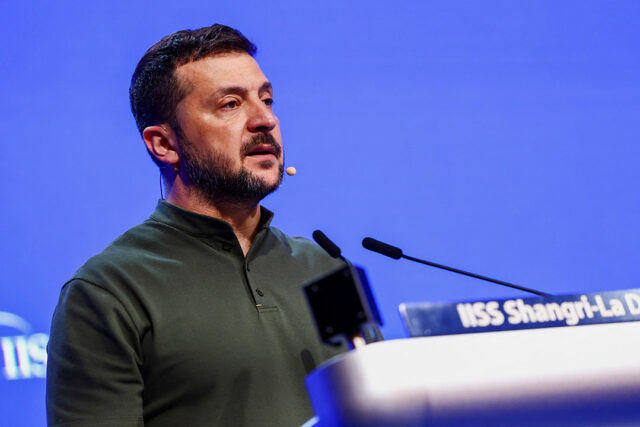
Ukrainian President Volodymyr Zelensky, June 2, 2024. — REUTERS

PARIS — Ukrainian President Volodymyr Zelenskiy is expected on Monday to seal deals with France on a supply of air-defense capabilities, warplanes and missiles, seeking to bolster his army’s long-term capacity to fight Russia’s ongoing invasion.

Mr. Zelenskiy is in Paris for talks with French President Emmanuel Macron as heavy Russian drone and missile attacks on Ukraine have increased in recent weeks and Moscow has reported sharp ground advances in the southeastern Zaporizhzhia region.

“A historic agreement has also been prepared with France – there will be a significant strengthening of our combat aviation, air defense, and other defense capabilities. According to the visit schedule, this will take place on Monday,” Mr. Zelenskiy said in a post on X on Sunday.

There have been talks for several weeks to see how France could provide more military support for Kyiv’s air defenses despite political and budgetary instability in Paris that has raised questions over how much France can actually do.

Mr. Macron pledged last month to offer more Mirage fighter jets, after initially promising to deliver six, and a new batch of Aster 30 surface-to-air missiles, produced by European group MBDA, for the SAMP/T air-defense batteries operated by Kyiv.

But according to two people briefed on the matter, Monday’s visit will yield more for Kyiv. It could include a 10-year strategic aviation agreement that would signal the provision to Kyiv of multi-role, Dassault-made Rafale combat jets.

Some could come directly from French stocks, although the bulk would be longer-term and part of Ukraine’s efforts to increase its long-term fleet to 250 warplanes, including the US F-16 and Sweden’s Gripen.

Operating the advanced jets would take time given the rigorous training program for would-be pilots.

The two sources said Monday could also see deals for more SAMP/T air-defense systems, from existing French stocks or through long-term, next-generation orders including for missiles and anti-drone systems.

The sources said it was not clear how these deals would be financed.

In a media briefing ahead of Mr. Zelenskiy’s visit, Mr. Macron’s office said the aim was to “put French excellence in the arms industry at the service of Ukraine’s defense” and “enable it to acquire the systems it needs to respond to Russian aggression”.

Mr. Zelenskiy will attend a briefing by various manufacturers, including Dassault, on Monday morning before signing a letter of intent and contracts later in the day, according to a French presidency schedule that gave no specific details.

A separate forum in the afternoon will bring together Ukrainian and French firms working in the drone sector to see how they can combine their efforts.

France, along with Britain, has pushed for the creation of coalition of about 30 countries willing to send troops and assets to Ukraine or along its western borders once a peace deal with Russia is agreed.

A key objective is to ensure Ukraine has sufficient long-term military and economic aid to keep its army strong enough to deter any future Russian attack. — Reuters

Vincent Co-led Puregold doubles down on grassroots retail, reaffirms sari-sari store advocacy

Sari-sari stores serve as trusted community institutions across the Philippines. These bridge access gaps in underserved areas, offer small-volume purchasing for budget-conscious households, and often extend credit based on long-standing neighborhood relationships. Their presence sustains hyperlocal economies and forms a vital foundation of the country’s retail ecosystem. 

As one of the country’s leading retailers, Puregold has long recognized that the strength of this micro-retail sector is closely tied to the strength of the broader retail landscape. The company’s extensive network of sari-sari store partners has been a major contributor to its growth and nationwide reach. 

Puregold Price Club, Inc. President Vincent Co continues to champion sari-sari stores as essential pillars of local communities and the national retail ecosystem.

This understanding is at the core of an initiative championed by Puregold Price Club, Inc. President Vincent Co. The Sari-Sari Stories series reflects his advocacy to empower local entrepreneurs who keep grassroots commerce thriving across the country. The project trains the spotlight on the people running these neighborhood staples, and recognizes their central role in both community life and national economic activity. 

“Puregold’s continued success reflects the unrelenting hard work of our sari-sari store members,” says Vincent. “With Sari-Sari Store Stories, we aim to celebrate them not only as business collaborators, but also as proud Filipino icons. Puregold remains committed to ensuring that the humble tindahan continues to thrive and remains a meaningful part of every community.” 

Vincent Co emphasizes that the success of Puregold is closely tied to the dedication and resilience of sari-sari store partners.

The company’s strong performance in the third quarter highlights the strategic importance of these partnerships. Long-time sari-sari store owners and neighborhood retailers remain a core driver of Puregold’s sustained growth, relying on the company as a trusted supplier and business ally. 

Through the series, Puregold honors these establishments while also reinforcing its commitment to inclusive growth and community-centered development. The initiative aims to elevate awareness of the critical role sari-sari stores play in sustaining local economies and supporting grassroots commerce.


Spotlight is BusinessWorld’s sponsored section that allows advertisers to amplify their brand and connect with BusinessWorld’s audience by publishing their stories on the BusinessWorld Web site. For more information, send an email to online@bworldonline.com.

Join us on Viber at https://bit.ly/3hv6bLA to get more updates and subscribe to BusinessWorld’s titles and get exclusive content through www.bworld-x.com.

Recto says 25-bp cut likely in Dec.

FINANCE SECRETARY RALPH G. RECTO — DEPARTMENT OF FINANCE FACEBOOK PAGE

By Katherine K. Chan

FINANCE SECRETARY Ralph G. Recto ruled out an “off-cycle” move on monetary policy easing despite weaker-than-expected third-quarter growth, but noted there is a high chance of a rate cut at the central bank’s next meeting.

“I’m not sure about an ‘off-cycle’ cut, but there’s a good chance for a rate cut before the end of the year,” Mr. Recto told BusinessWorld on the sidelines of a Senate hearing on Thursday.

He said the Monetary Board is more likely to cut the key policy rate by 25 basis points (bps) at the Dec. 11 meeting.

Asked if there is a chance for a 50-bp cut, Mr. Recto said: “There’s always a chance. It all depends on what happens. But I think there’s a higher probability for a 25-bp cut.”

Bangko Sentral ng Pilipinas (BSP) Deputy Governor Zeno Ronald R. Abenoja told BusinessWorld that they have not discussed any possible off-cycle monetary policy easing.

“I haven’t heard anything,” he said. “So, it’s probably just rumors. As far as I know, there are no discussions.”

In October, the BSP lowered borrowing costs by 25 bps to a three-year low of 4.75%. It has so far reduced the key policy rate by 175 bps since it began its easing cycle in August last year.

The slower-than-expected gross domestic product (GDP) growth in the third quarter and benign inflation give the BSP room for another rate cut in December.

The Philippine economy grew by 4% in the third quarter, the slowest growth seen in over four years or since the first quarter of 2021.

BSP Governor Eli M. Remolona, Jr. in October said they could cut rates by another 25 bps at the Dec. 11 meeting and potentially more in 2026 to support the economy amid a slowdown due to the ongoing flood control scandal.

Rizal Commercial Banking Corp. Chief Economist Michael L. Ricafort on Thursday said the third-quarter GDP data prompted speculation about an off-cycle interest rate cut.

Mr. Ricafort said it is “possible, but not 100% sure” for the BSP to cut rates before its scheduled meeting on Dec. 11.

“There have been rumors in the market since (Wednesday) about a possible off-cycle monetary easing, particularly a cut in large banks’ RRR (reserve requirement ratio), after the softer local GDP growth data (on Nov. 7),” he said in a Viber message on Thursday.

“Every (one) percentage point cut in large banks’ RRR is equivalent to about P180-billion additional liquidity infused into the banking system that could increase lending and other investments such as fixed income or bonds, among others,” he added.

On Feb. 21, the BSP cut universal and commercial banks’ RRR by 200 bps to 5%, which took effect in the week of March 28.

Meanwhile, Mr. Ricafort noted that the latest third-quarter GDP data have caused the yields on the PHP (Philippine peso) Bloomberg Valuation Service to decline slightly and the peso to slump to a fresh low against the US dollar.

On Nov. 12, the peso fell to a new record low after closing at P59.17 versus the greenback, slipping by 18.5 centavos from its P58.985 finish on Tuesday.

The BSP chief earlier said they will not intervene in the foreign exchange market unless the peso’s depreciation leads to inflationary pressures.

“I think the BSP intervenes just to make sure that the curve is not too wide,” Mr. Recto said.

“But I’m sure everyone knows that the BSP, to a certain degree, intervenes in the market just to flatten the curve.”

He also noted that the peso might not weaken further if both the BSP and the US Federal Reserve would cut in December.

“It all depends on what the Fed does,” Mr. Recto said. “If the Fed cuts rates also, then it would be the same.”

Last month, the Fed delivered its second 25-bp cut this year, bringing its interest rate to the 3.75-4% range. This brought its total cuts to 150 bps since September 2024.

However, December easing by the Fed remains uncertain as policymakers weigh concerns over economic data after US President Donald J. Trump ended the longest US government shutdown last week.

PHL investment slump seen to persist amid corruption probe

A cyclist rides past an anti-corruption mural in Quezon City, Sept. 20. — PHILIPPINE STAR/MIGUEL DE GUZMAN

By Aubrey Rose A. Inosante and Justine Irish D. Tabile, Reporters

THE INVESTMENT OUTLOOK is expected to remain weak through next year unless reforms are implemented and those linked to the flood control scandal are jailed, economists said.

“If reforms and transparency improve, we could see a turnaround by mid-2026,” Jonathan L. Ravelas, a senior adviser at Reyes Tacandong & Co. said in a Viber message to BusinessWorld on Nov. 13.

Geopolitical tensions, unpredictable policy shifts, and weak global demand may also risk further weighing on investor sentiment, he added.

Data from the Philippine Statistics Authority showed foreign investment pledges approved by investment promotion agencies slumped by 48.7% to P73.68 billion in the third quarter.

Mr. Ravelas attributed this sharp drop in foreign investment approvals to the “shaken investor confidence” triggered by corruption concerns, policy delays, and global uncertainty.

“The message is clear: we need to restore trust and fast-track reforms to stay competitive,” he added.

The government’s sweeping corruption crackdown since August has hurt economic growth as well as consumer and investor confidence.

In the third quarter, gross domestic product (GDP) grew 4%, its weakest since 2021, as the corruption scandal slowed public spending. This brought the nine-month average to 5%, lower than the government’s 5.5-6.5% full-year target for 2025.

GlobalSource Partners Country Analyst Diwa C. Guinigundo said it would be difficult to invite a “reflow of foreign capital” without charging those involved in the flood control scandal with plunder and malversation of public funds.

“We need to restore public trust and confidence in the business outlook in the Philippines,” he told BusinessWorld in a Viber message.

Earlier this month, President Ferdinand R. Marcos, Jr. declared that business confidence in the Philippines has been “restored,” crediting his administration’s crackdown on government irregularities for bolstering trust in economic management.

Last week, Mr. Marcos said people linked to anomalous flood control projects will be jailed before Christmas.

However, Foreign Buyers Association of the Philippines (FOBAP) President Robert M. Young said the country is still “in the process” of regaining lost confidence.

Mr. Guinigundo blamed high business costs, corruption in infrastructure projects, and weak respect for contracts and the rule of law in the country for the slump in foreign pledges in the third quarter.

“Foreign investors remain skeptical about the country’s macroeconomic prospects after the weak third‑quarter showing,” Mr. Guinigundo said in a Viber message.

Amid global headwinds from higher tariffs and a fragmented trade system, Mr. Guinigundo said the Philippine government must slash red tape and bring down business costs.

Foundation for Economic Freedom President Calixto V. Chikiamco said weak investments will likely continue unless the administration undertakes major reforms.

“Possible headwinds: political instability due to failure to bring perpetuators of the public works fraud to justice and sharpening rift between the Marcos and Duterte factions,” he said in a Viber message.

Mr. Chikiamco said the “overvalued” peso and the “lousy” tariff deal with the US have also affected the investment outlook.

Meanwhile, Federation of Philippine Industries Chair Elizabeth H. Lee said that the peso’s slide to a new all-time low of P59.17 against the dollar reflects global and local challenges.

“Locally, unresolved corruption cases and stalled infrastructure projects have tested confidence and slowed growth,” she said in a statement over the weekend.

“The path forward is clear: we must resolve corruption cases with transparency and accountability,” she said, adding this will help “restore trust, attract investment, and unlock infrastructure spending.”

She said this will create the stability that manufacturers need “to expand production, safeguard employment, and drive growth.”

“By protecting jobs in manufacturing and showing that clean governance drives stability, we can shorten the peso’s weakness, rebuild confidence, and put the economy back on a stronger, more sustainable growth path,” she added.

Philippine Chamber of Commerce and Industry Chairman George T. Barcelon attributed the peso’s recent performance to rate cuts by the Bangko Sentral ng Pilipinas, “coupled with the higher demand of dollars due to foreign investors off-loading stock investments and buying dollars to remit their money.”

“Like many business and civic organizations, academy and church institutions, we are in solidarity with public sectors hoping for an unbiased resolution,” he said in a Viber message.

FOBAP’s Mr. Young said that the weaker peso does not benefit Filipino exporters much.

“Actually, there is no significant gain because we are importing most of the materials. When you import materials, of course you use dollars to pay,” he said in a phone interview. “So, if ever, there will be some gain, it will be a very, very small margin only.”

However, he said that the benefits of the peso depreciation are only enjoyed by those who do not import their raw materials.

Philippines now turns to technology after flood control projects vanish

PEDESTRIANS walk on a makeshift pathway along P. Burgos Street in Manila on Sept. 6. — PHILIPPINE STAR/NOEL B. PABALATE

By Patricia B. Mirasol, Multimedia Producer

APRIL B. ELISTERIA wades through knee-deep water every time it rains in her neighborhood in Las Piñas City. The 39-year-old helper at a private elderly care home and mother of four has lived with floods for as long as she can remember.

“Sometimes the floodwaters are thigh-high near the entrance of our community,” she said in an Oct. 8 Viber interview. “I walk a fair distance to the entrance because no car can enter our place anymore,” she added in Filipino.

Her family has elevated their home to keep floodwaters from seeping in. “We’ve been here for so long, we already got used to the situation,” Ms. Elisteria said. “When I get home, I take a shower right away to avoid getting sick.”

Floods remain a part of daily life for many urban poor Filipinos despite decades of government projects meant to address them. Now, those projects themselves are under scrutiny.

Government investigators recently confirmed that 421 of roughly 8,000 flood control projects nationwide were “ghosts” — nonexistent despite being allocated funds. The revelations triggered the removal of P255 billion ($4.4 billion) worth of projects from the proposed 2026 national budget, effectively cutting flood control allocations to zero.

As the scandal unfolds, public officials are looking to technology to restore trust, improve transparency, and curb corruption by design. Blockchain ledgers, livestreamed bidding and satellite mapping are now being tapped to track how every peso of public works spending moves — and whether something actually gets built.

The Department of Public Works and Highways (DPWH) has faced recurring questions over the integrity of its flood control program, a key infrastructure item in annual budgets. The “ghost” project revelations reinforced long-standing suspicions of systemic graft tied to infrastructure contracts.

Digitalization, automation and the removal of personal discretion create systems that make corruption more difficult, experts said.

The DPWH has begun livestreaming procurement activities, and on Sept. 30 launched “Integrity Chain,” a blockchain-powered transparency platform developed with the Blockchain Council of the Philippines (BCP).

The system aims to embed accountability into infrastructure workflows by maintaining immutable records that cannot be secretly altered.

The platform functions like a digital ledger, Mark S. Gorriceta, a founding BCP trustee, said in a Zoom interview. Every transaction, every data point is permanent once entered, and any tampering will be visible, he pointed out.

The Integrity Chain will initially cover foreign-assisted projects, which already follow stricter standards.

“Validation does not rely solely on the government,” Mr. Gorriceta said. “Independent validators from civil society, the academe, media, and nongovernment groups will check the data before it’s finalized.”

Public Works Secretary Vivencio “Vince” B. Dizon said during the platform signing that he welcomes private sector scrutiny. “Everyone should be watching,” he said.

Mr. Gorriceta said AI (artificial intelligence) would also be integrated to verify data accuracy. In three months, he expects the players to share the results from the pilot phase.

At least 10 blockchain-related bills are pending in Congress. But experts warn against seeing blockchain as a cure-all.

“Blockchain won’t prevent collusion among vendors and government officials,” Jeffrey Ian C. Dy, a former undersecretary at the Department of Information and Communications Technology, said in a Facebook post.

He also said the government’s lack of expertise could create dependence on proprietary systems “akin to graft.” Mr. Dy has suggested limiting blockchain to transactional data, defining clear rules on data use, and determining who should access it.

WATCHING FROM SPACE
Beyond blockchain, agencies are turning to space-based monitoring to catch irregularities early. The Department of Human Settlements and Urban Development (DHSUD) is integrating satellite and geospatial data into its oversight systems.

Its Automated Land Use and Zoning Compliance Assessment and Monitoring (AutoCAM) tool uses remote sensing, machine learning and geographic information systems to track whether land use complies with local plans — and whether flood control projects are built in appropriate areas.

Ibani C. Padao, officer-in-charge director at the DHSUD’s Environmental, Land Use and Urban Planning and Development Bureau, said AutoCAM could detect zoning violations in real time.

“In protected agricultural zones, for example, if the tool detects that residential structures are being built, it will be tagged as not allowed or conditionally allowed,” he told BusinessWorld via Zoom.

DHSUD Assistant Secretary Mylene A. Rivera said the agency’s challenge lies in ensuring local governments use their approved land-use plans.

“After approval, these plans are often shelved and not used as a reference for development,” she said in the same Zoom call in Filipino. “Even diligent local governments learn about violations only after the fact because they don’t see everything.”

Ms. Rivera said AutoCAM could compare approved land-use maps with satellite images from the Philippine Space Agency (PhilSA). “If the plan doesn’t match what’s happening on the ground, the system flags it in real time,” she said. “That saves local governments a lot of time.”

The DHSUD will also launch a digital platform called PlanSmart for Sustainable Human Development on Nov. 17. It integrates hazard maps with planning data to help local governments make risk-informed decisions.

The initial rollout will cover 15 local governments per regional office, or about 200 nationwide. The target is for all local governments to have risk-informed plans by 2028. AutoCAM is slated for nationwide rollout by May 2026.

The Department of Budget and Management (DBM) has revived an older technology-driven project tracking system known as Digital Information for Monitoring and Evaluation, or DIME. First launched in 2017, it uses drones, geotagging, and satellite images to monitor major public investments. It was discontinued in 2021 and relaunched in 2023 through a partnership with the local space agency.

“The initial goal is to integrate PhilSA’s imagery with DBM’s platform,” Romer Kristi D. Aranas, information technology officer at the space agency’s High-Performance Computing and Information Systems Division, said via Zoom.

PhilSA expects project images to be publicly available through the DIME website by 2026.

“We are ready as far as technical capability and access to data are concerned,” Julius M. Judan, senior science research specialist at PhilSA’s Space Mission Control and Operations Division, said in the same Zoom interview.

He added that satellite data would be cross-validated with project timelines and milestones “to reach relevant conclusions.”

BEYOND THE TOOLS
Both Mr. Aranas and Mr. Judan stressed that government capacity-building is critical. “We integrate the data processing know-how and what the technical requirements are so it would be self-sustaining, and they can do it themselves long term,” Mr. Judan said.

Ms. Rivera of DHSUD said some local governments still lack the resources and expertise to use such tools effectively.

“You can’t give solutions if you don’t understand the situation on the ground,” she said in Filipino. “The goal is to make planning easy for them, to give them a template they can adapt to local realities.”

Experts say the technologies being deployed — blockchain, AI and satellite monitoring — mark progress toward transparency. Yet they emphasize that digital systems cannot replace political will.

Science and technology can provide tools that enable desired social outcomes, William G. Padolina, chairman of the Science, Technology and Innovation Foresight Steering Committee of the National Academy of Science and Technology, said in an e-mailed reply to questions.

“But the choice to harness which of these tools can promote societal interests, especially to recover from shocks, remains a political decision,” he added.

Mr. Dy said flood control corruption starts with budget enactment, which no technology could capture. “Perhaps the stance should shift from ‘anti-corruption’ to ‘increasing transparency in government.’”

Transparency advocates have long argued that corruption thrives in discretionary budgeting — a point made clear by the “ghost” projects’ discovery. Oversight mechanisms are often activated only after projects have been funded and payments released.

Economists note that eliminating P255 billion in questionable allocations could improve fiscal discipline in 2026, but warn of gaps in actual flood mitigation if legitimate projects are also delayed.

State efforts to digitize oversight represent a rare convergence of science, policy and accountability. Whether these systems will outlast political cycles — and actually prevent “ghost” projects — remains to be seen.

For residents like Ms. Elisteria, though, the test of reform will be simpler: the day her street finally stays dry. “I just hope the floods stop becoming a fixture in our lives because it’s so hard.”


YGG Play Summit 2025 expands to empower Filipino digital workforce

In the lead-up to its 2025 edition, the YGG Play Summit has revealed a major expansion of the Skill District, the learning hub within its City of Play experience. Designed by Metaversity, the educational arm of YGG Pilipinas, the district offers an immersive upskilling experience to uncover earning opportunities across Web3 and AI. Visitors can join workshops that teach practical, jobs-oriented skills for the digital economy in content creation, marketing, community management, game development, and more.

The Skill District is one of four themed zones in the City of Play alongside the Player District, Degen District, and The Arena. Three new experiences have been added: The Prompt to Prototype vibe coding workshop will teach aspiring builders how to create games using AI. The Metaversity Interactive forum will gather stakeholders across industry, government, and academe to work with students to address critical skills gaps in the emerging tech workforce.

Finally, Metaverse Filipino Worker (MFW) City — the pioneering builder residency led by YGG Pilipinas and the Department of Information and Communications Technology (DICT) — will unveil the results of its pilot program to educate developers from the MIMAROPA region in the Sui blockchain’s Move programming language.

“This collaboration truly reflects the core of our DICT thrust in Digital Bayanihan, showcasing how industries, communities, and the government can work together to empower talent across all regions of the country,” said DICT MIMAROPA Regional Director Emmy Lou Versoza-Delfin.

Ms. Versoza-Delfin added that these initiatives align with President Ferdinand Marcos, Jr.’s directives to create more jobs for Filipinos and Secretary Henry Aguda’s commitment to generate more digital and digitally enabled employment opportunities. “These efforts bring us closer to a future where Filipinos can build transformative, sustainable, and rewarding careers without having to leave the comfort of their own homes,” she said.

The World Economic Forum’s Future of Jobs Report 2025 identifies technology as the dominant force reshaping the global labor market, driving both job creation and displacement. Expanding digital access alone is expected to generate 19 million new roles while rendering nine million obsolete. AI and information processing technology are forecasted to create and displace millions more.

For the Philippines, this underscores the urgent need to develop digital fluency and technical capabilities, so workers can seize opportunities instead of being left behind by automation.

Official school partner STI College — Bonifacio Global City will participate in the Skill District alongside IT, computer science, and esports organizations from more than 10 schools across different regions of the country, including the University of Santo Tomas, National University, Polytechnic University of the Philippines, University of Southeastern Philippines — Davao City, and the Philippine Christian University — Cavite.

Aside from the Skill District events, industry leaders will also take the stage for panels, fireside chats, and keynotes. Speakers include Mench Dizon of YGG Pilipinas, Sylvain Loe Mie of Ubisoft, Luke Barwikowski and Heidi Christine of Pixels, Theo Agranat of Gunzilla Games, TK of Spekter Games, Jihoz of Sky Mavis, Kohji Nagata of Parallel, Roby John of SuperGaming, Hantao of Moku, Alessia Baumgartner of DWF Labs, Shi Khai Wei of LongHash Ventures, Daryl Lim of TRIVE Digital, Oliver Maroney of OpenSea, Wei Zhou of Coins.ph, and Joony Koo of AO Labs.

Summit sponsors this year include game studios Sky Mavis, Aurory, Pixels, Parallel TCG, and Vibes TCG; the Layer-1 blockchain Sui; creative powerhouse Spekter Agency; Web3 investment firm DWF Labs; and Philippine crypto exchange Coins.ph.

Set to run from Nov. 19 to 22, YGG Play Summit will return to SMX Aura, Bonifacio Global City (BGC). Tickets and the full event agenda are available on the YGG Play Summit website at yggplaysummit.com.


SparkUp is BusinessWorld’s multimedia brand created to inform, inspire, and empower the Philippine startups; micro, small and medium enterprises (MSMEs); and future business leaders. This section will be published every other Monday. For pitches and releases about startups, e-mail to bmbeltran@bworldonline.com (cc: abconoza@bworldonline.com). Materials sent become BW property.

Huawei holds the sixth Innovation and Intellectual Property Forum

Huawei held its sixth Innovation and Intellectual Property (IP) Forum on Nov. 11, where the company announced the winners of its biannual “Top Ten Inventions” award. The event gathered experts in innovation and intellectual property from around the world to explore the importance of openness and IP protection in driving innovation and social progress.

“Open innovation drives society and technology forward, and it’s in our DNA. We are committed to an open approach to innovation,” Chief Legal Officer Liuping Song said. “Huawei respects the IP of others, and protects our own, including patents, trademarks, copyrights, and trade secrets.”

In 2024, Huawei’s patent licensing revenue was approximately US$630 million. The patent royalties that Huawei has paid over the years are nearly three times the amount of royalties it has received.

Marco Alemán, assistant director-general of the World Intellectual Property Organization (WIPO), noted that “Huawei is a leading global user of WIPO’s Global IP Services and a strong driver of innovation. Huawei had 6,600 published Patent Cooperation Treaty (PCT) applications in 2024, and has been the top user of the PCT system since 2014.”

At the forum, Huawei unveiled the innovations that won its sixth Top Ten Inventions award, spanning a range of business domains that are key to future development, including computing, the HarmonyOS operating system, and storage.

Alan Fan, vice-president and head of the Intellectual Property Rights Department at Huawei, emphasized that, as a leading contributor to technology in the ICT sector, Huawei shares its technologies through open-source software, open hardware, patent filings, standard contributions, and academic papers.

As part of its efforts to drive open innovation, Huawei launched the Chaspark Patent site in June 2024. It’s a free and robust platform for researchers around the world to search for patent information, a service that can be prohibitively expensive for students, individual researchers, and small organizations in tech. Today the company announced major updates to Chaspark Patent, including new features such as semantic search and AI summary.

Other guest speakers at the forum include Yali Zhu, general manager of PatSnap China; Qi Wang, Asia-Pacific director of Clarivate; Mattia Fogliacco, president of Sisvel; and Laurie Fitzgerald, president of Avanci Vehicle. They shared their own experience and best practices in open innovation.

Mr. Song concluded by stating, “We are committed to building an environment that protects innovation and IP, and work closely with industry partners to promote constructive IP protection. This way, the industry can continue to grow and develop together.”


SparkUp is BusinessWorld’s multimedia brand created to inform, inspire, and empower the Philippine startups; micro, small and medium enterprises (MSMEs); and future business leaders. This section will be published every other Monday. For pitches and releases about startups, e-mail to bmbeltran@bworldonline.com (cc: abconoza@bworldonline.com). Materials sent become BW property.

Patis Tesoro is not slowing down and is as creative as ever

NOW in her 70s, Patis Tesoro, the grande dame of Filipino fashion, doesn’t seem like she will be running out of steam anytime soon. At a benefit show called Filipiniana is Forever (also the title of Ms. Tesoro’s book, released earlier this year) for the Zonta Club of Alabang on Nov. 4, the designer showed an 86-piece collection (she counted them herself; press releases from the organizers counted 100). None of them were from the archives of the woman who helped revive the dying piña1 industry back in the 1990s. “All fresh,” she told BusinessWorld after the show.

One hundred percent of the ticket sales for the evening — the show was held at the Grand Hyatt Manila’s ballroom — was earmarked towards the Zonta Club of Alabang’s advocacy programs, centered on women’s health, education, livelihood, and development. It was also a selling show, with about 30% of the sales from Ms. Tesoro’s clothes going towards the Zonta Club.

Men clad in (just) malongs2, with different checked patterns and embroidered with gold outlines, opened the show. Women wore pink pants and embroidered baros (a loose top that serves as the upper garment of a traditional Filipiniana dress), then a silver brocade top with black figures over a dress. Ms. Tesoro’s signatures were seen all throughout: native textiles (sheer piña with heavy, opaque cotton patadyong3; among others), then fanciful embroidery in all the colors of a garden, outlined in gold. Ms. Tesoro, aside from being one of the most famous fashion designers of her generation, is also an accomplished gardener.

It was not all just traje de mestizas, ternos, and baro’t sayas4 — though hers are lovely: we saw some of her work painted all over with pink roses, executed with contrasting blackwork embroidery. Another one had a green lattice pattern woven into the fabric, while dragons appeared on a magnificent traje de mestiza, scattering green and gold all over it. The finale dress was a traje de mestiza with white-worked sleeves woven with delicate red flowers paired with a trailing black skirt. Other than her usual — nay, classic — repertoire of Filipiniana, we saw coats in a reptilian green Chinese silk, barongs5 embroidered in gold, richly embroidered robe de styles, and tunics and shifts heavily embroidered and appliquéd all over.

Asked where she got the energy to mount such a show, she said with laughter, “I’m not dead yet.” On a serious note, she says she gets her energy from a mission: “To make sure that our culture goes forward and does not die.”

She’s not done yet: among her upcoming plans and projects are an artists’ enclave she hopes to put up with painter Romulo Galicano (whom she fondly calls Mulong), and a Filipino-style old folks’ home.

“I want to also be involved in a piña museum — which we do not have,” she said.

As we’ve mentioned, it’s a busy year for her, with a documentary accompanying the release of the Filipiniana is Forever book, a partnership with younger fashion designer Jor-el Espina, a retrospective in the Iloilo Museum of Modern Art, and now a brand-new collection. Rosy-cheeked and much younger-looking that evening, she told BusinessWorld, “I think people think I’m old and I’m going to die. Maybe that’s why they want all of these to happen.”

With a laugh good enough for a fairytale witch however, she said, “But I’ll surprise them and live for another 50 years!” — Joseph L. Garcia

1Piña is a translucent fabric derived from pineapples from which much traditional clothing is made.

2Malongs are traditional tube skirts from Mindanao.

3Patadyong is a tube skirt from the Visayas, usually made in a checkered cotton fabric.

4Traje de mestizas, ternos, and baro’t sayas are three kinds of traditional formal women’s wear. The first, also called the Maria Clara, is composed of a full skirt, and a piña loose-sleeved top and kerchief. The terno is a formal long gown with butterfly sleeves. The baro’t saya — literally blouse and skirt — is made of a loose blouse, sometimes of piña, a skirt that can fall from the knee to the ground, a tapis or overskirt, and an alampay or small scarf draped over a shoulder.

5Barong or barong Tagalog, is a formal men’s shirt made of embroidered piña.

US reshoring measures may raise PHL office vacancies, analysts say

STOCK PHOTO | Image by DC Studio from Freepik

By Beatriz Marie D. Cruz, Reporter

PROPOSED LAWS in the United States aimed at deterring the offshoring of American call center jobs could lift office vacancies in the Philippines, according to property consultants.

“While it is still too early to assess the exact impact on real estate take-up, efforts by the US government to discourage offshoring to the Philippines may lead to higher office vacancies and will require landlords and developers to rethink their leasing strategies,” Edward Gador, associate director for commercial leasing at Leechiu Property Consultants, told BusinessWorld in an e-mail.

The proposed Halting International Relocation of Employment (HIRE) Act and the Keep Call Centers in America Act do not impose an outright ban on offshoring, but their passage may slow down demand in the country’s office market, said CBRE Philippines Country Head Jie C. Espinosa.

“Our projection for overall vacancy in the market to go down to single-digit levels again — similar to how things were pre-pandemic — is contingent on the continuing growth of the information technology-business process management (IT-BPM) sector,” he said in an e-mail.

The Philippine IT-BPM industry, one of the world’s top outsourcing destinations, has long been a major demand driver in the country’s office market.

In the third quarter alone, IT-BPM firms accounted for 42% of net take-up in Metro Manila, according to CBRE data.

“If we suffer a setback in this sector, vacancy will remain in the double-digit levels,” Mr. Espinosa added.

The proposed Keep Call Centers in America Act seeks to limit federal benefits granted to companies that outsource call center jobs overseas.

Meanwhile, US Senate Bill 2976, or the HIRE Act, proposes a 25% excise tax on American firms’ payments to foreign service providers for work consumed in the US.

Both measures are aimed at protecting US-based call center jobs threatened by the rise of offshoring and artificial intelligence (AI)-powered bots.

If passed in their current form, the measures could push up Metro Manila’s office vacancy by 150-300 basis points, affecting business process outsourcing (BPO)-heavy submarkets such as the Bay Area, Ortigas, and the Bonifacio Global City fringes, according to Savills Philippines Chief Executive Officer (CEO) Joe Curran.

“If both bills pass in their current form, we could see a 30% to 50% slowdown in new leasing activity from US-based customer-experience or voice-BPO tenants over the next 12 months,” he said in an e-mail to BusinessWorld.

Vacancy rates in provincial hubs such as Cebu, Clark, Bacolod, and Iloilo could also rise by 200-400 basis points, mainly in single-tenant voice centers, Mr. Curran said.

However, modern business parks hosting diversified global capability centers (GCCs) or in-house shared-service hubs that serve global markets are expected to remain resilient against the impacts of US protectionist bills, he added.

“Should these two proposed US legislations be enacted, we may see a slowdown in outsourcing decisions and, consequently, a tempered demand for office space,” said Kevin Jara, director and head of tenant representation at Colliers Philippines.

The IT and Business Process Association of the Philippines (IBPAP) has been monitoring the impact of the two bills, noting that these are not affecting current IT-BPM operations in the country.

“If passed in their current form, the measures would increase the cost of offshored services and introduce additional compliance requirements for US companies operating overseas,” IBPAP President and CEO Jonathan Jack R. Madrid said in an e-mail.

“For now, it is viewed as a low-likelihood but high-visibility development, and organizations are following closely — assessing potential risks, preparing phased response plans, and monitoring the bill’s progress,” he added.

While US protectionist legislation may dampen take-up, the Philippines’ office market is still likely to attract global IT-BPM tenants, supported by its network of high-quality office parks and skilled workforce, Mr. Curran said.

“Protectionist measures may slow short-term activity, but the Philippines’ depth of talent and adaptability will keep it among the world’s top service-delivery destinations,” he noted.

Mr. Gador also noted that the two proposals do not address cost and staffing challenges in the US, casting doubt on large-scale reshoring.

“A typical US-based call center agent earns around $18/hour (excluding benefits, training, insurance, etc.), bringing total costs to $30-$40/hour. In comparison, a Philippine-based agent earns $12-$15/hour, all-inclusive. This gap alone discourages reshoring, even when factoring in possible penalties from government,” he said.

However, the threat of US offshoring should push office developers to offer competitive rates and high-quality spaces to sustain take-up, property consultants said.

Landlords must diversify their office portfolios to attract non-US global capability centers; offer ready-for-occupancy suites; and invest in dual power feeds, connectivity, and AI-ready infrastructure, Mr. Curran said.

Developers should also take a more “pragmatic approach” in renewal negotiations, Mr. Espinosa said.

“A lot of these companies engage their landlords way ahead of lease expirations and would generally ask for flexibility heading into their renewal terms,” he said.

ADVERTISEMENT
ADVERTISEMENT