Home Blog Page 6928

Airlines scramble to rejig schedules amid U.S. 5G rollout concerns

STOCK PHOTO | Image from Pixabay

Major international airlines rushed on Tuesday to rejig or cancel flights to the United States on the eve of a 5G wireless rollout that triggered safety concerns, despite two wireless carriers saying they will delay parts of the deployment.

The Federal Aviation Administration (FAA) has warned that potential 5G interference could affect height readings that play a key role in bad-weather landings on some jets and airlines say the Boeing 777 is among models initially in the spotlight.

Despite an announcement by AT&T and Verizon that they would delay turning on some 5G towers near airports, several airlines still canceled flights. Others said more cancellations were likely unless the FAA issued new formal guidance in the wake of the wireless announcements.

“While this is a positive development toward preventing widespread disruptions to flight operations, some flight restrictions may remain,” Delta Air Lines said.

The world’s largest operator of the Boeing 777, Dubai’s Emirates, said it would suspend flights to nine U.S. destinations from Jan. 19, the planned date for the deployment of 5G wireless services.

Emirates flights to New York’s JFK, Los Angeles and Washington DC will continue to operate.

Japan’s two major airlines, All Nippon Airways and Japan Airlines, said they would curtail Boeing 777 flights.

ANA said it was cancelling or changing the aircraft used on some U.S. flights. JAL said it would not use the 777 on U.S. mainland routes “until safety is confirmed,” according to a notice to passengers reported by airline publication Skift.

Korean Air Lines said it had switched away from 777s and 747-8s on six U.S. passenger and cargo flights and expected to also change planes used on another six flights on Wednesday.

The airlines said they were acting in response to a notice from Boeing that 5G signals may interfere with the radio altimeter on the 777, leading to restrictions.

A spokesman for Boeing had no immediate comment.

The 777 last year was the second-most used widebody plane on flights to and from U.S. airports with around 210,000 flights, behind only the 767, according to data from FlightRadar24.

Industry sources said Boeing had issued technical advisories noting potential interference, but that flight restrictions were in the hands of the FAA, which has for now limited operations at key airports unless airlines qualify for special approvals.

Radio altimeters give precise readings of the height above the ground on approach and help with automated landings, as well as verifying the jet has landed before allowing reverse thrust.

Air India, which serves four U.S. destinations with Boeing 777s, said those flights would be curtailed or face changes in aircraft type starting from Wednesday.


WORKHORSE JET

The announcement of cancellations came despite the wireless carriers delaying turning on some 5G towers near key airports.

Airline industry sources said the decision had arrived too late to affect complex aircraft and crewing decisions for some Wednesday flights.

British Airways opted to switch aircraft on its daily flight to Los Angeles to an Airbus A380 from the usual Boeing 777 service, two people familiar with the matter told Reuters.

That entails pre-positioning a flight crew in Los Angeles to fly the Airbus superjumbo back to London on the return leg.

Web tracker Flightradar24 said the A350 may also be used. The radio altimeters on the two Airbus jets have been cleared while the planemaker is still assessing its other models.

The 777 mini-jumbo is a workhorse of the long-haul travel market that remains depressed following COVID-19, while its freighter equivalent has reshaped the aviation route map during the pandemic, according to a spokesperson for Flightradar 24.

Not all 777s are affected. Emirates, which is also a major user of the larger A380, will switch to the larger aircraft for Los Angeles and New York but keep flying the 777 to Washington, which is not affected.

Qatar Airways, which operates both Boeing 777s and A350s to the United States, said it was evaluating the situation.

President Joe Biden hailed the agreement with the wireless carriers, saying it would allow more than 90% of wireless tower deployment to occur as scheduled. He said they would work to “reach a permanent, workable solution around these key airports.” – Reuters

China launches campaign to plug greenhouse gas monitoring gap

BEIJING – China will force key industrial sectors and regions to take action to measure greenhouse gas emissions as part of a new initiative to improve data quality and oversight, according to an environment ministry document reviewed by Reuters.

Under the pilot programme, some of China‘s biggest coal-fired power providers, steel mills and oil and gas producers must draw up comprehensive new greenhouse gas monitoring plans by the end of this year.

It comes as China, the world’s biggest greenhouse gas emitter, needs to beef up its measurement of carbon emissions in line with its monitoring of air pollutants to meet a pledge by President Xi Jinping to become carbon neutral by around 2060, say experts and environmentalists.

“In contrast to air pollutants, there is a major gap in reporting on CO2 emissions – there is no regular reporting in place that would disclose the country’s total emissions,” said Lauri Myllyvirta, lead analyst with the Helsinki-based Centre for Research on Energy and Clean Air (CREA).

“Expanding the emission monitoring and disclosure that is currently in place for air pollutants to CO2 would be a huge step forward.”

After some success in curbing the choking smog that envelops many of China‘s industrial cities over winter, the State Council, China‘s cabinet, has already promised to expand curbs on pollutants such as volatile organic compounds (VOCs), nitrogen oxides and heavy metal waste.

This will require more real-time environmental monitoring stations and advanced technologies that can detect a wider range of emissions and catch companies trying to cheat, officials and environmentalists said.

But the yawning coverage gap on carbon dioxide emissions could prove the biggest challenge. China up to now has relied largely on proxy indicators – including energy consumption – to measure CO2, falling behind countries in Europe.

According to the policy document, dated September 2021 and supplied to Reuters by the Ministry of Ecology and Environment (MEE), the new monitoring programme aims to provide “statistical support” for the country’s fight against climate change.

Cities like Tangshan and Hangzhou, along with regions like Inner Mongolia and Yunnan, have also been ordered to assess their ability to act as carbon sinks, including forest coverage rates and land use changes.

The pilot programme, scheduled to be completed in the first three months of 2023, is designed to assess best practices for measuring greenhouse gases. It will include the oil and gas, steel and thermal power sectors, as well as waste processing, and will cover key gases like methane as well as carbon dioxide.

State companies involved in the pilot programme – including the China Petrochemical Corp (Sinopec), the China National Petroleum Corp and the Shandong Energy Corp – did not immediately respond to requests for comment.


REAL-TIME MONITORING

Around 23,000 of China‘s major polluters are now plugged into a national real-time emissions monitoring system that measures air pollutants like sulphur dioxide or ammonia in water, though this is still a fraction of the millions of factories across the country that require monitoring.

An accurate measure of carbon emissions has also become increasingly important for China‘s plans to build out its national emissions trading system (ETS), which currently covers the power sector but will later be expanded to other sectors.

“When it comes to controlling emissions, and cap and trade, and all the other issues like carbon pricing – all of this needs to be based on accurate data, otherwise it will be meaningless,” said Ma Jun, director of the Institute of Public and Environmental Affairs (IPE), a non-government organisation focused on environmental monitoring.

The launch of the first phase of the ETS was repeatedly delayed partly because of data quality concerns.

Consultancy Frost & Sullivan estimated sales of environmental monitoring devices in China will surpass 102 billion yuan ($16 billion) in 2023, four times the level in 2014.

But up to now there has been no legal requirement for firms to measure greenhouse gas.

IPE’s Ma said monitoring CO2 would be expensive for firms, but was vital to ensure the levels of compliance required green financing and carbon trading.

“When it comes to emissions trading you need to go extremely accurate,” he said, noting companies needed to be able to determine precisely how many credits to buy.

“Any slight change in parameters or emission factors could mean a difference of hundreds of millions of yuan.” – Reuters

Globe wins Opensignal award for largest uplift in 5G global mobile gaming experience

Globe has received yet another global recognition for its network upgrade and modernization efforts, winning top prizes at the 5G Global Mobile Network Experience Awards 2021[1].

The top Philippine firm placed first in 5G improvement over 4G for Games Experience, and second in 5G improvement over 4G for Video Experience, owing to its massive investments in network improvements.

At its 2021 awards, independent global standard Opensignal recognized Globe for having the largest uplift in mobile multiplayer gaming experience, with an improvement of 65.2%. 5G Video experience with Globe was also elevated to a rating of excellent, with an uplift of 32.8% better than 4G.

The results highlight impressive improvements in user experience that can be achieved through extensive investments in 5G, which can deliver internet speeds up to 100 times faster than 4G. It also has less lag, making it suitable for video streaming and gaming.

“Globe 5G will not only change the way we play our favorite online or console-based games, but it also opens up new use cases for gaming and eSports. At the same time, it provides higher-quality streaming experiences on mobile screens and better video streaming delivery. Globe continues to improve its network. With 5G, the future is closer than ever,” said Ernest Cu, Globe President and CEO.

London-based Opensignal measures 5G Games Experience based on how mobile users experience real-time multiplayer mobile gaming on an operator’s 5G network compared to older 4G technology. On a scale of zero to 100, it analyzes how the multiplayer mobile games experience is affected by mobile network conditions, including latency, packet loss, and jitter, to determine the impact on gameplay and the overall games experience.

Meanwhile, Opensignal’s 5G Video Experience uses a combination of real-world measurements of video streams from smartphone users over an operator’s 5G network versus 4G.   These include picture quality, stall rate, and loading time to reflect users’ perceived video experience using an approach based on standards of the International Telecommunication Union.

Video traffic currently accounts for a significant portion or 66 percent of all mobile data traffic globally. The share continues to grow as mobile users keep moving to better streaming resolutions enabled by the deployments of 5G networks.

Opensignal said 5G users consume more content on their smartphones at a higher quality for up to 2.7 times more mobile data than 4G users. Mobile network operators around the world continue to roll out commercial 5G networks to support the demand for mobile data.

Globe strongly supports the United Nations Sustainable Development Goals, particularly UN SDG No. 9, highlighting the roles of infrastructure and innovation as crucial drivers of economic growth and development. It is committed to upholding the UN Global Compact principles and contributing to 10 UN SDGs.

To know more about Globe, visit www.globe.com.ph.

[1] Opensignal Awards – 5G Global Mobile Network Experience Awards 2021, based on independent analysis of mobile measurements recorded during the period Jan 1 – Jun 29, 2021 © 2022 Opensignal Limited.


Spotlight is BusinessWorld’s sponsored section that allows advertisers to amplify their brand and connect with BusinessWorld’s audience by enabling them to publish their stories directly on the BusinessWorld Web site. For more information, send an email to online@bworldonline.com.

Join us on Viber to get more updates from BusinessWorld: https://bit.ly/3hv6bLA.

Play to the top with the latest Omen by HP 16 gaming laptop

The grind never stops with the Omen by HP 16 laptop, powered by 11th Gen Intel® Core™ i7 processor and up to NVIDIA® GeForce RTX™ 3070 GPU to take gaming to the next level.

Gaming has grown from being a casual hobby to a lucrative career. For many players today, they may be introduced to video games through streaming platforms. While others are avid esport watchers who want to be like the pros.

Whether one is a casual or grinding to the top, they need a high-powered device that will level up their gameplay. The latest Omen by HP 16 laptop might just fit their needs because of its powerful capabilities without the bulk.

Max power and performance

Gaming happens with Intel®. The Omen is powered by 11th Gen Intel® Core™ i7 processor that ensures constant movements and shots are smooth. The 11th Gen Intel® Core™ processors bring powerful performance to your laptop for desktop-caliber gameplay, creation and mobile workstation productivity. These processors offer the pinnacle of mobile performance and unmatched connectivity, and are further equipped with the NVIDIA® GeForce RTX™ 3070 GPU that can handle stunning graphics, especially for cinematic games.

Sleek, compact design for gaming anywhere

From the desk to the living room couch to their friend’s house, gamers can carry the Omen by HP 16 laptop anywhere thanks to its sleek and lightweight design. It has a 16.1 diagonal inch screen with up to a QHD display, and a 165Hz refresh rate, so there’s no on-screen lag here. The Omen also comes with a floating hinge design that makes the screen look like it’s levitating.

The Omen by HP 16 laptop has a sleek 16.1 diagonal screen with up to a QHD display and a floating hinge, so gamers can play in style anywhere.

Play longer and cooler

With up to 9 hours battery life, players can grind any game as long as they want on the Omen by HP 16 laptop. They also don’t have to worry about overheating as it’s built with the OMEN Tempest Cooling, a three-sided venting and five-way airflow system that will keep everything cool even in the most heated games.

Personalize the gaming experience

Just like in-game customizations, players can customize the Omen’s performance and lighting options via the OMEN Gaming Hub. They can also get rewards just by playing certain games. It’s a one-stop hub to easily optimize the way they play.

Enjoy game sounds and cutscenes on loud speaker

Most gamers keep their headphones on to know where their opponents are, but there are also games that don’t require them. With audio by Bang & Olufsen, players can immerse themselves while playing and watching cutscenes while on loud speaker.

Overall, the Omen by HP 16 laptop carries the ideal specs to run various games. Casuals, advanced players, and esports pros will certainly feel a level-up in gameplay every time. The great part is that they can bring this gaming device anywhere, so the grind doesn’t stop.

Get the latest Omen by HP 16 laptop at HP Official Store in Lazada, Shopee, or visit the nearest Authorized HP Reseller store.


Spotlight is BusinessWorld’s sponsored section that allows advertisers to amplify their brand and connect with BusinessWorld’s audience by enabling them to publish their stories directly on the BusinessWorld Web site. For more information, send an email to online@bworldonline.com.

Join us on Viber to get more updates from BusinessWorld: https://bit.ly/3hv6bLA.

Millionaires group calls for wealth tax at virtual Davos

ZURICH – A group of more than 100 billionaires and millionaires has issued a plea to political and business leaders convening virtually for the World Economic Forum: make us pay more tax.

The group calling itself the “Patriotic Millionaires” said that the ultra-wealthy were not currently being forced to pay their share of the global economic recovery from the pandemic.

“As millionaires, we know that the current tax system is not fair. Most of us can say that, while the world has gone through an immense amount of suffering in the last two years, we have actually seen our wealth rise during the pandemic – yet few if any of us can honestly say that we pay our fair share in taxes,” the signatories said in an open letter, published on the occasion of the World Economic Forum’s “virtual Davos“, which began on Jan. 17.

Reuters reported last year on the staggering rise in billionaires’ wealth in 2020, as the world went into lockdown and the global economy faced its worst recession since World War Two, prompting the millionaires group to call for higher taxes.

While that spurred more than 130 countries to agree a deal to ensure big companies pay a global minimum tax rate of 15%, aimed at making it harder for them to avoid taxation, the millionaires said the wealthy still needed to contribute more.

Over the course of the two years of the pandemic, the fortunes of the world’s 10 richest individuals have risen to $1.5 trillion – or by $15,000 a second – a study by Oxfam this week showed.


‘PART OF THE PROBLEM’

In the letter, the signatories including Disney heiress Abigail Disney and venture capitalist Nick Hanauer told Davos participants convening for a week of online power-brokering and talks: “You’re not going to find the answer in a private forum… you’re part of the problem.”

A spokesperson for the World Economic Forum said paying a fair share of taxes was one of the forum’s tenets, and a wealth tax -as exists in Switzerland, where the organisation is based -could be a good model to deploy elsewhere.

In most countries outside a handful in Europe and some recent joiners in South America, the rich do not have to pay annual taxes on assets such as real estate, stocks or artwork, because they are taxed only when the asset is sold.

According to a study conducted by the Patriotic Millionaires together with Oxfam and other non-profits, a progressive wealth tax starting at 2% for those with more than $5 million and rising to 5% for billionaires could raise $2.52 trillion, enough globally to lift 2.3 billion people out of poverty and guarantee healthcare and social protection for individuals living in lower income countries.

The World Bank in 2021 published an article urging countries to consider a wealth tax to help reduce inequality, replenish state coffers depleted by COVID-19 relief schemes and regain social trust.

However, outside Argentina and Colombia, no new wealth tax schemes have been initiated since the start of the pandemic. – Reuters

Mild COVID cases still lead to attention and memory issues – study

LONDON – People with mild COVID-19 who do not suffer any other traditional “long COVID” symptoms can still exhibit deteriorated attention and memory six to nine months after infection, a study by Britain’s Oxford University has found.

Cognitive issues impacting concentration levels, along with forgetfulness and fatigue, are features of long COVID – a condition that afflicts some after an initial bout of infection – but it has not been established how widespread issues with attention span might be following COVID-19 infection.

In the study, participants who had tested positive for COVID-19 previously but did not report other traditional long COVID symptoms were asked to complete exercises to test their memory and cognitive ability.

The researchers found that participants were significantly worse at recalling personal experiences, known as episodic memory, up to six months after infection.

They also had a bigger decline in their ability to sustain attention over time than uninfected individuals up to nine months after infection.

“What is surprising is that although our COVID-19 survivors did not feel any more symptomatic at the time of testing, they showed degraded attention and memory,” said Dr Sijia Zhao of the Department of Experimental Psychology, University of Oxford.

“Our findings reveal that people can experience some chronic cognitive consequences for months.”

The researchers said that individuals over time demonstrated episodic memory and attention span largely returned to normal after six and nine months, respectively.

Participants also performed well in tests of other cognitive abilities, including working memory and planning, in the analysis of 136 participants.

Stephen Burgess of the MRC Biostatistics Unit at the University of Cambridge highlighted the small number of people involved in the study, adding that it was not randomised.

“However, despite this, differences between the COVID and non-COVID groups in terms of several specific measures of cognitive ability looked at in this study were striking,” he said.

“Despite the limitations of non-randomised research, it seems unlikely that these results can be explained by systematic differences between the groups unrelated to COVID infection.” – Reuters

Coca-Cola Beverages Philippines partners with ORIX Rental Corporation as its fleet solutions provider

Coca-Cola Beverages Philippines, Inc. (CCBPI)—the bottling arm of Coca-Cola in the country—strengthens its partnership with ORIX Rental Corporation (ORC), one of the country’s leading companies engaged in Full Service Operating Lease (FSOL) of cars, vans and light trucks—with the latest delivery of almost 300 new service vehicles for Coca-Cola’s sales force under ORC’s FSOL solutions.

The procurement of new Toyota service vehicles is part of CCBPI’s Tools of Trade refresh program, which decommissions older vehicles to upgrade the fleet with new models. Once the delivery tranches of vehicles are finalized, CCBPI will have a total of close to 800 units with active operating leases with ORC.

The delivery of the first batch composed of 202 units started in December 2020 and was completed last April. Last September, CCBPI awarded ORC a contract to provide close to 600 more units, which are scheduled to be turned over from December 2021 onwards.

“Our Company’s top priority has always been to look after our people. Part of our People First commitment is to make sure that our associates have the proper resources for a more fulfilling career,” says Richard Schlasberg, CCBPI Commercial Vice President. “Amid the challenges we face, we are pursuing our People initiatives and we continue to empower our people through initiatives like refreshing our tools of trade.”

Schlasberg adds, “We are excited to complete the deliveries and to fully transition to the new vehicles very soon. We are very grateful for our partnership with ORC, and for their help and support.”

“We are truly honored to have been chosen as the corporate fleet solutions partner of CCBPI. ORIX Rental Corporation is a Business Process Outsourcing (BPO) company. Our full service operating lease offers worry-free solutions that help improve the efficiency and productivity of the sales and operating officers of companies. We manage all the time-consuming administrative tasks such as vehicle purchase, maintenance, registration and insurance, thereby allowing our clients to concentrate on their core business,” ORC President Constancio Tan said during the ceremonial turnover held recently at Toyota Makati, Inc. (TMI) showroom in Makati City.

Present at the turnover ceremony were Ronald Tamayo (CCBPI Procurement Director), Mike Gamo (Procurement Category Manager), Shintaro Yamaji (ORC Director), Helen Aguilar (ORC Executive Group Head), Lito Ondevilla (ORC Marketing and Operations Group Head), Blesilda Rodriguez (President, Toyota Makati, Inc.), and Cristina Fe Arevalo (Senior Vice President of New Mobility Business Division, Toyota Motor Philippines).

FSOL benefits and advantages

ORC services multinational companies and big local corporations by providing vehicles for lease to cater to their various transportation needs. Its FSOL product is the best option for acquiring brand new vehicles since companies do not need to allocate any funds and pay outright. The monthly rental payments are fixed throughout the term of the lease period.

The company’s FSOL offers a complete service package – from the purchase of vehicles, periodic service maintenance, insurance claims, LTO renewal and disposal of units. Each client will have one central contact (Fleet Service Advisor) who will oversee all matters related to their fleet such as scheduling of preventive maintenance, assisting during accidents and addressing technical concerns for the entire lease agreement.

Companies can rest assured that vehicles are in prime condition since maintenance is carried out regularly. ORC has close to 400 accredited dealers and repair shops nationwide that can provide servicing maintenance of the leased vehicles.

The full range of ORC’s value-added services include 24-hour roadside assistance, seminars on defensive driving techniques, carnapping prevention, basic vehicle maintenance and fuel saving tips, and access to Fleet Portal to view various vehicle reports.

ORC’s proven track record in FSOL and its extensive network of dealers help companies manage their businesses more efficiently, saving both time and money. With its presence nationwide, ORC is able to adapt its services to the needs of each client and help them make the best decisions for their company fleet.

ORC is a wholly-owned subsidiary of ORIX METRO Leasing and Finance Corporation, a joint venture between Metropolitan Bank and Trust Company (Metrobank) and ORIX Corporation, a pioneer in the leasing industry in Japan. For more information about ORC’s FSOL solutions, call (02) 8804-0800 / (02) 8858-8888 locals 231, 156 and 801 or email lpondevilla@orix.com.ph, oqromanillos@orix.com.ph, jglizada@orix.com.ph or visit www.orix.com.ph.


Spotlight is BusinessWorld’s sponsored section that allows advertisers to amplify their brand and connect with BusinessWorld’s audience by enabling them to publish their stories directly on the BusinessWorld Web site. For more information, send an email to online@bworldonline.com.

Join us on Viber to get more updates from BusinessWorld: https://bit.ly/3hv6bLA.

UnionBank at 40: Future forward, a leap to enduring greatness

Aboitiz-led Union Bank of the Philippines (UnionBank) is widely-known to have been trailblazing many firsts in the country since it began operations forty years ago. UnionBank has always been among the first to embrace technological innovations to empower its customers into the future of banking. The Bank’s 40-year journey began with a simple vision: to become one of the top three universal banks in the country with respect to market capitalization, profits, and customer coverage.

UnionBank began building the foundations for its operations in 1981, and in just a year, became a commercial bank on Jan. 19, 1982. A decade after, in 1992, the Bank debuted at the Manila and Makati Stock Exchanges in June of that year, and was granted a Universal Banking License the month after.

In 1994, UnionBank acquired the International Corporate Bank, which marked the first of a series of acquisitions that would strengthen UnionBank’s capabilities to deliver banking services tailored to the unique needs of Filipino customers.

In 2006, UnionBank purchased 98% of one of the top 20 largest banks in the country International Exchange Bank (iBank), making it the 7th largest private domestic commercial bank in the Philippines.

In 2013, in line with a renewed thrust to enable financial inclusion in the country, UnionBank acquired thrift bank City Savings Bank. The acquisition enabled the Bank to expand its customer franchise and achieve its goal of financial inclusion that is also driven by sustainability.

In its thrust to promote sustainable financial inclusion, the Bank entered into its first venture into rural banking and micro-financing by acquiring a majority stake in the Cebu-based First-Agro Industrial Bank (FairBank) in 2016.

In the same year, UnionBank embarked on its radical digital transformation journey, favoring expansion through digital channels over the traditional opening of more branches, while reinforcing its commitment to deliver superior customer experience and making a promise that ‘no one gets left behind’ to promote inclusive prosperity in the Philippines.

The rest, as they say, is history as UnionBank went full throttle on its journey and continued to achieve numerous industry-firsts, gaining the reputation as the country’s most innovative bank even before the Filipino mass adoption of the internet.

UnionBank was the first Philippine bank to introduce mobile banking through wireless application protocol-enabled cellphones, the first Philippine Bank to launch a banking website, first to use an online payment card through EON, first to use a chat bot (Talk to Rafa), first to launch its own stablecoin (PHX), first to introduce mobile check deposit through its award-winning app UnionBank Online, opened The ARK — the first fully digital bank branch in the country, launched UBX — the Bank’s fintech and corporate venture capital arm, leveraging ecosystems and data to explore new possibilities to make financial services more instinctive and accessible, the first Philippine bank to go fully on the cloud, and launched UnionDigital becoming the first publicly listed Philippine bank with a digital banking license.

Capping off the year 2021, UnionBank surprised the country with the announcement of a game-changing deal to acquire the consumer banking business of American banking giant Citi in the Philippines. Seen as the largest transaction in the local banking community in recent years, UnionBank Chairman Erramon Isidro M. Aboitiz said, “This acquisition further cements our position as a leading bank in the Philippines, as well as fast-tracks our growth aspirations in the retail banking segment.”

Today as it ushers in its 40th year, UnionBank is globally-recognized by International Banker magazine as “already an unequivocal digital trailblazer in both the Philippines and Southeast Asia”, named ‘Asia Trailblazer Institution of the Year’ by Retail Banker International, and ‘Best Bank for Customer Experience in Southeast Asia’ from Global Brands Magazine, among many other international recognitions.

“Our success today has been a product of looking ahead into the future and preparing for the evolution of banking. We will continue to help ‘tech up’ customers, partners, institutions in line with our ‘Tech Up, Pilipinas’ aspiration, empowering all of us to weather this pandemic and emerge more resilient than ever. Together, we can be future forward and leap to being a bank of enduring greatness,” said UnionBank President and CEO Edwin R. Bautista.


Spotlight is BusinessWorld’s sponsored section that allows advertisers to amplify their brand and connect with BusinessWorld’s audience by enabling them to publish their stories directly on the BusinessWorld Web site. For more information, send an email to online@bworldonline.com.

Join us on Viber to get more updates from BusinessWorld: https://bit.ly/3hv6bLA.

BoI sets P1-trillion investment goal

PHILIPPINE STAR/ MIGUEL DE GUZMAN

THE BOARD of Investments (BoI) is targeting to approve P1 trillion in investment pledges this year, despite the threat from more variants of the coronavirus disease 2019 (COVID-19).

This year’s goal is 53% higher than P655.4 billion worth of investment approvals in 2021, but lower than P1.018-trillion investments in 2020.

“Buoyed by 2021 FDI (foreign direct investments) results as well as the healthy pipeline of strong investment leads, both foreign and domestic, and with the reforms that we are anticipating to still be passed in the next months, we are confident of hitting P1 trillion in BoI-approved investments this year,” Trade Secretary and BoI Chairman Ramon M. Lopez said in a statement on Tuesday.

Central bank data showed FDI net inflows rose by 48% year on year to $8.14 billion in January to October .

“The data released by the BSP are consistent with the figures of the BoI, where a surge of foreign investments by 218% was recorded last year. This goes to show that the pandemic did not stop the flow of foreign investments into the country and we are looking forward to getting more in 2022,” Mr. Lopez said.

Mr. Lopez said in a mobile phone message he is confident the BoI would meet its investment target this year due to the “expected passage of major economic reforms that will ease restrictions on foreign equity participation.” 

He cited the recently signed law amending the Retail Trade Liberalization Act (RTLA), as well as measures tweaking the Foreign Investments Act and Public Service Act.

Republic Act (RA) No. 11595, which amended the RTLA, reduced the minimum paid-up capital for new foreign retailers to P25 million. The amendments to the Public Service Act would open up more sectors to foreign investments.

“Plus, with the country’s participation in the Regional Comprehensive Economic Partnership (RCEP) and other free trade agreements and more aggressive and targeted investment promotion, the continued push for ‘Build, Build, Build’ infrastructure program and Ease of Doing Business, we can be more bullish on our investments target for 2022,” Mr. Lopez said.   

The Senate has yet to concur with the ratification of the RCEP, which took effect in 11 other nations on Jan. 1.

Trade Undersecretary and BoI Managing Head Ceferino S. Rodolfo in a statement said he expects last year’s investment leads could still materialize by the second or third quarter of 2022.

He said a “big” telecommunications project worth P155 billion is now up for approval by the Fiscal Incentives Review Board.

Other upcoming projects include a new domestic shipping operator, new operator of charging stations, three new operators of telecommunication infrastructure, a new producer of animal feeds, and a cement manufacturer, Mr. Rodolfo said.

“(We are) zeroing in on projects that will transform the Philippine economy to become more modern such as telecommunications, roads, green energy, health, innovation and digitization, sustainable and competitive heavy industries among others,” the BoI said.

Meanwhile, the Philippine Economic Zone Authority (PEZA) is wooing more investors from the United States to aid the country’s economic recovery.   

“The Americans remain as one of the top three biggest contributors of investments in the Philippines under PEZA,” PEZA Director-General Charito B. Plaza said at a webinar on Tuesday.

Based on PEZA data, US investments in the country as of the third quarter of 2021 had reached P400.67 billion, while exports amounted to $6.76 billion.   

The data also showed that there were 420 American enterprises registered with PEZA, employing 330,906 workers. — Revin Mikhael D. Ochave

Dynasties, celebrities dominate circus of Philippine elections

REUTERS
A man wearing a face mask takes part in a simulation for the 2022 Philippine election at a polling station in Pasay City, Dec. 29, 2021. — REUTERS/LISA MAIE DAVID

By Kyle Aristophere T. Atienza, Reporter

PAUL OLID, 23, said he has yet to hear presidential candidates for this year’s elections discuss how they plan to jumpstart the Philippine economy amid a coronavirus pandemic.

“It’s still the same kind of people who are running,” the first-time voter said in a Facebook Messenger chat. “No matter how good their track records are, if their platforms don’t align with what the country currently needs, then it might not solve our problems.”

Mr. Olid may be too advanced for a voter in a country where families monopolize political power and celebrities get elected for their entertainment value.

President Rodrigo R. Duterte will leave his post after six years of turning policies and institutions upside down, and political analysts think Filipinos still have yet to learn that the gamble with an autocratic populist has not paid off.
“We are at a time of great uncertainty,” Ador R. Torneo, a professor and director of De La Salle University’s Institute of Governance, said in a Facebook Messenger chat. “Many stakeholders are waiting for concrete plans for economic recovery but only a handful of presidential candidates have shared their plan.”

He said few candidates have presented their programs, including those leading in opinion polls.

London-based Capital Economics this month said the list of presidential candidates in the Philippines has been uninspiring and bodes poorly for the Southeast Asian nation’s future.

Candidates should be talking about their political and economic platforms four months into the elections, said Michael Henry Ll. Yusingco, a research fellow at the Ateneo de Manila University Policy Center.

“That would have been ideal for us voters,” he said in a Messenger chat. “It would give us more time to evaluate the plans and possibly even ask questions.”

In its report, Capital Economics said the late dictator’s son Ferdinand “Bongbong” R. Marcos, Jr. was well ahead in opinion polls “but faces charges of tax evasion, which could see him disqualified.”

“He will be joined in the race by a host of other candidates, including a retired actor (Francisco “Isko” M. Domagoso) and a former boxing world champion (Senator Emmanuel “Manny” D. Pacquiao, Sr.),” the think tank said.

There’s also Vice-President Maria Leonor “Leni” G. Robredo, who entered politics after her husband, a local government champion, died in a plane crash in 2012. She beat Mr. Marcos by a hair in the 2016 vice-presidential contest.

She will have to beat him again, which some see as a rerun of the 1986 snap elections, when widow Corazon C. Aquino crushed the Marcoses. That year, a popular street uprising toppled the dictator’s regime and sent him and his family into self-exile in the United States.

“Name recognition goes a long way in Philippine politics, which explains why three of the last four presidents have been actors and the children of former presidents,” it added.

The foreign think tank was referring to ex-President Joseph E. Estrada, who was an action star before he became president in 1998, his successor Gloria Macapagal-Arroyo and the late Benigno S.C. Aquino III.

Mr. Estrada was toppled by a popular uprising in 2001 and spent years in prison before he was convicted for corruption and later pardoned by Ms. Arroyo, the daughter of the late President Diosdado P. Macapagal, Sr.

Ms. Arroyo was later jailed under the government of Mr. Aquino, who was thrust into the political limelight after the death of his mother in 2009.

Mr. Aquino, like his parents, came from pedigreed stock — landed, aristocratic families that have long been part of the ruling elite. His campaign was based on a legacy far greater than his own.

Aside from having the first female Philippine president for a mother, his father Benigno Jr. was the country’s greatest democracy champion before he was assassinated in 1983 presumably by agents of the dictator Ferdinand E. Marcos.

“Name recognition doesn’t correlate with competence,” Capital Economics said. “A lack of policy-making experience in leaders (plus high levels of corruption) has contributed to the economy’s poor performance over recent decades.”

“Foreign investors and other countries with ties to the Philippines or have an interest there have often looked closely at political developments in the country as an indicator of stability in other areas like the economy,” said Maria Ela L. Atienza, a political science professor at the University of the Philippines.

Some critics expect Mr. Marcos to follow in his father’s footsteps by reviving cronyism, censorship and military abuse. He will be a step ahead of Mr. Duterte, who revered the dictator and styled his leadership after him.

Aside from corruption, the country’s weak political system also prevents leaders from pursuing economic reforms, she said.

“The country has weak political parties and even a popular president cannot always count on allies in both Houses of Congress to solidly back up much needed reforms that can improve the economy,” Ms. Atienza said in a Viber message.

Mr. Yusingco said none of the candidates have presented a roadmap for their term in the next six years. “Not even a first 100 days plan.”

He noted that only two candidates have campaign websites. “Hopefully, when the campaign period officially begins next month, all the candidates will have websites with details of their programs.”

Few presidential candidates have real policy experience and achievements, said Robin Michael U. Garcia, a political economy professor at the University of Asia and the Pacific.

“Policy-making expertise can be relegated to industry experts and scholars in different fields,” he said in a Messenger chat.

He said a presidential candidate should have a vision and plan for a developing country struck by the pandemic. “He should also have empathy for people so he can follow through on his vision.”

PHL eyes climate change policy loan from ADB

PHILIPPINE COAST GUARD FACEBOOK PAGE

THE ASIAN Development Bank (ADB) is in the initial stages of analyzing a policy loan program that will help address climate change in the Philippines.

The program would address local policy changes in social inclusion, clean energy, electric mobility, climate financing and food security, the ADB said.

“Climate change impacts are estimated to cause a decline of between 9% and 21% of agricultural productivity by 2050,” the multilateral lender said in its initial poverty and social analysis released on Tuesday.

“The Philippines is recognized as a country with high natural disaster risk levels, and these are exacerbated by climate-related risk.”

The program, the ADB said, would help pursue policy reforms on social inclusion in climate action, addressing the vulnerability of women and children.

“This policy reform in energy will encourage the uptake of clean energy by improving clean supply and efficiency,” the ADB said.

The policy reform aims to cut costs for consumers, lower financial risks for investors and create a national policy that would support the use of electric vehicles in public transportation.

“New agriculture policies will support adaptation and institutionalize or embed a climate resilient agriculture approach in the Department of Agriculture and improve productivity and resilience for staple crops after extreme climate events to improve food security,” the ADB said. “Creating new agriculture research centers will promote gender-sensitive and climate-resilient plant breeding.”

The multilateral lender said the income of women in rural areas is based on agriculture and fish, and women are put at risk of food insecurity during natural disasters.

Women represent a quarter of workers in agriculture, which could be a low estimate due to the work being seen as an extension of their household tasks. This “invisibility” then leads to unequal access to land ownership and credit.

“Gender equality in climate financing has been uneven across climate-related sectors — well-integrated in agriculture and water but poorly addressed in the infrastructure and energy sectors,” the ADB said.

The bank is looking at lending $3 billion to the Philippines this year, which will focus on infrastructure and climate change resiliency programs.

About 20 typhoons hit the Philippines every year, causing billions of pesos in damage and displacing thousands of Filipinos. Typhoon Odette caused widespread destruction in Central Visayas and Mindanao in December. — Jenina P. Ibañez

NEDA urges private sector to increase productivity as PHL pursues high-income status

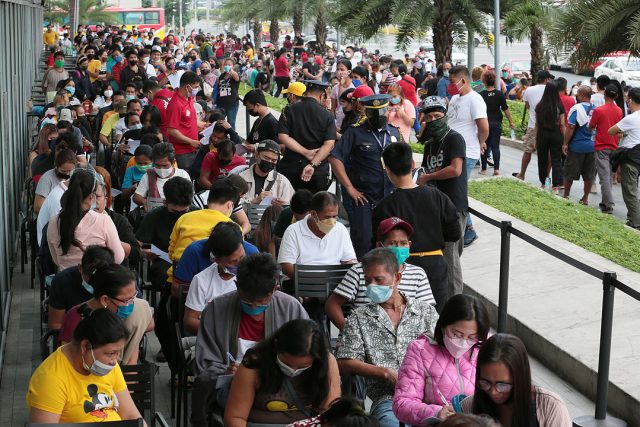
Hundreds of Filipinos wait in line at a COVID-19 vaccination site in Pasay City, Jan. 16. — PHILIPPINE STAR/ MICHAEL VARCAS

SOCIOECONOMIC Planning Secretary Karl Kendrick T. Chua said the private sector should help increase productivity as the Philippines recovers from the effects of the pandemic and pursues high-income status.

“(An) issue I want to bring up — which requires significant support from the private sector — is enhancing or increasing productivity,” he said at an event organized by the Financial Executives Institute of the Philippines on Tuesday.

“In the next two years, the Philippines will likely enter the upper middle-income country status. That is a level of development that can only be sustained and bring us to high-income level in the next generation if we innovate.”

He said if the country simply assembles products and does not develop innovative production, then it will “hardly” become a high-income country.

Improving productivity involves enhancing human capital development, health and education outcomes, logistics, factory and office business processes, and governance, Mr. Chua said.

The government has been rolling out the fourth phase of its national action plan against the coronavirus disease 2019 (COVID-19).

Meanwhile, the government’s pandemic-response scores for November rose as infection management improved at the time, National Economic and Development Authority (NEDA) Undersecretary Rosemarie G. Edillon said.

NEDA last year launched the government’s pandemic scorecard, which measures the country’s infection management, vaccine rollout, and socioeconomic recovery during this fourth phase.

Ms. Edillon in a presentation on Tuesday said the country had a 6.98 score out of 9 in November, higher than the 4.9 in October and 4.42 in September.

Infection management jumped to 2.82 from 1.44 in October, while the vaccine rollout score moved up to 1.72 from 1.28. Meanwhile, the economic recovery score inched up to 2.44 from 2.19.

“We are still battling the Omicron but we are more confident now actually that since we have been here before and we know that this is something that we can weather,” she said.

She said she expects better numbers for December but some reduction in January due to the Omicron-driven surge in COVID-19 cases.

Ms. Edillon added that it is too early for the government to revise its economic targets for 2022.

Government economic managers expect the gross domestic product to expand by 7-9% this year. They expect weekly productivity losses of P3 billion due to the shift to the more restrictive Alert Level 3 in Metro Manila and neighboring provinces, a response to the surge in COVID-19 cases after the holidays.

“There’s still a lot of developments that can happen, hopefully very positive developments at that,” Ms. Edillon said. “There’s still enough time to catch up.”

Meanwhile, ING Bank N.V. Manila Senior Economist Nicholas Antonio T. Mapa said revenge spending stopped as COVID-19 cases shot up, although noted that authorities have been downplaying the impact of the latest surge amid lower hospitalization rates.

“Officials are also extra confident of still achieving the 7-9% growth target this year, pointing to past experiences where GDP managed to crest 7% during a similar surge,” he said in an e-mail.

“And although metrics do suggest a lower hospitalization rate so far, one cannot dismiss the fact that the recovery momentum has been disrupted by the current spike in cases.”

Mr. Mapa said the surge in cases would result in household spending shifting to healthcare goods. Productivity will also be reduced after thousands of workers caught the virus, he said.

“All these disruptions may be overcome but we need to brace for a potential pullback in expectations and sentiment from both firms and consumers alike.”

The daily COVID-19 tally went up to 28,471 cases on Tuesday for a total active case count of 284,458. — Jenina P. Ibañez

ADVERTISEMENT
ADVERTISEMENT