Home Blog Page 6902

Peso climbs on stock market’s gains, oil prices

THE PESO strengthened versus the greenback on Tuesday, supported by upbeat investor sentiment following stock market gains and the decline in global oil prices.

The local unit closed at P51.26 per dollar on Tuesday, gaining three centavos from its P51.29 finish on Monday, based on data from the Bankers Association of the Philippines.

The peso opened Tuesday’s session weaker at P51.35 versus the dollar. Its worst showing was at P51.40, while its intraday best was at P51.20 against the greenback.

Dollars exchanged increased to $1.041 billion on Tuesday from $827.5 million on Monday.

The peso appreciated following gains in the local stock market, Rizal Commercial Banking Corp. Chief Economist Michael L. Ricafort said in a Viber message.

The Philippine Stock Exchange index rose by 35.57 points or 0.49% to close at 7,288.21 on Tuesday. The broader all shares index also increased by 16.97 points or 0.44% to 3,864.48.

The local benchmark climbed even as Asian shares and US futures fell sharply on Tuesday, with investors nervous about the potential for military conflict in Ukraine and ahead of a key Federal Reserve meeting that could offer hints about the timing and pace of rate hikes, Reuters reported.

Benchmarks slid, with most extending losses in afternoon trade. MSCI’s broadest index of Asia-Pacific shares outside Japan shed 1.43% to its lowest in a month. The Nikkei closed down 1.66%, having earlier touched its lowest level since December 2020.

Meanwhile, a trader said the peso appreciated on the back of the decline in global oil prices.

Reuters reported that oil prices were down by about 2% on Monday, on concerns over quicker-than-expected rate hikes by the US Federal Reserve.

However, Brent crude futures have risen by 61 cents or 0.7% to $86.88 per barrel by 0722 GMT of Tuesday, while the US West Texas Intermediate futures climbed 44 cents or 0.5% to $83.75 a barrel. This, amid escalating tension in Eastern Europe and the Middle East over worries on possibly supply disruptions.

For Wednesday, Mr. Ricafort gave a forecast range of P51.15 to P51.35, while the trader expects the local unit to move within P51.10 to P51.35 per dollar. — LWTN with Reuters

PHL shares rise on hopes of eased mobility curbs

BW FILE PHOTO

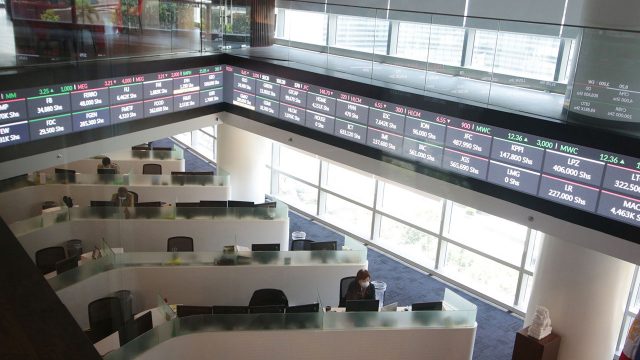
SHARES bounced back on Tuesday amid hopes of eased quarantine restrictions following the continued decline in coronavirus disease 2019 (COVID-19) cases in Metro Manila.

The benchmark Philippine Stock Exchange index (PSEi) inched up 35.57 points or 0.49% to close at 7,288.21 on Tuesday, while the broader all shares index advanced 16.97 points or 0.44% to 3,864.48.

Regina Capital Development Corp. Head of Sales Luis A. Limlingan said in a Viber message that investors are hoping for an easing in mobility restrictions in Metro Manila.

“With the National Capital Region’s (NCR) risk classification being downgraded and COVID-19 reproduction number down to 0.91 as confirmed by OCTA Research group, the investor sentiment improved, inspiring them to go on bargain hunting with the market closing in positive territory,” Diversified Securities, Inc. Equity Trader Aniceto K. Pangan said in a text message.

The Philippines and Metro Manila’s COVID-19 risk classification has been downgraded to high risk from critical risk, the Health department said on Tuesday.

In a televised meeting between President Rodrigo R. Duterte and his Cabinet members on Monday night, Health chief Francisco T. Duque III said the infection growth rate across the country between Jan. 11 to Jan. 24 declined to 176% from 3,361%.

Meanwhile, in Metro Manila, the growth rate fell to 65% from 7,225%.

Mr. Duque said the capital region is ready for a more relaxed Alert Level 2 by next month amid decreasing COVID-19 cases and high vaccination rates.

“The lowering of risk classifications has overpowered local investors’ concerns on the upcoming US Federal Reserve monetary policy meeting,” Timson Securities, Inc. Trader Darren Blaine T. Pangan said in a Viber message.

The Fed, which had announced plans to begin paring back unprecedented stimulus, is set to update its policy trajectory at the close of its two-day meeting. Concerns that the central bank could tighten too quickly added to investor nerves, Reuters reported.

Most sectoral indices advanced on Tuesday except for mining and oil, which dropped 101.81 points or 0.97% to 10,300.44; and financials, which slipped 0.32 points or 0.02% to end at 1,637.49.

On the other hand, industrials gained 106.28 points or 1.02% to 10,488.05; services climbed 14.29 points or 0.72% to 1,976.23; property added 20.07 points or 0.63% to 3,197.87; and holding firms increased 22.43 points or 0.31% to 7,163.76.

Value turnover rose to P6.28 billion with 1.26 billion shares switching hands on Tuesday from the P6.05 billion with 1.96 billion issues traded the previous day.

Decliners beat advancers, 96 against 82, while 52 names closed unchanged.

Diversified Securities’ Mr. Pangan put the PSEi’s support at 7,200 and resistance at 7,400. — MCL with Reuters

By automating finance, CFOs can embrace more strategic role — IBM study

UNSPLASH

Fewer than 10% of finance-related activities are dedicated to analysis and action that support decision-making, according to a study on the role of the chief financial officer (CFO) by technology firm IBM. Instead, many activities are low-value and transactional.

Published on Jan. 20, the IBM 2021 Global CFO study surveyed 2,000 C-suite finance leaders in 28 industries and 43 locations worldwide.

“Freeing up the time to work on strategic challenges is an issue for finance organizations,” said Natalie Pia H. Azarcon, managing partner at IBM Consulting, IBM Philippines, “especially if finance doesn’t have the right tools and systems needed to automate traditional work, such as making payments, closing books, and the like.”

Only 46% of CFO respondents in the Asia Pacific, including the Philippines, say finance is effective at execution.

“Half of the finance department’s time continues to be spent on transactional activities, which have remained relatively consistent across IBM’s 18 years of research,” said Ms. Azarcon.

Artificial intelligence (AI), she told BusinessWorld, can be leveraged to automate and eliminate low-value and transactional activities, thereby freeing up the time to drive deeper business insights and better business outcomes. 

The IBM study found that 63% of Asia Pacific CFOs say AI technology has been implemented in their planning processes, with 51% also reporting AI’s implementation in financial forecasting, management/performance reporting (52%), and profitability/margin analysis (50%).

“Today, in the modern tech-fueled economy, the CFO is uniquely situated to influence the organization’s digital transformation: setting the financial baseline, building the business case, helping to determine the value of each initiative, collaborating across the C-suite to gain buy-in, and tracking benefit realization,” said Ms. Azarcon. — Patricia B. Mirasol

Count your luck and celebrate Chinese New Year at SM Supermalls

Good fortune awaits shoppers at SM Supermalls this Year of the Tiger 

It’s going to be a prosperous 2022 as SM Supermalls celebrates the Year of the Tiger with fun-filled events and activities for its shoppers! Whether you choose to stay home or safely shop at SM Supermalls, there are exclusive CNY deals for everyone to enjoy!

Lucky Dining Deals. Kick off the festivities with an abundant gastronomic feast with discounts and promos from January 16 to February 2. Shoppers can enjoy Lucky Eats Deals of as much as a 22% discount from participating tenants. For your convenience, you can easily shop via the SM Malls Online app where you can arrange for delivery or pick-up, or by calling our SM Customer Care hotline at (02) 8876-111, 0917-876-111 or 0908-876-1111. You can also have your fill of your favorite food while safely dining at Chinese New Year-themed indoor and outdoor Lucky Eats Dining Spots.

Lucky Red Finds Bazaar. Boost your luck and find all the lucky red items from SM Supermalls’ partner tenants and affiliates in this Chinese New Year-themed pop-up market.

Lucky Tiger Park. Families will be treated to a dazzling Chinese New Year experience featuring an outdoor set-up with lighted 3D tiger art installations, Chinese lanterns, and Drive-Thru Lion and Dragon Dances and Fireworks Displays to welcome the year of the Tiger!

Lucky Paws. Show off your pet’s best CNY-themed costume and get a chance to win pawsome prizes when you submit photos of your pets online or take them to select SM Supermalls Paw Parks.

Lucky Forecasts. When it comes to ushering in good fortune, SM Supermalls knows how to help prepare shoppers for the positive energy this new year brings. By scanning the QR codes, you can check out your 2022 Chinese zodiac brought to you by Feng Shui expert Ms. Marites Allen. Plus, you can also get a chance to win exciting prizes and SM vouchers!

Additionally, SM Supermalls has also prepared other activities and promos for everyone to enjoy until February:

  • Lucky Plants. Attract good luck all year round with lucky plants in your home! This Chinese New Year-themed green market in select SM malls features floras that are considered lucky like the lucky bamboo, money tree, Jade plant, mandarin orange tree, orchid, bamboo, and bonsai.
  • Lucky Finds on SM Deals. Check out CNY exclusive offers from SM Supermalls’ tenant partners and affiliates from Buy 1 Get 1 deals and 50% discounts.
  • Lucky22 vouchers. If you opt to stay at home during these festivities, don’t worry about missing out on these exciting deals because SM Supermalls has got you covered. SM Malls Online will be having Lucky22 vouchers– a special voucher offering a 22% discount on food and non-food items for stay-at-home shoppers like you!
  • Lucky in Red Pick-up at Curbside Promo. When you pick up your order at SM via SM Customer Care Hotline, SM will be giving away Php 200 worth of SM GCs on February 1 for those decked in red! So wear something red or drive by to pick up the items you’ve ordered in your flashy red car! This promo is for the first 22 customers only, so be sure to get there as early as you can.

Enjoy all these and more when you celebrate your #LuckyDaysAtSM this Chinese New Year! So, increase your luck and safely celebrate with SM Supermalls as it welcomes the Year of the Tiger with wishes of prosperity, health, abundance, and continuous good fortune!

For #SafeMallingAtSM, you can follow @smsupermalls on all social media platforms.


Spotlight is BusinessWorld’s sponsored section that allows advertisers to amplify their brand and connect with BusinessWorld’s audience by enabling them to publish their stories directly on the BusinessWorld Web site. For more information, send an email to online@bworldonline.com.

Join us on Viber to get more updates from BusinessWorld: https://bit.ly/3hv6bLA.

Guatemala gives ex-paramilitaries 30 years for raping indigenous women

GUATEMALA CITY – Guatemala‘s highest court on Monday sentenced five former paramilitaries to 30 years in prison after they were found guilty of raping 36 Mayan women between 1981 and 1985 during the bloodiest time of the Central American nation’s civil war.

The trial against the former members of the so-called Civil Self-Defense Patrol, armed groups recruited by the army, began three weeks ago.

During the trial, survivors and relatives of the victims of the Achi indigenous group gave testimony.

“The women were subjected to continuous rape and also to domestic slavery,” said Gervi Sical, one of the judges as the sentence was read.

The former patrolmen “disappeared” all the men from a village in Baja Verapaz, in northern Guatemala, and then raped, tied up and threatened the women, Sical said. After being raped, they were urinated on.

Pedrina Lopez, one of the victims, said they were not seeking revenge but rather justice. “We don’t want this to happen again,” she said.

The five former patrolmen are alive and in prison.

In 2016, two soldiers were sentenced for sexual violence, and sexual and domestic slavery of 15 Q’eqchi women, also of Mayan origin. – Reuters

S.Korea’s GDP growth climbs to 11-year high, but recovery uneven

SEOUL – South Korea’s economy expanded at the fastest pace in 11 years in 2021 helped by a jump in exports and construction activity, tempering declines in capital investment and a slow recovery in the coronavirus-hit service sectors.

Record exports drove the rebound but swathes of the economy have fallen behind. Jobs are still vanishing across manufacturing and service sectors, a reminder that liberal President Moon Jae-in’s promises to boost employment have not materialised.

Hours after Bank of Korea data showed the economy expanded 4.0% last year, hundreds of small business owners plan to gather near the National Assembly in Seoul to shave their heads in protest against social distancing rules that have hammered retail and service sector sales.

Sentiment remains pessimistic as South Koreans head to the polls for the 2022 Presidential election slated for March 9.

The main candidates from the ruling and opposition parties have seized on the discontent, making an equitable society a centerpiece of their policy visions.

The BOK expects GDP to grow 3.0% this year as Asia’s fourth-largest economy benefits from strength in semiconductor exports and increased public spending, though record domestic COVID-19 cases this week are a threat to consumption.

“Global demand for our chips is resilient and strong exports will keep (South Korea’s) growth momentum solid,” said Hwang Sang-pil, head of BOK’s Economics Statistics department.

“People are getting used to social distancing curbs. Activity was slower in December but the hit is smaller than before.”

The economy expanded a seasonally adjusted 1.1% in the October-December period from three months earlier, beating the 0.9% expansion tipped in a Reuters poll and up from a 0.3% rise in the third quarter.

From a year earlier, the economy expanded 4.1% in the fourth quarter, also beating a median forecast of 3.7% in the poll.

The BOK on Jan. 14 raised its benchmark interest rate to pre-pandemic levels and signalled it may tighten further as growth and inflationary pressures remain strong.

South Korea’s economy has had a sharp albeit uneven bounce from the coronavirus slump in 2020, when it contracted 0.9%, with exports expanding at their fastest annual pace in 11 years last year while the consumption recovery has been patchy due to social distancing curbs.

A recent Reuters poll of 20 economists forecast the economy will grow 2.9% this year, below the 3.0% projected by the BOK.

Tuesday’s data showed exports were the main driver of growth in the fourth quarter, jumping 4.3% on-quarter.

Growth was also helped by private consumption and construction investment, which expanded 1.7% and 2.9%, respectively.

The service sector grew 1.3% in the fourth quarter, stronger than the third quarter but slower than the second.

Capital investment declined 0.6% on-quarter, following a 2.4% drop in the preceding three months. – Reuters

Do not assume COVID pandemic reaching ‘end game’, warns WHO

IMAGE VIA WHO/P. VIROT

GENEVA – The head of the World Health Organization (WHO) warned on Monday that it was dangerous to assume the Omicron variant would herald the end of COVID-19’s acutest phase, exhorting nations to stay focused to beat the pandemic.

“It’s dangerous to assume that Omicron will be the last variant and that we are in the end game,” Tedros Adhanom Ghebreyesus told a WHO executive board meeting of the two-year pandemic that has killed nearly 6 million people.

“On the contrary, globally the conditions are ideal for more variants to emerge.”

Though Omicron has sent total cases soaring to nearly 350 million, its less lethal impact and the increasing prevalence of vaccines has led to optimism in some parts that the worst of the pandemic may have passed.

Tedros, the WHO‘s first African head who is running unopposed for a second term, urged discipline and unity in combatting the coronavirus.

“The COVID-19 pandemic is now entering its third year and we are at a critical juncture,” he told a news conference earlier. “We must work together to bring the acute phase of this pandemic to an end. We cannot let it continue to drag on, lurching between panic and neglect.”


GERMANY BIGGEST DONOR

Countries must maximise strategies and tools already available, such as testing and inoculation, for the global health emergency to end this year, he said.

Tedros’ bid for a second term received a boost when the WHO shelved a decision on his native Ethiopia’s request to investigate accusations of links to rebel forces.

He told board members he was seeking an overhaul of the agency’s funding model, with Germany now the largest donor, supplanting Washington which had accused the WHO of pro-China bias under former President Donald Trump’s administration.

The United States is resisting a financing proposal that would make the U.N. health body more independent, raising doubts about the Biden administration’s long-term support. – Reuters

In surprise move, Singapore tightens monetary policy on inflation risks

REUTERS

Singapore‘s central bank tightened its monetary policy settings on Tuesday in its first out-of-cycle move in seven years, as global supply constraints and brisk economic demand elevate inflation pressures across the region.

The city-state’s trade-dependent economy is highly susceptible to swings in global inflation and the central bank’s sudden move comes as price pressures ring alarm bells for policymakers elsewhere in Asia.

Selena Ling, head of treasury research and strategy at OCBC, said she expects the central bank to tighten again in April, describing Tuesday’s move as only a “slight tightening.”

“If they had announced a more aggressive tightening today, then that would have dampened expectations for April,” she said.

The Monetary Authority of Singapore (MAS), which manages monetary policy through exchange rate settings, said it would slightly raise the rate of appreciation of its policy band.

The width of the band, known as the Nominal Effective Exchange Rate, or S$NEER, and the level at which it is centered will be unchanged.

The MAS last surprised with an off-cycle move in January 2015 when it eased its policy after a collapse in global oil prices.

Last year, many Asia-Pacific economies largely shrugged off inflationary threats that had rattled policymakers in Europe and the United States but that thinking now appears to be shifting.

Australia’s core inflation flew to its fastest annual pace since 2014 in the December quarter, data showed on Tuesday, challenging the central bank’s benign interest rate outlook.

In Japan, a country renowned for its stubbornly tepid price growth, policymakers have also acknowledged creeping inflation pressures.

Singapore‘s policy move comes just a day after data showed core inflation in the city-state climbed in December by the fastest pace in nearly eight years.

“This move builds on the pre-emptive shift to an appreciating stance in October 2021 and is appropriate for ensuring medium-term price stability,” the MAS said, referring to its tightening move late last year.

The central bank is due to review its stance at a scheduled semi-annual policy meeting in April, when it was widely expected by economists to tighten again.

The Singapore dollar strengthened to 1.3425 versus the U.S. dollar, its highest since October 2021.


‘DOUBLE TIGHTENING’

Singapore‘s bellwether economy is expected to grow 3-5%, unchanged from earlier forecasts.

“2022 will be year of double tightening for Singapore – both fiscal and monetary levers will grind tighter,” said OCBC’s Ling.

The MAS expects Singapore‘s economic recovery, which has so far been led by the trade-related and services sectors, to extend to the domestic-oriented and travel-related sectors this year as COVID-19 restrictions are eased.

Singapore has vaccinated 88% of its 5.5 million people against COVID-19 and 55% have received booster shots.

The MAS forecasts core inflation to be 2.0–3.0% this year, from the 1.0–2.0% expected in October. Headline inflation is expected to be 2.5–3.5%, from the earlier forecast range of 1.5–2.5%.

“While core inflation is expected to moderate in the second half of the year from the elevated levels in the first half as supply constraints ease, the risks remain skewed to the upside,” the MAS said.

Singapore will release its annual budget on Feb. 18, when the government is expected to announce the timing for an anticipated hike in goods and services tax.

The city-state’s economy grew 7.2% in 2021, its fastest pace in over a decade, rebounding from a record 5.4% contraction in 2020. The government has spent more than S$100 billion over the last two years to cushion its economy from the impact of the pandemic.

Instead of interest rates, the MAS manages policy by letting the local dollar rise or fall against the currencies of its main trading partners within an undisclosed band.

It adjusts its policy via three levers: the slope, mid-point and width of the policy band. – Reuters

Biden curses Fox News reporter after he asks about inflation

REUTERS

WASHINGTON – U.S. President Joe Biden was caught on a hot mic cursing a Fox News reporter at a White House event on Monday after the journalist shouted a question about the impact of rising inflation on this year’s congressional elections.

As journalists were ushered out of a meeting of Mr. Biden‘s Competition Council, Peter Doocy, a White House correspondent with whom Mr. Biden regularly spars, asked if it was OK to ask about inflation and if it was a political liability.

“That’s a great asset, more inflation,” Mr. Biden responded sarcastically over a din of reporters shouting questions, apparently not realizing his microphone was still on. “What a stupid son of a bitch,” he added.

U.S. consumer prices increased solidly in December, culminating in the largest annual rise in inflation in nearly four decades.

Within about an hour of the exchange, Mr. Biden called Mr. Doocy’s cell phone and said “it’s nothing personal, pal,” Mr. Doocy later told Fox News host Sean Hannity.

The White House did not respond to a request for comment while Fox News pointed Reuters to a transcript of an interview with Mr. Doocy about the exchange on Monday evening.

Mr. Biden took office a year ago pledging to take a hard line on any disrespect among members of his administration.

“If you’re ever working with me and I hear you treat another colleague with disrespect, talk down to someone, I promise you I will fire you on the spot … no ifs, ands or buts,” Mr. Biden told political appointees during a virtual swearing-in ceremony. “Everybody is entitled to be treated with decency and dignity,” he said at the time.

Mr. Biden‘s predecessor, Republican Donald Trump, famously attacked reporters at rallies and news conferences, to the delight of many of his supporters.

Mr. Doocy, who has long covered Mr. Biden, regularly gets called on by the president at events, often asking skeptical and critical questions. Conservative-leaning Fox News has been critical of Mr. Biden‘s presidency and Democrats. – Reuters

Keeping vigilant in an increasingly digital world

By Bjorn Biel M. Beltran, Special Features Writer

The revolution in financial and digital technology has created endless opportunities for global economic growth and financial inclusion, yet it has also birthed new risks. With every digital banking platform or e-wallet allowing small business owners new ways to earn and grow, there are scammers and fraudsters looking to take advantage of the same technologies for their latest grift.

According to the Credit Card Association of the Philippines (CCAP), a group consisting of 18 credit card companies, fraudulent credit card activities via remote and other digital payment channels have increased by 21% since early 2020 when the global pandemic started.

The group identified the most common method, dubbed as “Virtual Account Take Overs” and which involves gaining access to One Time Passwords of unwitting customers to perform validated online transactions, as the most dominant scam in the country today.

“The industry has been experiencing high volumes of fraud cases causing financial detriment. These perpetrators have carried out fraud by using the various digital payment platforms to commit crime,” CCAP Executive Director Alex Ilagan said in a statement.

The CCAP report reinforced previous research that found increasing digital fraud attempts against businesses and consumers in the Philippines since the onset of the pandemic. The Global Consumer Pulse study of global information and insights company TransUnion found that 44% of Philippine-based consumers have been targeted by digital fraud in the first three months of 2021.

In terms of digital fraud attempts against enterprises, this was a 31% increase in attacks this year from pre-pandemic level in March 11, 2019 to March 10, 2020 during the COVID-19.

The study was based on intelligence from billions of transactions and over 40,000 websites and apps from TransUnion TruvalidateTM, a flagship identity proofing, risk-based authentication, and fraud analytics solution suite.

“Fraudsters are always looking to take advantage of significant world events. The COVID-19 pandemic and its corresponding rapid digital acceleration brought about by stay-at-home orders is a global event unrivaled in the online age,” TransUnion Philippines president and chief executive officer Pia Arellano had said in a statement.

According to the study, there was a significant increase, more than a 10-fold (1,108%), in attempted fraud from the Philippines against telecommunication companies during the pandemic.

“Fraud can have a potentially disastrous impact on a business’ and a consumer’s finances. In our increasingly digital economy, being able to spot fraudulent transactions whilst still providing genuine consumers with a great experience is a balancing act that organizations need to solve. By using the latest solutions, businesses can build trusted relationships and transact with confidence knowing they are safeguarding both themselves and the consumers they serve,” Ms. Arellano said.

The continued growth of digital payment platforms in the country could create an environment where online fraud and other cybercrimes can fester, and the organization urged major telecommunications providers and policymakers in the National Telecommunications Commission (NTC) and in Congress to implement stricter rules and laws in the space.

Particularly, the CCAP is advocating for the tightening of the telcos’ existing Know Your Customer process when onboarding new prepaid and postpaid customers, particularly when it comes to the ID verification process when customers request to change mobile numbers when declaring a lost or stolen mobile unit.

“We respectfully request that this be addressed urgently. Perpetration of a successful unauthorized SIM swap will affect both the telcos’ and the banks’ customers, resulting in financial losses, loss of public trust and confidence, and close scrutiny from the regulators,” said CCAP in separate letters sent to various groups.

CCAP further pushed for the swifter passage of House Bill 5793 or the “Subscriber Identity Module (SIM) Card Registration Act,” and Senate Bill 2395 or the “SIM Card Registration Act,” which were already approved on third and final reading in both Houses of Congress. Both proposed measures are seeking to establish a system of SIM card sale and registration to “help law enforcers track down those who use mobile phones to engage in criminal activities,” said CCAP.

“To date, there are no existing laws which protect the consumers from this mode of attack from the fraudsters. We believe that the passage and implementation of this law will greatly deter the activities of the fraudsters as they will now have accountability from the use of the then registered SIM cards,” CCAP added.

Meanwhile, the CCAP said that the NTC needs to have a stronger recourse mechanism for consumers who fell victim to fraud.

“We believe that this will effectively facilitate a convenient, standard, and reliable reporting platform with a consistent, trustworthy process where consumers report telephone numbers being used by fraudsters or by some random persons offering to click links or awards/prizes or even offer jobs, without these being triggered by consumers. This standardized reporting mechanism is absent in today’s environment which leads hesitancy from the victims to properly report incidents to their respective banks or telecommunication providers,” CCAP told NTC.

Aside from Virtual Account Take Overs, other common methods of scamming are: phishing and vishing, which lures victims into giving sensitive data by offering fake promos or assistance to help with their account that has been hacked; using lost or stolen cards to make unauthorized transactions; and card replacement scams, which lure people into believing credit card is due for replacement or upgrade.

Essentials in secure transactions: Strong passwords and alert eyes

Photo from freepik

Cases of online fraud and cyber theft have made headlines in the past weeks. In fact, over 40,000 online fraud complaints were received by the Bangko Sentral ng Pilipinas (BSP) from 2020 to 2021. These situations serve as a reminder for consumers to vigilantly keep their accounts and transactions secure, especially as digital platforms are increasingly used for banking and payments in the new normal.

A key in keeping transactions secure is strong and unique passwords. According to a primer developed by the Financial Consumer Protection Department of the BSP, a strong password should be long and contain a combination of characters. It should not contain personal information such as birthday, name of partner or child, or mobile number.

Consumers are also recommended to make different passwords for each of their accounts in order to prevent all accounts from being compromised by a hacker or phisher.

Moreover, Credit Information Corporation, on its website, tells consumers to avoid pattern combinations. “Instead, think of a long, complicated, words-number-character combination for your password that will make not make sense but is guaranteed unique,” CIC wrote.

Having strong passwords, however, is not enough to keep one’s online transactions secure.

Consumers must beware of suspicious links, especially those that are used in online fraud. These attacks typically come in the form of phishing emails and spoofed websites.

Phishing attacks often start in unexpected emails asking for one’s personal information, bank account or credit card details, or passwords. These emails might deceitfully advise consumers to “update” their account lest their account might be deactivated or due to a “detected unauthorized transaction.”

“The email looks legitimate but often has a generic greeting, grammatical errors, sense of urgency, and no verifiable contact information of the sender,” BSP wrote in a primer on frauds and scams.

To avoid getting attacked by phishing, keep in mind that banks or financial institutions will never ask for personal information, even the one-time pin (OTP), through email. Such suspicious emails cannot be trusted, so do not click the links or attachments in these emails.

Unless the email site warns of phishing beforehand, one way to determine if such email is a phishing attempt is to check the address used by hovering — or placing the cursor (but not clicking) — on the address. If it consists of numerous characters or looks longer than a typical address, consider it suspicious.

“Always call your bank or financial institution directly to verify if an email is legitimate”, BSP added.

Not only do scammers use email to trick consumers, but they also use websites that look legitimate. Personal information, bank account, or credit card details are also sought by these websites, which are usually linked to phishing emails or other fake websites.

To avoid such attacks, BSP advises, always check the address bar or properties of a website to verify if it is legitimate. Check the website address for https:// at the beginning and a visible closed padlock icon. Be familiar as well with legitimate addresses and domain names, since fake websites have addresses that mimic banks, popular brands, and companies. — Adrian Paul B. Conoza

DTI warns of impact of RCEP delay

REUTERS

DEPARTMENT of Trade and Industry (DTI) Secretary Ramon M. Lopez on Monday warned delays in the Senate’s concurrence of the Regional Comprehensive Economic Partnership (RCEP) will have a negative impact on the economy.

“It is not just a simple trade agreement that provides enhanced market access and stable business environment. It is a strategic tool to sustain the region’s economic advantage. RCEP is expected to promote economic efficiency of member states, linking their strengths in manufacturing, technology, agriculture, and natural resources, and it will reinforce the global value chain network, which the Philippines is very much a part of,” Mr. Lopez said in a statement.

The RCEP was ratified by President Rodrigo R. Duterte on Sept. 2, 2021, and is now pending in the Senate for its concurrence. Since Jan. 1, the RCEP is now in force in 11 countries: Brunei, Cambodia, Lao People’s Democratic Republic (PDR), Singapore, Thailand, Vietnam, Australia, China, Japan, South Korea, and New Zealand. 

The Senate only has until Feb. 4 to tackle the RCEP, before lawmakers go on a break for the election campaign.

Mr. Lopez said the delay in Senate’s action would hurt economic activity and job creation as trade and investments would be diverted to other countries in the region.

“As other countries in the region enjoy the preferential treatment arising from enhanced market access, wider sourcing of raw materials and strengthened and transparent trading systems, the existing linkages of the Philippines to the global value chain may deteriorate as investors and businesses look to other countries for better economic environment and opportunities. Even our exports could become less competitive, including electronics, which account for 62% of our exports, and even agricultural product exports,” the Trade chief said.

Meanwhile, the Asian Development Bank (ADB) said the Philippines is one of several countries seen to offer greater market access for services trade under the RCEP.

The multilateral bank said the trade deal’s chapter on trade in services, for the most part, replicates those in recent ASEAN + 1 free trade deals. But RCEP covers a greater share of overall trade in services among all parties, it added.

New market access opportunities have been identified in a variety of sectors, including educational, health, computer-related, and other business services, in such countries as the People’s Republic of China, Indonesia, the Philippines, and Thailand.

But it also said that a “deep comparative analysis” will be needed for more transparency.

Trade in services in the RCEP covers financial services, telecommunications, and professional services.

Compared with ASEAN + 1 free trade agreements, there are higher foreign equity caps under RCEP. It also covers additional financial services.

When it comes to telecommunications, RCEP covers mobile services, including number portability, or the ability of a mobile customer to retain the same number even when they switch providers. RCEP also rolls out new market opportunities in this sector from commitments made by Indonesia, Lao PDR, Malaysia and Thailand.

Meanwhile, the Philippines is one of several countries that made greater market access commitments in professional services, along with Cambodia, China, Indonesia, South Korea, Lao PDR, and Malaysia.

“These commitments would benefit firms supplying legal, architectural, planning, engineering, veterinary, accounting, auditing, and bookkeeping services,” the ADB said.

Meanwhile, a farmers’ group said the country will not lose its export markets if the Senate fails to ratify the trade deal because it already participates in several ASEAN + 1 trade pacts that continue to provide similar tariff concessions to RCEP.

The Federation of Free Farmers in a statement on Monday said safeguards need to be put in place for vulnerable sectors before finalizing the deal.

“Joining RCEP now is ill-advised since many sectors, particularly in agriculture, are unprepared for open competition,” the group said. — J.P.Ibañez

ADVERTISEMENT
ADVERTISEMENT