Home Blog Page 6876

GS yields end mixed on hawkish Fed
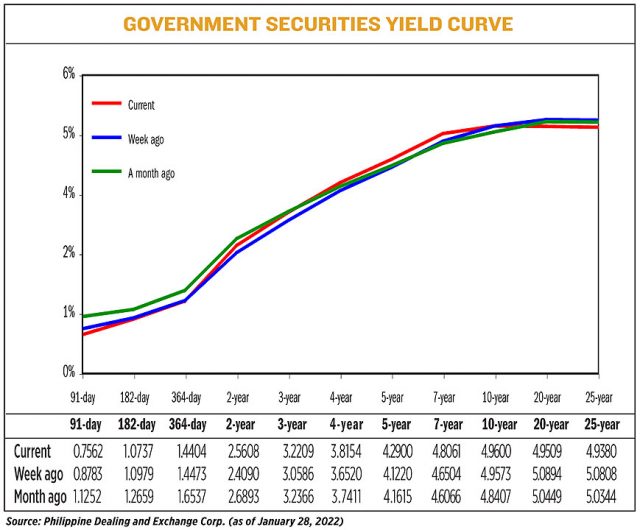
YIELDS on government securities (GS) ended mixed last week after the US Federal Reserve signaled it would raise its benchmark rates starting March.

GS yields in the secondary market increased by 3.36 basis points (bps) on average week on week, based on the PHP Bloomberg Valuation (BVAL) Service Reference Rates as of Jan. 28 published on the Philippine Dealing System’s website.

Yields, which move opposite to bond prices, were mixed across the curve last week. At the short end of the curve, yields on the 91-, 182-, and 364-day papers dropped by 12.21 bps, 2.42 bps, and 0.69 bps, to 0.7562%, 1.0737%, and 1.4404%, respectively.

The belly of the curve rose as the two-, three-, four-, five-, and seven-year debt papers increased by 15.18 bps, 16.23 bps, 16.34 bps, 16.80 bps, and 15.57 bps, to yield 2.5608%, 3.2209%, 3.8154%, 4.2900%, and 4.8061%, respectively.

At the long end, the 10-year note inched up by 0.27 bp to 4.9600%, while the 20- and 25-year papers fell by 13.85 bps (to 4.9509%) and 14.28 bps (4.938%).

ATRAM Trust Corp. Head of Fixed Income Jose Miguel B. Liboro said GS rates shot up last week due to sudden increase in global bond yields.

“Local rates were put under pressure as global investors began to price in more aggressive than expected policy action from the US Federal Reserve,” Mr. Liboro said in an e-mail interview.

A bond trader said rates began rising ahead of the Federal Open Market Committee (FOMC) meeting and “finally broke resistance levels when the statement was deemed more hawkish than expected,” pushing rates at the belly of the curve upwards.

“Short-end was pinned lower because investors prefer to only short bonds (the shorter, lesser risk from fluctuations), tail-end was flat due to less supply and some specific demand for yield pickup,” the bond trader said in a Viber message.

At the end of the two-day FOMC meeting on Jan. 25-26, Fed Chairman Jerome H. Powell said the US central bank was likely to begin hiking interest rates in March to tame runaway inflation, Reuters reported.

He also reaffirmed its plan to end its bond buying that month.

However, Mr. Powell said the pace of succeeding rate hikes this year remain undecided as well as how quickly the Fed will let its massive balance sheet decline.

“While we believe that a 25-bp hike from the BSP later in the year is likely, softening inflation and a bias towards supporting local growth prospects are likely to take precedence over any spillover effect from a potential Fed hiking cycle,” Mr. Liboro said.

“We expect market to remain defensive early on due to pressure from global yields. However, the possibility of another inflation print below 4% for January is likely to spur some buying interest over the short term,” he added.

For the bond trader, yields this week would most likely “trend sideways with an upward bias” targeted at the four-year bonds and “longer tenors” due to expected weekly auctions by the Bureau of the Treasury (BTr).

The BTr will offer on Tuesday P35 billion in reissued five-year papers with a remaining life of four years and two months.

The Treasury plans to borrow P200 billion — P60 billion from Treasury bills and P140 billion from Treasury bonds — from domestic debt market in February. — Ana Olivia A. Tirona with Reuters


Six mobile ASF labs planned for P100 million

FREEPIK

THE Department of Agriculture (DA) said it plans to deploy six mobile laboratory units (MLUs) worth P100 million to contain African Swine Fever (ASF).

Along with the Bureau of Animal Industry (BAI), the DA will deploy the MLUs to ASF-affected regions by March.

Agriculture Secretary William D. Dar said in a statement that each mobile lab can be sent to any local government unit (LGU) where ASF is suspected. They will also serve as mobile veterinary schools to train LGU personnel in disease detection, prevention, and monitoring.

The BAI is also being tapped to manage Regional Animal Disease Diagnostic Laboratories that can confirm the presence of animal diseases through reverse transcription polymerase chain reaction (RT-PCR) tests.

“These laboratories just need to optimize processes to further strengthen the country’s animal diagnostic infrastructure,” BAI Director Reildrin G. Morales said.

The DA has also forged a partnership with science and veterinary group BioAssets Diagnostic Clinic to help contain ASF and other transboundary animal diseases.

BioAssets offers a project known as Brisk Response through In-location Diagnostics and Genome Sequencing (BRIDGES) which can isolate and characterize the ASF virus at a molecular level.

“BRIDGES may also be used to differentiate the field strain from vaccine strain, which may fast-track vaccine research development,” the DA said.

The project has an initial funding of P39.2 million from BioAssets and the Department of Science and Technology under the Science for Change Program.

The BAI and BioAssets have agreed to collaborate on biosecurity measures, provide onsite detection tools, and offer preventive diagnostics. — Luisa Maria Jacinta C. Jocson

New SRP list curtails retailers — supermarket group

By Revin Mikhael D. Ochave, Reporter

THE latest suggested retail price (SRP) list is hampering the freedom and growth of local retailers, according to the Philippine Amalgamated Supermarkets Association, Inc. (Pagasa).

Pagasa President Steven T. Cua said in a mobile phone message that any form of price control like the SRP list is not necessary unless there is an emergency or calamity.

“Applying a list of SRPs chokes the freedom of retailers to play with price strategies to compete and grow in the Philippine environment,” Mr. Cua said.

“Supermarkets in this country live with paper-thin margins. This is the major reason why foreign retailers have not survived or are not attracted to invest here despite the many times the Retail Trade Liberalization Act has decreased capital requirements for entering our soil,” he added.

Further, Mr. Cua said SRPs are set by manufacturers so the range of prices for a product will not drastically change.

However, he noted that it is just “suggested” since suppliers cannot force retailers to sell at prices wanted by the former.

“At this point, consumers do not seem to be aware or affected by this (SRP list) as they have more immediate concerns like health and livelihood,” Mr. Cua said.

On Jan. 27, the Department of Trade and Industry (DTI) announced the latest SRP list of basic necessities and prime commodities. The list showed that some of the products with price increases include bottled water, processed canned meat and canned beef, instant noodles, salt, and canned sardines.

Based on the new SRP list, 66% or 143 out of 216 stock keeping units (SKUs) kept their prices while 34% or 73 SKUs hiked their prices as a result of higher production costs.

The DTI previously said that the price hikes of around 86% of the 73 SKUs varied from 1% to 9%, which were lower compared to the rates of cost movement of some raw materials.

“All requests for adjustments were carefully reviewed to ensure that prices were reasonable. The DTI made sure that the price adjustments are justified. Not allowing reasonable price adjustments despite cost increases will affect investment climate, business viability and ability to keep the jobs in their companies,” Trade Undersecretary Ruth B. Castelo said.

Meanwhile, the DTI is seeking amendments to Republic Act No. 7581 or the Price Act in a bid to deter constant violators.

Trade Secretary Ramon M. Lopez said in a television interview over the weekend that one possible amendment to the Price Act is to allow the DTI to have a stronger enforcement power over violators.

Under the Price Act, the DTI has a mandate to ensure that the prices of basic goods and prime commodities are reasonable for consumers.

“Maybe we can allow DTI to have a stronger police power in the sense that perennial violators, if the law can allow (us) to revoke their licenses,” Mr. Lopez said.

“There is reasonable mandate in the sense that we can institute fines and penalties. That’s clear. But sometimes you need stricter measures. There are recidivists, or those who often violate to the point that there is a need to revoke the license,” he added.

Toyota Raize now available to reserve

PHOTO FROM TOYOTA MOTOR PHILIPPINES CORP.

SAID TO BE “arriving in just a few days,” the all-new Toyota Raize SUV, reported Toyota Motor Philippines Corp. (TMP), is now available to order. The company declared that interested parties may inquire at the nearest Toyota dealership or a preferred authorized marketing professional “on how to get listed for reservations.”

The brand’s five-seater crossover is designed and developed to be compact, active, and useful both for everyday and leisure on weekends. The Raize will come in four variants — 1.0 Turbo CVT, 1.2 G CVT, 1.2 E CVT, and 1.2 E MT — and is priced from P746,000 up to P1,036,000. It also comes in gray and silver metallic exterior colors, with a red finish available for the G CVT variant. The Turbo CVT variant exclusively offers two-tone colors including white and black, turquoise and black, and yellow and black.

For more information, visit a Toyota dealership or inquire online (toyota.com.ph/raize) and choose a preferred dealership, which will revert back on the product inquiry. TMP’s official pages are Toyota Motor Philippines on Facebook, toyota.com.ph, ToyotaMotorPH of Instagram, and Toyota PH on Viber. Customers are also encouraged to download the myToyota PH app for Android and iOS for all Toyota needs, from car selection to car care, maintenance, and upgrades.

2 Filipino films win awards at the 2022 Sundance film fest

Don Josephus Eblahan’s The Headhunter’s Daughter — FACEBOOK.COM/HEADHUNTERSDAUGHTER.FILM

TWO Filipino films — one about an aspiring country singer, and another about a retired filmmaker, both of whom have a common goal of fulfilling their passions — were honored at the 2022 Sundance Film Festival awarding ceremony on Jan. 29.

Don Josephus Eblahan’s The Headhunter’s Daughter won the Short Film Grand Jury Prize while Martika Ramirez Escobar’s Leonor Will Never Die won the Special Jury Award in the World Cinema Dramatic Competition. Both films had their world premieres at this year’s virtual film festival.

The Headhunter’s Daughter follows an aspiring country singer (played by Ammin Acha-ur) who leaves home with her horse named July, and journeys from the Cordilleran highlands to the city to audition for a televised singing competition.

“We were entranced by this poetic and dream-like film which follows its character with gorgeous cinematography, direction, and acting, capturing a unique sense of place,” presenting juror Blackhorse Lowe said at the ceremony, reading the film’s citation for The Headhunter’s Daughter.

A post on The Headhunter’s Daughter’s official Facebook page stated: “Our hearts are full from all the kind messages and thoughtful reception about our film. We are grateful for this opportunity to premiere our film in Sundance, but to win the Grand Jury Prize brings a whole new layer of emotions, still currently being processed by each, and everyone involved in the film. But one thing is for certain, we are all overjoyed! Salamat! (Thank you!).”

Leonor Will Never Die follows retired filmmaker Leonor Reyes (played by Sheila Francisco) who, after a near death experience, falls into a coma and finds herself as the protagonist of her own unfinished screenplay.

“Switching in-between genres, this film within a film follows an ailing screenwriter who enters her unfinished screenplay of a gangster film to experience and edit her own creation. Constantly shifting in tone, the film is a playful display of the love of cinema. Its innovative and risk-taking spirit is especially commendable,” presenting juror La Frances Hui said, reading the film’s citation for Leonor Will Never Die.

“Films can speak and films can be heard, and today I’m glad that our film is felt by the jury. Thank you so much Sundance Film Festival, our spirits are smiling,” Leonor Will Never Die director Ms. Escobar wrote on Facebook.

Salamat sa lahat ng nanood, bumati, nagkwento, nagparamdam, nagreact, umiyak, ngumiti at nagpakita ng pagmamahal sa aming pelikula (Thank you to everyone who watched, greeted, talked about, flet, reacted, cried, smiled, and showed love for our movie),” she added.

Due to the COVID-19 pandemic, the film festival was held online for a second consecutive year. It ran from Jan. 20 to 30.

Founded in 1978 by the Sundance Institute, the Sundance Film Festival is the largest independent film festival in the United States and is held annually in Park City, Utah. Filmmakers who had their breakthrough at the film festival include Quentin Tarantino, Kevin Smith, David O. Russel, and Darren Aronofsky. — Michelle Anne P. Soliman

Catholic bishops spurn banks funding coal plants

By Marielle C. Lucenio

CATHOLIC bishops in the country said they will withdraw their resources from banks that continue to finance coal projects by 2025 and will reject donations from “destructive” industries.

“We must not allow the financial resources of our Catholic institutions to be invested in favor of coal-fired power plants, mining companies, and other destructive extractive projects,” the Catholic bishops wrote in their “Pastoral Letter on Ecology” released on Jan. 29.

These decisions, which the Catholic Bishops’ Conference of the Philippines (CBCP) came up after a two-day online plenary assembly, were strengthened by Pope Francis’ leadership and call for more investments in renewable energy.

The bishops urged priests to discuss with and demand their respective banks where they deposit their financial resources to come up with policies and plans to phase out their exposure to coal, fossil gas, and destructive energy.

“Without clear commitments and policies from these banks to divest from fossil fuels, we commit to withdraw all our resources that are with them not later than 2025, and hold them accountable to their fiduciary duties and moral obligations as climate actors,” the bishops wrote.

They also asserted a “non-acceptance policy” of whatever kind from owners or operators and anyone from the extractive industries especially those from coal, fossil gas, mining, quarrying, and logging regardless of the scale of operations.

“Our people need to be very critical, especially our parish priests. While we have several needs in our pastoral work, let us not compromise the welfare of our environment,” CBCP President Bishop Pablo Virgilio S. David said in press conference on Saturday.

Bishop Gerardo A. Alminaza of Diocese of San Carlos and Convenor of Withdraw from Coal urged companies to turn their backs against “dirty energy.”

“We challenge them to take the CBCP’s Pastoral Letter on Ecology as an invitation to exhibit genuine leadership in advancing climate action by ending their fossil fuel funding and paving the path to a future powered by clean energy from renewables,” he said in a separate statement.

The Energy department declared in October 2020 a moratorium on new coal power plant projects for a more sustainable power mix.

Several banks committed not to finance new coal plant projects.

Bank of the Philippine Islands (BPI) is aiming to reduce coal financing in its portfolio by half in 2026, exit coal financing as early as 2033 and to reach zero loan to the sector by 2037.

In 2020, Rizal Commercial Banking Corp. (RCBC) said its entire banking system is moving towards making its loan available only for non-coal projects.

BDO Capital & Investment Corp. President Eduardo V. Francisco, meanwhile, said during the Energy investment Forum on Dec. 3, 2021 that the company would discuss with Asian Development Bank to explore lending opportunities for coal-fired projects to avoid stranded assets for coal investors and assist the country in the energy transition.

AMLC tells covered persons to tighten guard against fencing

THE Anti-Money Laundering Council (AMLC) reminded its covered persons to be vigilant of fencing and conduct due diligence.

In an advisory, the AMLC reminded covered institutions that fencing, or dealing and accepting fenced items, is a violation of Presidential Decree No. 1612 or the Anti-Fencing Law.

The law defines fencing as an act of buying, keeping, concealing, or selling an item or anything of value with knowledge that it came from proceeds from robbery or theft.

“Covered persons are advised to conduct proper due diligence of their customers/clients and monitor transactions to recognize when a transaction, or a series of transactions, are unusual,” the AMLC said.

The dirty money watchdog said covered persons should submit suspicious transaction reports within the next working date after identifying that a transaction or an attempted transaction is dubious in nature.

It said covered persons should watch out for markers of suspicious transactions, such as when a customer is not properly identified, the lack of purpose or justification for the transaction, or when an amount involved appears to be not commensurate to a client’s financial capacity.

Covered persons should also look for signs that a client’s transaction appears to be structured to avoid AMLA requirements, instances when a transaction is a deviation from the customer’s profile and previous dealings, or when these transactions are related to unlawful activities under the country’s anti-dirty money laws.

The AMLC said covered persons may be slapped with administrative sanctions and penalties if they fail to do due diligence or miss monitoring transactions and filing reports. — LWTN

Thai pig farmers angered by havoc from suspected ASF

REUTERS

NAKHON PATHOM, Thailand — Business began unravelling for Thai pig farmer Jintana Jamjumrus two years ago, after dozens of her animals got feverish and died within days of a mysterious illness she suspected of being a viral disease with no known vaccine, African Swine Fever (ASF).

This month, officials identified the first case of ASF in Jintana’s province of Nakhon Pathom, after years of saying it was not in Thailand, unleashing a political firestorm as pork prices hit an all-time high near which they may stay for months.

“There’’ no way they didn’t know. Pigs died all over the country … Why the cover-up?” Jintana, 75, asked about the deaths in previous years. “What can they do now? There’s nothing left.”

In parliament, an opposition lawmaker accused the government of a years-long cover-up, though a deputy agriculture minister denied this, saying authorities had successfully kept out the disease in previous years.

But small farmers, whose losses have driven 54% of them out of business in the past year, are skeptical, particularly as the viral disease, for which there is no vaccine, has killed hundreds of millions of pigs in Europe and Asia since 2018.

“I had to let the sick ones die and sell off the healthy ones,” said Jintana. “My business was all gone.”

Earlier warning would have saved their livelihoods, say the small farmers, and perhaps averted the pork shortage that drove retail prices in Bangkok to 215 baht ($6.47) per kg on Jan. 11, the highest daily average in a database stretching back to 2001.

The high prices led to a ban on exports of live animals until April, and consumer prices could stay high as production could take months to recover, putting further strain on rural communities already reeling from the hog losses.

Since the confirmation, Thailand has uncovered ASF in 22 areas of 13 provinces and culled more than 400 pigs, all on small farms, said Bunyagith Pinprasong, the director of the Bureau of Disease Control and Veterinary Services.

Between 2019 and 2021, livestock authorities culled nearly 300,000 pigs deemed at high risk of ASF, though it was never detected in any samples from dead pigs, Bunyagith told Reuters.

Most pig deaths earlier were because of porcine reproductive and respiratory syndrome (PRRS), he said.

“We implemented strict and effective measures to prevent ASF, which is why it wasn’t found before,” he said. “We will control and curb its spread until a vaccine is developed.”

By the time Thailand confirmed the first ASF outbreak this month, nearly 100,000 smallholders, or those rearing up to 50 pigs, had disappeared, leaving just 79,000, government figures on the livestock industry show.

Small farmers’ herds were halved to 1 million pigs, accounting for the bulk of the loss in the national herd, which stands at 10.85 million, down 17% from last year’s 13.1 million, the data shows.

Smallholders and small farms, or those with herds of between 51 and 500 animals, normally contribute about 30% of Thailand’s pork production of about 19 million to 20 million pigs, about 18 million of which are consumed domestically and the rest exported.

“The current decrease in pigs is due to previous disease outbreaks, not because of African Swine Fever,” said Bunyagith, adding that PRRS and classical swine fever were the most common diseases in Thai pigs, with vaccines available for both.

“But whether PRRS or ASF, there will be losses for smallholders without a good farm management system.”

While small farms struggle, shares of Thailand’s biggest food producer, Charoen Pokphand Foods Pcl, jumped in January to their highest in nearly seven months, and shares of peer Thaifoods Group Pcl hit their highest since April.

Further shrinking of small farms’ market share threatens longer-term implications for food prices, said Kevalin Wangpichayasuk of Kasikorn Research Center.

“Smallholders’ gradual disappearance means fewer players and lower competition, which will have an impact on price,” Kevalin told Reuters.

Bunyagith said rearing new animals to bridge the gap would take up to 10 months, so the government plans to offer smallholders loans and new piglets to help rebuild.

But farmers said they had lost faith in the government and doubted pig farming could still yield a livelihood, at least until a vaccine is found.

Jamnian Iangjiam, 62, said she gave up pig farming after two attempts to restart with new piglets saw them get sick too.

“I’m in debt because I spent my last savings on raising new pigs, and now I have nothing,” said Jamnian, her pig pens empty since May. “I’m done.” — Reuters

Up to P130K discount in Chery’s ‘Growling Tiggo’ promo

PHOTO FROM CHERY AUTO PHILIPPINES

CHERY AUTO Philippines fires off a salvo of deals for the new year, designed for people who are looking for a new SUV. As much as P130,000 in discounts can be had for the Chery Tiggo 7 Pro, and all-in low down payments of as low as P28,000 or low monthly payments of as low as P5,435 for the Tiggo 2 can be realized through the “Growling Tiggo” promo.

The Tiggo 2 is said to be the lowest-priced crossover, and is competitively priced even against entry-level hatchbacks. Fresh graduates and those who live an active lifestyle are the expected drivers of this sporty ride.

On the other hand, the all-new Tiggo 2 Pro can be brought home with a low down payment as low as P68,000 or acquired through a monthly payment as low as P8,213. It’s also available with a cash discount of P35,000.

The larger vehicle that is the Chery Tiggo 5X also ups on convenience and features, and is available with cash discounts of up to P110,000, all-in down payment as low as P38,000, or monthly amortization as low as P7,005. It boasts leather seats, push-button starter, and multifunction steering wheel.

The aforementioned Tiggo 7 Pro is European-inspired and can be had for a low down payment of P58,000 or monthly payment as low as P10,299. It gets a push-button starter, a huge 10.25-inch HD touchscreen infotainment system, a panoramic sunroof, and is powered by a 1.5-liter turbocharged DOHC 16-valve VVT engine mated to a class-leading nine-speed CVT.

But Chery’s biggest and most luxurious offering remains to be the seven-seater midsize Tiggo 8, which is available with a cash discount of up to P100,000, a low down payment of P78,000, or a monthly installment of as low as P12,517. The Tiggo 8 is said to be suitable for executives, families, and people who put a premium on style, comfort, space, and safety. The Tiggo 8 features a panoramic sunroof; dual, side, and curtain air bags; luxurious leather seats; premium entertainment system; and a 360-degree HD camera, among others.

The Tiggo 8 also comes with the Chery Smartwatch Key. Apart from the device’s time and date display, health monitoring, and incoming call features, the Smartwatch Key also allows the user to control Tiggo 8 functions such as passive entry, remote engine start, window control key, and trunk lid opening. The key is also water splash-resistant at 3ATM (30 meters).

Chery Auto Philippines still offers its industry-leading “Premium Preserv” suite of warranties: 10-year/one-million-km engine warranty, five-year general vehicle warranty, plus three-year free preventive maintenance service, and three-year free roadside assistance to all buyers of any Tiggo model.

For more information, follow Chery Auto Philippines on social media: Chery Auto Philippines (Facebook) and @cheryautophilippines (Instagram) for more updates, or call the 24/7 Chery Auto Philippines hotline at 0917-552-4379.

Sales of LVMH’s Hublot, Bulgari watches top pre-pandemic levels

Lvcea watch with pink mother-of-pearl dial featuring Intarsio marquetry

ZURICH — LVMH’s luxury watch brands Hublot and Bulgari have pushed sales above 2019 levels in the past year and more growth is expected this year on strong US demand, company executives told Reuters ahead of LVMH Watch Week that kicks off today.

Hublot and Bulgari, alongside LVMH stablemates Zenith and TAG Heuer, are holding LVMH Watch Week online, with digital presentations of their latest collections.

Hublot is showing an extra-slim version of its Big Bang watch, while Italian jeweler Bulgari has Serpenti Misteriosi watches which are hidden in snake-like bracelets and rings.

The Serpenti watches, which can cost as much at €240,000 euros ($271,464.00) for the most expensive models, are powered by a new miniature Piccolissimo mechanical movement.

Swiss luxury watch sales declined sharply in 2020, when the pandemic shuttered shops and curbed tourism. But they bounced back last year, with Swiss watch exports slightly above 2019 levels at the end of November, thanks to strong demand in the United States and China.

Switzerland’s full-year watch exports are due on Jan. 27, the same day luxury goods group LVMH reports full-year results.

“2021 was a good year, we did better than in 2019,” Hublot Chief Executive Ricardo Guadalupe said in an interview on Monday, highlighting 30% sales growth in the United States and “excellent numbers” in mainland China.

“We obviously won’t see the same strong rebound between 2021 and 2022, but we believe we’ll have solid growth.”

He also said that tourist shoppers were still largely absent and that supply chain issues, mainly due to workers sick with the Omicron variant, had caused production delays that would hopefully be resolved by the summer.

Bulgari Chief Executive Jean-Christophe Babin told Reuters the brand had also done better last year than in pre-pandemic 2019 thanks to market share gains.

“We want to continue with this positive trend in 2022,” he said, adding new yellow gold models should help to attract US consumers who are fans of that type of gold, while Asians tend to prefer rose gold.

“The United States became our second-biggest market last year and it has one of the best growth rates currently,” Mr. Babin said.

Kering, the other big French luxury goods group that competes with LVMH, said on Monday it was divesting its Swiss watch brands Girard-Perregaux and Ulysse Nardin. — Reuters

Alyssa Valdez joins pool of Hanoi Southeast Asian Games hopefuls

ALYSSA Valdez has finally made it to the 20-player national pool. — PVL

ALYSSA Valdez, the face of Philippine volleyball, has finally made it to the 20-player national pool where the country will select who are the 14 to represent the country in the 31st Hanoi Southeast Asian (SEA) Games set May 12-23.

Unpicked the first time, Ms. Valdez, a former SEA Games flag-bearer and national team captain, was given the call on Sunday by the Philippine National Volleyball Federation (PNVF)after seven who were selected last year begged off because the biennial event will run smack into the UAAP.

“The federation approved the recommendation of the national coaching staff for the national pool where we will eventually name the final composition of the teams for the Hanoi SEA Games,” said PNVF president Ramon Suzara.

Other new names to the pool were Ms. Valdez’s Creamline teammate Jia Morado, Ces Molina of Cignal, Jasmine Nabor of Chery Tiggo, Kat Tolentino of Choco Mucho and Kath Arado of PLDT.

The PNVF also included high school standouts Casiey Monique Dongallo and Jelaica Gajero, who impressed in its Champion’s League late last year.

They will join Jaja Santiago, Kalei Mau, Dindin Manabat, Deanna Wong, Iris Tolenada, Dawn Macandili, Dell Palomata, Riri Meneses, Abi Marano, Jema Galanza, Kim Kianna Dy and Mylene Paat.

The PNVF also announced the men’s squad that will be headed by Bryan Bagunas and Marck Espejo, who are both currently playing in Japan as imports.

Meanwhile, the women’s beach volley pool will be headed by 2019 SEA Games bronze medalists Cherry Rondina and Bernadeth Pons while the mean’s will be led by Jude Garcia and Jaron Requinton. — Joey Villar

Kai Sotto, Adelaide 36ers upset reigning champions Melbourne United, 88-83

ADELAIDE 36ers’ Kai Sotto and Mitch McCarron — ADELAIDE 36ERS

KAI Sotto stepped up in crunch time as Adelaide shocked reigning champion Melbourne United, 88-83, to regain winnings ways in the Australia National Basketball League at the Adelaide Entertainment Center on Sunday.

Mr. Sotto sank the game-clinching dagger in the last 34 seconds to help the 36ers cap off a gigantic upset win and end their three-game losing spell in the process.

The 7-foot-3 Filipino pride finished with 12 points, his third straight double-figure outing, on top of four rebounds and an assist in only 21 minutes of play.

He also had identical scores in Adelaide’s previous losses against Illawarra and Tasmania.

Dusty Hannahs led the way with 19 points including the game-tying trey late in regulation for the 36ers, who also avenged their 97-78 loss against Melbourne last week.

The win pushed the 36ers to 4-6 heading into a crucial battle against Brisbane with the same record this Thursday. Jo Lual-Acuil had 23 markers and 12 rebounds in a rare loss for Melbourne, which still kept pole position with an 8-3 card. — John Bryan Ulanday

ADVERTISEMENT
ADVERTISEMENT