Home Blog Page 6851

Lack of system to monitor commercial fishing vessels seen disadvantaging small fishermen

PHILSTAR FILE PHOTO

FISHERIES stakeholders said the Department of Agriculture (DA) needs to find a way to track the fishing fleet after a court ruling against a requirement that the commercial fishing industry install Vessel Monitoring Systems (VMS).

“We are alarmed that intrusion of commercial fishing vessels in municipal waters remains pervasive due to slow implementation of measures that are in the Philippine Fisheries Code, as amended by Republic Act (RA) No. 10654,” according to Gloria E. Ramos, vice-president of Oceana, an ocean conservancy group.

The Malabon City Regional Trial Court (RTC) recently declared Fisheries Administrative Order (FAO) No. 266 unconstitutional. FAO No. 266 requires VMS installation. The VMS systems form part of the Bureau of Fisheries and Aquatic Resources (BFAR)’s Integrated Marine Environment Monitoring System.

“We waited for five years for the rules on vessel monitoring measures to apply to all commercial fishing vessels to be issued. We will not allow continuous neglect even as we know that our poor artisanal fisherfolk suffer because our fisheries resources are pillaged by the illegal intrusion of commercial fishing in municipal waters,” she added.

Kasama po ako sa National Fisheries and Aquatic Resources Management Council (NFARMC) at tinalakay namin… ang pagpapatupad ng vessel monitoring measures. Walang kwenta ang aming pag-uusap kung papabayaan lang ito at hindi ipapatupad (I was part of the NFARMC, where we discussed and passed the vessel monitoring measures. It seems like our discussions were pointless, because they were not rolled out),” according to Romeo Gupong, a fisherfolk leader and Fisheries Management Area 7 representative.

The fisheries stakeholders called on the upholding of preferences for fisherfolk in municipal waters.

“The vessel monitoring system is an important tool to ensure that commercial fishing operators do not enter municipal waters,” Mr. Gupong said.

Only 257 commercial fishing vessels registered under the jurisdiction of Malabon and Navotas are covered by the order of the Malabon Regional Trial Court, according to Oceana, citing data from the BFAR.

“This is only 5% of the total 3,0775,156 commercial fishing vessels nationwide that should have vessel monitoring systems as required in the Fisheries Code, as amended, and as ordered in FAO No. 266,” Oceana said.

“We join the fisherfolk groups in calling on Agriculture Secretary William D. Dar and BFAR Director Eduardo B. Gongona to comply with their duty to implement the law, protect our municipal water and our municipal fisherfolk,” Ms. Ramos said.

Mahabang panahon nating pinaglaban ang RA No. 10654 pero ginagawa pa rin nila ang lahat ng paraan para tayo maisahan. Labanan natin ito at huwag nating hayaang mapunta sa wala ang pangangalagang ginawa natin sa municipal waters. (We have been fighting for RA 10654 for a long time, but they have done everything to put one over us. We must continue to fight to ensure that our stewardship of municipal waters does not go to waste),” according to Pablo R. Rosales, chairman of PANGISDA, a fisherfolk organization. — Luisa Maria Jacinta C. Jocson

BFAR completes 9 hatcheries; 21 in pipeline

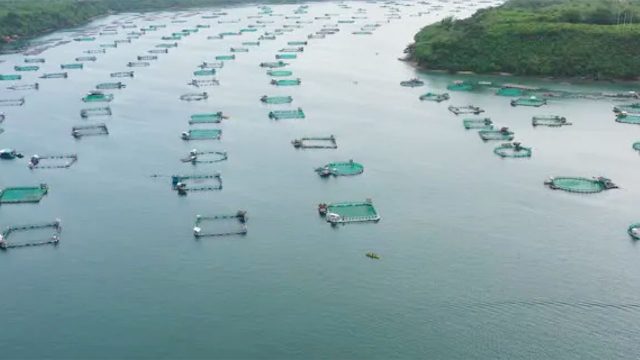
THE Bureau of Fisheries and Aquatic Resources (BFAR) said that it has completed nine multi-species hatcheries and aquaculture facilities, with 21 still under construction.

The department allocated P635 million for the construction of 37 hatcheries, and said it expects to complete construction by the end of 2022.

Under the Legislated Hatcheries Program, the project aims to meet the demand for aquaculture seed stock, reduce dependence on imported fry, and augment local production.

“Further, it aims to increase the variety of cultivable species in the country, promote species diversification, and provide venue for fisheries extension services,” the BFAR said.

The completed facilities include hatcheries in Perez, Quezon and Sultan Naga Dimaporo, Lanao del Norte, as well as mangrove seed banks and nurseries in Baras, Viga, Panganiban, Bagamanoc, San Andres, Caramoran, and Pandan, Catanduanes.

Meanwhile, the remaining legislated hatcheries under construction will include mangrove crab seed banks, nurseries, grow-out production farms and marine hatcheries in Catanduanes, Quezon, Albay, Cebu, Surigao del Norte, Surigao del Sur, Agusan del Norte, Lanao del Norte, and Sultan Kudarat.

Training and development centers are currently in development in the Eastern Visayas.

The Southeast Asian Fisheries Development Center/Aquaculture Department has partnered with the BFAR to prepare feasibility studies, provide assistance in identifying suitable sites and in designing the facilities. — Luisa Maria Jacinta C. Jocson

How can accounting relate to climate change?

There has been an increased public focus on the harmful effects of climate change, with practices and reforms continuously being developed and implemented globally to reduce its negative impact. Because of this, some industry players are taking steps to address climate change, such as utility companies focusing on renewable energy investment, financial institutions expanding their portfolios to include green bonds, and private entities investing in technologies to conserve resources.

Regulators have also been taking steps to address climate change. For instance, the Philippine Securities and Exchange Commission (SEC) issued Sustainability Reporting Guidelines for Publicly Listed Companies (PLCs) in 2019 to help PLCs better assess and manage their non-financial performance across the economic, environmental, social and governance (ESG) aspects of their organizations. Similarly, the International Financial Reporting Standards (IFRS) Foundation also established the International Sustainability Standards Board (ISSB) to develop sustainability reporting standards that will provide a high-quality, comprehensive baseline of ESG information.

It is to be expected that in the years to come, climate change will have an even more significant impact on the way entities do business. Because of the potential impact of climate change and the continuing drive to manage it, various entities are facing the challenge of adopting these new practices and reforms in anticipation of how they will eventually impact their financial statements.

CONSIDERING CLIMATE CHANGE IN FINANCIAL STATEMENTS
Currently, there is no specific accounting standard or guidance in the Philippines that deals directly with climate change matters. However, entities are still expected by regulators and stakeholders to explain how climate change is considered in their financial statements in a way where its impact is material or significant from a qualitative perspective. They need to disclose how climate change may impact the significant assumptions, judgments and estimates used in preparing their financial statements. Entities also need to ensure that the information from the financial statements agrees with the information provided to the stakeholders and general public through publications and press releases.

Given these, we cite some accounting standards that entities may revisit in preparing their financial statement in consideration of the impact of climate change.

GOING CONCERN
The Philippine Accounting Standard (PAS) 1, Presentation of Financial Statements, provides that an entity shall prepare financial statements on a going concern basis unless management either intends to liquidate the entity, to cease trading or has no realistic alternative but to do so. When management is aware of material uncertainties related to events or conditions that may cast significant doubt upon the entity’s ability to continue as a going concern, the entity is required to disclose those uncertainties.

Risks coming from climate change may be a source of material uncertainty to some entities due to its potential impact on their future business activities, such as bank financing restrictions. Accordingly, entities need to revisit the impact of climate change on their financial statements particularly on their judgment to continue as a going concern and related disclosures pertaining to material uncertainties.

Furthermore, entities will need to consider how natural resources issues that are necessary for their operations, such as waste management, water, and energy, will affect their ability to continue as a going concern.

INVENTORY
According to PAS 2, Inventories, inventory shall be measured at the lower of cost and net realizable value. Given the developments brought by climate change, entities need to assess whether inventory has become less profitable or obsolete as the cost may not be recoverable if the inventory is damaged by climate disturbances, if it has become wholly or partially obsolete, or if selling prices have declined.

PROPERTY, PLANT AND EQUIPMENT
PAS 16, Property, Plant and Equipment discusses how entities should measure, recognize and disclose information on property plant and equipment. Changes in the economic and legal environment coming from the societal pressures and legislation may affect how entities measure, recognize and disclose information on property plant and equipment. This is due to the potential impacts on the useful life, residual value, designs, technology and decommissioning of property, plant and equipment.

Given the uncertainty, entities need to consider how the measurement and recognition principles in accounting for the entities’ transactions, events and conditions will be impacted by these changes and how disclosures can be enhanced to allow the users of financial statements to better understand the judgments made by entities on their property, plant and equipment.

IMPAIRMENT OF ASSETS
PAS 36, Impairment of Assets requires an entity to assess at the end of each reporting period whether there is any indication that an asset may be impaired. If any such indication exists, the entity is required to estimate the recoverable amount of the asset. Action from governments and public awareness on climate change may drive impairment indicators.

For example, a government may require entities to focus on new products and technologies that will conserve resources, potentially resulting in a significant decline in the value of the entity’s existing assets. If the public has already been consciously investing in entities with climate change initiatives, investors may withdraw their support from entities who are not concerned with such initiatives. It can also result in adverse changes to the technological environment of an entity, which may result in the obsolescence of its assets. These may also affect forward-looking information, such as cash flow projections in estimating the recoverable amount of an entity’s assets.

Due to this, entities may need to consider how the impairment indicators will affect the measurement of their assets, including relevant disclosures on assumptions, judgments and estimates.

PROVISIONS
PAS 37, Provisions, Contingent Liabilities and Contingent Assets requires that provisions need to be recognized when: (1) an entity has a present obligation (legal or constructive) as a result of a past event; (2) it is probable that an outflow of resources embodying economic benefits will be required to settle the obligation; and (3) a reliable estimate can be made of the obligation.

New legal requirements and laws, decommissioning and asset retirement obligations and legal claims in response to climate change may give rise to new obligations that may lead to a potential significant impact on the recognition and measurement of provisions. Due to the significant uncertainty, entities need to consider the adequacy of the disclosures in how they incorporate climate change risks in recognizing and measuring their provisions.

ASSESSING THE IMPACT OF CLIMATE CHANGE
The items cited in the foregoing are based on general accounting considerations and are not inclusive of everything that entities should consider. Since each entity’s business, operations and situation are unique, each entity will need to apply significant judgment and analysis of relevant facts and circumstances to reasonably assess the impact of climate change.

As the global conversation between and among businesses, consumers and regulators grows increasingly dynamic, entities will need to proactively consider how the risks from climate change may affect not only their operations but also their financial statements. More importantly, they will also need to consider potential solutions to the climate change disruptions that are happening now and those that are emerging — before it’s too late.

This article is for general information only and is not a substitute for professional advice where the facts and circumstances warrant. The views and opinions expressed above are those of the author and do not necessarily represent the views of SGV & Co.


Anna Maria Rubi B. Diaz is a senior director from the Financial Accounting Advisory Services (FAAS) service line of SGV & Co.

OCTA cites continued drop in COVID-19 infections

PHILIPPINE STAR/ MICHAEL VARCAS

By Kyle Aristophere T. Atienza, Reporter

DAILY coronavirus infections in the Philippines might drop to 4,000 by mid-February and to as low as 1,000 by the end of the month, according to researchers from the country’s premier university.

Daily infections in Manila, the National Capital Region (NCR) might return to the pre-Omicron surge level by the end of February if the decline continues, OCTA Research Group fellow Fredegusto P. David tweeted at the weekend.

The national average daily cases hit 8,442 on Feb. 1 to 5, he said.“The number of new COVID-19 cases around the country continues to decrease.”

The average daily cases fell to 17,025 on Jan. 25 to 31 from 28,666 a week earlier and 34,958 two weeks earlier, he added.

He also said the virus reproduction number had fallen to 0.55 as of Feb. 2 from 0.93 on Jan. 26.

Mr. David said the seven-day positivity rate in the Philippines had gone down to 25% from 34%, while the country’s hospital bed occupancy rate was down to 40% from 49%. 

Of the 7,689 cases on Saturday, 877 came from Metro Manila. The capital region reported 1,535 cases on Feb. 4, but Mr. David said that “a high percentage of this was due to a backlog.”

The Department of Health (DoH) reported 8,361 coronavirus infections on Sunday, bringing the total to 3.6 million.

The death toll hit 54,526 after 312 more patients died, while recoveries rose by 18,431 to 3.43 million, it said in a bulletin.

It said 21.5% of 38,675 samples on Feb. 4 tested positive for COVID-19, still above the 5% threshold set by the World Health Organization (WHO).

Of 126,227 active cases, 4,864 did not show symptoms, 116,598 were mild, 3,008 were moderate, 1,447 were severe and 310 were critical.

DoH said 79% of the latest cases occurred from Jan. 24 to Feb. 6. The top regions with new cases in the past two weeks were Metro Manila with 863, the Davao region with 683 and Western Visayas with 657. It added that 25% of new deaths occurred in February and 18% in January.

The agency said 264 duplicates had been removed from the tally, 194 of which were recoveries, while 243 recoveries were relisted as deaths. Two laboratories failed to submit data on Feb. 4.

It said 42% of intensive care unit beds in the country had been used, while the rate for Metro Manila was 35%.

The Philippines and other countries have started easing lockdowns amid hopes that the highly mutated Omicron variant, which was first detected in South Africa, might have peaked.

The country is set to allow the entry of fully vaccinated nationals of non-visa countries starting Feb. 10, almost two months after it suspended a plan to welcome back foreign tourists due to the threat of the Omicron variant. 

Mr. David said a potential influx of foreign travelers might lead to another spike. ”Spikes in cases could happen but this is dependent mostly on a new variant,” he said in a Facebook Messenger chat. 

The World Health Organization has said some countries with high immunity rates, strong healthcare systems and decreasing coronavirus infections and deaths could now consider easing restrictions, according to a report by the Los Angeles Times.

The Philippines is scrambling to vaccinate more people as it reopens the economy.

It had fully vaccinated 59.81 million people as of Feb. 4, while almost 60.66 million have received their first dose, data from the Health department showed. More than eight million booster shots have been given out.

COVOVAX
Meanwhile, local drug distributor Faberco Life Sciences, Inc. has submitted to Philippine authorities the data to allow the use of the COVID-19 vaccine made by Serum Institute of India for children aged 12 to 17.

“This could help the government increase the coverage rate and achieve the overall goal of 90% covid vaccination rate nationwide,” Luningning Villa, the company’s medical director, said in an e-mailed statement.

Covovax, which is produced by the Serum Institute under license from Novavax, Inc., is the first protein subunit vaccine that was authorized for emergency use in the Philippines in November.

Protein subunit vaccines pick out only specific fragments of a virus to trigger an immune response, Faberco said.

“These protein fragments can neither replicate, nor can it cause COVID-19,” it said, noting that the technology in Covovax has been used for years in some vaccines for hepatitis B, shingles and whooping cough, and has been proven harmless and safe.

Covovax is 90.4% effective against the coronavirus and offers 100% protection against moderate and severe disease, Faberco said.

It is 93.2% effective against the predominantly circulating variants of concern and variants of interest, and 91% effective in seniors and seriously ill people, it added.

The vaccine is expected to be available in the country next month.

Undecided voters could be swayed by debates — analysts

By John Victor D. Ordoñez and Jaspearl Emerald G. Tan

PRESIDENTIAL candidates should join debates and forums where they can make a stand on issues and influence undecided voters for this year’s elections, political analysts said at the weekend.

“It may be less about substance and more about demeanor,” Herman S. Kraft, an associate professor who heads the University of the Philippines (UP) Political Science department, said in a Viber message. “Regardless, voters seeking answers can get some inputs from these debates.”

He said candidates rarely give concrete plans at these events, but their confidence could rub off on voters the right way.

At least two presidential interviews and forums where candidates squared off have been aired, both of which former Senator Ferdinand “Bongbong” R. Marcos, Jr. did not attend. He alleged bias of the journalist in the first and a conflict of schedule in the second.

“Forums and debates are the real litmus test to know the candidates well, their passion, conviction and dedication to public  service,” Marlon M. Villarin, a political science professor from the University of Santo Tomas, said in a Viber message.

But forums and debates are not the be-all and end-all of winning voters, said Gerard V. Eusebio, a political science professor at De La Salle University.

“These fora are not too crucial because the majority of voters, the lower classes, do not watch these,” he said in a Facebook Messenger chat. “But it is better than nothing.”

The Commission on Elections (Comelec) is holding its own presidential debates between February and April.

Mr. Villarin said the Comelec presidential debates would be more engaging because they will be face-to-face.

“It’s very important for these debates to be face-to-face because the body language and mannerisms of candidates could be deciphered more and their true characters will be revealed,” he said.

Comelec spokesman James B. Jimenez last week said that if a candidate fails to make it, their designated podium will be kept to highlight the absence. “We will really make a big deal of it if a candidate does not attend,” he told reporters.

The campaign period for national positions starts on Tuesday and will run until May 7, two days before the elections.

Meanwhile bills that seek to prohibit political dynasties are bound to fail because many congressmen belong to these powerful families, political analysts said.

“It would affect most members, particularly the House of Representatives,”Mr. Kraft said in another Viber message.

Hansley A. Juliano, a political analyst from the Ateneo de Manila University, said the country had been ruled by clans even before it claimed independence.

“Recent attempts at anti-dynasty bills are doomed to fail,” he said in a Messenger chat, adding that ousting one dynasty results in new ones.

“Even making a distinction between fat dynasties and thin dynasties might be difficult to implement: after all, once power and wealth gravitate, it’s difficult to either let go or disperse,” he added.

Only a strong president could ensure the passage of a law against political dynasties, said Antonio Gabriel M. La Viña, dean of the Ateneo School of Government.

“There are many members — perhaps a majority of them — of Congress who come from dynasties,” he said in a Viber message. “They have obstructed any progress on this.”

“Only a strong president could get this done but the last four — Joseph E. Estrada, Gloria Macapagal Arroyo, Benigno S.C. Aquino III and Rodrigo R. Duterte — also belonged to dynasties,” he added.

Mr. Juliano said people should not vote for candidates from dynasties. “By voting for new candidates with zero or limited ties to political families, you legislate anti-nepotism and anti-dynasty laws.”

The government must guarantee equal access to opportunities for public service and prohibit political dynasties “as may be defined by law,” according to the 1987 Constitution.

Various bills against political dynasies were filed in both Houses of Congress in the past, but these never progressed.

Plastics industry says waste management law amendments not needed to address disposal problems

THE PHILIPPINE Plastics Industry Association (PPIA) said amending the country’s waste management law is not necessary to adopt established plastic disposal solutions such as waste-to-energy facilities. 

PPIA President Danny Ngo said Republic Act (RA) No. 9003 or the Ecological Solid Waste Management Act, approved in Jan. 2001, should be “left untouched” as it is flexible in terms of new waste technologies.   

“RA 9003 should be left untouched and should not be amended. The PPIA firmly believes that RA 9003 is flexible in adopting such technologies which do not require amending the law. Its mandate is more on the management of solid waste entering the sanitary landfill,” Mr. Ngo said in a statement. 

He said various waste-to-energy technologies have long been in use by developed countries to address plastic waste.

“Many environment-sensitive countries in Europe, the US, Japan, even neighbor Singapore have been adopting this technology for decades now, significantly curbing their waste residual problem and at the same time boosting their power supply,” he said. 

The PPIA statement comes after the two chambers of Congress recently approved on third and final reading their respective bills seeking to amend RA 9003. 

Senate Bill 2425 seeks to institutionalize extended producer responsibility (EPR), which would give accountability to companies for the appropriate and effective recovery, treatment, recycling, or disposal of their products after being sold and used by consumers. 

These companies include producers, manufacturers, and importers of consumer goods that use plastic packaging.

Aside from institutionalizing EPR, House Bill 10696 proposes that companies be mandated to establish programs to reduce their production, use, and importation of plastic products.

The bill will also require the creation of a national framework for all types of product wastes to lessen trash that is detrimental to the environment. — Revin Mikhael D. Ochave 

Solon files resolution seeking incentives for green businesses — big and small

BW FILE PHOTO

A RESOLUTION that seeks to assess incentives that can be given to businesses, whether big or small, that adopt environment-friendly practices has been filed in the House of Representatives.

House Resolution 2483, filed by Las Piñas Rep. Camille A. Villar last week, called on various committees to evaluate and propose legislative measures on how government can provide support to large corporations as well as micro, small, and medium enterprises (MSMEs) that take initiatives to help protect the environment.

“When I filed the resolution, I am considering incentives in the form of tax holidays, in the form of deductibility of expenses and duty-free tariff on major equipment, tools and machineries… or any other fiscal incentives that may be accorded by the government considering that green industries are sunshine industries,” she told BusinessWorld in a Viber message. 

“Also, a faster lane in the processing of permits and similar dossiers in regular government (departments) or LGUs (local government units) for those (who) engage in this sector,” she added.

With government support, she said, these industries will be able to generate more jobs and contribute further to post-pandemic economic recovery while helping address pollution, waste, and climate change threats.  

“While consumers need to be fully aware of the need and importance of buying sustainable items, entities must be rewarded for employing eco-friendly methods in order to reduce their cost and result in lower prices,” the resolution said. — Jaspearl Emerald G. Tan

IDIS calls on Davao City gov’t to reinforce new protection rules for water source area

IDIS

ENVIRONMENTAL protection advocacy group IDIS called on the Davao City government to strengthen the enforcement of new local laws after a recent clean-up drive at the Panigan-Tamugan Watershed generated sacks of plastics and other non-biodegradable wastes. 

“Despite our persistent call, the number of collected wastes is not decreasing,” non-profit organization Interfacing Development Interventions for Sustainability (IDIS) said in a statement last week.

The Panigan-Tamugan Watershed is an upcoming water source for Davao City’s growing demand through a bulk supply project by Apo Agua Infrastructura, Inc. 

The Aboitiz-led firm is expected to start operating the facility this year, which will supply over 300 million liters per day to the city’s water distributor. 

“Last year of the same month, volunteers collected six sacks of mixed wastes. And while the policies protecting the watershed area are in place, strict implementation is still a challenge,” said IDIS.

Most of the accumulated waste was single-use plastics, face masks, various plastic containers, and soiled diapers. 

IDIS staff are among the members of the monitoring Bantay Bukid, along with communities around watershed areas and other volunteers such as students.

The Davao City government, which provides support to the Bantay Bukid, passed ordinances last year banning single-use plastics and the regulation of recreational activities within watershed areas.

Under the rules, single-use plastic products such as drinking cups, condiments containers, cutlery, balloon sticks, and hand gloves are no longer allowed to be sold, used, or distributed in the city. 

The multi-sector Watershed Management Council also passed two resolutions last year containing guidelines on trekking and other recreational in protected areas. 

IDIS underscored that barangay or village-level leaders should be at the forefront of managing recreational as well as agri-business activities within their jurisdictions to ensure the protection of rivers and the overall watershed area. — Maya M. Padillo 

SC disqualifies bar examinees for violating rules, ‘Honor Code’

SC PUBLIC INFORMATION OFFICE

THE SUPREME COURT (SC) has disqualified several bar examinees for violating rules and the “Honor Code,” the exams chair announced Sunday, the last of the two-day written test for aspiring lawyers. 

Justice Marvic M.V.F Leonen, who heads the Office of the Bar Chairperson, said among the violations include withholding information on previously testing positive for coronavirus, using a mobile phone inside the examination room; and accessing social media during lunch break inside the testing venues.

“I take my constant message of honor to the examinees seriously. I owe it not only to those who risked their lives just to make the 2020/21 Bar examinations but most especially to those examinees who could have taken the Bar examinations were it not for their positive COVID-19 test results,” Mr. Leonen said in a statement. 

There were 219 applicants who were unable to take the exams after testing positive for coronavirus disease 2019 (COVID- 19). Bar takers were required to undergo an antigen test Friday, the first day of the exam. 

Those disqualified are still eligible to take future bar exams.

About 11,000 examinees took the bar exams in 31 testing sites across the country on the first day, Mr. Leonen said in a press briefing Friday. 

“The examinees this year will fill the lack of lawyers we’ve had over the past two years because of the pandemic,” he said. — John Victor D. Ordoñez 

Quiboloy lawyer questions timing of ‘most wanted’ poster released by US FBI

FBI.GOV

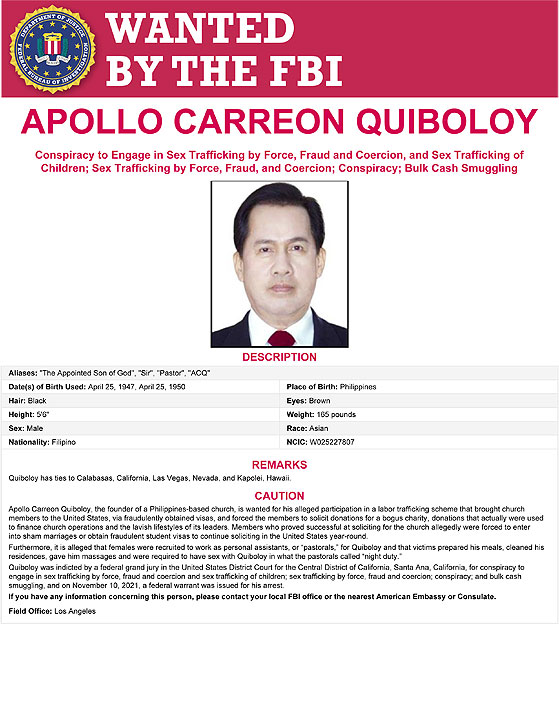
THE LAWYER of religious leader Apollo C. Quiboloy, who has been indicted for sex trafficking and bulk cash smuggling among other charges in a United States court, questioned the timing of the release of a “most wanted” poster on the accused by the US Federal Bureau of Investigation last week. 

Ferdinand S. Topacio, who was hired by Mr. Quiboloy to handle the cases, said in a virtual press conference on Sunday that the publication of the poster on FBI’s official website is being used to tarnish President Rodrigo R. Duterte’s reputation.

Mr. Quiboloy, known as a long-time friend and spiritual adviser of the President, was indicted in a California district court on Nov. 10, 2021 and a federal warrant has been issued for his arrest.

Mr. Topacio maintained that the charges, including forcing women as young as 12 to have sex with the religious leader, are fabricated. Two associates are also named in the cases.

“They are polluted witnesses who are disgruntled members with axe to grind against the pastor,” Mr. Topacio said of the victims. 

The lawyer said the timing may be a “distraction and an issue” against Mr. Duterte’s administration as the May 2022 elections near, in which the US might be interfering. 

Asked what Washington would gain from “destroying” the President in his last few months in Malacañang, Mr. Topacio said it may be to undermine the vice-presidential run of Mr. Duterte’s daughter, Sara, and the candidacy of her running-mate Ferdinand “Bongbong” R. Marcos, Jr. 

Mr. Quiboloy publicly endorsed the Marcos-Duterte tandem last week in his home base Davao City.

Mr. Topacio also warned the public that “any libelous statements” against Mr. Quiboloy will be “dealt with to the fullest extent of the law.” 

“No one should underestimate our resolve to protect the interests of Pastor Quiboloy.” 

The US and the Philippines have an extradition treaty that was signed In Nov. 1994. 

Gabriela Women’s Party Rep. Arlene D. Brosas, meanwhile, asked the Justice department to issue a hold departure order against Mr. Quiboloy “while the extradition request remains pending.”

The Justice department may issue a hold order to monitor any attempt of a “wanted” individual to leave the country. — Kyle Aristophere T. Atienza

Lacson plans to align national and local budget priorities

SENATOR Panfilo “Ping” M. Lacson, Sr. plans to address what he called a disconnect between national and local government budget priorities if he wins the presidency in the May elections.

“The reason why the problem is so large is due to the lack of consultation with the countryside and the LGUs (local government units),” he said in a mix of English and Filipino in an interview with DZRH News on Saturday. 

The presidential candidate, under his platform for governance, has been stressing his plan for budget reforms in both the preparation and implementation stages.

“For budget preparation, there’s a lot to be desired,” he said. He pointed out that fund ceilings set by the Development Budget Coordination Committee limits agencies and forces them to “rush and intended beneficiaries are not consulted.” 

“This is what we will change,” he said, vowing to push for zero-based budgeting where each department will have leeway to present and justify as many priority projects, programs, and activities. 

He also said insertions by lawmakers during the budget review are usually done without closely discussing feasibility with implementers on the ground, which leaves unused government funds by the end of the year. 

Mr. Lacson cited that from 2010 to 2020, the average unused funds amounted to P328 billion. 

“You are unable to implement this because you don’t know, you are not who made the plan,” he said.

The senator said under his administration, he will seek involvement of members of civil society organizations, non-government organizations, and town-level development councils as resource persons during budget committee hearings. 

Meanwhile, Mr. Lacson on Sunday denied a report by the Philippine Center for Investigative Journalism (PCIJ) that he ran some P915 million worth of media ads in 2021. 

“I asked my campaign team, volunteers, and supporters about this. They insisted that they never saw, much less had this much money. No way we could have spent what we didn’t have,” he said on Twitter.

The PCIJ said it based the amounts on published rate cards “before discounts were given to his campaign team.” — Alyssa Nicole O. Tan

If Russia takes Ukraine, insurgency could be Putin’s nightmare

VALERY TENEVOY/UNSPLASH

IF RUSSIA invades Ukraine, President Vladimir Putin will face an immediate and difficult choice: how far to go. Most analysts believe he will probably move forward with an invasion, but is likely to have his military stop within the pro-Russian enclaves of southeastern Ukraine. This would allow him to declare independence for the Donbas region and secure a “land bridge” from Russia proper to its annexed territory in Crimea.

But what if he decides to drive to Kyiv, and overturn the democratically elected government of President Volodymyr Zelenskiy? Putin has positioned enough firepower on the border — troops, tanks, missiles — as well as naval and cyberwarfare assets to conduct a shock-and-awe campaign similar to the 2003 US invasion of Iraq.

This is something the US and Western allies are thinking about seriously. In the aftermath of such a total invasion, would there be a strong Ukrainian resistance movement? And what would the West do to support it?

In my visits to Ukraine as the North Atlantic Treaty Organization’s military commander, I found its troops and government officials to be fiercely proud of their language, heritage, and national sovereignty. Ukrainian troops deployed to Afghanistan under my command, and also participated in several other NATO missions. What they may have lacked in training and equipment they made up through determination and toughness.

The Ukrainian collective memory stretches back through many involvements with Russian troops in the interwar years of the 20th century, during the famines and fighting of World War II, and during the Cold War years of the Soviet Union. As Timothy Snyder points out in his book Bloodlands, the Ukrainians suffered greatly and at the hands of Russians over the past century. They can and will fight. And the Western democracies can help.

The US has been on both sides of insurgencies, of course. It fought a long war in Vietnam that it ultimately lost to the North Vietnamese and Viet Cong. More recently, the Taliban simply outlasted US patience in Afghanistan.

On the other hand, Washington supported a successful insurgency, ironically, against the Soviets during their occupation of Afghanistan — American Stinger missiles may have been the key technology that helped turn the tide. Allied support to the French resistance in World War II was a crucial element in undermining German control over the population in the months leading up to D-Day.

This kind of support can be done clandestinely, led by the Central Intelligence Agency. But in the situation of a democracy overrun by an authoritarian neighbor, there seems little value in hiding the ball. If the US makes the decision that it will support a potential Ukrainian resistance movement, it should be laying the groundwork immediately, while Russian tanks are still parked on the other side of the border.

This means getting supplies into the hands of Ukrainian special forces, who would be a central part of such a resistance force. They would need the ability to move out of the population centers, organize and live off the land, communicate collectively, and, above all, inflict damage on the occupiers.

This implies a need for transportable explosives, light but lethal handheld missiles to use against Russian tanks and close-air support, and plenty of conventional ammunition and hardware including sniper rifles, high-end optical sights and night vision devices. Cyberwarfare support would be a must. And trainers in-country — both military and CIA.

One key would be for the Zelenskiy government to get out of Kyiv before the Russians consolidated control. The government-in-exile should be welcomed in a NATO capital, and provided full support from the alliance administratively and diplomatically. It should continue to function via its system of ambassadors worldwide, and communicate effectively with the resistance leadership within the country. The model of Charles de Gaulle’s Free French government — despite occasionally being a challenge to the World War II allies — would be suitable.

And much as the mujahideen of the 1980s gradually turned Afghanistan in a killing field for Russian troops, so could a well-armed and supported resistance force make Ukraine a very deadly experience. This would entail cutting Russian supply lines, targeting senior officers, destroying Russian heavy equipment, using cybertools to damage Russian command and control, and rallying the populace for civil resistance (strikes, shop closures, and transportation shutdowns).

No one wants to see an invasion of Ukraine, and we should all hope diplomacy and common sense will prevail. And if Putin chooses to unleash his forces, it’s likely they will be limited to the southeast of the country.

But combat has a way of getting out of control, of climbing the ladder of escalation. If Russian tanks roll across the Dnieper River to the capital, Ukrainians will fight — and a powerful resistance movement may be the best hope. The West should preparing now to help.

BLOOMBERG OPINION

ADVERTISEMENT
ADVERTISEMENT