Home Blog Page 6846

Quiboloy lawyer questions timing of ‘most wanted’ poster released by US FBI

FBI.GOV

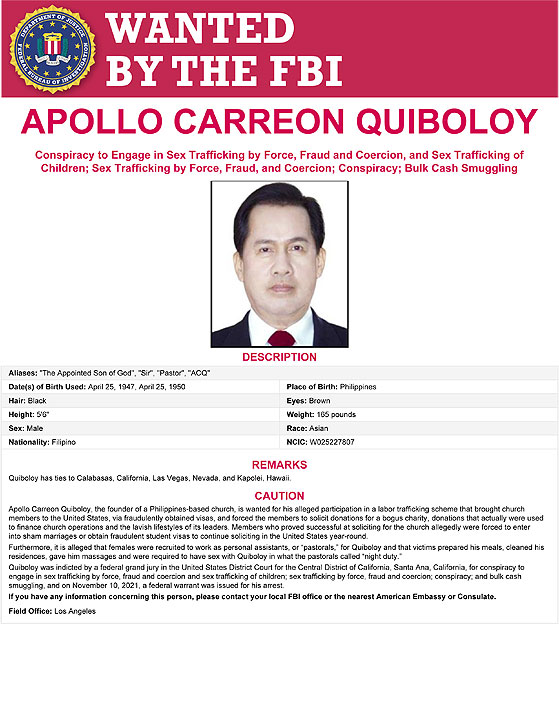
THE LAWYER of religious leader Apollo C. Quiboloy, who has been indicted for sex trafficking and bulk cash smuggling among other charges in a United States court, questioned the timing of the release of a “most wanted” poster on the accused by the US Federal Bureau of Investigation last week. 

Ferdinand S. Topacio, who was hired by Mr. Quiboloy to handle the cases, said in a virtual press conference on Sunday that the publication of the poster on FBI’s official website is being used to tarnish President Rodrigo R. Duterte’s reputation.

Mr. Quiboloy, known as a long-time friend and spiritual adviser of the President, was indicted in a California district court on Nov. 10, 2021 and a federal warrant has been issued for his arrest.

Mr. Topacio maintained that the charges, including forcing women as young as 12 to have sex with the religious leader, are fabricated. Two associates are also named in the cases.

“They are polluted witnesses who are disgruntled members with axe to grind against the pastor,” Mr. Topacio said of the victims. 

The lawyer said the timing may be a “distraction and an issue” against Mr. Duterte’s administration as the May 2022 elections near, in which the US might be interfering. 

Asked what Washington would gain from “destroying” the President in his last few months in Malacañang, Mr. Topacio said it may be to undermine the vice-presidential run of Mr. Duterte’s daughter, Sara, and the candidacy of her running-mate Ferdinand “Bongbong” R. Marcos, Jr. 

Mr. Quiboloy publicly endorsed the Marcos-Duterte tandem last week in his home base Davao City.

Mr. Topacio also warned the public that “any libelous statements” against Mr. Quiboloy will be “dealt with to the fullest extent of the law.” 

“No one should underestimate our resolve to protect the interests of Pastor Quiboloy.” 

The US and the Philippines have an extradition treaty that was signed In Nov. 1994. 

Gabriela Women’s Party Rep. Arlene D. Brosas, meanwhile, asked the Justice department to issue a hold departure order against Mr. Quiboloy “while the extradition request remains pending.”

The Justice department may issue a hold order to monitor any attempt of a “wanted” individual to leave the country. — Kyle Aristophere T. Atienza

Lacson plans to align national and local budget priorities

SENATOR Panfilo “Ping” M. Lacson, Sr. plans to address what he called a disconnect between national and local government budget priorities if he wins the presidency in the May elections.

“The reason why the problem is so large is due to the lack of consultation with the countryside and the LGUs (local government units),” he said in a mix of English and Filipino in an interview with DZRH News on Saturday. 

The presidential candidate, under his platform for governance, has been stressing his plan for budget reforms in both the preparation and implementation stages.

“For budget preparation, there’s a lot to be desired,” he said. He pointed out that fund ceilings set by the Development Budget Coordination Committee limits agencies and forces them to “rush and intended beneficiaries are not consulted.” 

“This is what we will change,” he said, vowing to push for zero-based budgeting where each department will have leeway to present and justify as many priority projects, programs, and activities. 

He also said insertions by lawmakers during the budget review are usually done without closely discussing feasibility with implementers on the ground, which leaves unused government funds by the end of the year. 

Mr. Lacson cited that from 2010 to 2020, the average unused funds amounted to P328 billion. 

“You are unable to implement this because you don’t know, you are not who made the plan,” he said.

The senator said under his administration, he will seek involvement of members of civil society organizations, non-government organizations, and town-level development councils as resource persons during budget committee hearings. 

Meanwhile, Mr. Lacson on Sunday denied a report by the Philippine Center for Investigative Journalism (PCIJ) that he ran some P915 million worth of media ads in 2021. 

“I asked my campaign team, volunteers, and supporters about this. They insisted that they never saw, much less had this much money. No way we could have spent what we didn’t have,” he said on Twitter.

The PCIJ said it based the amounts on published rate cards “before discounts were given to his campaign team.” — Alyssa Nicole O. Tan

If Russia takes Ukraine, insurgency could be Putin’s nightmare

VALERY TENEVOY/UNSPLASH

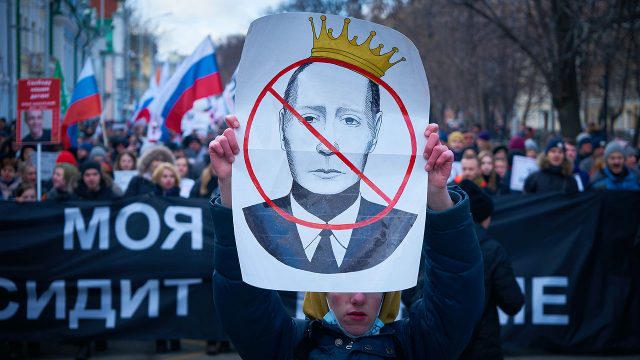
IF RUSSIA invades Ukraine, President Vladimir Putin will face an immediate and difficult choice: how far to go. Most analysts believe he will probably move forward with an invasion, but is likely to have his military stop within the pro-Russian enclaves of southeastern Ukraine. This would allow him to declare independence for the Donbas region and secure a “land bridge” from Russia proper to its annexed territory in Crimea.

But what if he decides to drive to Kyiv, and overturn the democratically elected government of President Volodymyr Zelenskiy? Putin has positioned enough firepower on the border — troops, tanks, missiles — as well as naval and cyberwarfare assets to conduct a shock-and-awe campaign similar to the 2003 US invasion of Iraq.

This is something the US and Western allies are thinking about seriously. In the aftermath of such a total invasion, would there be a strong Ukrainian resistance movement? And what would the West do to support it?

In my visits to Ukraine as the North Atlantic Treaty Organization’s military commander, I found its troops and government officials to be fiercely proud of their language, heritage, and national sovereignty. Ukrainian troops deployed to Afghanistan under my command, and also participated in several other NATO missions. What they may have lacked in training and equipment they made up through determination and toughness.

The Ukrainian collective memory stretches back through many involvements with Russian troops in the interwar years of the 20th century, during the famines and fighting of World War II, and during the Cold War years of the Soviet Union. As Timothy Snyder points out in his book Bloodlands, the Ukrainians suffered greatly and at the hands of Russians over the past century. They can and will fight. And the Western democracies can help.

The US has been on both sides of insurgencies, of course. It fought a long war in Vietnam that it ultimately lost to the North Vietnamese and Viet Cong. More recently, the Taliban simply outlasted US patience in Afghanistan.

On the other hand, Washington supported a successful insurgency, ironically, against the Soviets during their occupation of Afghanistan — American Stinger missiles may have been the key technology that helped turn the tide. Allied support to the French resistance in World War II was a crucial element in undermining German control over the population in the months leading up to D-Day.

This kind of support can be done clandestinely, led by the Central Intelligence Agency. But in the situation of a democracy overrun by an authoritarian neighbor, there seems little value in hiding the ball. If the US makes the decision that it will support a potential Ukrainian resistance movement, it should be laying the groundwork immediately, while Russian tanks are still parked on the other side of the border.

This means getting supplies into the hands of Ukrainian special forces, who would be a central part of such a resistance force. They would need the ability to move out of the population centers, organize and live off the land, communicate collectively, and, above all, inflict damage on the occupiers.

This implies a need for transportable explosives, light but lethal handheld missiles to use against Russian tanks and close-air support, and plenty of conventional ammunition and hardware including sniper rifles, high-end optical sights and night vision devices. Cyberwarfare support would be a must. And trainers in-country — both military and CIA.

One key would be for the Zelenskiy government to get out of Kyiv before the Russians consolidated control. The government-in-exile should be welcomed in a NATO capital, and provided full support from the alliance administratively and diplomatically. It should continue to function via its system of ambassadors worldwide, and communicate effectively with the resistance leadership within the country. The model of Charles de Gaulle’s Free French government — despite occasionally being a challenge to the World War II allies — would be suitable.

And much as the mujahideen of the 1980s gradually turned Afghanistan in a killing field for Russian troops, so could a well-armed and supported resistance force make Ukraine a very deadly experience. This would entail cutting Russian supply lines, targeting senior officers, destroying Russian heavy equipment, using cybertools to damage Russian command and control, and rallying the populace for civil resistance (strikes, shop closures, and transportation shutdowns).

No one wants to see an invasion of Ukraine, and we should all hope diplomacy and common sense will prevail. And if Putin chooses to unleash his forces, it’s likely they will be limited to the southeast of the country.

But combat has a way of getting out of control, of climbing the ladder of escalation. If Russian tanks roll across the Dnieper River to the capital, Ukrainians will fight — and a powerful resistance movement may be the best hope. The West should preparing now to help.

BLOOMBERG OPINION

Harm reduction or harm promotion? Prostitution, drugs and nicotine addiction

FREEPIK

What do prostitution, drugs, alcohol, and nicotine addiction have in common? They all demoralize and harm society. Since they cause harm, strict regulation is absolutely necessary.

Strict regulation, however, can take different forms. A persistent difficult behavior like engaging in prostitution, drugs, binge drinking or smoking may cause a government to use threats or coercion. Worse, the government resorts to criminalizing some activities like prostitution and drug use.

Criminalization of certain activities deemed harmful to society, however, can do more harm than good. The case of prohibition of alcohol in the United States in the last century stands out as a negative example of criminalizing an activity. The Prohibition may have discouraged alcohol drinking but did not eliminate it. Worse, it deepened criminality and violence, and made otherwise harmless people into criminals. The Prohibition was eventually lifted, an acknowledgement of a failed policy.

The appropriate policy is very contextual. In many cases, instead of criminalization, a better benign approach is harm reduction. But the concept of harm reduction can also be manipulated and distorted.

I first learned about harm reduction as an essential political tool during my college thesis writing class. A controversial topic got my interest after watching a Jay Taruc documentary regarding prostitution in the country. The current policy focusing on criminalizing and penalizing prostitutes is so anti-poor and discriminatory. Most of the victims are women from poor or hard-up families. Yet, making prostitution a crime has not ended the oldest profession in the world. Unfavorable economic conditions like the rise of unemployment make prostitution viable.

Having a progressive mindset, I thought: “Oo nga no, sex work is work.” So, for my political science thesis paper, I wrote about a harm reduction strategy to decriminalize adult prostitution, and at the same time combat the rising abuse cases, human trafficking, and prostitution of minors. I pushed for strict regulations that protected the rights and welfare of sex workers, not criminalization, which punished them.

Harm reduction is both a principle and practice with the aim of improving the safety of people who engage in potentially risky behavior. It is a strategy that is directed toward individuals or groups to mitigate or minimize the negative impact or effects associated with certain behaviors.

Sweden is one country that leads the way in harm reduction as applied to prostitution. Sweden introduced a law in 1995 that says that the “seller” of sexual services (or the prostitute) should not be punished. The result was a decline in unsafe, risky street prostitution by 50% since the law’s implementation until 2014. Violence against both female and male prostitutes also decreased by 20% and 25%, respectively, during the same period.

In the Philippine policy environment, harm reduction can also be used as an approach to prevent teenage pregnancy, drug abuse, and nicotine abuse, among others. But authorities prefer an iron-fist policy, and sideline harm reduction for some risky behaviors like prostitution and drug use.

Further, in some areas where harm reduction is ostensibly done, its use is superficial, or even deceptive. What happens then in this case is not harm reduction but harm promotion.

Take the case of President Rodrigo Duterte’s war on drugs. Its violent nature, leading to thousands being killed, contradicts the harm reduction objective. Moreover, the war against drugs has turned into a war against the poor. Most of the civilians killed or targeted in the anti-drug operations come from poor families and impoverished areas.

Near the end of his term, the President has acknowledged that his administration has not solved the drug menace. Recall that his campaign promise was to end the drug problem within the first year of his term.

A harm reduction strategy would have recognized that drug use could not be eliminated, and the important and realistic goal would have been substantially reducing the harm from drug abuse. This could have been done through having good healthcare and treatment facilities, having access to safer alternatives (for example, giving clean and safe needles to those already hooked on opioids), providing counseling and establishing support groups, etc.

A bolder harm reduction policy is to decriminalize drug use. The fact is, many of those using drugs are not habitual users. But when caught, they are sent to jail, making their lives more miserable. The majority of prison inmates are users of drugs, but they do not pose a threat to society. Why jail them? Such an iron-fist policy is ineffective to deal with drug abuse, and it actually results in harm promotion.

But the term “harm reduction” is also being used as a camouflage for harm promotion. Take the case of the Vape Bill, which Congress recently approved. It is packaged as a harm reduction strategy for nicotine abuse.

The proponents claim that vapes and e-cigarettes, most commonly known as electronic nicotine and non-nicotine delivery systems (ENDS/ENNDS) and heated tobacco products (HTPs), are a substitute for harmful cigarettes. The vape proponents say that vape use is harm reduction since vape products are less harmful than cigarettes. That can be true for smokers, even though the jury is out whether vaping is an effective smoking cessation tool.

But here’s the rub. The said bill relaxes the provisions of RA 11467. The existing law strictly regulates vapes, e-cigarettes, and heated tobacco products. It is thus deceptive to say that the new bill introduces harm reduction. There is already a law on vaping that is consistent with harm reduction, but the bill that intends to supplant the current rules will be a deregulation of vaping.

The vape bill, lowers the age of access to vapes and e-cigarettes from 21 years old to 18 years old; transfers regulatory jurisdiction from the Food and Drug Administration (FDA) to the Department of Trade and Industry (DTI); and reverses the ban on multiple flavors.

A Vera Files study says that these provisions in the bill have the intention of enticing the non-smokers, especially the youth, to purchase and use vape products. For instance, e-juices for vapes sold online are categorized under the “toys, games, and collectibles” section on e-commerce websites. Another indication that vaping is mainly targeted to non-smokers is the fact that some of the e-juice flavors, such as bubblegum, marshmallow, and “Yakult,” are being advertised as “beginner-friendly.”

Recall that harm reduction is meant to minimize adverse effects, in this case those associated with nicotine addiction. Introducing vaping to non-smokers or enticing them to do so cannot be called harm reduction. Vaping-related injuries are well-documented; yet legislators endorse vape use by relaxing the regulations. The vape bill is far from being a harm reduction strategy. It is for this reason that the medical associations (except for a handful of doctors defying their associations) want the President to veto the vape bill.

To conclude, much still has to be done for policy-makers, politicians and the public at large to understand and appreciate what harm reduction is.

Since harm reduction is principally a health issue, the health organizations, including the Department of Health (DoH), assume a leading role in the promotion of harm reduction. We must acknowledge the centrality of health practitioners in the decision-making process to shape public health policies, including those on harm reduction. That is why it does not make sense that the regulation of vape products is removed from DoH and transferred to the Department of Trade and Industry.

That said, harm reduction is a whole-of-society approach. The harm inflicted on prostitutes can be minimized by having institutions and policies that generate quality jobs and that provide robust social welfare programs. The harm suffered by drug users can be reduced by making social conditions less stressful, by creating civic spaces, and by giving communities and stakeholders ownership of local programs regarding drug and crime control.

Sadly, at present, we are far from the principle and practice of harm reduction. If it is used, it is done wrongly and even deceptively. What we have is not harm reduction but harm promotion.


Ella Iellamo does policy research and analysis for the public health program of Action for Economic Reforms (AER). AER is supporting the medical associations and civil society organizations in opposing the vape bill.


Interview no-show and the Marcos myths

FACEBOOK.COM/BONGBONGMARCOS

It was disappointing that Bongbong Marcos opted not to participate in Jessica Soho’s presidential interview last month. Although I am aware that he has much to avoid, I never thought of him as a man who would easily back down from public discourse. His refusal to participate confirmed two of my assumptions about him. First, that he is unable to defend his family’s wealth, human rights record, and his personal achievements in a serious interview. And second, that he would rather let trolls fight his wars for him through half-truths and disinformation.

What are the issues Marcos Jr. cannot seem to defend? What are the questions he is hesitant to answer?

Through well-produced videos, memes, and messages on social media, certain myths have formed about the presidency of Ferdinand Marcos and about Marcos Jr. himself. Some of these myths cannot be defended in an intelligent, fact-based interview.

Myth No. 1. That the 1970s, under martial law, was the golden era of the country. It was the era when the country was prosperous and when poverty did not exist.

Here are the facts. During the 21 years that Marcos was in charge, the economy grew by an average rate of only 3.8%. We were left behind by Thailand and Malaysia whose economies grew by 6-7%.

The peso depreciated from a strong P3.92 to one US dollar in 1965 to P19.99 in 1986 — a 500% loss in value; real wages (spending power) plummeted from P100/day in 1966 to just P27/day in 1986; per capita income increased by only three-fold over 21 years while it increased 10-fold in Thailand and Malaysia; unemployment was at 7.2% in 1965 and surged to 33% in 1986; poverty rates were at 7.2% in 1965 and rose to a staggering 44.2% in 1986.

By the time Marcos was ousted, the Philippines was among the poorest countries in Asia where per capita income was below that of Japan, Singapore, Brunei, Macau, Hong Kong, Taiwan, South Korea, Malaysia, the Maldives, Thailand, and even Mongolia.

We lost competitiveness in most of our industries. Martial law gave Marcos extraordinary legislative and executive powers which he used to sequester successful industrial companies such as those in auto manufacturing, steel mills, and textile mills. These companies were taken over by cronies, all of whom failed to sustain their profitability. The failure was due in one part to corruption and in another part to the sheer lack of management expertise. Marcos selected his cronies not for their talents but for their loyalty.

In agriculture, the cronies were made to establish monopolies to give the dictator absolute economic control of the sector. As court records indicate, Danding Cojuangco controlled the coconut industry, Juan Ponce Enrile controlled logging, and Roberto Benedicto controlled sugar. These industries eventually collapsed too.

The martial law era was not the golden years of the Philippines, rather, it was the time of our great fall from one of the richest countries in Asia to one of the poorest.

Myth No. 2. That the Marcos era was the heyday of infrastructure.

Here are the facts. With borrowed funds, Marcos established the Construction and Development Corporation of the Philippines (CDCP). While it is true that roads, bridges, and classrooms were built by the CDCP, large chunks of funds fell into personal pockets. It was the same story for the power sector, the housing sector, and the transport sector.

History further shows that the infrastructure projects were often over-engineered, designed to extract maximum commissions or kickbacks.

Prestige projects like the Cultural Center, the Coconut Palace, and Folk Arts Theatre gave the image of progress but yielded little or no economic returns. They were built to create an illusion of prosperity, all of which were funded by debt.

Speaking of debt — from a foreign debt of only $600 million when Marcos took office in 1965, foreign obligations increased 43X to an eye watering $26 billion by 1986. In October 1983, the Marcos government ran out of dollar reserves and had no option but to declare a debt moratorium. To keep the economy afloat, Marcos resorted to short term loans at high interest rates. By 1986, Our debts were so massive that debt service alone accounted for half of the country’s exports. This resulted in a currency crisis and the need to devalue the peso even more.

Economist agree that the Philippine economic collapse of the 1980s was due to Marcos’ debt-driven economic policy. The heavy debt load was also the reason why succeeding governments in the 1990s and early 2000s could not invest much on infrastructure and social services.

Myth No. 3. Marcos fought the Oligarchs.

The fact is, Marcos was the oligarch of oligarchs. In 1998, Imelda bragged in an Inquirer interview, and I quote: “We practically own everything in the Philippines, from electricity, telecommunications, airlines, banking, beer, tobacco, newspaper publishing, television stations, shipping, oil, mining, hotels and beach resorts, down to coconut milling, small farms, real estate and insurance.”

Successful companies were sequestered by Marcos from hard-working entrepreneurs. But because the Marcoses and their cronies had little management expertise, these companies eventually fell into bankruptcy. This is why the Philippines lost its economic competitiveness in multiple industries.

Myth No. 4. Marcos Jr. is the most prepared and the most trustworthy presidential candidate.

We all know that Marcos Jr. lied about his academic credentials, lied to the courts about his family’s ill-gotten wealth, lied about human rights abuses, and failed to file his income tax returns. How can a liar and a tax delinquent be considered trustworthy?

As for his governance abilities, the best reference is to look at Ilocos Norte. Marcos Jr. and his kin controlled Ilocos Norte for decades. Yet, it remains one of the poorest regions in the country where the majority live from hand to mouth. A quick look at NEDA statistics on regional GDP proves this. They have no world class industries to speak of. The Bangui wind farm, for which Marcos Jr. takes credit, was not built by him but by Northwind Power, an Ayala subsidiary.

Interviews and debates are meant to reveal the real mettle of a candidate. They are meant to clarify doubts and shed light on grey areas. By refusing to be interviewed, it is clear that Marcos Jr. prefers to live in the shadows — relying on trolls to propagate the myths.


Andrew J. Masigan is an economist

andrew_rs6@yahoo.com

Facebook@AndrewJ. Masigan

Twitter @aj_masigan

COVID backlash brews in Canada, sending warning across globe

REUTERS
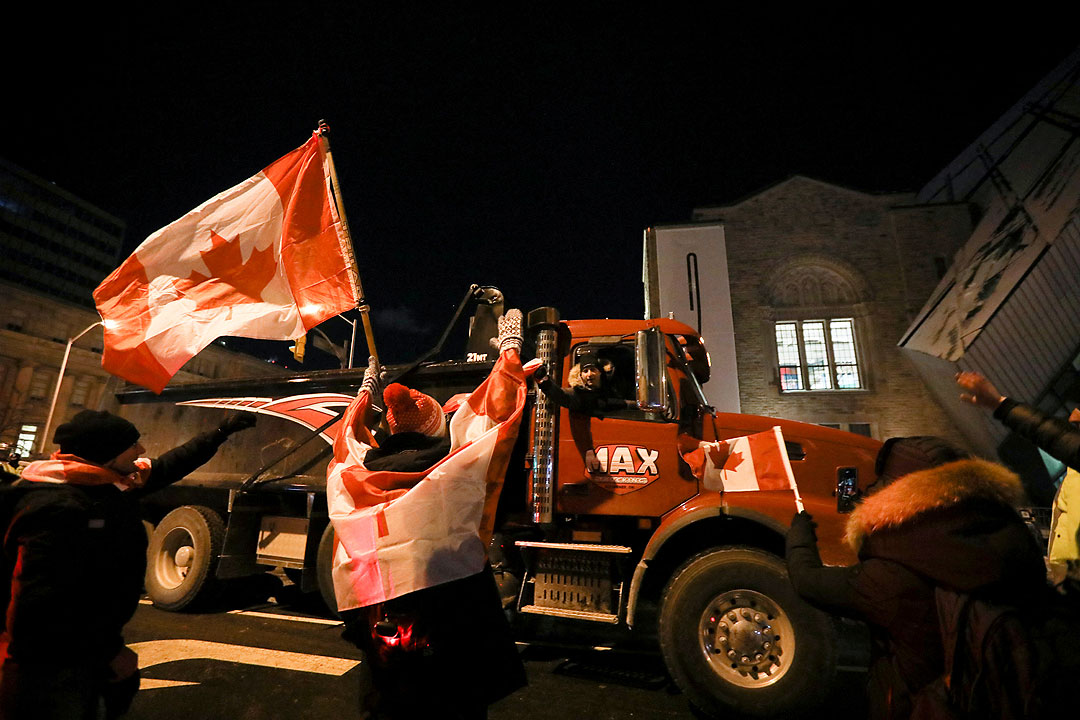
People gather in the streets during a protest by truckers and supporters against coronavirus disease (COVID-19) vaccine mandates, in Toronto, Ontario, Canada, Feb. 5. — REUTERS/CARLOS OSORIO

CANADIANS have done as they were told during the pandemic. They lined up for shots until the country had one of the developed world’s best vaccination rates; they endured some of North America’s longest lockdowns; and they’ve complied with a wide assortment of curfews and quarantines.

But even in a society known for its civility and deference to authority, many are reaching their limit.

Pent-up frustration and rage have burst into the downtown core of the nation’s capital, with hundreds of truckers and other protesters occupying Ottawa’s streets for nearly a week to oppose vaccine mandates. Protests are expanding across Canada this weekend and are threatening to spill over into the US with demonstrators planning a convoy to Washington, D.C.

The group in Canada has been championed on Fox News and by podcaster Joe Rogan, Tesla billionaire Elon Musk and former President Donald Trump. Demonstrators have started to build makeshift shelters and collect propane tanks, vowing to stay until vaccine mandates are lifted.

The populace may disapprove of their un-Canadian-like antics, but there is a growing sense of support for a message they’re delivering — that strict COVID restrictions no longer make sense. The protests have been the talk of the nation, around dinner tables, on talk shows and social media. And they serve as a warning shot not just to Prime Minister Justin Trudeau but to leaders everywhere: If even Canada is starting to resist pandemic measures, what does that mean for the rest of the world?

“People are starting to ask, what is the point or what is the efficacy of these restrictions?’” said Shachi Kurl, president of the Angus Reid Institute, a research firm in Vancouver.

A late January poll by the institute found 54% of Canadians want to end restrictions and let people self-isolate if they’re at risk. That was up 14 percentage points from just a few weeks earlier. Omicron, a variant that’s highly infectious but appears less likely to cause serious illness, has changed the perception of risk, Ms. Kurl said.

The reaction is “not knee-jerk. It’s just been building,” she said.

As COVID fatigue turns into angst, weary government leaders must decide whether it’s time to start treating the virus as an endemic disease, like seasonal flu. Experts have warned that might be premature. But if Canada is any guide, there will likely be growing public pressure to remove restrictions, whether the science supports that or not.

Inside the capital, it’s the ongoing presence of hundreds of rigs that has made this a unique event. Although there has been almost no violence or property damage, the crowd of trucks lends the demonstrations a menacing air, with the implied threat of heavy machinery in the streets. The city center is almost entirely blockaded, with trucks spilling out into residential neighborhoods. Drivers blast deafening air horns all day and, in some cases, deep into the night.

The protests started in reaction to Canadian and US laws that went into effect in January, requiring truckers crossing the border to be fully vaccinated. They have morphed into a fury over COVID restrictions more broadly. Measures to control Omicron hit the economy hard in January, resulting in the country losing 200,100 jobs during the month, Statistics Canada said Friday.

“I’m here because I’ve been segregated from my family,” Cody Ward, a 30-year-old father of three, said while hanging out in the four-door sedan he drove in from Nova Scotia. Parked less than a mile from the House of Commons, near an intersection with apartment buildings and a Catholic church, Mr. Ward was surrounded by scores of trucks, lined up three lanes across.

Mr. Ward said that some extended family members won’t let him into their homes because he’s unvaccinated and he blamed Canada’s politicians for creating a divisive environment. He said he’d arrived in Ottawa on Tuesday and is prepared to demonstrate for weeks, or even months.

He’s not a trucker, but he’s been taken in by an “Adopt-a-Trucker” program set up by protest organizers, and a local couple is giving him food and shelter. About a third of Canadians support the protest, while 36% think Mr. Trudeau should scrap the vaccine mandate for truckers, according to new polling from Innovative Research Group.

More than C$10 million ($7.8 million) was raised for the protesters on a GoFundMe page, but the crowd-funding site shut it down on Friday, citing reports from police of violence and other unlawful activity.

Mr. Trudeau — who labeled the trucker convoy a “fringe minority” — has shown no sign of reversing his government’s vaccine mandates. He campaigned and won last year’s election promising to protect health care and impose new travel restrictions on the unvaccinated. 

Yet the backlash is being felt by political leaders. Conservative Leader Erin O’Toole, Mr. Trudeau’s primary rival in the 2021 election, was dumped by his caucus this week in a putsch led by lawmakers who disliked the party’s turn to the center. For some, his refusal to embrace the protesters’ cause was another sign of weakness. After deposing him in a vote on Wednesday, a few went out and posed for pictures with the truckers.

Quebec’s premier backed down on a threat to impose a special tax on unvaccinated residents. The government of Saskatchewan, in the heart of country’s more conservative west, said it will scrap all restrictions soon, including proof-of-vaccination requirements for public places.

“Eradicating COVID is not realistic and COVID zero is not achievable,” Saskatchewan Premier Scott Moe said Thursday, imploring residents to live normal lives. “Have dinner with your friends. Go to the movies. Go to your kids’ games, most importantly. You should do all of these things without constantly assessing if your every activity is absolutely necessary.” — Bloomberg

N.Korea grows nuclear program, profits from cyberattacks — UN report

UNITED NATIONS — North Korea continued to develop its nuclear and ballistic missile programs during the past year and cyberattacks on cryptocurrency exchanges were an important revenue source for Pyongyang, according to an excerpt of a confidential United Nations report seen on Saturday by Reuters.

The annual report by independent sanctions monitors was submitted on Friday evening to the U.N. Security Council North Korea sanctions committee.

“Although no nuclear tests or launches of ICBMs (intercontinental ballistic missiles) were reported, DPRK continued to develop its capability for production of nuclear fissile materials,” the experts wrote.

North Korea is formally known as the Democratic People’s Republic of Korea (DPRK). It has long-been banned from conducting nuclear tests and ballistic missile launches by the U.N. Security Council.

“Maintenance and development of DPRK’s nuclear and ballistic missile infrastructure continued, and DPRK continued to seek material, technology and know-how for these programs overseas, including through cyber means and joint scientific research,” the report said.

Since 2006, North Korea has been subject to U.N. sanctions, which the Security Council has strengthened over the years in an effort to target funding for Pyongyang’s nuclear and ballistic missile programs.

The sanctions monitors noted that there had been a “marked acceleration” of missile testing by Pyongyang.

The United States and others said on Friday that North Korea had carried out nine ballistic missile launches in January, adding it was the largest number in a single month in the history of the country’s weapons of mass destruction and missile programs.

“DPRK demonstrated increased capabilities for rapid deployment, wide mobility (including at sea), and improved resilience of its missile forces,” the sanctions monitors said.

North Korea’s mission to the United Nations in New York did not immediately respond to a request for comment.

CYBERATTACKS, ILLICIT TRADE
The monitors said “cyberattacks, particularly on cryptocurrency assets, remain an important revenue source” for North Korea and that they had received information that North Korean hackers continued to target financial institutions, cryptocurrency firms and exchanges.

“According to a member state, DPRK cyberactors stole more than $50 million between 2020 and mid-2021 from at least three cryptocurrency exchanges in North America, Europe and Asia,” the report said.

The monitors also cited a report last month by cybersecurity firm Chainalysis that said North Korea launched at least seven attacks on cryptocurrency platforms that extracted nearly $400 million worth of digital assets last year.

In 2019, the U.N. sanctions monitors reported that North Korea had generated an estimated $2 billion for its weapons of mass destruction programs using widespread and increasingly sophisticated cyberattacks.

The latest report said North Korea’s strict blockade in response to the COVID-19 pandemic meant “illicit trade, including in luxury goods, has largely ceased.”

Over the years the U.N. Security Council has banned North Korean exports including coal, iron, lead, textiles and seafood, and capped imports of crude oil and refined petroleum products.

“Although maritime exports from DPRK of coal increased in the second half of 2021, they were still at relatively low levels,” the monitors said.

“The quantity of illicit imports of refined petroleum increased sharply in the same period, but at a much lower level than in previous years,” the report said. “Direct delivery by non-DPRK tankers to DPRK has ceased, probably in response to COVID-19 measures: instead, only DPRK tankers delivered oil.”

North Korea’s humanitarian situation “continues to worsen,” the report said. The monitors said that was probably due to the COVID-19 blockade, but that a lack of information from North Korea meant it was difficult to determine how much U.N. sanctions were unintentionally harming civilians. — Reuters

UK’s Elizabeth wants Charles’ wife to be ‘Queen Camilla’ when he’s king

JOE GIDDENS/ POOL VIA REUTERS
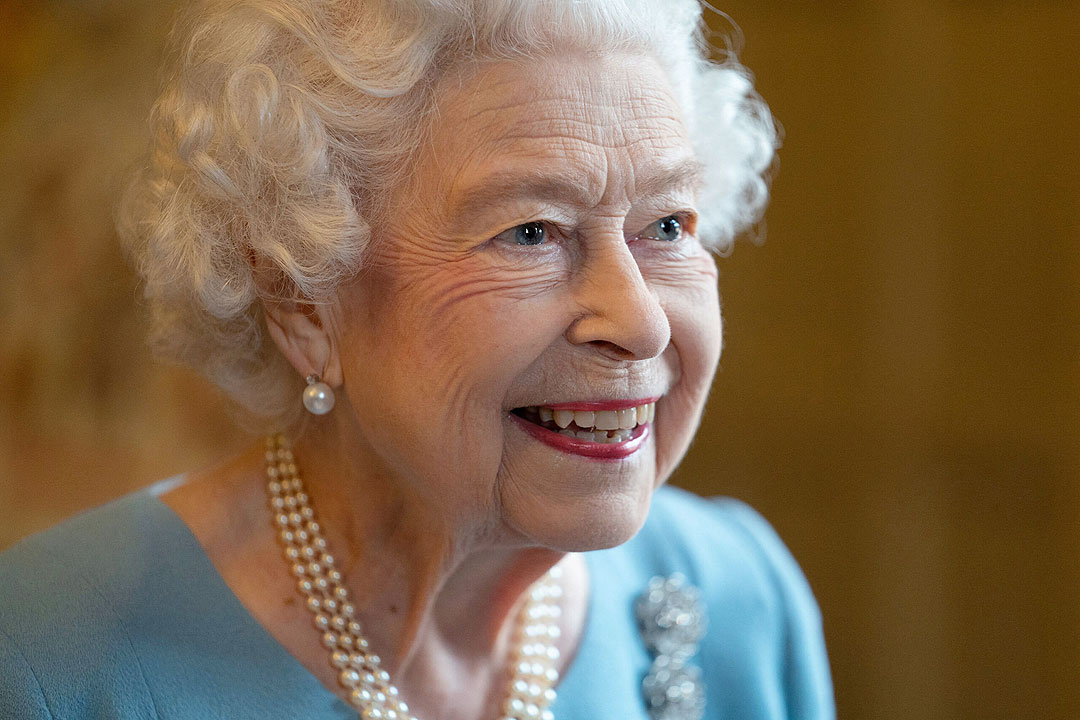
Britain’s Queen Elizabeth reacts as she attends a reception in the Ballroom of Sandringham House with representatives from local community groups to celebrate the start of the Platinum Jubilee, in Sandringham, Britain, Feb. 5, 2022. — JOE GIDDENS/ POOL VIA REUTERS

LONDON — Britain’s Queen Elizabeth said on Saturday that she wants Prince Charles’ wife Camilla to be styled Queen Consort when he becomes king, cementing her place at the heart of the royal family after once being judged an outsider.

In a letter written to mark the 70th anniversary of her accession to the throne, Elizabeth said the occasion had given her pause to reflect upon the loyalty and affection shown to her by the British public.

She said she hoped Charles and Camilla would receive the same support.

“(It) is my sincere wish that, when that time comes, Camilla will be known as Queen Consort as she continues her own loyal service,” Elizabeth said.

Charles and Camilla, long-time lovers, were married in 2005 in a civil ceremony in Windsor. Their Clarence House residence said on Saturday that they were “touched and honored by Her Majesty’s words.”

Elizabeth’s move reflects a wider acceptance of Camilla’s status as a royal.

Tabloid newspapers no longer target her as they did in the decade following the death in 1997 of Charles’ first wife, Princess Diana.

Camilla — whose current title is Duchess of Cornwall — now regularly represents the royal family alongside Charles during official duties.

Throughout British history, the wife of a king typically is given the title Queen Consort. At the time of their marriage, it had been officially decided that Camilla would use the title Princess Consort if Charles were to become king.

While Elizabeth on Sunday celebrates 70 years on the British throne — an unprecedented stretch — the anniversary comes at a time of tumult for the royal family.

From the US sex abuse court case facing her son Prince Andrew to allegations by her grandson Prince Harry and his wife of racism in the royal household, rarely has the 95-year-old Elizabeth’s family faced such scrutiny and damaging headlines.

Last year she lost her husband of 73 years, Philip, whom she acknowledged in her letter on Saturday.

“I was blessed that in Prince Philip I had a partner willing to carry out the role of consort and unselfishly make the sacrifices that go with it. It is a role I saw my own mother perform during my father’s reign,” Elizabeth said.

POMP AND POIGNANCY
Earlier on Saturday, Elizabeth kicked off celebrations for the 70th anniversary of her accession to the throne by inviting local community groups to her Sandringham residence in the east of England.

The queen, pictured smiling and wearing a light blue dress, cut a celebratory cake baked by a local resident and heard a rendition of “Congratulations” played by a concert band.

“I remain eternally grateful for, and humbled by, the loyalty and affection that you continue to give me,” she said in her letter to the public.

Ironically Elizabeth was not destined to be monarch at her birth, and became queen only because her uncle Edward VIII abdicated to be with American divorcee Wallis Simpson.

But in 2015, she overtook Victoria as Britain’s longest-reigning sovereign in a line that traces its origin back to Norman King William I and his 1066 conquest of England.

This weekend’s low-key events are a prelude to more pomp and ceremony to mark the platinum jubilee in early June, when the government will add an extra public holiday.

But Elizabeth said the anniversary was to her one of reflection and poignancy.

“It is a day that, even after 70 years, I still remember as much for the death of my father, King George VI, as for the start of my reign,” she wrote.

“As we mark this anniversary, it gives me pleasure to renew to you the pledge I gave in 1947 that my life will always be devoted to your service.” — Reuters

UN’s Guterres to China’s leaders: allow ‘credible’ visit by rights envoy

REUTERS/MIKE SEGAR/FILE PHOTO

UNITED NATIONS — U.N. Secretary-General Antonio Guterres told Chinese leaders on Saturday that he expected authorities to allow U.N. human rights chief Michelle Bachelet to make a “credible visit” to the country, including Xinjiang, the United Nations said.

Mr. Guterres met with China’s President Xi Jinping and Foreign Minister Wang Yi on the sidelines of the Winter Olympics, according to a U.N. readout of the meetings.

Ms. Bachelet has long sought access to Xinjiang to investigate accusations of abuse against ethnic Uyghurs. The issue has soured relations between Beijing and the West, sparking accusations of genocide from Washington and a US-led diplomatic boycott by some countries of the Winter Olympics.

“The Secretary-General … expressed his expectation that the contacts between the office of the High Commissioner for Human Rights and the Chinese authorities will allow for a credible visit of the High Commissioner to China, including Xinjiang,” said the U.N. readout of Mr. Guterres’ meetings.

Ms. Bachelet’s office in Geneva said last month that conversations were underway for a possible trip to the area in northwest China in the first half of the year.

Rights groups accuse China of widescale abuses against Uyghurs and other minority groups, including torture, forced labor and detention of 1 million people in internment camps.

China calls them re-education and training facilities, denies abuses, and says it is combating religious extremism.

Mr. Guterres also discussed Afghanistan and climate change — among other issues — during his meetings with Mr. Xi and Mr. Wang.

“The Secretary-General recognized the important efforts China is making to address climate change but reiterated the appeal for additional efforts to accelerate the transition to the green economy to bridge the emissions gap,” said the U.N. statement.

Mr. Guterres traveled to Beijing to attend the opening ceremony of the Winter Olympics on Friday. The ceremony concluded with the Olympic flame cauldron lit by two young Chinese Olympians, one of them a member of China’s Uyghur minority. — Reuters

Jimmy Butler scores 27 as Heat use big third quarter to beat Hornets

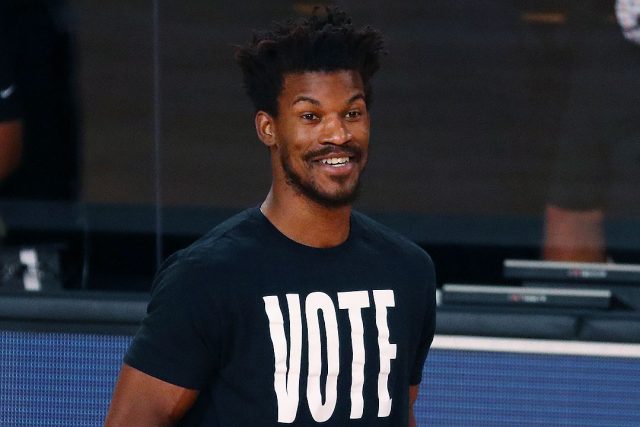
JIMMY BUTLER — REUTERS

JIMMY Butler poured in 27 points and the Miami Heat used a tremendous third quarter to produce a 104-86 victory over the host Charlotte Hornets on Saturday night.

Bam Adebayo supplied 20 points and 12 rebounds as Miami controlled the play in the lane for much of the second half.

The Heat trailed 51-46 at half time, but cranked out a 35-8 edge in the third quarter. Butler had nine points in the quarter.

Tyler Herro added 19 points for Miami, which has won back-to-back games following a three-game skid.

The Hornets lost their fourth consecutive game, including the second one in two nights at home. Charlotte dropped to 14-10 at home.

Terry Rozier led Charlotte with 16 points, while Miles Bridges had 15 points and LaMelo Ball provided 12 points. Gordon Hayward, who was in his second game back following an ankle injury, was scoreless in 22 minutes, missing all seven of his shots from the floor.

The Hornets’ 3-point shooting was spotty, going 10-for-36. Super sub Kelly Oubre, Jr. struggled by going 3-for-15 from the field (1-for-9 on 3s).

Butler made 10 of 13 shots from the field. The Heat’s efficiency for parts of the second half helped overcome the team’s 11-for-32 shooting on 3-pointers for the game. Miami also was 17-for-18 on free throws.

The Hornets had good moments in the second quarter, when Miami was limited to 15 points. The Heat connected on only two shots from the field in the final 5-1/2 minutes of the first half.

The Heat led 31-23 before going cold.

Miami was in its fourth game of a six-game road swing, now 2-2 in those games. The Heat had Kyle Lowry back for his second game after a nine-game absence because of a personal issue, and he turned in nine points.

Twin brothers Caleb Martin of Miami and Cody Martin of Charlotte both scored eight points in reserve roles. — Reuters

Cameroon stages dramatic comeback to win third place at Cup of Nations

YAOUNDE — Skipper Vincent Aboubakar scored two late goals as Cameroon staged an extraordinary comeback from three goals down against Burkina Faso to level the match at 3-3 and win third place on penalties at the Africa Cup of Nations on Saturday.

The tournament hosts put together a thrilling recovery in the final 20 minutes at the Ahmadou Ahidjo Stadium to force a draw and go on and win the third-place playoff game 5-3 in the resulting penalty shootout.

Aboubakar was brought on at half time as Cameroon played most of their unused squad players from the start and found themselves 2-0 down at the break.

A 28th-minute goal from defender Steeve Yago and an own goal from Cameroon goalkeeper Andre Onana on the stroke of half time handed a Burkina a shock lead and Djibril Ouattara added a third early in the second half to the surprise of the home crowd.

But Cameroon pulled a goal back in the 71st minute through Stephane Bahoken in a melee following a corner before Aboubakar took advantage of two goalkeeping howlers to score twice in the space of two minutes in the 86th and 87th.

It means he ends the tournament on eight goals.

A stunning comeback was completed as Cameroon converted all their kicks in the shootout while Onana saved one from Blati Toure to ensure some consolation for the home country, days after they were eliminated on post-match penalties in the semifinal against Egypt. — Reuters

Three players sit atop leaderboard at Pebble Beach

BEAU Hossler shot a third-round 65 on Saturday to vault into a three-way tie for the lead with Andrew Putnam and Tom Hoge at the Pebble Beach Pro-Am in Pebble Beach, Calif.

Hossler recorded an eagle on his way to a bogey-free round on the Pebble Beach Golf Links. Putnam and Hoge shot matching 4-under 68s as all three players sit at 15-under 200 after 54 holes.

Patrick Cantlay (third-round 68), Jordan Spieth (63) and Joel Dahmen (66) sit tied for fourth at 14 under, one stroke back. Irishman Seamus Power, the second-round leader, is alone in seventh at 13 under, two shots back.

Australian Jason Day (70) and Denny McCarthy (66) are four shots back in a tie for eighth.

Hossler has shot back-to-back 65s after an opening 70. Playing “conservatively” Saturday, he finished with a flurry, posting four birdies in his last six holes. Hossler jumped 14 spots up the leaderboard on moving day.

“Pebble can give and take so quickly, right?” Hossler said. “I was glad to be on the receiving end today. I hit it well, played really conservatively, frankly, as even though it might not look like it and was fortunate to not have any misses really get me in significant trouble. It was as fairly stress free as you can be around here.”

Hoge posted his bogey-free round on Spyglass Hill Golf Club, getting two birdies in his final five holes.

“I don’t know what it is, but I always seem to shoot better scores at Spyglass than I have at some of the others,” Hoge said. “I don’t know, I mean, it certainly is an advantage just from the way the scoring averages are and all the golf courses, but I seem to play Spyglass a little bit better, so it was a good one for me today.”

Putnam had a chaotic round on Pebble Beach Golf Links. Starting on No. 14, he settled down after posting a bogey and double-bogey in consecutive holes. He would finish the round with seven birdies, including five in a row on Nos. 4-8.

“It was pretty ugly, that first nine,” Putnam said. “It was a really bad start, a 3-putt, kind of a stupid mistake and then kind of got a bad break, ball got kind of buried up in a lip. So it can happen out here. And kind of kept it in play and started hitting some good shots, and the putter started working pretty good on that front side.”

Spieth vaulted 34 spots up the leaderboard playing on Pebble Beach. He opened with two birdies, added an eagle on No. 6, and finished the round with eight birdies against a bogey on No. 13.

Pebble Beach hosts the final round on Sunday. — Reuters

ADVERTISEMENT
ADVERTISEMENT