Home Blog Page 6810

Yields on government debt climb as US inflation surges

By Ana Olivia A. Tirona, Researcher

YIELDS on government securities (GS)surged last week after investors continued to price in a potentially more aggressive US Federal Reserve hike in March after the world’s largest economy reported a 40-year high inflation rate in January.

GS yields in the secondary market jumped by 14.12 basis points (bps) on average week on week, based on the PHP Bloomberg Valuation (BVAL) Service Reference Rates as of Feb. 11 published on the Philippine Dealing System’s website.

Yields, which move opposite to prices, rose across the board on Friday from their Feb. 4 close except for that on the six-month Treasury bill (T-bill), which dropped by 6.69 bps to 1.058%.

Rates of the short-dated 91- and 364-day T-bills went up by 2.29 bps and 1.59 bps to 0.7726% and 1.4553%, respectively.

At the belly of the curve, yields on the two-, three-, four-, five-, and seven-year Treasury bonds (T-bonds) jumped by 7.38 bps, 10.31 bps, 14.7 bps, 20.36 bps, and 28.47 bps, respectively, to 2.5548%, 3.2623%, 3.9098%, 4.4332%, and 4.9998%.

At the end of the curve, rates of the 10-, 20-, and 25-year papers also climbed by 48.22 bps (to 5.3627%), 14.18 bps (5.2418%) and 14.53 bps (5.2384%), respectively.

“Local GS yields skyrocketed week on week as traders and investors continued to recalibrate expectations on the number and magnitude of US Federal Reserve’s imminent rate hikes as their inflation continues to run hot,” a bond trader said in a Viber message on Friday.

The trader also noted that the reissued 10-year papers last week were fully awarded despite fetching higher yields.

“GS further sold off after the RTB (retail Treasury bond) announcement came out as the issuance may tighten liquidity,” the trader said.

“The upward movement was broadly felt at the belly and tail-end of the curve. However, short-term rates remained subdued as local participants highly expect the Bangko Sentral ng Pilipinas (BSP) to remain accommodative,” a second bond trader said in an e-mail interview.

US inflation rate peaked at 7.5% year on year in January, this was the largest annual increase in 40 years or since February 1982, Reuters reported.

This could further bolster the case for a more aggressive rate hike from the Fed in March.

Meanwhile, last week, the Bureau of the Treasury raised P35 billion as planned through the reissued 10-year papers despite average yield rising to 5.093%, tracking a sell-off in the US bond market. The tenor attracted P51.077 billion in bids.

The Treasury said on Friday it will offer this year’s first RTBs to raise at least P30 billion. The five-year bonds will be sold from Feb. 15 to 28 with a swap offer for notes maturing on March 14 and July 4. The settlement will be on March 4.

Due to the RTB offer, the Treasury canceled its scheduled auctions of seven- and 10-year T-bonds on Feb. 15 and 22.

“For the week ahead, bearish sentiment for local bonds will persist given elevated global yields and as traders gear up for the RTB offering. On that note, yields are expected to move with upward bias for the week,” the first bond trader said.

The second bond trader expects GS yields to move with an upward trend amid potentially strong US producer inflation report and hawkish cues from the January 2022 Fed policy minutes.

“However, the increase in GS yields might be limited as the BSP is broadly expected to remain dovish in its policy meeting this week,” the second bond trader added.

The BSP’s Monetary Board is scheduled to meet on Feb 17. — with Reuters

KonsultaMD integrating into Huawei’s wearables

By Arjay L. Balinbin, Senior Reporter

917VENTURES’ KonsultaMD said it is integrating its telemedicine platform into wearable technology through Huawei as part of its non-face-to-face services.

“KonsultaMD continues to break new ground with its integration into Huawei wearables,” KonsultaMD Chief Executive Officer Cholo A. Tagaysay told BusinessWorld in an e-mail interview.

917Ventures serves as the corporate venture builder of Globe Telecom, Inc.

“KonsultaMD will soon be able to track your steps, calories, workouts, heart rate, oxygen, stress levels, and sleep,” Mr. Tagaysay added.

Data analytics and consulting company GlobalData said wearable technology is a “key driver” in the growth of mobile health.

“With the increasing number of smartphone users worldwide, it is not a surprise to see a rise in the popularity of mobile health apps. When coupled with wearable technology, we can expect to see continued market growth,” Kevin Dang, medical data analyst at GlobalData, said in a statement.

“We can clearly see that the two segments that dominate global wearables revenue are hearables and smartwatches. Hearables have been around quite some time now as their main purpose is for listening to music. Smartwatches, on the other hand, have gained traction in recent years — with their abundance of built-in functions they are very versatile devices,” he added.

GlobalData expects the wearable technology market to grow at a compound annual growth rate of 19% to $64 billion by 2024, a 237% increase since 2019.

“Mobile health is in a very exciting stage of development. Its applications span from mainstream daily usage with wearables to specific use cases in healthcare. The possibilities are endless and the potential for growth is astounding,” Mr. Dang said.

KonsultaMD’s Mr. Tagaysay said that “in the near future,” the company will also launch app developments that involve hospital integration and clinics.

“We will continue to partner with health products and establishments, super apps, tech, insurance, retail and local government units,” he added.

Globe said last week that KonsultaMD is exhibiting “strong growth” with more than 140% revenue growth, reaching over a million members (+168% year on year) across 50,000 retail outlets nationwide.

“To further expand its reach, KonsultaMD is now also partnering with over 60 brands and utilizing social media app TikTok,” it also said.

Gilas women’s team bracing for return to training

WITH the continuous improvement of the pandemic situation in the country, the Gilas Pilipinas women’s team is bracing for a return to its own training camp soon to prepare for the fast-approaching Southeast Asian (SEA) Games.

Coach Pat Aquino said the Samahang Basketbol ng Pilipinas (SBP) already requested for a training clearance from the Philippine Sports Commission with less than three months left in their SEA Games title defense preparation.

“We’re getting ready to go back to training,” Mr. Aquino told The STAR following the SBP’s submission of the formal request letter through executive director Sonny Barrios.

“We’re hoping for the soonest approval so we can start preparing as early as possible,” he added.

Though Gilas is willing to enter another bubble training, Mr. Aquino is hoping for a nod to hold camp under a closed-circuit setup like the other pro and national teams right now.

“…We will be ready for bubble training. We will follow Inter-Agency Task Force (IATF) protocols,” he added, citing the regular Zoom workouts of the Filipina ballers since their last stint.

Gilas last saw action in the 2021 FIBA Women’s Asia Cup last October in Jordan, finishing at seventh place to stay in the prestigious Division A.

In Hanoi this May, the Filipina ballers will be out for a second straight gold medal in both 3×3 and 5-on-5 events after a twin-title in the 2019 edition held here. — John Bryan Ulanday

Bigger land boosts Bicol region’s 2021 palay, corn outputs

PHILSTAR FILE PHOTO

THE Department of Agriculture (DA) said palay production in the Bicol region posted growth of 4.01% growth, while corn output rose 3.81% growth in 2021 amid an increase in the land area planted to the two staple crops, with rice benefiting from greater adoption of hybrid seed.

The region reported palay production of 1.35 million metric tons (MT), a record, while corn output came in at 292,748 MT, according to the Philippine Statistics Authority.

DA Bicol Regional Executive Director Rodel P. Tornilla said palay output was the second record for Bicol since 2011.

He said strong performances were turned in by farmers in areas practicing a clustering strategy, where resources are shared by cultivators pooling their small plots.

Rice and Corn Program Head Earl Vincent P. Vegas said that the increase in yield could be attributed to the expansion of the hectarage planted to hybrid rice.

Camarines Norte posted an increase in palay production of 7.17% to 116,292.63 MT, followed by Camarines Sur, where output grew 5.04% to 683,203 MT. Sorsogon posted output growth of 3.97% to 150,793.40 MT; Albay 3.95% to 224,533 MT; and Masbate 0.50% to 148,754 MT. Output in Catanduanes contracted 13.48% to 23,376 MT.

Output of yellow corn, the variety used for animal feed, was 220,170.50 MT in 2021, while white corn output was 75,577.78 MT.

The area planted to corn increased by 1.82% to 108,929.87 hectares in 2021.

Camarines Sur has the most land planted to corn (47,838 hectares), followed by Masbate (38,722 hectares), Albay (20,699 hectares), and Camarines Norte (1,029). — Luisa Maria Jacinta C. Jocson

Giving shape to time

“MY soul burns ardently to understand this most intricate enigma,” said St. Augustine in his Confessions, making an inquiry about the nature of time. For centuries, philosophers and scientists have struggled to give shape to the nature of time. A smartwatch campaign by tech company Garmin throws its hat into the ring, and its contenders are a dancer, an artist, and a model.

The watch in question is the Garmin Vivomove Sport, with a case of fiber-reinforced polymer and silicone straps. Measuring 40mm, it combines the look of an analog watch with a smartwatch, with several apps designed to track the user’s body in its movement through time (and also to sync with their phone).

The movement of the body through time is essential in its discussion. Eva Hoffman, in her 2009 book Time (under the Big Ideas, Small Books series) condenses the thoughts of philosopher Maurice Merleau-Ponty on time: “Merleau-Ponty stressed that we construct time not through pure perception but through motility and action, through our bodies’ motions in space and through acting within and upon the world.”

Dancer Ella Fortun seems to think so. In a series of videos shot by Garmin in Intramuros, streamed through Facebook on Feb. 8, Ms. Fortun says, “When I imagine what time looks like, I see an elegant and precise dance move.”

“I can imagine myself centerstage with a long, silky skirt. My arm propels forward and in an upward motion, because time for me isn’t linear. It’s circular, and it flows,” she said. “I love contemporary dance because it’s a reflection of how I move with time. The song creeps in, and I move slowly at first, finding my footing.”

“Time just flows by so quickly when I’m onstage. In these ecstatic moments, time dissolves and I feel almost weightless,” she said.

Ms. Fortun tested out the Garmin Vivomove Sport in Cocoa, showing how she taps the screen to see the apps. The apps include a Pulse Ox to check blood oxygen saturation, a fitness tracker, a hydration tracker, a sleep tracker, and even a menstrual cycle and pregnancy tracker. The smartwatch can sync to one’s phone, with meeting alerts, incoming call and messaging alerts, powered with a maximum battery life of five days. “I can use this for work, and for working out,” said the dancer.

Artist Denise Heredia, meanwhile, said, “I think time looks very colorful, like a rainbow. It’s disorganized and organized at the same time.”

“Time to me is colorful because I like to spend it spreading beauty and positivity through my art,” she said. She tested out the model in Ivory, and said, “The overall aesthetic is just perfect for me.”

Model Jessica Yang, currently in the Philippines, said, “Time looks like opportunities: opportunities to create new things and do better.

“In my line of work, time moves swiftly. There are only seconds between outfits and sets; only split seconds between shots and poses to get everything on point,” she said. “There are also moments when time stands still. Like when I’m on the runway. Time is frozen and almost feels like it doesn’t exist.

“I would say time and I have a great relationship. Like my life is intertwined with it, and each moment is magic —  a present.” Testing out her smartwatch in Cool Mint, she said, “The color is amazing. And as a fashion girl, I approve.”

We won’t just leave it at that: we end with the words of St. Augustine, again in Confessions: “So, then, as I was saying, we measure periods of time as they pass. And if anyone asks me, ‘How do you know this?,’ I can answer: ‘I know because we measure.’”

The Garmin Vivomove Sport costs P9,595, and is available on ph.garmin.com, Lazada, Shopee, and Kinetic. — Joseph L. Garcia

SC to PNB: Show details of debtor firm’s obligations

BW FILE PHOTO

THE SUPREME COURT (SC) ruled as unjust the penalty imposed by Philippine National Bank (PNB) on AIC Construction Corp.’s debt, as it ordered the bank to give a detailed accounting and explanation of the company’s loan obligations.

In its decision promulgated in October 2021, the high court said PNB’s interest penalties charged to the construction company were unjust. It upheld the Court of Appeals’ decision of abiding by the principle of mutuality of contracts.

“Courts may equitably reduce unconscionable interest charges especially if it was determined through subjective and one-sided criteria, thus violating the principle of mutuality of contracts,” it said in the ruling written by SC Associate Justice Marvic M.V.F Leonen.

“Monetary interest is always agreed upon by the parties and they are free to stipulate on the rates that will apply to their loans,” the High Court said citing the principle.

In 1988, the construction company opened an account with the lender and was granted an omnibus credit line of P10 million.

Over the years, the credit line gradually increased until it amounted to P65 million in 1998, with P40 million as the principal amount, and P25 million as interest set by PNB.

AIC Construction negotiated to restructure the loan by offering to pay in full through the exchange of its properties in Pampanga, but this alternative could not be agreed on.

PNB set its final demand to the company in the full payment of P140,836,511.29 in 2001. The mortgaged properties of the company were forced to close the following year.

AIC construction then filed a complaint against the lender for the annulment of interest and penalty increases.

“It (AIC Construction) alleged that Philippine National Bank acted in bad faith by delaying the acceptance of their proposals, and its capricious and arbitrary policies prevented them from paying their loan obligations,” the decision read.

A trial court previously dismissed the company’s complaint citing the plaintiffs could not prove the interest increases were unconscionable or unreasonable.

PNB argued that AIC Construction had no right to compel the bank to accept the alternative mode of payment and that the company voluntarily entered the loan agreement with knowledge of interest charges.

The SC ruling came after a petition filed by PNB to review if the Court of Appeals made an error in its conclusion of the interest penalties being unconscionable or unreasonable. — John Victor D. Ordoñez

LANDBANK net income up 27% in 2021

LAND BANK of the Philippines (LANDBANK) posted a 27% growth in its net income year on year in 2021 on the back of lower cost of funds and loan loss provisions.

The state-run bank’s net profit grew to P21.75 billion in 2021, up from P17.14 billion a year earlier and higher than its P19.68-billion income target.

LANDBANK’s net income translated to a return on equity of 11.75%, while return on assets rose to 0.88% from 0.78%.

The bank’s net income in 2020 dropped by 7.57% amid the economic downturn caused by the coronavirus pandemic.

The earnings growth can be attributed to the lower cost of funds and provisions for losses, the bank said in a statement on Sunday.

LANDBANK President and CEO Cecilia C. Borromeo said the bank’s financial performance in 2021 showed resiliency “amid another challenging year.”

“We will build on this momentum as we continue to take on an expanded role and a more holistic approach in supporting key development sectors and the nation at large,” she said.

The state-run bank’s total assets rose 9.5% to P2.586 trillion from P2.362 trillion a year earlier.

“This was propelled by deposits expanding by 8.39% to P2.269 trillion, mainly from the rise in deposits of government and private accounts,” LANDBANK said.

The bank’s net interest margin was at 2.86%.

LANDBANK’s loans to the agriculture and development sectors last year financed the construction of 303 kilometers of farm-to-market roads, 33 hospital buildings, 1,954 hospital beds, 9 school buildings, and 96 classrooms. The loans also connected 18,303 households to potable water.

LANDBANK’s merger with the United Coconut Planters Bank (UCPB) will take effect on March 1, with the combined entity producing a lender with nearly P3 trillion in assets.

President Rodrigo R. Duterte in June last year signed an executive order approving the merger, in which all assets and liabilities of UCPB will be transferred to LANDBANK. The order noted that the banks both have a compatible development mission. — J.P. Ibañez

7 cars we’d love to see in the PHL

PHOTO FROM FORD

We hope these beauties are coming ‘swoon’

IT’S THE SEASON of love and what better way to celebrate this — at least for car lovers — than to make a list of cars that make our hearts beat faster. In the spirit of Hearts’ Day, I made a wish list of cars that we currently don’t have in the Philippines — but whose local showroom appearance will make it seem like Christmas came early.

But first, a caveat: Some of these cars aren’t exactly designed for our market — not just for the Philippines, but for the whole of Southeast Asia. So don’t hold your breath waiting for these models to appear in your neighborhood dealer. That said, some inspired (and aggressive) marketing people might just be able to convince their HQ principals to bring these vehicles here.

Here is our dream list, in no particular order:

1. Ford Bronco

Decades before the Expedition and the Explorer hit the road — 1966 to be exact — Ford already had the Bronco. Five generations of Broncos came out in the US market over three decades, but the model took a 25-year hiatus and only reappeared on the international stage last year. And it’s a smash hit, with a design that harkens back to the original, but with the high build quality and cutting-edge technology of this digital age. The midsize Bronco comes in three-door and five-door body styles, and even as a smaller compact Bronco Sport model.

2. Cadillac Escalade

This is one car brand and model that will be an absolute game-changer in the local luxury car scene. It’s amazing that a brand name that has never been sold in this country can still have so much impact and recall. But without a doubt, having a Cadillac Escalade as an option will make every single luxury SUV buyer think long and hard before plunking down money on another German SUV. If the Escalade becomes officially available here, expect it to be a fixture in every golf and country club, as well as the parking lots of Senate and Congress.

3. Mazda CX-50

Often based on sedans, most crossovers are biased more for road comfort than actual heavy-duty off-roading. And rightly so, as most of them spend more time trundling through mall parking lots than traipsing through the woods. The Mazda CX-50 tries to break that mold. One look at the army green paint with bold CX-50 graphics, the raised ride height, the big off-road wheels and tires, and that prominent roof rack (which can accommodate kayaks and tents) and you’ll know that this is one Mazda that’s trying to break free from the exquisitely smooth — and very car-like — styling of the CX series. Even the cabin is designed for ruggedness and resilience. Best of all, it’s got the muscle (as much as 253ps and 434Nm from an available 2.5-liter turbo) and the traction (from the standard i-Activ all-wheel drive) to put its money where its mouth is. The Mazda CX-50 may yet be the crossover that actually crosses over to a more faithful overlanding experience than any other model of its kind.

4. Toyota Sequoia

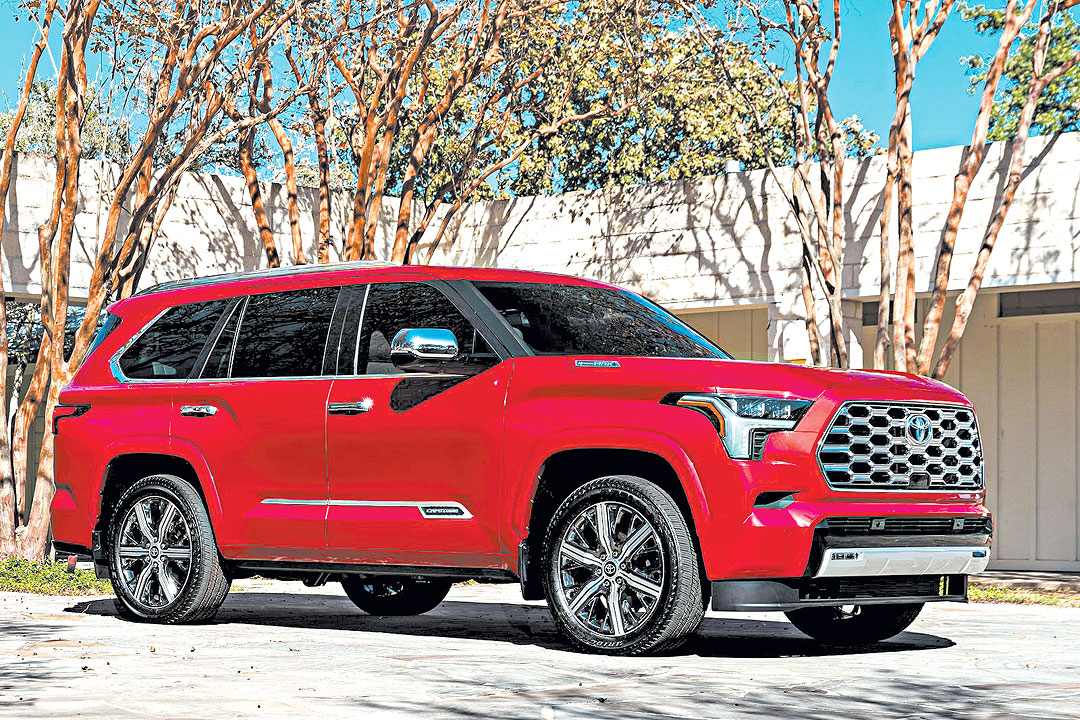
Filipinos (and the rest of the world) are perennially making a beeline to a Toyota showroom to drive off with the Land Cruiser. Toyota can’t seem to build them fast enough. But there’s one other humongous Toyota SUV that might stop them in their tracks: the Sequoia. It’s entirely appropriate to name Toyota’s North American flagship after that country’s tallest tree. The Sequoia projects an imposing aura, mostly from that bold and compelling front end and the vehicle’s massive bulk. The best part is, the all-new 2023-model Sequoia (it’s an eight-seater with a seven-seat option with middle-row captain chairs) comes as a fuel-efficient hybrid powered by a 3.4-liter twin-turbo V6 that teams up with an electric motor for a combined 437hp and a whopping 790Nm of torque. If there’s an unbeatable tag team, it can only be the Land Cruiser-Sequoia.

5. Peugeot Landtrek

Pickup trucks are the bread and butter of most brands that sell them here. All of them come from the usual suspects. But there’s one truck out there that’s certain to shake up the status quo. It comes from a French brand but is made in China (by Changan) and is sold mainly in Latin America and Africa. It’s the Peugeot Landtrek, a midsize pickup powered by a 1.9-liter turbodiesel engine or a 2.4-liter turbo petrol engine. Pickups are some of the most customized vehicles on the planet; owners simply want to stand out — or at the very least differentiate their truck from countless others. Having a premium French-branded pickup in a sea of Japanese models will certainly appeal to those owners.

6. Mitsubishi Eclipse Cross

Here’s one vehicle that should neatly fill a niche in Mitsubishi’s crossover portfolio. It’s the Eclipse Cross — and it’s the perfect model to elevate the triple-diamond brand to a level of premium in the compact crossover class. The Eclipse Cross may not be new on the global stage (it became available in Japan and the US in 2018) but it should surely make many heads turn with its novel sleekly shaped silhouette if it finds itself in Metro Manila streets. The Eclipse Cross name is also a significant reminder of how the world is turning from sedans and sports cars to SUVs and crossovers. The Mustang muscle car name now graces the electric Mustang Mach-E SUV. The Corolla begat the Corolla Cross. And now, the Eclipse, Mitsubishi’s iconic sports car, has morphed into the Eclipse Cross.

7. Nissan Z

The current Nissan 370Z was hailed as one of the greatest sports cars ever. It also comes from one of the most illustrious bloodlines in the sports car realm. But it has been too long in the market and is now more than ripe for retirement. Thankfully, Nissan has the all-new Z car waiting in the wings. Like its immediate predecessors, it has a somewhat chunky styling when viewed from the side. But the front end is a beautiful throwback to the original Fairlady Z while the rear end — especially the taillights — hark back to the sensational 300ZX of the ’90s. Together with the Toyota Supra, the new Z signals a renaissance of high-powered Japanese sports cars. Bringing in the new Z to the Philippines is not as much a wish as it is a must.

China soymeal prices hit record highs, deal fresh blow to hog sector

REUTERS

BEIJING/SINGAPORE — China’s soymeal futures soared to record highs last week on concerns about the scale of South America’s drought-hit soybean crop and tightening meal supplies in domestic markets.

Elevated prices of soymeal, the top protein ingredient in animal feed, could lift production costs for Chinese hog farmers who are already struggling with huge losses, and may push some to exit the market, traders and analysts said.

The most actively traded soymeal futures on the Dalian Commodity Exchange rallied to 3,792 yuan ($596.22) per ton this week, the highest price on record, and up 13% from before the week-long Chinese New Year holiday.

Worries about how smaller South American crops will tighten the global soybean balance was the main driver behind the meal rally, although tightness in the domestic meal market was also supportive, analysts and traders said.

“Soybean imports in the second half of last year were low, and importers were waiting for margins to improve,” said Darin Friedrichs, co-founder of agricultural research firm Sitonia Consulting. “But now there are production issues. US futures have rallied a lot, and Dalian meal is playing catch-up,” Friedrichs said.

Chinese importers had been counting on abundant and cheap soybean supplies from Brazil to start arriving this month and fulfil their needs for the first quarter of 2022. But the South American crop issues have now caught some off guard. “Crushing plants aren’t receiving sufficient cargos,” said a manager based in southern China with a top crusher. “We did not make much purchases earlier as margins were low,” said the manager, who declined to be named because of the sensitivity of the issue.

Strong international soybean prices alongside relatively weak domestic soymeal prices since mid-2021 have pressured crushing margins in China, and most crushers faced hefty losses late in the year. Margins have recovered to positive territory this year, but remain well below the long-term average, stifling crusher appetite for soybeans.

“Crush margins are bad and crushers aren’t motivated (to crush),” said a feed ingredient purchase manager in Shandong, a major processing hub in eastern China. Cash prices of soymeal in the district jumped about 10% to more than 4,000 yuan per ton this week because of tightening supplies after a protracted stretch of low crushing activity, according to the manager.

“If hog margins are terrible, (crushers) they don’t want to have huge stocks of soy meal because farmers might leave (the industry) and they could have trouble selling the stocks,” Friedrichs said.

Some have already left, after months of negative margins last year and widening losses in 2022. Farmers in Shandong, a major hog producer, were losing 288 yuan with each pig raised this week. The woes are expected to continue as China entered the traditionally weak consumption season after the Spring Festival holiday while meal prices push higher.

“If soymeal prices remain high, it will increase farming costs, pushing more farmers — big and small — to further cut production capacity,” said Li Ming, analyst with the agriculture section of Mysteel, a China-based commodity consultancy.

China’s sow herd was 43.29 million head at the end of December, down 2.9% from the previous quarter, according to official data.

“It is too much. Soymeal prices rose more than 500 yuan per ton after Spring festival,” said a manager with a feed producer in the northeastern region, declining to be named because of the sensitivity of the issue. “The end users can’t take this. Farmers can’t afford the losses any more, especially the smaller and medium ones, they had been losing since last year,” he said. Reuters

Frayna on course in sweeping SEAG qualifier

WGM JANELLE MAE FRAYNA — NCFP

WOMAN Grandmaster (WGM) Janelle Mae Frayna drew with Woman International Master (WIM) Antoinette Mae San Diego in 57 moves of a Sicilian Rossolimo to stay on course in sweeping the Southeast Asian Games (SEAG) national team selection at the PACE in Quezon City on Sunday.

Ms. Frayna, who topped the blitz event on Thursday, was currently tied with Ms. San Diego after the first three of the six-game title showdown, 1.5-1.5, of this event where the winner will represent the country in the rapid section of the Hanoi SEA Games.

Ms. Frayna won the first game in 63 moves of another Siciluan duel while Ms. San Diego struck back in the second game with a 44-move triumph of a Queen’s Pawn London System.

Three more games were being played at press time and Ms. Frayna hopes she ends up the winner again.

If she accomplishes the feat, Ms. Frayna will complete a chess grand slam after topping the National Championships — a standard event — in December last year and the blitz section Thursday.

In the men’s side, IM Jan Emmanuel Garcia was leading GM Darwin Laylo, 2-1.

Mr. Garcia pounced on a time-starved Mr. Laylo in the first game in escaping with a 53-move victory of a King’s Indian Defense and the former repeated over the latter in the second game via a 42-move win of an English Opening.

Mr. Laylo, who eliminated the country’s national standard champion and blitz king IM Daniel Quizon in the semis, bounced back strong by seizing the third game in just 23 moves of a Gruenfeld Defense. — Joey Villar

The art of black

BAUME & Mercier is exploring vision through the color black, as seen through the work of artist Pierre Soulages.

Pierre Soulage is known for his various works in exploring light and shade through the color black, but especially in a 1989 series called Outrenoir. In a statement, he said, “When the light is more intensely reflected, the black appears less black, and its surface effects become more noticeable, more active.” In an article from auction house Christie’s (https://www.christies.com/features/Beyond-Black-Pierre-Soulages-10009-3.aspx), he said, “I saw that it was no longer black that gave meaning to the painting but the reflection of light on dark surfaces. Where it was layered the light danced, and where it was flat it lay still. A new space had come into being.”

The watch created in his honor is therefore a stark, pure black.

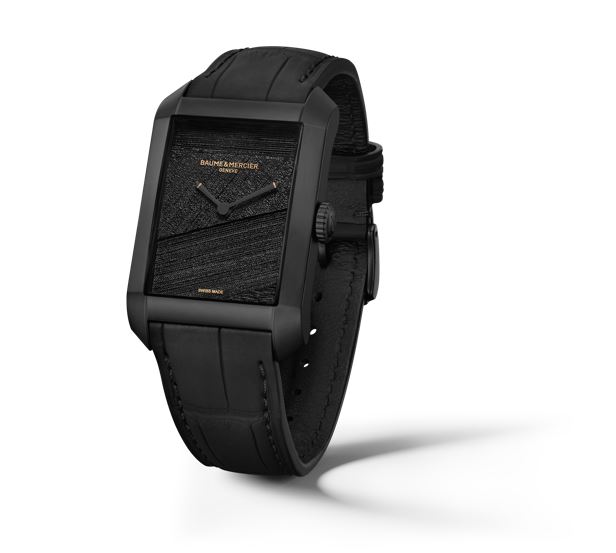
The Hommage à Pierre Soulages transposes the properties of his Peinture 390 x 130cm 17 mars 2019, along with works in the Outrenoir series onto the brand’s Hampton model. The art deco-inspired rectangular piece, according to the company, evokes the proportions of a canvas. The watch was made with the collaboration of Musée Soulages and the Association des Amis du Musée.

“For Baume & Mercier, collaborating with Musée Soulages is a way to acknowledge how important art really is to the brand. This is more than a polite acknowledgment: it is a way of showing thanks for fulfilling our souls and the passage of time, inspiring us and thrilling us,” the brand said in a statement.

The watch case is in stainless steel — black of course — with a DLC coating case, mounted on a nubucked alligator strap — black again. It has a power reserve of 42 hours, with a sapphire crystal case back, running on the Swiss-made ETA 2892-A2 movement. The case measures 9.88 mm in its thickness, and is 31 mm by 28.10966 mm in its width and length. The black hands are tipped with gilt, and the dial itself is brushed, sculptural black, and gazing at the watch feels like gazing at a Soulages work in person, every day.

Why Soulages? According to the brand, “Because his work continues to captivate as much as ever, even when it is not in view. His black galaxy asks questions, enchants, and baffles; shiny, matte, dusty, streaked, flat, smooth, polished or salient.”

Of course, the privilege of owning a Soulages on your own wrist comes at a price: $5,850, and reflecting the artist’s age (he was born in 1919) there will only be 102 pieces, each numbered, in the whole world. —  J.L. Garcia

Peso may rise ahead of remittance data

BW FILE PHOTO

THE PESO may appreciate versus the greenback this week on expectations of strong remittances, although upbeat US data may support the dollar.

The local unit finished trading at P51.34 per dollar on Friday, shedding 10.5 centavos from its P51.235 close on Thursday, based on data from the Bankers Association of the Philippines. It also weakened by 20 centavos from its P51.14-a-dollar finish on Feb. 4.

The peso weakened after hawkish signals from a US Federal Reserve official, Rizal Commercial Banking Corp. Chief Economist Michael L. Ricafort said in a Viber message.

St. Louis Federal Reserve Bank President James Bullard said on Thursday that he would like to see a full percentage point increase in interest rates by July, Reuters reported. His statement came after the release of inflation data.

Fed officials have been providing forward guidance about a possible rate hike by March, and quicker inflation bolsters the case for policy tightening.

The US consumer price index increased 7.5% year on year in January, the quickest in four decades. It was faster than the 7.3% median estimate in a Reuters poll and the 7% in December.

The decline in global oil prices for consecutive days also guided exchange rate movements last week, UnionBank of the Philippines, Inc. Chief Economist Ruben Carlo O. Asuncion said.

Brent crude hit 94 a barrel during Monday’s session, but closed lower at $92.69, Reuters reported.

Oil prices declined in the next sessions. However, it closed the week 3% higher by Friday. Brent crude futures rose by 3.3% or $3.03 to $94.44 per barrel on Friday, while US West Texas Intermediate crude rose by $3.22 or 3.6% to $93.10 a barrel.

Mr. Ricafort said the market will monitor the release of remittance data this week. The Bangko Sentral ng Pilipinas (BSP) is set to release December remittances data on Feb. 15.

Cash remittances in November rose by 5.1% year on year to $2.502 billion. This caused inflows in the 11 months to November to increase by 5.2% to $28.43 billion.

The central bank had forecast cash remittances to have grown by 6% in 2021. It expects a 4% rise this year.

Meanwhile, Mr. Asuncion said US retail sales may also affect market sentiment this week as this could also influence the Fed’s policy decision.

He said the BSP’s policy review on Thursday may not necessarily boost the peso as the market expects the central bank to continue to keep benchmark interest rates steady.

All 16 analysts in a BusinessWorld poll believe the Monetary Board to keep the key policy rate at a record low of 2%. They said the BSP is likely to continue supporting economic recovery, but said rate hike may come as soon as the second quarter if data warrant.

For this week, both Mr. Asuncion and Mr. Ricafort gave a forecast range of P51 to P51.50 per dollar. — Luz Wendy T. Noble with Reuters

ADVERTISEMENT
ADVERTISEMENT