Home Blog Page 6801

Billionaire e-commerce mogul partners with SpaceX for 3 more crewed flights

Screenshot via SpaceX/YouTube

LOS ANGELES – The billionaire e-commerce mogul who last year led the world’s first all-private space crew launched into orbit said on Monday he plans to help bankroll up to three more such missions with SpaceX, independent of NASA’s human spaceflight program.

Jared Isaacman, founder and CEO of Shift4 Payments Inc , said his new “Polaris” collaboration with fellow billionaire and SpaceX chief Elon Musk could launch its first four-member crew as early as the fourth quarter of this year.

Dubbed Polaris Dawn, the mission would aim to set a new orbital altitude record and feature the world’s first commercial spacewalk, while also testing the laser-based communications system of SpaceX‘s Starlink satellite network, Isaacman said in a message online.

If successful, the initiative would mark yet another milestone in the growing commercialization of space, for which human exploration was long the sole domain of professional astronauts.

As he did in the history-making “Inspiration4” flight that carried a quartet of private citizens into orbit last September aboard a SpaceX Crew Dragon capsule, Isaacman plans to serve as mission commander of the Polaris Dawn mission.

A spokesman told Reuters that Isaacman and SpaceX “are investing in the mission together” but not revealing any financial details.

Isaacman, an experienced jet pilot who flew in the Black Diamond civilian aerobatics squadron and co-founded a private air force of fighter planes for military training, introduced his three Polaris Dawn crewmates on a conference call from Los Angeles on Monday.

Although none is a professional astronaut, all have close career ties to the aerospace field.

The Polaris Dawn pilot is retired U.S. Air Force combat pilot Scott Poteet, a former Shift4 executive and mission director for Inspiration4.

Rounding out the crew will be two lead space operations engineers from SpaceX – Sarah Gillis, who oversees the company’s astronaut training program, and Anna Menon, who manages crew operations development. Both have also served as SpaceX mission control operators.

Plans call for a SpaceX Falcon 9 rocket to launch the Polaris Dawn from Kennedy Space Center in Cape Canaveral, Florida, and for the crew to spend up to five days in orbit.

To achieve Isaacman’s objective of reaching the highest altitude ever in Earth orbit, Polaris would have to surpass the all-time record 850 miles (1,368 km) set in 1966 by NASA’s Gemini 11 mission.

The planned spacewalk, set for much lower orbit at about 310 miles (500 km) over the Earth, would prove an especially challenging feat as the first ever “extravehicular activity,” or EVA, attempted by non-professional astronauts.

A second Polaris mission would, like the first, make use of the Falcon 9-Crew Dragon combo that has become the SpaceX workhorse for numerous NASA missions.

But the third flight envisioned for the Polaris program would break ground as the first human flight aboard Musk’s next-generation Starship, which SpaceX is developing for eventual missions to the moon and Mars.

Undertaking the maiden crewed flight of a brand-new spacecraft without seasoned professional astronauts would stray from longstanding practice at SpaceX, which relied on NASA veterans to fly its first human missions of the Falcon 9 and Crew Dragon.

Polaris is not the only commercial space outfit looking to send its own crew to orbit in the near future.

SpaceX plans separately to launch a four-person private crew of the Houston-based spaceflight company Axiom to the International Space Station on March 30 for what would be the first all-private flight to dock at the orbiting research laboratory. The debut Axiom crew includes a retired NASA astronaut and a former Israeli fighter pilot. – Reuters


Japan’s economy rebounds on solid spending, Omicron clouds outlook

PIXABAY

TOKYO – Japan’s economy rebounded in the final three months of 2021 as falling coronavirus cases helped prop up consumption, though rising raw material costs and a spike in new Omicron variant infections cloud the outlook.

Bank of Japan Governor Haruhiko Kuroda also highlighted escalating tensions in Ukraine as a fresh risk to the central bank’s forecast for a moderate economic recovery.

The world’s third-largest economy expanded an annualised 5.4% in October-December after contracting a revised 2.7% in the previous quarter, government data showed on Tuesday, falling short of a median market forecast for a 5.8% gain.

Some analysts expect the economy to slump again in the current quarter as rising COVID-19 cases keep households from shopping and supply chain disruptions hit factory output.

“The economy will likely stall in January-March or it could even contract, depending on how the Omicron variant affects service-sector consumption,” said Takeshi Minami, chief economist at Norinchukin Research Institute.

Economic growth was driven largely by a 2.7% quarter-on-quarter rise in private consumption, which accounts for more than half of Japan’s gross domestic product (GDP).

The expansion in consumer spending, which was bigger than market forecasts for a 2.2% gain, came after Japan ended coronavirus curbs in October.

Capital expenditure also rose 0.4%, roughly in line with market forecasts. External demand added 0.2% point to growth, a sign exports continued to benefit from the global recovery.

“As the economy re-opened, service consumption, such as for hotels, restaurants and entertainment, got a big boost,” said Wakaba Kobayashi, an economist at Daiwa Institute of Research.

Japan’s recovery, however, continues to lag other advanced economies, forcing the BOJ to keep monetary policy ultra-loose, even as other central banks eye interest rate hikes.

The country’s seasonally-adjusted real GDP, sized around 541 trillion yen ($4.69 trillion), remains below the pre-pandemic level of late 2019.

A record spike in Omicron cases forced the government to impose loose curbs on most areas and keep borders closed, which likely dampened consumption since the outset of this year.

Rising infections have also forced some manufacturers to halt production, causing output disruptions and delivery delays at auto giants such as Toyota Motor Corp.

Meanwhile, creeping import costs add risks to Japan’s fragile recovery.

“Heightening tensions in Ukraine could have unfavourable effects on global and Japanese growth if they spark a surge in fuel and commodity prices,” BOJ governor Kuroda told parliament on Tuesday.

Hiroshi Shiraishi, senior economist at BNP Paribas Securities, expects economic growth to slow to an annualised pace of 1-1.5% in January-March, or even decline.

“The economy‘s recovery could delay into later this year as the Ukraine crisis may drive up fuel costs and dampen corporate appetite for capital expenditure,” he said.

“There’s not much left for the government and the central bank to do in terms of new stimulus measures. Both fiscal and monetary policy have reached a limit.” – Reuters

S.Korea candidates kick off presidential race dominated by scandal, third-party challenge

SEOUL – South Korea’s presidential candidates formally began campaigning on Tuesday in what is set to be the tightest race in 20 years between its two main parties, dominated by scandals that have allowed a third challenger to potentially play the role of kingmaker.

Polls say voters are looking for a president who can clean up polarised politics and corruption, and tackle the runaway housing prices and deepening inequality that have dogged Asia’s fourth-largest economy.

Curbing North Korea’s weapons tests and resuming talks would be a plus, but even a record month of missile testing by Pyongyang in January hasn’t made foreign policy a key issue for the March 9 vote in South Korea.

But the major issues named in the polls have been overshadowed by scandals and petty controversies, ranging from allegations of abuse of power to spats over one candidate’s relationship with a shaman and an anal acupuncturist.

Fourteen candidates have signed up since official registration opened on Sunday, with Lee Jae-myung, the flag-bearer of the ruling Democratic Party, facing off against Yoon Suk-yeol, from the conservative main opposition People Power Party.

Dubbed the “unlikeable election” due to high disapproval ratings and smear campaigns waged by both sides, Lee and Yoon are neck and neck in polls, although Yoon has maintained a slight lead in recent weeks.

A survey released on Sunday by Realmeter showed 41.6% of respondents favoured Yoon and 39.1% picked Lee, while Southern Post put Yoon just 0.5% ahead with 35.5%.

That would contrast with the last three presidential elections, which were largely predictable. The upcoming contest could be the closest since 2002 when an opposition challenger lost to former President Roh Moo-hyun by a 2.33% margin, or 570,980 votes.

“This is the foggiest election we’ve seen in a while, it’s very rare that a likely winner had yet to emerge just three weeks before the vote,” said Bae Jong-chan, a political analyst who runs the Insight K think tank.

A former governor of Gyeonggi province, Lee shot to prominence through his aggressive handling of the coronavirus pandemic and his advocacy of universal basic income.

Yoon is a political novice, but has gained popularity thanks to his image as a staunch prosecutor-general who steered high-profile investigations into corruption scandals engulfing aides to former President Park Geun-hye and current President Moon Jae-in.

But growing frustration over mainstream politics and controversy involving both candidates‘ families have been a fillip for Ahn Cheol-soo, a renowned software mogul and doctor who is a minor opposition contender.


MERGED CAMPAIGN

Ahn formally offered on Sunday to merge campaigns with Yoon, saying it would expedite a “overwhelming victory” and national unity.

His latest ratings hovered between 7-8% after peaking at 15%. Polls indicated a convincing victory if Yoon and Ahn unite, although it was not clear if all Ahn’s supporters would automatically follow him on a combined ticket.

Some officials from Yoon’s campaign have also called for a merger, floating the idea of forming a coalition government and appointing Ahn as prime minister.

Yoon said he would give the proposal “positive consideration” but said he was not entirely happy about Ahn’s call to use a poll to pick which of the two men would lead the ticket.

A Yoon aide said his campaign would prefer a negotiation between the candidates to determine the flag-bearer. Ahn said he was open to talks but would not accept unilateral demands for him to step down.

Ahn’s rise has come amid deepening voter disgust over controversies involving the families of both Lee and Yoon.

Lee, who has apologised over his son’s illegal gambling, faces a possible criminal investigation over allegations that he illegally hired a provincial government employee to serve his wife as a personal assistant, and let her misappropriate government funds through his corporate credit card.

Lee and his wife have apologised for causing public concern and said they would cooperate with any investigation.

Yoon, meanwhile, has apologised for his wife’s inaccurate resume when she applied for teaching jobs years ago, and denied accusations from Democrats that a shaman who is close to his wife was deeply involved in his campaign.

He has also denied ties to an anal acupuncturist.

Lee’s campaign raised new allegations on Sunday that Kwon Oh-soo, chairman and the largest shareholder of Deutsch Motors Inc., a BMW car dealer in South Korea, sponsored Yoon’s wife’s company in a bid to evade investigations while Yoon worked as a prosecutor. Kwon was arrested last year on charges of manipulating his firm’s stock prices.

The ruling Democratic Party also criticised Yoon at the weekend for putting his feet on a train seat without taking off his shoes as lacking a sense of citizenship and public etiquette.

Yoon’s campaign hit back, accusing the Democrats of levelling groundless allegations even after Lee vowed to cease negative campaigns. – Reuters

World Bank, IMF relocate some staff from Ukraine, operations continue

WASHINGTON – The World Bank and International Monetary Fund said on Monday they had temporarily relocated some staff from Ukraine amid rising concerns about a potential Russian invasion, but both institutions said their lending and support work in Ukraine was continuing.

The World Bank said in an internal memo seen by Reuters that it has temporarily suspended staff missions to Ukraine and is closely monitoring the situation at the border, where Russia has massed a large military force within striking distance of Ukraine.

“The World Bank Group’s foremost priority is to keep our staff and their families safe. In line with our evacuation policy, temporary relocation of staff is under way and enhanced security measures are in place,” the memo said.

The memo did not provide details on where or how many staff were being relocated.

The IMF has temporarily relocated its resident representative in Ukraine, Vahram Stepanyan, outside of the country, an IMF spokesperson said.

Stepanyan, an Armenian national, has headed the IMF office in Kyiv since July 2021, working with local Ukrainian employees.

IMF staff remain engaged and in contact with their Ukrainian counterparts,” the IMF spokesperson said.

A World Bank Group spokesperson also said the development lender’s operations in Ukraine would continue, adding: “To this end, staff will continue to work on our program from Ukraine and alternate locations.”

The United States is relocating its Ukraine embassy operations from the capital Kyiv to the western city of Lviv, Secretary of State Antony Blinken said on Monday, citing a “dramatic acceleration in the buildup of Russian forces.”

The IMF maintains a $5 billion loan program for Ukraine, while the World Bank has provided nearly $1.3 billion in financing to Ukraine since the COVID-19 pandemic started. – Reuters

AMLC warns vs digital vote buying

PHILIPPINE STAR/ MICHAEL VARCAS
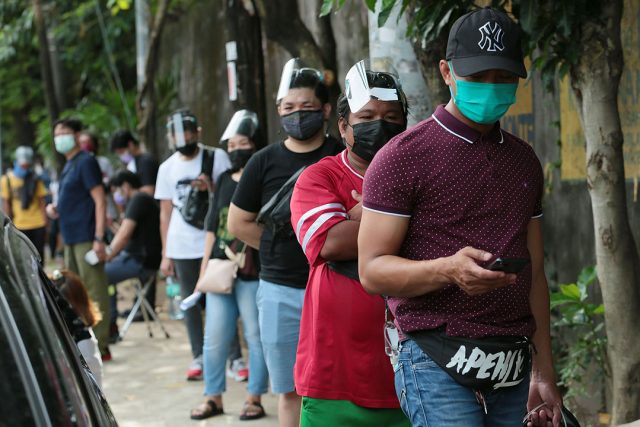
Residents of Quezon City line up outside the Commission on Elections office on Oct. 21, 2021. — PHILIPPINE STAR/ MICHAEL VARCAS

BANKS AND FINANCIAL institutions should closely monitor large transactions that may be part of money-laundering and vote-buying activities during the election campaign period, the Anti-Money Laundering Council (AMLC) said. 

The AMLC issued the advisory “in anticipation of the influx of financial activities that usually occur during the election period, and to ensure that proceeds from unlawful activities are not laundered during the campaign period.”

Filipinos will head to the polls on May 9 to vote for a new president, vice-president, lawmakers and local officials. The three-month election campaign period officially began on Feb. 8.

The “dirty money” watchdog reminded all covered persons to conduct appropriate customer due diligence measures, as outlined in the Anti-Money Laundering Act of 2001. They should closely monitor their customers’ transactions, and file suspicious transaction reports, if needed.

Aside from banks, covered persons include financial institutions like pawnshops, foreign exchange dealers, money changers, money changers and remittance companies, jewelry dealers, casinos, offshore gaming operators, and real estate brokers and developers. 

“Covered persons must be mindful of…red flag indicators and suspicious behaviors that are related/linked or are analogous to possible money laundering activities,” AMLC said in a statement.

These red flags include large transactions in a short period of time; and transactions that appear to be inconsistent with a customer’s financial profile or business.

Suspicious transactions include “unjustified” large cash deposits and withdrawals, “unusual” transactions that are not in line with everyday dealings; and structured cash deposits and money transfers.

Other red flags include the use of multiple accounts by a single person; and use of several money service businesses to send funds.

Earlier, the Bangko Sentral ng Pilipinas (BSP) through Memorandum M-2021-074 dated Dec. 31, 2021 also warned against the possible proliferation of digital vote buying amid the upcoming elections on May 9. Financial institutions were also told to watch out for the possibility that online banking and mobile wallet applications will be used for vote-buying activities. 

The BSP said financial institutions should ensure appropriate customer onboarding, effective fraud management, and ongoing transaction monitoring.

The Parish Pastoral Council for Responsible Voting (PPCRV) Chairperson Myla Villanueva said they have been alerted about offers of money to buy voters’ votes months ahead of the May 9 election. 

“We hear a lot of issues about vote buying and it’s very difficult for PPCRV to catch that and report it. We’re hearing a lot of big numbers being offered to people and families in fact,” Ms. Villanueva said in an interview with ABS-CBN News Channel on Monday.

Asian Institute of Management economist John Paolo R. Rivera said the culture of vote buying “exists because of poverty.”

“It’s challenging to regulate it because we do not have sophisticated systems to detect it. We only know it happened when it happens. It’s a bandaid solution to alleviate hunger and poverty, which the poor grabs because it will help them survive the day,” Mr. Rivera said in a Viber message.

Under the Omnibus Election Code, persons found guilty of vote buying or selling may face penalties of imprisonment for one to six years, disqualification from public office, and forfeiture of one’s right to vote.

The Commission on Election last week said cases of vote buying or giving money and other goods in exchange for support on election day may be reported through social media platforms. Comelec Spokesman James B. Jimenez said they are looking for ways to address the possible use of e-wallet services for such activities.

The Philippines has been included among jurisdictions under increased monitoring by the Financial Action Task Force (FATF) in June 2021. It needs to prove it has implemented tighter measures against dirty money and terrorism financing to exit the FATF’s “gray list.”

The government is hoping to be removed from the gray list by January 2023. — LWTN

PHL, Japan set to hold ‘high-level’ meeting

REUTERS
A person holds Japan’s national flag at the Imperial Palace in Tokyo, Japan, Jan. 2, 2020. — REUTERS/KIM KYUNG-HOON

THE PHILIPPINES and Japan will hold a high-level meeting on infrastructure development and economic cooperation this week, the Department of Finance (DoF) said, after Japan wrapped up its five-year aid commitment to the Philippines.

The two countries on Feb. 16 will discuss updates on financing extended by Japan for the Philippine coronavirus disease 2019 (COVID-19) response, along with advances on Japan-funded program supporting the peace process in Mindanao, DoF said in a press release on Monday.

The Japanese government donated over a million doses of the AstraZeneca vaccine to the Philippines last year.

Japan-backed coronavirus response projects also include support for medical equipment procurement and cold chain storage system development in the Philippines. The Asian Development Bank has also said it will also extend a $2-million technical assistance grant from the Japan Fund for Poverty Reduction to support health policy reforms in local government units.

Meanwhile, Japan has also been extending loans and grants supporting the Mindanao peace process, including road network projects in areas affected by conflict and agriculture livelihood assistance.

“Japan has been actively supporting these peace-building programs through the framework of the Japan-Bangsamoro Initiatives for Reconstruction and Development,” the DoF said.

The discussion, which will be done through teleconferencing, is the two countries’ 12th high-level meeting on infrastructure development and economic cooperation.

The first high-level committee meeting was held in 2017, after Japan Prime Minister Shinzo Abe committed to provide ¥1 trillion (about P446 billion) in financing support to the Philippines over five years, mostly funding big-ticket infrastructure projects.

The DoF in July last year said Japan’s funding commitment had been completed, adding that the country plans to further expand its assistance to the Philippines.

In the upcoming meeting, the Philippine side will be chaired by Finance Secretary Carlos G. Dominguez III, with Japan Special Advisor to the Prime Minister Mori Masafumi as his counterpart.

Discussions during the meeting will also include updates on the Japan-supported big-ticket projects under the government infrastructure program, including the Metro Manila Subway, the North-South Commuter Railway project, rehabilitation of the Metro Rail Transit Line 3 (MRT-3), Dalton Pass East Alignment Road, Central Mindanao Highway, and the Parañaque Spillway.

Last month, Japan also extended $13 million in aid for humanitarian responses in areas affected by Typhoon Odette, which hit parts of Visayas and Mindanao in December.

Japan was the Philippines’ top source of official development assistance over the two decades leading up to 2020, DoF data showed. Japan accounted for $14.139 billion worth of loans or 72% of the foreign aid portfolio over 2001 to 2020. — Jenina P. Ibañez

Traffic congestion eases in Metro Manila in 2021

PHILIPPINE STAR/ MICHAEL VARCAS
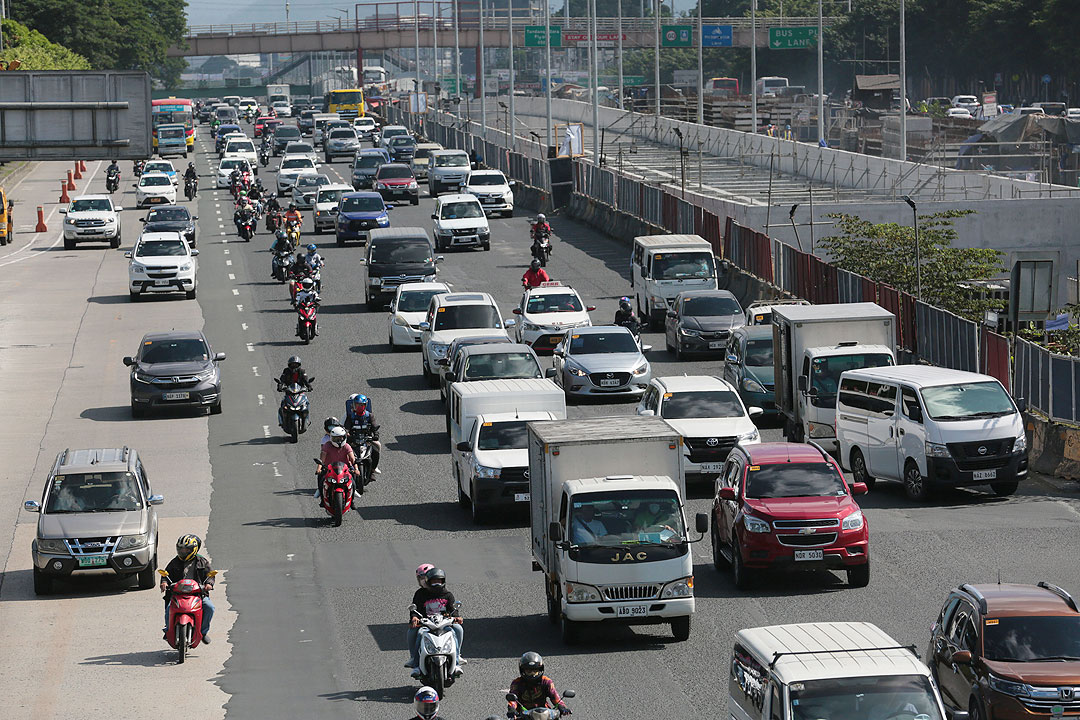
Traffic congestion in Metro Manila eased in 2021, according to a global traffic index. — PHILIPPINE STAR/ MICHAEL VARCAS

By Arjay L. Balinbin, Senior Reporter

TRAFFIC CONGESTION in the Philippine capital further eased last year, pushing Metro Manila out of the top five most congested cities in the world.

The TomTom Traffic Index 2021 showed Metro Manila is the 18th most congested city in the world, from 4th spot in 2020.

With strict lockdowns and mobility curbs in place during the second year of the coronavirus pandemic, Metro Manila saw its average congestion level decline to 43% in 2021, from 53% in 2020.

Amsterdam-based TomTom International B.V. said a 43% average congestion level means that on average, travel times were 43% longer than during the baseline non-congested conditions. For instance, a 30-minute trip driven in free-flow condition will take 13 minutes longer in 43% congestion.

TomTom, a geolocation technology specialist, computes the baseline per city by analyzing free-flow journey times of all vehicles on the entire road network — recorded 24/7, 365 days a year. It covered 404 cities in 58 countries.

The most congested city is Turkey’s Istanbul, with an average congestion level of 62%, followed by Moscow, Russia (61%); Kyiv, Ukraine (56%); Bogota, Colombia (55%); and Mumbai, India (53%).

Aside from Metro Manila, other cities with an average congestion level of 43% last year were Yekaterinburg, Russia; Tel Aviv, Israel; and Tokyo, Japan.

Metro Manila was the sixth most congested in Asia. India’s Mumbai, Bengaluru, and New Delhi were the region’s top three most congested cities.

In 2021, Metro Manila experienced the worst day in terms of traffic congestion on Aug. 5 with 90%. This was the day before the capital region was placed under an enhanced community quarantine due to the Delta-driven surge in coronavirus cases.

The report showed Friday had the worst rush hour, from 5 p.m. to 6 p.m. in Metro Manila. This was earlier than the 6-7 p.m. Friday rush hour in 2020 and 2019.

Congestion in Metro Manila averaged 53% during morning rush last year, a decrease of 42 percentage points since 2019, or before the pandemic, while it averaged 81% during evening rush, a decrease of 47 percentage points since 2019.

Time lost by motorists during rush hours last year reached 157 hours or equivalent to six days and 13 hours. This was four days and five hours less than in 2019.

Sought for comment, Transport expert Rene S. Santiago said the results for Metro Manila were not surprising because of the strict lockdowns.

“No face-to-face schooling means about four million trips a day disappeared. Work from home still dominated in 2021,” he said in a Viber chat.

“It is not a cause for joy, ironically, because economic activities [are] humming below pre-pandemic [levels]. What we should be planning for: how to retain some hybrids of remote working and remote schooling post-COVID,” he added.

Acting Socioeconomic Planning Secretary Karl Kendrick T. Chua said last year the community quarantines and physical distancing regulations intended to help protect lives had inadvertently “reduced transport supply and resulted in public transport shortages.”

In response to the public transport shortages, the government started creating protected bike lanes around the National Capital Region (NCR). The government had built 296 kilometers of bike lanes as of April last year, complete with pavement markings, bollards, curbs and solar studs.

TRAFFIC JAMS
Now that the NCR is under the more relaxed alert level status, the congestion level in Metro Manila as of Feb. 14 at 4:02 p.m., according to TomTom’s live traffic update, was 89%, significantly higher than the average last year.

“The economy is more open this year than last year. December last year, infection level was low and people underwent a lockdown revenge,” Mr. Santiago said, adding that face-to-face classes may resume soon.

Even if all restrictions on public transportation are lifted, Mr. Santiago expressed concern that there would be a shortage in drivers.

“Jeepney drivers will lose money if they go out because revenues won’t cover boundary fee plus cost of fuel,” he added.

For his part, Robert Y. Siy, a development economist and city and regional planner, said there is a need to make the “Build, Build, Build” infrastructure program of the current administration “less car-centric.”

Ang laki ng share ng infrastructure for roads and bridges that are primarily for cars,” he said during an online forum on Monday.

He also said that the government should replicate the EDSA Busway in other areas of Metro Manila. “We need to have dedicated lanes for public transport. Majority of our citizens use public transport, and public transport is our best weapon against traffic, climate change, and pollution,” he added, noting that this will eventually convince car users to shift to public transport.

Meanwhile, the Management Association of the Philippines (MAP) expressed its support for the government’s Integrated Bus Terminal Exchange (ITX) program.

“It is a key structural and transformational transportation reform measure in which provincial buses terminate inbound trips at an ITX terminal on the outskirts of the metropolis and passengers transfer to city commuter buses,” it said in an e-mailed statement.

MAP noted the ITX system spares provincial buses from getting stuck in urban traffic and enables faster turnaround trips back to provincial destinations.

“The government can assist the provincial bus operators in extracting value from their idled city terminals, which are sitting on now valuable land. These terminal sites can be devoted to other higher-yield commercial uses or disposed of at much higher prices. The gains earned should more than offset the cost of using the ITX terminal,” it added.

Metro Manila 18<sup>th</sup> worst traffic-congested city in 2021

Overhaul of MRT-3 trains to be completed by 2023

PHILIPPINE STAR/ MICHAEL VARCAS
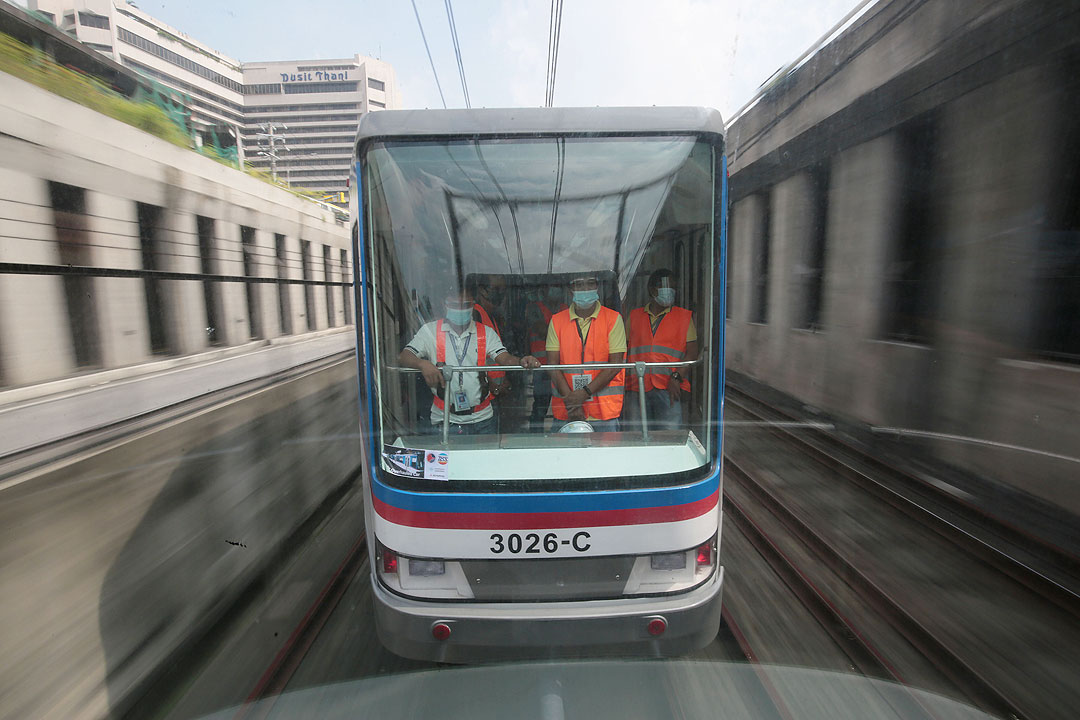
The overhaul of train cars of the Metro Rail Transit Line 3 is expected to be completed by 2023. — PHILIPPINE STAR/ MICHAEL VARCAS

THE overhaul of Metro Rail Transit Line 3’s (MRT-3) light rail vehicles (LRVs) is expected to be completed by early next year, an official said.

The Department of Transportation (DoTr) said the general overhaul of the MRT-3 train cars is part of the comprehensive rehabilitation of the rail line along EDSA. It aims to restore the MRT-3 to its high-grade design condition.

The number of revamped LRVs rose to 43 this month, with two LRVs deployed on Feb. 9. At present, 29 more train cars are scheduled for overhaul by the MRT-3 maintenance provider.

Work on the remaining 29 train cars will be completed by “April 2023,” MRT-3 Director for Operations Michael J. Capati told BusinessWorld in a phone message last week.

MRT-3 service providers Sumitomo Corp., Mitsubishi Heavy Industries Engineering, Ltd., and TES Philippines, Inc. have been contracted to overhaul all 72 LRVs.

They were also tasked to replace mainline tracks, rehabilitate power and overhead catenary systems, upgrade signaling, communications and CCTV systems, and repair all escalators and elevators.

The government imposed a 30% cap on rail passenger capacity during the strictest phases of the community quarantine. It was raised to 70% starting Nov. 4, 2021.

The MRT-3 rehabilitation project has reduced travel time from the North Avenue Station to the Taft Avenue Station to 45 minutes from the previous one hour and 15 minutes, the department noted. — Arjay L. Balinbin

FedEx tells farmers: Tap health-conscious Europe

FILIPINO farming entrepreneurs should take advantage of the country’s privileged access to European markets where demand for healthy food products has surged during the pandemic, the local unit of FedEx Corp. said in a report.

“The Department of Trade and Industry (DTI) has touted the market potential of Philippine agricultural products, especially in the European Union (EU) and the UK, where there is heavy demand for wellness-focused food products,” FedEx Express Philippines said.

“The demand for immunity-boosting, nutritious foods and beverages has surged as a result of the pandemic,” it added.

Separately, the European Snacks Association (ESA) reported that food products containing traditional and raw materials are gaining popularity among average consumers and more people are becoming conscious of the nutritional content of the food they consume.

In its report, FedEx Philippines said the Philippines enjoys privileged trading access to both the EU and the United Kingdom (UK) but Filipino small and medium-sized enterprises’ (SMEs) exporting power remains largely untapped.

“Some of the SMEs’ export-related challenges include their inability to adapt to changing market conditions and consumer preferences in export markets, as well as their low production capabilities. Furthermore, compliance with regulatory requirements and quality standards, both in local and potential export markets, also pose challenges to the entry of Philippines SMEs into the export market,” it said.

“The Philippines is one of the beneficiary-countries of the EU Generalized Scheme of Preference Plus (GSP+) that grants zero tariffs to 6,274 product lines. The same trade benefits are in place with the UK, which implemented its own GSP to mirror the EU’s GSP+ scheme after Brexit,” the company added.

The products included in this scheme are some varieties of fish, dairy, fruits, vegetables, coconut oil, coffee, cocoa, tobacco, chemicals, fertilizers, essential oils, soaps, and other commodities.

In 2021, the Department of Trade and Industry reported the “promising possibilities” of Philippine products such as processed fruits, calamansi, coconut, butterfly pea, and moringa.

“However, the EU continues to be a largely untapped market for Filipino producers, with products exported only to a select few European Free Trade Agreement (EFTA) countries. UK government statistics show that the Philippines lag behind other beneficiary countries in imports and utilization rate,” FedEx Philippines said.

The delivery services company said that for businesses to break into the international market, they must look into trade and logistics arrangements.

“The DTI’s Export Marketing Bureau (EMB) offers assistance to producers getting ready to venture beyond Philippine shores and also helps with connecting them with foreign buyers. SMEs can leverage trade agreements by focusing on global markets where their products are in demand and where beyond-the-border barriers are manageable,” it said.

“Logistics service providers who are well-versed in facilitating cross-border trade for their customers, such as FedEx, can play a critical role in helping to simplify complex processes for SMEs so that they can prosper globally. As a logistics service provider, we can guide businesses on the right packaging solutions to ensure that goods, especially perishable items, are delivered safely and securely,” it added. — Luisa Maria Jacinta C. Jocson

ODA-funded projects to continue during election period — DPWH

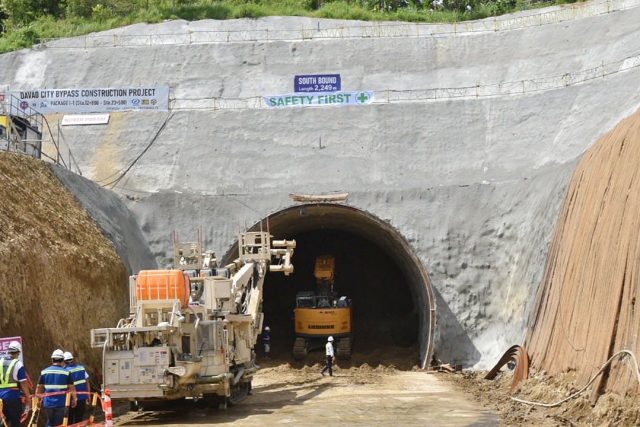
CONSTRUCTION of a two-tube tunnel is ongoing in Davao City. It is part of the 45.5-kilometer Davao City Bypass Road Project. — COURTESY OF DEPARTMENT OF PUBLIC WORKS AND HIGHWAYS

By Arjay L. Balinbin, Senior Reporter

THE implementation of projects funded through official development assistance (ODA) will not be disrupted during the election season, the Department of Public Works and Highways (DPWH) said.

“The Commission on Elections (Comelec) has to be notified and informed. Most of these are ODA-funded projects, so these are actually exempted from the election ban, except for those that are actually in the pipeline where there is no yet financing. What I am referring to are [those] projects that are still yet to be approved by the NEDA (National Economic and Development Authority) Board,” Public Works and Highways Undersecretary Emil K. Sadain said during a virtual briefing on Tuesday.

“Projects with approved loan agreements… can proceed [with] the implementation,” he added.

Under the Omnibus Election Code of the Philippines, the prohibition on releasing, disbursing or expending any public funds for public works does not apply “to ongoing public works projects commenced before the campaign period or similar projects under foreign agreements.”

The Comelec has said the public works ban for the May national elections will run from March 25 to May 8, 2022.

Also exempted from the public works ban, according to the Comelec rules posted on its website, are maintenance of existing and/or completed public works projects and those undertaken by contract through public bidding or by negotiated contract awarded.

Payment for the usual cost of preparation of public works project for working drawings, specifications, bills of materials, and estimates, purchase of materials and equipment, and other procedures preparatory to actual construction, and all incidental expenses for wages of watchmen and other laborers employed for such work in the central office and field storehouses is also exempted.

However, the prohibition does not cover emergency work during a public calamity, but is limited to the restoration of the damaged facility.

The Comelec said department secretaries, chief executives, heads of agencies (including government corporations, government financing institutions and state universities and colleges) with public works projects falling under any of the exceptions should apply for a “certificate of exception.”

NEDA Undersecretary Roderick M. Planta said there are 18 ODA-funded projects on the list submitted by the DPWH, including those projects funded by Japan, South Korea, Asian Development Bank (ADB), China, World Bank and Asian Infrastructure Investment Bank (AIIB). These projects are also part of the revised list of infrastructure flagship projects of the current administration.

Eight of the 18 projects that require Comelec certification are Japan ODA-funded, according to the list provided by Mr. Planta to BusinessWorld. These include Davao City Bypass Construction Project, Road Network Development Project in Conflict Affected Areas in Mindanao, Cebu-Mactan Bridge (4th Bridge) and Coastal Road Construction Project, and Metro Manila Priority Bridges Seismic Improvement Project.

The other Japan-funded projects are Pasig-Marikina River Channel Improvement Project Phase IV; Flood Risk Management Project for Cagayan River, Tagoloan River and Imus River; Flood Risk Management Project for Cagayan de Oro River; and Cavite Industrial Area Flood Management Project.

The list also includes four South Korean ODA-funded projects: Samar Pacific Coastal Road Project, Panguil Bay Bridge Project, Integrated Disaster Risk Reduction and Climate Change Adaptation Measures in Low-Lying Areas of Pampanga Bay, and consulting services for the Panay-Guimaras-Negros Link bridge.

Also included are three Asian Development Bank-funded projects: Improving Growth Corridors in Mindanao Road Sector Project, Reconstruction and Development Plan for a Greater Marawi, and Metro Manila Bridges Project.

A certificate of exception is also sought for the China-funded Ambal-Simuay River and Rio Grande de Mindanao River Flood Control Projects as well as the consulting services for the Davao River Bridge (Bucana Bridge), which is partly funded through the General Appropriations Act.

Moreover, the DPWH also included the Metro Manila Flood Development Project Phase 1, which is funded by the World Bank and the AIIB.

DPWH’s Mr. Sadain said the department is targeting to finish “about 24” projects this year, with 18 out of the 119 infrastructure flagship projects completed by the end of President Rodrigo R. Duterte’s term ends in June.

He said that of the 18 projects, 11 projects have been finished and seven more are being completed, including Flood Risk Management project for Cagayan River, Tagoloan River, and Imus River; Binondo-Intramuros Bridge; Samar Pacific Coastal Road Project;  LRT-2 East Extension; Motor Vehicle Recognition and Enhancement System; Unified Grand Central Station or North Triangle Common Station; and Malitubog-Maridagao Irrigation Project Stage 2.

He also noted that 89 projects out of the 119 on the list “will be carried out in 2023 and beyond.”

Century Properties sets 5.7524% rate for P3-B bond

CENTURY Properties Group, Inc. (CPG) has set the rate for its P3-billion, five-year fixed-rate bond at 5.7524% per annum, citing “strong capital markets.”

The bond comprises a P2-billion base offer with an oversubscription option of up to P1 billion.

“We are happy with the strong capital markets condition allowing us to price the issuance at the tighter end of the range of our indicative spread,” CPG Chief Finance Officer Ponciano S. Carreon said in a statement on Monday.

The offer period for CPG’s bond offering will end on Friday, Feb. 18. Its listing at the Philippine Dealing & Exchange Corp. is set to Thursday next week, Feb. 24.

China Bank Capital Corp., sole issue manager, sole lead underwriter, and sole bookrunner of the offer, expects the offering to “be very well received” by investors.

“This marks the fourth capital markets transaction of CPG, and we expect this offering to be very well received by a broad range of investors. We are honored to be a reliable partner of the CPG group in achieving its growth ambitions,” China Bank Capital President Ryan Martin L. Tapia said.

CPG said P1 billion of the proceeds from the offering will be used for the horizontal affordable housing projects of PHirst Park Homes, Inc. (PPHI), a joint venture with Mitsubishi Corp.

“We are greatly encouraged with the capital markets confidence in CPG and with the continued preference of first-homebuyers for our PPHI projects,” CPG President and Chief Executive Officer Jose Marco R. Antonio said.

“For this year, we will be launching four new master planned communities to serve the strong demand for quality affordable homes,” he added.

PPHI has launched three projects in Cavite, Bulacan, and Quezon as of September last year, which brought a total expected revenue of P2.9 billion. It launched another Cavite project in December 2021.

PPHI currently has 11 master planned communities, which are located in Batangas, Bulacan, Cavite, Laguna, and Pampanga.

Meanwhile, the balance will be used to partially refinance debt and other general corporate purposes.

The P3-billion offering is the initial tranche of the company’s shelf-registered P6-billion debt securities program shelf-registered with the Securities and Exchange Commission.

On Monday, CPG shares at the stock market closed unchanged at 42 centavos apiece. — Keren Concepcion G. Valmonte

DMW expects ‘exponential’ growth as it completes new projects this year

LOCATED within Aseana City in Parañaque, Parqal is touted by DMW as the “ideal model of a community-focused development.”

By Keren Concepcion G. Valmonte, Reporter

D.M. WENCESLAO & Associates, Inc. (DMW) is expecting “exponential” growth for the company as more of its projects are completed this year.

The property developer is aiming to end the year with a 240,000 square meters (sq.m.) in gross leasable area (GLA), DMW Chief Executive Officer Delfin Angelo C. Wenceslao said.

He said he expects an “exponential” growth “considering the amount of supply that [DMW is] putting into the market.”

“It’s not just 10%, 15%. From 90,000 sq.m. [of office GLA] in 2019, we’re currently already at a 160,000 sq.m. and 240,000 sq.m. by the end of this year,” Mr. Wenceslao said in an interview with BusinessWorld on Feb. 4.

The company expects Parqal, its “first truly mixed-use development,” to be completed by the third quarter, adding 70,148 sq.m. to its GLA. It is located within DMW’s Aseana City, located along Manila Bay in Parañaque City.

“It’s a mix of retail office and public space and we want to highlight this public space because 60% of that current development is actually dedicated to outdoor accessible, weather and climate protected public space, which I think is going to add extreme value to the developments already in the area,” Mr. Wenceslao said.

DMW noted that logistics and traditional companies are taking up the bulk of its office portfolio.

Mr. Wenceslao noted that most tenants are those moving from “pre-war buildings” to the company’s newly built offices for “the same rates.” DMW added several pandemic contingencies to its office buildings, including air filters, automated doors, among others.

The company was able to maintain its occupancy rate at 89% as of end-September 2021, leaving a vacancy of 11%.

DMW expects its office vacancy rate to rise with the recent completion of its 8912 Asean Ave., which added 69,284 sq.m. of GLA.

“We expect vacancy rate to rise only because of the huge addition of supply from 8912 Asean Ave., which only came online in the fourth quarter last year and is still yet to achieve stable occupancy,” Mr. Wenceslao said.

These office developments form part of the company’s 107.5-hectare Aseana City project.

For the residential segment, DMW is developing a four-tower condominium called MidPark Towers. This will be DMW’s second residential project inside the city after Pixel Residences.

The company still has 4,200 sq.m. of “non-core” plots to sell in Aseana City.

“We’re willing to let go of certain plots if we feel that these are uses which we won’t necessarily undertake ourselves or it’s something that we feel could add value to the community,” Mr. Wenceslao said. “We want to be able to provide a variety of brands and uses to our existing and future office or residential locators.”

DMW has completed two 1,790 sq.m. land sales in Aseana City, and inked a 25-year lease contract with Landers for a 15,064 sq.m. plot.

“Our leasing businesses will continue to account for the majority of our earnings. Residential sales are meant to replace land sales moving forward,” Mr. Wenceslao said.