Home Blog Page 6767

PATAFA sets series of SEAG selection meets

PATAFA President Philip Ella Juico — PHILIPPINE STAR FILE PHOTO

MAKING up for lost time, the Philippine Athletics Track and Field Association (PATAFA) is staging a series of Southeast Asian Games (SEAG) selection meets starting today with a two-day competition at the Baguio Athletic Bowl.

PATAFA President Philip Ella Juico said they have also set competitions at the Imus Sports Center on Sunday and the PhilSports track oval in Pasig City next month along with the National Open and the National Championships in April also at the PhilSports Complex.

“The reason for these competitions is, as you know, our athletes were not able to compete outside the region and this will somehow affect their competitive edge,” said Mr. Juico during Tuesday’s online Philippine Sportswriters Association Forum.

“Since they can’t compete outside, PATAFA is bringing the competitions to them,” he added.

The former Philippine Sports Commission chairman said the events would be supported by Milo and Lily’s Peanut Butter.

Milo vice-president Lester Castillo said their partnership with the PATAFA is in one with their vision of helping not just Philippine sports but its grassroots development program as well.

“We in Milo share the same vision with PATAFA. Milo in particular has always had the belief in nourishing kids’ journey to success through nutritious energy and inspiration to grow in sport,” said Mr. Castillo.

PATAFA secretary-general Renato Unso said events to be played in Baguio are decathlon, heptathlon, all the throwing events, individual pole vault, high jump and 3000-meter steeplechase while 100m, 200m, 400m, 800m, 1500m, 3000m, 3000m steeplechase and 5000m are lined up in Imus.

From there, the bulk of the national pool will proceed to Pasig for third leg, which will host all track and field events line up in the biennial meet slated for May 12-23.

Embracing innovation to benefit Filipino cancer patients, families

The biopharmaceutical industry is building a pipeline that is changing patients’ lives and, hopefully, will transform cancer into just another chronic illness that does not carry a death sentence. 

“We are seeing dramatic improvements in survival rates across different cancer types, including those common among Filipinos such as breast, cervical, colorectal, lung, ovarian, and prostate cancer, as well as non-Hodgkin’s lymphoma,” said Dr. Diana M. Edralin, general manager of Roche Philippines and president of the Pharmaceutical and Healthcare Association of the Philippines (PHAP), at a Feb. 14 forum held in conjunction with the third anniversary of the enactment of the National Integrated Cancer Control Act (NICCA). 

According to Dr. Edralin, with early detection, immediate and proper intervention, and treatment adherence, 6 out of 10 people diagnosed with these types of cancer today can live five or more years compared to 3 out of 10 people in 1975. Seventy-three percent of recent cancer survival gains are attributable to treatment advances, including new medicines. 

However, cancer drug development is a long and complex process. It takes approximately 14 years, more than 7 million work hours, over 6,500 experiments, and around 423 researchers to discover one revolutionary cancer medicine that eventually becomes the standard of care. And yet, there are also many failures. In the past 20 years, for the 115 cancer medicines approved, more than 1,300 projects were unsuccessful. 

Nevertheless, Dr. Edralin explained, these research investments are all worth it as researchers build on knowledge gained from these setbacks. With the introduction of new medicines, we are now seeing progression-free survival for certain types of cancers. Progression-free survival is the length of time during and after treatment that a patient survives without the cancer getting worse, she explained. 

In a subgroup of lung cancer patients given a new type of therapy, the overall survival rate increased from 19 months to 60 months or 3.3 years. Over the past decade, the five-year survival rate of cancer patients in the US improved by more than half from 14.5% to 23.7% due to innovations in treatment and diagnostics.  

“This is important because lung cancer is the second most common cancer and the number one cause of cancer-related deaths in the country. Imagine the impact if these newer medicines are easily accessible to every Filipino, regardless of age, gender or socioeconomic status,” Dr. Edralin said. 

It was underscored that there is a need to embrace innovation for the benefit of Filipino cancer patients, noting that countries such as the US, Germany, UK, Japan, and France, among others, where the highest number of new medicines are available are also experiencing the lowest death rates for cancer. To reduce cancer deaths in the country, she highlighted the need to broaden the availability of new cancer medicines in the national formulary and PhilHealth benefit packages. 

“Medicine availability is critical, and is the first step of access. We can change the medicine access availability narrative now with the tools provided for by NICCA. This could make a huge difference in providing Filipino patients access to much needed cancer medicines,” said Dr. Edralin. 

There are more than 1,300 cancer medicines and vaccines in development or under review by the US Food and Drug Administration, she added, noting that around 68% of medicines in the oncology pipeline are likely to be first-in-class medicines with new and unique mechanisms of action.  

“We are starting to understand how cancer works at a molecular level. New drug molecules that target specific receptors and pathways may offer longer survival or even cure cancer,” she said. 

Dr. Edralin commended local academic and training institutions and investigators who enabled the participation of Filipino cancer patients in global clinical trials. She also lauded the Department of Health for adopting the first targeted therapy for breast cancer, the most common cancer among Filipino women since the 1980s. “This innovative treatment has addressed at least 35% of breast cancer cases and increased the number of survivors in the country. We hope that more of these innovations will be adopted, especially those that are already available in the Philippines.” 


Teodoro B. Padilla is the executive director of the Pharmaceutical and Healthcare Association of the Philippines (PHAP), which represents the biopharmaceutical medicines and vaccines industry in the country. Its members are at the forefront of research and development efforts for COVID-19 and other diseases that affect Filipinos.

Flood of Japanese cash ready to buy Treasuries after US Federal Reserve

TREASURIES are off to their worst start to a year in over four decades, but a familiar set of supporters may soon ride to their rescue.

Momentum is building for Japanese investors — the biggest foreign holder of US bonds — to ramp up purchases, with recent auctions showing strong overseas demand and fund managers signaling there’s no real alternative. They are seen waiting for a volatile March to pass before positioning for the start of the new fiscal year in April — having been notable bond sellers on accelerating bets of Federal Reserve rate hikes.

“In the new fiscal year, there is no change for US Treasuries to be quite an important investment destination for Japanese investors,” said Satoshi Nagami, head of the asset allocation group at Sumitomo Mitsui DS Asset Management Co. But “until US monetary policy path becomes firm and clear, it would be difficult to immediately jump in on buying.”

Bond market volatility has picked up this month with Treasuries selling off when hawkish expectations for rate hikes are in the ascendancy and rallying when geopolitical sentiment worsens. Benchmark yields slid to as low as 1.84% in Asia trading on Tuesday amid the deepening tensions in Ukraine.

But recent US auctions have shown a surge in demand from foreign investors, as 10-year US yields traded close to 2%. For the Japanese, European debt is still seen as less attractive even after German bunds broke above zero earlier this year, while the Bank of Japan (BoJ) caps yields at home.

The currency-hedged yield on benchmark 10-year Treasuries was 1.21% on Friday, compared with 0.61% for an equivalent position in German bunds and 0.94% on 30-year Japanese government bonds, according to data compiled by Bloomberg. US markets were shut on Monday for a public holiday.

DOUBLE WHAMMY
A double whammy of soaring inflation and the Fed laying the groundwork for rate hikes have helped send a Bloomberg gauge of Treasuries down about 3% so far this year — its worst start since at least 1980. A spike in volatility and the potential for a super-sized rate hike in March are some of the reasons Japan’s fund managers have remained on the sidelines.

While it’s hard to quantify the effect on Treasuries a ramp up in purchases by the Japanese could have, historical periods when they pulled back from the market often coincided with spikes in yields.

“Japanese investors are taking a wait-and-see stance because of the risk of a 50 basis point Fed rate hike in March,” said Naokazu Koshimizu, a senior rates strategist at Nomura Securities Co. in Tokyo. “If the Fed lifts the rate by 50 basis points in March, inflation slows in the April-June period and it becomes more likely that the Fed will hike at a slower pace, then I’d expect Japanese demand for Treasuries to materialize.”

Mr. Koshimizu spoke before comments Friday from New York Fed President John Williams leaning against a half-point move, which led traders to pare back their expectations for March. On Monday, Fed Governor Michelle Bowman suggested that a half percentage-point increase could be on the table if incoming inflation data is too high.

The rise in yields has been global, so there are other avenues for Japanese money. Uncertainty over the pace of rate hikes across the Pacific suggests some may consider bonds from Europe.

“Relative carry income is higher for US than Europe now, but the difference with the US is that the pace of rate hikes would be slow in Europe,” said Eiichiro Miura, general manager of the fixed-income department at Nissay Asset Management Corp. “While life insurers will likely keep certain allocations to Treasuries, they may also turn to Europe, keeping in mind the risk of US rate hikes accelerating.”

LOCAL INTERVENTION
And while yields in Japan have also climbed — the 30-year yield came close to 1% Thursday, its highest since February 2016 — the BoJ anchors it with its yield-curve control policy. The central bank intervened in 10-year bonds on Feb. 14 and some traders are speculating it could also do something on longer-dated securities.

That suggests the demand for Treasuries will continue — Japanese investors bought more of them than bonds from any other market last year, even as they cut purchases by almost half to 5.5 trillion yen ($47.7 billion).

“We do expect that the Japanese buying of Treasuries will persist, especially once the financial year end has passed, and for as long as the BoJ holds rates down in Japan,” said Andrew Mulliner, head of global aggregate strategies at Janus Henderson. — Bloomberg

Singapore-based ADVANCE.AI eyes opportunities in PHL financial services

SINGAPORE-BASED artificial intelligence (AI) company ADVANCE.AI is targeting to onboard more clients from the Philippines, focusing on financial services, its newly appointed country manager for the Philippines said.

“These are the three main sectors we will be focusing on: FSIs (financial service institutions) in payments and remittance as well as lending; banks in traditional and digital; and fintech, specifically crypto, payments and remittance, and lending,” ADVANCE.AI Country Manager Michael M. Calma told BusinessWorld in an e-mailed reply to questions.

“The aim is to leverage our technology to allow more Filipinos to access digital banking services, with our facial recognition technology allowing consumers to open a bank account remotely using eKYC (electronic Know Your Customer),” he added.

ADVANCE.AI provides digital transformation, fraud prevention, and process automation solutions for its enterprise clients. It currently partners more than 1,000 enterprise clients across banking, financial services, fintech, payment, retail and e-commerce sectors.

The company is part of Advance Intelligence Group, a technology startup based in Singapore.

ADVANCE.AI announced the appointment of Mr. Calma last week. He said he intends to “adopt a very open, consultative and customer-centric approach to partnerships within other solution providers, banks/financial services and the NBFI (nonbanking financial institution) space, and also with regulators to support national agenda of driving financial inclusion among unbanked and underbanked.”

He also hopes to expand the company’s Philippine team. “We have several open roles in business development and also solutions consulting. We want to ensure our clients and partners that we are investing in a local team to provide them only the best support.” — Arjay L. Balinbin

Arts & Culture (02/23/22)

CCP’s Pasinaya celebrates EDSA People Power

THIS year, the Cultural Center of the Philippines’ (CCP) Pasinaya Open House Festival celebrates the spirit of the EDSA People Power Revolution. Two years into the COVID-19 pandemic, the CCP’s Pasinaya goes online again on Feb. 26 to 27. This year’s festival carries the theme “Sana All Lumilikha, Lumalaya” (Hopefully all can create, be free).  Celebrating the 36th anniversary of EDSA People Power this year, Pasinaya 2022 is a two-day virtual event that will showcase various activities in the performing arts, literary arts, visual arts, film and broadcast arts. It will feature an exhibit, a forum, a digital timeline, and the lighting of the CCP façade. The festival has special premieres such as Radyo Malaya: Soundbites of a Revolution by PumaPodcast, a radio drama re-enactment of the events during the EDSA Revolution in 10 episodes; Pagsamo: Gabay at Pagbabago, presented by Kaisa sa Sining – Luzon Network, a performance that is a prayer for guidance and change; Isang Harding Papel, a storytelling session by Kara David of a book that talks about a girl and her mother during Martial Law; OPM’s Not Dead! Ang Panitik sa Musika ng Asin, Banyuhay at Punoy Punk, a tribute to the songwriters and musicians of Original Pilipino Music (OPM); Pili-pino, a dance video collaboration interpreting the song “Handog ng Pilipino sa Mundo,” with direction and choreography by Ronelson Yadao; and Panata sa Kalayaan, a dramatic reading of “Panata sa Kalayaan” by artists Nanding Josef, Shamaine Buencamino, Irma Adlawan, Monique Wilson, Nonie Buencamino, Tibo Fernandez, PETA, Kasing Sining of Bohol, and the Tanghalang Pilipino Actors Company followed by the song interpretation by Sing Philippines Youth Choir conducted by Mark Anthony Carpio. Visitors can reminisce about the days of the EDSA Revolution through social media by tuning in to various posts such as People Power 1986: Where Were You? Mga Saysay Mula Sa Sining Biswal; Edsa 36: An Intimate Retrospective On The CCP During The People Power Revolution; Banned! Valerio Nofuente Collection — Online Exhibit, and the Kalayaan Book Fair. For more details, follow the CCP’s official social media accounts on Facebook, Twitter, Instagram or visit the CCP website at www.culturalcenter.gov.ph.

72-year-old artist creates first NFTs

IN HIS first foray into NFTs, Carlos will be dropping seven non-fungible tokens (NFTs) simultaneously with his online exhibition of artworks on Feb. 28, his 72nd birthday.Into the World of Carlos” introduces NFTs into the body of work of the artist, minted on Foundation.app as a grant from First Mint Fund and in collaboration with animator IJ Cacnio. “While NFTs are a new medium for me, it seems like an exciting and organic progression for my work,” says Carlos, who goes by a single name. “It’s quite the adventure: one that transcends physical and temporal limitations and holds so many possibilities.” The NFTs sprung from a remark Carlos’ collectors have told him over the years: “I wish I could step into the painting.” This dictated the thematic concept of the roadmap of the NFTs, and with these first seven works, Carlos has invited viewers to “step into his world” through the shared vision of Cacnio. At 72, Carlos may be one of the oldest–if not the oldest — NFT artists to date. Into the World of Carlos launches on Feb. 28 on www.artbycarlos.com and https://www.foundation.app/@artbycarlos. For more information, contact 0917-822-5673 or e-mail contact@artbycarlos.com.

Podcast inspired by Chito Gaston’s legacy

CHITO Gascon’s legacy inspires advocates across generations. In January, Asia Society Philippines, together PumaPodcast, BUKAS, and Youth Led — a project of The Asia Foundation and the United States Agency for International Development — launched Kung Gusto Mong Pagbabago: The Chito Gascon Leadership Series in honor of the late chairperson of the Commission on Human Rights. The series, hosted by broadcaster Roby Alampay, invites reform advocates across generations for a conversation on their experiences and challenges in pursuing change then and now. The conversations were presented on Facebook livestream and are now also a podcast. From January to May, the five-part series will feature a luminary from a different field. In its pilot episode, Kung Gusto Mong Pagbabago invited lawyer Ted Te of the Free Legal Assistance Group (FLAG), for the keynote speech. He spoke on the theme of activism and advocating for change. “Activism, while important, has its limits,” he says. “Shouting outside the establishment can only work if people inside are willing to listen. Advocacy becomes essential when you’re already inside the room and the person who is supposed to change things is about to listen.” The episode’s panel of young changemakers featured human rights lawyer Ross Tugade, Usapang Econco founder Maien Vital, and Ken Abante of the We Solve Foundation. Episode2, “Speaking Truth to Power,” goes live on Asia Society Philippines’ Facebook page on Feb. 24, 6 p.m., featuring Sheila Coronel, Atom Araullo, and more. To hear highlights from each episode, follow Kung Gusto Mong Pagbabago: The Chito Gascon Leadership Series wherever you listen to podcasts.

Pasig River Appreciation Walk this month

REBIRTH MANILA and the NotoPAREX Network will be holding their first Heritage Walk for 2022 on Feb. 26 from 10 a.m. to noon. Meeting time for The Pasig River Appreciation Walk is at 9:30 a.m. at Plaza Lawton /Liwasang Bonifacio. The group is limited to 20 participants due to coronavirus disease 2019 (COVID-19) restrictions. To register, visit https://forms.gle/zvFgic9oiGLgabs76. Admission is free but donations are appreciated and there are souvenirs for sale. For more information, visit www.facebook.com/akim.63 and Rebirth Manila at Facebook.

Silverlens exhibits on site and online

SILVERLENS presents the exhibit Resonant Earth, featuring ceramic and stoneware works by Joseph Gabriel, Hanna Pettyjohn, Pam Quinto (curated by Carlos Quijon, Jr.), will run from Feb. 22 to March 26. Meanwhile, at the Online Viewing Room, Chati Coronel’s exhibit, Inner Constellations, will run from Feb. 22 to March 10. The gallery is located at 2263 Don Chino Roces Ave. Ext., Makati. For details contact 8816-0044 or 0917-587-4011or e-mail info@silverlensgalleries.com. The gallery’s website is at www.silverlensgalleries.com.

Gateway Gallery holds talks on conservation, archiving

IN line with the celebration of National Arts Month, the Gateway Gallery will be conducting two back-to-back talks on art and cultural management on Feb. 24. Art conservator June Mercy Poticar-Dalisay will discuss preventive conservation, qualifications of a conservator, factors of deterioration, and care of artworks in “Adding Value to Artworks through Preventive Conservation.”  Manager of Artemis Restoration Services, Dalisay has done restoration works on the Central Bank art collection, the Manila Hotel art collection, and the PNB art collection. She has restored three murals done by Manansala and Tam Austria, and continues to conserve and maintain the collection of the Development Bank of the Philippines. Meanwhile, archives manager Marites Alberto Gonzaga will share her knowledge on “Archiving Principles and Practices for Non-Archivists.” Gonzaga is the Archives Manager of the Araneta Group and Deputy Director of the President Manuel A. Roxas Foundation since 1998. The talks will be held onsite at the Gateway Gallery, 5th floor of Gateway Tower in Araneta City, Quezon City, from 3 to 5 p.m. Registration fee is P1,000, which is inclusive of handouts and certificates. To register, click the online registration form on the official Facebook event page (https://fb.me/e/WovpRnc5).

Colorful exhibit at ARTablado

TWO artists, Melli Villavicencio and Kimberly Mamaril, consider how a prism transforms light into a myriad of colors and the act of artistic creation itself. According to Villavicencio and Mamaril: “We internalize the external factors that come through us and we try to make sense of the world out of it. We bend the light and conceive a spectrum of stories.” Their works can be seen in the exhibit “Prism,” which will be on view at ARTablado, Level 3, Robinsons Galleria from March 1-15. Ms. Mamaril used to work as a copywriter in an ad agency before deciding to pursue painting full time. She expresses themes of railing against consumerism, the digital age, and the sexual objectification of women via pop imagery that is juxtaposed and fragmented. Aside from teaching visual communications in St. Paul’s College, Pasig, Ms. Villavicencio teaches art therapy for children under the Autism Spectrum Disorder. She is known for her colorful, fancy, almost child-like visual style — whimsical yet introspective at the same time.

Cinemalaya calls for short feature films

THE CINEMALAYA Philippine Independent Film Festival 2022 is now open for submission of entries for its Short Film Category. Deadline for submission is on or before April 8, at 6 p.m. The Short Film Category is open to Filipino filmmakers only. Entries must have been produced within the period of March 5, 2021 to April 8, 2022. Interested participants can submit their entries via online or offline channels. The 10 short feature finalists will be screened during the 2022 Cinemalaya Film Festival from Aug. 5 to 14. For the complete mechanics, visit the CCP and Cinemalaya websites (www.culturalcenter.gov.ph and www.cinemalaya.org). For more updates, follow the CCP and Cinemalaya official Facebook social media accounts.


Obiena not part of national training pool — Juico

OLYMPIAN pole-vaulter Ernest John “EJ” Obiena will need to enter the Hanoi Southeast Asian Games (SEAG) via other means if he wants to participate in the biennial event set on May 12-23.

This came after Philippine Athletics Track and Field Association (PATAFA) President Philip Ella Juico confirmed that the World No. 5 and Asian record-holder was not part of the national training pool list preparing for the Hanoi meet.

“EJ Obiena is not in the national training pool list,” said Mr. Juico in Tuesday’s online Philippine Sportswriters Association Forum.

Mr. Juico, however, is not closing the possibility of Mr. Obiena being reconsidered for national team re-inclusion if the PATAFA board decides it.

But without PATAFA’s endorsement, the reigning Southeast Asian Games gold medalist and record-holder will have to find other ways to get to see action for a chance to strike gold anew.

One way mentioned in the past was through the endorsement of the Philippine Olympic Committee (POC).

In fact, POC President Abraham Tolentino had listed Mr. Obiena in the 80 athletes who will finance their own trip to Hanoi.

The congressman from Tagaytay said there is an International Olympic Committee (IOC) provision that emphasized on the National Olympic Committee’s sole authority to submit the delegation proposed by the national sports associations as the final list in all IOC-sanctioned events including the SEA Games.

Mr. Obiena is a sure gold in the SEA Games and could impact the country’s bid to match, if not improve, on its 11-8-8 gold, silver and bronze medal haul in the last edition in Capas, Tarlac two years ago. — Joey Villar

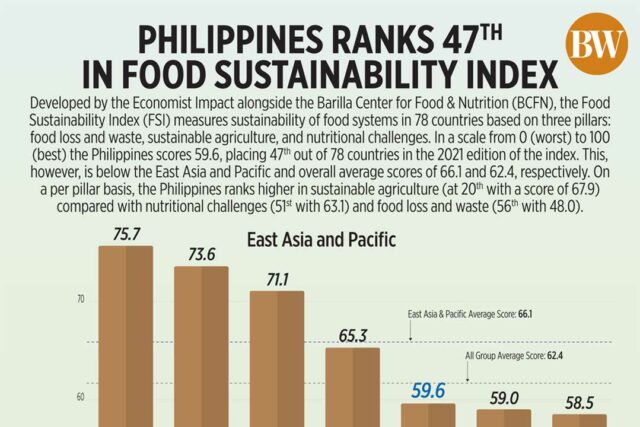
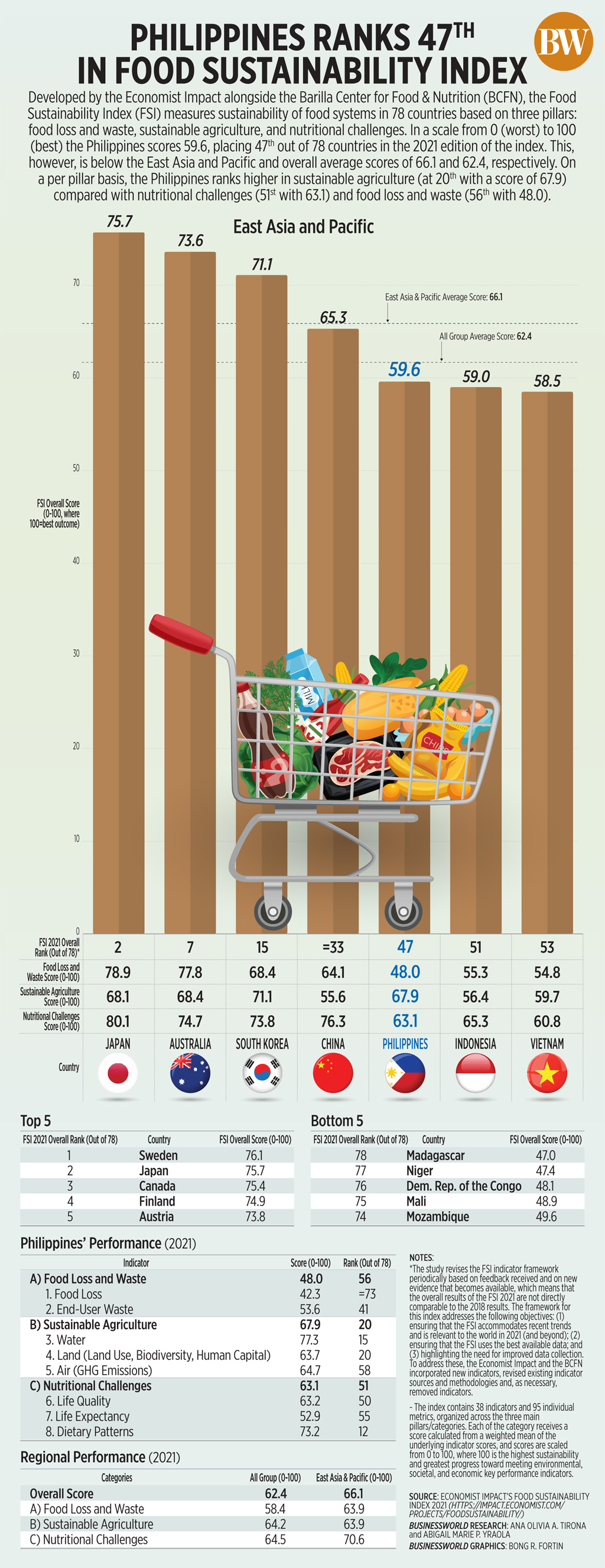
Philippines ranks 47th in food sustainability index regional

Philippines ranks 47<sup>th</sup> in food sustainability index regional

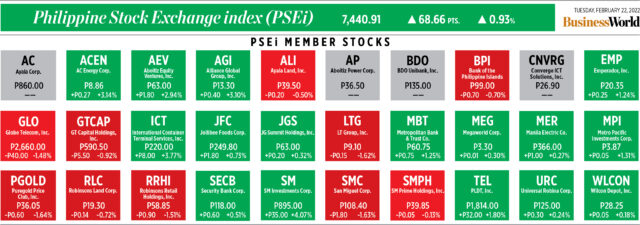
How PSEi member stocks performed — February 22, 2022

Here’s a quick glance at how PSEi stocks fared on Tuesday, February 22, 2022.


Senior legislator rules out giving gov’t power to regulate fuel prices

PHILIPPINE STAR/KRIZ JOHN ROSALES

By Marielle C. Lucenio

SENATOR Sherwin T. Gatchalian, who chairs his chamber’s energy committee, said on Tuesday that giving the government the power to control fuel prices is “dangerous,” and instead proposed the permanent implementation of fuel subsidies for jeepney drivers.

“Time and time again, (we have seen) that the government is the worst operator. When you put businesses in the hands of the government, corruption will ensue,” Mr. Gatchalian told BusinessWorld by phone call.

Retail fuel prices rose for an eighth consecutive week on Tuesday.

Groups representing consumer and rural interests have urged legislators to give back to the government the power to control fuel prices, which would require the repeal of the Downstream Oil Industry Deregulation Act of 1998. The law gave oil companies the power to set their own market prices to increase competition in the fuel market.

Mr. Gatchalian said measures such as the suspension of the excise tax on fuel, which was resorted to by Thailand, will hurt the economy by cutting off a source of government revenue.

“The country earned around P131 billion in excise taxes in 2020, and it is projected to increase over time,” he said.

Instead, he said, the Land Transportation Franchising and Regulatory Board (LTFRB) must make the fuel subsidy program for jeepney drivers permanent. The program is known as Pantawid Pasada.

“I would rather institutionalize the program down to the tricycle drivers as it is supposed to be a shock absorber against increasing oil prices,” he said.

BusinessWorld asked the LTFRB to comment, but it had not replied at the deadline.

On Tuesday, petroleum product prices increased for an eighth consecutive week, with the price raised P0.80 per liter for gasoline; P0.65 for diesel; and P0.45 for kerosene.

Since the start of the year, fuel prices have increased by P8.75 per liter for gasoline; P10.85 for diesel; and P9.55 for kerosene.

BIR reminds political candidates to declare unused contributions

PHILSTAR

THE Bureau of Internal Revenue (BIR) told political candidates to report their unused contributions as income, to maintain up-to-date tax registrations, and to issue receipts for political contributions.

The BIR issued the reminders in Circular No. 22-2022, which applies to all candidates, political parties, party-list groups, and campaign contributors.

In most cases, campaign contributions are not classified as taxable income because they are typically not used for personal spending, the BIR said. However, campaign funds that were either unused or used before the campaign period are subject to income tax and must be declared on income tax returns.

“Thus, to be considered as exempt from the income tax, these campaign contributions must have been utilized to cover a candidate’s expenditures for his/her electoral campaign during the campaign period,” the BIR said.

The circular, released on Monday, requires all candidates and political organizations to issue non-VAT (value-added tax) official receipts for every contribution received, whether in cash or in kind, at fair market value.

Similarly, only donations used during the campaign period are exempt from donor’s tax.

The campaign period officially began on Feb. 8. The elections will be held on May 9.

Goods and services purchased with campaign funds are subject to 5% creditable withholding tax. These include payments for media services, printing, entertainment, and property rental.

The use of land and equipment free of charge for the campaign should be declared as expenses, based on prevailing rates.

The Omnibus Election Code requires all political candidates and groups are required to keep a record of contributions and expenses. After the election, they must submit a statement of these contributions and spending to the Commission on Elections.  Jenina P. Ibañez

DPWH evaluating sites for NCR catch basins to counter floods

THE Department of Public Works and Highways (DPWH) regional office in Metro Manila said it is currently evaluating sites for catch basins to minimize flooding in the capital.

The site initially proposed was the open space at the University of Santo Tomas campus, but this was rejected due to fears that construction would affect the university’s older buildings.

“We started scouting possible government areas… doon sa mga low-lying areas na noted na sa pagbabaha (in low-lying areas where flooding happens),” DPWH Regional Director Nomer Abel P. Canlas told BusinessWorld in a recent phone interview.

“We are now in the process of surveying and coordinating with some LGUs (local government units) and other government agencies,” he added.

He said the project, known as a water impounding facility, will be proposed to the DPWH national office.

In the DPWH’s flood management master plan for the Greater Metro Manila area, among the considered measures was the application of rainwater catchment system that will enable some communities to store rainwater for reuse instead of allowing it to run off into a waterway.

The World Bank estimates that the Philippines was visited by 94 destructive typhoons between 2011 and 2015, or 9.3% more than the number of typhoons between 2006 and 2010.

The World Bank provided technical and financial assistance for the department’s flood management master plan for Greater Metro Manila.

“The Philippines is expected to be among the countries that will suffer long-term and repetitive damage from extreme weather patterns brought about by climate change. Lack of inclusive growth negatively affects the ability of a large part of the population to deal with natural disasters,” the World Bank said in a project information document posted on its website.

The World Bank also noted that many areas in Metro Manila are low-lying and designated as flood prone, with insufficient protection against frequent inundation as natural drainage is often restricted during rainfall events by high river and sea water levels.

“About 80% (1,700 mm) of the annual rainfall occurs during the typhoon season from June through October, when rain can be particularly intensive. As a result, flooding is a recurrent problem in Metro Manila that causes flooding of roads, affecting traffic and movement of people, and flooding in houses and buildings.” — Arjay L. Balinbin

BoI pitching potential Taiwan locators

NEW CLARK CITY

THE Board of Investments (BoI) is inviting more Taiwan investors to enter the Philippine market, noting that some export locators have expanded recently.

Ceferino S. Rodolfo, BoI managing head and Trade undersecretary, said the door is fully open to Taiwan companies, with the Philippine economy picking up momentum in the wake of the coronavirus disease 2019 (COVID-19) pandemic.

“We are ready to make it happen for you here in the Philippines. (The) door is fully open. In the Philippines, even during the pandemic, we strive hard to make sure that export manufacturing remains in operation. Some have even expanded,” Mr. Rodolfo said during a recent webinar conducted by the Bases Conversion and Development Authority (BCDA) and the Taipei Economic and Cultural Office (TECO) in the Philippines.  

He added that the business climate is set to improve following the passage of amendments to the Retail Trade Liberalization Act and the amendments to the Public Service Act and Foreign Investment Act, which are awaiting the signature of President Rodrigo R. Duterte.

Mr. Rodolfo encouraged Taiwan companies to jointly develop and process minerals needed to fill gaps in the value chain for electric vehicles.

“We invite Taiwan companies so that we can process nickel, cobalt, and copper,” Mr. Rodolfo said.

TECO representative in the Philippines Michael Peiyung Hsu called New Clark City in Tarlac a promising venue for Taiwan investors.

According to the BCDA, 15 Taiwan companies have located in New Clark City, generating 4,933 jobs and accounting for investment worth $213.54 million.

BCDA Executive Vice-President Aileen Anunciacion R. Zosa said some of the investment opportunities in New Clark City include the Information and Communication Technology Corridor Project, the Data Center Colocation Facility, the Solid Waste Management, the Waste-to-Energy Project, and Research and Knowledge-based Pharmaceutical and Medical Facilities. — Revin Mikhael D. Ochave

ADVERTISEMENT
ADVERTISEMENT