Home Blog Page 6607

Palace confident of getting buy-in for recovery plan when new gov’t takes over
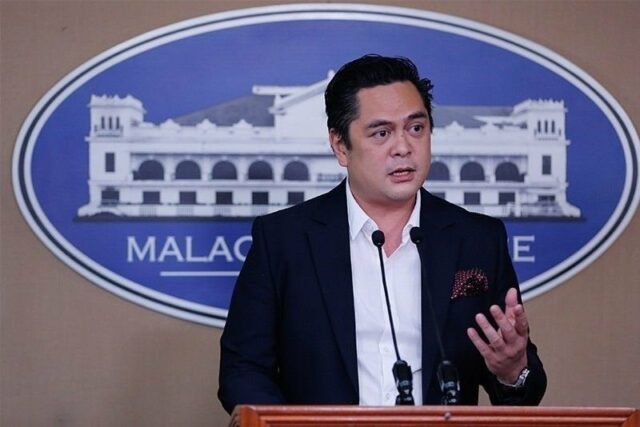
Jose Ruperto Martin M. Andanar, Acting Presidentiall Spokesman | Philstar

THE next administration is legally bound to implement Executive Order (EO) 166, which contains elements of President Rodrigo R. Duterte’s economic recovery plan, unless it is revoked, the Palace said in a statement.  

The President’s acting spokesman, Jose Ruperto Martin M. Andanar, rejected claims that EO 166 represents the outgoing government’s closing move in effecting an economic recovery. 

“We do not share the view that this is the current Administration’s exit plan, for this forms part of the country’s preparation to build resilience under the new normal,” he said. 

“Unless Executive Order No. 166 is modified or revoked, it will remain effective and operational,” he added. 

EO 166 is a 10-point economic recovery agenda that, among others, designated the Inter-agency Task Force for the Management of Emerging Infectious Diseases and the National Task Force Against COVID- 19 as the bodies responsible for the agenda’s implementation and for aligning all government measures to ensure a coordinated response to the weakened economy. 

The agenda calls for legislation that will facilitate the efficient rollout of emergency measures and the development of a comprehensive pandemic response framework.

Mr. Andanar said Mr. Duterte’s office is confident that the next administration will adhere to the principles of EO 166.   

In a joint statement, the National Economic and Development Authority (NEDA), the Department of Finance, and the Department of Trade and Industry said EO 166 will boost the economic recovery.  

“Through the EO, we will be able to help more firms adapt and pursue the full and safe reopening of the economy,” Trade Secretary Ramon M. Lopez was quoted as saying.

Socio-Economic Planning Secretary Karl Kendrick T. Chua said in the statement that the Philippines has made significant progress in implementing elements of the 10-point agenda, citing the move to more permissive quarantine settings after the Omicron wave of the coronavirus receded.

Under Alert Level 1, NEDA estimates that economic activity will be boosted by around P10.8 billion per week and reduce the number of unemployed by around 195,000 over the next quarter, compared to the economy’s performance under to Alert Level 2, the next and less permissive quarantine setting.  

Mr. Chua, however, said the full benefit of Alert Level 1 cannot be maximized if many schools are still not conducting face-to-face learning.   

“NEDA estimates that the economy is… around P12 billion per week (below potential performance) since schools are largely closed. Further, one-fourth of parents have to stay at home to help their younger children study in modular or online learning,” according to the statement. “The result is drastic loss in productivity and foregone income opportunities.” — Kyle Aristophere T. Atienza 

Budget proposed in 2023 to bring NCR overhead cables underground

THE Department of Public Works and  Highways (DPWH) is seeking funding in the 2023 budget to begin taking overhead cables underground in the National Capital Region (NCR), the regional director in charge of Metro Manila public works said. 

“We requested some P200 million for this project in the 2023 National Expenditure Program,” DPWH-NCR Regional Director Nomer Abel P. Canlas told BusinessWorld by phone on Thursday. 

He said the funding will support both the feasibility study and infrastructure that will house the buried cables.  

The DPWH is also hoping to “subsidize the transfer costs” for distribution companies that use overhead cable like Manila Electric Co. (Meralco) and telecommunications companies. Water utilities may also be supported in moving their above-ground transmission assets. 

“If we can’t (get) funding from utility companies…, the government [can] initially take charge of the finances,” he said. “We have to start somewhere.” 

Mr. Canlas also noted that the project could be revenue-positive for the government by making utility companies pay to use the infrastructure that will house the buried lines.  

“If the utility companies use the infrastructure, I think it’s just proper, perhaps, to bill them in some way. That’s being considered,” he added. 

The feasibility studies will be conducted along the Epifanio de los Santos Avenue (EDSA) and the Katipunan Avenue Extension. Mr. Canlas said the DPWH also wants to include the Radial Road 10 or R10. 

Apart from the aesthetic advantages, underground cable minimizes accidents from electrocution as well as damage to utility poles during typhoons. 

Among the benefits to utility companies is that they get to skip the step of acquiring road right-of-way for their posts, according to Mr. Canlas. 

In a statement, the DPWH said that it recently studied Davao City’s implementation of an underground utility cable system. 

“One of the suggestions raised is the imposition of ordinances requiring full participation of the concessionaires, and the creation of ‘Underground Utility Cabling Committee’ that will constantly coordinate and meet for developments and issues in the implementation,” it noted. 

The government has been pressed to consider underground cable as part of its disaster resiliency strategy in order to minimize service outages during calamities. 

Utility service providers have said they are willing to shift to an underground cable system if the government provides subsidies and if given adequate planning of the infrastructure. 

DoF says Customs modernization behind enhanced collections

PHILSTAR FILE PHOTO

COLLECTIONS by the Bureau of Customs have benefited from modernization, with targets exceeded during the two years of the pandemic, its parent agency, the Department of Finance (DoF) said.  

The DoF said in a statement on Thursday that collections received a boost from automated processes, with 2020 collections amounting to P537.69 billion, 106.2% of the target. In 2021 collections were P643.56 billion, or 104.3% of the target. 

Customs Commissioner Rey Leonardo B. Guerrero was quoted as saying that the Customs modernization program integrated data from the Ports of Manila, Cebu and Davao and the Manila International Container Port for monitoring by the Customs Operation Center (COC) in Manila. 

The COC, launched in December 2020, is the bureau’s center for intelligence, monitoring and enforcement. 

Mr. Guerrero also cited positive results from the Cargo Targeting System, developed by the World Customs Organization (WCO), which monitors advanced submission of aircraft and ship cargo manifests for profiling and risk assessment.   

He added that the BoC’s Information and Communications Technology-enabled projects have automated the submission, processing and approval of applications by importers and exporters. The application process is compliant with WCO standards.  

The Bureau plans to roll out a day and night payment system, to speed up the release of goods delayed by Customs operating hours. 

The current payment system only runs from 8 a.m. to 5 p.m., Mr. Guererro said. — Tobias Jared Tomas 

Peso advances as central bank keeps key policy rates untouched

BW FILE PHOTO

THE PESO strengthened on Thursday after the central bank continued to keep borrowing costs steady to support economic recovery.

The local unit closed at P52.33 per dollar on Thursday, rising by six centavos from its P52.39 finish on Wednesday, based on data from the Bankers Association of the Philippines.

The peso opened Thursday’s session at P52.41 per dollar. Its weakest showing was at P52.43, while its intraday best was at P52.15 against the greenback.

Dollars exchanged declined to $960.95 million on Thursday from $1.015 billion on Wednesday.

The peso appreciated after the central bank left benchmark rates at record lows, a trader said in a Viber message.

The Bangko Sentral ng Pilipinas (BSP) kept rates steady at its meeting on Thursday but said it could hike soon amid rising inflation risks amid the war between Russia and Ukraine.

“The Monetary Board sees scope to maintain the BSP’s policy settings in order to safeguard the momentum of economic recovery amid increased uncertainty, even as it continues to develop its plans for the gradual normali-zation of its extraordinary liquidity measures,” BSP Governor Benjamin E. Diokno said at a virtual briefing on Thursday.

Meanwhile, Rizal Commercial Banking Corp. Chief Economist Michael L. Ricafort said the peso appreciated following the BSP’s new inflation forecasts.

Citing the steep increase in prices of oil and other commodities, the central bank now expects inflation to reach 4.3% in 2022, which is already above its 2-4% target and the 3.7% estimate previously.

By 2023, inflation is expected to slow to 3.6%.

For Friday, both Mr. Ricafort and the trader gave a forecast range of P52.20 to P52.40 per dollar. — LWTN

Local stocks rise on recovery plan, BSP decision

COURTESY OF PHILIPPINE STOCK EXCHANGE, INC.

SHARES rose on Thursday following the approval of an executive order outlining a 10-point agenda for the economy’s recovery and the Bangko Sentral ng Pilipinas’ (BSP) decision to keep benchmark interest rates steady.

The benchmark Philippine Stock Exchange index (PSEi) gained by 73.18 points or 1.04% to close at 7,082.61 on Thursday, while the broader all shares increased by 34.60 points or 0.92% to 3,759.35.

“The local bourse rose this Thursday amid hopes that the Philippine economy’s recovery would remain strong despite headwinds from offshore. Strong economic recovery hopes were backed by the newly approved Executive Order (EO) No. 166 which is seen to give emphasis on stronger pandemic countermeasures and further reopening of the economy,” Philstocks Financial, Inc. Senior Research Analyst Japhet Louis O. Tantiangco said in a Viber mes-sage.

President Rodrigo R. Duterte on Monday signed EO No. 166, a 10-point policy agenda aimed at accelerating the economy’s recovery from the pandemic. The order places emphasis on strengthening the country’s healthcare capacity and accelerating the coronavirus disease 2019 vaccination program.

“Investors turned into bargain hunters as [they] took bets ahead of the Monetary Board meeting later this afternoon. Recall that BSP chief Benjamin E. Diokno said that the regulatory body doesn’t see the need to follow the Fed’s pace in raising the policy rate, underscoring the notion that the benchmark rate will be left untouched, even as the war in Ukraine drags on,” Regina Capital Development Corp. Head of Sales Luis A. Limlingan said in a Viber message.

The BSP Monetary Board at its meeting on Thursday kept rates steady as expected to support the economy despite inflation risks caused by rising commodity prices due to the war between Russia and Ukraine.

“The market was up due to the rebound of telecommunications and consumer names. Consumer names were among the under-performers this year due to rising commodity prices; they will be among the most hurt. Telcos are [also] expected to be main beneficiaries of the amended Public Service Act,” COL Financial Group First Vice-President April Lynn C. Lee-Tan added in a Viber message.

Majority of sectoral indices ended in the green except for property, which fell by 17.83 points or 0.53% to 3,345.35 and financials, which dropped by 0.13 point to 1,654.26.

Meanwhile, mining and oil climbed by 608.02 points or 4.92% to 12,954.99; holding firms rose by 148.83 points or 2.25% to 6,757.31; services improved by 30.97 points or 1.65% to 1,908.13; and industrials went up by 87.49 points or 0.92% to 9,532.64.

Value turnover increased to P7.83 billion with 15.09 billion shares changing hands on Thursday from the P5.89 billion or 1.41 billion issues on Wednesday.

Advancers outnumbered decliners, 108 versus 64, while 58 names closed unchanged.

Net foreign selling grew to P797.92 million from the P734.65 million seen the previous trading day. — L.M.J.C. Jocson

Comelec: Marcos cases to be resolved by April

REUTERS

By John Victor D. Ordoñez

THE COMMISSION on Elections (Comelec) will decide on the pending disqualification cases against the son and namesake of the late dictator Ferdinand E. Marcos by April, a commissioner of the poll body said on Thursday.

“Since I did not participate in the discussion on these cases, I was told by the chairman before the end of April, a decision by the en banc will be forthcoming on the consolidated cases and motion for reconsiderations,” Commissioner George M. Garcia said in a press briefing streamed live on the Comelec Facebook Page.

“The earliest would be the second week of April, the latest will be the third week of April,” he said.

Mr. Garcia, an election law expert who handled high-profile cases prior to his recent Comelec appointment, earlier said that he will inhibit from cases involving former clients, which include presidential candidate Ferdinand “Bongbong” R. Marcos, Jr.

Comelec Chairman Saidamen B. Pangarungan, who was also recently appointed, has said that the commission will fast-track pending cases.

The election body has yet to decide on several cases seeking to bar Mr. Marcos from the elections scheduled on May 9.

The Comelec First Division dismissed three consolidated disqualification petitions against Mr. Marcos, ruling that his failure to file tax returns in the 1980s did not involve wicked, deviant behavior. The case is on appeal with the en banc.

The Second Division rejected a similar petition in January, citing that Mr. Marcos did not mislead the public when he said in his certificate of candidacy that he was eligible to run for president. The case is also on ap-peal with the en banc.

Decisions by the Comelec en banc could be elevated before the Supreme Court.

The Akbayan party-list group, among those that filed a disqualification petition, asked the Comelec en banc on Monday to fast-track its decision.

RULING PARTY

Mr. Garcia also said that the Comelec chairman has instructed the designated writer of the decision for the dispute case involving the ruling PDP-LABAN party to expedite the resolution.

Mr. Garcia is also inhibiting from the case as he previously lawyered for the party prior to the internal rift between two factions.

Comelec earlier allowed candidates from both factions to use the party name on the printed ballots pending a decision on the dispute.

The resolution is expected to be released before the end of March.

Meanwhile, the Comelec held a random ballot testing on Thursday at the National Printing Office, which was previously requested by election lawyer Romulo B. Macalintal. The proceeding was also streamed live on the Comelec Facebook Page.

Mr. Macalintal earlier asked Comelec to examine randomly selected ballots in the presence of representatives of political parties and candidates so they can test the security of the printing process.

Representatives from different political parties and citizens’ arms were allowed to examine the randomly selected ballots.

“I would like to thank the Comelec. I would like to thank the Comelec for being transparent with this process,” Mr. Macalintal said at the event.

About 87.2% or 58.8 million of the 67.4 million total ballots have been printed as of Thursday, Mr. Garcia said.

LOCAL CANDIDATES

The first day of the campaign period for local positions — including House representatives, provincial governor, mayor, vice mayor, and councilors — starts Friday.

Last week, Comelec lifted the permit requirement to hold rallies and sorties for candidates and political parties as pandemic-related restrictions in most parts of the country have been eased.

Candidates earlier urged the election body to review what they deemed impractical campaign guidelines.

“We have been listening to requests to loosen restrictions, but in our loosening of restrictions, this doesn’t mean we can hold super-spreader events,” Mr. Garcia said in Filipino at the press briefing on Thursday.

Lacson leaves party that now supports Robredo’s candidacy

SENATOR PANFILO Panfilo M. Lacson, Sr. on Thursday announced that he will now be running for president as an independent candidate after leaving Partido Ng Demokratikong Reporma, which announced on the same day its endorsement of Vice President Maria Leonor “Leni” G. Robredo.

“Today, I officially announce my resignation as Chairman and member of Partido Ng Demokratikong Reporma, which effectively makes me an independent candidate for the presidency in the upcoming May 2022 elections,” he said in a statement.

Mr. Lacson said he was informed on Wednesday by the party’s president, Rep. Pantaleon D. Alvarez, “that their slate in Davao del Norte, led by the party secretary-general and Provincial Governor Edwin Jubahib, has decided to endorse another presidential candidate.”

The senator took his oath as the party’s chairman in July, a few days after he officially announced his candidacy for the country’s top seat. He has been a member of the Partido Reporma, his first party, since 2004.

Commission on Elections (Comelec) Commissioner George M. Garcia told reporters in a media briefing Thursday that Mr. Lacson’s party affiliation will not change in the ballot.

“As far as the Comelec is concerned, whatever his or her party was at the time of the filing of the COCs (certificates of candidacy) will be his party for the purposes of the ballots,” he said.

Former House representative Francisco Ashley L. Acedillo, the party’s spokesperson, and several other party members have also resigned to support Mr. Lacson’s candidacy.

The senator and former police chief said he has no intention of backing out from the race.

“Like a true-blooded warrior that I am all my life, I will continue this fight in pursuit of my quest to serve my country and our people, as your Chief Executive – if God and the Filipino people will it, come May 9, 2022.”

ROBREDO

On Thursday afternoon, Mr. Alvarez formally announced Partido Reporma’s support for Ms. Robredo, who was in Davao Region for campaign sorties.

“We reasonably believe that the only realistic option at this point, with roughly a month and a half left, is to converge with Leni Robredo’s campaign,” Mr. Alvarez, a former Duterte ally, said in a statement.

He said Ms. Robredo represents ideals “which are substantially in line with the aims of Partido Reporma: to reform government and provide a better future for Filipinos.”

Mr. Alvarez said his partymates and ground leaders will work to boost the opposition bet’s candidacy.

Mr. Alvarez was among the President’s defenders when he was still the head of the lower chamber. He once slammed Ms. Robredo and called her shameless for criticizing the administration’s drug war that has killed thousands of suspects.

The ex-Duterte ally also eyed filing an impeachment complaint against Ms. Robredo in 2017, but it was not pursued.

The impact of Partido Reporma’s endorsement on Ms. Robredo’s campaign machinery “depends on how many people in the party will carry her candidacy,” said Maria Ela L. Atienza, a political science professor at the University of the Philippines.

“This is because most political parties in the Philippines are weak and Partido Reporma is not a big party in the first place,” she said in a Viber message.

However, Ms. Atienza pointed out that the former House speaker “was able to muster support to defeat Hugpong ng Pagbabago candidates” in Davao del Norte in the 2019 mid-term elections.

Hugpong ng Pagbabago is a regional party led by Davao City Mayor and vice-presidential candidate Sara Duterte-Carpio, the President’s daughter.

“If he can muster the same support for VP Leni, this is a sizeable number,” she said.

Earlier in the day, an estimated 6,000 supporters showed up at a grand rally for Ms. Robredo and her running mate Senator Francis “Kiko” N. Pangilinan in Davao del Sur, another province in a region that is considered as the Dutertes’ bailiwick.

The opposition candidate, who has managed to get endorsements from opposition groups from across the Philippine political spectrum, was able to gather a record number of supporters in several areas in southern Philippines in previous weeks.

Ms. Robredo defeated Mr. Marcos in the 2016 vice-presidential race by just over 260,000 votes. There were more than 54.36 million registered voters that year with an 81.95% turnout.

Mr. Marcos, whose presidential candidacy has been opposed by civic groups due to his failure to file income tax returns in the 1980s, is now backed by large traditional political parties in the country, including the PDP-Laban faction headed by Mr. Duterte.

The President himself has yet to endorse a successor.

The National Unity Party (NUP) on Thursday announced its endorsement of Mr. Marcos following a meeting between him and party officials the previous night.

NUP, which was founded in 2010 by ex-President Gloria M. Arroyo’s former allies, lauded and echoed Mr. Marcos’ call for unity, which has been criticized for lack of substance.

NUP is currently headed by Elpidio Barzaga, Jr., a district representative and a member of a traditional political clan in vote-rich Cavite.

The late dictator’s heirs still owe the government billions of pesos in estate and income taxes, the agency tasked to recover the family’s ill-gotten wealth said last week. — Alyssa Nicole O. Tan and Kyle Aristophere T. Atienza

Lawmaker calls for ‘more rational’ alert system as cases drop

PHILIPPINE STAR/ MICHAEL VARCAS

A MEMBER of the House of Representatives on Thursday called on the administration to reassess the pandemic alert level system still in place as the number of coronavirus critical patients continues to drop.

“I appeal to the Inter-Agency Task Force for the Management of Emerging Infectious Diseases to have a more rational calibration of the Alert Level system that reflects on-the-ground realities,” Albay Rep. Jose Maria S. Salceda said in a statement.

“We should stop focusing on raw case numbers. What matters is the number of people at real risk of dying from this pandemic. That means a shift towards critical case rates and hospital utilization rates.”

A health official said on Thursday that there’s no significant increase in coronavirus infections in the Philippines.

“We do not see any significant uptick in the number of cases in different parts of the country,” Health Undersecretary Maria Rosario S. Vergeire told ABS-CBN’s Teleradyo in Filipino.

Ms. Vergeire said infections continue to fall daily with an average of 490 cases nationwide, 150 of which are in the National Capital Region.

The government has placed Metro Manila and 47 other areas under Alert Level 1, the least restrictive level, until the end of the month.

Ms. Vergeire earlier said all Philippine areas should be under Alert Level 1 before any deescalation to lower risk classification could be imposed.

She said any status lower than Alert Level 1 will be declared for the entire country and not per area.

The Philippines recorded 3,572 infections from March 14 to 20, 13% lower than a week earlier. — Jaspearl Emerald G. Tan and Kyle Aristophere T. Atienza

Manila backs ICJ call to end invasion

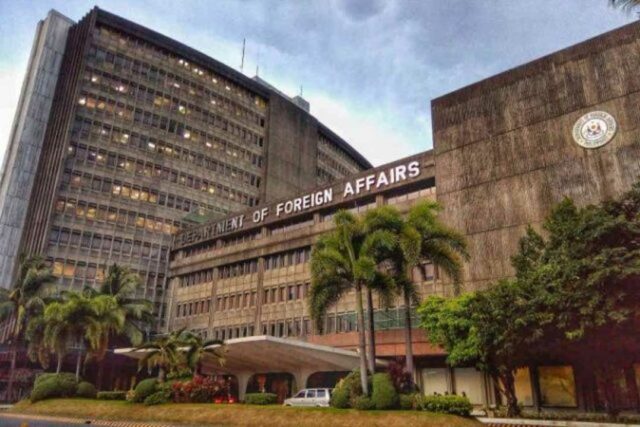
DEPARTMENT OF FOREIGN AFFAIRS FACEBOOK PAGE

THE PHILIPPINES has expressed full support to the International Court of Justice (ICJ), where Ukraine has filed an application to investigate Russia’s allegations of genocide to justify its invasion that started on February 24.

“In this regard, the Philippines takes this opportunity to reaffirm its full support for the International Court of Justice, the principal judicial organ of the United Nations,” the Philippine Department of Foreign Affairs (DFA) said in a statement dated March 23.

The ICJ, in an order released on March 16, said it is “profoundly concerned about the use of force by the Russian Federation in Ukraine, which raises very serious issues of international law… It deems it necessary to emphasize that all States must act in conformity with their obligations under the United Nations Charter and other rules of international law, including international humanitarian law.”

The ICJ ordered Russia to halt its invasion as there was no evidence that genocide was committed in Ukraine territory. It also told both states “to refrain from any action which might aggravate or extend the dispute before the Court or make it more difficult to resolve.”

The Philippine government, the DFA said in its statement, “further urges Russia and Ukraine to abide by the decision of the International Court of Justice and to continue exerting every effort, short of the latter surrendering any portion or particle of a state’s sovereignty and the rights, privileges, and prerogatives pertaining thereto — war is not the worst evil nor is peace at the price of submission — to peacefully settle their dispute in the interest of upholding the rule of law and maintaining international peace and security.”— Alyssa Nicole O. Tan

DFA blames recruitment agencies for influx of applicants at Aseana office

PHILSTAR

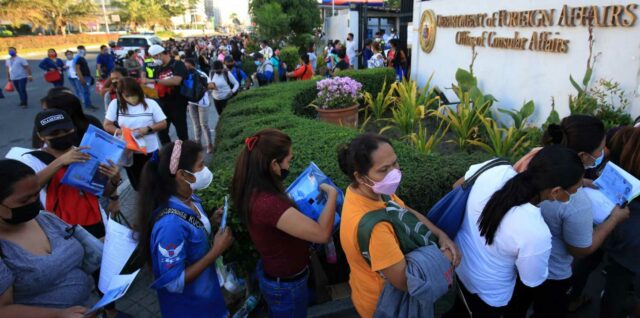
THE DEPARTMENT of Foreign Affairs (DFA) on Thursday said the influx of applicants for apostille services at its Parañaque office, some of whom spent the night lining up outside, were prompted by misinformation from their recruitment agencies.

“According to accounts of applicants, their recruitment agencies urged them to line up and stay overnight at DFA Aseana so that all their travel documents could be expedited,” Office of Consular Affairs Deputy Assistant Secretary and Executive Director Christian de Jesus told reporters in a briefing.

“Other applicants conveyed that their agencies instructed them late at night to proceed to DFA-Aseana immediately,” he added.

After the department announced on Tuesday that it will begin allowing apostille walk-in applications at its Aseana office the next day, hundreds of applicants started forming a line outside until late at night to have their documents processed for overseas employment.

The DFA said the recruitment agencies’ behavior were “highly irresponsible and malicious” as it disregarded the department’s announced limits for walk-in applications.

As of Thursday, DFA-Aseana was processing 900 passport and 1,400 authentication applications daily through the online appointment system. Walk-in applications are limited to 300 per day.

DFA reminded the public that 10 other consular offices also offer slots for walk-in applicants.

It also cautioned against fixers who claim to offer assistance in obtaining passports and appointment slots for higher fees. — Alyssa Nicole O. Tan

Davao Oriental signs P296.5-M bulk water supply deal with Mactan Rock

THE DAVAO Oriental provincial government has signed a P296.5-million bulk water supply project with Mactan Rock Industries, Inc., which will address demand for the capital Mati City.

Mactan Rock Industries, a Cebu-based water management firm, was the sole bidder for the project, the provincial government said in a press statement.

The project “poised to address the lack of water supply in the City of Mati is set to start within the next few days,” it said.

The bulk water system will use both surface and groundwater and will be set up along the Mayo River.

It will supply 11 of the city’s 26 villages, namely: Mayo, Don Salvador Lopez, Don Enrique Lopez, Don Martin Marundan, Dahican, Bobon, Tamisan, Lawigan, Matiao, Central and Sainz.

Governor Nelson L. Dayanghirang said he initiated the project “a few years back” to address water supply problems in the growing city.

“The big-ticket water project is also a significant boost to investments in the province as it will attract even more tourism-related investments in the city,” he said.

The provincial government said the project is designed to be sustainable, ensuring a balance between providing sufficient water supply to Mati City and protecting natural resources. — MSJ

Private-public partnerships sought to strengthen healthcare system

THE PHARMACEUTICAL and Healthcare Association of the Philippines (PHAP) has named Diana M. Edralin as its new president.

In a statement on Thursday, PHAP announced that Ms. Edralin has replaced Beaver R. Tamesis, who will now be the group’s chairman emeritus after serving as president for six years.

Ms. Edralin previously held leadership positions at pharmaceutical firms such as AstraZeneca, Eli Lilly and Novo Nordisk.

“We have witnessed that the health of the nation is crucial to its social and economic progress. Due to its wider implications, health should be prioritized. Public and private investments and collaborations to strengthen the healthcare system will be crucial as we navigate our way out of the pandemic, and prepare for any future health concerns,” Ms. Edralin said.

“As a science-driven organization, we are in unique position to partner with the government and the nation to ensure that innovative and life-saving medicines and vaccines are available to Filipino patients at the time they are needed,” she added.

Further, Ms. Edralin said the group will work on the introduction of new medicines in the country to improve the health of Filipinos, citing lessons learned from policies formed during the coronavirus pandemic.

“First, regulatory processes can be accelerated without compromising the high standards set by the government. Second, the government can centralize the procurement of medicines and vaccines to secure supply, and make these available for free or at lower prices,” she said.

“And third, the continued open collaboration between the public and private sector can save more lives and eventually kickstart economic recovery.”

Other members of the PHAP board are: Vice President Janette Jakosalem (Market Managing Director, Zuellig Pharma Philippines); and trustees Yee Kok Cheong (General Manager, Boehringer Ingelheim Philippines); Melissa Comia (General Manager, Abbott Philippines); Lotis Ramin (President, AstraZeneca Pharmaceuticals Phils.); Ken Saito (President and General Manager, Otsuka Philippines Pharmaceutical, Co.); Jugo Tsumura (President and Managing Director, Novartis Healthcare Pharmaceutical, Inc.); and Teodoro Padilla (Executive Director, PHAP). — Revin Mikhael D. Ochave