Home Blog Page 6503

3.6M expired shots under COVAX to be replaced, says DoH

PHILIPPINE STAR/ MICHAEL VARCAS

ABOUT 3.6 million coronavirus vaccine doses donated to the Philippines have expired and will be replaced by a global program for equal access to COVID-19 vaccines, according to the Department of Health (DoH).

The expired vaccines accounted for 1.5% of the country’s coronavirus vaccine stocks, Health Secretary Francisco T. Duque III told a televised meeting with President Rodrigo R. Duterte aired on Wednesday. These will be replaced at no cost under the COVID-19 vaccine global access or COVAX, he added.

He said the government had appealed to vaccine makers to replace expired coronavirus vaccines bought by the government.

Vaccine czar Carlito G. Galvez, Jr. told the meeting the country still had 98 million coronavirus vaccine shots.

“COVAX may replace expired vaccines with freshly manufactured ones with a longer shelf life of more or less six months to a year,” he said in Filipino.

More than 67 million Filipinos have been fully vaccinated against the coronavirus, about 13 million of whom had also been injected with booster shots, according to DoH.

The Philippines might experience another surge in coronavirus infections by May or June, similar to what other countries are experiencing now, OCTA Research Group fellow Fredegusto P. David told a virtual town meeting on Monday.

The Philippines on Monday started giving out second booster shots against the coronavirus to seriously ill people.

Among those eligible for the shots are people with weak immune systems, those living with HIV, cancer, transplant and bedridden patients, and the terminally ill, the Department of Health (DoH) said in a statement.

A coronavirus disease 2019 (COVID-19) outbreak could happen among unvaccinated Filipinos, said Teodoro J. Herbosa, an adviser at the National Task Force Against COVID-19.

OCTA President Ranjit S. Rye, citing a poll they conducted on March 5 to 10, said 77% of Filipinos were willing to get their booster shots, while 23% were unsure.

He added that 53% of those who were unsure felt that booster shots are safe, while 35% thought these are not needed.

Only certain areas in the capital region were ready to roll out the second booster shots, the Health department said on Monday.

Members of the vulnerable sector should get a vaccine brand that is different from their earlier shots for more protection, according to Nina Gloriani, who heads the government’s vaccine expert panel.

The second booster vaccine should be injected three months after the first, the Health department said earlier.

The government would soon give out a second booster for seniors and health workers to boost protection, said Ms. Gloriani, who heads the government’s Vaccine Expert Panel.

An independent advisory body of DoH would probably release its recommendations on the use of second booster shots for these categories this week.

Ms. Gloriani said they don’t expect any problems about safety.

Some medical frontliners and senior citizens this week wrongly received second booster shots at a hospital in Metro Manila even if the initial rollout was supposed to be limited to people with a weak immune system.

Rontgene M. Solante, a member of the government’s vaccine expert panel, told a town hall meeting on Monday economic frontliners should get their first booster shots to ensure that economic recovery was not derailed.

Based on DoH guidelines, economic frontliners include private sector workers required to physically report for work, employees in government agencies and informal sector workers and self-employed people who work outside. They also include people who work in private households.

At the same meeting, presidential adviser for entrepreneurship Jose Ma. A. Concepcion III said Filipinos should take their booster shots to prevent lockdowns, which would stall the recovery momentum of businesses.    

“We don’t want to go back to Alert Level 3,” he said. “That would really destroy the renewed enthusiasm of entrepreneurs as they see their lives and businesses coming back. You don’t want to break that momentum.”

The private sector is working on how to entice more Filipinos to get their COVID-19 booster shots, he separately said in a mobile phone message.

“It is challenging with the current environment. But we are working on it,” he added.    

He also said private companies are conducting information drives to inform people that COVID-19 vaccines are safe. — Norman P. Aquino

SC: Taguig owns Fort Bonifacio 

OJ SERRANO-UNSPLASH

THE SUPREME COURT (SC) has upheld Taguig City’s ownership of the 729-hectare Bonifacio Global City Complex and several villages in a three-decade dispute with Makati City. 

In a 52-page decision dated Dec. 1 but released only on Wednesday, the tribunal favored Taguig based on historical, documentary and testimonial evidence. 

“We find that Taguig presented evidence that is more convincing and worthier of belief than those proffered by Makati,” it said, affirming a 2011 ruling by a Pasig trial court and a subsequent appellate court decision. 

“We rule that Taguig has a superior claim to the disputed areas,” it added in the ruling written by Justice Ricardo R. Rosario. 

The trial court in 1994 stopped the Makati City government from exercising jurisdiction over parcels of land that made up Fort Bonifacio, including the so-called Inner Fort that comprises the villages of Pembo, Comembo, Cembo, South Cembo, West Rembo, East Rembo and Pitogo. 

The Philippine Army headquarters, Navy installation, Marines’ headquarters, Consular area, Joint US Military Assistance Group area, Heritage Park, Libingan ng mga Bayani, AFP Officers Village and the so-called six villages are in these areas. — Norman P. Aquino

Philippines renews call for Russian withdrawal 

REUTERS

THE PHILIPPINES has renewed its call for Russia to withdraw from Ukraine, according to the Department of Foreign Affairs (DFA). 

The government issued the call at a joint committee meeting with the European Union (EU), DFA said in a statement on Wednesday. 

The Philippines and EU “agreed to continue to work together closely and stand up for the international rules-based order, the principles of sovereignty and nonaggression, as well as for a peaceful diplomatic solution,” it added. 

The Philippines and EU also recognized the importance of a United Nations-backed arbitral ruling that voided China’s claim to more than 80% of the South China Sea based on a 1940s map, it said. — Kyle Aristophere T. Atienza 

Outgoing Duterte declines US-led ASEAN meeting set May 11-13

PCOO.GOV.PH

PHILIPPINE PRESIDENT Rodrigo R. Duterte has declined an invitation to attend a United States-backed conference for southeast Asian leaders to be held in Washington D.C. after the May 9 presidential election.  

Mr. Duterte told a taped Cabinet meeting aired Wednesday that it would not be too appropriate for him to attend the summit on May 11 to 13 because his successor would already be known by then and may not share his position on an “agreement” or “commitment” that will be discussed in the meeting.  

I have an invitation in the US to join ASEAN countries to have a dialogue with President Joe Biden. The problem is the dates of the conference are May 11 to 13 and by that time, the elections are done and we would already know who the new president is,he said, referring to the 10-member Association of Southeast Asian Nations.  

I might take a stand that would not be acceptable to the next administration.” 

The Philippines’ foreign affairs agency has not issued an official statement on who will attend the conference. Mr. Duterte, 77, has never visited the US during his six-year term.   

On May 9, Filipinos will choose his successor, who is likely to reassess the current administration’s policy of engagement with China.  

Political analysts have said that his policy on the countrys sea dispute with Beijing is a major election issue.  

Vietnam and Malaysia, which are ASEAN members, also claim parts of the South China Sea.   

The Philippines and the European Union (EU) agreed in a recent joint committee meeting to strengthen partnerships to maintain a rules-based order in the Indo-Pacific region and underscored the importance of enforcing a 1980s treaty on sea borders, which China does not recognize.   

In a statement on Wednesday, the Department of Foreign Affairs (DFA) said the Philippines and European bloc also recognized the importance of the 2016 United Nations-backed arbitral ruling that invalidated Beijings claims to more than 80% of the South China Sea based on a 1940s map.  

On maritime security, both the Philippines and the EU expressed concern over unilateral actions that endanger peace, security and stability and the international rules-based order,it said.  

The DFA said the Philippines proposed the establishment of a sub-committee on maritime cooperation. 

Two ships hired by a local firm to do a seismic survey in Philippine-claimed areas in the South China Sea were reportedly tailed and overshadowed by a Chinese Coast Guard ship earlier this month. 

International observers have said that the South China Sea, a key shipping route, is important for the regional ambitions of China, which has been in a trade war with the US involving tariffs and intellectual property rights, among other issues.   

The US last year reaffirmed its commitment to defend the Philippines against any armed attacks in the South China Sea and other areas in the Pacific. Kyle Aristophere T. Atienza

Duterte signs laws on Marawi compensation, Metro Davao agency   

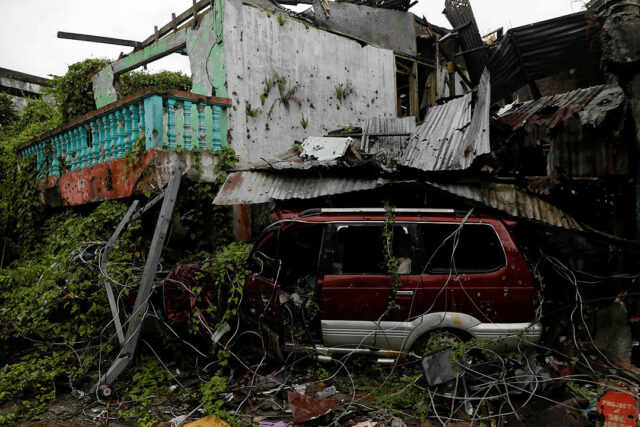
A DILAPIDATED building and car is seen in the most affected war-torn area of Marawi City in this May 14, 2019 photo, two years after pro-Islamic State militants began their attacks on May 23, 2017. — REUTERS

PRESIDENT RODRIGO Rodrigo R. Duterte has approved a measure providing compensation for people who lost family members and properties due to a five-month clash between state forces and Daesh-inspired extremists who laid siege on Marawi City in southern Philippines in 2017.   

Heirs of victims who lost their lives during the Marawi siege are entitled to compensation under Republic Act No.11696, signed by Mr. Duterte on April 13.  

Owners of residential, cultural, and commercial structures and other private properties inside the so-called “main affected areasthat were destroyed from the heavy gun battle would also receive tax-free compensation, according to the law. The law lists 24 barangays.   

The measure, which was approved by Congress only this year, grants private property owners a compensation based on the sum of the current market value of the land and current replacement costs.  

Under the law, owners of properties demolished under the Marawi rehabilitation program would also receive compensation.  

When we started the struggle and fight for the rights of Marawi Siege victims and survivors, it was an uphill climb all the way. We never even thought we would witness this day come,Rolanisah Dipatuan-Dimaporo, a doctor who works at the regions Ministry of Health and a member of the Marawi Reconstruction Conflict Watch, said in a statement released by the group.   

This critical law marks the most significant action for the full recovery of Marawi, mechanisms and processes where people who lost their loved ones and owners of properties that were demolished and destroyedwill now be established and victims now may file their claims for compensation,she said.   

The government, through an inter-agency task force, has been reconstructing public structures and building new housing complexes for displaced residents who will have to be permanently relocated.   

The rehabilitation program has been criticized for delays and alleged lack of transparency.   

On the other hand, Housing Secretary Eduardo D. Del Rosario, who heads the Marawi task force, has said they are on schedule with finishing a “substantial” number of ongoing projects by June 30.  

“We remain on track to complete substantial number of the infrastructure projects by the end of the term of President Rodrigo Roa Duterte,” he said last week following his monthly visit to the city.   

METRO DAVAO
Mr. Duterte has also signed the proposed measure creating the Metropolitan Davao Development Authority (MDDA), an agency that will coordinate an integrated urban development plan in Region 11.   

The law, designated as Republic Act 11708, was signed on April 13.  

It covers 15 towns and cities. These are: Davao City; cities of Panabo, Tagum, and the Island Garden City of Samal in Davao del Norte; Digos City in Davao del Sur; Mati City in Davao Oriental; and the municipalities of Sta. Cruz, Hagonoy, Padada, Malalag, and Sulop in Davao del Sur; Carmen in Davao del Norte; Maco in Davao de Oro; and Malita and Sta. Maria in Davao Occidental.  

The MDDA will be adopting a plan prepared by the Davao Regional Development Council, which includes synchronized programs on sewerage and septage systems, infrastructure development, solid waste management, public transport and traffic management, and public safety and security.  

Operating funds for the MDDA will be allocated under the annual national budget and contributions from member local governments. Kyle Aristophere T. Atienza and Marifi S. Jara

Law establishing judicial security force signed

PHILSTAR FILE PHOTO

PRESIDENT RODRIGO R. Duterte has signed into law a measure creating a security force under the supervision of the Supreme Court to protect judiciary members and their families as well as court assets.  

The Judiciary Marshals Act, signed on April 8, creates the Office of the Judiciary Marshals, which will be under the control and supervision of the High Court through the Office of the Court Administrator. 

The office will be responsible for the security and protection of the members, officials, personnel, and property of the judiciary. 

It is tasked to conduct threat assessments to ensure safe and orderly court proceedings, trials and hearing. It is also mandated to conduct investigations on erring members of the judiciary.  

The law gives the office the authority to assist in the execution of all lawful writs, processes, and orders, and assist in the protection of witnesses. It may also assist in the management and disposal of seized, frozen or forfeited assets.  

The number of lawyers killed under the administration of Mr. Duterte increased by 500%, according to the Integrated Bar of the Philippines. It said about 10 lawyers were getting killed under every administration since 1972 before Mr. Duterte assumed the presidency in 2016. Kyle Aristophere T. Atienza

Bangsamoro to set up 71 vaccination hubs post-election to improve low 28% coverage rate 

MINISTRY OF HEALTH BARMM

THE BANGSAMORO Ministry of Health is setting up 71 vaccination sites across the region after the May 9 elections to ramp up coverage rate, which stood at only 28% of the target population as of April 18.  

I am inviting our fellow Bangsamoro who have not yet been vaccinated to participate in the upcoming Special Vaccination Days in the region, because vaccine is Halal and it can help eliminate the threat of COVID-19 (coronavirus disease 2019) pandemic,Chief Minister Ahod B. Ebrahim said in a briefing earlier this week.   

The vaccination days are set between May 11 to 20, with at least three days scheduled for each of the provinces of Basilan, Sulu, Tawi-Tawi, Maguindanao, and Lanao del Sur.    

At least 215,776 people are targeted for inoculation within that period.   

As of April 18, Department of Health data show the Bangsamoro Autonomous Region in Muslim Mindanao (BARMM) had administered 1,478,544 jabs, the lowest among 17 regions in the country.   

The regions target population for vaccination against COVID-19 is 3.4 million.   

Of the total in BARMM, 904,735 were first dose, 492,189 second dose, and 81,620 booster shot.   

Health OIC Minister Zulqarneyn M. Abas said in the same briefing that the regions low coverage rate is mainly due to hesitancy.   

Our top enemy in the low vaccination roll out in our region is the high vaccination hesitancy of the public, he said.   

The Philippine government has set a target nationwide coverage of at least 70%.   

Health ministry Director General Amirel S. Usman said while the region has been recording low COVID-19 cases and remains at relatively low risk,a higher vaccination rate would help mitigate potential future outbreaks.   

The mass vaccination project is supported by the United Nations International Childrens Emergency Fund (UNICEF), International Organization for Migration (IOM), local government units, and sectoral leaders. MSJ 

Gov’t extends MRT-3 free-ride offering until May 30 

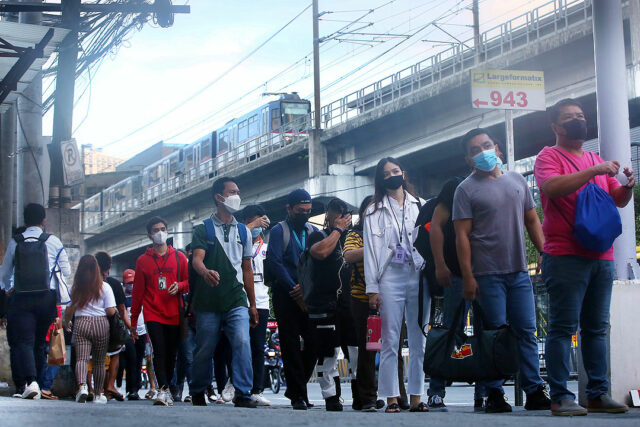
PHILIPPINE STAR/ MIGUEL DE GUZMAN

THE TRANSPORTATION department announced on Wednesday that the free-ride program of the Metro Rail Transit Line 3 (MRT-3) will be extended through May.  

The objective is to continue to help commuters who have been affected by the increase in commodity and energy prices, the Department of Transportation (DoTr) said in a statement.  

This is also intended to allow more people to benefit from the improved service of the newly-rehabilitated MRT-3 line,it said in mixed Filipino and English.  

The free-ride offering was launched in March with the goal of restoring confidence in the key commuter train line after an extensive overhaul.  

The extension of the program, the department said, will further test its capacity and performance in accommodating up to or more than 350,000 passengers.”  

The MRT-3 free ride extension will be under the same schedule/operating hours of the rail line from 4:40 a.m. to 10:10 p.m., while similar mechanics/procedures on availing the Libreng Sakayas well as health and safety protocols will be implemented,it added. 

The department noted that prior to the programs implementation, the MRT-3 recorded the highest ridership of 258,989 on March 25. During the implementation of the free ride, the highest was 335,993 recorded on April 8. — Arjay L. Balinbin 

100-project pipeline to be left to next gov’t; 12 BBB works finished

PHILIPPINE STAR/ RUSSELL PALMA

THE Department of Public Works and Highways (DPWH) said the infrastructure projects completed on the eve of the government handover are 12 major works and seven more due for completion by June 30, leaving a pipeline of 100 projects for the next administration.

“Coming up with a huge package of infrastructure projects is not an ordinary task. If you compare that with previous administrations, it entails huge effort, both technical and financial operations,” DPWH Undersecretary Emil K. Sadain said on the sidelines of the 5th Interagency Infrastructure Flagship Projects Forum.

The P8-trillion Build, Build, Build (BBB) program identified 119 infrastructure flagship projects, with seven completed in 2020, including the P18-billion New Clark City Phase 1 and the P14.97-billion Clark International Airport Expansion Project, and five in 2021, including the P21.97-billion MRT-3 Rehabilitation Project.

“You cannot simply say that one project or a big project can be done or completed overnight. It has to consume much time, from the preparations of the design, procurement, the construction,” Mr. Sadain said.

National Economic and Development Authority Undersecretary Roderick M. Planta said at the briefing: “The headline metric is the public expenditure as a percentage of gross domestic product (GDP), and we’re consistently hitting at the minimum 5% of GDP, and this is at least twice what was spent or as compared to previous decades of infrastructure development.”

Asian Development Bank Country Director Kelly Bird said: “To sum it up, it’s been hugely successful to be able to get public spending above 5% more or less consistently… The railway projects, the extension on road networks and bridges, and these are lifting up long term economic growth and creating jobs and are also important for economic recovery.”

Japan International Cooperation Agency Philippines chief representative Sakamoto Takema said: “I’m very positive for the Philippine BBB Policy, and we are very happy to support that.”

The DPWH is expecting the completion of seven more flagship projects by the end of President Rodrigo R. Duterte’s term on June 30. These projects include the P9.76-billion LRT 2 East Extension and the P7.51-billion Flood Risk Management Project in Cagayan, Tagoloan, and Imus Rivers. 

The department is projecting the completion of 12 more major projects by December, including the P45.29-billion Southeast Metro Manila Expressway Project and the P75-billion MRT-7.

Mr. Sadain cited six major challenges the next government needs to address — contract management, planning and technical operation, acquisition of road right-of-way, fiscal management, utilization and expiration of loans, and strengthening of organizational structure.

The department said 35 big projects for which construction is ongoing are expected to be completed by 2023 onward. These include the NLEX-SLEX Connector Road, Boracay Circumferential Road, and Davao City Bypass Construction projects.

“The next administration should sustain the momentum,” Mr. Sadain said.

“The golden age of infrastructure does not stop with this administration. It goes beyond the succeeding administrations if we want to ensure there will be a closure in the infrastructure gap comparatively with neighboring countries,” he added. — Arjay L. Balinbin

PAGCOR calls for separate online sabong regulator

PHILSTAR FILE PHOTO

PHILIPPINE AMUSEMENT and Gaming Corp. (PAGCOR) Chief Andrea D. Domingo said online cockfighting, known as e-sabong, needs a separate regulator with sufficient authority to deal with the local governments involved in the trade.

“I would really encourage that, that there will be an independent regulator away from PAGCOR for e-sabong,” Ms. Domingo said at an online forum organized by Kapihan sa Manila Bay.  

“But because sabong is hybrid, there are traditional operations controlled by local government units (LGUs), which means we have no oversight over the fights,” she said. “We only control online betting.”

Ms. Domingo also said cockfighting took place over the Easter weekend on the strength of mayors’ permits. “Sabong will happen in studios, then will be video streamed by operators. We have no control over that,” she added. 

Last week, Senator Francis N. Tolentino received reports that e-sabong operator Pitmasters Live logged over 200 matches on April 15, Good Friday.

“So if only one regulator handles (e-sabong), if it is removed from PAGCOR, we can concentrate on our present offerings, on what we should regulate,” Ms. Domingo said. “Our responsible gaming policies would become more effective.” 

She added that offshore betting on e-sabong was illegal, as PAGCOR has not licensed such activities.

As of April 25, Ms. Domingo said that PAGCOR reported P17 billion in gross gaming revenue (GGR), and projects earnings of P25 billion to P30 billion by June.

Casino operations regulated by PAGCOR posted GGR of P13.51 billion, while smaller operations, which include slot machines and gaming tables, earned P1.76 billion and over P1 billion respectively.

“It would be possible that by the end of the year, PAGCOR would have P60 to P65 billion a year in GGR, almost twice as much as last year’s,” she added. “But for the next half of the year, we really think there won’t be any more upsurge, and if we continue operating at 90%, 100% capacity, PAGCOR should be able to make more in the last six months.”

Ms. Domingo also said that as of April 25, licensed casinos generated P8.16 billion in GGR, Bingo operations earned P2.43 billion, and online gaming operations posted P649.59 million.

“We had more than 800 (bingo stations), but after the pandemic, (this total fell to about) 400,” she added. “We had a lot of closures.”

Meanwhile, Philippine Offshore Gaming Operations earned P412.18 million in GGR, while e-sabong posted revenue of P1.8 billion. — Tobias Jared Tomas

BARMM tops regions in 2021 agriculture growth by value

PHILSTAR FILE PHOTO

THE Bangsamoro Autonomous Region in Muslim Mindanao (BARMM) posted the top growth rate in 2021 among the regions for agricultural output by value, the Philippine Statistics Authority (PSA) said.

BARMM’s value of production in agriculture and fisheries grew 7.2% at constant 2018 prices, the PSA said.

This was followed by the Central Visayas with a growth rate of 5%, Mimaropa 3.5%, Northern Mindanao 2.9%, Western Visayas 2.8%, Cagayan Valley 2.3%, and Zamboanga Peninsula 1.7%.

Central Luzon accounts for 13% of PHL’s agri production in 2021Meanwhile, Calabarzon output by value contracted by 13.3%, followed by Central Luzon (9.2%), Caraga (6.8%), Bicol (4.8%), Ilocos (3.4%), Cordillera Administrative Region (2.8%), Davao (0.9%), Eastern Visayas (0.7%), and Soccsksargen (0.6%).

In the crops subsector, Cagayan Valley posted growth of 5.9%, followed by Mimaropa and Central Visayas with 4.9% each.

In livestock and poultry, Mimaropa posted the top growth rates of 15.4% and 9.3% respectively.

The value of fisheries production was highest in BARMM at 22.8%, followed by Davao with 12.2% and Central Luzon 12.1%.

Central Luzon accounted for the largest share of the national total at 12.9%.

The region also accounted for the largest share of poultry and fisheries production at 27.6% and 16.9% respectively.

Northern Mindanao accounted for the largest share of the national total in the crops category (11.4%) and livestock (11.7%).

Federation of Free Farmers National Manager Raul Q. Montemayor said that the decline in agricultural production in Calabarzon was due mostly to the decline in livestock output of 40.9%, likely due to the lingering effects of African Swine Fever.

“On the other hand, BARMM’s 7.2% increase was due largely to the improvement in its gross value added (GVA) for fisheries with tilapia and mudfish exhibiting very large growth rates,” he said in a Viber message. 

Mr. Montemayor said that growth rates must be interpreted carefully, as a region can show high growth rates after coming off a low base from the previous year.

“A region with a high growth rate may account for only a small portion of the total GVA,” he said.

In 2021, agricultural output contracted by 1.7%, with a growth rate of 0.6% in the last three months.

The PSA projects that in 2021 the value of production in agriculture and fisheries worsened from the 1.2% decline recorded in 2020. The likely result will miss the Department of Agriculture’s 2% growth target.

“What may be more significant is the fact that agricultural GVA in constant 2018 prices deteriorated overall in 2021. Compared to 2019 levels, the total decline is about 3% mostly brought about by the drop in livestock and to a lesser extent poultry,” he added. — Luisa Maria Jacinta C. Jocson

UNESCO says girls outperforming male counterparts in math, reading

PHILIPPINE STAR/ MIGUEL DE GUZMAN

SCHOOLGIRLS are outperforming their male counterparts in key subjects, with the gap in the Philippines quantified at 1.4 percentage points in mathematics by Grade 8, according to a report issued on Wednesday by the United Nations Educational, Scientific and Cultural Organization (UNESCO).

According to UNESCO’s Gender Report: Deepening the Debate on Those Still Left Behind, the broad conclusions were arrived at from data compiled from primary and secondary students in 120 countries.

In a statement, UNESCO said the gender gap in learning has closed in the poorest countries, with some countries even reversing the gap.

“For example, by Grade 8, the gap is in favor of girls in mathematics by 7 percentage points in Malaysia, by 3 points in Cambodia, by 1.7 points in Congo and by 1.4 points in the Philippines,” according to a UNESCO statement.

According to the report, girls outperform boys in reading in primary education, an advantage that increases with age.

It added that in subjects traditionally seen as unfriendly to girls, they tend to perform better in societies that recognize the importance of gender equality.

This outperformance extends to situations “where more girls study STEM (science, technology, engineering, and math) subjects in tertiary education,” the report noted.

“This may also be one reason why girls tend to choose STEM-related subjects in universities,” UNESCO said.

Globally, the number of students enrolled in tertiary institutions increased to 235 million in 2020 from 100 million in 2000. The share of women in the student population rose from 48.8% to 51.9% during this period.

However, the report found that girls are still less likely to be top performers because of continuing biases and stereotypes. — Keisha B. Ta-asan

ADVERTISEMENT
ADVERTISEMENT