Home Blog Page 6492

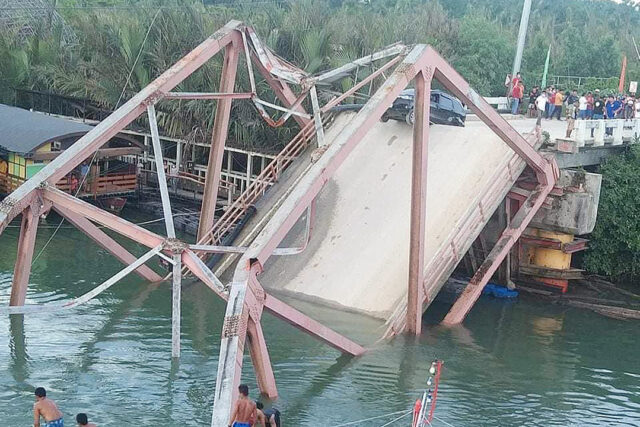
3 locals, 1 Austrian tourist die in Bohol bridge collapse  

PHILIPPINE COAST GUARD/ EDSEL GONZAGA    

THREE Filipino residents and an Austrian tourist died after the old Clarin Bridge, also referred to as Loay Bridge, in Bohol collapsed on Wednesday afternoon.  

Governor Art C. Yap, in a live-streamed briefing late Wednesday, confirmed the number of casualties and reported that 20 others were rescued. 

At least 12 vehicles that fell into the Loboc River when the bridge collapsed were found while three others recorded on a CCTV camera crossing the bridge have yet to be located, said Mr. Yap.    

Search operations by diving teams were set to resume Thursday mid-morning.   

Mr. Yap said responders had to call off operations after conducting three sets of rescue dives due to strong rain and currents, and murky water with visibility at just one to two feet.   

The diving teams were composed of members of the Philippine Coast Guard, Bureau of Fire Protection, local emergency responders under the TARSIER 117, and the private diving group in Panglao.   

Of the 12 vehicles that fell, one was a dump truck, six were four-wheel cars, three tricycles, and two motorbikes.     

The bridge, built in the 1970s, was reinforced after being affected during the magnitude 7.2 earthquake that struck Bohol in 2013.   

Construction for a new bridge started in 2018 and was scheduled to be opened within the first half of this year.   

The new bridge is being rushedweather permitting, in two to three days it will be made passable,Mr. Yap said.  

The governor said an inquiry on the incident will be conducted. MSJ 

Comelec formally signs agreement with KBP; taps gov’t TV station in last-minute education campaign

COMELEC

THE COMMISSION on Elections (Comelec) on Thursday formally signed a deal with the Philippines broadcasters association for the one-on-one interviews with candidates for the country’s top two positions, a substitute event for the cancelled last round of debates.  

The election agency announced on Monday that the supposed third round of debates would be modified into a panel-interview format following the failure of their private partner, Impact Hub Manila, to comply with about P14 million of its financial obligations to the venue, Sofitel Philippine Plaza Manila.    

Comelec has turned to the Kapisanan ng mga Broadcaster ng Pilipinas (KBP) for assistance in organizing the final event.  

KBP, a non-government and non-profit organization of broadcast media in the country, held its own presidential forum in February that tackled subjects such as unemployment, corruption, and foreign relations.  

“The Comelec decided to adopt this taped interview format because informing the public about their candidates is imperative for an informed and wise vote,” Comelec Chairman Saidamen B. Pangarungan said at the signing ceremony held at the Comelec office in Manila.   

“This is also to overcome the challenge of scheduling with the candidates because we are aware that their schedules are full for the final days of the campaign.” 

The national and local elections will be on May 9.   

Aside from the president and vice president positions, the electorate will also be voting for 12 senators, party-list groups, district-based congressional representatives, provincial governors, mayors, vice mayors, and local council members.   

Also on Thursday, Comelec signed a deal with state run People’s Television Network (PTV4) for the production and airing of programs on election procedures and the candidates.  

“PTV4 in partnership with Comelec, at this crucial juncture, agrees to deliver quality television shows that will provide the electorate more opportunities to create an informed choice,Mr. Pangarungan said at the event held at the Manila Hotel.  

“On election day, PTV4 coverage will also be a partner of the Comelec to inform the public of important information to guide them in the exercise of their civic duties,he said. John Victor D. Ordoñez

Lacson-Sotto tandem says winning still possible with support of ‘silent majority’ 

PRESIDENTIAL aspirant Senator Panfilo M. Lacson, Sr. and his running mate, Senate President Vicente C. Sotto III, remain confident of a possible win on May 9, banking on what they called the “silent majority” who have expressed support.   

Every time we go to a placeno matter how distant from the capital, whether in a city or a far-flung rural townthere would be people who would come to us and whisper theres a lot of them Senator, Mr. Senate President, we are just here. We are your silent supporters,Mr. Lacson said in Filipino at a town hall forum in Malabon City on Thursday.  

He said there may be a major upset on election day as many people have personally pledged their support to their candidacy. 

We have so many silent supporters. They told us, they (the public) might be surprised that on May 9, we will be there. When we go to the polling booth, they would be really surprised that what will come out of our ballots (are votes for) Lacson-Sotto,the presidential candidate said.  

The latest opinion poll survey conducted by the OCTA Research group from April 2 to 6 showed Mr. Lacson remained in fifth place among 10 candidates. Mr. Sotto, on the other hand, has been at number two among vice presidential bets.   

The tandem had repeatedly shrugged off poll survey results, saying they were unbotheredbecause the numbers they felt on the ground indicated differently.  

The two have mainly been campaigning through sectoral dialogues and town hall meetings.  

It is always fulfilling to hear directly from our people and be listened to,Mr. Lacson said. 

He explained that dialogues ensure that the peoples woes are not only heard but also understood. We always engage the people, the crowd, our audience in a conversation because that’s how we learn from them and they learn from us.Alyssa Nicole O. Tan

Liverpool breezes past Villarreal to close in on Champions League final

LIVERPOOL, England — An own goal and a Sadio Mane strike earned Liverpool a 2-0 victory in their Champions League semifinal first-leg against Villarreal on Wednesday, putting Jürgen Klopp’s side on course for their third European Cup final in five seasons.

After the drama of Tuesday’s other semifinal, which saw Manchester City beat Real Madrid 4-3 at the Etihad, it was never going to be easy for this game to compete in the entertainment stakes.

But Liverpool did enough to build themselves a solid lead for Tuesday’s return game in Spain where they will be confident of finishing off the job.

Villarreal defended in numbers in the first half to frustrate the six-times European Cup winners, with Thiago Alcantara going closest to breaking the deadlock with a thunderous strike from distance that hit the post.

There were several half-chances for Liverpool with Jordan Henderson drilling into the side netting and Mohamed Salah floating an effort wide, while Mane saw a deflected effort zip just past the post.

But for the most part, Unai Emery’s defense coped well, with Pau Torres in command at the back and the central midfield pairing of Dani Parejo and Etienne Capoue protecting the area in front of them.

Liverpool turned it up a notch after the break and moments after Brazilian midfielder Fabinho had seen one effort ruled out for offside, Henderson’s cross was deflected into his own net by Pervis Estupinan to break Villarreal’s resistance.

Able to express themselves with the deadlock broken, Mohamed Salah threaded a sublime pass through for Mane to put the game beyond the visitors 133 seconds later.

Liverpool’s pressing was too much for the Spaniards at times and they had chances to make the result more comprehensive.

Andy Robertson had a fine effort ruled out for offside after connecting with a sweeping cross from Trent Alexander-Arnold, while Virgil van Dijk tried his luck with a long-range thunderbolt which nearly knocked Villarreal keeper Geronimo Rulli off his feet.

Anfield showed its appreciation at the final whistle but in truth this was a game that felt more like a group-stage match than a last-four encounter.

“They are a very organized team and we knew they would make it difficult. It was just important that we kept going and believed that we would eventually break them down. We did that with two good goals,” said Henderson.

“Majority of the game, our counter-press was really good. It made it difficult for them. But the game is still alive and it will be tough in Villarreal.” — Reuters

Giannis Antetokounmpo carries Bucks to Game 5 clincher over Bulls

GIANNIS Antetokounmpo eclipsed the 30-point mark for the third time in the last four games as the Milwaukee Bucks earned a 116-100 win over the visiting Chicago Bulls on Wednesday night to advance to the second round of the Eastern Conference playoffs.

The two-time MVP finished with 33 points and nine rebounds on 11-for-15 shooting to lead Milwaukee to its first postseason series win over the Bulls since 1985.

Reserve Pat Connaughton added 20 points off the bench and Bobby Portis chipped in 14 along with 17 rebounds. Grayson Allen contributed 13 points, Brook Lopez had 12 and Jrue Holiday posted 10 points and nine assists.

With Zach LaVine in the league’s health and safety protocol, Patrick Williams paced Chicago with 23 points on 9-for-13 shooting. Nikola Vucevic finished with 19 points and 16 rebounds, and reserve Coby White went for 17 points.

Bulls All-Star DeMar DeRozan scored just 11 points, while Troy Brown, Jr. added 10.

The Bulls launched a season-high 52 3-pointers on the night, but only 15 fell (28.8%).

The Bucks went into the break with a 60-42 lead behind 23 points on 8-for-9 shooting from Antetokounmpo. Milwaukee had led by as much as 29, but the Bulls closed the half on a 22-11 run over the final 7:11 to cut the deficit.

Chicago’s defense got torn apart down low in the opening half, as the Bucks scored 34 points in the paint compared to the Bulls’ 16.

Williams led Chicago with 12 points through the first 24 minutes of action, and White added 11. They were the only two Bulls with more than six points.

A 13-6 run capped off by a three-point play from Ayo Dosunmu brought Chicago within 11 with 9:32 left in the third quarter, but that was the closest it would get.

Portis answered with a pair of 3-pointers and the Bulls would go on to trail by at least 15 for the remainder of the game.

Milwaukee got off to a fast start, shooting 61.9% from the field in the first quarter to jump out to a 16-point lead. Antetokounmpo erupted during the frame, posting 15 points and six rebounds. — Reuters

‘I’m done’: Fury sticks to retirement plan after triumph over Whyte

WBC heavyweight world champion Tyson Fury closed the door on a return to the ring, saying on Wednesday that the siren song of fame, fortune and glory were simply not enough to lure him back.

The Briton knocked out Dillian Whyte in front of a sell-out crowd at Wembley Stadium on Saturday to retain his heavyweight crown, telling fans afterwards it was unlikely he would fight again.

His wife, Paris, later told BT Sport that he would only return for a title unification bout.

“This is the truth, the gospel truth, nothing but the truth, I’m done,” Fury told Piers Morgan Uncensored on Fox Nation.

“You know every good dog has his day and like the Roman leader said, there will always be someone else to fight.”

The 33-year-old, who previously promised his wife he would retire, extended his unbeaten record to 32 wins and a draw with Saturday’s victory over Whyte.

“When is enough enough? I’m happy, I’m healthy, I’ve still got my brains, I can still talk,” said Fury.

“I’ve got a beautiful wife, I’ve got six kids, I’ve got umpteen belts, I’ve got plenty of money, success, fame, glory. What more am I doing it for?” — Reuters

Collapsed Nets

It’s a reflection of the outsized expectations heaped upon the Nets that their stunning first-round exit continues to be a major subject in hoops circles. Not that they didn’t have ample reasons to cite for their seeming collapse. They appeared to be snakebit from the outset, needing to navigate a complex web of obstacles both of their own making and beyond their control. The bottom line, of course, is that they had on their roster 12-time All-Star Kevin Durant, universally deemed to be the greatest scorer in National Basketball Association history. He was supposed to be their “Get Out of Jail, Free” card, and he failed to deliver on his promise.

Indeed, Durant produced numbers well below his playoff norms in the first-round series against the higher-seeded Celtics. To contend that he was hard-pressed to carry the Nets would be an understatement; his 26.3-5.8-6.3 splits off 38% shooting from the field in 44 minutes on the floor was as much an offshoot of the effectiveness of the defense as of his inability to carry the requisite load amid all the dysfunction. Which is to say he deserved all the criticism coming his way, and more. It goes with the territory.

Durant being Durant, however, there was to be no stopping him from responding in kind. Given all his accomplishments, conventional wisdom had him moving on and understanding the opprobrium to be part and parcel of superstardom. Instead, he went about defending himself in quarters he would have been better off leaving alone. In particular, he took exception to the comments of Hall of Famer Charles Barkley on Inside the NBA following the Nets’ postseason demise. To be sure, the analysis was on point, with the catchy “Who’s gonna want to play on that team?” query contextualized in the face of their salary cap concerns. Nonetheless, he saw fit to post an Instagram story containing four photos of one of the best players in league annals alongside other marquee names with the Rockets and Sixers; he included the caption “Where would chuck be without the big homies.”

Which is just plain wrong. After all, Barkley did lead the Suns to the NBA Finals, and was just two wins short of claiming the Larry O-Brien Trophy in a season that capped by Most Valuable Player honors. Moreover, the argument Durant railed against focused on his failings, incontrovertible under any circumstance and irrespective of the body of work of any and all others. Then again, who’s to say how his mind works? Didn’t he once go to such lengths as to create a fake account just to get back at otherwise-faceless personalities on Twitter?

Make no mistake. Durant remains without peer in terms of putting the ball through the hoop. Needless to say, though, he needs help — and not simply because basketball is a team sport. The game is so sophisticated these days that otherworldly talent alone does not guarantee success. “No regrets,” he said in the aftermath of the Nets’ elimination. “S—t happens.” And he’s right. Now if he only believed it and stopped being so sensitive, he may yet find the time to concentrate on the things that do matter.


Anthony L. Cuaycong has been writing Courtside since BusinessWorld introduced a Sports section in 1994. He is a consultant on strategic planning, operations and Human Resources management, corporate communications, and business development.

Dramatis personae

PRESIDENTIAL ASPIRANTS Isko Moreno, Norberto Gonzales and Ping Lacson — PHILIPPINE STAR/RUSSELL PALMA

His spokesperson had announced that he was going to be present. But because he was campaigning in the provinces and could not catch a flight to the National Capital Region on time, boxer-cum Senator Emmanuel “Manny” Pacquiao failed to get into the act.

It was just as well. His supporters thanked their lucky stars for his non-attendance. The backlash in much of social and other media against that Easter Sunday (April 17) joint press conference at the Peninsula Manila hotel was enough to further shrink the already slim to zero chances of Pacquiao’s fellow candidates — Mayor “Isko” Moreno Domagoso, Senator Panfilo Lacson, and former Arroyo regime Defense Secretary Norberto Gonzales — of winning the Presidency.

To start things off during that sorry event, Domagoso read a statement declaring the quartet’s (Pacquiao was meant to be a signatory to it) supposed commitment to putting the citizenry first in the government agenda. The statement also included a pledge of unity and a condemnation of “political bickering.” It echoed Ferdinand Marcos, Jr.’s declarations about the need for a “unifying leader” and for “moving on” from condemning his father’s 14-year dictatorship. It also pointedly excluded Vice-President Maria Leonor “Leni” Robredo, suggesting thereby that all four would unite against her, to the benefit of — who else? — Marcos Junior.

What later transpired created more dissension rather than less even among Domagoso, Lacson, Pacquiao, and Gonzales. Lacson distanced himself from Domagoso’s call for Vice-President Robredo to withdraw her candidacy, as did Pacquiao, while Gonzales apologized to the Vice-President for his seeming agreement with that demand.

But neither Lacson nor Gonzales had protested Domagoso’s call during the event itself. Only when outrage over it had escalated did Lacson and Gonzales claim non-agreement with it. If that event did achieve something, it was those three gentlemen’s encouraging the suspicion that they are among the cast of characters, the dramatis personae, in the Confusing the Electorate, Part 2 political drama.

At the core of that play is the intent to divide opposition votes by fielding candidates pretending to be “oppositionists.” It would replicate, though with some revision, what happened in 2016. Out of five candidates for President then, of which four were perceived to be opposed to the outgoing administration, Rodrigo Duterte prevailed by winning a mere 32% of the votes.

That ploy has worked so well that even some supposedly more discerning groups have bought into it. The non-government organization Center for People Empowerment in Governance (CenPEG), for example, identified in one of its policy papers Domagoso, Lacson, and Pacquiao together with VP Robredo and labor leader Leodegario “Ka Leody” de Guzman as opposition candidates.

CenPEG apparently assumed that any candidate other than Mr. Duterte’s own, and who promises what they think various sectors want to hear, such as resuming peace talks between the Philippine Government and the National Democratic Front of the Philippines (NDFP) and adopting authentic land reform and a national industrialization program, merits that title. That assumption forgets that promising the moon and the stars is nearly every candidate’s stock in trade — Mr. Duterte himself promised much in 2016, but failed to deliver — and ignores their track records during the six years of the Duterte regime, which, in Domagoso’s, Lacson’s, Gonzales’, and Pacquiao’s case, consisted of unquestioning support for it.

The assumptions behind the CenPEG paper of what being in the opposition means glossed over the four’s role as Duterte regime enablers. It also limited the definition of it to merely running against regime candidates, and ignoring the imperative of any true oppositionist’s being pro-democracy and anti-dictatorship, which neither Domagoso, Lacson, and Gonzales, nor Pacquiao ever were.

Pacquiao, for example, is on record as justifying the thousands of “drug war”-related killings by saying that governments have the right to kill. He cited as proof the killing of Jesus Christ (!)— which, by the way, was not carried out by a legitimate government, but by the occupation army of imperial Rome. Lacson has been accused of human rights violations since his days as an active police officer, and was the principal author of the Duterte regime-instigated Anti-Terror Law, while Domagoso, whose his six-year silence implicitly supported the regime, has been asking Mr. Duterte to endorse his candidacy.

During their press conference, the trio present also claimed that VP Robredo’s supporters would protest a Marcos-Duterte win to the extent of “destabilizing” government. Right on cue did President Duterte threaten to arrest “trouble makers,” while the police announced that they would consult the three to get more information and prevent any such disturbance, which Marcos Junior later echoed. That script only added to the trio’s being widely perceived as front men of the very regime they have been pretending to oppose.

On the basis of their track records and pro-democracy stance, only VP Robredo and labor leader De Guzman merit the title of oppositionists. But only Robredo seems to be the more viable opposition candidate. The phenomenal surge in the number of people in her campaign sorties suggests that her chances of winning the Presidency are improving by the day. By demanding her withdrawal from the Presidential elections, despite — or more likely because of — that fact, all three present in the Easter Sunday press conference revealed the purpose behind the strategy that led them, despite their slim chances of winning the Presidency (evident in the low poll numbers of Moreno and Lacson, and Gonzales’ own zero) to run for the country’s highest elective post, and that is, to prevent a Robredo victory.

They persist in running, but both Moreno’s and Lacson’s support has been crumbling. One of the groups that asked Domagoso to run for the Presidency, Ikaw Muna, Pilipinas (You First, Philippines), has shifted its support to VP Robredo. Lacson’s own Partido para Demokratikong Reporma (Party for Democratic Reform) has done the same. But both persist in their futile candidacies despite the self-evident fact that any true oppositionist would, at this point, see the need to unite behind the candidate with the most chances of defeating the Marcos-Duterte partnership. Indicative of where their true sympathies lie is not only their persistence, but also Lacson’s and Moreno’s concentrating their attacks on VP Robredo while abandoning their demand that the Marcoses pay the government the P200 billion-plus in estate (inheritance) taxes they owe.

As defections to VP Robredo continue and she grows in strength, it has become more and more urgent for the regime and its surrogates and clones to focus on their real target in the May 9 elections. The Easter Sunday and other attacks by so-called oppositionists on VP Robredo were only the latest in a series assailing her for supposedly asking Moreno et. al. to withdraw, which the VP’s team has denied. The demand for unity against the Marcos-Duterte team has mostly come from some Robredo supporters, while Pacquiao’s Vice-Presidential running mate Lito Atienza has urged those 2022 Presidential candidates who are truly against authoritarian rule to form a “united front.”

The Easter Sunday Moreno-Lacson-Gonzales debacle is making it clear to anyone with at least a double-digit IQ who the true candidates of the opposition are, and, incidentally, who is succeeding in convincing the electorate that the right leaders are those who can competently address the many problems of the terrible present and lead this country to a hopeful future. It could be a major turning point in one of the most crucial Philippine elections in decades.


Luis V. Teodoro is on Facebook and Twitter (@luisteodoro).

www.luisteodoro.com

Next six years after Duterte won’t be rosy

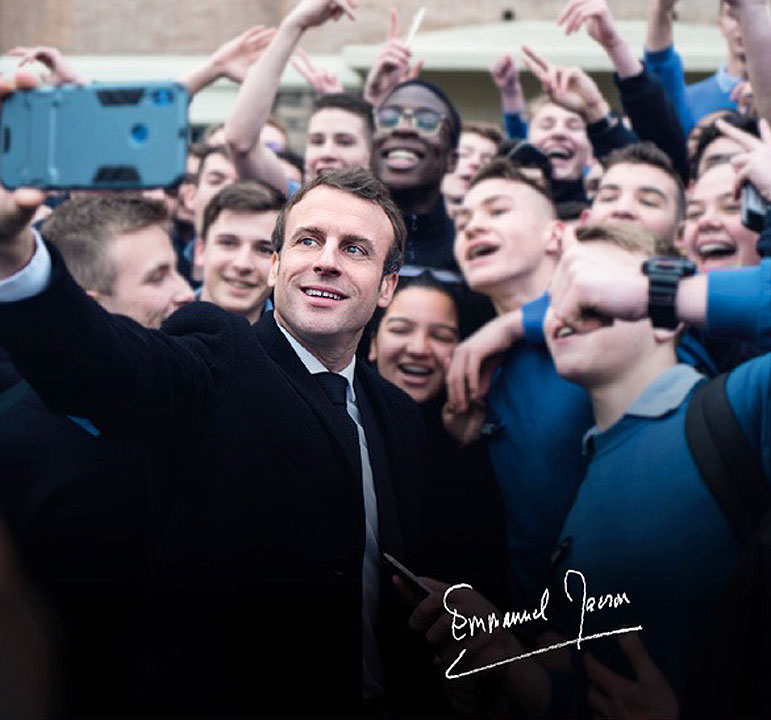
After the first-round elections on April 10, followed by the April 24 runoff, France voted reelectionist Emmanuel Macron as president for another five years against Marine Le Pen, 58.54% against 41.6%. But from all indications, those numbers are ambiguous because French media reported that Macron’s firm support could not have been more than 28%, representing those who voted for him during the runoff. The rest were the beavers “who want to build a dam” against the far-right Le Pen without really supporting him. On the other hand, majority of the 42% who opted for Le Pen wrote her name on the ballot because they wanted to express “anger and resentment” against Macron’s government which failed them.

More interesting is that Le Pen lost the election because many of those who avoided her were not exactly Macron supporters, but she was unacceptable to many French people because of her father, “an unreconstructed far-rightist.” Her weak executive experience also trimmed her votes.

Macron should not get too excited in celebrating his victory. He would be claiming the crown while 28% of the voters actually abstained, the highest number in 50 years. Some 8.6% of those who voted either delivered a blank ballot or spoilt their papers. One in four French people stayed away from the initial polls. Macron would also be challenged by the need to establish a majority in the parliament, with immense threat from the left-wing presidential candidate Jean-Luc Melenchon who finished a strong third during the initial round. Forming a rainbow coalition is unavoidable if Macron is serious about his legislative agenda. In France, that is called cohabitation.

And Macron’s legislative list is long and tough to shepherd through Parlement français.

He will have his hands full with the pension reform which could be divisive. The so-called “yellow vest” movement could form around the issue of inflation in France. He will have to deliver on his campaign promise to overhaul France’s climate policy which involves the green transition and implementation ranging from energy conservation to air pollution and tree planting. Major reforms of the European Union are also in Macron’s agenda as he would need considerable skill in steering France through the Ukraine-Russia war.

We don’t see electoral ambiguity happening in the Philippines on May 9.

What is emerging is the polarization of politics into the color-coded political camps of Vice-President Leni Robredo and former Senator Bongbong Marcos. If there was a runoff (if the Philippine Constitution had allowed for such), it would have been between the two of them who would have gathered the biggest number of votes. It’s not going to be a three or 10-way contest. The other presidential candidates would have failed to win enough votes to join in the final showdown if we were on French soil. Their tiny survey results appear to confirm this weak ability to inspire votes; their rallies are sparse and there is little euphoria on which to build momentum. Unlike Marcos Jr., however, they have never lacked courage to stand for hours and debate before the public in utter respect for the electorate and our democratic process.

But there could be some potential problems.

Unlike in France, the next leaders in the Philippines might be selected based on “soft facts” crafted by paid trolls and bloggers, disinformation if you will, rather than on hard facts. The truth in this country seems to have been devalued such that people from nearly all income classes would rather depend on TikToks and tweets than on actually studying the issues and forming their own judgment. With unprecedented resources behind him, Marcos Jr. has been in this game for the last six years while he was also protesting his loss to VP Leni in 2016.

In a recent interview, he reiterated his reservation with the final decision of the Presidential Electoral Tribunal in declaring Ms. Robredo as the duly-elected vice-president. Yet, it was he who claimed he was cheated, it was he who chose the specific provinces for the recount, and it was he who saw that VP Leni’s margin of over 200,000 votes even increased by around 15,000. Marcos Jr. should be advised that he is casting doubt on the integrity of the same institution that would decide on any dispute that might arise on May 9.

Some NGOs have taken up the cause of fact checking the contents of these social media uploads. By this time, more and more people have come to know the truth behind Marcos Jr.’s academic credentials, his public service record, Marcos Sr.’s plunder of the public treasury and human rights violations, as well as Marcos Jr.’s conviction for tax violations. It’s a question of time before the Filipino people succeed in reversing the tide of the Goebbels-like disinformation campaign. But for many unsuspecting Filipinos, six years of repetition have entrenched these lies in the people’s mind.

Umberto Eco’s book On Literature argues that while truth is powerful, “experience teaches us that truth often takes a long time to prevail, and the acceptance of truth costs blood and tears.”

What could accelerate the emergence of truth?

One is for those who support the truth to realize that survey results may not be conclusive. It is true many commentators have expressed their thoughts on the enormous challenge of consolidating the momentum of VP Leni and converting this to actual votes. For the latest available survey results continue to favor Marcos Jr. even as he loses momentum and VP Leni gains it by a large margin. On the other hand, one analysis using Google Trends and applying this to the French election, assessed Macron and Le Pen to score 57% and 43%, respectively. The actual result last April 24? Macron won 58.5% of the votes while Le Pen ended up with 41.5%.

So far during the week ending April 18, VP Leni garnered 54% of all Google searches. With Marcos Jr. at less than half at 21%, it seems the pinks have it.

Of course, neither survey results nor Google Trends wins election. It is the votes that will be cast on May 9 that do.

There is something in VP Leni’s campaign that is noticeably absent in Marcos Jr.’s. It is momentum. It is the kind of momentum coming from VP Leni herself by inspiring people to think beyond this generation, and the people themselves who are prepared to render volunteer service. They spend their own money and do everything that would help their candidate and her entire ticket. “Hindi kami bayad” (We are not paid off) has been the distinguishing chant of VP Leni’s crowds, numbering in the tens and hundreds of thousands in each major city and province. The snowballing continues to this day.

For beyond the massive support of star entertainers, VP Leni’s campaigns are discourses with substantive political and economic content. She offers an agenda of change in governance, rule of law and justice, public health management, economic growth and jobs, and territorial integrity.

It should not be surprising that the business community is more comfortable with her candidacy; she has a clear-cut platform of government. No guesswork is necessary because she is always engaged in public debates. No trace of corruption could be thrown at her or her family. She is not a product of social media. She is a real person who experiences fatigue — she removes her high-heeled shoes when her feet command her to do so. She has no qualms about taking public transport. She loved to serve even before her foray into politics.

Both leading candidates should realize that the next six years after Duterte (A.D.) would be more difficult than when he assumed the presidency in 2016. Not rosy, but we see more thorns definitely. The world is just recovering from the two years of pandemic lockdowns and another threat looms ahead. Russia has changed the equation in the petroleum and grains industry. Therefore, governance is harder to execute to achieve economic recovery and provide jobs to our people.

It is important that we also remind ourselves of the availability bias. When we navigate, we tend to prefer a wrong map than no map at all. The beauty of VP Leni’s candidacy is that she is offering a map, and it is the right one.


Diwa C. Guinigundo is the former deputy governor for the Monetary and Economics Sector, the Bangko Sentral ng Pilipinas (BSP). He served the BSP for 41 years. In 2001-2003, he was alternate executive director at the International Monetary Fund in Washington, DC. He is the senior pastor of the Fullness of Christ International Ministries in Mandaluyong.

Leaf in springtime is the promise of sustainability

There is nothing more valuable in these times than the currency of hope. Daily life in a world in crisis — from the COVID-19 pandemic, climate change and environmental degradation, inflation, deepening poverty and hunger, modern war and the menace of nuclear weapons — is more than enough to cause dark nights of the soul and, perhaps, Easter celebrations are more poignant and sanguine because of it.

As early as 2015 and perhaps as a foreshadowing of the challenging times ahead, global leaders at their most prosperous designed the Sustainable Development Goals (SDGs) as Global Goals — termed as the blueprint to achieve a better or more sustainable future for all people and the world by 2030. Explained briefly, the SDGs is a global action plan to eradicate poverty in all its forms and dimensions. It targets the 5 Ps — “People” in that all human beings fulfill their potential in dignity and equality, “Planet” or the promotion of sustainable consumption and production, “Prosperity” in targeting inequality in all its forms, “Peace” through just and inclusive societies, as achieved through “Partnerships” in a spirit of strengthened global solidarity.

In 2020 and what should have been the decade of delivery of the SDGs, the situation turned precipitous. Far from reversing climate change, the spread of COVID-19 exacerbated global poverty. The world faces the worst economic recession since the great depression, with the most vulnerable groups — women, migrants, refugees, children, the elderly, and persons with disabilities — being the hardest hit. While the world’s ledger is in the red in terms of achieving, in effect, a better life for all, the root causes and uneven impacts of COVID-19 illustrate precisely why there is a need for finding transformative pathways out of the current global crises.

Through a more local lens, the Philippines recognizes the value of adhering to the SDGs and has even adopted the global goals in its Philippine Development 2017-2022. The country even participated in a Voluntary National Review in 2016 and 2019 and shall do so again in the 2022 High-Level Political Forum on Sustainable Development. This marks considerable progress in the country’s political will to ensure that inclusive growth is enjoyed by all. Milestones that are expected to be included in the 2022 report are:

• Government Mandate for Sustainability Reporting issued by the Securities and Exchange Commission in 2019 for publicly listed companies, with a view to making it universally required by 2023. As of 2021, it was estimated that more than 90% of Philippine listed firms submitted sustainability reports and 22% published a report on sustainability impacts and performances. As disclosures become the norm, it is expected that the public and interest groups can now adequately measure, understand, and evaluate the economic, environmental, social, and governance impacts of large corporations. However, much work is still needed in standardizing the reporting formats to confirm to the standards set in the Global Reporting Initiative (GRI).

• Philippine data sources and basis for the analysis with SDGs were improved over the last couple of years. In 2016, the Philippine Statistics Authority (PSA) Board issued a resolution enjoining government agencies to provide data support to the SDGs. As a result, in 2017, the PSA Board approved and included the Official List of SDG Indicators for monitoring by the National Economic Development Authority (NEDA), other government agencies, and local government units.

• NEDA, the agency tasked with the implementation and oversight over the Philippines’ SDG commitments, developed the official website at www.sdg.neda.gov.ph to serve as the repository of key government information, resources, and activities that contribute to each SDG.

• The passage of the much-awaited reforms to the Public Service Act, Retail Trade Liberation Act, and the Foreign Investment Act is critical in increasing the investment capital needed to boost enterprises to recovery. The increased effort towards investment in sectors that are essential to public welfare is seen as a big push for work to provide good health, well-being, quality education, clean water and sanitation, affordable and clean energy, as well as needful infrastructure to improve the life of all. The liberalization is likewise expected to yield massive impacts on job creation and inclusive growth.

• The Philippines’ active participation in the 66th Session of the Commission on the Status of Women (CSW 66), led by the Philippine Commission on Women (PCW), is expected to ramp up the efforts of the government to remove the structural barriers to women’s economic empowerment. Understanding that the persistent problem of the feminization of poverty, especially as women bear the burden of unpaid care work, labor and investment environments are to be changed to allow for enabling technologies and programs that can decrease the gender gap. A prime example of this thrust is the inclusion of gender indicators in the National Strategy for Financial Inclusion 2022-2028 to reduce the disparities in financial inclusion.

While much remains to be done in recovering from the setback caused by the pandemic, continued investments in data and innovation can be the key to responding to crises and supporting SDG acceleration. It can still be a decade of delivery; information on SDG actions by the government and the private sector needs to be made available and transparent to the public so that standards of public service and commerce by big companies will be elevated. Scrutiny and support can now be given by the public to government efforts that promote long-term community building and environmental protection. The marketplace is slowly transforming into one where sustainable cities and communities are the best products and services demanded by consumers. Corporate social responsibility (CSR) programs are now a relic of the past as sustainability becomes mainstream and consumers become more discerning about the bottom-line of companies and that they focus not just on profit, but on people and on the planet too.

It is also important that we as consumers understand our commercial options and, as citizens, push for more inclusive legislation or government action. I hope and trust that our collective efforts, gleaned from the suffering of recent times, become the vernal equinox that can tilt the earth to its proper balance. This is for the trees we plant but need not see; a legacy of leaves in spring time.

May you and your future children enjoy the renewal of Easter.


Kristine C. Francisco-Alcantara is the managing partner of Abad Alcantara and Associates, program officer of PhilWEN and Oxfam’s GRAISEA Project on Mainstreaming Women’s Economic Empowerment, and a member of the Board of Trustees of the Foundation for Economic Freedom.

AAALaw@tradelawyers.ph

www.tradelawyers.ph

The disappearing Congress: The Philippines as an administrative state

TINGEY-INJURY-LAW-FIRM-UNSPLASH

Section 12 of RA 11525 (“COVID-19 Vaccination Program Act of 2021”) makes it very clear that vaccination cards cannot be made a requirement for government or business transactions and declares that vaccinated individuals shall “not be considered immune from COVID-19.” So why is it that government agencies are requiring vaccine cards for entry into hotels, restaurants, and businesses, including the Commission on Higher Education (CHED) for students and faculty to go to school? More pointedly: Why are unelected government bureaucrats able to go directly against a law made by elected legislators?

Because this essentially is what happens when a country morphs into an “administrative state.”

An administrative state is one where Executive Branch’s administrative agencies exercise “the power to create, adjudicate, and enforce their own rules” (see Ballotpedia). There are two features at play here which, although constitutional, the undue over-employment of which unfortunately leads to a weakening of our democratic system of government.

The first is the constant delegation of powers to the Executive Branch, whereby powers traditionally in Congress’ hands are instead given to government agencies under the control and supervision of the President. So long as two jurisprudential conditions are met (i.e., completeness and the sufficient standards test), the Congress can very well abdicate its responsibilities to the Executive Branch.

The other feature is judicial deference, a principle of judicial review whereby the courts defer to the agency’s interpretation or enforcement of a law. Thus, in Remolona vs. Civil Service Commission (G.R. No. 137473), the Supreme Court said that courts will not generally interfere with purely administrative matters addressed to the sound discretion of government agencies unless there is a clear showing of arbitrary, capricious, or grave abuse of discretion amounting to lack of jurisdiction. And in Nuesa vs. Court of Appeals (G.R. No. 132048), findings of administrative officials and agencies that have acquired expertise because their jurisdiction is confined to specific matters are generally accorded not only respect but at times even finality if such findings are supported by substantial evidence (see Antonio Nachura’s “Outline Reviewer in Political Law”).

The problem with having a civil service of expanded powers is that it upends the deliberately designed tripartite form of government of equal and separate powers. Effectively, substantial power is concentrated under the Executive Branch headed by one person: the President.

Thus, this relevant point: “power and authority vested in one body is the very definition of tyranny. The US Constitution’s system of separated powers [from which we derive our own constitutional system] safeguards individual liberties by dividing legislative, executive, and judicial authority across three coequal branches, ensuring that no one branch can exert absolute rule. Federalist Papers authors such as James Madison and Alexander Hamilton used the flaws of human nature to support the necessary constraints of government.” Hence why “ambition must be made to counteract ambition” (“How America’s Administrative State Undermines the Constitution,” American Legislative and Exchange Council, October 2020).

So called “progressives,” believing their cause justifies a work-around the legislative process, called for ever faster means of imposing increasing government regulations. But this only resulted in “unelected bureaucrats” setting aside elected officials “in determining broad ranging regulations, free from democratic oversight or political interference. Over time, a complete lack of accountability from the courts and further enablement by Congress have allowed federal entities with ‘quasi-legislative’ and ‘quasi-judicial’ powers to subvert constitutional principles and exert inordinate influence in the lives of citizens with minimal recourse.”

A profound illustration of this shift can be seen in our budget system. Congress has always been touted as possessing the “power of the purse” and the reason for this is that, since tax funds are culled from citizens, then it is but fair that the spending or allocation of tax money be decided by their duly elected representatives — hence, Congress.

Not anymore.

In 2014, then university professor, now Secretary of Education, Leonor Magtolis Briones pointed out that Congress has control of only “around 23% of the budget.” Instead, the power “now belongs to the President.” The reason is that “lump sums indicate an inherent vulnerability in the budget because of limited transparency and accountability in handling these funds.” Thus, “after the budget is passed, executive power may even disregard Congress’ approved budget altogether.” (“President, not Congress, holds power of the purse,” Philippine Star, August 2014; see also “Who really holds the ‘power of the purse’?,” PIDS, December 2009).

This shift to an administrative state, where unelected bureaucrats hold sway over people’s lives without accountability is not only inherently undemocratic but utterly despotic. It also encourages incompetence, as we have seen in recent years’ COVID-19 measures.

Fixing the budget system to have it firmly under Congress’ power is a step in the right direction. Imposing greater public and regular congressional oversight over these administrative agencies is another. Finally, it would be better to vastly reduce the number of national government agencies and instead devolve many of their functions to local government units, whose administrators have greater accountability to their constituents.


Jemy Gatdula is a senior fellow of the Philippine Council for Foreign Relations and a Philippine Judicial Academy law lecturer for constitutional philosophy and jurisprudence

https://www.facebook.com/jigatdula/

Twitter@jemygatdula

Food protectionism in play as Indonesia palm export ban starts

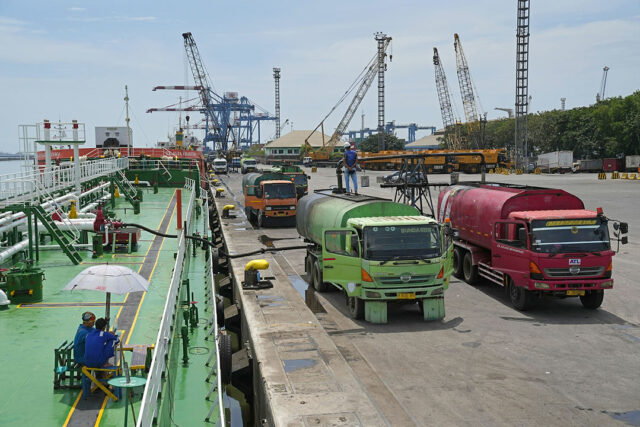
PALM OIL loaded into trucks from a tanker docked at Tanjung Priok Port in Jakarta, Indonesia, on April 26. — BLOOMBERG

INDONESIA’s palm oil export ban kicked off Thursday in one of the most drastic cases of food protectionism since the war erupted in Ukraine.

The top shipper imposed a sweeping ban on cooking oil exports, covering palm oil products across the value chain. It’s hard to overstate the importance of the tropical oil as it’s found everywhere today — in food, soap, lipstick and even printing ink — which makes Indonesia’s move important for the world.

It adds to the impact of Russia’s invasion of Ukraine, which has already plunged the global edible oil market into disarray. With world food costs surging to all-time highs, governments are taking steps to secure their own supplies. The United Nations has urged leaders to keep trade open, warning that protectionism will drive up prices and lead to empty shelves in countries dependent on imports.

Indonesia’s export ban is “inflationary for everyone,” said Atul Chaturvedi, president of the Solvent Extractors’ Association of India. India is the top importer of palm oil and gets about 45% of its supply from the Southeast Asian country. “If the supply chain is disrupted, companies will try to ration their supplies because they don’t know what’s going to happen tomorrow.”

Indonesia is certainly not making it easy to navigate its palm export ban. The top producer said Friday it would suspend all shipments of cooking oil, sending prices of palm oil and its substitute soybean oil soaring. Then late Monday, reports emerged that only palm olein, a refined product, would be halted, prompting a swift retreat in prices and traders rushing to comply with the ban.

The government delivered another shock Wednesday evening, widening the ban to include crude palm oil, RBD palm oil and even used cooking oil, contradicting its earlier statement. That covers the products across the entire supply chain. Indonesia accounts for a third of global edible oil exports.

The move is “one of the biggest acts of agriculture nationalism so far during this surge in food prices,” said Tobin Gorey, an agri-commodities strategist at Commonwealth Bank of Australia.

Palm oil futures dropped as much as 3.9% to 6,714 ringgit a ton, paring gains this week. Prices jumped by the 10% trading limit a day earlier, hours before Indonesia announced the widened export ban.

President Joko Widodo late Wednesday said that the ban would be lifted once the local demand for food staples is met, adding that it was “ironic” that the country had difficulty getting cooking oil. The decision to ban exports came after earlier policies weren’t effective in easing the shortage, he said.

Still, it’s uncertain whether the ban will have the desired effect. The government acknowledged that the policy may cut the country’s palm output and result in unsold harvests for farmers. There are also concerns about when Indonesian producers will run out of storage capacity to store oil that they can no longer export.

“With this hard stance, the government is punishing errant refiners by punishing the whole Indonesian plantation industry,” RHB Research analyst Hoe Lee Leng wrote in a note. “All players in Indonesia would likely suffer, although pure upstream exporters would likely suffer more.” — Bloomberg

ADVERTISEMENT
ADVERTISEMENT